

The DOI matches its Crossref record; 22 of the 22 references it cites were found in a registry or an index.
The Construction and Validation of an Abridged Version of the Autism-Spectrum Quotient (AQ-Short)
Open accessAbstract
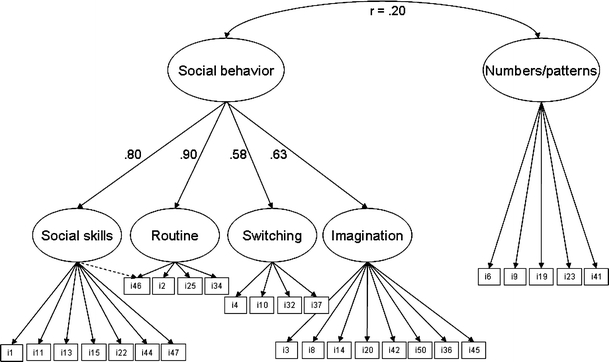
This study reports on the development and validation of an abridged version of the 50-item Autism-Spectrum Quotient (AQ), a self-report measure of autistic traits. We aimed to reduce the number of items whilst retaining high validity and a meaningful factor structure. The item reduction procedure was performed on data from 1,263 Dutch students and general population adults. The resulting 28-item AQ-Short was subsequently validated in 3 independent samples, both clinical and controls, from the Netherlands and the UK. The AQ-Short comprises two higher-order factors assessing 'social behavioral difficulties' and 'a fascination for numbers/patterns'. The clear factor structure of the AQ-Short and its high sensitivity and specificity make the AQ-Short a useful alternative to the full 50-item version.
Overview
The claims and statistics of this paper haven’t been checked yet.
Run the check — free, no account needed. It reads the open-access text and checks the sources it cites.
Integrity signals
Registry
Cites
Statistics
Figures
Verification
Claims the paper makes
The claims and statistics of this paper haven’t been checked yet.
Run the check — free, no account needed. It reads the open-access text and checks the sources it cites.
Claims other papers make about this one
Each is checked against this paper’s own text: does it say what the citing paper says it does?
The cited source doesn’t support the claim as written.
In the citing paper
“To verify the clinical diagnosis of ASD, we will use a cut-off ≥70 on the 28-item Short version of the AQ-28 [43, 44].”
From The effect of dialectical behaviour therapy in autism spectrum patients with suicidality and/or self-destructive behaviour (DIASS): Study protocol for a multicentre randomised controlled trial (2020) · cites this paper as [43]
Checked by a reasoning model — may be wrong.
Experimental — accuracy not yet measuredThe source backs part of the claim, not all of it — or backs it for a different population, condition or comparison.
In the citing paper
“A clinical cutoff score of > 65 has sensitivity of 0.97 and specificity of 0.82 for ASD (Hoekstra et al., 2011).”
From A mixed methods study of autistic adults' mental health therapy experiences (2023) · cites this paper as Hoekstra et al., 2011
Experimental — accuracy not yet measuredThe source backs part of the claim, not all of it — or backs it for a different population, condition or comparison.
In the citing paper
“The AQ-28 is scored between 28 and 72, and a cut-off score of 65 is the threshold, above which further assistance with seeking ASD diagnosis is recommended. The cut-off score has good sensitivity (0.97) and specificity (0.82). The AQ-28 also has good internal consistence (Cronbach’s alpha = 0.77–0.86).”
From Differences in anxieties and social networks in a group-matched sample of autistic and typically developing students transitioning to university (2020) · cites this paper as Hoekstra et al., 2011
Experimental — accuracy not yet measuredThe cited source says what the claim attributes to it.
In the citing paper
“Autism characteristics were assessed using the Autism Spectrum Quotient-Short (AQ-Short) (Hoekstra et al., 2011), which is an abridged 28-item version of the original 50-item AQ (Baron-Cohen et al., 2001), a continuous self-report measure of autism spectrum traits in adults.”
From A mixed methods study of autistic adults' mental health therapy experiences (2023) · cites this paper as Hoekstra et al., 2011
The cited source says what the claim attributes to it.
In the citing paper
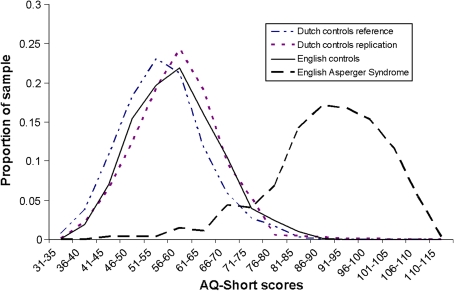
“For TD students, the mean AQ-28 score was 64.54, which is somewhat higher than the previously reported control samples of 56–59.73 (Hoekstra et al., 2011).”
From Differences in anxieties and social networks in a group-matched sample of autistic and typically developing students transitioning to university (2020) · cites this paper as Hoekstra et al., 2011
The cited source says what the claim attributes to it.
In the citing paper
“The mean score on the Autism Quotient-28 (AQ-28) for the autistic students was 83.07, and with an exception of two students who scored 59 and 64, all students’ scores met the suggested clinical cut-off score of 65 (Hoekstra et al., 2011).”
From Differences in anxieties and social networks in a group-matched sample of autistic and typically developing students transitioning to university (2020) · cites this paper as Hoekstra et al., 2011
The cited source says what the claim attributes to it.
In the citing paper
“The AQ-Short is a reliable instrument for a quick assessment of quantitative autistic traits.”
Self-check
Percentages, sums and reported differences re-computed from the paper’s own numbers.
The self-check needs the paper’s full text.
Citations
Cites
Lord, C., Rutter, M., & Le Couteur, A. (1994) · Journal of Autism and Developmental Disorders · doi:10.1007/bf02172145 · Cited by 9,065
Schermelleh-Engel, K., Moosbrugger, H., & Müller, H. (2003) · Department of Psychology - University of Koblenz-Landau · doi:10.23668/psycharchives.12784 · Cited by 8,975
Lord, C., Risi, S., Lambrecht, L., Cook, E. H., Leventhal, B. L., DiLavore, P. C., Pickles, A., & Rutter, M. (2000) · Journal of Autism and Developmental Disorders · doi:10.1023/a:1005592401947 · Cited by 7,520
Baron-Cohen, S., Wheelwright, S., Skinner, R., Martin, J., & Clubley, E. (2001) · Journal of Autism and Developmental Disorders · doi:10.1023/a:1005653411471 · Cited by 6,450
Self-citationAutistic Traits in the General Population: A Twin Study
Constantino, J. N., & Todd, R. D. (2003) · Archives of General Psychiatry · doi:10.1001/archpsyc.60.5.524 · Cited by 1,317 · cited 2×
“Autism spectrum conditions (ASC; including autistic disorder, Asperger syndrome [AS] and pervasive developmental disorder not otherwise specified [PDD-NOS]) are now commonly conceptualized as dimensional, representing the extreme end of one or more continuously distributed traits in the general population ( Constantin…”
BackgroundWoodbury-Smith, M. R., Robinson, J., Wheelwright, S., & Baron-Cohen, S. (2005) · Journal of Autism and Developmental Disorders · doi:10.1007/s10803-005-3300-7 · Cited by 771
Self-citationHoekstra, R. A., Bartels, M., Cath, D. C., & Boomsma, D. I. (2008) · Journal of Autism and Developmental Disorders · doi:10.1007/s10803-008-0538-x · Cited by 651
Self-citationThe Autism Spectrum Quotient: Children’s Version (AQ-Child)
Bonnie Auyeung, B., Baron‐Cohen, S., Wheelwright, S. J., & Allison, C. L. (2007) · Journal of Autism and Developmental Disorders · doi:10.1007/s10803-007-0504-z · Cited by 650
Self-citationThe Autism-Spectrum Quotient (AQ)—Adolescent Version
Baron-Cohen, S., Hoekstra, R. A., Knickmeyer, R., & Wheelwright, S. (2006) · Journal of Autism and Developmental Disorders · doi:10.1007/s10803-006-0073-6 · Cited by 546
Self-citationHappé, F., & Ronald, A. (2008) · Neuropsychology Review · doi:10.1007/s11065-008-9076-8 · Cited by 498
Research works printed but not linked: 1
- Muthén, L. K., & Muthén, B. O. (2007). Mplus user’s guide (5th ed.). Los Angeles, CA: Muthén & Muthén.
Cited by
Sorted by citations
Items 201–300 of 506
Lei, J., Ashwin, C., Brosnan, M., & Russell, A. (2020) · Autism · doi:10.1177/1362361319894830 · Cited by 18
“For TD students, the mean AQ-28 score was 64.54, which is somewhat higher than the previously reported control samples of 56–59.73 (Hoekstra et al., 2011).”
BackgroundResultInfluentialLei, J., Ashwin, C., Brosnan, M., & Russell, A. (2019) · Journal of Autism and Developmental Disorders · doi:10.1007/s10803-019-04070-5 · Cited by 18
Self-Compassion, Camouflaging, and Mental Health in Autistic Adults
Galvin, J., Aguolu, P., Amos, A., Bayne, F., Hamza, F., & Alcock, L. (2024) · Autism in Adulthood · doi:10.1089/aut.2023.0110 · Cited by 18
Denning, E. C., Brannan, D., Murphy, L. A., Losco, J. A., & Payne, D. (2018) · Psi Chi Journal of Psychological Research · doi:10.24839/2325-7342.jn23.2.166 · Cited by 22
Coping‐resilience profiles and experiences of stress in autistic adults
Muniandy, M., Richdale, A. L., & Lawson, L. P. (2022) · Autism Research · doi:10.1002/aur.2817 · Cited by 20
The effectiveness of a scientific reasoning intervention for conspiracy theory beliefs
Georgiou, N., Delfabbro, P., & Balzan, R. P. (2023) · Applied Cognitive Psychology · doi:10.1002/acp.4039 · Cited by 18
Predictors of sleep quality for autistic people across adulthood
Charlton, R. A., McQuaid, G. A., Bishop, L., Lee, N. R., & Wallace, G. L. (2023) · Autism Research · doi:10.1002/aur.2891 · Cited by 18
Examining Rates of Traumatic Events and Posttraumatic Stress Disorder Symptoms Among Autistic Adults
Andrzejewski, T. M., Batista, S. G., Abu-Ramadan, T. M., Breitenfeldt, K. E., Tassone, A. U., Winch, A. T., Rozek, D. C., & McDonnell, C. G. (2023) · Autism in Adulthood · doi:10.1089/aut.2023.0022 · Cited by 20
Taneera, S. N., & Alhajj, R. (2025) · Network Modeling Analysis in Health Informatics and Bioinformatics · doi:10.1007/s13721-024-00499-6 · Cited by 21
Macpherson, M. C., Fay, N., & Miles, L. K. (2020) · Acta Psychologica · doi:10.1016/j.actpsy.2020.103140 · Cited by 20
Adults with autism spectrum disorder show atypical patterns of thoughts and feelings during rest
Simpraga, S., Weiland, R. F., Mansvelder, H. D., Polderman, T. J. C., Begeer, S., Smit, D. J. A., & Linkenkaer‐Hansen, K. (2021) · Autism · doi:10.1177/1362361321990928 · Cited by 18
Scheeren, A. M., Howlin, P., Bartels, M., A, L. K. M., & Begeer, S. (2021) · Autism Research · doi:10.1002/aur.2653 · Cited by 17
Self-citationPredicting intervention use in autistic children: Demographic and autism-specific characteristics
Jonkman, K. M., Back, E., & Begeer, S. (2022) · Autism · doi:10.1177/13623613221102748 · Cited by 20
Murphy, D. (2011) · Journal of Forensic Psychiatry and Psychology · doi:10.1080/14789949.2011.596942 · Cited by 20
WAND: A multi-modal dataset integrating advanced MRI, MEG, and TMS for multi-scale brain analysis
McNabb, C. B., Driver, I. D., Hyde, V., Hughes, G., Chandler, H. L., Thomas, H., Allen, C. S., Messaritaki, E., Hodgetts, C. J., Hedge, C., et al. (2025) · Scientific Data · doi:10.1038/s41597-024-04154-7 · Cited by 23
Andrews, H. E., Hedley, D., & Bury, S. M. (2023) · Autism in Adulthood · doi:10.1089/aut.2022.0117 · Cited by 19
Sierro, G., Rossier, J., & Möhr, C. (2016) · Comprehensive Psychiatry · doi:10.1016/j.comppsych.2016.03.011 · Cited by 17
Do early-life eating habits predict later autistic traits? Results from a population-based study
Hof, M. V. ’., Ester, W. A., van Berckelaer‐Onnes, I., Hillegers, M. H. J., Hoek, H. W., & Jansen, P. W. (2020) · Appetite · doi:10.1016/j.appet.2020.104976 · Cited by 21
Muniandy, M., Richdale, A. L., Arnold, S. R. C., Trollor, J. N., & Lawson, L. P. (2021) · Research in Autism · doi:10.1016/j.rasd.2021.101764 · Cited by 18
Sedgewick, F., Leppänen, J., Austin, A., & Tchanturia, K. (2021) · European Eating Disorders Review · doi:10.1002/erv.2873 · Cited by 17
Wilson, N. J., Stevens, A., Srasuebkul, P., Kersten, M. L., Lin, Z., Trollor, J. N., & Arnold, S. R. C. (2021) · Journal of Transport & Health · doi:10.1016/j.jth.2021.101117 · Cited by 17
Cai, R. Y., Edwards, C., Love, A. M. A., Brown, L., & Gibbs, V. (2024) · Autism · doi:10.1177/13623613241235061 · Cited by 30
Are Autistic Traits in the General Population Related to Global and Regional Brain Differences?
Koolschijn, P. C. M. P., Geurts, H. M., van der Leij, A. R., & Scholte, H. S. (2015) · Journal of Autism and Developmental Disorders · doi:10.1007/s10803-015-2441-6 · Cited by 17
The Relationship of Age with the Autism-Spectrum Quotient Scale in a Large Sample of Adults
Lodi‐Smith, J., Rodgers, J. D., Luna, V. M., Khan, S., Long, C., Kozlowski, K. F., Donnelly, J. P., Lopata, C. J., & Thomeer, M. L. (2021) · Autism in Adulthood · doi:10.1089/aut.2020.0010 · Cited by 16
Liu, F., Scheeren, A. M., Grove, R., Hoekstra, R. A., Wang, K., Guo, D., Wang, C., & Begeer, S. (2021) · Journal of Autism and Developmental Disorders · doi:10.1007/s10803-021-05342-9 · Cited by 16
Self-citationNo differences between adults with and without autism in audiovisual synchrony perception
Weiland, R. F., Polderman, T. J. C., Smit, D. J. A., Begeer, S., & der Burg, E. V. (2022) · Autism · doi:10.1177/13623613221121414 · Cited by 17
Pathways to Anxiety and Depression in Autistic Adolescents and Adults
Richdale, A., Lawson, L., Chalmers, A., Uljarević, M., Morris, E., Arnold, S. R. C., & Trollor, J. N. (2023) · Depression and Anxiety · doi:10.1155/2023/5575932 · Cited by 16
Edwards, C., Tutton, T., & Gibbs, V. (2024) · Neurodiversity · doi:10.1177/27546330241240648 · Cited by 15
Robel, L., Rousselot‐Pailley, B., Fortin, C., Lévy-Rueff, M., Golse, B., & Falissard, B. (2013) · European Child & Adolescent Psychiatry · doi:10.1007/s00787-013-0451-5 · Cited by 15
Atherton, G., & Cross, L. (2021) · Psychological Reports · doi:10.1177/0033294120988135 · Cited by 20
Exploring the income, savings and debt levels of autistic adults living in Australia
Cai, R. Y., Gallagher, E., Haas, K., Love, A. M. A., & Gibbs, V. (2022) · Advances in Autism · doi:10.1108/aia-01-2022-0004 · Cited by 15
Ratner, K., Li, Q., Zhu, G., Estevez, M., & Burrow, A. L. (2023) · Journal of Happiness Studies · doi:10.1007/s10902-023-00625-7 · Cited by 21
Chee, Z. J., Scheeren, A. M., & de Vries, M. (2023) · Autism · doi:10.1177/13623613221147395 · Cited by 14
Investigating the structure of the autism-spectrum quotient using Mokken scaling.
Stewart, M. E., Allison, C. L., Baron‐Cohen, S., & Watson, R. A. (2015) · Psychological Assessment · doi:10.1037/pas0000058 · Cited by 15
Self-citationEmotion processing differences mediate the link between sex and autistic traits in young adulthood
Livingston, L. A., Waldren, L. H., Walton, E., & Shah, P. (2022) · JCPP Advances · doi:10.1002/jcv2.12096 · Cited by 13
Listener-oriented phonetic reduction and theory of mind
Turnbull, R. (2019) · Language Cognition and Neuroscience · doi:10.1080/23273798.2019.1579349 · Cited by 14
ZAHARIA, A. L., Noir-Kahlo, K., Bressoud, N., Sander, D., Dukes, D., & Samson, A. C. (2021) · Frontiers in Psychology · doi:10.3389/fpsyg.2021.705937 · Cited by 13
Richdale, A., Chetcuti, L., Hayward, S. M., Abdullahi, I., Morris, E., & Lawson, L. (2023) · Autism Research · doi:10.1002/aur.2899 · Cited by 13
Goldfarb, Y., Assion, F., & Begeer, S. (2024) · Autism · doi:10.1177/13623613241239388 · Cited by 13
Thomas, K. S., Keating, J., Ross, A. A., Cooper, K., & Jones, C. R. G. (2025) · Journal of Eating Disorders · doi:10.1186/s40337-025-01215-z · Cited by 15
Meng, F., & Xuan, B. (2023) · Asian Journal of Psychiatry · doi:10.1016/j.ajp.2023.103580 · Cited by 13
Kempenaers, C., Braun, S., Delvaux, N., & Linkowski, P. (2017) · European Review of Applied Psychology · doi:10.1016/j.erap.2017.09.001 · Cited by 13
Hwang, Y., Arnold, S. R. C., Trollor, J., & Uljarević, M. (2020) · Autism · doi:10.1177/1362361320908095 · Cited by 11
Suzuki, T., Wada, K., Muzembo, B. A., Ngatu, N. R., Yoshii, S., & Ikeda, S. (2020) · JMA Journal · doi:10.31662/jmaj.2020-0001 · Cited by 14
Aller, T. B., Barrett, T. S., Levin, M. E., & McClain, M. B. (2022) · Journal of Contextual Behavioral Science · doi:10.1016/j.jcbs.2022.09.001 · Cited by 14
A qualitative exploration of an autism-specific self-compassion program: The ASPAA
Edwards, C., Gibbs, V., Love, A. M. A., Brown, L., & Cai, R. Y. (2024) · Autism · doi:10.1177/13623613241234097 · Cited by 12
Wallace, G. L., Said, A. J., & McQuaid, G. A. (2024) · Autism Research · doi:10.1002/aur.3274 · Cited by 12
Murray, A. L., McKenzie, K., Kuenssberg, R., & O’Donnell, M. (2014) · Journal of Autism and Developmental Disorders · doi:10.1007/s10803-014-2154-2 · Cited by 12
Leung, C. N. W., Leung, C. S. Y., Chan, R. W. S., & Leung, P. W. L. (2022) · Autism Research · doi:10.1002/aur.2847 · Cited by 12
Cheung, T. C. K., Tahsin, B. R., Pereira, C. F., Mukhi, S., & Niemeier, M. (2023) · Journal of Autism and Developmental Disorders · doi:10.1007/s10803-022-05889-1 · Cited by 12
O’Keefe, N., & Lindell, A. K. (2013) · Brain and Cognition · doi:10.1016/j.bandc.2013.08.005 · Cited by 14
Werkman, M. F., Brouwer, S., Dijkxhoorn, Y. M., van Berckelaer‐Onnes, I. A., Reijneveld, S. A., Landsman-Dijkstra, J., & Begeer, S. (2020) · Research in Autism · doi:10.1016/j.rasd.2020.101663 · Cited by 12
Does anxiety induced by social interaction influence the perception of bistable biological motion?
Peng, W., Cracco, E., Troje, N. F., & Braß, M. (2021) · Acta Psychologica · doi:10.1016/j.actpsy.2021.103277 · Cited by 13
Zhang, W., Li, X., Yao, J., Ye, Q., & Peng, W. (2021) · Acta Psychologica Sinica · doi:10.3724/sp.j.1041.2021.00613 · Cited by 12
Leighton, D. C., Legate, N., LePine, S., Anderson, S. F., & Grahe, J. E. (2018) · Psi Chi Journal of Psychological Research · doi:10.24839/2325-7342.jn23.2.98 · Cited by 15
Georgiou, N., Delfabbro, P., & Balzan, R. P. (2022) · Journal of Experimental Psychopathology · doi:10.1177/20438087221125046 · Cited by 11
Lao, U., Dai, J., Liang, F., Chen, Q., Cao, W., Pan, Y., Zou, X., & Zhu, H. (2024) · Autism in Adulthood · doi:10.1089/aut.2024.0001 · Cited by 12
Camouflage, Burnout-Exhaustion, and Depression in Autistic Adults
Benatov, J., Sarel-Mahlev, E., & Bar-Yehuda, S. (2025) · Autism in Adulthood · doi:10.1089/aut.2024.0147 · Cited by 11
Nguyen, T. H., Miguel, H. O., Condy, E. E., Park, S., & Gandjbakhche, A. (2021) · Brain Sciences · doi:10.3390/brainsci11030397 · Cited by 11
Relationship between affective state and empathy in medical and psychology students
Bohler, T. E., Brown, R. F., & Dunn, S. M. (2021) · Australian Psychologist · doi:10.1080/00050067.2021.1926218 · Cited by 11
Seeing minds – a signal detection study of agency attribution along the autism-psychosis continuum
Lisøy, R. S., Biegler, R., Haghish, E. F., Veckenstedt, R., Moritz, S., & Pfuhl, G. (2022) · Cognitive Neuropsychiatry · doi:10.1080/13546805.2022.2075721 · Cited by 9
Stress and well‐being in autistic adults: Exploring the moderating role of coping
Muniandy, M., Richdale, A. L., & Lawson, L. P. (2023) · Autism Research · doi:10.1002/aur.3028 · Cited by 16
Svedholm‐Häkkinen, A. M., Halme, S., & Lindeman, M. (2017) · International Journal of Clinical and Health Psychology · doi:10.1016/j.ijchp.2017.11.001 · Cited by 13
Bertschy, K., Skorich, D. P., & Haslam, S. A. (2019) · Journal of Autism and Developmental Disorders · doi:10.1007/s10803-019-04149-z · Cited by 11
Huntjens, A., van den Bosch, L. (., Sizoo, B. B., Kerkhof, A. J. F. M., Smit, F., & van der Gaag, M. (2024) · Autism · doi:10.1177/13623613241302875 · Cited by 12
Spaargaren, K. L., Roke, Y., Begeer, S., van Straten, A., Riper, H. M., Greaves‐Lord, K., & Scheeren, A. M. (2025) · Autism · doi:10.1177/13623613251346885 · Cited by 11
Gestational Age in Autistic Children and Adolescents: Prevalence and Effects on Autism Phenotype
Martini, M. I., Merkelbach, I., & Begeer, S. (2022) · Journal of Autism and Developmental Disorders · doi:10.1007/s10803-022-05466-6 · Cited by 10
Golan, O., Terner, M., Israel‐Yaacov, S., Allison, C. L., & Baron‐Cohen, S. (2022) · Autism · doi:10.1177/13623613221117020 · Cited by 11
Self-citationAutistic Traits of People Who Engage in Pup Play: Occurrence, Characteristics and Social Connections
Wignall, L., Moseley, R. L., & McCormack, M. (2023) · The Journal of Sex Research · doi:10.1080/00224499.2023.2239225 · Cited by 13
Women Are Better at Selecting Gifts than Men
Pollmann, M. M. H., & van Beest, I. (2013) · PLoS ONE · doi:10.1371/journal.pone.0081643 · Cited by 10
Autism spectrum conditions affect preferences in valued personal possessions.
Spikins, P., Wright, B., & Scott, C. (2017) · Evolutionary Behavioral Sciences · doi:10.1037/ebs0000105 · Cited by 11
Sari, N. P., Jansen, P. W., Blanken, L. M. E., Ruigrok, A. N. V., Prinzie, P., Tiemeier, H. W., Baron‐Cohen, S., van IJzendoorn, M. H., & White, T. J. H. (2022) · Molecular Autism · doi:10.1186/s13229-022-00507-4 · Cited by 13
Self-citationIncreased persuadability and credulity in people with corpus callosum dysgenesis
Barnby, J. M., Dean, R. J., Burgess, H., Kim, J. J., Teunisse, A. K., Mackenzie, L., Robinson, G. A., Dayan, P., & Richards, L. J. (2022) · Cortex · doi:10.1016/j.cortex.2022.07.009 · Cited by 10
McQuaid, G. A., Duane, S. C., Ahmed, N., Lee, N., Charlton, R. A., & Wallace, G. L. (2023) · Autism Research · doi:10.1002/aur.3076 · Cited by 12
Charlton, R. A., McQuaid, G. A., & Wallace, G. L. (2024) · Research in Autism · doi:10.1016/j.rasd.2024.102460 · Cited by 9
Stroud, J., Rice, C., Orsini, A., Schlosser, M., Lee, J., Mandy, W., & Kamboj, S. K. (2024) · Psychopharmacology · doi:10.1007/s00213-024-06685-8 · Cited by 11
Belief in Science‐Related Conspiracy Theories
Littrell, S., Diekman, A. B., Seelig, M. I., Premaratne, K., Wuchty, S., Verdear, D., Klofstad, C., & Uscinski, J. E. (2025) · Journal of Social Issues · doi:10.1111/josi.70004 · Cited by 14
EEG frequency tagging evidence of social interaction recognition
Oomen, D., Cracco, E., Braß, M., & Wiersema, J. R. (2022) · Social Cognitive and Affective Neuroscience · doi:10.1093/scan/nsac032 · Cited by 9
Harris, E., & Carciofo, R. (2023) · Chronobiology International · doi:10.1080/07420528.2023.2224872 · Cited by 9
Hollocks, M. J., McQuaid, G. A., Yerys, B. E., Strang, J. F., Anthony, L. G., Kenworthy, L. E., Lee, N., & Wallace, G. L. (2023) · Autism Research · doi:10.1002/aur.3025 · Cited by 10
Jertberg, R., Begeer, S., Geurts, H. M., Chakrabarti, B., & der Burg, E. V. (2025) · Autism Research · doi:10.1002/aur.70015 · Cited by 10
Exploring Self-Reported Eating Disorder Symptoms in Autistic Men
Kinnaird, E., Sedgewick, F., Stewart, C. S., & Tchanturia, K. (2019) · Autism in Adulthood · doi:10.1089/aut.2019.0017 · Cited by 9
Abu-Ramadan, T. M., Tassone, A. U., Andrzejewski, T. M., Breitenfeldt, K. E., Batista, S. G., & McDonnell, C. G. (2025) · Journal of Autism and Developmental Disorders · doi:10.1007/s10803-025-06986-7 · Cited by 10
van der Cruijsen, R., Begeer, S., & Crone, E. A. (2024) · Autism · doi:10.1177/13623613241232860 · Cited by 8
Romero‐Martínez, Á., Moya‐Albiol, L., Vinkhuyzen, A. A. E., & Polderman, T. J. C. (2015) · American Journal of Medical Genetics Part B Neuropsychiatric Genetics · doi:10.1002/ajmg.b.32352 · Cited by 8
Self-citationWhat are Replicable Aspects of the Broader Autism Phenotype among College Students?
Riccio, A., Kapp, S. K., Daou, N., Shane, J., & Gillespie‐Lynch, K. (2020) · Collabra Psychology · doi:10.1525/collabra.271 · Cited by 8
Athar, M. E., Ebrahimi, A., Karimi, S., Esmailzadeh, R., Asl, E. M., Azizi, M., Heidarzadeh, S., Siahkamari, E., Sharifi, A., & Farani, A. R. (2021) · Frontiers in Psychiatry · doi:10.3389/fpsyt.2021.744180 · Cited by 8
Testing a theory‐driven factor structure of the autism‐spectrum quotient
Zhu, Y., Mu, W., Chirica, M. G., & Berenbaum, H. (2022) · Autism Research · doi:10.1002/aur.2763 · Cited by 8
Camilleri, L. J., Maras, K., & Brosnan, M. (2024) · Autism in Adulthood · doi:10.1089/aut.2023.0063 · Cited by 8
Is there an optimal self-report measure to investigate autism-related sex differences?
Waldren, L. H., Livingston, L. A., & Shah, P. (2025) · Research in Autism · doi:10.1016/j.reia.2025.202617 · Cited by 8
Disordered eating in autistic trans and gender diverse people: a lived experience-led scoping review
White, L., Schweizer, K., & Thomas, K. S. (2025) · Journal of Eating Disorders · doi:10.1186/s40337-025-01447-z · Cited by 10
Short report: A co-designed psychoeducation for older autistic adults-a multiple case study
Groenendijk, E., van Heijst, B. F., & Geurts, H. M. (2022) · Autism · doi:10.1177/13623613221138691 · Cited by 7
Charlton, R. A., McQuaid, G. A., Lee, N., & Wallace, G. L. (2023) · Journal of Autism and Developmental Disorders · doi:10.1007/s10803-023-06131-2 · Cited by 7
Impact of animated objects on autistic and non-autistic users
Alzahrani, M. S., Uitdenbogerd, A. L., & Spichkova, M. (2022) · IEEE/ACM International Conference on Software Engineering: Software Engineering in Society (ICSE-SEIS) · doi:10.1109/icse-seis55304.2022.9794013 · Cited by 14
Moseley, R. L., Atkinson, C., Surman, R., Greville-Harris, M., May, L., & Vuillier, L. (2023) · Journal of Eating Disorders · doi:10.1186/s40337-023-00746-7 · Cited by 12
Does stereopsis account for the link between motor and social skills in adults?
Smith, D., Ropar, D., & Allen, H. A. (2018) · Molecular Autism · doi:10.1186/s13229-018-0234-4 · Cited by 9
Bayesian Network Structure and Predictability of Autistic Traits
Briganti, G., Williams, D. R., Mulder, J., & Linkowski, P. (2020) · Psychological Reports · doi:10.1177/0033294120978159 · Cited by 6
Eyes on you: Ensuring empathic accuracy or signalling empathy?
Wever, M. C. M., van Houtum, L. A. E. M., Janssen, L. H. C., Spruit, I. M., Tollenaar, M. S., Rot, M. A. H., & Elzinga, B. M. (2022) · International Journal of Psychology · doi:10.1002/ijop.12862 · Cited by 7
Cerezo, R., Fernández, E., Gómez, C., Sánchez‐Santillán, M., Taub, M., & Azevedo, R. (2020) · Journal of Visualized Experiments · doi:10.3791/60331 · Cited by 7
McQuaid, G. A., Ratto, A. B., Jack, A., Khuu, A., Smith, J. V., Duane, S. C., Clawson, A., Lee, N., Verbalis, A. D., Pelphrey, K. A., et al. (2023) · doi:10.31234/osf.io/kc6ax · Cited by 7
Metadata
- Authors
- Hoekstra, R. A., Vinkhuyzen, A. A. E., Wheelwright, S., Bartels, M., Boomsma, D. I., Baron-Cohen, S., Posthuma, D., & van der Sluis, S.
- Affiliations
- The Open University (GB)
- Vrije Universiteit Amsterdam (NL)
- University of Cambridge (GB)
- Corresponding author
- Hoekstra, Rosa A.
- Venue
- Journal of Autism and Developmental Disorders
- Published
- 2010-08-10
- Volume
- 41
- Issue
- 5
- Pages
- 589-596
- ISSN
- 0162-3257 (ISSN-L)
- 1573-3432
- PMC
- PMC3076581
- OpenAlex
- W2130501331
- Cited by
- 506
- References
- 22
- Citations by year
- 2026: 42 · 2025: 45 · 2024: 47 · 2023: 66 · 2022: 59 · 2021: 70 · 2020: 34 · 2019: 33 · 2018: 27 · 2017: 22 · 2016: 14 · 2015: 16 · 2014: 6 · 2013: 16 · 2012: 5
- FWCI
- 4.64
- Type
- journal article
- Language
- en
- Open access
- hybrid
- doi.org
- Licence
- cc-by-nc
- Locations
- Journal of Autism and Developmental Disorders (publishedVersion, cc-by-nc)
- PubMed Central (publishedVersion, cc-by-nc)
- PubMed (publishedVersion)
- Research Portal (King's College London) (publishedVersion, other-oa)
- Amsterdam UMC (VU Amsterdam) - Institutional Repository (publishedVersion, other-oa)
- VU Research Portal (publishedVersion, other-oa)
- Open Research Online (The Open University) (acceptedVersion)
- Pure Amsterdam UMC (submittedVersion, other-oa)
- Digital Academic REpository of VU University Amsterdam (Vrije Universiteit Amsterdam) (submittedVersion)
- Data Archiving and Networked Services (DANS) (submittedVersion, other-oa)
- Funders
- National Institute for Health and Care Research
- Nederlandse Organisatie voor Wetenschappelijk Onderzoek (NWO/ SPI 56-464-14192, NWO 575-25-006, 56‐464‐14192, 451-08-025, VENI-451-08-025, Spi-56-464-14192, VIDI-016-065-318, 14192, 575-25-006)
- Medical Research Council
- Topics
- Life Sciences › Neuroscience › Cognitive Neuroscience › Autism Spectrum Disorder Research
- Social Sciences › Decision Sciences › Management Science and Operations Research › Psychometric Methodologies and Testing
- Social Sciences › Psychology › Experimental and Cognitive Psychology › Anxiety, Depression, Psychometrics, Treatment, Cognitive Processes
- Keywords
- Autism Spectrum Quotient, autistic traits, item reduction, self-report measures, factor structure, sensitivity and specificity, autism spectrum disorder
- MeSH terms
- Child, Child Development Disorders, Pervasive, Factor Analysis, Statistical, Humans, Psychometrics, Surveys and Questionnaires, Sensitivity and Specificity, Social Behavior, Reproducibility of Results, Young Adult, Self Report, Diagnostic Self Evaluation
About these checks
Registry, retraction, Cites and statistics results are computed, not judged, with one exception: a printed reference that no index lists is read once by a model before it counts as a citation error. Claims are extracted by a model and kept only when their quote appears verbatim in the text; each cited source is then checked, with a model’s help, for whether it says what the claim relies on. Those verdicts can be wrong — read the claim’s quote and the cited source before relying on one.
Statistics and arithmetic are recomputed, not judged.
Confidence bands are shown only for fields calibrated on our annotated test set. None is calibrated yet, so no band is shown.
What counts as a claim ›How we measure confidence ›How we check this ›
Are you an author, or do you see a problem with this page? Request a review
