

The Impact of COVID-19 on Anxiety and Worries for Families of Individuals with Special Education Needs and Disabilities in the UK
Open accessPublished version of a preprint
The DOI matches its Crossref record; 49 of the 50 references it cites were found in a registry or an index.
Abstract
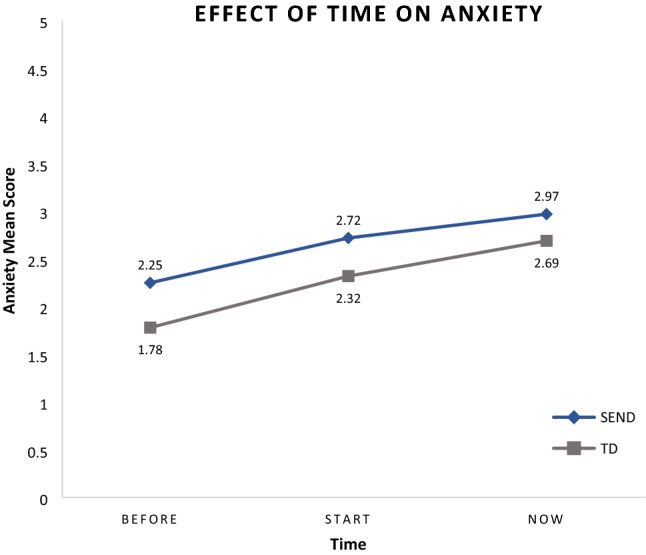
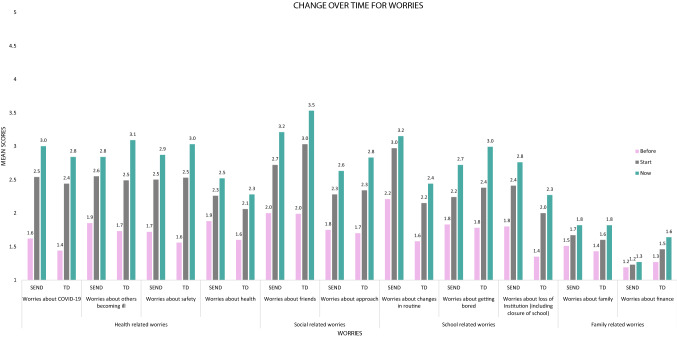
COVID-19 has affected people across the world. The current study examined anxiety and worries during the first UK national lockdown in March 2020. Parents (n = 402) reported on their own anxiety and worries as well as that of their son/daughter with Special Education Needs and Disabilities (SEND) and typically developing (TD) child (n = 186) at three time points. Although both groups showed increased anxiety across the three time points, levels of anxiety in the SEND group, but not the TD siblings, were predicted by awareness about COVID-19. In addition, worries differed between the groups showing that COVID-19 impacts the wellbeing of those with SEND differently to that of their TD siblings.
Overview
The claims and statistics of this paper haven’t been checked yet.
Free: it reads the open-access text and checks the first 5 claims that cite a source we can check. Create a free account to check every claim.
Integrity signals
Registry
Cites
Statistics
Figures
Verification
Claims the paper makes
The claims and statistics of this paper haven’t been checked yet.
Free: it reads the open-access text and checks the first 5 claims that cite a source we can check. Create a free account to check every claim.
Claims other papers make about this one
Each is checked against this paper’s own text: does it say what the citing paper says it does?
The check wasn’t confident either way, so it gives no verdict — never disputed.
In the citing paper
“Research also indicates that mindfulness practice may help with the development of compassion and reducing stress, anxiety [34], and depression [10-13].”
From Psychological Interventions and Those With Elements of Positive Psychology for Child and Youth Mental Health During the COVID-19 Pandemic: Literature Review, Lessons Learned, and Areas for Future Knowledge Dissemination (2024) · cites this paper as [12]
Experimental — accuracy not yet measured
Self-check
Percentages, sums and reported differences re-computed from the paper’s own numbers.
The self-check needs the paper’s full text.
Citations
Cites
The psychological impact of quarantine and how to reduce it: Rapid review of the evidence
Brooks, S. K., Webster, R. K., Smith, L. E., Woodland, L., Wessely, S., Greenberg, N., & Rubin, G. J. (2020) · The Lancet · doi:10.1016/s0140-6736(20)30460-8 · Cited by 16,378
McLean, C. P., Asnaani, A., Litz, B. T., & Hofmann, S. G. (2011) · Journal of Psychiatric Research · doi:10.1016/j.jpsychires.2011.03.006 · Cited by 2,519
Comorbid psychiatric disorders in children with autism: interview development and rates of disorders
Leyfer, O. T., Folstein, S. E., Bacalman, S., Davis, N. O., Dinh, E., Morgan, J., Tager-Flusberg, H., & Lainhart, J. E. (2006) · Journal of Autism and Developmental Disorders · doi:10.1007/s10803-006-0123-0 · Cited by 1,637
Behavioral and emotional disorders in children during the COVID-19 epidemic
Jiao, W. Y., Wang, L. N., Liu, J., Fang, S. F., Jiao, F. Y., Pettoello-Mantovani, M., & Somekh, E. (2020) · The Journal of Pediatrics · doi:10.1016/j.jpeds.2020.03.013 · Cited by 1,468
Duan, L., Shao, X., Wang, Y., Huang, Y., Miao, J., Yang, X., & Zhu, G. (2020) · Journal of Affective Disorders · doi:10.1016/j.jad.2020.06.029 · Cited by 991
Parenting stress and child behavior problems: a transactional relationship across time
Neece, C. L., Green, S. A., & Baker, B. L. (2012) · American Journal on Intellectual and Developmental Disabilities · doi:10.1352/1944-7558-117.1.48 · Cited by 953
The Developmental Epidemiology of Anxiety Disorders: Phenomenology, Prevalence, and Comorbidity
Costello, E. J., Egger, H. L., & Angold, A. (2005) · Child and Adolescent Psychiatric Clinics of North America · doi:10.1016/j.chc.2005.06.003 · Cited by 802
Immediate Psychological Effects of the COVID-19 Quarantine in Youth From Italy and Spain
Orgilés, M., Morales, A., Delvecchio, E., Mazzeschi, C., & Espada, J. P. (2020) · Frontiers in Psychology · doi:10.3389/fpsyg.2020.579038 · Cited by 781
Russell, B. S., Hutchison, M., Tambling, R., Tomkunas, A. J., & Horton, A. L. (2020) · Child Psychiatry & Human Development · doi:10.1007/s10578-020-01037-x · Cited by 704
Asbury, K., Fox, L., Deniz, E., Code, A., & Toseeb, U. (2021) · Journal of Autism and Developmental Disorders · doi:10.1007/s10803-020-04577-2 · Cited by 558
Anxiety in a neglected population: Prevalence of anxiety disorders in pre-adolescent children
Cartwright-Hatton, S., McNicol, K., & Doubleday, E. (2006) · Clinical Psychology Review · doi:10.1016/j.cpr.2005.12.002 · Cited by 543
Mental health before and during the COVID-19 pandemic in two longitudinal UK population cohorts
Kwong, A. S. F., Pearson, R. M., Adams, M. J., Northstone, K., Tilling, K., Smith, D., Fawns-Ritchie, C., Bould, H., Warne, N., Zammit, S., et al. (2021) · The British Journal of Psychiatry · doi:10.1192/bjp.2020.242 · Cited by 529
Effective Educational Practices for Students With Autism Spectrum Disorders
Iovannone, R., Dunlap, G., Huber, H., & Kincaid, D. (2003) · Focus on Autism and Other Developmental Disabilities · doi:10.1177/10883576030180030301 · Cited by 449
COVID-19 and people with intellectual disability: impacts of a pandemic
Courtenay, K., & Perera, B. (2020) · Irish Journal of Psychological Medicine · doi:10.1017/ipm.2020.45 · Cited by 413
Handbook on Quality of Life for Human Service Practitioners
Helm, D. T. (2003) · Mental Retardation · doi:10.1352/0047-6765(2003)41<479:br>2.0.co;2 · Cited by 369
Social identity, self‐esteem, and mental health in autism
Cooper, K., Smith, L. G. E., & Russell, A. (2017) · European Journal of Social Psychology · doi:10.1002/ejsp.2297 · Cited by 354
Learning Disabilities and Anxiety: A Meta-Analysis
Nelson, J. M., & Harwood, H. (2011) · Journal of Learning Disabilities · doi:10.1177/0022219409359939 · Cited by 350
Neece, C., McIntyre, L. L., & Fenning, R. (2020) · Journal of Intellectual Disability Research · doi:10.1111/jir.12769 · Cited by 344
Handbook on Quality of Life for Human Service Practitioners
Schalock, R. L., & Alonso, M. Á. V. (2002) · Cited by 341
Zhang, J., Shuai, L., Yu, H., Wang, Z., Qiu, M., Lu, L., Cao, X., Xia, W., Wang, Y., & Chen, R. (2020) · Asian Journal of Psychiatry · doi:10.1016/j.ajp.2020.102077 · Cited by 323
Jeste, S., Hyde, C., Distefano, C., Halladay, A., Ray, S., Porath, M., Wilson, R. B., & Thurm, A. (2020) · Journal of Intellectual Disability Research · doi:10.1111/jir.12776 · Cited by 298
Mutluer, T., Doenyas, C., & Aslan Genc, H. (2020) · Frontiers in Psychiatry · doi:10.3389/fpsyt.2020.561882 · Cited by 256
Willner, P., Rose, J., Stenfert Kroese, B., Murphy, G. H., Langdon, P. E., Clifford, C., Hutchings, H., Watkins, A., Hiles, S., & Cooper, V. (2020) · Journal of Applied Research in Intellectual Disabilities · doi:10.1111/jar.12811 · Cited by 239
Dhiman, S., Sahu, P. K., Reed, W. R., Ganesh, G. S., Goyal, R. K., & Jain, S. (2020) · Research in Developmental Disabilities · doi:10.1016/j.ridd.2020.103790 · Cited by 231
The other side of COVID-19: Impact on obsessive compulsive disorder (OCD) and hoarding
Banerjee, D. D. (2020) · Psychiatry Research · doi:10.1016/j.psychres.2020.112966 · Cited by 219
Including Children with Developmental Disabilities in the Equation During this COVID-19 Pandemic
Aishworiya, R., & Kang, Y. Q. (2021) · Journal of Autism and Developmental Disorders · doi:10.1007/s10803-020-04670-6 · Cited by 207
Lindsay, S., Proulx, M., Scott, H., & Thomson, N. (2014) · International Journal of Inclusive Education · doi:10.1080/13603116.2012.758320 · Cited by 172
Supporting Families with Children with Special Educational Needs and Disabilities During COVID-19Preprint
Toseeb, U., Asbury, K., Code, A., Fox, L., & Deniz, E. (2020) · doi:10.31234/osf.io/tm69k · Cited by 127
Shalev, R. A., Lavine, C., & Martino, A. D. (2019) · Journal of Developmental and Physical Disabilities · doi:10.1007/s10882-018-9641-x · Cited by 121
Rhodes, S. M., Park, J., Seth, S., & Coghill, D. R. (2012) · Journal of Child Psychology and Psychiatry · doi:10.1111/j.1469-7610.2011.02436.x · Cited by 113
Self-citationMental health outcomes of developmental coordination disorder in late adolescence
Harrowell, I., Hollén, L., Lingam, R., & Emond, A. M. (2017) · Developmental Medicine & Child Neurology · doi:10.1111/dmcn.13469 · Cited by 110
Neuropsychological functioning in depressed adolescent girls
Matthews, K., Coghill, D., & Rhodes, S. (2008) · Journal of Affective Disorders · doi:10.1016/j.jad.2008.02.003 · Cited by 107
Self-citationWigham, S., Barton, S., Parr, J. R., & Rodgers, J. (2017) · Journal of Mental Health Research in Intellectual Disabilities · doi:10.1080/19315864.2017.1299267 · Cited by 107
Rose, J., Willner, P., Cooper, V., Langdon, P. E., Murphy, G. H., & Kroese, B. S. (2020) · International Journal of Developmental Disabilities · doi:10.1080/20473869.2020.1764257 · Cited by 107
Guidance for the Treatment and Management of COVID ‐19 Among People with Intellectual Disabilities
Alexander, R., Ravi, A., Barclay, H., Sawhney, I., Chester, V., Malcolm, V., Brolly, K., Mukherji, K., Zia, A., Tharian, R., et al. (2020) · Journal of Policy and Practice in Intellectual Disabilities · doi:10.1111/jppi.12352 · Cited by 102
Stressful Life Events and Child Anxiety: Examining Parent and Child Mediators
Platt, R., Williams, S. R., & Ginsburg, G. S. (2016) · Child Psychiatry & Human Development · doi:10.1007/s10578-015-0540-4 · Cited by 99
RIX, J., HALL, K., NIND, M., SHEEHY, K., & WEARMOUTH, J. (2009) · Support for Learning · doi:10.1111/j.1467-9604.2009.01404.x · Cited by 83
Panicker, A. S., & Ramesh, S. (2018) · Journal of Applied Research in Intellectual Disabilities · doi:10.1111/jar.12496 · Cited by 83
Beidel, D. C., & Turner, S. (2007) · Routledge eBooks · doi:10.4324/9780203955321 · Cited by 66
Herwegen, J. V., Ashworth, M., & Palikara, O. (2018) · Research in Developmental Disabilities · doi:10.1016/j.ridd.2018.06.014 · Cited by 61
Self-citationAshworth, M., Palikara, O., & Van Herwegen, J. (2019) · Journal of Applied Research in Intellectual Disabilities · doi:10.1111/jar.12594 · Cited by 60
Self-citationBecker, S. P., Langberg, J. M., Evans, S. W., Girio-Herrera, E., & Vaughn, A. J. (2015) · Journal of Clinical Child & Adolescent Psychology · doi:10.1080/15374416.2014.930689 · Cited by 56
Mental health during the COVID-19 pandemic in two longitudinal UK population cohorts
Kwong, A. S. F., Pearson, R. M., Adams, M. J., Northstone, K., Tilling, K., Smith, D., Fawns-Ritchie, C., Bould, H., Warne, N., Zammit, S., et al. (2020) · doi:10.1101/2020.06.16.20133116 · Cited by 53
Views of professionals about the educational needs of children with neurodevelopmental disorders
Herwegen, J. V., Ashworth, M., & Palikara, O. (2019) · Research in Developmental Disabilities · doi:10.1016/j.ridd.2019.05.001 · Cited by 50
Self-citationDockrell, J. E., Ricketts, J., Palikara, O., Charman, T., & Lindsay, G. (2019) · Frontiers in Education · doi:10.3389/feduc.2019.00029 · Cited by 41
Self-citationBeyond Behaviour: Is Social Anxiety Low in Williams Syndrome?
Dodd, H. F., Schniering, C. A., & Porter, M. A. (2009) · Journal of Autism and Developmental Disorders · doi:10.1007/s10803-009-0806-4 · Cited by 31
O’Hagan, B., & Kingdom, S. (2020) · Tizard Learning Disability Review · doi:10.1108/tldr-09-2020-0025 · Cited by 29
Chafouleas, S. M., Iovino, E. A., & Koriakin, T. A. (2020) · Journal of Developmental and Physical Disabilities · doi:10.1007/s10882-019-09724-x · Cited by 26
Self-Advocacy, “Learning Difficulties,” and the Social Model of Disability
Goodley, D., Armstrong, D., Sutherland, K., & Laurie, L. (2003) · Mental Retardation · doi:10.1352/0047-6765(2003)41<149:sldats>2.0.co;2 · Cited by 24
COVID19 Crisis Response Survey for families of Individuals with Special NeedsPreprint
Herwegen, J. V., Dukes, D., & Samson, A. C. (2020) · doi:10.17605/osf.io/5nkq9 · Cited by 10
Self-citation
Research works printed but not linked: 1
- Schalock, R. L. (Ed.). (1996b). Quality of life: Vol. 1. Conceptualization and measurement. Washington, DC: American Association on Mental Retardation.
Cited by
Politi, E., Lueders, A., Sankaran, S., Anderson, J., Assche, J. V., Spiritus-Beerden, E., Roblain, A., Phalet, K., Derluyn, I., Verelst, A., et al. (2021) · European Psychologist · doi:10.1027/1016-9040/a000460 · Cited by 46
Nicklin, L. L., Wilsdon, L., Chadwick, D. D., Rhoden, L., Ormerod, D., Allen, D., Witton, G., & Lloyd, J. (2022) · Education and Information Technologies · doi:10.1007/s10639-022-10899-8 · Cited by 36
Totsika, V., Kouroupa, A., Timmerman, A., Allard, A., Gray, K. M., Hastings, R. P., Heyne, D. A., Melvin, G. A., & Tonge, B. J. (2023) · Journal of Autism and Developmental Disorders · doi:10.1007/s10803-023-06025-3 · Cited by 33
Amirova, A., CohenMiller, A., & Sandygulova, A. (2022) · Frontiers in Psychiatry · doi:10.3389/fpsyt.2022.913902 · Cited by 31
Samson, A. C., Sokhn, N., Herwegen, J. V., & Dukes, D. (2022) · Frontiers in Psychiatry · doi:10.3389/fpsyt.2022.940872 · Cited by 29
Self-citation
Metadata
- Authors
- Sideropoulos, V., Dukes, D., Hanley, M., Palikara, O., Rhodes, S., Riby, D. M., Samson, A. C., & Van Herwegen, J.
- Affiliations
- University College London (GB)
- University of Geneva (CH)
- Durham University (GB)
- University of Warwick (GB)
- University of Edinburgh (GB)
- University of Fribourg (CH)
- ORCID
- Venue
- Journal of Autism and Developmental Disorders
- Published
- 2021-07-01
- Volume
- 52
- Issue
- 6
- Pages
- 2656-2669
- ISSN
- 0162-3257 (ISSN-L)
- 1573-3432
- PMC
- PMC8246131
- OpenAlex
- W3175660544
- Cited by
- 49
- References
- 48
- Citations by year
- 2026: 6 · 2025: 3 · 2024: 9 · 2023: 14 · 2022: 16 · 2021: 1
- FWCI
- 6.81
- Type
- journal article
- Language
- en
- Open access
- hybrid
- doi.org
- Licence
- cc-by
- creativecommons.org/licenses/by/4.0 (tdm)
- creativecommons.org/licenses/by/4.0 (vor)
- Locations
- Journal of Autism and Developmental Disorders (publishedVersion, cc-by)
- PubMed Central (publishedVersion, cc-by)
- PubMed (publishedVersion)
- Warwick Research Archive Portal (University of Warwick) (acceptedVersion)
- Durham Research Online (Durham University) (acceptedVersion)
- Durham Research Online (Durham University) (submittedVersion, cc-by)
- Edinburgh Research Explorer (University of Edinburgh) (submittedVersion, cc-by)
- UCL Discovery (University College London) (submittedVersion)
- PsyArXiv (OSF Preprints) (submittedVersion, cc-by)
- PsyArXiv (OSF Preprints) (submittedVersion)
- Funders
- Schweizerischer Nationalfonds zur Förderung der Wissenschaftlichen Forschung (SNSF PP00P1_176722)
- Topics
- Social Sciences › Psychology › Clinical Psychology › COVID-19 and Mental Health
- Social Sciences › Psychology › Clinical Psychology › Family and Disability Support Research
- Social Sciences › Psychology › Clinical Psychology › Child and Adolescent Psychosocial and Emotional Development
- Keywords
- COVID-19 pandemic, lockdown, anxiety, worry, special educational needs and disabilities, parents, siblings, children with disabilities, well-being, typically developing children
- MeSH terms
- Autism Spectrum Disorder, COVID-19, SARS-CoV-2, Anxiety, Child, Communicable Disease Control, Education, Special, United Kingdom, Humans
About these checks
Registry, retraction, Cites and statistics results are computed, not judged, with one exception: a printed reference that no index lists is read once by a model before it counts as a citation error. Claims are extracted by a model and kept only when their quote appears verbatim in the text; each cited source is then checked, with a model’s help, for whether it says what the claim relies on. Those verdicts can be wrong — read the claim’s quote and the cited source before relying on one.
Statistics and arithmetic are recomputed, not judged.
Confidence bands are shown only for fields calibrated on our annotated test set. None is calibrated yet, so no band is shown.
What counts as a claim ›How we measure confidence ›How we check this ›
Are you an author, or do you see a problem with this page? Request a review
Data sources
Bibliographic data: Semantic Scholar, OpenAlex, Crossref.
Contains information from the Semantic Scholar Academic Graph Datasets, made available under the ODC Attribution License (ODC-BY 1.0).
Semantic Scholar’s data is described in: Kinney, R., et al. (2023). The Semantic Scholar Open Data Platform. arXiv:2301.10140.
