

Adolescents’ Social Network Site Use, Peer Appearance-Related Feedback, and Body Dissatisfaction: Testing a Mediation Model
Open accessThe DOI matches its Crossref record; 57 of the 57 references it cites were found in a registry or an index.
Abstract
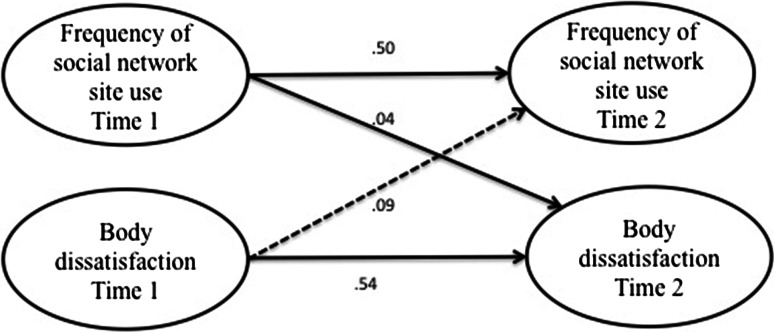
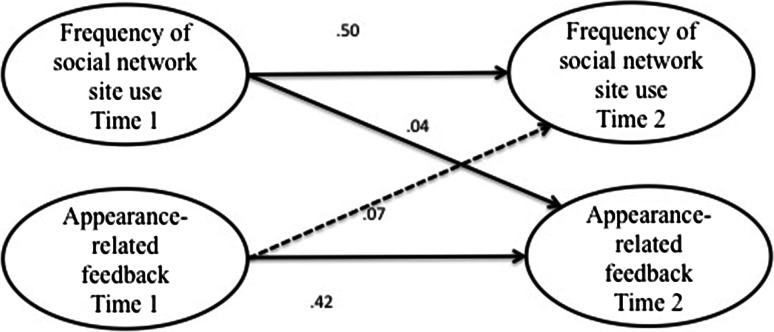
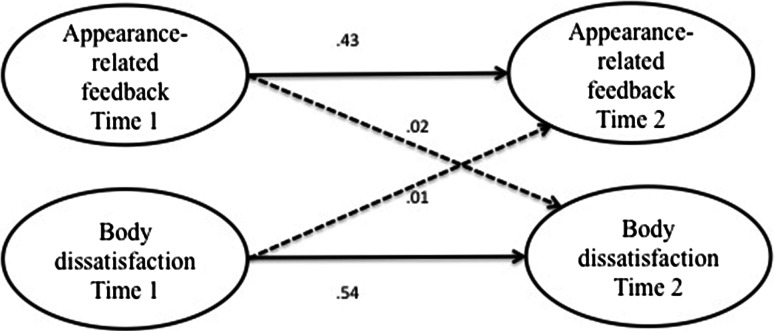
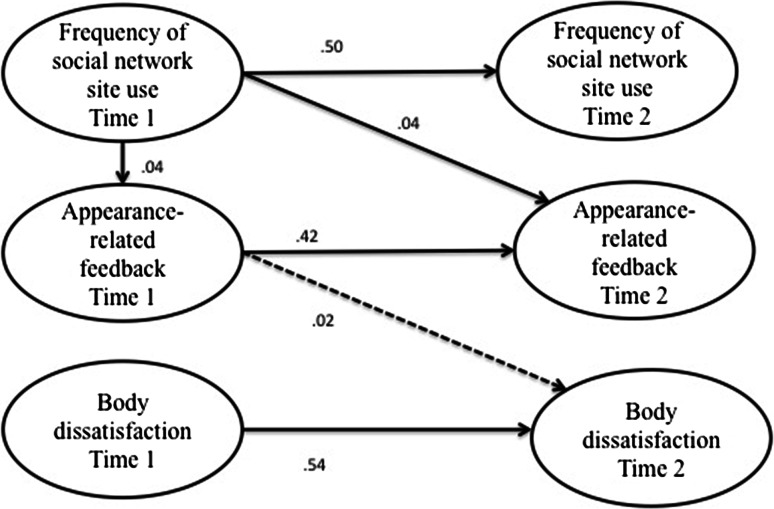
Previous correlational research indicates that adolescent girls who use social network sites more frequently are more dissatisfied with their bodies. However, we know little about the causal direction of this relationship, the mechanisms underlying this relationship, and whether this relationship also occurs among boys to the same extent. The present two-wave panel study (18 month time lag) among 604 Dutch adolescents (aged 11-18; 50.7% female; 97.7% native Dutch) aimed to fill these gaps in knowledge. Structural equation modeling showed that social network site use predicted increased body dissatisfaction and increased peer influence on body image in the form of receiving peer appearance-related feedback. Peer appearance-related feedback did not predict body dissatisfaction and thus did not mediate the effect of social network site use on body dissatisfaction. Gender did not moderate the findings. Hence, social network sites can play an adverse role in the body image of both adolescent boys and girls.
Overview
The claims and statistics of this paper haven’t been checked yet.
Free: it reads the open-access text and checks the first 5 claims that cite a source we can check. Create a free account to check every claim.
Integrity signals
Registry
Cites
Statistics
Figures
Verification
Claims the paper makes
The claims and statistics of this paper haven’t been checked yet.
Free: it reads the open-access text and checks the first 5 claims that cite a source we can check. Create a free account to check every claim.
Claims other papers make about this one
Each is checked against this paper’s own text: does it say what the citing paper says it does?
The source backs part of the claim, not all of it — or backs it for a different population, condition or comparison.
In the citing paper
“Adolescence is an important period for shaping of esthetic preferences and the internalization of appearance norms, as well the development of eating patterns (de Vries et al., 2016;Rodgers & Melioli, 2016).”
From Relation Between Social Media Use and Body Image Concerns and Disordered Eating in Adolescence: A Systematic Review and Meta-Analysis (2026) · cites this paper as de Vries et al., 2016
Experimental — accuracy not yet measuredThe source backs part of the claim, not all of it — or backs it for a different population, condition or comparison.
In the citing paper
“and thereby poses a significant risk for adolescents in terms of body and weight dissatisfaction [2,11,12].”
From Effects of Social Media and Smartphone Use on Body Esteem in Female Adolescents: Testing a Cognitive and Affective Model (2020) · cites this paper as [11]
Experimental — accuracy not yet measuredThe source backs part of the claim, not all of it — or backs it for a different population, condition or comparison.
In the citing paper
“An additional study with adolescents found social media to be a source of appearance pressure that contributed to body dissatisfaction; authors argued that social media may be an additional source of appearance pressure that resembled the original three sources in the model (de Vries et al., 2016).”
From Incorporating social media and muscular ideal internalization into the tripartite influence model of body image: Towards a modern understanding of adolescent girls’ body dissatisfaction (2022) · cites this paper as de Vries et al., 2016
Experimental — accuracy not yet measuredThe cited source says what the claim attributes to it.
In the citing paper
“An emerging body of work has documented associations between adolescents' use of SM and heightened body image concerns (e.g., de Vries et al., 2016; Marengo et al., 2018; Rodgers et al., 2020)”
From The Perfect Storm: A Developmental-Sociocultural Framework for the Role of Social Media in Adolescent Girls' Body Image Concerns and Mental Health. (2022) · cites this paper as de Vries et al., 2016
In the citing paper
“On the other hand, other studies suggest that gender plays no significant role in the relationships between media use, social comparison, and body dissatisfaction (de Vries, Peter, de Graaf, & Nikken, 2016; Steers, Wickham, & Acitelli, 2014).”
From The reciprocal and indirect relationships between passive Facebook use, comparison on Facebook, and adolescents' body dissatisfaction (2017) · cites this paper as de Vries et al., 2016
1 more claim about this paper
Create a free account to see every claim other papers make about this one.
Self-check
Percentages, sums and reported differences re-computed from the paper’s own numbers.
The self-check needs the paper’s full text.
Citations
Cites
An Introduction to the Bootstrap
Efron, B., & Tibshirani, R. J. (1994) · doi:10.1201/9780429246593 · Cited by 40,500
An Introduction to the Bootstrap
Efron, B., & Tibshirani, R. J. (1993) · doi:10.1007/978-1-4899-4541-9 · Cited by 21,230
(2010) · Intellectum (Universidad de La Sabana) · doi:10.1111/j.1467- · Cited by 16,131
To parcel or not to parcel: Exploring the question, weighing the merits
Little, T. D., Cunningham, W. A., Shahar, G., & Widaman, K. F. (2002) · Structural Equation Modeling: A Multidisciplinary Journal · doi:10.1207/s15328007sem0902_1 · Cited by 6,552 · cited 3×
“In the structural equation models, the eight items of the body dissatisfaction scale were combined into three parcels using the item-to-construct balanced procedure suggested by Little et al. (2002).”
BackgroundMethodInfluentialCole, D. A., & Maxwell, S. E. (2003) · Journal of Abnormal Psychology · doi:10.1037/0021-843x.112.4.558 · Cited by 3,605 · cited 2×
“In the set-up of the models, we followed recommendations by Cole and Maxwell (2003). All analyses therefore included previous levels of the variables of interest.”
MethodThe Predictive Validity of Multiple-Item versus Single-Item Measures of the Same Constructs
Bergkvist, L., & Rossiter, J. R. (2007) · Journal of Marketing Research · doi:10.1509/jmkr.44.2.175 · Cited by 3,107 · cited 1×
“A single item was used as recommended for constructs that are concrete and singular (Bergkvist and Rossiter 2007).”
MethodExacting beauty: Theory, assessment, and treatment of body image disturbance.
Thompson, J. K., Heinberg, L. J., Altabe, M., & Tantleff-Dunn, S. (1999) · doi:10.1037/10312-000 · Cited by 3,100
The Impact of Social Media on Children, Adolescents, and Families
O'Keeffe, G. S., Clarke-Pearson, K., & Council on Communications and Media (2011) · Pediatrics · doi:10.1542/peds.2011-0054 · Cited by 2,943 · cited 1×
“The effect of social network sites on the lives and the development of adolescents is important to investigate given the role social network sites currently play in adolescents’ lives (O’Keeffe and Clarke-Pearson 2011).”
BackgroundCollege students' social networking experiences on Facebook
Pempek, T. A., Yermolayeva, Y. A., & Calvert, S. L. (2009) · Journal of Applied Developmental Psychology · doi:10.1016/j.appdev.2008.12.010 · Cited by 2,081 · cited 2×
“Users present oneself to others on these profiles through text and pictures, they view and comment on the selfpresentations of other users, and they read others’ comments on the own self-presentations (Espinoza and Juvonen 2011; Pempek et al. 2009).”
BackgroundGroesz, L. M., Levine, M. P., & Murnen, S. K. (2002) · International Journal of Eating Disorders · doi:10.1002/eat.10005 · Cited by 1,772 · cited 4×
“…the effects of media, such as TV and magazines, have typically focused on the effects of exposure to highly idealized images of physically attractive people and appearance-focused content on body dissatisfaction [for meta-analyses see Bartlett et al. 2008 (males); Groesz et al. 2002 (females)].”
BackgroundInfluential
Cited by
Items 201–300 of 321
Predictive Effect of Adolescents' Body Cathexis on General Self-efficacy and The Use of Instagram
DALKIÇ, A., & Kaya, Z. (2021) · Participatory Educational Research · doi:10.17275/per.21.50.8.2 · Cited by 5
Manneville, F., Omorou, A. Y., Legrand, K., Lecomte, E., Rydberg, J. A., Briançon, S., & Guillemin, F. (2021) · Preventive Medicine · doi:10.1016/j.ypmed.2021.106668 · Cited by 5
Jin, S. A., & Ryu, E. (2022) · Behavioral Sciences · doi:10.3390/bs12100396 · Cited by 8
“Thus, a growing body of research has examined these contemporary issues revolving around the theme of exposure to social media and its impact on body image perception [22,54] and eating disorders [8], using various research methodologies, including cross-sectional survey [7], longitudinal study [57], experiment [5,22,…”
BackgroundKlimas, N., Maciaszek, J., & Laudańska–Krzemińska, I. (2024) · Physical Culture and Sport Studies and Research · doi:10.2478/pcssr-2024-0018 · Cited by 7
Cocca, A., Ornelas, J. R. B., Pérez, J. E. P., & Viciana, J. (2016) · Retos · doi:10.47197/retos.v0i30.50243 · Cited by 12
Harvey, O., & Parrish, M. (2019) · Practice · doi:10.1080/09503153.2019.1653450 · Cited by 4
The body dissatisfaction role in the adoption of compulsive healthy eating behaviors
Silva, S. C. L. D. C. E., Elmashhara, M. G., & Sousa, M. I. (2022) · International Review on Public and Nonprofit Marketing · doi:10.1007/s12208-022-00357-z · Cited by 5
“Several studies have looked into the effects of SM on body image perception, and the findings support Thompson and Heinberg’s (1999) assumptions indicating that SM constitute a risk factor for the development of BD (Bennett et al., 2020; de Vries et al., 2016, 2019).”
ResultRamdhany, L. A., & Hakim, M. A. (2024) · Jurnal Ilmiah Psikologi Candrajiwa · doi:10.20961/jip.v9i1.77381 · Cited by 5
Adolescent and parental views on weight and weight management: a qualitative study
Little, M., Jebb, S. A., & Aveyard, P. N. (2025) · Archives of Disease in Childhood · doi:10.1136/archdischild-2024-327306 · Cited by 6
Prince, T., Driver, C., Boyes, A., Mulgrew, K. E., Elwyn, R., Mills, L., & Hermens, D. F. (2025) · Behavioural Brain Research · doi:10.1016/j.bbr.2025.115647 · Cited by 5
“Conversely, some adolescents may perpetrate BRC to assert social status [46], deflect attention from their own appearance-related insecurities [49], or conform to peer and online norms that idealise thinness and objectify bodies [24,37].”
Maes, C., Vanherle, R., Fardouly, J., & Vandenbosch, L. (2025) · Communication Research · doi:10.1177/00936502251338901 · Cited by 7
Timler, A., McIntyre, F., Harris, S. (., & Hands, B. P. (2020) · Human Movement Science · doi:10.1016/j.humov.2020.102710 · Cited by 3
Ketidakpuasan tubuh dan internalisasi media pada remaja
Hartati, P., & Novianty, A. (2021) · Jurnal Ilmiah Psikologi Terapan · doi:10.22219/jipt.v9i1.12444 · Cited by 10
“Namun, penelitian lainnya menunjukkan bahwa semakin sering menggunakan media sosial, dapat meningkatkan ketidakpuasan tubuh pada remaja laki-laki (de Vries et al., 2016).”
BackgroundSentiment Analysis of Local Tourism in Thailand from YouTube Comments Using BiLSTM
Khruahong, S., Surinta, O., & Lam, S. C. (2022) · Lecture notes in computer science · doi:10.1007/978-3-031-20992-5_15 · Cited by 7
Teo, D. W. X., Teong, V. W. L., Ramachandran, R., Lim, S. L., & Lin, C. (2023) · Singapore Medical Journal · doi:10.4103/singaporemedj.smj-2022-062 · Cited by 4
“[19] This suggests that social media use leads to elevated body dissatisfaction, but body dissatisfaction does not necessarily lead to a greater need for use of social media.”
Cross-generational Effects of Social Media on Body Image Perception
Speranza, T. B., Abrevaya, S., & Ramenzoni, V. C. (2024) · Revista Mexicana de Trastornos Alimentarios/Mexican Journal of Eating Disorders · doi:10.22201/fesi.20071523e.2024.2.797 · Cited by 8
“Because only adults in the Z generation were included (older than 18), perhaps the effect of peer pressure in teenage years was diluted (Chua & Chang, 2016; Kenny, Sullivan, Callaghan, Molcho, & Kelly, 2018; Rodgers & Rousseau, 2022; de Vries, Peter, de Graaf, & Nikken, 2016).”
Sierra, I., Roncero, M., Rodríguez-Testal, J. F., & Senín-Calderón, C. (2025) · Current Psychology · doi:10.1007/s12144-024-07245-1 · Cited by 3
Wei, Z., Liu, K., Yang, W., Zhang, Y., Fu, H., & Fu, L. (2025) · Humanities and Social Sciences Communications · doi:10.1057/s41599-025-05396-5 · Cited by 3
“In the past decade, there has been a dramatic increase in social media exposure, which is associated with the increase of body image dissatisfaction (De Vries et al., 2015).”
Vendemia, M. A., Goodboy, A. K., Chiasson, R. M., & Dillow, M. R. (2025) · Human Communication Research · doi:10.1093/hcr/hqaf001 · Cited by 8
Digital Technology and Health: A Theoretical Framework
Šmahel, D., Macháčková, H., Šmahelová, M., Čevelíček, M., Almenara, C. A., & Holubčíková, J. (2018) · Springer eBooks · doi:10.1007/978-3-319-93221-7_2 · Cited by 4
Social media, adolescent developmental tasks, and music
Pluretti, R., & Bobkowski, P. S. (2019) · Oxford University Press eBooks · doi:10.1093/oso/9780198808992.003.0019 · Cited by 6
Digital technologies and adolescents’ body image
Aubrey, J. S., Yan, K., & Gahler, H. (2022) · Elsevier eBooks · doi:10.1016/b978-0-12-818872-9.00156-4 · Cited by 4
Johansen, L. H., Nilsen, T.-E., Madsen, S. S., & Andreassen, S.-E. (2024) · Education Sciences · doi:10.3390/educsci14111227 · Cited by 2
Beyond the screen: The relationships between online activities and eating disorder risk
Ding, X. (2025) · Eating Behaviors · doi:10.1016/j.eatbeh.2025.101963 · Cited by 2
Chen, W., Lu, A., Li, J., An, Y., Ke, X., Li, K., & Liu, S. (2025) · Current Psychology · doi:10.1007/s12144-025-08110-5 · Cited by 2
Examining the Relationship Between Time Spent on Social Media Platforms and Body Image Concerns
Malhotra, K., Miles, S., Tan, E. J., & Phillipou, A. (2025) · European Eating Disorders Review · doi:10.1002/erv.70030 · Cited by 6
“…excessive time spent, appearance‐based use, using filters, online feedback) has been shown to be associated with negative body image in adolescents (De Vries et al. 2016; Jarman, Marques, McLean, Slater, and Paxton 2021b), young adults (Engeln et al. 2020; Fardouly and Vartanian 2015), older…”
Attention to Instagram features in female youth with anxiety symptoms
McGowan, Y., Banire, B., Burns, H., Sutherland, D., Stewart, S. H., Klein, R. M., & Meier, S. M. (2025) · Comprehensive Psychiatry · doi:10.1016/j.comppsych.2025.152641 · Cited by 2
A network analysis of risk and protective factors for body image in young adult women
Hallez, Q., El-Jor, C., & Shankland, R. (2026) · Eating and Weight Disorders - Studies on Anorexia Bulimia and Obesity · doi:10.1007/s40519-026-01815-x · Cited by 3
Benmoyal‐Bouzaglo, S. (2022) · Recherche et Applications en Marketing (English Edition) · doi:10.1177/20515707221106981 · Cited by 7
“Moreover, they discuss, either within or outside the social network, the appearance of their peers (de Vries et al., 2016).”
BackgroundAhadzadeh, A. S., Amini, M., Wu, S. L., & Haolin, Z. (2022) · Makara Human Behavior Studies in Asia · doi:10.7454/hubs.asia.3281121 · Cited by 7
Sica, L. S. (2022) · PSICOLOGIA DI COMUNITA · doi:10.3280/psc2022-002003 · Cited by 8
Impact of Adolescent Social Media Use on Body Image, Mental Health and Eating Disorders: A Review
Rajesh, S., & Draper, L. (2022) · Journal of Student Research · doi:10.47611/jsrhs.v11i4.3388 · Cited by 7
Dantas, Í. J. D. M., Freire, A. G., Solino, L. J. S., & Curth, M. (2023) · Modapalavra e-periódico · doi:10.5965/1982615x16392023e0009 · Cited by 2
A Study of Interpersonal Relationships and Mental Health in Adolescence
Wu, Y., & Xia, Y. (2024) · Lecture Notes in Education Psychology and Public Media · doi:10.54254/2753-7048/60/20240473 · Cited by 6
Role of Social Media in Comparing Physical Appearance, Body Dissatisfaction and Drive for Thinness
Saeed, M., Afzal, H., Khawar, H., Khan, Z., Idrees, S., & Maqbool, H. S. (2025) · Bulletin of business and economics · doi:10.61506/01.00571 · Cited by 1
“Several studies have suggested that social media exposure could foster body dissatisfaction and result in risky eating behaviors by broadcasting thinness ideals individuals thus long for (Blowers et al., 2003; De Vries et al., 2016; Jerome, 2019; Fan & Iqbal, 2022; Clark, 2022).”
(2021) · International Journal of Advanced Trends in Computer Science and Engineering · doi:10.30534/ijatcse/2021/391032021 · Cited by 2
Kahumoku‐Fessler, E., Vazsonyi, A. T., Haque, A., & Brown, M. D. (2017) · American Journal of Family Therapy · doi:10.1080/01926187.2017.1303652 · Cited by 4
Le développement sexuel et psychosocial de l'enfant et de l'adolescent
Boislard, M.-A., & van de Bongardt, D. (2017) · De Boeck Supérieur eBooks · doi:10.3917/dbu.heber.2017.01.0039 · Cited by 12
Benmoyal‐Bouzaglo, S. (2021) · Recherche et Applications en Marketing (French Edition) · doi:10.1177/07673701211049819 · Cited by 2
Filaili, L. N., Rosyita, H., & Handayani, P. R. (2021) · Jurnal Teknologi Informasi · doi:10.52643/jti.v7i2.1905 · Cited by 4
Salwa, H. I., & Atmaka, D. R. (2023) · Jurnal Ilmiah Permas Jurnal Ilmiah STIKES Kendal · doi:10.32583/pskm.v13i3.1010 · Cited by 2
An Examination of Instagram Use and Body Image in a Sociocultural Model of Disordered Eating
Haller, S. (2020) · TSpace (University of Toronto) · Cited by 6
Nesneleştirilmiş Beden Bilincinin Dindarlık ile Selfitiş Davranış İlişkisindeki Rolü
AHMEDİ, B. K., & ŞAHİN, M. (2021) · Akademik İncelemeler Dergisi · doi:10.17550/akademikincelemeler.956805 · Cited by 2
“175 Journal of Academic Inquiries Volume 16 – Issue 2 (October 2021) Kendi bedenine sürekli başkalarının gözünden bakma pozisyonunda olma bazı performans kayıplarına ve psikolojik zorluklara neden olmaktadır (Doğan, 2016, 37).”
Vlasak, T., Barth, A., & Augner, C. (2025) · The European Journal of Psychiatry · doi:10.1016/j.ejpsy.2025.100297 · Cited by 2
Investigating bidirectional relationships between Instagram “addiction” and eating disorder symptoms
Messer, M., Liu, C., Jarman, H. K., Anderson, C., & Linardon, J. (2025) · Eating Behaviors · doi:10.1016/j.eatbeh.2025.102047 · Cited by 2
Surprenant, R., Bezeau, D., Cabot, I., Smith, J., Kim, H. S. A., & Fitzpatrick, C. (2025) · Health Education & Behavior · doi:10.1177/10901981251387139 · Cited by 1
“Much of the recent literature has examined the impact of social media use on body image concerns (Holland & Tiggemann, 2016; Kelly et al., 2018; de Vries et al., 2016).”
King, G. M., O’Brien, M., & McLean, S. A. (2026) · Journal of Eating Disorders · doi:10.1186/s40337-026-01560-7 · Cited by 2
“This is consistent with other research among adolescents whereby social media activity predicted increased body dissatisfaction over 18-months among girls and boys [35] and over 2-years among girls but not boys [36].”
Ülger, T. G., Akçalı, Ç., & Özyurt, M. (2026) · Journal of Public Health · doi:10.1007/s10389-026-02753-9 · Cited by 1
Duman, N., Karagöz, B., Çağatay, Ş., & Gültemen, N. (2026) · Journal of Information Systems and Management Research · doi:10.59940/jismar.1682535 · Cited by 1
TUNG, W. L., & Rahman, M. M. (2021) · Malaysian Journal of Public Health Medicine · doi:10.37268/mjphm/vol.21/no.1/art.781 · Cited by 1
Bazile, K. E. (2020) · Mercer University Libraries (Mercer University) · Cited by 3
Ürün, J., Muslu, G. K., & Manav, G. (2022) · Turkish Journal of Family Medicine & Primary Care · doi:10.21763/tjfmpc.1008130 · Cited by 2
Behaviour, Belief and Impairment (BBI): a diagnostic procedure for eating disorders in primary care
Ridgeway, L., Katzman, D. K., & McNicholas, F. (2022) · Irish Journal of Medical Science (1971 -) · doi:10.1007/s11845-022-03086-8 · Cited by 2
“A longitudinal study (n = 604, aged 11–18 years) showed that social network site use predicted increased body dissatisfaction, with equal impact in both adolescent boys and girls [15].”
BackgroundDer Einfluss der Medien auf das Körperbild
Götz, M. (2022) · Springer eBooks · doi:10.1007/978-3-662-63544-5_23 · Cited by 1
The Impact of Social Media on Chinese High School Students' Body and Image Anxiety
Lin, X. (2023) · Lecture Notes in Education Psychology and Public Media · doi:10.54254/2753-7048/2/2022470 · Cited by 1
“For example, Vries et al. [10] pointed out that adolescents are psychologically immature when it comes to refuting prevailing beauty standards on online platforms.”
BackgroundGaravand, H. (2023) · فصلنامه علمی و پژوهشی اعتیادپژوهی · doi:10.52547/etiadpajohi.17.67.25 · Cited by 2
Ni, Y. (2023) · Journal of Student Research · doi:10.47611/jsrhs.v12i4.5593 · Cited by 2
Socially Marginalized Youths' Experiences with Social Media and its Impact on their Relationships
Regan, K. A. (2017) · Scholarship@Western (Western University) · Cited by 1
Reading Phoebe Gloeckner'sA Child's Life and Other Storiesat the Time of #MeToo
Michael, O. (2018) · Life Writing · doi:10.1080/14484528.2018.1507416 · Cited by 2
Ergenlik Döneminde Yaşanan Negatif Etkilerin Çeşitli Değişkenler Açısından İncelenmesi
DEMİRCİ, Z. A. (2020) · Bilecik Şeyh Edebali Üniversitesi Sosyal Bilimler Enstitüsü Dergisi · doi:10.33905/bseusbed.809146 · Cited by 1
Silhouette féminine et réseaux sociaux
Cassuto, D.-A. (2021) · Pratiques en nutrition · doi:10.1016/j.pranut.2021.09.008 · Cited by 1
Malibari, M. (2016) · QSpace (Queen's University Library) · Cited by 1
Gonzalez, S. E. (2018) · Lincoln (University of Nebraska) · Cited by 3
INDIVIDUAL DIFFERENCES AMONG SNAPCHAT USERS: USES AND MOTIVATIONS
Baker, N. (2020) · Digital Commons - URI (University of Rhode Island) · doi:10.23860/baker-nicole-2020 · Cited by 1
The Impact of Social Networking Sites on Body Dissatisfaction among Men and Women: a Meta-AnalysisPreprint
Castaneda, F. (2020) · Thesis Commons (OSF Preprints) · doi:10.31237/osf.io/vts75 · Cited by 1
Speranza, T. B., Abrevaya, S., & Ramenzoni, V. C. (2021) · doi:10.31234/osf.io/y826u · Cited by 1
“However, due to only including adults in the Z generation, perhaps the effect of peers' importance in teenage years was diluted (De Vries et al., 2016; Kenny et al., 2017; Chua & Chang, 2016).”
Filice, E. (2021) · UWSpace (University of Waterloo) · Cited by 2
Rosenbaum, D. L., & Gillen, M. M. (2022) · Elsevier eBooks · doi:10.1016/b978-0-12-818872-9.00112-6 · Cited by 4
Dostupnost moderne tehnologije kod osnovnoškolaca viših razreda
Matić, V. (2016) · Hrvatski časopis za javno zdravstvo
Roger J.R. Levesque: Adolescents, Privacy, and the Law: A Developmental Science Perspective
Smith, A. J. (2017) · Journal of Youth and Adolescence · doi:10.1007/s10964-017-0711-7
“Several areas of research focus on privacy issues, such as those involving adolescents’ media use (de Vries et al. 2016; Sasson and Mesch 2016), schooling (see Tanner-Smith and Fisher 2016), parental monitoring (see Khurana et al. 2015; Ksinan and Vazsonyi 2016), interventions (Knight et al. 2015),…”
BackgroundZiaei, F., & Nickname, M. (2017) · Razavi International Journal of Medicine · doi:10.5812/rijm.62159
“In the next stage, individuals were divided into two groups: control group (15 individuals) and experiment group (15 individuals) (21).”
BackgroundMethodAnalysis of Pinterest as a Tool for Dissemination of Nutrition Information for Parents of Teenagers
Black, H. A., Schumacher, J., Vollmer, R. L., & Harpel, T. S. (2019) · Children and Teenagers · doi:10.22158/ct.v2n1p72
Moreira, G. S. X., Lorenzato, L., Neufeld, C. B., & Almeida, S. S. (2020) · Estudos de Psicologia (Natal) · doi:10.22491/1678-4669.20180041 · Cited by 1
“In addition, longitudinal studies revealed that the high frequency of use of social networks predicts increased dissatisfaction with body image over time and these impacts were the same for boys and girls (Vries et al., 2016).”
BackgroundSelfie: the visual communication on instagram
Филипов, М., & Кaлимбетовa, А. (2019) · Herald of journalism · doi:10.26577/hj.2019.v54.i4.02
Особенности использования источников информации казахстанской и российской молодежи
Maulsharif, M. (2019) · The Journal of Psychology and Sociology · doi:10.26577/jpss.2019.v69.i2.017
Investigating the Effects of Social Media on Body Image Satisfaction in Young Adults
Isufaj, S. (2020) · NORMA · Cited by 1
Mannino, G., Salerno, L., Bonfanti, R. C., Albano, G., & Coco, G. L. (2021) · Research Square · doi:10.21203/rs.3.rs-622603/v1
Vimalakanthan, K. (2021) · UWSpace (University of Waterloo)
Առաքելյան, Տ. Ա., & Վարդանյան, Ն. Տ. (2020) · Modern Psychology · doi:10.46991/sbmp/2020.3.1.009
The Necessity of Aesthetic Metanoia
Brock, B. (2022) · Journal of Disability & Religion · doi:10.1080/23312521.2022.2051678
Ioannidis, K. (2022) · Research Publications (Maastricht University) · doi:10.26481/dis.20220623ki · Cited by 1
Can Social Media Make Us More Trusting?
Bohler, J. A., Drake, J. R., Paul, R. C., & Kisling, E. L. (2022) · Journal of Electronic Commerce in Organizations · doi:10.4018/jeco.305738
“SNS usage is often associated with negative impacts on the user’s life, such as poor body image (de Vries et al., 2015), reduced academic performance (Doleck & Lajoie, 2018), privacy violations in job searches (Drake & Furner, 2020), and increased social anxiety (Dobrean & Pasarelu, 2016).”
BackgroundSilhouette féminine à l’ère des réseaux sociaux et impact sur les adolescentes✩
Cassuto, D.-A. (2022) · La Revue de Santé Scolaire et Universitaire · doi:10.1016/j.revssu.2022.10.008
Amaral, G. R. (2022) · TECCOGS Revista Digital de Tecnologias Cognitivas · doi:10.23925/1984-3585.2022i25p9-49
(2023) · Emerald Group Publishing Limited eBooks · doi:10.1108/978-1-80455-786-020231019
Social Network Site Use and Body Dissatisfaction in Chinese Adolescents: A Longitudinal AnalysisPreprint
Liu, M., Zhang, T., Zhang, G., Wang, K., Huang, Y., & Zhang, X. (2024) · SSRN Electronic Journal · doi:10.2139/ssrn.4791410
Sudiasi, B., & Ariyanto, M. S. (2023) · Jurnal Riset dan Inovasi Pembelajaran · doi:10.51574/jrip.v3i3.1155 · Cited by 7
The Influence of Media on Body Image
Götz, M. (2024) · Springer eBooks · doi:10.1007/978-3-662-67662-2_23
Effects of Social Media Use on Body Image and Disordered Eating in AdolescentsPreprint
Sabol, M. A., & Duell, N. (2024) · PsyArXiv (OSF Preprints) · doi:10.31234/osf.io/fxh6m · Cited by 6
If It’s Not on Facebook, It Did Not Happen: The Dynamics and Influence of Social Networks
Lončarić, V., Senci, V., & Golubic, L. T. (2024) · Sociologija i prostor · doi:10.5673/sip.62.1.8
“…socialization during adolescence, the time when children begin to become more familiar with their bodies and notice differences compared to others (de Vries et al., 2016)we know little about the causal direction of this relationship, the mechanisms underlying this relationship, and whether this…”
BackgroundRachmawati, P. (2024) · MitraMas Jurnal Pengabdian dan Pemberdayaan Masyarakat · doi:10.25170/mitramas.v2i2.5494
Institut društvenih znanosti Ivo Pilar, Z., Blažev, M., Blažev, D., Filozofski fakultet, S. U. Z., Dević, I., Institut društvenih znanosti Ivo Pilar, Z., Korajlija, A. L., & Filozofski fakultet, S. U. Z. (2024) · Socijalna psihijatrija · doi:10.24869/spsih.2024.109
“Studies have shown that spending more time on social media leads to lower self-esteem and greater body image concerns, as well as more eating disorders (5, 6, 8, 32, 33).”
InfluentialAyaz, A. (2025) · Çukurova Üniversitesi Sosyal Bilimler Enstitüsü Dergisi · doi:10.35379/cusosbil.1513658 · Cited by 1
Imagem corporal em meninas adolescentes: uma intervenção
de Souza, R. S. E., & de Melo, G. F. (2025) · Caderno Pedagógico · doi:10.54033/cadpedv22n5-009
School‐Based Body Image Programming: A Critical Literature Review
Bennett, C. J., Glassman, T., Saltzman, B. S., Dake, J. A., Natal, G. R., & Kruse‐Diehr, A. J. (2025) · Psychology in the Schools · doi:10.1002/pits.23468 · Cited by 1
“Since that time, the world has changed a great deal, particularly the proliferation of social media, which profoundly impacts body image and eating disorders (de Vries et al. 2016; McLean et al. 2015).”
Female neighbors and careers in science
Goulas, S., Megalokonomou, R., & Zhang, Y. Q. J. (2025) · Research Policy · doi:10.1016/j.respol.2025.105229 · Cited by 2
What was causing what? Adolescents' social networking site use and body dissatisfaction
Liu, M., Zhang, T., Zhang, G., Huang, Y., & Zhang, X. (2025) · Social Behavior and Personality An International Journal · doi:10.2224/sbp.14381
Anaswara, T. T. (2025) · International Journal For Multidisciplinary Research · doi:10.36948/ijfmr.2025.v07i04.51313
Neuropsychological aspects of self-image in social media use
Krause, R., & Krause, M. (2025) · Frontiers in Psychology · doi:10.3389/fpsyg.2025.1643857 · Cited by 1
Sheehy, M. R., Vora, T., Hiscock, B. B., George, A. C., Swab, M., Fawcett, J. M., & Fawcett, E. J. (2025) · Media Psychology · doi:10.1080/15213269.2025.2564698
“Although longitudinal studies have found that BI disturbance does not predict later SM use (e.g., de Vries et al., 2016; Steinsbekk et al., 2021), it’s unclear if these findings extend to BDD.”
Metadata
- Authors
- de Vries, D. A., Peter, J., de Graaf, H., & Nikken, P.
- Affiliations
- University of Amsterdam (NL)
- Netherlands Youth Institute (NL)
- Venue
- Journal of Youth and Adolescence
- Published
- 2015-03-19
- Volume
- 45
- Issue
- 1
- Pages
- 211-224
- ISSN
- 0047-2891 (ISSN-L)
- 1573-6601
- PMC
- PMC4698286
- OpenAlex
- W2085912670
- Semantic Scholar
- ab212fc2506b0e18059a9dba010639e3519d1217
- Cited by
- 320
- References
- 56
- Citations by year
- 2026: 20 · 2025: 37 · 2024: 34 · 2023: 26 · 2022: 43 · 2021: 45 · 2020: 45 · 2019: 25 · 2018: 16 · 2017: 16 · 2016: 11 · 2015: 2
- FWCI
- 18.60
- Type
- journal article
- Language
- en
- Open access
- hybrid
- doi.org
- Locations
- Journal of Youth and Adolescence (publishedVersion, cc-by)
- Europe PMC (PubMed Central) (publishedVersion, cc-by)
- PubMed Central (publishedVersion, cc-by)
- PubMed (publishedVersion)
- EUR Research Repository (Erasmus University Rotterdam) (publishedVersion)
- EUR Research Repository (Erasmus University Rotterdam) (submittedVersion)
- UvA-DARE (University of Amsterdam) (submittedVersion)
- Data Archiving and Networked Services (DANS) (submittedVersion, other-oa)
- Topics
- Social Sciences › Psychology › Clinical Psychology › Eating Disorders and Behaviors
- Social Sciences › Psychology › Clinical Psychology › Body Image and Dysmorphia Studies
- Social Sciences › Sociology and Political Science › Impact of Technology on Adolescents
- Keywords
- social network sites, body dissatisfaction, body image, peer influence, adolescents, gender differences, mediation, adolescent boys, adolescent girls
- MeSH terms
- Adolescent, Adolescent Behavior, Body Image, Child, Female, Humans, Longitudinal Studies, Male, Models, Psychological, Netherlands, Peer Group, Personal Satisfaction, Surveys and Questionnaires, Social Support, Social Media
About these checks
Registry, retraction, Cites and statistics results are computed, not judged, with one exception: a printed reference that no index lists is read once by a model before it counts as a citation error. Claims are extracted by a model and kept only when their quote appears verbatim in the text; each cited source is then checked, with a model’s help, for whether it says what the claim relies on. Those verdicts can be wrong — read the claim’s quote and the cited source before relying on one.
Statistics and arithmetic are recomputed, not judged.
Confidence bands are shown only for fields calibrated on our annotated test set. None is calibrated yet, so no band is shown.
What counts as a claim ›How we measure confidence ›How we check this ›
Are you an author, or do you see a problem with this page? Request a review
Data sources
Bibliographic data: Semantic Scholar, OpenAlex, Crossref.
Contains information from the Semantic Scholar Academic Graph Datasets, made available under the ODC Attribution License (ODC-BY 1.0).
Semantic Scholar’s data is described in: Kinney, R., et al. (2023). The Semantic Scholar Open Data Platform. arXiv:2301.10140.
