

The DOI matches its Crossref record; 60 of the 61 references it cites were found in a registry or an index; 14 of the 47 sources its claims cite were checked for support.
Identity Development and Social-Emotional Disorders During Adolescence and Emerging Adulthood: A Systematic Review and Meta-Analysis
Open accessAbstract
Depression, anxiety and eating disorders (“social-emotional disorders”) are common during adolescence/emerging adulthood, periods of intense identity development. Despite this, there are few reviews of existing research on the relationship between symptoms of these disorders and ongoing identity development. This study systematically reviewed, narratively synthesized and meta-analyzed longitudinal investigations of the relationship between identity synthesis/confusion and depression, anxiety and eating disorders symptoms during adolescence/emerging adulthood. Three databases (PsycInfo, Medline, Embase) were searched. Study quality was systematically appraised, findings were qualitatively synthesized and (where possible) meta-analyzed. 20 studies (55% “fair” quality, 45% “poor” quality) were identified, including 13,787 participants (54.2% female, mean age = 14.48 years, range 10–29 years). The narrative synthesis found evidence of bidirectional relationships between identity synthesis/confusion and depression, anxiety and eating disorder symptoms. Meta-analyses and meta-regressions of a sub-sample of studies (N = 9) indicated no significant associations between identity synthesis or confusion and anxiety or depression symptoms. More high-quality research is needed before firm conclusions can be drawn.
Overview
AI snapshot
Written from the paper’s full text.
TL;DR
This systematic review and meta-analysis examined longitudinal associations between identity synthesis/confusion and depression, anxiety, and eating disorder symptoms during adolescence and emerging adulthood. Narrative synthesis found some evidence of bidirectional relationships, but meta-analyses of a sub-sample found no significant associations between identity and anxiety or depression symptoms.
Key findings
- The review identified 20 studies with 13,787 participants (54.2% female, mean age = 14.48 years, range 10–29 years); 55% were rated “fair” quality and 45% “poor” quality, with no studies rated “good.”
- Narrative synthesis found evidence of bidirectional relationships between identity synthesis/confusion and depression, anxiety, and eating disorder symptoms; for example, high synthesis/low confusion trajectories were associated with fewer depression and anxiety symptoms than low synthesis/high confusion trajectories.
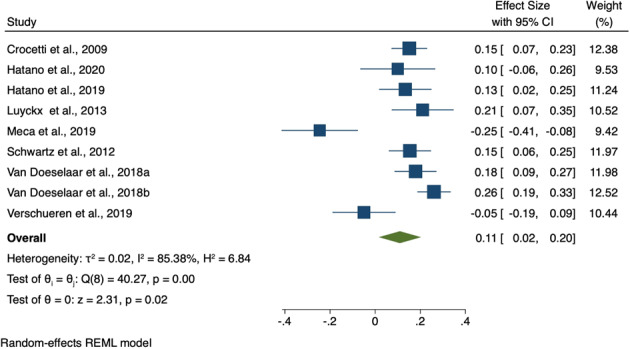
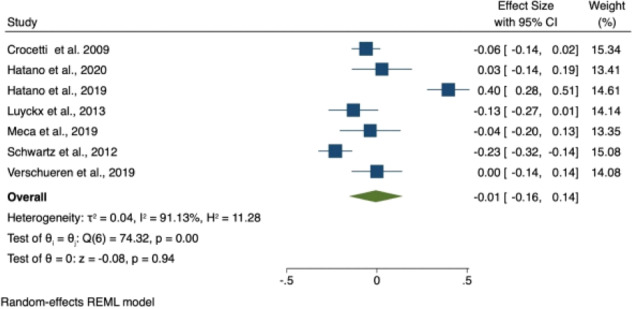
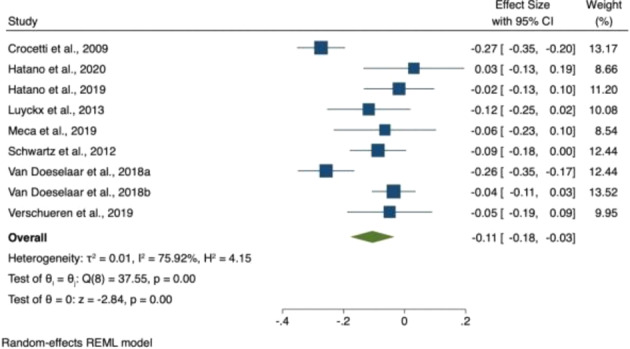
- Meta-analyses of 9 studies found a significant increase in identity synthesis over time (SMD = 0.11; 95% CI 0.02–0.20; p = 0.02) and a significant decrease in depression and anxiety symptoms over time (SMD = −0.11; 95% CI −0.18 to −0.03; p = 0.005), but no significant change in identity confusion (SMD = −0.01; 95% CI −0.16 to 0.14; p = 0.94).
- Meta-regressions found no statistically significant predictors of change in identity synthesis or depression and anxiety symptoms, and the meta-analyses indicated no significant associations between identity synthesis or confusion and anxiety or depression symptoms.
Methods
- Systematic review conducted according to PRISMA; PsycInfo, Medline, and Embase were searched from inception until 22 June 2021, supplemented by internet and reference-list hand-searches.
- Inclusion criteria required longitudinal quantitative studies using (neo)Eriksonian identity measures and measures of social-emotional disorder symptoms, with at least 95% of samples aged 10–30 years; non-English studies and gray literature were excluded.
- Findings were narratively synthesized; study quality was appraised with the Newcastle Ottawa Scale; meta-analyses and meta-regressions were conducted in Stata/SE 16.0 using random-effects models and standardized mean differences.
Limitations
- The paper states that gray literature and non-English studies were excluded, studies were predominantly from the Netherlands and the United States, and most included studies were only of fair quality with shortfalls in selection, comparability, and outcome measurement (e.g., self-report questionnaires, <70% retention).
- The paper states that meta-analyses could not include all identified studies due to heterogeneity, included multiple publications from the same cohort, and may have been underpowered for meta-regression with only nine studies.
- Evident from the text: no included studies assessed the efficacy of identity-focused clinical interventions, only three studies focused on eating disorder symptoms, and a meta-analysis of eating disorder symptoms was not possible due to insufficient data.
Model-written summary. Check it against the paper before relying on it.
Integrity signals
Registry
Cites
Statistics
Figures
Verification
Claims the paper makes
27 Own result · 20 Own method · 17 No full text of the sources · 12 Sources not found · 10 Partly supported · 5 Own interpretation · 5 No basis given · 3 Supported · accuracy not yet measured
Every source the paper cites for this claim was checked and supports it.
In the paper
“There was no prospective association between identity confusion and drive for thinness.”
§ Identity Development and Social-Emotional Disorders During Adolescence and Emerging Adulthood: A Systematic Review and Meta-Analysis > Results > Narrative Synthesis
What the sources say
- Supportedcites Verschueren et al., 2018 source
The Discussion states that, in the cross-lagged models, drive for thinness was not related to identity confusion over time. This supports the claim of no prospective association in the adolescents studied. (LLM, conf=0.94)
plain- Asserted: passes — The authors put it forward as true.
- Checkable: passes — It can be checked against evidence.
- Load-bearing: unclear — It is unclear whether the paper’s conclusions depend on it.
- Based: passes — The paper gives a reason why it holds.
- Supported
Every source the paper cites for this claim was checked and supports it.
In the paper
“This study found that a “high risk” eating disorder symptom trajectory (i.e., normal BMI + high levels of eating disorder symptoms) had higher levels of identity confusion compared to “low risk” groups”
§ Identity Development and Social-Emotional Disorders During Adolescence and Emerging Adulthood: A Systematic Review and Meta-Analysis > Results > Narrative Synthesis
What the sources say
- Supportedcites Verschueren et al. 2019 source
The Trajectory Classes section identifies girls’ Class 1 as normal BMI/high symptoms and Classes 2 and 3 as normal BMI/low symptoms and low BMI/low symptoms. The Discussion reports that the classes with the highest eating-disorder symptoms experienced the most identity confusion, supporting the comparison attributed to this study. Page numbers were not available in our copy. (LLM, conf=0.86)
plaincorrelational- Asserted: passes — The authors put it forward as true.
- Checkable: passes — It can be checked against evidence.
- Load-bearing: unclear — It is unclear whether the paper’s conclusions depend on it.
- Based: passes — The paper gives a reason why it holds.
- Supported
The cited sources support only part of this claim — read each source’s verdict below.
In the paper
“High identity synthesis also predicted low eating disorders symptoms (body dissatisfaction; bulimia; drive for thinness) and high identity confusion predicted high body dissatisfaction and bulimia one and two years later, with small effect sizes.”
§ Identity Development and Social-Emotional Disorders During Adolescence and Emerging Adulthood: A Systematic Review and Meta-Analysis > Results > Narrative Synthesis
What the sources say
- Partly supportedcites Verschueren et al., 2018 sourceExperimental — accuracy not yet measured
The Results section, “Directionality of Effects Linking Identity Formation and ED Symptomatology” (page unavailable), reports that identity confusion positively predicted body dissatisfaction and bulimia symptoms over time in a study with three annual measurements. The reported cross-lagged paths link consecutive measurements; our copy does not establish a separate prediction two years later or document the claimed small effect sizes. (LLM, conf=0.82)
plaindirect- Asserted: passes — The authors put it forward as true.
- Checkable: passes — It can be checked against evidence.
- Load-bearing: passes — The paper’s conclusions depend on it.
- Based: passes — The paper gives a reason why it holds.
- Partly supported
Every source the paper cites for this claim was checked and supports it.
In the paper
“identity synthesis and confusion predicted eating disorder symptoms one and two years later”
§ Identity Development and Social-Emotional Disorders During Adolescence and Emerging Adulthood: A Systematic Review and Meta-Analysis > Results > Narrative Synthesis
What the sources say
- Supportedcites Verschueren et al., 2021 source
The Results section reports that identity synthesis predicted relative decreases, and identity confusion relative increases, in eating disorder symptomatology over time. The Methods section describes three annual measurement points in Flanders, Belgium, with participants aged 10–21. The reported predictions are across successive one-year intervals within a two-year study, rather than a separately reported direct two-year prediction. (LLM, conf=0.87)
plaindirect- Asserted: passes — The authors put it forward as true.
- Checkable: passes — It can be checked against evidence.
- Load-bearing: unclear — It is unclear whether the paper’s conclusions depend on it.
- Based: passes — The paper gives a reason why it holds.
- Supported
The cited sources support only part of this claim — read each source’s verdict below.
In the paper
“one of these studies found that high depression and anxiety symptoms did predict higher identity confusion”
§ Identity Development and Social-Emotional Disorders During Adolescence and Emerging Adulthood: A Systematic Review and Meta-Analysis > Results > Depression and anxiety symptoms
What the sources say
- Partly supportedcites Hatano et al., 2020 sourceExperimental — accuracy not yet measured
The ‘Identity Processes, Trajectories, and Their Associations’ section identifies anxiety and depression as internalizing problems. The ‘Relations Among Identity Trajectories, Subjective Well-Being, and Psychosocial Problems’ section reports an association between internalizing problems and moratorium identity trajectories. It does not report that depression and anxiety symptoms predicted later identity confusion; the paper analyzes associations with identity trajectories, not that directional prediction. (LLM, conf=0.83)
plaindirect- Asserted: passes — The authors put it forward as true.
- Checkable: passes — It can be checked against evidence.
- Load-bearing: unclear — It is unclear whether the paper’s conclusions depend on it.
- Based: passes — The paper gives a reason why it holds.
- Partly supported
The cited sources support only part of this claim — read each source’s verdict below.
In the paper
“High identity synthesis also predicted low eating disorders symptoms (body dissatisfaction; bulimia; drive for thinness) and high identity confusion predicted high body dissatisfaction and bulimia one and two years later, with small effect sizes.”
§ Identity Development and Social-Emotional Disorders During Adolescence and Emerging Adulthood: A Systematic Review and Meta-Analysis > Results > Narrative Synthesis
What the sources say
- Partly supportedcites Verschueren et al., 2018 sourceExperimental — accuracy not yet measured
The Results section (‘Directionality of Effects Linking Identity Formation and ED Symptomatology’; page unavailable) says identity synthesis negatively predicted all three eating-disorder symptoms over time. The Methods describe successive one-year cross-lagged paths across three annual measurements, but the cited passages do not establish a direct prediction two years later or characterize these effects as small. (LLM, conf=0.84)
plaindirect- Asserted: passes — The authors put it forward as true.
- Checkable: passes — It can be checked against evidence.
- Load-bearing: passes — The paper’s conclusions depend on it.
- Based: passes — The paper gives a reason why it holds.
- Partly supported
The cited sources support only part of this claim — read each source’s verdict below.
In the paper
“one found no such effect”
§ Identity Development and Social-Emotional Disorders During Adolescence and Emerging Adulthood: A Systematic Review and Meta-Analysis > Results > Depression and anxiety symptoms
What the sources say
- Partly supportedcites Hatano et al., 2020 sourceExperimental — accuracy not yet measured
Table 6 (presented under Conclusion; page unavailable) shows no significant association between the reported identity trajectories and change in internalizing problems, which partly supports a claim about no effect over time. But the paper does not report a separate result for depressive symptoms or measure an 'elevated identity confusion' group; its Results section also reports that moratorium trajectories were positively associated with the level of internalizing problems. (LLM, conf=0.78)
plain- Asserted: passes — The authors put it forward as true.
- Checkable: passes — It can be checked against evidence.
- Load-bearing: unclear — It is unclear whether the paper’s conclusions depend on it.
- Based: passes — The paper gives a reason why it holds.
- Partly supported
The cited sources support only part of this claim — read each source’s verdict below.
In the paper
“within-person increases in depressive symptoms were associated with decreases in identity synthesis and increases in identity confusion six months later during adolescence, with small effect sizes”
§ Identity Development and Social-Emotional Disorders During Adolescence and Emerging Adulthood: A Systematic Review and Meta-Analysis > Results > Depression and anxiety symptoms
What the sources say
- Partly supportedcites Meca et al., 2019 sourceExperimental — accuracy not yet measured
The Results (Establishing Directional Effects; page unavailable) report within-person associations in the claimed directions: higher depressive symptoms predicted lower identity coherence and higher identity confusion at the next analyzed wave, with standardized coefficients of −0.162 and 0.276. But the Methods (Procedure; page unavailable) state that these analyses used waves 12 months apart, not six months apart. The paper measures identity coherence rather than a variable named identity synthesis, and its sample was recently immigrated Hispanic adolescents. (LLM, conf=0.92)
plaincorrelational- Asserted: passes — The authors put it forward as true.
- Checkable: passes — It can be checked against evidence.
- Load-bearing: unclear — It is unclear whether the paper’s conclusions depend on it.
- Based: passes — The paper gives a reason why it holds.
- Partly supported
The cited sources support only part of this claim — read each source’s verdict below.
In the paper
“There was some evidence that depression, anxiety and eating disorder symptoms impact identity development, such that elevated symptoms were associated with identity development difficulties (i.e., low identity synthesis/high identity confusion) later in adolescence (Hatano et al., 2020; Schwartz et al., 2012; van Doeselaar et al., 2018; Verschueren et al., 2018; Verschueren et al., 2021).”
§ Identity Development and Social-Emotional Disorders During Adolescence and Emerging Adulthood: A Systematic Review and Meta-Analysis > Discussion > Narrative Synthesis
What the sources say
- Partly supportedcites Hatano et al., 2020 sourceExperimental — accuracy not yet measured
Split into 2 atoms — 0 confirmed, 2 partially supported, 0 disputed, 0 misattributed, 0 unverifiable. Expand the claim to see per-atom verdicts.
- Not checked — no full text of the sourcecites Schwartz et al., 2012 source
- Not checked — no full text of the sourcecites van Doeselaar et al., 2018 source
hedgedcorrelational- Asserted: passes — The authors put it forward as true.
- Checkable: passes — It can be checked against evidence.
- Load-bearing: passes — The paper’s conclusions depend on it.
- Based: passes — The paper gives a reason why it holds.
- Partly supported
The cited sources support only part of this claim — read each source’s verdict below.
In the paper
“Several studies found evidence for an overlap between identity development and depression and anxiety symptoms, such that adolescents and emerging adults in identity development trajectories characterized by high synthesis and low confusion had fewer depression and anxiety symptoms than those in identity development trajectories characterized by low synthesis and high confusion (Becht et al., 2016”
§ Identity Development and Social-Emotional Disorders During Adolescence and Emerging Adulthood: A Systematic Review and Meta-Analysis > Discussion > Narrative Synthesis
What the sources say
- Not checked — no full text of the sourcecites Becht et al., 2016 source
- Not checked — no full text of the sourcecites Crocetti et al., 2009 source
- Partly supportedcites Hatano et al., 2020 sourceExperimental — accuracy not yet measured
Split into 2 atoms — 0 confirmed, 2 partially supported, 0 disputed, 0 misattributed, 0 unverifiable. Expand the claim to see per-atom verdicts.
plaincorrelational- Asserted: passes — The authors put it forward as true.
- Checkable: passes — It can be checked against evidence.
- Load-bearing: passes — The paper’s conclusions depend on it.
- Based: passes — The paper gives a reason why it holds.
- It may state two separate claims as one. 32
- Probably not a substantial claim. 33
The cited sources support only part of this claim — read each source’s verdict below.
In the paper
“They found that high body dissatisfaction and bulimia symptoms (but not drive for thinness) predicted lower identity synthesis and higher identity confusion one and two years later amongst Dutch adolescents, with small effect sizes.”
§ Identity Development and Social-Emotional Disorders During Adolescence and Emerging Adulthood: A Systematic Review and Meta-Analysis > Results > Narrative Synthesis
What the sources say
- Partly supportedcites Verschueren et al., 2018 sourceExperimental — accuracy not yet measured
The Results (Directionality of Effects Linking Identity Formation and ED Symptomatology) report that body dissatisfaction and bulimia symptoms predicted lower identity synthesis and higher identity confusion across successive annual measurements; the Discussion says drive for thinness did not show the same pattern. But Participants and Procedure identifies the students as Flemish adolescents in Dutch-speaking Belgium, not adolescents in the Netherlands. The models test one-year cross-lagged paths over a two-year study, rather than a distinct prediction two years later, and the cited passages do not establish the claimed small effect sizes. (LLM, conf=0.89)
plaindirect- Asserted: passes — The authors put it forward as true.
- Checkable: passes — It can be checked against evidence.
- Load-bearing: unclear — It is unclear whether the paper’s conclusions depend on it.
- Based: passes — The paper gives a reason why it holds.
It may state two separate claims as one.
- Partly supported
The cited sources support only part of this claim — read each source’s verdict below.
In the paper
“within-person increases in identity synthesis were associated with decreases in depressive symptoms six months later – with a small effect size – during adolescence, but there was no effect of identity confusion”
§ Identity Development and Social-Emotional Disorders During Adolescence and Emerging Adulthood: A Systematic Review and Meta-Analysis > Results > Depression and anxiety symptoms
What the sources say
- Partly supportedcites Meca et al., 2019 sourceExperimental — accuracy not yet measured
The Results (Establishing Directional Effects; page unavailable) report that higher-than-usual identity coherence predicted lower depressive symptoms at the next wave (β = −0.164), while the Discussion says identity confusion did not predict subsequent depressive symptoms. However, Methods (Procedure; page unavailable) specifies that the analyses used waves 12 months apart, not six months apart. The finding also concerns recently immigrated Hispanic adolescents, rather than adolescents generally. (LLM, conf=0.91)
plaincorrelational- Asserted: passes — The authors put it forward as true.
- Checkable: passes — It can be checked against evidence.
- Load-bearing: fails — The paper’s conclusions may not depend on it.
- Based: passes — The paper gives a reason why it holds.
Probably not a substantial claim. The paper’s conclusions may not depend on it. It may state two separate claims as one.
- Partly supported
The cited sources support only part of this claim — read each source’s verdict below.
In the paper
“Visual inspection of the forest plot suggests that two studies - by the same research group, and drawing participants from the same cohort - found effects in the opposite direction to the other studies (i.e., increasing identity confusion), driving this counter-intuitive finding (Hatano et al., 2019; Hatano et al., 2020).”
§ Identity Development and Social-Emotional Disorders During Adolescence and Emerging Adulthood: A Systematic Review and Meta-Analysis > Discussion > Meta-analyses
What the sources say
- Partly supportedcites Hatano et al., 2019 sourceExperimental — accuracy not yet measured
Split into 2 atoms — 0 confirmed, 2 partially supported, 0 disputed, 0 misattributed, 0 unverifiable. Expand the claim to see per-atom verdicts.
- Partly supportedcites Hatano et al., 2020 sourceExperimental — accuracy not yet measured
Split into 2 atoms — 0 confirmed, 2 partially supported, 0 disputed, 0 misattributed, 0 unverifiable. Expand the claim to see per-atom verdicts.
hedgeddirect- Asserted: passes — The authors put it forward as true.
- Checkable: passes — It can be checked against evidence.
- Load-bearing: passes — The paper’s conclusions depend on it.
- Based: passes — The paper gives a reason why it holds.
It may state two separate claims as one.
- Partly supported
A result the paper reports from its own data — it cites no other source for it, so there is none to check. The quote shows it is in the paper.
In the paper
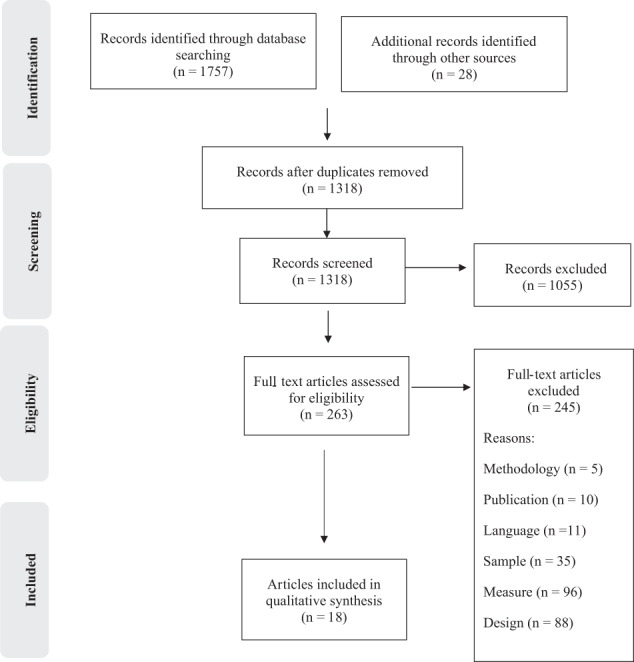
“The review therefore included a total of 18 articles, reporting 20 studies.”
§ Identity Development and Social-Emotional Disorders During Adolescence and Emerging Adulthood: A Systematic Review and Meta-Analysis > Results > Study Selection and Characteristics
plain- Asserted: passes — The authors put it forward as true.
- Checkable: passes — It can be checked against evidence.
- Load-bearing: fails — The paper’s conclusions may not depend on it.
- Based: passes — The paper gives a reason why it holds.
Probably not a substantial claim. The paper’s conclusions may not depend on it. It may state two separate claims as one.
A result the paper reports from its own data — it cites no other source for it, so there is none to check. The quote shows it is in the paper.
In the paper
“The systematic search yielded a total of 1318 records following deduplication.”
§ Identity Development and Social-Emotional Disorders During Adolescence and Emerging Adulthood: A Systematic Review and Meta-Analysis > Results > Study Selection and Characteristics
plain- Asserted: passes — The authors put it forward as true.
- Checkable: passes — It can be checked against evidence.
- Load-bearing: fails — The paper’s conclusions may not depend on it.
- Based: passes — The paper gives a reason why it holds.
Probably not a substantial claim. The paper’s conclusions may not depend on it.
The paper states this without a source or data behind it here, so there is nothing to check it against. The quote shows it is in the paper.
In the paper
“All studies used self-report measures of both identity development and mental health problems.”
§ Identity Development and Social-Emotional Disorders During Adolescence and Emerging Adulthood: A Systematic Review and Meta-Analysis > Results > Characteristics of Included Studies
plain- Asserted: passes — The authors put it forward as true.
- Checkable: passes — It can be checked against evidence.
- Load-bearing: fails — The paper’s conclusions may not depend on it.
- Based: passes — The paper gives a reason why it holds.
Probably not a substantial claim. The paper’s conclusions may not depend on it.
A result the paper reports from its own data — it cites no other source for it, so there is none to check. The quote shows it is in the paper.
In the paper
“seven studies (35.0%) included both adolescents and emerging adult participants (range: 10–24 years)”
§ Identity Development and Social-Emotional Disorders During Adolescence and Emerging Adulthood: A Systematic Review and Meta-Analysis > Results > Characteristics of Included Studies
plain- Asserted: passes — The authors put it forward as true.
- Checkable: passes — It can be checked against evidence.
- Load-bearing: fails — The paper’s conclusions may not depend on it.
- Based: passes — The paper gives a reason why it holds.
Probably not a substantial claim. The paper’s conclusions may not depend on it.
In the paper
“one study found that this pertained to school-related anxiety symptoms only, and not social and generalized anxiety”
§ Identity Development and Social-Emotional Disorders During Adolescence and Emerging Adulthood: A Systematic Review and Meta-Analysis > Results > Depression and anxiety symptoms
What the sources say
- Not matchedcites Crocetti et al., 2009; Nelemans et al., 2014
Couldn’t be matched to a paper in Crossref, so it can’t be checked.
plaincorrelational- Asserted: passes — The authors put it forward as true.
- Checkable: passes — It can be checked against evidence.
- Load-bearing: unclear — It is unclear whether the paper’s conclusions depend on it.
- Based: passes — The paper gives a reason why it holds.
It may state two separate claims as one.
- Not matched
A result the paper reports from its own data — it cites no other source for it, so there is none to check. The quote shows it is in the paper.
In the paper
“1300 articles were excluded as not relevant”
§ Identity Development and Social-Emotional Disorders During Adolescence and Emerging Adulthood: A Systematic Review and Meta-Analysis > Results > Study Selection and Characteristics
plain- Asserted: passes — The authors put it forward as true.
- Checkable: passes — It can be checked against evidence.
- Load-bearing: fails — The paper’s conclusions may not depend on it.
- Based: passes — The paper gives a reason why it holds.
Probably not a substantial claim. The paper’s conclusions may not depend on it.
A result the paper reports from its own data — it cites no other source for it, so there is none to check. The quote shows it is in the paper.
In the paper
“Studies include a total of 13,787 participants, and all were nonclinical, community-based samples.”
§ Identity Development and Social-Emotional Disorders During Adolescence and Emerging Adulthood: A Systematic Review and Meta-Analysis > Results > Characteristics of Included Studies
plainn = 13,787- Asserted: passes — The authors put it forward as true.
- Checkable: passes — It can be checked against evidence.
- Load-bearing: unclear — It is unclear whether the paper’s conclusions depend on it.
- Based: passes — The paper gives a reason why it holds.
It may state two separate claims as one.
A result the paper reports from its own data — it cites no other source for it, so there is none to check. The quote shows it is in the paper.
In the paper
“Three studies (15.0%) focused on eating disorder symptoms; the remainder measured depression and anxiety symptoms.”
§ Identity Development and Social-Emotional Disorders During Adolescence and Emerging Adulthood: A Systematic Review and Meta-Analysis > Results > Characteristics of Included Studies
plain- Asserted: passes — The authors put it forward as true.
- Checkable: passes — It can be checked against evidence.
- Load-bearing: fails — The paper’s conclusions may not depend on it.
- Based: passes — The paper gives a reason why it holds.
Probably not a substantial claim. The paper’s conclusions may not depend on it. It may state two separate claims as one.
A result the paper reports from its own data — it cites no other source for it, so there is none to check. The quote shows it is in the paper.
In the paper
“20 studies (55% “fair” quality, 45% “poor” quality) were identified, including 13,787 participants (54.2% female, mean age = 14.48 years, range 10–29 years).”
§ Identity Development and Social-Emotional Disorders During Adolescence and Emerging Adulthood: A Systematic Review and Meta-Analysis > Abstract
plainn = 13,787- Asserted: passes — The authors put it forward as true.
- Checkable: passes — It can be checked against evidence.
- Load-bearing: unclear — It is unclear whether the paper’s conclusions depend on it.
- Based: passes — The paper gives a reason why it holds.
It may state two separate claims as one.
A result the paper reports from its own data — it cites no other source for it, so there is none to check. The quote shows it is in the paper.
In the paper
“one study (5.0%) emerging adults only (range: 17–29 years)”
§ Identity Development and Social-Emotional Disorders During Adolescence and Emerging Adulthood: A Systematic Review and Meta-Analysis > Results > Characteristics of Included Studies
plain- Asserted: passes — The authors put it forward as true.
- Checkable: passes — It can be checked against evidence.
- Load-bearing: fails — The paper’s conclusions may not depend on it.
- Based: passes — The paper gives a reason why it holds.
Probably not a substantial claim. The paper’s conclusions may not depend on it.
A result the paper reports from its own data — it cites no other source for it, so there is none to check. The quote shows it is in the paper.
In the paper
“As only two studies reported data on eating disorder symptoms, it was not possible to conduct a meta-analysis of change in eating disorder symptoms due to insufficient data.”
§ Identity Development and Social-Emotional Disorders During Adolescence and Emerging Adulthood: A Systematic Review and Meta-Analysis > Methods > Meta-analyses and Meta-regression
plain- Asserted: passes — The authors put it forward as true.
- Checkable: passes — It can be checked against evidence.
- Load-bearing: passes — The paper’s conclusions depend on it.
- Based: passes — The paper gives a reason why it holds.
It may state two separate claims as one.
The paper states this without a source or data behind it here, so there is nothing to check it against. The quote shows it is in the paper.
In the paper
“As sufficient data were not available to standardize baseline identity and depression/anxiety scores, only studies who provided raw baseline scores on the same continuous measure (i.e., the same scale) were able to be included in these continuous predictors.”
§ Identity Development and Social-Emotional Disorders During Adolescence and Emerging Adulthood: A Systematic Review and Meta-Analysis > Methods > Meta-analyses and Meta-regression
plainn = 4- Asserted: passes — The authors put it forward as true.
- Checkable: passes — It can be checked against evidence.
- Load-bearing: passes — The paper’s conclusions depend on it.
- Based: passes — The paper gives a reason why it holds.
Probably not a substantial claim. It may state two separate claims as one.
In the paper
“high identity synthesis predicted lower depressive symptoms in adolescents but found no such effect for anxiety disorder symptoms”
§ Identity Development and Social-Emotional Disorders During Adolescence and Emerging Adulthood: A Systematic Review and Meta-Analysis > Results > Depression and anxiety symptoms
What the sources say
- Not checked — no full text of the sourcecites Schwartz et al., 2012 source
plaindirect- Asserted: passes — The authors put it forward as true.
- Checkable: passes — It can be checked against evidence.
- Load-bearing: passes — The paper’s conclusions depend on it.
- Based: passes — The paper gives a reason why it holds.
It may state two separate claims as one.
The paper states this without a source or data behind it here, so there is nothing to check it against. The quote shows it is in the paper.
In the paper
“Data on change in depression and anxiety symptoms and identity synthesis and confusion over time (i.e., standardized mean difference—mean scores at follow-up minus mean scores at baseline, divided by the pooled pretest standard deviation) were available for all studies.”
§ Identity Development and Social-Emotional Disorders During Adolescence and Emerging Adulthood: A Systematic Review and Meta-Analysis > Methods > Meta-analyses and Meta-regression
plain- Asserted: passes — The authors put it forward as true.
- Checkable: passes — It can be checked against evidence.
- Load-bearing: passes — The paper’s conclusions depend on it.
- Based: passes — The paper gives a reason why it holds.
Probably not a substantial claim.
A result the paper reports from its own data — it cites no other source for it, so there is none to check. The quote shows it is in the paper.
In the paper
“Just two studies reporting the required data used a measure of anxiety only, and several studies assessed anxiety and depression as a composite. For this reason, change in depression and anxiety symptoms were examined together, rather than in separate meta-analyses.”
§ Identity Development and Social-Emotional Disorders During Adolescence and Emerging Adulthood: A Systematic Review and Meta-Analysis > Methods > Meta-analyses and Meta-regression
plain- Asserted: passes — The authors put it forward as true.
- Checkable: passes — It can be checked against evidence.
- Load-bearing: passes — The paper’s conclusions depend on it.
- Based: passes — The paper gives a reason why it holds.
It may state two separate claims as one.
In the paper
“Three studies (reported in two publications) found no evidence for an effect of within-person change in identity synthesis but did find such an effect for identity confusion in adolescents and emerging adults”
§ Identity Development and Social-Emotional Disorders During Adolescence and Emerging Adulthood: A Systematic Review and Meta-Analysis > Results > Depression and anxiety symptoms
What the sources say
- Not matchedcites Becht et al., 2019; Hatano et al., 2020
Couldn’t be matched to a paper in Crossref, so it can’t be checked.
plain- Asserted: passes — The authors put it forward as true.
- Checkable: passes — It can be checked against evidence.
- Load-bearing: unclear — It is unclear whether the paper’s conclusions depend on it.
- Based: passes — The paper gives a reason why it holds.
It may state two separate claims as one.
- Not matched
A result the paper reports from its own data — it cites no other source for it, so there is none to check. The quote shows it is in the paper.
In the paper
“The trim and fill correction was performed and pooled effect sizes were converted to an exponential form, with key findings for change in identity synthesis (SMD = 0.11; 95% CI: 0.01–0.203) and depression and anxiety symptoms (SMD = −0.132; 95% CI: −0.201 to −0.06) remaining statistically significant.”
§ Identity Development and Social-Emotional Disorders During Adolescence and Emerging Adulthood: A Systematic Review and Meta-Analysis > Results > Sensitivity Analysis
plain- Asserted: passes — The authors put it forward as true.
- Checkable: passes — It can be checked against evidence.
- Load-bearing: passes — The paper’s conclusions depend on it.
- Based: passes — The paper gives a reason why it holds.
It may state two separate claims as one.
A result the paper reports from its own data — it cites no other source for it, so there is none to check. The quote shows it is in the paper.
In the paper
“The Egger test indicated small study effects within the identity synthesis meta-analysis (t = −5.61, p = 0.00), but not in the identity confusion (t = 1.50, p = 0.77) and depression and anxiety symptoms (t = 2.93, p = 0.16) meta-analyses.”
§ Identity Development and Social-Emotional Disorders During Adolescence and Emerging Adulthood: A Systematic Review and Meta-Analysis > Results > Sensitivity Analysis
hedged- Asserted: passes — The authors put it forward as true.
- Checkable: passes — It can be checked against evidence.
- Load-bearing: unclear — It is unclear whether the paper’s conclusions depend on it.
- Based: passes — The paper gives a reason why it holds.
It may state two separate claims as one.
In the paper
“Preliminary evidence indicated that effects may differ according to identity domain (i.e., depressive symptoms associated with later educational synthesis, but not interpersonal synthesis) (van Doeselaar et al., 2018).”
§ Identity Development and Social-Emotional Disorders During Adolescence and Emerging Adulthood: A Systematic Review and Meta-Analysis > Discussion > Narrative Synthesis
What the sources say
- Not checked — no full text of the sourcecites van Doeselaar et al., 2018 source
hedgedcorrelational- Asserted: passes — The authors put it forward as true.
- Checkable: passes — It can be checked against evidence.
- Load-bearing: unclear — It is unclear whether the paper’s conclusions depend on it.
- Based: passes — The paper gives a reason why it holds.
It may state two separate claims as one.
What the paper did — it cites no source for this, so there is none to check. The quote shows it is in the paper.
In the paper
“The quality of included studies was independently appraised by two reviewers (RP and AA) using the Newcastle Ottawa Quality Assessment Scale (NOS)”
§ Identity Development and Social-Emotional Disorders During Adolescence and Emerging Adulthood: A Systematic Review and Meta-Analysis > Methods > Quality Assessment
plain- Asserted: passes — The authors put it forward as true.
- Checkable: passes — It can be checked against evidence.
- Load-bearing: passes — The paper’s conclusions depend on it.
- Based: passes — The paper gives a reason why it holds.
Probably not a substantial claim.
In the paper
“suggested that these disorders might be conceptualized collectively as “social-emotional disorders”, and may share etiological and maintenance factors (Rapee et al., 2019).”
§ Identity Development and Social-Emotional Disorders During Adolescence and Emerging Adulthood: A Systematic Review and Meta-Analysis > Introduction
What the sources say
- Not checked — no full text of the sourcecites Rapee et al., 2019 source
hedgedcorrelational- Asserted: passes — The authors put it forward as true.
- Checkable: passes — It can be checked against evidence.
- Load-bearing: passes — The paper’s conclusions depend on it.
- Based: passes — The paper gives a reason why it holds.
Probably not a substantial claim. It may state two separate claims as one.
What the paper did — it cites no source for this, so there is none to check. The quote shows it is in the paper.
In the paper
“Ratings were compared between reviewers and consensus achieved through discussion.”
§ Identity Development and Social-Emotional Disorders During Adolescence and Emerging Adulthood: A Systematic Review and Meta-Analysis > Methods > Quality Assessment
plain- Asserted: passes — The authors put it forward as true.
- Checkable: passes — It can be checked against evidence.
- Load-bearing: fails — The paper’s conclusions may not depend on it.
- Based: passes — The paper gives a reason why it holds.
Probably not a substantial claim. The paper’s conclusions may not depend on it. It may state two separate claims as one.
In the paper
“The scale’s inter–rater reliability has been found to range from fair to high depending on the types of studies assessed and the raters (Hartling et al., 2013; Oremus et al., 2012).”
§ Identity Development and Social-Emotional Disorders During Adolescence and Emerging Adulthood: A Systematic Review and Meta-Analysis > Methods > Quality Assessment
What the sources say
- Not matchedcites Hartling et al., 2013; Oremus et al., 2012
Couldn’t be matched to a paper in Crossref, so it can’t be checked.
plaincorrelational- Asserted: passes — The authors put it forward as true.
- Checkable: passes — It can be checked against evidence.
- Load-bearing: fails — The paper’s conclusions may not depend on it.
- Based: passes — The paper gives a reason why it holds.
Probably not a substantial claim. The paper’s conclusions may not depend on it.
- Not matched
In the paper
“It proposes that successful identity development involves moving from a state of predominant “identity confusion” (i.e., a sense of inconsistency or uncertainty in one’s idea of oneself) towards “identity synthesis””
§ Identity Development and Social-Emotional Disorders During Adolescence and Emerging Adulthood: A Systematic Review and Meta-Analysis > Introduction
What the sources say
- Not matchedcites Erikson, 1950
Couldn’t be matched to a paper in Crossref, so it can’t be checked.
plaindirect- Asserted: passes — The authors put it forward as true.
- Checkable: passes — It can be checked against evidence.
- Load-bearing: passes — The paper’s conclusions depend on it.
- Based: passes — The paper gives a reason why it holds.
Probably not a substantial claim.
- Not matched
What the paper did — it cites no source for this, so there is none to check. The quote shows it is in the paper.
In the paper
“Prior to study selection, eligibility criteria were specified”
§ Identity Development and Social-Emotional Disorders During Adolescence and Emerging Adulthood: A Systematic Review and Meta-Analysis > Methods > Selection Process
plain- Asserted: passes — The authors put it forward as true.
- Checkable: passes — It can be checked against evidence.
- Load-bearing: fails — The paper’s conclusions may not depend on it.
- Based: passes — The paper gives a reason why it holds.
Probably not a substantial claim. The paper’s conclusions may not depend on it.
What the paper did — it cites no source for this, so there is none to check. The quote shows it is in the paper.
In the paper
“Two reviewers (RP, AA) independently screened the titles and abstracts of retrieved articles.”
§ Identity Development and Social-Emotional Disorders During Adolescence and Emerging Adulthood: A Systematic Review and Meta-Analysis > Methods > Selection Process
plain- Asserted: passes — The authors put it forward as true.
- Checkable: passes — It can be checked against evidence.
- Load-bearing: fails — The paper’s conclusions may not depend on it.
- Based: passes — The paper gives a reason why it holds.
Probably not a substantial claim. The paper’s conclusions may not depend on it.
What the paper did — it cites no source for this, so there is none to check. The quote shows it is in the paper.
In the paper
“Discrepancies between the reviewers’ decisions were resolved through discussion.”
§ Identity Development and Social-Emotional Disorders During Adolescence and Emerging Adulthood: A Systematic Review and Meta-Analysis > Methods > Selection Process
plain- Asserted: passes — The authors put it forward as true.
- Checkable: passes — It can be checked against evidence.
- Load-bearing: fails — The paper’s conclusions may not depend on it.
- Based: passes — The paper gives a reason why it holds.
Probably not a substantial claim. The paper’s conclusions may not depend on it.
What the paper did — it cites no source for this, so there is none to check. The quote shows it is in the paper.
In the paper
“No third-party was consulted.”
§ Identity Development and Social-Emotional Disorders During Adolescence and Emerging Adulthood: A Systematic Review and Meta-Analysis > Methods > Selection Process
plain- Asserted: passes — The authors put it forward as true.
- Checkable: passes — It can be checked against evidence.
- Load-bearing: fails — The paper’s conclusions may not depend on it.
- Based: passes — The paper gives a reason why it holds.
Probably not a substantial claim. The paper’s conclusions may not depend on it.
In the paper
““Exploration” (i.e., trying various identity options) and “commitment” (i.e., selecting identity options) were later proposed as the key processes underpinning identity confusion and synthesis (Marcia, 1966).”
§ Identity Development and Social-Emotional Disorders During Adolescence and Emerging Adulthood: A Systematic Review and Meta-Analysis > Introduction
What the sources say
- Not checked — no full text of the sourcecites Marcia, 1966 source
plaindirect- Asserted: passes — The authors put it forward as true.
- Checkable: passes — It can be checked against evidence.
- Load-bearing: passes — The paper’s conclusions depend on it.
- Based: passes — The paper gives a reason why it holds.
Probably not a substantial claim.
What the paper did — it cites no source for this, so there is none to check. The quote shows it is in the paper.
In the paper
“One reviewer (RP) extracted data concerning sample characteristics, measures and main findings from the included articles using a prepiloted data form. These data were independently checked (i.e., extracted data were compared to those reported in the included articles) by a second reviewer (AA).”
§ Identity Development and Social-Emotional Disorders During Adolescence and Emerging Adulthood: A Systematic Review and Meta-Analysis > Methods > Data Extraction
plain- Asserted: passes — The authors put it forward as true.
- Checkable: passes — It can be checked against evidence.
- Load-bearing: fails — The paper’s conclusions may not depend on it.
- Based: passes — The paper gives a reason why it holds.
Probably not a substantial claim. The paper’s conclusions may not depend on it. It may state two separate claims as one.
In the paper
“This scale was developed to assess the quality of nonrandomized studies in systematic reviews and meta-analyses and is recommended for use by the Cochrane Collaboration (Higgins et al., 2019).”
§ Identity Development and Social-Emotional Disorders During Adolescence and Emerging Adulthood: A Systematic Review and Meta-Analysis > Methods > Quality Assessment
What the sources say
- Not matchedcites Higgins et al., 2019
Couldn’t be matched to a paper in Crossref, so it can’t be checked.
plain- Asserted: passes — The authors put it forward as true.
- Checkable: passes — It can be checked against evidence.
- Load-bearing: fails — The paper’s conclusions may not depend on it.
- Based: passes — The paper gives a reason why it holds.
Probably not a substantial claim. The paper’s conclusions may not depend on it. It may state two separate claims as one.
- Not matched
In the paper
“Based on levels of past and current exploration and commitment, individuals can be categorized into four discrete identity statuses: “diffusion”; “moratorium”; “foreclosure” and “achievement” (Marcia, 1966).”
§ Identity Development and Social-Emotional Disorders During Adolescence and Emerging Adulthood: A Systematic Review and Meta-Analysis > Introduction
What the sources say
- Not checked — no full text of the sourcecites Marcia, 1966 source
plain- Asserted: passes — The authors put it forward as true.
- Checkable: passes — It can be checked against evidence.
- Load-bearing: fails — The paper’s conclusions may not depend on it.
- Based: passes — The paper gives a reason why it holds.
Probably not a substantial claim. The paper’s conclusions may not depend on it.
In the paper
“A systematic review was conducted in accordance with the relevant PRISMA statement guidelines (Moher et al., 2009).”
§ Identity Development and Social-Emotional Disorders During Adolescence and Emerging Adulthood: A Systematic Review and Meta-Analysis > Methods
What the sources say
- Not checked — no full text of the sourcecites Moher et al., 2009 source
plain- Asserted: passes — The authors put it forward as true.
- Checkable: passes — It can be checked against evidence.
- Load-bearing: passes — The paper’s conclusions depend on it.
- Based: passes — The paper gives a reason why it holds.
Probably not a substantial claim.
What the paper did — it cites no source for this, so there is none to check. The quote shows it is in the paper.
In the paper
“Full text versions of the remaining articles were then obtained and screened independently by the same reviewers.”
§ Identity Development and Social-Emotional Disorders During Adolescence and Emerging Adulthood: A Systematic Review and Meta-Analysis > Methods > Selection Process
plain- Asserted: passes — The authors put it forward as true.
- Checkable: passes — It can be checked against evidence.
- Load-bearing: fails — The paper’s conclusions may not depend on it.
- Based: passes — The paper gives a reason why it holds.
Probably not a substantial claim. The paper’s conclusions may not depend on it.
In the paper
“Studies focused exclusively on ethnic identity development were excluded because its development is conceptualized distinctly from other forms form of identity (Phinney & Ong, 2007).”
§ Identity Development and Social-Emotional Disorders During Adolescence and Emerging Adulthood: A Systematic Review and Meta-Analysis > Methods > Selection Process
What the sources say
- Not checked — no full text of the sourcecites Phinney & Ong, 2007 source
plain- Asserted: passes — The authors put it forward as true.
- Checkable: passes — It can be checked against evidence.
- Load-bearing: passes — The paper’s conclusions depend on it.
- Based: passes — The paper gives a reason why it holds.
Probably not a substantial claim.
In the paper
“identity development difficulties may increase the likelihood of the emergence of social-emotional disorders, social-emotional disorders may increase the likelihood of identity development difficulties, or both phenomena may be underpinned by common causes (Klimstra & Denissen, 2017).”
§ Identity Development and Social-Emotional Disorders During Adolescence and Emerging Adulthood: A Systematic Review and Meta-Analysis > Introduction
What the sources say
- Not checked — no full text of the sourcecites Klimstra & Denissen, 2017 source
hedgedconditional- Asserted: passes — The authors put it forward as true.
- Checkable: passes — It can be checked against evidence.
- Load-bearing: passes — The paper’s conclusions depend on it.
- Based: passes — The paper gives a reason why it holds.
Probably not a substantial claim. It may state two separate claims as one.
In the paper
“Ongoing identity development may increase vulnerability to social-emotional disorders, whilst such difficulties may also impede identity development (Klimstra & Denissen, 2017).”
§ Identity Development and Social-Emotional Disorders During Adolescence and Emerging Adulthood: A Systematic Review and Meta-Analysis > Introduction
What the sources say
- Not checked — no full text of the sourcecites Klimstra & Denissen, 2017 source
hedgedconditional- Asserted: passes — The authors put it forward as true.
- Checkable: passes — It can be checked against evidence.
- Load-bearing: passes — The paper’s conclusions depend on it.
- Based: passes — The paper gives a reason why it holds.
It may state two separate claims as one.
A conclusion the paper draws from its own results — it cites no other source for it, so there is none to check. The quote shows it is in the paper.
In the paper
“The narrative review therefore found some support for bidirectional relationships between identity confusion/synthesis and social-emotional disorders i.e., that high identity confusion and low identity synthesis are both a cause and a consequence of social-emotional disorders.”
- Also stated in: § Conclusion · hedged
“The narrative synthesis found some evidence for bidirectional relationships between identity synthesis and confusion and socio-emotional disorders during adolescence and emerging adulthood.”
§ Identity Development and Social-Emotional Disorders During Adolescence and Emerging Adulthood: A Systematic Review and Meta-Analysis > Discussion > Narrative Synthesis
hedgeddirect- Asserted: passes — The authors put it forward as true.
- Checkable: passes — It can be checked against evidence.
- Load-bearing: passes — The paper’s conclusions depend on it.
- Based: passes — The paper gives a reason why it holds.
It may state two separate claims as one.
- Also stated in: § Conclusion · hedged
What the paper did — it cites no source for this, so there is none to check. The quote shows it is in the paper.
In the paper
“Consensus between the reviewers following independent rating of study quality was 86%. After discussion, consensus was 100%”
§ Identity Development and Social-Emotional Disorders During Adolescence and Emerging Adulthood: A Systematic Review and Meta-Analysis > Results > Quality Assessment
plain- Asserted: passes — The authors put it forward as true.
- Checkable: passes — It can be checked against evidence.
- Load-bearing: fails — The paper’s conclusions may not depend on it.
- Based: passes — The paper gives a reason why it holds.
Probably not a substantial claim. The paper’s conclusions may not depend on it. It may state two separate claims as one.
What the paper did — it cites no source for this, so there is none to check. The quote shows it is in the paper.
In the paper
“non-English studies and gray literature (i.e., research unpublished or published in noncommercial form) were also excluded from the review”
§ Identity Development and Social-Emotional Disorders During Adolescence and Emerging Adulthood: A Systematic Review and Meta-Analysis > Methods > Selection Process
plain- Asserted: passes — The authors put it forward as true.
- Checkable: passes — It can be checked against evidence.
- Load-bearing: fails — The paper’s conclusions may not depend on it.
- Based: passes — The paper gives a reason why it holds.
Probably not a substantial claim. The paper’s conclusions may not depend on it. It may state two separate claims as one.
What the paper did — it cites no source for this, so there is none to check. The quote shows it is in the paper.
In the paper
“it is possible that potentially informative studies were not identified which may bias the findings.”
§ Identity Development and Social-Emotional Disorders During Adolescence and Emerging Adulthood: A Systematic Review and Meta-Analysis > Discussion > Limitations
hedgedconditional- Asserted: passes — The authors put it forward as true.
- Checkable: passes — It can be checked against evidence.
- Load-bearing: fails — The paper’s conclusions may not depend on it.
- Based: passes — The paper gives a reason why it holds.
Probably not a substantial claim. The paper’s conclusions may not depend on it. It may state two separate claims as one.
What the paper did — it cites no source for this, so there is none to check. The quote shows it is in the paper.
In the paper
“Studies demonstrated shortfalls in selection and comparability of study groups (e.g., nonrepresentative samples; relevant factors not controlled for at baseline) and measurement of outcomes (e.g., self-report questionnaires; <70% retention rates).”
- Also stated in: § Conclusion · plain
“There were shortfalls in selection and comparability of study groups (e.g., nonrepresentative samples; relevant factors not controlled for at baseline) and measurement of outcomes (e.g., self-report questionnaires; <70% retention rates).”
§ Identity Development and Social-Emotional Disorders During Adolescence and Emerging Adulthood: A Systematic Review and Meta-Analysis > Discussion > Limitations
boosted- Asserted: passes — The authors put it forward as true.
- Checkable: passes — It can be checked against evidence.
- Load-bearing: passes — The paper’s conclusions depend on it.
- Based: passes — The paper gives a reason why it holds.
It may state two separate claims as one.
- Also stated in: § Conclusion · plain
What the paper did — it cites no source for this, so there is none to check. The quote shows it is in the paper.
In the paper
“The Higgins I2 heterogeneity statistic ranged from 75.92% to 91.13% across our three sets of analyses, justifying the use of the random-effects model.”
§ Identity Development and Social-Emotional Disorders During Adolescence and Emerging Adulthood: A Systematic Review and Meta-Analysis > Results > Sensitivity Analysis
plaindirect- Asserted: passes — The authors put it forward as true.
- Checkable: passes — It can be checked against evidence.
- Load-bearing: passes — The paper’s conclusions depend on it.
- Based: passes — The paper gives a reason why it holds.
It may state two separate claims as one.
What the paper did — it cites no source for this, so there is none to check. The quote shows it is in the paper.
In the paper
“Consensus between the reviewers following independent screening of full texts was 88%.”
§ Identity Development and Social-Emotional Disorders During Adolescence and Emerging Adulthood: A Systematic Review and Meta-Analysis > Results > Study Selection and Characteristics
plain- Asserted: passes — The authors put it forward as true.
- Checkable: passes — It can be checked against evidence.
- Load-bearing: fails — The paper’s conclusions may not depend on it.
- Based: passes — The paper gives a reason why it holds.
Probably not a substantial claim. The paper’s conclusions may not depend on it.
A conclusion the paper draws from its own results — it cites no other source for it, so there is none to check. The quote shows it is in the paper.
In the paper
“It is possible that this may bias the estimates of effect size.”
§ Identity Development and Social-Emotional Disorders During Adolescence and Emerging Adulthood: A Systematic Review and Meta-Analysis > Discussion > Limitations
hedgedconditional- Asserted: passes — The authors put it forward as true.
- Checkable: passes — It can be checked against evidence.
- Load-bearing: fails — The paper’s conclusions may not depend on it.
- Based: passes — The paper gives a reason why it holds.
Probably not a substantial claim. The paper’s conclusions may not depend on it.
What the paper did — it cites no source for this, so there is none to check. The quote shows it is in the paper.
In the paper
“Studies were predominantly conducted in the Netherlands and the United States, which may limit the generalizability of the review’s findings.”
§ Identity Development and Social-Emotional Disorders During Adolescence and Emerging Adulthood: A Systematic Review and Meta-Analysis > Discussion > Limitations
hedgedconditional- Asserted: passes — The authors put it forward as true.
- Checkable: passes — It can be checked against evidence.
- Load-bearing: unclear — It is unclear whether the paper’s conclusions depend on it.
- Based: passes — The paper gives a reason why it holds.
It may state two separate claims as one.
- Rests on an assumption: There are likely to be differences between the Netherlands and the United States and other countries regarding identity development and its association with mental health.
What the paper did — it cites no source for this, so there is none to check. The quote shows it is in the paper.
In the paper
“However, it is important to note that many studies did not control for identity development/social-emotional disorder at baseline so it is difficult to be certain about the direction of the effect.”
§ Identity Development and Social-Emotional Disorders During Adolescence and Emerging Adulthood: A Systematic Review and Meta-Analysis > Discussion > Narrative Synthesis
plain- Asserted: passes — The authors put it forward as true.
- Checkable: passes — It can be checked against evidence.
- Load-bearing: passes — The paper’s conclusions depend on it.
- Based: passes — The paper gives a reason why it holds.
It may state two separate claims as one.
What the paper did — it cites no source for this, so there is none to check. The quote shows it is in the paper.
In the paper
“This review highlights issues with the quality of research within the field, with all included studies only of fair or poor quality.”
§ Identity Development and Social-Emotional Disorders During Adolescence and Emerging Adulthood: A Systematic Review and Meta-Analysis > Conclusion
plain- Asserted: passes — The authors put it forward as true.
- Checkable: passes — It can be checked against evidence.
- Load-bearing: passes — The paper’s conclusions depend on it.
- Based: passes — The paper gives a reason why it holds.
It may state two separate claims as one.
What the paper did — it cites no source for this, so there is none to check. The quote shows it is in the paper.
In the paper
“Gray literature and non-English studies were excluded from the review.”
§ Identity Development and Social-Emotional Disorders During Adolescence and Emerging Adulthood: A Systematic Review and Meta-Analysis > Discussion > Limitations
plain- Asserted: passes — The authors put it forward as true.
- Checkable: passes — It can be checked against evidence.
- Load-bearing: fails — The paper’s conclusions may not depend on it.
- Based: passes — The paper gives a reason why it holds.
Probably not a substantial claim. The paper’s conclusions may not depend on it. It may state two separate claims as one.
The authors state this as an assumption.
The random effects model assumes both within-group variability and between-study heterogeneity.
“The random effects model assumes both within-group variability and between-study heterogeneity.”
The paper relies on this without support.
Intervention development remains in its infancy.
“However, intervention development remains in its infancy”
The paper relies on this without support.
There are few reviews of existing research on the relationship between symptoms of these disorders and ongoing identity development.
“Despite this, there are few reviews of existing research on the relationship between symptoms of these disorders and ongoing identity development.”
The paper relies on this without support.
Increased understanding of any link between identity development and social-emotional disorders may help to improve prevention and intervention efforts.
“Increased understanding of any link between identity development and social-emotional disorders may help to improve prevention and intervention efforts for these difficulties.”
The paper relies on this without support.
Rigorous reviews which synthesize existing basic research are needed to advance the field.
“rigorous reviews which synthesize existing basic research are needed to advance the field.”
The paper relies on this without support.
Social-emotional disorders are common during adolescence/emerging adulthood.
“Social-emotional disorders are common during adolescence/emerging adulthood, times of intense identity development.”
“Social-emotional disorders are common during adolescence/emerging adulthood, yet few reviews synthesize existing research on the relationship between these disorders and ongoing identity development.”
The paper relies on this without support.
Few reviews synthesize existing basic research exploring the relationship between identity development and social-emotional disorders.
“yet few reviews synthesize existing basic research exploring this relationship.”
“yet few reviews synthesize existing research on the relationship between these disorders and ongoing identity development.”
The paper relies on this without support.
There are likely to be differences between the Netherlands and the United States and other countries regarding identity development and its association with mental health.
“There are likely to be differences between these countries and other countries regarding identity development and its association with mental health.”
Self-check
Percentages, sums and reported differences re-computed from the paper’s own numbers.
Each contradiction between two passages listed here was confirmed by an independent check.
Rated minor: it would not touch a result — a value no result rests on, a p-value that stays on the same side of the significance level, or a conflict that is clerical, resolved elsewhere in the paper, or outside its own findings.
In the paper
§ Identity Development and Social-Emotional Disorders During Adolescence and Emerging Adulthood: A Systematic Review and Meta-Analysis > Methods > Quality Assessment
““Fair”: selection = 2 AND comparability ≤2 AND outcome/exposure ≤3; “Good”: selection ≤4 AND comparability ≤2 AND outcome/exposure ≤3.”
§ Identity Development and Social-Emotional Disorders During Adolescence and Emerging Adulthood: A Systematic Review and Meta-Analysis > Results > Quality Assessment
“the majority (N = 11, 55%) of the studies were judged to be of “fair” quality”
Rated minor: it would not touch a result — a value no result rests on, a p-value that stays on the same side of the significance level, or a conflict that is clerical, resolved elsewhere in the paper, or outside its own findings.
In the paper
§ Identity Development and Social-Emotional Disorders During Adolescence and Emerging Adulthood: A Systematic Review and Meta-Analysis > Methods > Meta-analyses and Meta-regression
“near duplicates (i.e., same cohort and ≤ 50% unique participants), only the study with the longest follow-up period was included.”
§ Identity Development and Social-Emotional Disorders During Adolescence and Emerging Adulthood: A Systematic Review and Meta-Analysis > Methods > Meta-analyses and Meta-regression
“overlapping but not exact or near duplicate samples (i.e., same cohort but ≥50% unique participants), all studies were included.”
Rated minor: it would not touch a result — a value no result rests on, a p-value that stays on the same side of the significance level, or a conflict that is clerical, resolved elsewhere in the paper, or outside its own findings.
In the paper
§ Identity Development and Social-Emotional Disorders During Adolescence and Emerging Adulthood: A Systematic Review and Meta-Analysis > Methods > Selection Process
“At least 95% of sample adolescents and/or emerging adults (i.e., individuals aged between 10 and 30 years)”
§ Identity Development and Social-Emotional Disorders During Adolescence and Emerging Adulthood: A Systematic Review and Meta-Analysis > Methods > Selection Process
“5% or more of the sample adults (i.e., individuals aged >30 years)”
Rated minor: it would not touch a result — a value no result rests on, a p-value that stays on the same side of the significance level, or a conflict that is clerical, resolved elsewhere in the paper, or outside its own findings.
In the paper
§ Identity Development and Social-Emotional Disorders During Adolescence and Emerging Adulthood: A Systematic Review and Meta-Analysis > Results > Meta-regression
“Study duration | 0.11”
§ Identity Development and Social-Emotional Disorders During Adolescence and Emerging Adulthood: A Systematic Review and Meta-Analysis > Results > Meta-regression
“−0.05 | 0.08 | 0.69”
Rated minor: it would not touch a result — a value no result rests on, a p-value that stays on the same side of the significance level, or a conflict that is clerical, resolved elsewhere in the paper, or outside its own findings.
In the paper
“Seven studies provided data on changes in identity confusion over adolescence/emerging adulthood and were included in the meta-analysis. These studies included a total of 5837 participants. Six studies (66.7%) included adolescent participants only and one study (14.3%) emerging adults only.”
§ Identity Development and Social-Emotional Disorders During Adolescence and Emerging Adulthood: A Systematic Review and Meta-Analysis > Results > Meta-Analyses
Reported 66.7 · recomputed 85.714286
Citations
Cites
Measuring inconsistency in meta-analyses
Higgins, J. P. T., Thompson, S. G., Deeks, J. J., & Altman, D. G. (2003) · BMJ · doi:10.1136/bmj.327.7414.557 · Cited by 63,139
Bias in meta-analysis detected by a simple, graphical test
Egger, M., Smith, G. D., Schneider, M., & Minder, C. (1997) · BMJ · doi:10.1136/bmj.315.7109.629 · Cited by 56,722
Preferred reporting items for systematic reviews and meta-analyses: the PRISMA Statement.
(2009) · PubMed Central · Cited by 44,859
Meta-analysis in clinical trials
DerSimonian, R., & Laird, N. (1986) · Controlled Clinical Trials · doi:10.1016/0197-2456(86)90046-2 · Cited by 39,552
Preferred reporting items for systematic reviews and meta-analyses: The PRISMA statement
Moher, D., Liberati, A., Tetzlaff, J., Altman, D. G., & the PRISMA Group* (2009) · Annals of Internal Medicine · doi:10.7326/0003-4819-151-4-200908180-00135 · Cited by 37,554
Cochrane Handbook for Systematic Reviews of Interventions: Cochrane Book Series
(2008) · doi:10.1002/9780470712184 · Cited by 25,048
Cochrane Handbook for Systematic Reviews of Interventions
(2019) · doi:10.1002/9781119536604 · Cited by 14,828
Erikson, E. H. (2026) · Zenodo (CERN European Organization for Nuclear Research) · doi:10.5281/zenodo.18614668 · Cited by 13,081
Cumpston, M., Li, T., Page, M. J., Chandler, J., Welch, V. A., Higgins, J. P., & Thomas, J. (2019) · Cochrane Database of Systematic Reviews · doi:10.1002/14651858.ed000142 · Cited by 7,218
Development and validation of ego-identity status.
Marcia, J. E. (1966) · Journal of Personality and Social Psychology · doi:10.1037/h0023281 · Cited by 5,172 · cited 2×
““Exploration” (i.e., trying various identity options) and “commitment” (i.e., selecting identity options) were later proposed as the key processes underpinning identity confusion and synthesis (Marcia, 1966).”
Background
Research works printed but not linked: 1
- Wells, G., Shea, B., O’Connell, D., Peterson, J., Welch, V., Losos, M., & Tugwell, P. (2014). Newcastle-Ottawa quality assessment scale cohort studies. Ontario, Canada: University of Ottawa.
Cited by
Sorted by citations
Nurturing positive mental health and wellbeing in educational settings – the PRICES model
Frazier, T., & Fosco, S. L. D. (2024) · Frontiers in Public Health · doi:10.3389/fpubh.2023.1287532 · Cited by 53
Identity development research: a systematic review of reviews
Maehler, D. B., & Hernández, D. (2025) · Self and Identity · doi:10.1080/15298868.2025.2549770 · Cited by 42
Identity formation in adolescence and emerging adulthood: a process-oriented and applied perspective
Luyckx, K., Vanderhaegen, J., Raemen, L., & Claes, L. (2023) · European Journal of Developmental Psychology · doi:10.1080/17405629.2023.2250128 · Cited by 35
The role of identity in anorexia nervosa: A narrative review
Croce, S. R., Malcolm, A., Ralph‐Nearman, C., & Phillipou, A. (2023) · New Ideas in Psychology · doi:10.1016/j.newideapsych.2023.101060 · Cited by 26
Solmaz, S., İnan, M., & Şahin, M. Y. (2025) · Frontiers in Public Health · doi:10.3389/fpubh.2025.1544044 · Cited by 23
Bogaerts, A., Claes, L., Raymaekers, K., Buelens, T., Bastiaens, T., & Luyckx, K. (2023) · Frontiers in Psychiatry · doi:10.3389/fpsyt.2023.1125812 · Cited by 28
Wong, T. K. Y., & Hamza, C. A. (2023) · Journal of Youth and Adolescence · doi:10.1007/s10964-023-01883-7 · Cited by 16
The relation between psychological capital and depression: a meta-analysis
Song, R., & Song, L. (2024) · Current Psychology · doi:10.1007/s12144-024-05626-0 · Cited by 21
Meltzer, L. J., & Gross, J. E. (2023) · Journal of Cystic Fibrosis · doi:10.1016/j.jcf.2023.05.005 · Cited by 14
Raemen, L., Claes, L., Buelens, T., Vankerckhoven, L., Oudenhove, L. V., & Luyckx, K. (2023) · Journal of Youth and Adolescence · doi:10.1007/s10964-023-01811-9 · Cited by 20
“Conversely, however, the distress associated with difficulties in identity formation can also trigger worry and depression (Potterton et al., 2022), which can lead to the development of (psychological characteristics of) somatic symptoms.”
BackgroundInfluentialThomson, M., Cavelti, M., Lerch, S., Koenig, J., Reichl, C., Mürner-Lavanchy, I. M., Wyssen, A., & Kaess, M. (2024) · Borderline Personality Disorder and Emotion Dysregulation · doi:10.1186/s40479-024-00252-5 · Cited by 15
Han, S. K., & Zhao, L. (2024) · BMC Psychology · doi:10.1186/s40359-024-02320-5 · Cited by 16
Wang, Y., Hawk, S. T., & Branje, S. (2023) · Journal of Research on Adolescence · doi:10.1111/jora.12884 · Cited by 14
Gavriel‐Fried, B., Malka, I., & Levin, Y. (2024) · International Journal of Environmental Research and Public Health · doi:10.3390/ijerph21060702 · Cited by 9
Coping Strategies in Emerging Adulthood among Russian Students
Klementyeva, M. V., & Ivanova, V. I. (2023) · Cultural-Historical Psychology · doi:10.17759/chp.2023190309 · Cited by 14
Xie, M., Zhao, Z., Yan, J., Cham, H., & Yip, T. (2023) · Journal of Adolescent Health · doi:10.1016/j.jadohealth.2023.09.012 · Cited by 11
Iannattone, S., Schuiringa, H. D., Aleva, A., Koster, N., van Aken, M. A. G., Hessels, C. J., van der Heijden, P. T., & Laceulle, O. M. (2024) · Journal of Youth and Adolescence · doi:10.1007/s10964-024-01971-2 · Cited by 10
Uzun, K., Ünlü, S., & Arslan, G. (2025) · Behavioral Sciences · doi:10.3390/bs15050687 · Cited by 10
Longitudinal analysis of adolescents at high risk of depression: Prediction models
Park, J., Choi, E. K., & Choi, M. (2025) · Applied Nursing Research · doi:10.1016/j.apnr.2025.151927 · Cited by 5
Vincenzo, C. D., Demaria, F., Bertoncini, I., Menghini, D., Antonietti, A., Vicari, S., & Pontillo, M. (2026) · Frontiers in Psychiatry · doi:10.3389/fpsyt.2025.1750938 · Cited by 5
Language skills and interpersonal trust in adolescents with and without mental illness
Clarke, A., Rose, T., & Meredith, P. J. (2022) · International Journal of Speech-Language Pathology · doi:10.1080/17549507.2022.2075466 · Cited by 6
Trajectories of Goth Music Preferences in Adolescence and Psychological Adjustment in Adulthood
McConnell, C., Poulin, F., White‐Gosselin, C., & Lacourse, É. (2023) · Journal of Youth and Adolescence · doi:10.1007/s10964-023-01873-9 · Cited by 5
Biocultural synthesis of adolescence: a roadmap to advance the field
Glass, D. J., & Emmott, E. H. (2025) · Journal of the Royal Anthropological Institute · doi:10.1111/1467-9655.14315 · Cited by 5
Can virtual reality improve social-emotional learning among adolescents? An experimental study
Feng, Q., Li, G., Chen, Y., Zhang, F., Li, W., & Luo, H. (2025) · Computers & Education · doi:10.1016/j.compedu.2025.105462 · Cited by 4
Shub, S., la Torre, G. G. D., Rodríguez-Mora, Á., & Navas, J. M. M. (2024) · International Journal of Adolescence and Youth · doi:10.1080/02673843.2024.2354920 · Cited by 3
Skoog, T., Claesdotter‐Knutsson, E., Håkansson, A., Kapetanovic, S., & Gerdner, A. (2025) · Archives of Sexual Behavior · doi:10.1007/s10508-025-03180-9 · Cited by 3
Cingranelli, L., Rowan, C. B., Gormley, Q. E., & Goodhines, P. A. (2025) · Evidence-Based Practice in Child and Adolescent Mental Health · doi:10.1080/23794925.2025.2509298 · Cited by 3
Jankowiak, B., Soroko, E., Kuryś-Szyncel, K., Jaskulska, S., Hill, C. T., Sawaumi, T., Sanz‐Barbero, B., Vives‐Cases, C., Neves, S., Inagaki, T., et al. (2025) · Emerging Adulthood · doi:10.1177/21676968251407353 · Cited by 2
Lyu, B., & Chen, J. (2026) · Acta Psychologica · doi:10.1016/j.actpsy.2026.106911 · Cited by 3
Servais, J., Vanhoutte, B., Aguirre-Sánchez-Beato, S., Aujoulat, I., Kraus, C., T'Sjoen, G. G., Tricas‐Sauras, S., & Godin, I. (2024) · Archives of Public Health · doi:10.1186/s13690-024-01270-z · Cited by 3
Emotional, mental disorders and depression in adolescents
Maulidiya, A. K., Su’udi, A., & Wibowo, W. (2024) · Jurnal Edukasi Ilmiah Kesehatan · doi:10.61099/junedik.v2i2.47 · Cited by 1
PERİDER-TJOD joint review on threatened abortion and guideline for its treatment
Demir, S. C., Polat, İ., Şahın, D., Gedikbaşı, A., Çetin, C., Tımur, H., & Tanaçan, A. (2025) · Journal of Turkish Society of Obstetric and Gynecology · doi:10.4274/tjod.galenos.2025.36926 · Cited by 1
Perceived Influence of Social Media, Identity, and Mental Health Outcomes
Weisskirch, R. S., & Crossman, K. A. (2025) · Emerging Adulthood · doi:10.1177/21676968251331289 · Cited by 1
Zhang, W., Song, X., Wang, X., Jiang, Z., Hong, X., Lei, T., & Cui, Y. (2025) · The European Journal of Psychiatry · doi:10.1016/j.ejpsy.2025.100310 · Cited by 1
Koo, H., Ishihara, K., Kanejima, Y., Nakatani, M., & Izawa, K. P. (2025) · Psychiatry International · doi:10.3390/psychiatryint6020062 · Cited by 1
Innovating reproductive health education: testing the concept of reproductive identity
Butt, Y., Sholomon, L., Moffitt-Hawasly, K., Walsh, G., McGlory, D., Orlandoni, T. D., Sandil, R., & Athan, A. M. (2025) · Human Fertility · doi:10.1080/14647273.2025.2533256 · Cited by 1
The Artist Mindset: A Collaborative Autoethnography by a Poet and a Psychiatrist
Taniguchi, Y., & Cullen, K. R. (2025) · Journal of Medical Humanities · doi:10.1007/s10912-025-09970-5 · Cited by 1
Kardash, O. L., Ohana, H., Arden, A., & Benish‐Weisman, M. (2025) · Youth & Society · doi:10.1177/0044118x251363275 · Cited by 3
Rodrigues, S. M., Wang, Q., Saghafi, A., Heidari, M. E., Shin, S. S., & Bounds, D. T. (2025) · Issues in Mental Health Nursing · doi:10.1080/01612840.2025.2559062 · Cited by 1
Depression and cognition in adolescents: A comparison of cross-sectional and longitudinal effects
Kuburi, S., Schumacher, A., Tu, E., & Korczak, D. J. (2026) · Journal of Affective Disorders · doi:10.1016/j.jad.2026.121282 · Cited by 1
Cyberbullying and emotional vulnerabilities: role of coping styles
Manzoor, Z., Sadiq, U., & Baig, K. B. (2026) · BMC Psychology · doi:10.1186/s40359-026-04021-7 · Cited by 3
Li, G., Kiefer, S. M., Tan, T., Kim, E.-S., & Lancaster, C. (2026) · Journal of Applied Developmental Psychology · doi:10.1016/j.appdev.2026.101932 · Cited by 1
Wu, H., Chen, X., Tian, W., Lin, Y., Huang, F., & Liao, M. (2026) · Frontiers in Psychiatry · doi:10.3389/fpsyt.2026.1727843 · Cited by 1
Health Affairs - A Matter of Concern of Emerging Adulthood: Research Trends, Themes, and Typology
Maity, I., Roy, U., & Karak, S. (2026) · Journal of Adult Development · doi:10.1007/s10804-026-09559-9 · Cited by 2
Pengembangan Modul Pelatihan Konselor Sebaya bagi Mahasiswa di Usia Emerging Adulthood
Hendrati, T. M. W., & Ratnasari, Y. (2024) · Psyche 165 Journal · doi:10.35134/jpsy165.v17i3.377 · Cited by 1
Adjustment to university by students in Canada, Spain, and Ecuador: distress and identity issues
Gfellner, B. M., Iñesta, A. I. C., & Cordero-Hermida, M. F. (2024) · Academia Mental Health and Well-Being · doi:10.20935/mhealthwellb7328 · Cited by 3
Hensler, I. I., & Emmott, E. H. (2025) · Qualitative Health Research · doi:10.1177/10497323251324385 · Cited by 2
Emmott, E. H., 井原, 泰., Tokumasu, Y., Nozaki, M., Saito, A., Kawamoto, T., Ito, S., Hassan, A., Brown, L. J., Dennett, T., et al. (2025) · Journal of Adolescent Research · doi:10.1177/07435584251349497 · Cited by 3
Farias, C. D. A., Cardoso, T. D. A., da Silva, M. M., D’Angelo, F., Mondin, T. C., Souza, L. D. D. M., da Silva, R. A., Kapczinski, F. P., Jansen, K., & Magalhães, P. V. D. S. (2022) · Frontiers in Psychiatry · doi:10.3389/fpsyt.2022.932484
Balkin, R. S., Winburn, A., Schmit, E. L., et al. (2023) · doi:10.1093/oso/9780197586761.003.0002
Azarmehr, R., Reck, A., Zhang, L., & Oshri, A. (2023) · Journal of Adolescence · doi:10.1002/jad.12249
Cao, H., Wang, S., Zhou, N., & Zhang, M. (2025) · Journal of Applied Developmental Psychology · doi:10.1016/j.appdev.2025.101761
Tran-Huu, S. F. (2025) · Springer eBooks · doi:10.1007/978-3-658-46965-8_2
Cheng, Y., Gu, H., Shi, Z., & Chen, H. (2025) · Journal of Interpersonal Violence · doi:10.1177/08862605251336361
Erwachsenwerden: Entwicklungsdynamik, Geschlechter, Diversität
Seiffge‐Krenke, I. (2025) · PiD - Psychotherapie im Dialog · doi:10.1055/a-2342-2566
Çavdar, A., & Boyacıoğlu, İ. (2025) · Current Research in Social Sciences · doi:10.30613/curesosc.1552509 · Cited by 1
Saifuddin, A., & Nisa, L. F. (2025) · Gadjah Mada Journal of Psychology (GamaJoP) · doi:10.22146/gamajop.102312
Schmied, E., Sosic-Vasic, Z., Connemann, B. J., & Kroener, J. (2025) · Research Square · doi:10.21203/rs.3.rs-7246251/v1
Attachment, Identity Processing Style, and Emotion Regulation among Emerging Adults
Daleandro, K., Branch, R., & Berman, S. L. (2025) · Trends in Psychology · doi:10.1007/s43076-025-00492-6 · Cited by 2
Psychometric Properties of the COVID-19 Stress Scale in College Students
Bielski, L. M., Diaz, A., Bolin, J. H., & Shaffer, L. A. (2025) · Behavioral Sciences · doi:10.3390/bs15101414
Lin, Y., Chen, X., Lin, J., Tian, W., Liao, M., & Huang, F. (2025) · BMC Psychiatry · doi:10.1186/s12888-025-07525-5
Wu, Y., Wang, Y., Han, S., Jiang, X., & Chiu, M. Y.-L. (2025) · Child Care Health and Development · doi:10.1111/cch.70189
Fiaz, I., Rehman, S., Ghazali, S. R., Saleem, S., & Abbas, S. (2025) · Sexuality & Culture · doi:10.1007/s12119-025-10478-2
Thomson, M., Cavelti, M., Lerch, S., Koenig, J., Reichl, C., Mürner-Lavanchy, I. M., Wyssen, A., & Kaess, M. (2024) · Figshare · doi:10.6084/m9.figshare.26703676
From social anxiety to identity formation: The bridging roles of self-esteem and speech avoidance
Kardash, O. L., Arden, A., Ohana, H., & Benish‐Weisman, M. (2026) · Comprehensive Psychiatry · doi:10.1016/j.comppsych.2026.152662 · Cited by 1
Gueta, T. Y., Lamash, L., & Stern, A. (2026) · Frontiers in Public Health · doi:10.3389/fpubh.2025.1713205
Adolescentes y redes sociales: identidad digital, autoestima y validación social
Gutiérrez-Martín, N., & Olmedo, E. O. (2026) · Doxa Comunicación Revista interdisciplinar de estudios de comunicación y ciencias sociales · doi:10.31921/doxacom.n42a3049 · Cited by 1
Battling Youth Disorientation in Teenagers Through Serious GamePreprint
Kurniawan, N., Wijaya, C., Djunaidy, J., et al. (2026) · SSRN Electronic Journal · doi:10.2139/ssrn.6142526
Bahramkhani, M., & Isazadeh, M. (2026) · Iranian Journal of Psychiatry and Behavioral Sciences · doi:10.5812/ijpbs-162436
Xin, Y., & Liuheng, L. (2026) · BMC Psychology · doi:10.1186/s40359-026-04093-5
Xie, H., Ma, Z., Yi, X., et al. (2026) · The Journal of Genetic Psychology · doi:10.1080/00221325.2026.2625050
Onyeama, F., Richardson, L., & Rose, J. (2026) · International Journal of Developmental Disabilities · doi:10.1080/20473869.2026.2632854
Mera, S., Zimmer‐Gembeck, M. J., & Conlon, E. G. (2026) · Mindfulness · doi:10.1007/s12671-025-02751-0 · Cited by 1
Yan, Y., Ye, Q., Li, T., Yuan, Y., & Dong, J. (2026) · BMC Psychiatry · doi:10.1186/s12888-026-07944-y · Cited by 1
Reclaiming the Past for the Self: A Historical Psychological Need Satisfaction Model
Chen, Y. (2026) · Review of General Psychology · doi:10.1177/10892680261433862
Twins and their singleton siblings differ in language, cognition, and social-emotional development
Wood, E., Brown, A., & von Stumm, S. (2026) · Child Development · doi:10.1093/chidev/aacaf029
“Yet, twins may also struggle to achieve independence from each other and a positive, individual identity that is separate from their role as twin (Akerman, 2003), which could affect their social-emotional development (Potterton et al., 2022).”
Alexithymia and Identity Development: The Moderating Role of Personality
Vinhais, R. S., da Silva, A. N., & Roberto, M. S. (2026) · Identity · doi:10.1080/15283488.2026.2650526
Tu, W., & Mao, J. (2026) · Frontiers in Psychology · doi:10.3389/fpsyg.2026.1789306
Loonam, A. D., Andrion, C., & Berman, S. L. (2026) · Behavioral Sciences · doi:10.3390/bs16040561
ACARÖZ, Ö. S., & Çakıcı, M. (2026) · Healthcare · doi:10.3390/healthcare14091164
Management of suicidal crisis in an adolescent with Becker muscular dystrophy: a case report
Wan, H., Zheng, L., Wu, X., Xiong, J., & Zhou, C. (2026) · BMC Psychiatry · doi:10.1186/s12888-026-08139-1 · Cited by 1
Zhang, W., Gao, R., Zheng, X., Guo, Y., & Ma, L. (2026) · BMC Public Health · doi:10.1186/s12889-026-27745-y
A Re-Examination of the Structure of the Depression Anxiety Stress Scales for Youth (DASS-Y)
Jovanović, V. (2026) · European Journal of Psychological Assessment · doi:10.1027/1015-5759/a000950
From Screen to Society: A Reflexive Thematic Analysis of Netflix’s Adolescence
Taj, M. S., Baboo, S., Mishra, P., & Sharma, R. D. (2026) · Annals of Indian Psychiatry · doi:10.4103/aip.aip_272_25
Zai, I., & Zai, A. (2026) · JMIR Dermatology · doi:10.2196/90820
Emotional regulation skills: psychometric analysis in college students
Astuti, A. D., Sunawan, S., & Mahfud, A. (2026) · Counsenesia Indonesian Journal Of Guidance and Counseling · doi:10.36728/cijgc.v7i1.6535
Sahu, A., Dhiman, A., & Sharma, M. (2026) · Cureus · doi:10.7759/cureus.110232
Hegazi, M. A., Abudawoud, D. H., Alahmadi, T. S., Alghamdi, W., Atwah, A. F., Almazrui, M. M., Alahmadi, R. A., Alshuwayki, M. M., Alzahrani, A. A., Alqahtani, A. S., et al. (2026) · Frontiers in Psychiatry · doi:10.3389/fpsyt.2026.1878623
Leung, C., Lai, J., Long, A., & Childs, K. (2026) · Children and Youth Services Review · doi:10.1016/j.childyouth.2026.109157
Is sustainable transport experience the key to shared mobility adoption? A multi-study approach
Duong, N. T., Bui, T., & Thi, T. D. P. (2026) · Transportation Planning and Technology · doi:10.1080/03081060.2026.2698804
Chatbots and teenagers: the metaphor of dialogue in a new social reality
Volkova, E. (2026) · Social Psychology and Society · doi:10.17759/sps.2026170203
Uzair, M., Fatima, R., & Yousafzai, A. (2026) · Research Square · doi:10.21203/rs.3.rs-10020513/v1
Interplay of mentalization, emotion regulation and identity integration among adolescents
Eloranta, S. J., Kangaslampi, S., Lindblom, J., Kaltiala‐Heino, R., Lindberg, N., & Peltonen, K. (2026) · Journal of Experimental Child Psychology · doi:10.1016/j.jecp.2026.106613
Begino-Barra, V., rivas, C., Cancela-Fraga, S., Rista, S., Paz, V., & Fernández‐Theoduloz, G. (2026) · Emerging Adulthood · doi:10.1177/21676968261473671
Development of Overall Identity and Mental Well-Being and Their Associations in Adulthood
Marin, L., Fadjukoff, P., Kekäläinen, T., Tolvanen, A. J., & Kokko, K. (2026) · Journal of Adult Development · doi:10.1007/s10804-026-09572-y
Schmied, E., Sosic-Vasic, Z., Connemann, B. J., & Kroener, J. (2026) · Frontiers in Child and Adolescent Psychiatry · doi:10.3389/frcha.2026.1878269
Fernández‐Sogorb, A., Pérez‐Marco, M., Gonzálvez, C., & Kearney, C. A. (2026) · Child & Youth Care Forum · doi:10.1007/s10566-026-09972-x
Muttaqin, D., Ardiyanti, D., Afiatin, T., & Ampuni, S. (2026) · International Journal of Developmental Science · doi:10.1177/2192001x261480495
Gray, C., Glasson, E. J., Leonard, H., & Dorozenko, K. P. (2026) · Youth & Society · doi:10.1177/0044118x261477769
Metadata
- Authors
- Potterton, R., Austin, A., Robinson, L., Webb, H., Allen, K. L., & Schmidt, U.
- Affiliations
- King's College London (GB)
- Corresponding author
- Potterton, Rachel
- Venue
- Journal of Youth and Adolescence
- Published
- 2021-11-16
- Volume
- 51
- Issue
- 1
- Pages
- 16-29
- ISSN
- 0047-2891 (ISSN-L)
- 1573-6601
- PMC
- PMC8732894
- OpenAlex
- W3212406359
- Cited by
- 106
- References
- 61
- Citations by year
- 2026: 49 · 2025: 31 · 2024: 12 · 2023: 12 · 2022: 2
- FWCI
- 1.47
- Type
- journal article
- Language
- en
- Open access
- hybrid
- doi.org
- Locations
- Journal of Youth and Adolescence (publishedVersion, cc-by)
- PubMed (publishedVersion)
- Edinburgh Research Explorer (University of Edinburgh) (submittedVersion, cc-by)
- PubMed Central (submittedVersion, cc-by)
- Funders
- National Institute for Health Research
- Institute of Psychiatry, Psychology and Neuroscience, King’s College London
- Topics
- Social Sciences › Psychology › Developmental and Educational Psychology › Identity, Memory, and Therapy
- Social Sciences › Psychology › Clinical Psychology › Child and Adolescent Psychosocial and Emotional Development
- Social Sciences › Psychology › Clinical Psychology › Eating Disorders and Behaviors
- Keywords
- identity construction, identity synthesis, identity confusion, depression, anxiety, eating disorders, adolescence, emerging adulthood, bidirectional relationship
- MeSH terms
- Adolescent, Adult, Anxiety, Anxiety Disorders, Child, Depression, Female, Humans, Longitudinal Studies, Male, Social Conditions, Young Adult
About these checks
Registry, retraction, Cites and statistics results are computed, not judged, with one exception: a printed reference that no index lists is read once by a model before it counts as a citation error. Claims are extracted by a model and kept only when their quote appears verbatim in the text; each cited source is then checked, with a model’s help, for whether it says what the claim relies on. Those verdicts can be wrong — read the claim’s quote and the cited source before relying on one.
A language model drew the claims from the paper on 2026-10-16, under version 3 of the claim definition (model deepseek-v4.1-flash, prompt extract-v3).
A second model labelled each claim on 2026-10-16 (model jev-1.13-20260917, definition revision gold-guideline-v0.2).
Cited sources are checked with a language model’s help (gpt-6-sol).
Statistics and arithmetic are recomputed, not judged.
Confidence bands are shown only for fields calibrated on our annotated test set. None is calibrated yet, so no band is shown.
What counts as a claim ›How we measure confidence ›How we check this ›
Are you an author, or do you see a problem with this page? Request a review
