

The DOI matches its Crossref record; 53 of the 53 references it cites were found in a registry or an index.
Age at autism spectrum disorder (ASD) diagnosis by race, ethnicity, and primary household language among children with special health care needs, United States, 2009–2010.
Open accessAbstract
We examined prevalence of diagnosed autism spectrum disorder (ASD) and age at diagnosis according to child's race/ethnicity and primary household language. From the 2009-2010 National Survey of Children with Special Health Care Needs, we identified 2729 3-17-year-old US children whose parent reported a current ASD diagnosis. We compared ASD prevalence, mean diagnosis age, and percentage with later diagnoses (≥5 years) across racial/ethnic/primary household language groups: non-Hispanic-white, any language (NHW); non-Hispanic-black, any language (NHB); Hispanic-any-race, English (Hispanic-English); and Hispanic-any-race, other language (Hispanic-Other). We assessed findings by parent-reported ASD severity level and adjusted for family sociodemographics. ASD prevalence estimates were 15.3 (NHW), 10.4 (NHB), 14.1 (Hispanic-English), and 5.2 (Hispanic-Other) per 1000 children. Mean diagnosis age was comparable across racial/ethnic/language groups for 3-4-year-olds. For 5-17-year-olds, diagnosis age varied by race/ethnicity/language and also by ASD severity. In this group, NHW children with mild/moderate ASD had a significantly higher proportion (50.8 %) of later diagnoses than NHB (33.5 %) or Hispanic-Other children (18.0 %). However, NHW children with severe ASD had a comparable or lower (albeit non-significant) proportion (16.4 %) of later diagnoses than NHB (37.8 %), Hispanic-English (30.8 %), and Hispanic-Other children (12.0 %). While NHW children have comparable ASD prevalence and diagnosis age distributions as Hispanic-English children, they have both higher prevalence and proportion of later diagnoses than NHB and Hispanic-Other children. The diagnosis age findings were limited to mild/moderate cases only. Thus, the prevalence disparity might be primarily driven by under-representation (potentially under-identification) of older children with mild/moderate ASD in the two minority groups.
Overview
The claims and statistics of this paper haven’t been checked yet.
Run the check — free, no account needed. It reads the open-access text and checks the sources it cites.
Integrity signals
Registry
Cites
Statistics
Figures
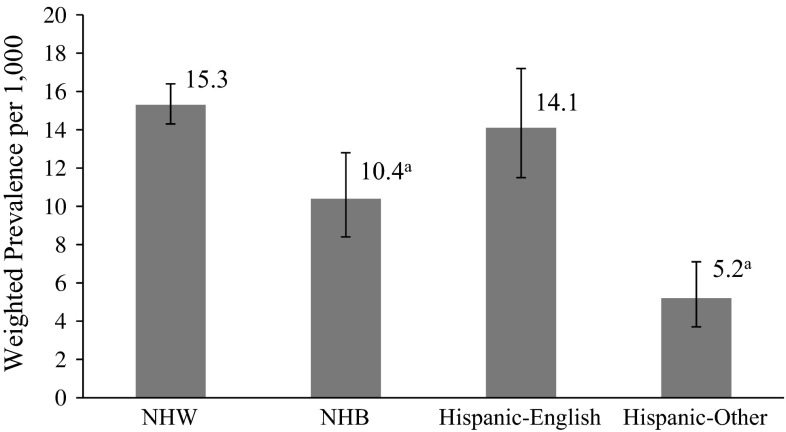
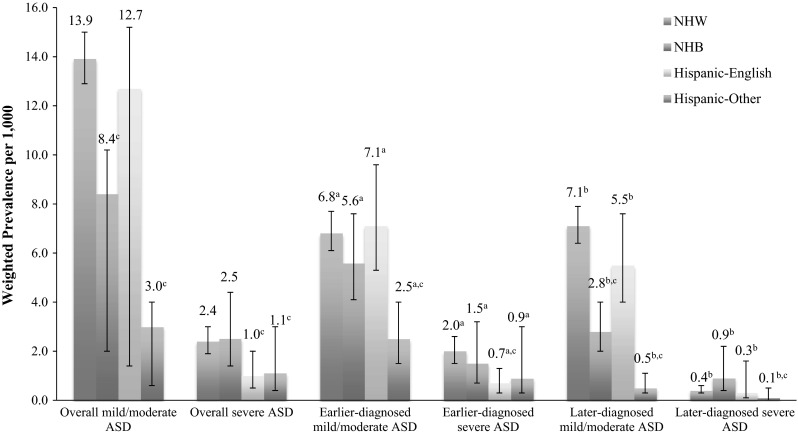
Verification
Claims the paper makes
The claims and statistics of this paper haven’t been checked yet.
Run the check — free, no account needed. It reads the open-access text and checks the sources it cites.
Claims other papers make about this one
Each is checked against this paper’s own text: does it say what the citing paper says it does?
In the citing paper
“For the Hispanic population, studies have identified lack of awareness of ASD, stigma associated with disability, lack of access to health care services due to noncitizenship or low income, and language barriers as factors that might reduce the identification of ASD among Hispanic children (31–35).”
In the citing paper
“In contrast, estimated ASD prevalence was similar for non-Hispanic white children compared with Hispanic children living in households where the primary language was English (14.3 per 1,000) (32).”
Self-check
Percentages, sums and reported differences re-computed from the paper’s own numbers.
The self-check needs the paper’s full text.
Citations
Cites
Diagnostic and Statistical Manual of Mental Disorders, Fourth Edition, Text Revision (DSM-IV-TR)
American Psychiatric Association (2000) · doi:10.1176/appi.books.9780890423349 · Cited by 11,069
Baio, J., Wiggins, L., Christensen, D. L., Maenner, M. J., Daniels, J., Warren, Z., Kurzius-Spencer, M., Zahorodny, W., Robinson, C., Rosenberg, et al. (2018) · MMWR. Surveillance Summaries · doi:10.15585/mmwr.ss6706a1 · Cited by 6,078
Morbidity and mortality weekly report
Gay, N., Gay, N., & Day, A. (1997) · The American Journal of Medicine · doi:10.1016/s0002-9343(97)89440-5 · Cited by 4,684
Morbidity and Mortality Weekly Report
(2010) · Wilderness and Environmental Medicine · doi:10.1016/j.wem.2010.09.015 · Cited by 2,976
Dawson, G., Rogers, S., Munson, J., Smith, M., Winter, J., Greenson, J., Donaldson, A., & Varley, J. (2010) · Pediatrics · doi:10.1542/peds.2009-0958 · Cited by 2,835
Identification and Evaluation of Children With Autism Spectrum Disorders
Johnson, C. P., Myers, S. M., & and the Council on Children With Disabilities (2007) · Pediatrics · doi:10.1542/peds.2007-2361 · Cited by 2,011
Fiore, A. E., Uyeki, T. M., Broder, K. R., Finelli, L., Euler, G. L., Singleton, J. A., Iskander, J. K., Wortley, P. M., Shay, D. K., Bresee, J., et al. (2009) · PubMed · Cited by 1,964
Trends in the prevalence of developmental disabilities in US children, 1997-2008
Boyle, C. A., Boulet, S., Schieve, L. A., Cohen, R. A., Blumberg, S. J., Yeargin-Allsopp, M., Visser, S., & Kogan, M. D. (2011) · Pediatrics · doi:10.1542/peds.2010-2989 · Cited by 1,732
Pediatrics, S. O. D. B. (2006) · PEDIATRICS · doi:10.1542/peds.2006-1231 · Cited by 1,472
Naarden Braun, K. V., Lopez, M., White, T., et al. (2023) · Carolina Digital Repository (University of North Carolina at Chapel Hill) · doi:10.17615/y3kk-5x30 · Cited by 1,381
Prevalence of Autism in a US Metropolitan Area
Yeargin-Allsopp, M., Rice, C., Karapurkar, T., Doernberg, N., Boyle, C., & Murphy, C. (2003) · JAMA · doi:10.1001/jama.289.1.49 · Cited by 1,248
Self-citationRacial/Ethnic Disparities in the Identification of Children With Autism Spectrum Disorders
Mandell, D. S., Wiggins, L. D., Carpenter, L. A., Daniels, J., DiGuiseppi, C., Durkin, M. S., Giarelli, E., Morrier, M. J., Nicholas, J. S., Pinto-Martin, J. A., et al. (2009) · American Journal of Public Health · doi:10.2105/ajph.2007.131243 · Cited by 946
Factors Associated With Age of Diagnosis Among Children With Autism Spectrum Disorders
Mandell, D. S., Novak, M. M., & Zubritsky, C. D. (2005) · Pediatrics · doi:10.1542/peds.2005-0185 · Cited by 896
Prevalence of Parent-Reported Diagnosis of Autism Spectrum Disorder Among Children in the US, 2007
Kogan, M. D., Blumberg, S. J., Schieve, L. A., Boyle, C. A., Perrin, J. M., Ghandour, R. M., Singh, G. K., Strickland, B. B., Trevathan, E., & van Dyck, P. C. (2009) · Pediatrics · doi:10.1542/peds.2009-1522 · Cited by 892
Rice, C. E. (2009) · PsycEXTRA Dataset · doi:10.1037/e562722010-001 · Cited by 762
Blumberg, S. J., Bramlett, M. D., Kogan, M. D., Schieve, L. A., Jones, J. R., & Lu, M. C. (2013) · PubMed · Cited by 726
Race differences in the age at diagnosis among medicaid-eligible children with autism
MANDELL, D. S., LISTERUD, J., LEVY, S. E., & PINTO-MARTIN, J. A. (2002) · Journal of the American Academy of Child & Adolescent Psychiatry · doi:10.1097/00004583-200212000-00016 · Cited by 684
Shattuck, P. T., Durkin, M., Maenner, M., Newschaffer, C., Mandell, D. S., Wiggins, L., Lee, L.-C., Rice, C., Giarelli, E., Kirby, R., et al. (2009) · Journal of the American Academy of Child & Adolescent Psychiatry · doi:10.1097/chi.0b013e31819b3848 · Cited by 623
Jiles, R. B., Hughes, E., Murphy, W., Flowers, N., McCracken, M., Roberts, H., Ochner, M., Balluz, L. S., Mokdad, A., Elam–Evans, L. D., et al. (2005) · PubMed · Cited by 596
Reichow, B. (2012) · Journal of Autism and Developmental Disorders · doi:10.1007/s10803-011-1218-9 · Cited by 584
The Changing Prevalence of Autism in California
Croen, L., Grether, J. K., Hoogstrate, J., & Selvin, S. (2002) · Journal of Autism and Developmental Disorders · doi:10.1023/a:1015453830880 · Cited by 511
Liptak, G. S., Benzoni, L. B., Mruzek, D. W., Nolan, K. W., Thingvoll, M. A., Wade, C. M., & Fryer, G. E. (2008) · Journal of Developmental & Behavioral Pediatrics · doi:10.1097/dbp.0b013e318165c7a0 · Cited by 504
Levy, S. E., Giarelli, E., Lee, L.-C., Schieve, L. A., Kirby, R. S., Cunniff, C., Nicholas, J., Reaven, J., & Rice, C. E. (2010) · Journal of Developmental & Behavioral Pediatrics · doi:10.1097/dbp.0b013e3181d5d03b · Cited by 504 · cited 1×
“Our finding that children with later ASD diagnoses were more likely than children with earlier diagnoses to have certain co-occurring health conditions was consistent with another recent study [41].”
ResultDesign and Operation of the National Survey of Children's Health, 2003.
Bramlett, M. D., Blumberg, S. J., Zablotsky, B., George, J. M., Ormson, A. E., Frasier, A. M., Vstecka, D. M., Williams, K. L., Skalland, B. J., Morrison, H. M., et al. (2005) · PubMed · Cited by 491
Practitioner Review: Diagnosis of autism spectrum disorder in 2‐ and 3‐year‐old children
Charman, T., & Baird, G. (2002) · Journal of Child Psychology and Psychiatry · doi:10.1111/1469-7610.00022 · Cited by 473
(2009) · PubMed · Cited by 409
Parents' Concerns About Children's Development: Prescreening Technique or Screening Test?
Glascoe, F. P. (1997) · PEDIATRICS · doi:10.1542/peds.99.4.522 · Cited by 349
National Autism Prevalence Trends From United States Special Education Data
Newschaffer, C. J., Falb, M. D., & Gurney, J. G. (2005) · PEDIATRICS · doi:10.1542/peds.2004-1958 · Cited by 316
From symptom recognition to diagnosis: children with autism in urban India
Daley, T. C. (2004) · Social Science & Medicine · doi:10.1016/s0277-9536(03)00330-7 · Cited by 306
Design and operation of the National Survey of Children with Special Health Care Needs, 2001.
Bramlett, M. D., Blumberg, S. J., Ormson, A. E., George, J. M., Williams, K. L., Frasier, A. M., Skalland, B. J., Santos, K. B., Vsetecka, D. M., Morrison, H. M., et al. (2003) · PubMed · Cited by 305
Schieve, L. A., Gonzalez, V., Boulet, S. L., Visser, S. N., Rice, C. E., Braun, K. V. N., & Boyle, C. A. (2012) · Research in Developmental Disabilities · doi:10.1016/j.ridd.2011.10.008 · Cited by 273
A Survey of Autism Knowledge in a Health Care Setting
Heidgerken, A. D., Geffken, G. R., Modi, A. C., & Frakey, L. L. (2005) · Journal of Autism and Developmental Disorders · doi:10.1007/s10803-005-3298-x · Cited by 241
Eapen, V., Črnčec, R., & Walter, A. (2013) · BMC Pediatrics · doi:10.1186/1471-2431-13-3 · Cited by 230 · cited 2×
“Previous studies suggest early intervention is associated with improved outcomes [3–6].”
BackgroundBlumberg, S. J., Bramlett, M. D., Kogan, M. D., Schieve, L. A., Jones, J. R., & Lu, M. C. (2013) · Cited by 224
Intervening in infancy: implications for autism spectrum disorders
Wallace, K. S., & Rogers, S. J. (2010) · Journal of Child Psychology and Psychiatry · doi:10.1111/j.1469-7610.2010.02308.x · Cited by 221
Age at Diagnosis of Autism Spectrum Disorders
Valicenti-McDermott, M., Hottinger, K., Seijo, R., & Shulman, L. (2012) · The Journal of Pediatrics · doi:10.1016/j.jpeds.2012.05.012 · Cited by 195
How Do Primary Care Physicians Identify Young Children with Developmental Delays? A National Survey
SICES, L., FEUDTNER, C., MCLAUGHLIN, J., DROTAR, D., & WILLIAMS, M. (2003) · Journal of Developmental & Behavioral Pediatrics · doi:10.1097/00004703-200312000-00002 · Cited by 176
Stichter, J. P., O’Connor, K. V., Herzog, M. J., Lierheimer, K. S., & McGhee, S. D. (2011) · Journal of Autism and Developmental Disorders · doi:10.1007/s10803-011-1249-2 · Cited by 132
Household Language Use and Health Care Access, Unmet Need, and Family Impact Among CSHCN
Yu, S. M., & Singh, G. K. (2009) · PEDIATRICS · doi:10.1542/peds.2009-1255m · Cited by 100
Responding to the mental health needs of latino children and families through school-based services
Garrison, E. G., Roy, I. S., & Azar, V. (1999) · Clinical Psychology Review · doi:10.1016/s0272-7358(98)00070-1 · Cited by 99
Profile of Referrals for Early Childhood Developmental Delay to Ambulatory Subspecialty Clinics
Shevell, M. I., Majnemer, A., Rosenbaum, P., & Abrahamowicz, M. (2001) · Journal of Child Neurology · doi:10.1177/088307380101600904 · Cited by 99
Frequency and Pattern of Documented Diagnostic Features and the Age of Autism Identification
Maenner, M. J., Schieve, L. A., Rice, C. E., Cunniff, C. M., Giarelli, E., Kirby, R. S., Lee, L.-C., Nicholas, J. S., Wingate, M. S., & Durkin, M. S. (2013) · Journal of the American Academy of Child & Adolescent Psychiatry · doi:10.1016/j.jaac.2013.01.014 · Cited by 79
Schieve, L. A., Rice, C., Yeargin-Allsopp, M., Boyle, C. A., Kogan, M. D., Drews, C., & Devine, O. (2012) · Maternal and Child Health Journal · doi:10.1007/s10995-012-1004-0 · Cited by 62
Self-citationPringle, B. A., Colpe, L. J., Blumberg, S. J., Avila, R. M., & Kogan, M. D. (2012) · PubMed · Cited by 60
Schieve, L. A., Boulet, S. L., Blumberg, S. J., Kogan, M. D., Yeargin-Allsopp, M., Boyle, C. A., Visser, S. N., & Rice, C. (2012) · Disability and Health Journal · doi:10.1016/j.dhjo.2011.09.001 · Cited by 55
Adams, S. H., Newacheck, P. W., Park, M. J., Brindis, C. D., & Irwin, C. E. (2013) · Academic Pediatrics · doi:10.1016/j.acap.2012.11.004 · Cited by 42
How good is general practice developmental screening?
Dearlove, J., & Kearney, D. (1990) · BMJ · doi:10.1136/bmj.300.6733.1177 · Cited by 38
Health care barriers for latino children and provision of culturally competent care
Lassetter, J. H., & Baldwin, J. H. (2004) · Journal of Pediatric Nursing · doi:10.1016/j.pedn.2004.01.007 · Cited by 18
Weiss, K. B. (2002) · Ambulatory Pediatrics · doi:10.1367/1539-4409(2002)002 · Cited by 4
Cited by
Sorted by citations
Christensen, D. L., Baio, J., Braun, K. V. N., Bilder, D., Charles, J., Constantino, J. N., Daniels, J., Durkin, M. S., Fitzgerald, R. T., Kurzius-Spencer, M., et al. (2016) · MMWR. Surveillance Summaries · doi:10.15585/mmwr.ss6503a1 · Cited by 1,964
Christensen, D. L., Braun, K. V. N., Baio, J., Bilder, D., Charles, J., Constantino, J. N., Daniels, J., Durkin, M. S., Fitzgerald, R. T., Kurzius-Spencer, M., et al. (2018) · MMWR. Surveillance Summaries · doi:10.15585/mmwr.ss6513a1 · Cited by 587
RetractedAge at autism spectrum disorder diagnosis: A systematic review and meta-analysis from 2012 to 2019
Hof, M. V. ’., Tisseur, C., van Berckelear-Onnes, I., van Nieuwenhuyzen, A. D. Y., Daniels, A. M., Deen, M. L., Hoek, H. W., & Ester, W. A. (2020) · Autism · doi:10.1177/1362361320971107 · Cited by 592
Stress and Parents of Children with Autism: A Review of Literature
Bonis, S. (2016) · Issues in Mental Health Nursing · doi:10.3109/01612840.2015.1116030 · Cited by 404
Genetic Etiologies, Diagnosis, and Treatment of Tuberous Sclerosis Complex
Salussolia, C. L., Klonowska, K., Kwiatkowski, D. J., & Sahin, M. (2019) · Annual Review of Genomics and Human Genetics · doi:10.1146/annurev-genom-083118-015354 · Cited by 163
Metadata
- Authors
- Jo, H., Schieve, L. A., Rice, C. E., Yeargin-Allsopp, M., Tian, L. H., Blumberg, S. J., Kogan, M. D., & Boyle, C. A.
- Affiliations
- Centers for Disease Control and Prevention (US)
- Health Resources and Services Administration (US)
- Corresponding author
- Jo, Heejoo
- Venue
- Maternal and Child Health Journal
- Published
- 2015-02-21
- Volume
- 19
- Issue
- 8
- Pages
- 1687-1697
- ISSN
- 1092-7875 (ISSN-L)
- 1573-6628
- PMC
- PMC4500845
- OpenAlex
- W2118526446
- Cited by
- 116
- References
- 53
- Citations by year
- 2026: 1 · 2025: 8 · 2024: 7 · 2023: 11 · 2022: 15 · 2021: 19 · 2020: 18 · 2019: 10 · 2018: 6 · 2017: 10 · 2016: 8 · 2015: 2
- FWCI
- 5.22
- Type
- journal article
- Language
- en
- Open access
- hybrid
- doi.org
- Locations
- Maternal and Child Health Journal (publishedVersion, cc-by)
- PubMed Central (publishedVersion, cc-by)
- PubMed (publishedVersion)
- Funders
- National Institutes of Health (CC999999)
- Topics
- Life Sciences › Neuroscience › Cognitive Neuroscience › Autism Spectrum Disorder Research
- Health Sciences › Medicine › Psychiatry and Mental health › Child Nutrition and Feeding Issues
- Social Sciences › Psychology › Clinical Psychology › Family and Disability Support Research
- Keywords
- autism spectrum disorder, age at diagnosis, racial and ethnic disparities, Hispanic children, non-Hispanic Black children, autism prevalence, ASD severity, underidentification, children with special health care needs
- MeSH terms
- Autism Spectrum Disorder, Adolescent, Black or African American, Child, Child, Preschool, Ethnicity, Family Characteristics, Female, Health Surveys, Hispanic or Latino, Humans, Language, Male, Population Surveillance, Severity of Illness Index, Socioeconomic Factors, United States, Prevalence, Black People, White People, Racial Groups
About these checks
Registry, retraction, Cites and statistics results are computed, not judged, with one exception: a printed reference that no index lists is read once by a model before it counts as a citation error. Claims are extracted by a model and kept only when their quote appears verbatim in the text; each cited source is then checked, with a model’s help, for whether it says what the claim relies on. Those verdicts can be wrong — read the claim’s quote and the cited source before relying on one.
Statistics and arithmetic are recomputed, not judged.
Confidence bands are shown only for fields calibrated on our annotated test set. None is calibrated yet, so no band is shown.
What counts as a claim ›How we measure confidence ›How we check this ›
Are you an author, or do you see a problem with this page? Request a review
