

Life cycle comparison of hydrothermal liquefaction and lipid extraction pathways to renewable diesel from algae
Open accessThe DOI matches its Crossref record; 33 of the 35 references it cites were found in a registry or an index.
Abstract
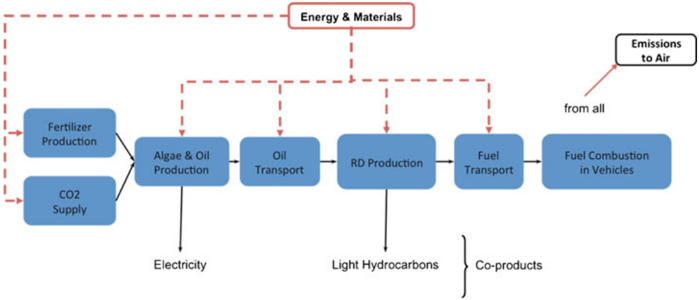
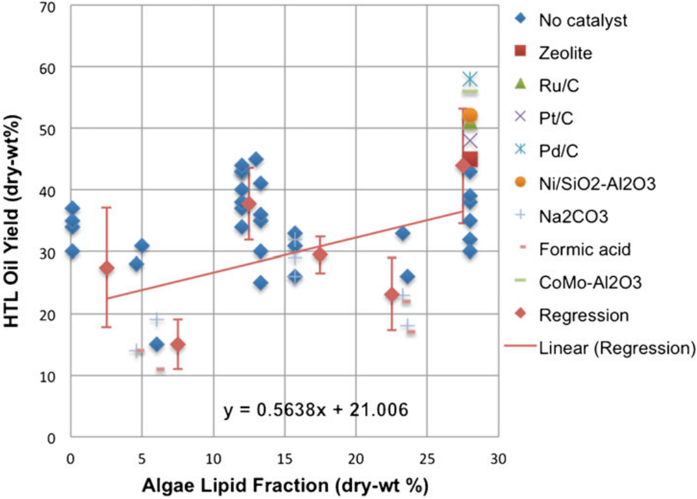
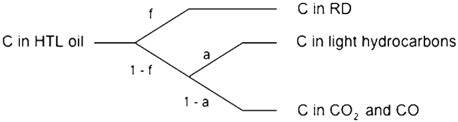
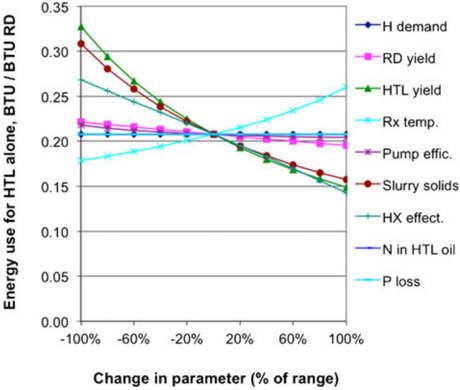
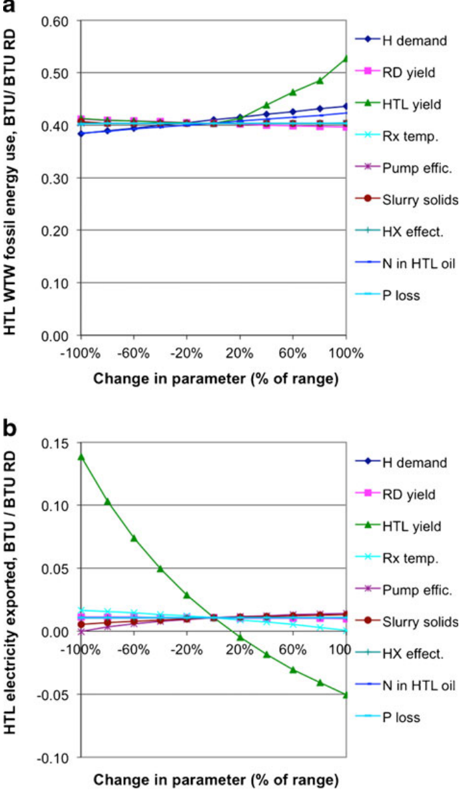
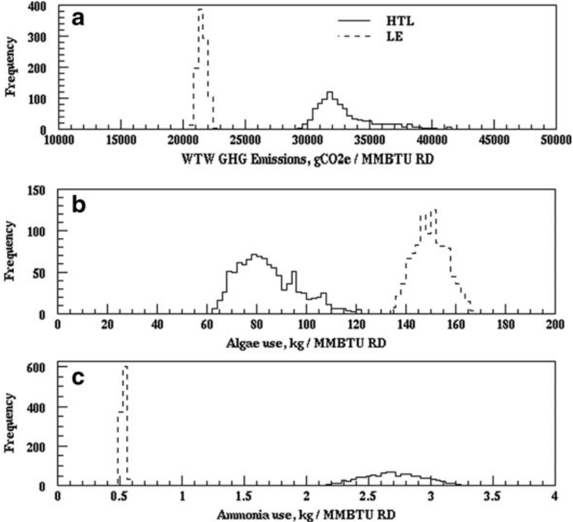
Algae biomass is an attractive biofuel feedstock when grown with high productivity on marginal land. Hydrothermal liquefaction (HTL) produces more oil from algae than lipid extraction (LE) does because protein and carbohydrates are converted, in part, to oil. Since nitrogen in the algae biomass is incorporated into the HTL oil, and since lipid extracted algae for generating heat and electricity are not co-produced by HTL, there are questions regarding implications for emissions and energy use. We studied the HTL and LE pathways for renewable diesel (RD) production by modeling all essential operations from nutrient manufacturing through fuel use. Our objective was to identify the key relationships affecting HTL energy consumption and emissions. LE, with identical upstream growth model and consistent hydroprocessing model, served as reference. HTL used 1.8 fold less algae than did LE but required 5.2 times more ammonia when nitrogen incorporated in the HTL oil was treated as lost. HTL RD had life cycle emissions of 31,000 gCO 2 equivalent (gCO 2 e) compared to 21,500 gCO 2 e for LE based RD per million BTU of RD produced. Greenhouse gas (GHG) emissions increased when yields exceeded 0.4 g HTL oil/g algae because insufficient carbon was left for biogas generation. Key variables in the analysis were the HTL oil yield, the hydrogen demand during upgrading, and the nitrogen content of the HTL oil. Future work requires better data for upgrading renewable oils to RD and requires consideration of nitrogen recycling during upgrading.
Overview
The claims and statistics of this paper haven’t been checked yet.
Free: it reads the open-access text and checks the first 5 claims that cite a source we can check. Create a free account to check every claim.
Integrity signals
Registry
Cites
Statistics
Figures
Verification
Claims the paper makes
The claims and statistics of this paper haven’t been checked yet.
Free: it reads the open-access text and checks the first 5 claims that cite a source we can check. Create a free account to check every claim.
Claims other papers make about this one
Each is checked against this paper’s own text: does it say what the citing paper says it does?
The source backs part of the claim, not all of it — or backs it for a different population, condition or comparison.
In the citing paper
“Frank et al. [34] report a lower GHG result compared to this study which is attributed to differences in downstream processing following biooil recovery through HTL and higher yield.”
From Lifecycle assessment of microalgae to biofuel: Comparison of thermochemical processing pathways (2015) · cites this paper as [34]
Experimental — accuracy not yet measuredThe cited source says what the claim attributes to it.
In the citing paper
“Only a limited number of studies included assessment of thermochemical conversion technologies on the metrics of net energy and greenhouse gas (GHG) emissions has been limited [1, 27, 28, 34, 60].”
From Lifecycle assessment of microalgae to biofuel: Comparison of thermochemical processing pathways (2015) · cites this paper as [34]
In the citing paper
“Frank et al. [34] examined the environmental impact of an HTL process with a well to pump (WTP) system boundary, but includes an additional processing of HTL byproducts to biogas.”
From Lifecycle assessment of microalgae to biofuel: Comparison of thermochemical processing pathways (2015) · cites this paper as [34]
In the citing paper
“HTL has been demonstrated to effectively convert wet, 20% solids, microalgae feedstock into bio-oil [2, 28, 34, 66].”
From Lifecycle assessment of microalgae to biofuel: Comparison of thermochemical processing pathways (2015) · cites this paper as [34]
In the citing paper
“Hydrogen demands for hydroprocessing and renewable diesel yields are determined based on the methods of Frank et al. [34] with details presented in the supplementary information.”
From Lifecycle assessment of microalgae to biofuel: Comparison of thermochemical processing pathways (2015) · cites this paper as [34]
1 more claim about this paper
Create a free account to see every claim other papers make about this one.
Self-check
Percentages, sums and reported differences re-computed from the paper’s own numbers.
The self-check needs the paper’s full text.
Citations
Cites
(2007) · Medical Entomology and Zoology · Cited by 9,612
Rodolfi, L., Chini Zittelli, G., Bassi, N., Padovani, G., Biondi, N., Bonini, G., & Tredici, M. R. (2009) · Biotechnology and Bioengineering · doi:10.1002/bit.22033 · Cited by 2,879 · cited 2×
“2011a, 2012); however, high-lipid algae have low productivity during the lipid accumulation phase (Rodolfi et al. 2009).”
Background(2007) · doi:10.1002/9780470172605 · Cited by 2,813
Life-Cycle Assessment of Biodiesel Production from Microalgae
Lardon, L., Hélias, A., Sialve, B., Steyer, J.-P., & Bernard, O. (2009) · Environmental Science & Technology · doi:10.1021/es900705j · Cited by 1,528
Williams, P. J. L. B., & Laurens, L. M. L. (2010) · Energy & Environmental Science · doi:10.1039/b924978h · Cited by 1,223 · cited 5×
“…we consider HTL RD yields between 0.75 and 0.85 and hydrogen demands between 0.065 and Table 6 Elemental composition of LE, HTL, and soybean oils Weight % Oil C H O N LE a 71 % 11 % 16 % 0.2 % HTL b 73 % 9.2 % 11 % 5.7 % Soybean c 77 % 12 % 12 % 0 % a Table 1 in Williams and Laurens (2010), C1H1.”
BackgroundMethodInfluentialBiller, P., & Ross, A. B. (2011) · Bioresource Technology · doi:10.1016/j.biortech.2010.06.028 · Cited by 1,131 · cited 10×
“…reports different yields for the various fractions (Table 1) and different distributions of solids between oil and aqueous phases (Alba et al. 2012; Biller and Ross 2011; Brown et al. 2010; Duan and Savage 2011; Jena and Das 2011; Jena et al. 2011; Minowa et al. 1995; Valdez et al. 2011; Vardon et…”
BackgroundMethodInfluentialEnvironmental Life Cycle Comparison of Algae to Other Bioenergy Feedstocks
Clarens, A. F., Resurreccion, E. P., White, M. A., & Colosi, L. M. (2010) · Environmental Science & Technology · doi:10.1021/es902838n · Cited by 1,118 · cited 1×
“Previous work showed that electricity production and nutrient recycling greatly affect energy and nutrient demands in the process (Campbell et al. 2009; Clarens et al. 2010, 2011; Frank et al. 2011a, 2012; Lardon et al. 2009; Stephenson et al. 2010).”
BackgroundTechno-Economic Analysis of Autotrophic Microalgae for Fuel Production
Davis, R., Aden, A., & Pienkos, P. T. (2011) · Applied Energy · doi:10.1016/j.apenergy.2011.04.018 · Cited by 1,069 · cited 2×
“High lipid fractions are required to improve economic viability (Davis et al. 2011) and to reduce water consumption and emissions on a fuel-basis (Wigmosta et al. 2011; Frank et al. 2011a, 2012); however, high-lipid algae have low productivity during the lipid accumulation phase (Rodolfi et al.…”
BackgroundHydrothermal liquefaction and gasification of Nannochloropsis sp.
Brown, T. M., Duan, P., & Savage, P. E. (2010) · Energy & Fuels · doi:10.1021/ef100203u · Cited by 745 · cited 8×
“…required and that the HTL oil can contain substantial amounts of nitrogen incorporated from the algal biomass (Alba et al. 2012; Biller and Ross 2011; Brown et al. 2010; Duan and Savage 2011; Jena and Das 2011; Jena et al. 2011; Minowa et al. 1995; Valdez et al. 2011; Vardon et al. 2011; Yu et al.…”
BackgroundMethodInfluential
Research works printed but not linked: 5
- Campbell PK, Beer T, Batten D (2009) Greenhouse gas sequestration by algae - energy and greenhouse gas life cycle studies. CSIRO, Clayton
- Elliott D, Sealock L Jr (1996) Chemical processing in high-pressure aqueous environments: low-temperature catalytic gasification. Chem Eng Res Des 74:563-566
- Lupton S, Kassa N, Galloway D, Lynch S (2011) Conversion of algal oils to hydrocarbon fuels. Presented at the 1st international conference on algal biomass, biofuels & bioproducts, St. Louis MO, 17-20 July 2011
- Shah RK, Sekulic DP (2002) Fundamentals of heat exchanger design. Wiley, Hoboken
- Wang M (1999a) The Greenhouse gases, regulated emissions, and energy use in transportation (GREET) model version 1.5. Argonne National Laboratory Wang M (1999b) GREET 1.5-transportation fuel-cycle model-Vol. 1: methodology, development, use, and results. ANL/ESD-39. Argonne National Laboratory
Cited by
Items 101–200 of 259
Onay, M., Sonmez, C., Oktem, H. A., & Yucel, A. M. (2014) · Bioresource Technology · doi:10.1016/j.biortech.2014.06.078 · Cited by 52
“Additionally, recent studies demonstrate that complete microalgal biomass including not only the lipids but also the carbohydrates and proteins can be converted into oil via HTL enabling the use of low-lipid algae for this process (Frank et al., 2013).”
BackgroundNeveux, N., Yuen, A. K. L., Jazrawi, C., He, Y., Magnusson, M. E., Haynes, B. S., Masters, A. F., Montoya, A., Paul, N. A., Maschmeyer, T., et al. (2014) · Algal Research · doi:10.1016/j.algal.2014.08.008 · Cited by 55
Shan, Y., Yin, L.-X., Djandja, O. S., Wang, Z., & Duan, P. (2021) · Fuel · doi:10.1016/j.fuel.2021.120288 · Cited by 54
Self-citationKasani, A. A., Esmaeili, A., & Golzary, A. (2021) · Algal Research · doi:10.1016/j.algal.2021.102597 · Cited by 52
Thomassen, G., Dael, M. V., Lemmens, B., & Passel, S. V. (2016) · Renewable and Sustainable Energy Reviews · doi:10.1016/j.rser.2016.02.015 · Cited by 53
Somers, M. D., Chen, P., Clippinger, J., Cruce, J. R., Davis, R., Lammers, P. J., & Quinn, J. C. (2021) · Algal Research · doi:10.1016/j.algal.2021.102419 · Cited by 49
Sequential Hydrothermal Liquefaction characterization and nutrient recovery assessment
Martinez-Fernandez, J. S., & Chen, S. (2017) · Algal Research · doi:10.1016/j.algal.2017.05.022 · Cited by 48
Ruhani, B., Movahedi, P., sadi, S., Ghasemi, A. M., Kheradmand, A., Dibaj, M., & Akrami, M. (2022) · Sustainability · doi:10.3390/su14021017 · Cited by 47
“Using the following equation, the yield of biocrude oil produced by the HTL process can be calculated [33]:”
MethodThe challenge of nitrogen compounds in hydrothermal liquefaction of algae
Matricon, L., Roubaud, A., Haarlemmer, G. W., & Geantet, C. (2023) · The Journal of Supercritical Fluids · doi:10.1016/j.supflu.2023.105867 · Cited by 47
Growing Algae for Biodiesel on Direct Sunlight or Sugars: A Comparative Life Cycle Assessment
Orfield, N. D., Levine, R. B., Keoleian, G. A., Miller, S. A., & Savage, P. E. (2015) · ACS Sustainable Chemistry & Engineering · doi:10.1021/sc5004117 · Cited by 45
Pirwitz, K., Rihko‐Struckmann, L., & Sundmacher, K. (2016) · Bioresource Technology · doi:10.1016/j.biortech.2016.06.095 · Cited by 45
“…higher compared to that of9 conventional extraction because carbohydrates and proteins are partly con-10 verted into organic solubles as well (Frank et al., 2013; Delrue et al., 2013).11 In general, liquefaction leads to the hydrothermal conversion of solid biomass12 into a bio-crude, an…”
BackgroundOsundeko, O., & Pittman, J. K. (2014) · Bioresource Technology · doi:10.1016/j.biortech.2013.11.035 · Cited by 41
Farooq, D., Thompson, I. P., & Ng, K. S. (2020) · Cleaner Engineering and Technology · doi:10.1016/j.clet.2020.100010 · Cited by 45
“, 2018) and environmental assessments (Frank et al., 2013) have been conducted on separate upgrading and HTL plant facilities further research is required to investigate the economic viability and environmental impact of integrated plant designs, similar to research performed by Zhu et al.”
ResultNegative Emission Energy Production Technologies: A Techno‐Economic and Life Cycle Analyses Review
Li, W., & Wright, M. M. (2019) · Energy Technology · doi:10.1002/ente.201900871 · Cited by 44
Fan, Y., Fonseca, F. G., Gong, M., Hoffmann, A., Hornung, U., & Dahmen, N. (2020) · Journal of Cleaner Production · doi:10.1016/j.jclepro.2020.124895 · Cited by 43
A perspective on algae, the environment, and energy
Savage, P. E., & Hestekin, J. A. (2013) · Environmental Progress & Sustainable Energy · doi:10.1002/ep.11847 · Cited by 36
Wei, C., Xu, Y., Li, Y., Wei, W., Feng, Y., Li, Z., & Xu, L. Y. (2024) · Journal of Cleaner Production · doi:10.1016/j.jclepro.2024.140559 · Cited by 42
A comparison of on-site nutrient and energy recycling technologies in algal oil production
Zhang, Y., Kendall, A. M., & Yuan, J. (2014) · Resources Conservation and Recycling · doi:10.1016/j.resconrec.2014.04.011 · Cited by 42
Zhang, P., Li, F., Su, B., & Li, X. (2022) · Journal of Cleaner Production · doi:10.1016/j.jclepro.2022.130895 · Cited by 42
Pankratz, S., Kumar, M., Oyedun, A. O., Gemechu, E., & Kumar, A. (2020) · Algal Research · doi:10.1016/j.algal.2020.101815 · Cited by 36
Biodiversity improves the ecological design of sustainable biofuel systems
Godwin, C. M., Lashaway, A. R., Hietala, D. C., Savage, P. E., & Cardinale, B. J. (2018) · GCB Bioenergy · doi:10.1111/gcbb.12524 · Cited by 35
Kushwaha, A., Yadav, A. N., Singh, B., Dwivedi, V., Kumar, S., Goswami, L., & Hussain, C. M. (2021) · Elsevier eBooks · doi:10.1016/b978-0-323-85387-3.00003-3 · Cited by 39
Chormare, R., Moradeeya, P. G., Sahoo, T. P., Seenuvasan, M., Baskar, G., Saravaia, H. T., & Kumar, M. A. (2023) · Chemosphere · doi:10.1016/j.chemosphere.2023.139760 · Cited by 39
Hydrothermal liquefaction of biomass for the generation of value-added products
Nallasivam, J., Prashanth, P. F., & Vinu, R. (2022) · Elsevier eBooks · doi:10.1016/b978-0-323-88511-9.00018-5 · Cited by 39
Resource requirements for the large-scale production of algal biofuels
Pate, R. C. (2013) · Biofuels · doi:10.4155/bfs.13.28 · Cited by 33
Choudhary, P., Malik, A., & Pant, K. K. (2020) · Sustainable Energy & Fuels · doi:10.1039/c9se00939f · Cited by 36
Fortier, M. P., Roberts, G. W., Stagg‐Williams, S. M., & Sturm, B. (2017) · Algal Research · doi:10.1016/j.algal.2017.06.009 · Cited by 32
Techno-economic analysis of ash removal in biomass harvested from algal turf scrubbers
Hess, D., Wendt, L. M., Wahlen, B. D., Aston, J. E., Hu, H., & Quinn, J. C. (2019) · Biomass and Bioenergy · doi:10.1016/j.biombioe.2019.02.010 · Cited by 31
Andersson, V., Heyne, S., Harvey, S., & Berntsson, T. S. (2020) · International Journal of Energy Research · doi:10.1002/er.5760 · Cited by 32
Algae-Based Wastewater Treatment for Biofuel Production: Processes, Species, and Extraction Methods
Lyon, S. R., Ahmadzadeh, H., & Murry, M. A. (2015) · Biofuel and biorefinery technologies · doi:10.1007/978-3-319-16640-7_6 · Cited by 32
Quiroz, D., Greene, J. M., McGowen, J., & Quinn, J. C. (2021) · Algal Research · doi:10.1016/j.algal.2021.102483 · Cited by 31
Zhang, Y., & Kendall, A. M. (2019) · Journal of Cleaner Production · doi:10.1016/j.jclepro.2019.05.137 · Cited by 31
Cabrera, D. V., & Labatut, R. A. (2021) · Sustainable Energy & Fuels · doi:10.1039/d0se01857k · Cited by 31
Saral, J. S., Satheesh, A. R., & Ranganathan, P. (2022) · Energy Conversion and Management X · doi:10.1016/j.ecmx.2022.100189 · Cited by 32
Bauer, S. K., Grotz, L., Connelly, E. B., & Colosi, L. M. (2016) · Bioresource Technology · doi:10.1016/j.biortech.2016.06.058 · Cited by 31
Lilonfe, S., Davies, B., Abdul-Manan, A. F. N., Dimitriou, I., & McKechnie, J. (2024) · Sustainable Production and Consumption · doi:10.1016/j.spc.2024.04.016 · Cited by 30
Infrastructure associated emissions for renewable diesel production from microalgae
Canter, C. E., Davis, R. E., Urgun‐Demirtas, M., & Frank, E. D. (2014) · Algal Research · doi:10.1016/j.algal.2014.01.001 · Cited by 30
Self-citationQuiroz‐Arita, C., Sheehan, J., & Bradley, T. H. (2017) · Algal Research · doi:10.1016/j.algal.2017.06.021 · Cited by 30
Bravo, I. N., Velasquez‐Orta, S. B., Ramírez, I. M., Güereca, L. P., Harvey, A., Cuevas, R., Yáñez-Noguez, I., & Ledesma, M. T. O. (2021) · Energy Conversion and Management · doi:10.1016/j.enconman.2021.114806 · Cited by 30
Karimi, M., & Şimşek, H. (2025) · Journal of Cleaner Production · doi:10.1016/j.jclepro.2025.146104 · Cited by 29
Pegallapati, A. K., & Frank, E. D. (2016) · Algal Research · doi:10.1016/j.algal.2016.06.019 · Cited by 29
Self-citationBello, M., Ranganathan, P., & Brennan, F. (2017) · ACS Sustainable Chemistry & Engineering · doi:10.1021/acssuschemeng.7b01833 · Cited by 28
Biodiversity Improves Life Cycle Sustainability Metrics in Algal Biofuel Production
Carruthers, D. N., Godwin, C. M., Hietala, D. C., Cardinale, B. J., Lin, X. N., & Savage, P. E. (2019) · Environmental Science & Technology · doi:10.1021/acs.est.9b00909 · Cited by 28
Environmental profile of algal Hydrothermal Liquefaction — A country specific case study
Patel, B., Guo, M., Shah, N., & Hellgardt, K. (2016) · Algal Research · doi:10.1016/j.algal.2015.12.017 · Cited by 27
A model-based combinatorial optimisation approach for energy-efficient processing of microalgae
Slegers, P. M., Koetzier, B. J., Fasaei, F., Wijffels, R. H., Straten, G. V., & van Boxtel, A. J. B. (2014) · Algal Research · doi:10.1016/j.algal.2014.07.004 · Cited by 26
“omogeniser – hexane 23 a No [7]”
Godwin, C. M., Hietala, D. C., Lashaway, A. R., Narwani, A., Savage, P. E., & Cardinale, B. J. (2017) · Environmental Science & Technology · doi:10.1021/acs.est.7b02137 · Cited by 26
Weber, R. S., Holladay, J. E., Jenks, C. J., Panisko, E. A., Snowden-Swan, L. J., Ramírez-Corredores, M. M., Baynes, B. M., Angenent, L. T., & Boysen, D. A. (2018) · Wiley Interdisciplinary Reviews Energy and Environment · doi:10.1002/wene.308 · Cited by 26
Gaber, K., Rösch, C., & Biondi, N. (2021) · BioEnergy Research · doi:10.1007/s12155-021-10279-z · Cited by 25
Continuous Hydrothermal Liquefaction for Biofuel and Biocrude Production from Microalgal Feedstock
Lababpour, A. (2018) · ChemBioEng Reviews · doi:10.1002/cben.201700017 · Cited by 24
Hise, A. M., Characklis, G. W., Kern, J. D., Gerlach, R., Viamajala, S., Gardner, R. D., & Vadlamani, A. (2016) · Bioresource Technology · doi:10.1016/j.biortech.2016.08.050 · Cited by 24
“…to evaluate performance benefits arising from the use of novel techniques for (1) boosting lipid productivity with a bicarbonate amendment (Gardner et al., 2013; Lohman et al., 2015) and (2) lowering capital costs and energy inputs for dewatering by utilizing temperature-sensitive…”
Wibawa, D. S., Nasution, M. A., Noguchi, R., Ahamed, T., Demura, M., & Watanabe, M. M. (2018) · Energies · doi:10.3390/en11030521 · Cited by 25
“Using the total biomass enables the utilization of fast-growing species because there is no need to wait for lipid production [14], and the HTL process utilizes biomass more efficiently than lipid extraction [15].”
MethodA probabilistic economic and environmental impact assessment of a cyanobacteria-based biorefinery
Beattie, A., Vermaas, W. F. J., Darzins, A., Holland, S. C., Li, S., McGowen, J. A., Nielsen, D. R., & Quinn, J. C. (2021) · Algal Research · doi:10.1016/j.algal.2021.102454 · Cited by 24
Watanabe, M. M., & Isdepsky, A. (2021) · Energies · doi:10.3390/en14216992 · Cited by 23
Hydrothermal Liquefaction of Biomass for Biofuel Production
Rudra, S., & Jayathilake, M. (2021) · Elsevier eBooks · doi:10.1016/b978-0-12-819727-1.00043-1 · Cited by 23
Maddi, B., Viamajala, S., & Varanasi, S. (2017) · ACS Sustainable Chemistry & Engineering · doi:10.1021/acssuschemeng.7b02309 · Cited by 23
Planning for Algal Systems: An Energy-Water-Food Nexus Perspective
Miara, A., Pienkos, P. T., Bazilian, M., Davis, R. E., & Macknick, J. (2014) · Industrial Biotechnology · doi:10.1089/ind.2014.0004 · Cited by 22
Magdeldin, M., Kohl, T., & Järvinen, M. (2016) · Biofuels · doi:10.1080/17597269.2015.1118785 · Cited by 22
“[28] conducted a comparative life cycle assessment between bio-crude production from direct HTL and lipid extraction combined with catalytic gasification.”
MethodLee, J., Choi, O. K., Oh, D., Lee, K., Park, K. Y., & Kim, D. (2020) · Energies · doi:10.3390/en13236392 · Cited by 21
Quiroz‐Arita, C., Yilmaz, Ö., Barlak, S., Catton, K. B., Quinn, J. C., & Bradley, T. H. (2016) · Bioresource Technology · doi:10.1016/j.biortech.2016.09.006 · Cited by 21
“For example, consider the LCA results documented in Frank et al. (2013), wherein microalgae cultivation and fuels production was found to have a net GHG emissions benefit of 20 gCO2eq MJ 1, without consideration of DLUC.”
BackgroundSambasivam, K. M., Praveen, K., Shashirekha, V., Tamilarasan, K., & Abinandan, S. (2023) · Bioresource Technology Reports · doi:10.1016/j.biteb.2023.101588 · Cited by 20
Venteris, E. R., Skaggs, R. L., Wigmosta, M. S., & Coleman, A. M. (2014) · Algal Research · doi:10.1016/j.algal.2014.02.002 · Cited by 20
Hydrothermal liquefaction of aquatic Feedstocks
Biller, P. (2018) · Elsevier eBooks · doi:10.1016/b978-0-08-101029-7.00003-5 · Cited by 20
Life cycle analysis of milking of microalgae for renewable hydrocarbon production
Chaudry, S., Bahri, P. A., & Moheimani, N. R. (2018) · Computers & Chemical Engineering · doi:10.1016/j.compchemeng.2018.11.019 · Cited by 20
Scenario studies for algae production
Slegers, P. M. (2014) · doi:10.18174/294573 · Cited by 20
Tan, J., Tan, R. R., Aviso, K. B., Promentilla, M. A. B., & Sulaiman, N. M. N. (2017) · Clean Technologies and Environmental Policy · doi:10.1007/s10098-017-1390-5 · Cited by 19
Microalgae: An Eco-friendly Tool for the Treatment of Wastewaters for Environmental Safety
Hwang, J.-H., Sadmani, A. H. M. A., Lee, S., Kim, K., & Lee, W. H. (2019) · Springer eBooks · doi:10.1007/978-981-13-3426-9_12 · Cited by 18
Energetic Performance of Photobioreactors for Algal Cultivation: Brief Review
Pegallapati, A. K., Arudchelvam, Y., & Nirmalakhandan, N. N. (2013) · Environmental Science & Technology Letters · doi:10.1021/ez400079f · Cited by 18
Ultrasound Applications in Lipid Extractions from Microalgae
Natarajan, R., Chen, X., & Lau, R. W. M. (2014) · Biofuels and biorefineries · doi:10.1007/978-94-017-9624-8_4 · Cited by 17
Wang, Z., Si, B., Summers, S., & Zhang, Y. (2024) · Energy Conversion and Management · doi:10.1016/j.enconman.2024.118716 · Cited by 16
Self-citationRo, J. W., Yothers, C. W., Kendall, A. M., Franz, A. K., & Zhang, R. (2024) · Journal of Environmental Management · doi:10.1016/j.jenvman.2024.120802 · Cited by 14
Kurniawan, K. I. A., Putra, A. S., Ishizaki, R., Rani, D. S., Rahmah, D. M., Husna, S. N. A., Ahamed, T., & Noguchi, R. (2024) · Environmental Science and Pollution Research · doi:10.1007/s11356-023-31582-6 · Cited by 13
“This condition means that the HTL process produced a higher amount of microal-gal bio-oil than the theoretical approach (transesterification process), as indicated in research on LCA between HTL and the transesterification process from algae (Frank et al. 2013).”
Venteris, E. R., Wigmosta, M. S., Coleman, A. M., & Skaggs, R. L. (2014) · Frontiers in Energy Research · doi:10.3389/fenrg.2014.00037 · Cited by 13
“However, the combination of HTL (Elliott et al., 2013; Frank et al., 2013) and nutrient recycling through AD or CHG can dramatically reduce the nutrient demand and increase the amount of biofuel that can be based on recycled waste nutrients including municipal sewage and animal manures (Venteris et…”
BackgroundMethodInfluentialA Cyanobacterial Sidestream Nutrient Removal Process and Its Life Cycle Implications
Quiroz‐Arita, C., Sheehan, J., Baral, N. R., Hughes, A. R., Peers, G., Hodgson, B., Sharvelle, S. E., & Bradley, T. H. (2019) · BioEnergy Research · doi:10.1007/s12155-019-9963-2 · Cited by 13
Singh, U., Naaz, F., Hawkins, T. R., Weinberg, E., Banerjee, S., Mroz, R., Ohri, N., Zhang, J., Lee, Y.-Y., Chen, F., et al. (2025) · Sustainable Energy & Fuels · doi:10.1039/d5se00329f · Cited by 12
Summers, S., Jing, Q., Kawale, H. D., Wang, Z., Mirzaei, D., & Zhang, Y. (2025) · ACS ES&T Engineering · doi:10.1021/acsestengg.5c00273 · Cited by 12
Self-citationJager, H. I., Efroymson, R. A., & Baskaran, L. M. (2019) · Water · doi:10.3390/w11040836 · Cited by 10
“To qualify as an ‘advanced’ biofuel under the US Renewable Fuel Standard, the GHG emissions from algal diesel must be less than half the emissions from the fossil diesel pathway that it replaces [23,24].”
BackgroundBest practices for bio-crude oil production at pilot scale using continuous flow reactors
Cheng, F., & Brewer, C. E. (2022) · Elsevier eBooks · doi:10.1016/b978-0-323-90971-6.00003-6 · Cited by 9
Biocrude oil and high-value metabolite production potential of the Nitzschia sp.
Al-Naimi, S., Al-Muftah, A., Das, P., Khan, S., AbdulQuadir, M., Jabri, H. M. S. J. A., & Alghasal, G. (2021) · Biomass Conversion and Biorefinery · doi:10.1007/s13399-021-02041-4 · Cited by 9
“Furthermore, microalgae with low lipid contents could also be used as feedstocks for the HTL process [11–13].”
Pongsurapipat, Y., Areeprasert, C., Takahashi, F., Tokimatsu, K., & Yoshikawa, K. (2016) · Biofuels · doi:10.1080/17597269.2016.1221297 · Cited by 9
“This is because of the differences in the process models, the production pathways, the assumptions and the system boundaries [10,12,24,33].”
BackgroundUtilization and preparation strategies of biomass containing lignin and cellulose: A review
Liu, C., Zhao, Y., Wang, S., Jiang, X., & Huang, Q. (2025) · Materials Today Chemistry · doi:10.1016/j.mtchem.2025.102926 · Cited by 8
Chaudry, S., Bahri, P. A., & Moheimani, N. R. (2016) · Computer-aided chemical engineering/Computer aided chemical engineering · doi:10.1016/b978-0-444-63428-3.50262-9 · Cited by 9
Genetic Engineering of Marine Microalgae to Optimize Bioenergy Production
Jutur, P. P., & Nesamma, A. A. (2015) · Elsevier eBooks · doi:10.1016/b978-0-12-800776-1.00024-8 · Cited by 8
Akbari, A., & Barton, P. I. (2019) · Processes · doi:10.3390/pr7050286 · Cited by 8
“[15] performed a comparative LCA of HTL and lipid-extraction technologies, showing that HTL is more efficient in biomass use and less efficient in nitrogen consumption (no nitrogen recovery from upgrading) then lipid extraction.”
MethodBennion, E. (2014) · Digital Commons - USU (Utah State University) · doi:10.26076/a1e5-d6f8 · Cited by 8
Kelp Energy Products and Marine Renewable Energy for Coastal Alaska Communities
Rinker, M. W., USDOE, Airhart, K., Anderson, D. M., Garavelli, L., Caruso, O. G., Grear, M. E., Harris, T. M., Huesemann, M. H., Michener, S., et al. (2021) · OSTI OAI (U.S. Department of Energy Office of Scientific and Technical Information) · doi:10.2172/1773487 · Cited by 8
The Production of Algal Biodiesel Using Hydrothermal Carbonization and In Situ Transesterification.
Levine, R. B. (2013) · Deep Blue (University of Michigan) · Cited by 7
Pyrolysis Strategies for Effective Utilization of Lignocellulosic and Algal Biomass
Maddi, B. (2014) · OhioLink ETD Center (Ohio Library and Information Network) · Cited by 7
Supply Chain Sustainability Analysis of Whole Algae Hydrothermal Liquefaction and Upgrading
Pegallapati, A. K., USDOE Office of Energy Efficiency and Renewable Energy (EERE), Dunn, J., Frank, E., Jones, S., Zhu, Y., Snowden-Swan, L. J., Davis, R. E., & Kinchin, C. M. (2015) · OSTI OAI (U.S. Department of Energy Office of Scientific and Technical Information) · doi:10.2172/1183770 · Cited by 7
“See Frank et al. (2013) for additional discussion of this issue.”
BackgroundSelf-citationAl-juboori, J. M., Lewis, D. M., Ashman, P. J., Hall, T., & van Eyk, P. J. (2023) · Biomass and Bioenergy · doi:10.1016/j.biombioe.2023.106929 · Cited by 6
Life-Cycle Assessment of Kelp in Biofuel Production
Shushpanova, D. V., & Kapralova, D. O. (2021) · IOP Conference Series Materials Science and Engineering · doi:10.1088/1757-899x/1079/7/072023 · Cited by 6
Wang, Z., Yang, Y., Gao, J., Cao, C., & Duan, P. (2025) · Biomass and Bioenergy · doi:10.1016/j.biombioe.2025.108682 · Cited by 5
Self-citationSustainable Algal Lipids: A Paradigm Shift Towards Nutritional Security and SDG‐2
Habib, M., Singh, S., Jan, S., Jan, K., Rao, E., & Bashir, K. (2025) · Comprehensive Reviews in Food Science and Food Safety · doi:10.1111/1541-4337.70309 · Cited by 5
Eboibi, B. E. (2018) · Journal of applied science and environmental management · doi:10.4314/jasem.v22i6.19 · Cited by 5
“In addition, there have been reports on the life cycle assessments and techno-economic analyses (LCA & TEA) of HTL-algae-to-biofuels (Pedersen et al., 2018; Delrue et al., 2013; Frank et al., 2012; Liu et al., 2013).”
BackgroundEffect of high CO2 concentrations on Desmodesmus abundans RSM lipidome
Mora‐Godínez, S., López, C. E. R., Senés‐Guerrero, C., Treviño, V., de la Garza, R. D., & Pacheco, A. (2022) · Journal of CO2 Utilization · doi:10.1016/j.jcou.2022.102183 · Cited by 5
Biomass and Bioenergy: Current State
Sun, C., Xia, A., Liao, Q., Kumar, G., & Murphy, J. D. (2018) · Green energy and technology · doi:10.1007/978-981-10-7677-0_1 · Cited by 4
The Sustainability of Biofuels Produced from Microalgae
Canter, C. E. (2013) · UA Campus Repository (The University of Arizona) · Cited by 4
Separation challenges and optimizations of sustainable algae and lignocellulose based biofuels
Adhikari, B. B. (2015) · CU Scholar (University of Colorado Boulder) · Cited by 4
Algal Biomass Conversion: Hydrothermal Liquefaction for Advanced Bio-Fuel Production
Rudra, S., & Akhtar, T. (2024) · Elsevier eBooks · doi:10.1016/b978-0-323-93940-9.00233-4 · Cited by 4
Ahmad, A., Kawale, H. D., Summers, S., Cantero, B. C. B., Allen, C. M., Hajj, R., Davidson, P., Zhang, Y., & Li, Y. (2025) · Chemical Engineering Journal · doi:10.1016/j.cej.2025.172283 · Cited by 3
Erneuerbare Kraftstoffe für Mobilität und Industrie
Müller‐Langer, F., Dietrich, R., Arnold, K., van de Krol, R., & Harnisch, F. (2016) · elib (German Aerospace Center) · Cited by 3
Metadata
- Authors
- Frank, E. D., Elgowainy, A., Han, J., & Wang, Z.
- Affiliations
- Argonne National Laboratory (US)
- Corresponding author
- Frank, Edward D.
- Venue
- Mitigation and Adaptation Strategies for Global Change
- Published
- 2012-06-07
- Volume
- 18
- Issue
- 1
- Pages
- 137-158
- ISSN
- 1381-2386 (ISSN-L)
- 1573-1596
- OpenAlex
- W2157432012
- Cited by
- 220
- References
- 35
- Citations by year
- 2026: 1 · 2025: 13 · 2024: 8 · 2023: 4 · 2022: 10 · 2021: 20 · 2020: 15 · 2019: 17 · 2018: 17 · 2017: 20 · 2016: 27 · 2015: 21 · 2014: 31 · 2013: 14 · 2012: 1
- FWCI
- 8.23
- Type
- journal article
- Language
- en
- Open access
- hybrid
- doi.org
- Licence
- cc-by
- creativecommons.org/licenses/by/2.0 (tdm)
- Locations
- Mitigation and Adaptation Strategies for Global Change (publishedVersion, cc-by)
- RePEc: Research Papers in Economics (submittedVersion)
- Funders
- U.S. Department of Energy (DE‐ AC02‐06CH11357, Contract No. DE-AC02-06CH11357., AC02‐06CH11357, 06CH11357, No. DE-AC02-06CH11357, DE-AC02-)
- University of Chicago (DE-AC02-06CH11357)
- University of Illinois at Urbana-Champaign
- Office of Energy Efficiency and Renewable Energy (AC02-06CH11357, DE‐AC02‐06CH11357, Contract No. DE-AC02-06CH11357)
- Biomass Program (DE-AC02-06CH11357)
- Office of Energy Efficiency
- Argonne National Laboratory (DE- AC02-06-CH11357, DE-AC02, AC02–06CH11357, No. DE-AC02-06CH11357, 06CH11357, Contract No. DE-AC02-06CH11357.)
- Topics
- Physical Sciences › Energy › Renewable Energy, Sustainability and the Environment › Algal biology and biofuel production
- Physical Sciences › Environmental Science › Environmental Engineering › Environmental Impact and Sustainability
- Life Sciences › Agricultural and Biological Sciences › Agronomy and Crop Science › Bioenergy crop production and management
- Keywords
- hydrothermal liquefaction, lipid extraction, algal biomass, renewable diesel, life cycle assessment, greenhouse gas emissions, nitrogen incorporation, hydroprocessing, biogas, marginal land cultivation, nitrogen recycling, energy consumption
About these checks
Registry, retraction, Cites and statistics results are computed, not judged, with one exception: a printed reference that no index lists is read once by a model before it counts as a citation error. Claims are extracted by a model and kept only when their quote appears verbatim in the text; each cited source is then checked, with a model’s help, for whether it says what the claim relies on. Those verdicts can be wrong — read the claim’s quote and the cited source before relying on one.
Statistics and arithmetic are recomputed, not judged.
Confidence bands are shown only for fields calibrated on our annotated test set. None is calibrated yet, so no band is shown.
What counts as a claim ›How we measure confidence ›How we check this ›
Are you an author, or do you see a problem with this page? Request a review
Data sources
Bibliographic data: Semantic Scholar, OpenAlex, Crossref.
Contains information from the Semantic Scholar Academic Graph Datasets, made available under the ODC Attribution License (ODC-BY 1.0).
Semantic Scholar’s data is described in: Kinney, R., et al. (2023). The Semantic Scholar Open Data Platform. arXiv:2301.10140.
