

Evaluating and establishing national norms for mental wellbeing using the short Warwick–Edinburgh Mental Well-being Scale (SWEMWBS): findings from the Health Survey for England
Open accessThe DOI matches its Crossref record; 26 of the 27 references it cites were found in a registry or an index.
Abstract
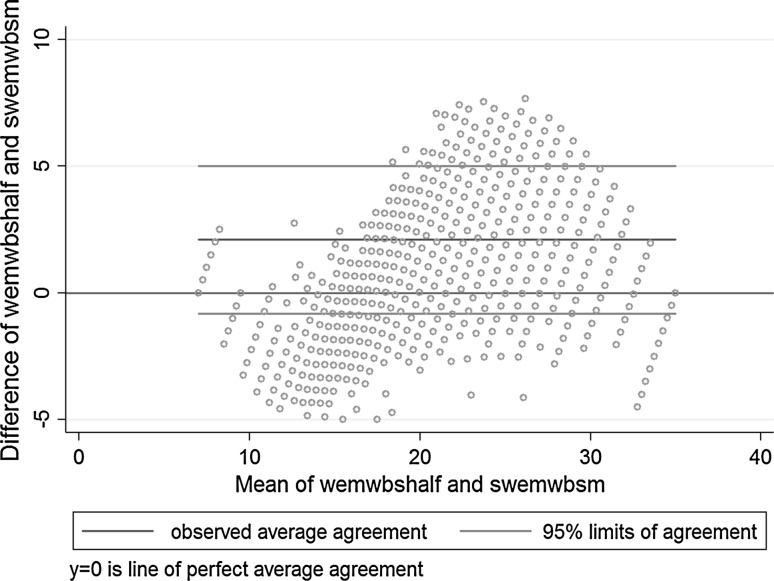
PURPOSE: The Warwick-Edinburgh Mental Well-being Scale (WEMWBS), 14 positively worded statements, is a validated instrument to measure mental wellbeing on a population level. Less is known about the population distribution of the shorter seven-item version (SWEMWBS) or its performance as an instrument to measure wellbeing. METHODS: Using the Health Survey for England 2010-2013 (n = 27,169 adults aged 16+, nationally representative of the population), age- and sex-specific norms were estimated using means and percentiles. Criterion validity was examined using: (1) Spearman correlations (ρ) for SWEMWBS with General Health Questionnaire (GHQ-12), happiness index, EQ-VAS (2) a multinomial logit model with SWEMWBS (low, medium and high wellbeing) as the outcome and demographic, social and health behaviours as explanatory variables. Relative validity was examined by comparing SWEMWBS with WEMWBS using: (1) Spearman correlations (continuous data), and (2) the weighted kappa statistic (categorical), within population subgroups. RESULTS: Mean (median) SWEMWBS was 23.7 (23.2) for men and 23.2 (23.2) for women (p = 0.100). Spearman correlations were moderately sized for the happiness index (ρ = 0.53, P < 0.001), GHQ-12 (ρ = -0.52, p < 0.001) and EQ-VAS (ρ = 0.40, p < 0.001). Participants consuming <1 portion of fruit and vegetables a day versus ≥5 (odds ratio = 1.43 95% Confidence Interval = (1.22-1.66)) and current smokers versus non-smokers (1.28 (1.15-1.41)) were more likely to have low vs medium wellbeing. Participants who binge drank versus non-drinkers were less likely to have high versus medium wellbeing (0.81 (0.71-0.92)). Spearman correlations between SWEMWBS and WEMWBS were above 0.95; weighted kappa statistics showed almost perfect agreement (0.79-0.85). CONCLUSION: SWEMWBS distinguishes mental wellbeing between subgroups, similarly to WEMWBS, but is less sensitive to gender differences.
Overview
The claims and statistics of this paper haven’t been checked yet.
Free: it reads the open-access text and checks the first 5 claims that cite a source we can check. Create a free account to check every claim.
Integrity signals
Registry
Cites
Statistics
Figures
Verification
Claims the paper makes
The claims and statistics of this paper haven’t been checked yet.
Free: it reads the open-access text and checks the first 5 claims that cite a source we can check. Create a free account to check every claim.
Claims other papers make about this one
Each is checked against this paper’s own text: does it say what the citing paper says it does?
The source backs part of the claim, not all of it — or backs it for a different population, condition or comparison.
In the citing paper
“Internal validity of the SWEMWBS has been demonstrated as good to excellent (α = 0.84; Fat et al., 2017).”
From Behind the masks: A cross-sectional study on intolerance of uncertainty, perceived vulnerability to disease and psychological flexibility in relation to state anxiety and wellbeing during the COVID-19 pandemic (2021) · cites this paper as Fat et al., 2017
Experimental — accuracy not yet measuredThe cited source says what the claim attributes to it.
In the citing paper
“Mean pre-intervention scores suggested at the beginning of the study participants were within the ‘low’ wellbeing range (below 19.3; Ng Fat et al., 2017) and were experiencing COVID-related distress (above 6 out of 10).”
From ACTing towards better living during COVID-19: The effects of Acceptance and Commitment therapy for individuals affected by COVID-19 (2022) · cites this paper as Ng Fat et al., 2017
The cited source says what the claim attributes to it.
In the citing paper
“when compared with normative comparison data, wellbeing levels, in particular, remained lower than the published norms”
From Mental health during the COVID-19 pandemic: exploring the role of psychological flexibility and stress-related variables. (2023) · cites this paper as Fat et al., 2017
Self-check
Percentages, sums and reported differences re-computed from the paper’s own numbers.
The self-check needs the paper’s full text.
Citations
Cites
The Measurement of Observer Agreement for Categorical Data
Landis, J. R., & Koch, G. G. (1977) · Biometrics · doi:10.2307/2529310 · Cited by 81,148 · cited 1×
“To assess the strength of agreement, we used the Landis and Koch classification [26]: slight: 0–0.”
MethodCoefficient Alpha and the Internal Structure of Tests
Cronbach, L. J. (1951) · Psychometrika · doi:10.1007/bf02310555 · Cited by 43,931
On Happiness and Human Potentials: A Review of Research on Hedonic and Eudaimonic Well-Being
Ryan, R. M., & Deci, E. L. (2001) · Annual Review of Psychology · doi:10.1146/annurev.psych.52.1.141 · Cited by 11,567
The Warwick-Edinburgh Mental Well-being Scale (WEMWBS): development and UK validation
Tennant, R., Hiller, L., Fishwick, R., Platt, S., Joseph, S., Weich, S., Parkinson, J., Secker, J., & Stewart-Brown, S. (2007) · Health and Quality of Life Outcomes · doi:10.1186/1477-7525-5-63 · Cited by 5,031 · cited 4×
“Similar moderate correlations were found between SWEMWBS and GHQ12 and EQ-VAS, as had been previously demonstrated for WEMWBS [9].”
BackgroundMethodResultInfluentialSelf-citationSubjective wellbeing, health, and ageing
Steptoe, A., Deaton, A., & Stone, A. A. (2015) · The Lancet · doi:10.1016/s0140-6736(13)61489-0 · Cited by 2,455 · cited 1×
“It is linked with good physical health and with longevity among older adults [7].”
BackgroundIs well-being U-shaped over the life cycle?
Blanchflower, D. G., & Oswald, A. J. (2008) · Social Science & Medicine · doi:10.1016/j.socscimed.2008.01.030 · Cited by 1,830 · cited 2×
“Mental wellbeing has been found to have a U-shaped relationship with age [5, 6].”
Stewart-Brown, S., Tennant, A., Tennant, R., Platt, S., Parkinson, J., & Weich, S. (2009) · Health and Quality of Life Outcomes · doi:10.1186/1477-7525-7-15 · Cited by 1,251
Self-citationGiornale Italiano di Psicologia
Amerio, P., Anolli, L., Cornoldi, C., Galli, P. F., Gerbino, W., Mosconi, G., Nicoletti, R., Palmonari, A., Parisi, D., Poli, M., et al. (2006) · Archivio istituzionale della ricerca (Alma Mater Studiorum Università di Bologna) · Cited by 713
Time-Limit Tests: Estimating their Reliability and Degree of Speeding
Cronbach, L. J., & Warrington, W. G. (1951) · Psychometrika · doi:10.1007/bf02289113 · Cited by 677
How Can Measures of Subjective Well-Being Be Used to Inform Public Policy?
Dolan, P., & White, M. P. (2007) · Perspectives on Psychological Science · doi:10.1111/j.1745-6916.2007.00030.x · Cited by 416 · cited 1×
“to assess progress outside of the usual economic and material indicators [1–3].”
Background
Research works printed but not linked: 6
- Tinkler, L. (2015). Measuring National Well-being: Personal Well-being in the UK, 2014–2015. In ONS. (Ed.), Statistical Bulletin.: ONS.
- McManus S Chanfreau J Lloyd C Predictors of wellbeing 2013 London Natcen
- Natcen Social Research, and University College Medical School Health Survey for England, 2010 [computer file] 2015 3 Colchester UK Data Archive
- NatCen Social Research, University College London, and Department of Epidemiology and Public Health Health Survey for England, 2013 [computer file] 2015 Colchester UK Data Archive
- NatCen Social Research, University College London, and Department of Epidemiology and Public Health Health Survey for England, 2011 [computer file] 2013 Colchester UK Data Archive
- NatCen Social Research, University College London, and Department of Epidemiology and Public Health Health Survey for England, 2012 [computer file] 2014 Colchester UK Data Archive
Cited by
Items 101–200 of 549
Age Appropriateness of the Self-Report Strengths and Difficulties Questionnaire
Black, L., Mansfield, R., & Panayiotou, M. (2020) · Assessment · doi:10.1177/1073191120903382 · Cited by 34
“However, self-reported psychological well-being in the current sample (M = 23.88, SD = 5.33) was similar to the average found in a nationally representative sample of 16- to 24-year-olds (M = 23.57, SD = 3.61; Ng Fat et al., 2017).”
ResultInfluentialPalmer, M. L., Tarver, J., Leno, V. C., Perez, J. P., Frayne, M., Slonims, V., Pickles, A. R., Scott, S., Charman, T., & Simonoff, E. A. (2022) · Journal of Autism and Developmental Disorders · doi:10.1007/s10803-021-05421-x · Cited by 41
Prudenzi, A., Graham, C. D., Rogerson, O., & O’Connor, D. B. (2023) · Psychology & Health · doi:10.1080/08870446.2021.2020272 · Cited by 27
“Although it is not possible to make direct comparisons with the levels of wellbeing pre-pandemic, the reported levels of wellbeing across the three time points were poor by comparison with the UK general population norms (Fat et al., 2017).”
ResultBastoni, S., Wrede, C., Ammar, A., Braakman‐Jansen, A., Sanderman, R., Gaggioli, A., Trabelsi, K., Masmoudi, L., Boukhris, O. F., Glenn, J. M., et al. (2021) · International Journal of Environmental Research and Public Health · doi:10.3390/ijerph18052619 · Cited by 34
“This 7-item version has recently been validated for the general population [21] and was available in Dutch [22,23] and Italian [24].”
BackgroundWell-being app to support young people during the COVID-19 pandemic: randomised controlled trial
Thabrew, H., Boggiss, A. L., Lim, D. H., Schache, K., Morunga, E., Cao, N., Cavadino, A., & Serlachius, A. S. (2022) · BMJ Open · doi:10.1136/bmjopen-2021-058144 · Cited by 32
Pescheny, J. V., Gunn, L. H., Pappas, Y., & Randhawa, G. (2019) · Journal of Public Health · doi:10.1093/pubmed/fdz155 · Cited by 30
Lamont, R. A., Calitri, R., Mounce, L. T. A., Hollands, L., Dean, S. G., Code, C., Sanders, A., & Tarrant, M. (2022) · Applied Psychology Health and Well-Being · doi:10.1111/aphw.12348 · Cited by 31
A Longitudinal Examination of Stress and Mental Ill-/Well-Being in Elite Football Coaches
Baldock, L., Cropley, B., Mellalieu, S. D., & Neil, R. (2022) · The Sport Psychologist · doi:10.1123/tsp.2021-0184 · Cited by 25
Wiggins, M., Sawtell, M., Wiseman, O., McCourt, C., Eldridge, S. M., Hunter, R. M., Bordea, E., Mustard, C., Hanafiah, A. N., Hatherall, B., et al. (2020) · BMC Health Services Research · doi:10.1186/s12913-020-05751-z · Cited by 25
“Emotional wellbeing Short Warwick-Edinburgh Mental Wellbeing Scale (SWEMWBS) [36] ✓ ✓ ✗ ✗”
Smyth, N., Thorn, L., Wood, C., Hall, D., & Lister, C. (2022) · Healthcare · doi:10.3390/healthcare10060978 · Cited by 46
“Scores below one SD of the mean were categorised as ‘low’ wellbeing, scores within one SD of the sample mean were categorised as ‘average’ wellbeing and scores above one SD of the mean were categorised as ‘high’ wellbeing [57].”
BackgroundMethodInfluentialJohn, A. M., Lee, S. C., Puchades, A., DelPozo‐Baños, M., Morgan, K., Page, N., Moore, G. F., & Murphy, S. (2022) · Journal of Adolescence · doi:10.1002/jad.12102 · Cited by 34
Dingle, G. A., Han, R., Alhadad, S. S. J., Beckman, E. M., Bentley, S. V., Gomersall, S. R., Hides, L. M., Maccallum, F., McKimmie, B. M., Rossa, K. R., et al. (2024) · Australian & New Zealand Journal of Psychiatry · doi:10.1177/00048674241233111 · Cited by 31
Kyytsönen, M., Vehko, T., Anttila, H., & Ikonen, J. (2023) · PLOS Digital Health · doi:10.1371/journal.pdig.0000245 · Cited by 35
“The second scale was the 7-item Short Warwick-Edinburgh Mental Well-being Scale [51].”
MethodHeaslip, V., Vahdaninia, M., Hind, M., Darvill, T., Staelens, Y., O'Donoghue, D., Drysdale, L., Lunt, S., Hogg, C., Allfrey, M., et al. (2019) · Health & Place · doi:10.1016/j.healthplace.2019.102273 · Cited by 28
Shannon, S., Breslin, G., Prentice, G., & Leavey, G. (2020) · Psychiatry Research · doi:10.1016/j.psychres.2020.113393 · Cited by 23
“Total scores can range from 14 through to 70, with higher scores indicating higher well-being (Stranges et al., 2014; Fat et al., 2017).”
Wood, C., Barton, J., & Smyth, N. (2021) · Journal of Health Psychology · doi:10.1177/1359105321999710 · Cited by 24
“A one sample t-test was conducted to compare the SWEMWBS score for the sample to the mean population score according to the Fat et al. (2017).”
InfluentialFawns‐Ritchie, C., Altschul, D., Campbell, A., Huggins, C. F., Nangle, C., Dawson, R., Edwards, R., Flaig, R., Hartley, L., Levein, C., et al. (2021) · Wellcome Open Research · doi:10.12688/wellcomeopenres.16987.1 · Cited by 20
Working conditions and well-being in UK social care and social work during COVID-19
Ravalier, J. M., McFadden, P., Gillen, P. A., Mallett, J., Nicholl, P., Neill, R. D., Manthorpe, J., Moriarty, J., Schroder, H. S., & Currie, D. (2022) · Journal of Social Work · doi:10.1177/14680173221109483 · Cited by 46
“UK norm scoring on the SWEMWBS has been found to be 23.7 for males and 23.6 for females (Ng Fat et al., 2017), indicating our sample as a whole had poorer psychological well-being than the national average.”
BackgroundInfluentialRakhimov, A., Realo, A., & Tang, N. K. Y. (2022) · Journal of Personality Assessment · doi:10.1080/00223891.2022.2093731 · Cited by 31
Severin, M. I., Akpetou, L. K., Annasawmy, P. A., Asuquo, F. E., Beckman, F., Benomar, M., Jaya-Ram, A., Malouli, M., Mees, J., Monteiro, I., et al. (2023) · Frontiers in Psychology · doi:10.3389/fpsyg.2023.1130596 · Cited by 31
Building resilience and well-being for post-covid adolescents through outdoor adventure
Allan, J. F., Doran, A., Jones, R., & Farrell, S. (2024) · Journal of Adventure Education & Outdoor Learning · doi:10.1080/14729679.2024.2312920 · Cited by 33
Content Moderator Mental Health, Secondary Trauma, and Well-being: A Cross-Sectional Study
Spence, R., Bifulco, A., Bradbury, P., Martellozzo, E., & DeMarco, J. (2024) · Cyberpsychology, Behavior, and Social Networking · doi:10.1089/cyber.2023.0298 · Cited by 29
“37 However, this sample was skewed toward lower scores.”
Konaszewski, K., Niesiobędzka, M., & Surżykiewicz, J. (2021) · Health and Quality of Life Outcomes · doi:10.1186/s12955-021-01716-w · Cited by 27
Baldwin, S., Malone, M., Murrells, T., Sandall, J., & Bick, D. (2021) · BMC Public Health · doi:10.1186/s12889-021-11870-x · Cited by 29
Solomon-Moore, E., Lambert, J. D., Grey, E., Gillison, F., Townsend, N. P., Busam, B., Velemis, K., Millen, C., Baber, F., & Griffin, T. L. (2022) · BMC Public Health · doi:10.1186/s12889-022-13888-1 · Cited by 29
Wood, C., Barton, J., & Wicks, C. L. (2022) · International Journal of Environmental Research and Public Health · doi:10.3390/ijerph192013166 · Cited by 32
“67 [43] at baseline but not at any other timepoints; whilst female wellbeing was significantly lower than the UK normative score of 23.”
BackgroundMethodResultInfluentialMeasuring Population Mental Health
OECD (2023) · OECD eBooks · doi:10.1787/5171eef8-en · Cited by 53
Extending the Comfort Zone: Building Resilience in Older People With Long-Term Conditions
Robinson, M., Hanna, E. S., Raine, G., & Robertson, S. (2017) · Journal of Applied Gerontology · doi:10.1177/0733464817724042 · Cited by 25
Dong, A., Zhang, X., Zhou, H., Chen, S., Zhao, W., Wu, M., Guo, J., & Guo, W. (2019) · Health and Quality of Life Outcomes · doi:10.1186/s12955-019-1120-2 · Cited by 23
“Whether the SWEMWBS shows similar properties to the WEMWBS has yet to be explored [45].”
MethodNorman, K., Govindjee, A., Norman, S. R., Godoy, M., Cerrone, K. L., Kieschnick, D. W., & Kassler, W. J. (2020) · JMIR Formative Research · doi:10.2196/17424 · Cited by 26
“Structured measures included the Positive States of Mind Scale (PSOM) [43], Posttraumatic Growth Inventory (PTGI) [44], PTSD checklist for the Diagnostic and Statistical Manual of Mental Disorders, Fifth Edition (PCL-5) [45], Patient Health Questionnaires (PHQs) [46], Short Warwick-Edinburgh Mental Well-Being Scale (S…”
MethodInfluentialBartolomé-Valenzuela, M., Pereda, N., & Guilera, G. (2024) · Child Abuse & Neglect · doi:10.1016/j.chiabu.2024.106770 · Cited by 22
Kyron, M. J., Podlogar, M. C., Joiner, T. E., McEvoy, P. M., Page, A. C., & Lawrence, D. M. (2020) · Psychological Assessment · doi:10.1037/pas0000949 · Cited by 23
Health, well‐being, and social support in older Australian lesbian and gay care‐givers
Alba, B., Lyons, A., Waling, A., Minichiello, V., Hughes, M., Barrett, C., Fredriksen‐Goldsen, K. I., & Edmonds, S. (2019) · Health & Social Care in the Community · doi:10.1111/hsc.12854 · Cited by 25
Fowler‐Davis, S., Barnett, D., Kelley, J. F., & Curtis, D. (2019) · Journal of Alzheimer s Disease · doi:10.3233/jad-190844 · Cited by 21
“The Warwick-Edinburgh Mental 115 Wellbeing Scale (short form) is a positively worded 116 validated scale to measure wellbeing measured on a 117 five-point Likert Scale [30, 31] and was used with 118 both PwD and FC.”
MethodThabrew, H., Chubb, L. A., Kumar, H., & Fouché, C. (2022) · JMIR Pediatrics and Parenting · doi:10.2196/29164 · Cited by 33
Hauch, D., Fjorback, L. O., & Juul, L. (2022) · Scandinavian Journal of Public Health · doi:10.1177/14034948221110002 · Cited by 22
Introducing the READY Study: DHH Young people’s Well-Being and Self-Determination
Young, A. M., Espinoza, F., Dodds, C., Squires, G., Rogers, K., Chilton, H., & O’Neill, R. (2023) · The Journal of Deaf Studies and Deaf Education · doi:10.1093/deafed/enad002 · Cited by 26
Economides, M., Male, R., Bolton, H., & Cavanagh, K. (2023) · SLEEP · doi:10.1093/sleep/zsad053 · Cited by 25
Hanzlová, R., & Lynn, P. J. (2023) · Health and Quality of Life Outcomes · doi:10.1186/s12955-023-02192-0 · Cited by 22
McFadden, P., MacLochlainn, J., Manthorpe, J., Naylor, R., Schroder, H. S., McGrory, S., Ravalier, J. M., Nicholl, P., Currie, D., Kirby, K., et al. (2024) · The British Journal of Social Work · doi:10.1093/bjsw/bcae014 · Cited by 26
Salman, A., Sellami, M., Al-Mohannadi, A. S., & Chun, S. (2019) · International Journal of Environmental Research and Public Health · doi:10.3390/ijerph16193596 · Cited by 23
Cleofas, J. V., & Alibudbud, R. C. (2023) · SAGE Open Nursing · doi:10.1177/23779608231158980 · Cited by 22
Wicks, C. L., Barton, J., Andrews, L., Orbell, S., SANDERCOCK, G. R. H., & Wood, C. (2023) · International Journal of Environmental Research and Public Health · doi:10.3390/ijerph20065083 · Cited by 25
Cain, S. M., Rooney, E., Cacace, S. C., Post, A., Russell, K., Rasmussen, S. A., Baker, J. C., & Cramer, R. J. (2024) · BMC Public Health · doi:10.1186/s12889-024-19448-z · Cited by 23
Crook, R., Gooding, P. A., Whittaker, C., Edge, D., Faichnie, C., Westwood, M., & Peters, S. (2021) · Studies in Graduate and Postdoctoral Education · doi:10.1108/sgpe-08-2020-0056 · Cited by 26
Rothbaum, B., Etengoff, C. M., & Uribe, E. (2021) · Journal of Community Psychology · doi:10.1002/jcop.22781 · Cited by 20
Hobbs, C., Jelbert, S. A., Santos, L. R., & Hood, B. M. (2022) · PLoS ONE · doi:10.1371/journal.pone.0263514 · Cited by 23
“The SWEMWBS has been validated for use in the general population [55].”
MethodWilding, S., O'Connor, D. B., Ferguson, E., Cleare, S., Wetherall, K., O’Carroll, R. E., Robb, K. A., & O’Connor, R. C. (2022) · Scientific Reports · doi:10.1038/s41598-022-24240-3 · Cited by 24
Han, J., McGillivray, L., Wong, Q. J., Werner-Seidler, A., Wong, I., Calear, A., Christensen, H., & Torok, M. (2020) · JMIR Research Protocols · doi:10.2196/23655 · Cited by 17
Wilkie, L., Fisher, Z., & Kemp, A. H. (2022) · Sustainability · doi:10.3390/su14159605 · Cited by 25
“Spearman correlations between SWEMWBS and WEMWBS are above 0.95, demonstrating the effectiveness of the short version [66].”
MethodInfluentialElnaem, M. H., Mubarak, N., Karattuthodi, M. S., Barakat, M. M., Abdelaziz, D. H., Mansour, N. O., Thabit, A. K., Ramatillah, D. L., Al‐Jumaili, A. A., Syed, N. K., et al. (2022) · Frontiers in Public Health · doi:10.3389/fpubh.2022.1011376 · Cited by 27
Black, L., Humphrey, N., Panayiotou, M., & Marquez, J. (2023) · Assessment · doi:10.1177/10731911231158623 · Cited by 25
Re-examining the association between the age of learning one is autistic and adult outcomes
Leung, F. Y. N., Shah, P., Mason, D., & Livingston, L. A. (2023) · Autism · doi:10.1177/13623613231173056 · Cited by 20
“…status (Lloyd & Devine, 2012; Mason et al., 2018; Skevington & McCrate, 2012), independent living status (Lawson et al., 2020; Patrício et al., 2014), employment status (Lloyd & Devine, 2012; Mason et al., 2018; Patrício et al., 2014), and income (McQuaid et al., 2022; Ng Fat et al., 2017).”
BackgroundMoghaddam, N. G., Morris, J. L., Bayliss, K., & Dawson, D. L. (2023) · Journal of Contextual Behavioral Science · doi:10.1016/j.jcbs.2023.06.003 · Cited by 24
The effect of local unemployment on health: A longitudinal study of Irish mothers 2001-2011
Briody, J., Doyle, O., & Kelleher, C. C. (2020) · Economics & Human Biology · doi:10.1016/j.ehb.2020.100859 · Cited by 18
Serlachius, A., Schache, K., Boggiss, A., Lim, D., Wallace-Boyd, K., Brenton-Peters, J., Buttenshaw, E., Chadd, S., Cavadino, A., Cao, N., et al. (2020) · JMIR Research Protocols · doi:10.2196/23716 · Cited by 17
The mental health and well-being profile of young adults using social media
Cara, N. H. D., Winstone, L., Sloan, L., Davis, O. S. P., & Haworth, C. M. A. (2022) · npj Mental Health Research · doi:10.1038/s44184-022-00011-w · Cited by 30
Wright, I., Travers-Hill, E., Gracey, F., Troup, J., Parkin, K., Casey, S., & Kim, Y. (2020) · The Cognitive Behaviour Therapist · doi:10.1017/s1754470x20000513 · Cited by 16
Venturo‐Conerly, K. E., Johnson, N. E., Osborn, T. L., Puffer, E. S., Rusch, T. W., Ndetei, D. M., Wasanga, C., Mutiso, V., Musyimi, C. W., & Weisz, J. R. (2022) · Trials · doi:10.1186/s13063-022-06394-7 · Cited by 20
“(SWEMBS)–7 The Short Warwick-Edinburgh Mental Wellbeing Scale (SWEMBS) will be used to determine subjective wellbeing of participants [32].”
MethodMullens, F., & Laurijssen, I. (2024) · BMC Public Health · doi:10.1186/s12889-024-19161-x · Cited by 47
“Even though SWEMWBS construct validity was confirmed in diverse populations (e.g., [13, 44]), in our study (longitudinal) confirmatory factor analyses led us to exclude two items (which improved model fit from poor to fair as RMSEA changed from 0.125 to 0.077 and CFI from 0.729 to 0.932), which…”
BackgroundInfluentialLyons, A., Alba, B., Waling, A., Minichiello, V., Hughes, M., Fredriksen‐Goldsen, K. I., Edmonds, S., Blanchard, M., & Irlam, C. (2020) · Journal of Aging and Health · doi:10.1177/0898264320952910 · Cited by 20
“Research has found that this shorter, seven-item version of the scale has similar validity to the longer version (Fat et al., 2017).”
BackgroundInternational Nurse Migration Experience of the First Two Years: A Mixed Methods Study
Pressley, C., Newton, D., Sanderson, L., Simkhada, B., Stephenson, J. R., Duodu, P. A., Gillibrand, W. P., Pallam, M. C., & Garside, J. (2024) · Journal of Advanced Nursing · doi:10.1111/jan.16543 · Cited by 20
Cinderby, S., Archer, D., Mehta, V. K., Neale, C., Opiyo, R. O., Pateman, R. M., Muhoza, C., Adelina, C., & Tuhkanen, H. (2021) · Frontiers in Sociology · doi:10.3389/fsoc.2021.729453 · Cited by 19
Mertens, E. C. A., van der Schalk, J., Siezenga, A. M., & van Gelder, J. (2022) · Internet Interventions · doi:10.1016/j.invent.2022.100509 · Cited by 17
Davies, J., McKenna, M., Denner, K., Bayley, J., & Morgan, M. (2022) · Journal of Mental Health · doi:10.1080/09638237.2022.2069694 · Cited by 19
Popay, J., Halliday, E. C., Mead, R., Townsend, A. F., Akhter, N., Bambra, C. L., Barr, B., de Cuevas, R. A., Daras, K., Egan, M., et al. (2023) · Public Health Research · doi:10.3310/grma6711 · Cited by 18
Turecek, S., Brymer, E., & Rahimi‐Golkhandan, S. (2024) · Psychology of sport and exercise · doi:10.1016/j.psychsport.2024.102769 · Cited by 27
McFadden, P., Moriarty, J., Schroder, H. S., Gillen, P. A., Manthorpe, J., & Mallett, J. (2020) · The British Journal of Social Work · doi:10.1093/bjsw/bcz165 · Cited by 18
Williams, A. J., Menneer, T., Sidana, M., Walker, T., Maguire, K., Mueller, M., Paterson, C., Leyshon, M., Leyshon, C., Seymour, E., et al. (2021) · JMIR Public Health and Surveillance · doi:10.2196/25037 · Cited by 16
Dunne, A., Haake, S. J., Quirk, H., & Bullas, A. M. (2021) · International Journal of Environmental Research and Public Health · doi:10.3390/ijerph182413072 · Cited by 27
“2 for males and females [42]) and the difference might be considered clinically significant [33].”
BackgroundGooding, P., Crook, R., Westwood, M., Faichnie, C., & Peters, S. (2023) · Studies in Graduate and Postdoctoral Education · doi:10.1108/sgpe-04-2022-0032 · Cited by 14
Xiong, W., Quinney, B. A., King, D. L., Ali, K., Radünz, M., Zhao, Y., Kyrios, M., & Fassnacht, D. B. (2025) · International Journal of Intercultural Relations · doi:10.1016/j.ijintrel.2025.102187 · Cited by 17
Bellis, M. A., Sharp, C., Hughes, K. E., & Davies, A. R. (2021) · Frontiers in Public Health · doi:10.3389/fpubh.2021.585715 · Cited by 18
Efficacy of the Tuned In music emotion regulation program in international university students
Vidas, D., Nelson, N. L., & Dingle, G. A. (2023) · Psychology and Health · doi:10.1080/08870446.2023.2197007 · Cited by 23
“Published norms from a UK sample of 16–24 year olds showed the average for this age-group to be 23.57 ( SD = 3.61) (Ng Fat et al., 2017).”
InfluentialPankow, K., King, N., Li, M., Byun, J., Jugoon, L., Rivera, D., Dimitropoulos, G., Patten, S. B., Kingslake, J., Keown‐Stoneman, C. D. G., et al. (2023) · Early Intervention in Psychiatry · doi:10.1111/eip.13458 · Cited by 16
“A score of ≤ 19 was set as the threshold for low well-being (Ng Fat et al., 2017).”
BackgroundCrane, M., Joly, L., Daly, B., Gage, H., Manthorpe, J., Cetrano, G., Ford, C., & Williams, P. (2023) · Health and Social Care Delivery Research · doi:10.3310/wxuw5103 · Cited by 25
Zayed, K. N., Omara, E. N., Al-Shamli, A., Al-Rawahi, N., Haramlah, A. A., Al-Attiyah, A. A., Al-Hadabi, B., Al-Yarobi, A., Al-Busafi, M., & Al-Jadidi, K. (2023) · BMC Psychology · doi:10.1186/s40359-023-01443-5 · Cited by 18
Wilson, J. J., McMullan, I., Blackburn, N. E., Klempel, N., Yakkundi, A., Armstrong, N., Brolly, C., Butler, L., Barnett, Y., Jacob, L., et al. (2021) · Journal of Public Health · doi:10.1093/pubmed/fdab009 · Cited by 14
Brazier, A., Larson, E., Xu, Y., Judah, G., Egan, M., Burd, H., & Darzi, A. W. (2022) · Anaesthesia · doi:10.1111/anae.15643 · Cited by 20
Music listening as a coping resource in domestic and international university students
Vidas, D., Nelson, N. L., & Dingle, G. A. (2022) · Psychology of Music · doi:10.1177/03057356211066964 · Cited by 21
Ashworth, E., Putwain, D. W., McLoughlin, S., Saini, P., Chopra, J., Rosser, B. A., & Eames, C. (2022) · Adversity and Resilience Science · doi:10.1007/s42844-022-00054-0 · Cited by 22
Wilding, S., O'Connor, D. B., Ferguson, E., Wetherall, K., Cleare, S., O’Carroll, R. E., Robb, K. A., & O’Connor, R. C. (2022) · Psychiatry Research · doi:10.1016/j.psychres.2022.114876 · Cited by 17
Vaingankar, J. A., Abdin, E., van Dam, R. M., Chong, S. A., Tan, L. W. L., Sambasivam, R., Seow, E., Chua, B. Y., Wee, H. L., Lim, W. Y., et al. (2020) · BMC Public Health · doi:10.1186/s12889-020-08569-w · Cited by 15
“While similar findings were observed with the SWEMWBS in UK [40], the association of marital status with mental well-being components has not been consistent [41, 42].”
ResultMann, E. M., Heesch, K. C., Rachele, J. N., Burton, N. W., & Turrell, G. (2022) · BMC Public Health · doi:10.1186/s12889-022-12905-7 · Cited by 18
“This study’s findings at the individual-level are consistent with single-level studies of the UK population showing that adults with a low SEP, measured as education and occupation [6] or income, [15] have lower MWB.”
MethodResultYiu, H. H. E., Buckell, J., Petrou, S., Stewart-Brown, S. L., & Madan, J. J. (2023) · Social Science & Medicine · doi:10.1016/j.socscimed.2023.115928 · Cited by 15
Self-citationThe COVID-19 Pandemic’s Impact on UK Older People’s Social Workers: A Mixed-Methods Study
MacLochlainn, J., Manthorpe, J., Mallett, J., McGrory, S., Ravalier, J. M., Nicholl, P., Schroder, H. S., Currie, D., & McFadden, P. (2023) · The British Journal of Social Work · doi:10.1093/bjsw/bcad139 · Cited by 17
Measuring sense of place in project environments to promote positive mental wellbeing
Lingard, H. C., & Turner, M. (2023) · International Journal of Project Management · doi:10.1016/j.ijproman.2023.102503 · Cited by 23
Mertens, E. C. A., Siezenga, A. M., van der Schalk, J., & van Gelder, J. (2023) · Prevention Science · doi:10.1007/s11121-023-01609-y · Cited by 17
“For the interim measurements, the short version (7 items; Ng Fat et al., 2017) was used (T2 α = .79; T3 α = .81).”
MethodChmiel, M. (2024) · Journal of Communication Management · doi:10.1108/jcom-03-2024-0046 · Cited by 21
Thomas, J., Bowes, N., Meyers, R. W., & Thirlaway, K. (2021) · Mental health and physical activity · doi:10.1016/j.mhpa.2021.100407 · Cited by 13
“6) provided a benchmark for comparison of sample scores with general population data (Fat et al., 2017).”
BackgroundInfluentialMental health literacy: A focus on daily life context for population health measurement
Chua, K., Hahn, J. S., Farrell, S., Jolly, A., Khangura, R. K., & Henderson, C. (2022) · SSM - Mental Health · doi:10.1016/j.ssmmh.2022.100118 · Cited by 20
Sumner, R. C., & Kinsella, E. L. (2022) · SSM - Mental Health · doi:10.1016/j.ssmmh.2022.100099 · Cited by 13
“19) was below general population norms (Fat et al., 2017).”
InfluentialRakow, K. E., Priestley, M. J., Byrom, N., Foster, J., & Dommett, E. J. (2024) · Higher Education · doi:10.1007/s10734-024-01365-0 · Cited by 27
“…components include emotions, mood, and satisfaction with life, eudai-monia includes sense of competence, engagement and interest in activities, commitment to meaningful goals and activities, and supporting others and being supported (Diener et al., 2010; Dodd et al., 2021; Ng Fat et al., 2017).”
Hong, Y., Jiang, X., Zhang, T., Luo, N., & Yang, Z. (2023) · Health and Quality of Life Outcomes · doi:10.1186/s12955-023-02108-y · Cited by 14
“However, the SWEMWBS was found to have preferable psychometric properties than the full version given its robust measurement properties and with the advantage of its additional brevity, and has been widely used in many population studies globally [8].”
BackgroundMethodMack, D. E., Vo, K. T., & Wilson, P. M. (2024) · Journal of Happiness Studies · doi:10.1007/s10902-024-00715-0 · Cited by 17
“Support for SWEMWBS score reliability has been forthcoming (i.e., 0.84; Ng Fat et al., 2017; Stewart-Brown et al., 2009).”
InfluentialCaregiver Employees’ Mental Well-Being in Hong Kong
Lee, M. M.-S., Yeoh, E., Wang, K., & Wong, E. L. (2024) · Healthcare · doi:10.3390/healthcare12101013 · Cited by 16
Wilson, C., Butler, N., Quigg, Z., Moore, D., & Bellis, M. A. (2024) · BMC Medicine · doi:10.1186/s12916-024-03821-1 · Cited by 19
Duan, W., Fei, Y., & Tang, X. (2019) · Child Indicators Research · doi:10.1007/s12187-019-09637-3 · Cited by 15
“The SWEMWBS showed strong psychometric characteristics in different samples (Bartram et al. 2013; Fat et al. 2016).”
BackgroundMethodAsiamah-Asare, B. K. Y., Thomas, E., Affandi, J. S., Schammer, M., Brown, P. A., Pilbeam, M., Harris, C., Ellison, C., Kwaśnicka, D., Powell, D., et al. (2021) · International Journal of Environmental Research and Public Health · doi:10.3390/ijerph182212264 · Cited by 16
Roberts, K., Travers-Hill, E., Coker, S., Troup, J., Casey, S., Parkin, K., & Kim, Y. (2021) · The Cognitive Behaviour Therapist · doi:10.1017/s1754470x21000258 · Cited by 11
Metadata
- Authors
- Ng Fat, L., Scholes, S., Boniface, S., Mindell, J., & Stewart-Brown, S.
- Affiliations
- University College London (GB)
- King's College London (GB)
- University of Warwick (GB)
- Venue
- Quality of Life Research
- Published
- 2016-11-16
- Volume
- 26
- Issue
- 5
- Pages
- 1129-1144
- ISSN
- 0962-9343 (ISSN-L)
- 1573-2649
- PMC
- PMC5376387
- OpenAlex
- W2553379941
- Cited by
- 548
- References
- 27
- Citations by year
- 2026: 53 · 2025: 73 · 2024: 86 · 2023: 82 · 2022: 91 · 2021: 83 · 2020: 44 · 2019: 20 · 2018: 11 · 2017: 4
- FWCI
- 18.32
- Type
- journal article
- Language
- en
- Open access
- hybrid
- doi.org
- Locations
- Quality of Life Research (publishedVersion, cc-by)
- PubMed Central (publishedVersion, cc-by)
- PubMed (publishedVersion)
- Warwick Research Archive Portal (University of Warwick) (acceptedVersion, cc-by)
- UCL Discovery (University College London) (submittedVersion)
- Research Portal (King's College London) (submittedVersion, cc-by)
- Funders
- University College London
- Topics
- Social Sciences › Psychology › Social Psychology › Psychological Well-being and Life Satisfaction
- Social Sciences › Decision Sciences › Management Science and Operations Research › Psychometric Methodologies and Testing
- Social Sciences › Economics, Econometrics and Finance › Economics and Econometrics › Health Systems, Economic Evaluations, Quality of Life
- Keywords
- psychological well-being, national standards, age- and sex-specific percentiles, criterion validity, relative validity, General Health Questionnaire, happiness index, EQ-VAS, fruit and vegetable intake, smoking, binge drinking, Health Survey for England, questionnaire agreement, mental health screening
- MeSH terms
- Adolescent, Adult, England, Female, Health Surveys, Humans, Male, Mental Health, Psychometrics, Quality of Life, Surveys and Questionnaires, Young Adult
About these checks
Registry, retraction, Cites and statistics results are computed, not judged, with one exception: a printed reference that no index lists is read once by a model before it counts as a citation error. Claims are extracted by a model and kept only when their quote appears verbatim in the text; each cited source is then checked, with a model’s help, for whether it says what the claim relies on. Those verdicts can be wrong — read the claim’s quote and the cited source before relying on one.
Statistics and arithmetic are recomputed, not judged.
Confidence bands are shown only for fields calibrated on our annotated test set. None is calibrated yet, so no band is shown.
What counts as a claim ›How we measure confidence ›How we check this ›
Are you an author, or do you see a problem with this page? Request a review
Data sources
Bibliographic data: Semantic Scholar, OpenAlex, Crossref.
Contains information from the Semantic Scholar Academic Graph Datasets, made available under the ODC Attribution License (ODC-BY 1.0).
Semantic Scholar’s data is described in: Kinney, R., et al. (2023). The Semantic Scholar Open Data Platform. arXiv:2301.10140.
