

COSMIN methodology for evaluating the content validity of patient-reported outcome measures: a Delphi study
Open accessThe DOI matches its Crossref record; 41 of the 41 references it cites were found in a registry or an index.
Abstract
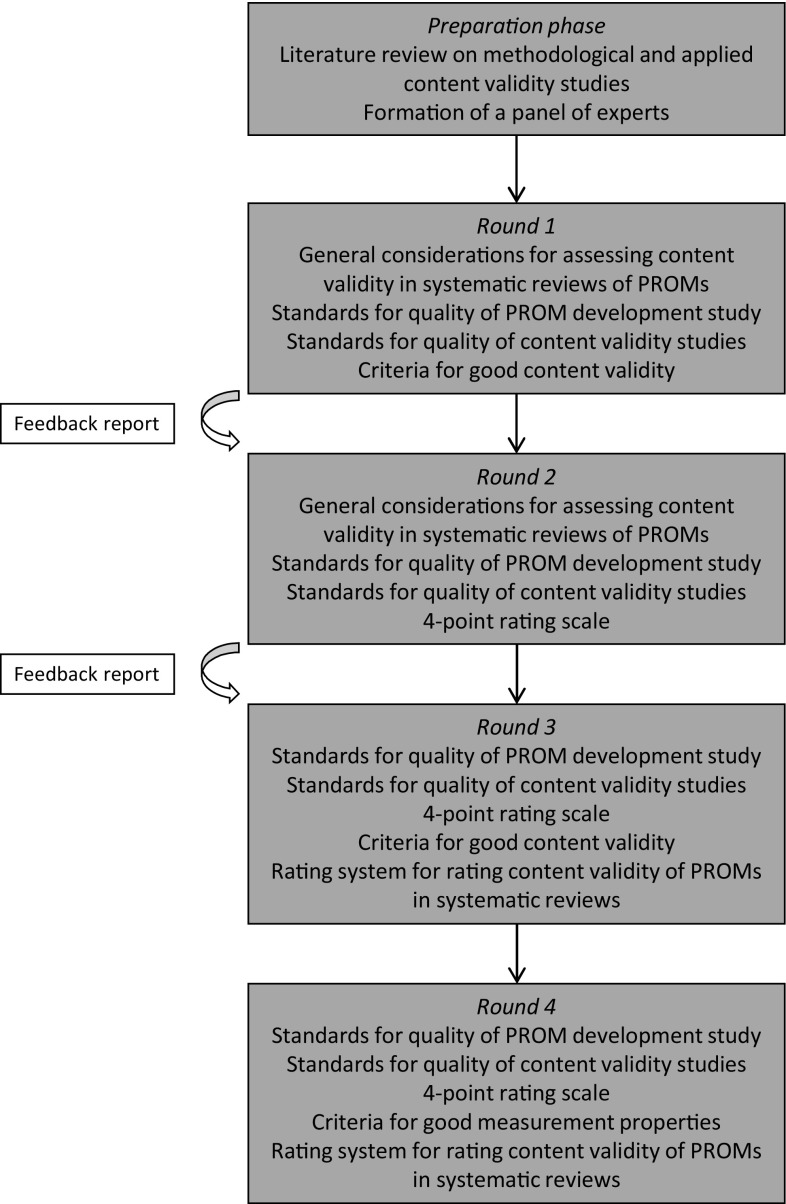
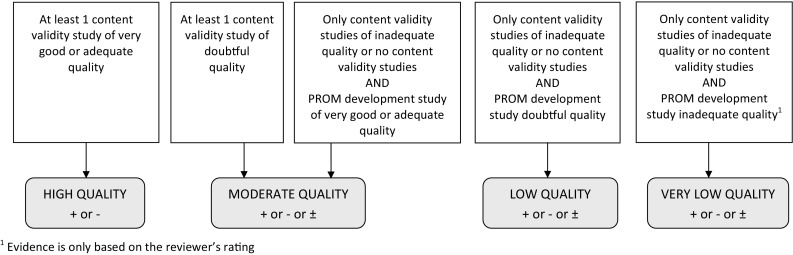
BACKGROUND: Content validity is the most important measurement property of a patient-reported outcome measure (PROM) and the most challenging to assess. Our aims were to: (1) develop standards for evaluating the quality of PROM development; (2) update the original COSMIN standards for assessing the quality of content validity studies of PROMs; (3) develop criteria for what constitutes good content validity of PROMs, and (4) develop a rating system for summarizing the evidence on a PROM's content validity and grading the quality of the evidence in systematic reviews of PROMs. METHODS: An online 4-round Delphi study was performed among 159 experts from 21 countries. Panelists rated the degree to which they (dis)agreed to proposed standards, criteria, and rating issues on 5-point rating scales ('strongly disagree' to 'strongly agree'), and provided arguments for their ratings. RESULTS: Discussion focused on sample size requirements, recording and field notes, transcribing cognitive interviews, and data coding. After four rounds, the required 67% consensus was reached on all standards, criteria, and rating issues. After pilot-testing, the steering committee made some final changes. Ten criteria for good content validity were defined regarding item relevance, appropriateness of response options and recall period, comprehensiveness, and comprehensibility of the PROM. DISCUSSION: The consensus-based COSMIN methodology for content validity is more detailed, standardized, and transparent than earlier published guidelines, including the previous COSMIN standards. This methodology can contribute to the selection and use of high-quality PROMs in research and clinical practice.
Overview
The claims and statistics of this paper haven’t been checked yet.
Free: it reads the open-access text and checks the first 5 claims that cite a source we can check. Create a free account to check every claim.
Integrity signals
Registry
Cites
Statistics
Figures
Verification
Claims the paper makes
The claims and statistics of this paper haven’t been checked yet.
Free: it reads the open-access text and checks the first 5 claims that cite a source we can check. Create a free account to check every claim.
Claims other papers make about this one
Each is checked against this paper’s own text: does it say what the citing paper says it does?
The source backs part of the claim, not all of it — or backs it for a different population, condition or comparison.
In the citing paper
“COSMIN requires that both experts and target population are involved in content validation for content validity to be considered adequate.”
From A systematic review of AI literacy scales (2024) · cites this paper as [54]
Experimental — accuracy not yet measuredThe source backs part of the claim, not all of it — or backs it for a different population, condition or comparison.
In the citing paper
“COSMIN considers content validity the most important measurement property of an instrument as it should be ensured that the instrument is relevant, comprehensive, and comprehensible with respect to the construct of interest and study population54.”
From A systematic review of AI literacy scales (2024) · cites this paper as [54]
Experimental — accuracy not yet measuredThe cited source says what the claim attributes to it.
In the citing paper
“published guidelines provide clear recommendations for the development and evaluation of self-report measures-the most prominent example is the consensus-based standards for the selection of health measurement instruments (COSMIN) guidelines (Mokkink et al., 2010), including recent COSMIN guidelines developed for evaluating content validity (Terwee et al., 2018).”
From Acceptance and Commitment Therapy Processes and Mediation: Challenges and How to Address Them (2023) · cites this paper as Terwee et al., 2018
In the citing paper
“For content validity, the results of each study were rated by two reviewers (A.C. and C.B.T.) independently against 10 established criteria: five on relevance, one on comprehensiveness, and four on comprehensibility [25].”
From Evidence on the measurement properties of health-related quality of life instruments is largely missing in patients with low back pain: A systematic review (2018) · cites this paper as [25]
In the citing paper
“Content validity is considered by clinimetric and psychometric experts as the first measurement property to consider when selecting an instrument [7,25].”
From Evidence on the measurement properties of health-related quality of life instruments is largely missing in patients with low back pain: A systematic review (2018) · cites this paper as [25]
Self-check
Percentages, sums and reported differences re-computed from the paper’s own numbers.
The self-check needs the paper’s full text.
Citations
Cites
Dermyshi, E., Wang, Y., Yan, C., Hong, W., Qiu, G., Gong, X., & Zhang, T. (2017) · Neonatology · doi:10.1159/000454668 · Cited by 24,451
GRADE: an emerging consensus on rating quality of evidence and strength of recommendations
Guyatt, G. H., Oxman, A. D., Vist, G. E., Kunz, R., Falck-Ytter, Y., Alonso-Coello, P., & Schünemann, H. J. (2008) · BMJ · doi:10.1136/bmj.39489.470347.ad · Cited by 23,305
Quality criteria were proposed for measurement properties of health status questionnaires
Terwee, C. B., Bot, S. D. M., de Boer, M. R., van der Windt, D. A. W. M., Knol, D. L., Dekker, J., Bouter, L. M., & de Vet, H. C. W. (2007) · Journal of Clinical Epidemiology · doi:10.1016/j.jclinepi.2006.03.012 · Cited by 10,764 · cited 2×
“The new COSMIN standards and criteria for content validity are not substantially different from earlier published guidelines, including the original COSMIN standards for content validity, but they are more detailed, standardized, and transparent [3, 20, 21, 23, 24, 37].”
BackgroundMethodSelf-citationGRADE guidelines: 1. Introduction—GRADE evidence profiles and summary of findings tables
Guyatt, G., Oxman, A. D., Akl, E. A., Kunz, R., Vist, G., Brozek, J., Norris, S., Falck-Ytter, Y., Glasziou, P., & deBeer, H. (2011) · Journal of Clinical Epidemiology · doi:10.1016/j.jclinepi.2010.04.026 · Cited by 10,681
Health Measurement Scales: A Practical Guide to Their Development and Use
Streiner, D. L., Norman, G. R., & Cairney, J. (1989) · Cited by 9,595
What is coefficient alpha? An examination of theory and applications
Cortina, J. M. (1993) · Journal of Applied Psychology · doi:10.1037/0021-9010.78.1.98 · Cited by 8,810 · cited 1×
“A high Cronbach’s alpha is no guarantee that the construct of interest is being measured or that no important concepts are missing [10, 11], and a high test–retest reliability or responsiveness does not imply that all items are relevant and that no important concepts are missing.”
BackgroundMokkink, L. B., Terwee, C. B., Patrick, D. L., Alonso, J., Stratford, P. W., Knol, D. L., Bouter, L. M., & de Vet, H. C. W. (2010) · Journal of Clinical Epidemiology · doi:10.1016/j.jclinepi.2010.02.006 · Cited by 4,465 · cited 1×
“Content validity is the degree to which the content of an instrument is an adequate reflection of the construct to be measured [1].”
BackgroundSelf-citationMokkink, L. B., Terwee, C. B., Patrick, D. L., Alonso, J., Stratford, P. W., Knol, D. L., Bouter, L. M., & de Vet, H. C. W. (2010) · Quality of Life Research · doi:10.1007/s11136-010-9606-8 · Cited by 4,260 · cited 5×
“The two newly developed COSMIN boxes replace box D (content validity) of the original COSMIN checklist [20].”
MethodInfluentialSelf-citationNorderyd, O. M., Koch, G., Papias, A., Köhler, A. A., Helkimo, A. N., Brahm, C., Lindmark, U., Lindfors, N., Mattsson, A., Rolander, B., et al. (2015) · PubMed · Cited by 3,584
COSMIN guideline for systematic reviews of patient-reported outcome measures
Prinsen, C. A. C., Mokkink, L. B., Bouter, L. M., Alonso, J., Patrick, D. L., de Vet, H. C. W., & Terwee, C. B. (2018) · Quality of Life Research · doi:10.1007/s11136-018-1798-3 · Cited by 3,345
Self-citationOn the use, the misuse, and the very limited usefulness of Cronbach’s alpha
Sijtsma, K. (2009) · Psychometrika · doi:10.1007/s11336-008-9101-0 · Cited by 2,814
Streiner, D. L., & Norman, G. R. (2008) · doi:10.1093/acprof:oso/9780199231881.001.0001 · Cited by 2,631
COSMIN Risk of Bias checklist for systematic reviews of Patient-Reported Outcome Measures
Mokkink, L. B., de Vet, H. C. W., Prinsen, C. A. C., Patrick, D. L., Alonso, J., Bouter, L. M., & Terwee, C. B. (2018) · Quality of Life Research · doi:10.1007/s11136-017-1765-4 · Cited by 2,479
Self-citationMeasurement in Medicine: A Practical Guide
de Vet, H. C. W., Terwee, C. B., Mokkink, L. B., & Knol, D. L. (2011) · doi:10.1017/cbo9780511996214 · Cited by 2,321
Self-citationAssessing health status and quality-of-life instruments: Attributes and review criteria
Lohr, K. N. (2002) · Quality of Life Research · doi:10.1023/a:1015291021312 · Cited by 2,269
Terwee, C. B., Mokkink, L. B., Knol, D. L., Ostelo, R. W. J. G., Bouter, L. M., & de Vet, H. C. W. (2012) · Quality of Life Research · doi:10.1007/s11136-011-9960-1 · Cited by 1,978 · cited 2×
“A total rating per box can be obtained by taking the lowest rating of any item in the box (‘worst score counts’) [30].”
BackgroundMethodSelf-citationMokkink, L. B., Terwee, C. B., Knol, D. L., Stratford, P. W., Alonso, J., Patrick, D. L., Bouter, L. M., & de Vet, H. C. (2010) · BMC Medical Research Methodology · doi:10.1186/1471-2288-10-22 · Cited by 1,834
Self-citation(2011) · Amsterdam UMC (VU Amsterdam) - Institutional Repository · Cited by 1,209
Self-citationPatrick, D. L., Burke, L. B., Gwaltney, C. J., Leidy, N. K., Martin, M. L., Molsen, E., & Ring, L. (2011) · Value in Health · doi:10.1016/j.jval.2011.06.013 · Cited by 1,135
Self-citationPrinsen, C. A. C., Vohra, S., Rose, M. R., Boers, M., Tugwell, P., Clarke, M., Williamson, P. R., & Terwee, C. B. (2016) · Trials · doi:10.1186/s13063-016-1555-2 · Cited by 1,106 · cited 2×
“In a recent international Delphi study on the selection of outcome measurement instruments for a core outcome set (COS), consensus was reached that at least content validity and internal structure should be adequate for recommending an instrument for a COS [14].”
BackgroundMethodSelf-citationPatrick, D. L., Burke, L. B., Gwaltney, C. J., Leidy, N. K., Martin, M. L., Molsen, E., & Ring, L. (2011) · Value in Health · doi:10.1016/j.jval.2011.06.014 · Cited by 1,095 · cited 1×
“, International Society For Pharmacoeconomics and Outcomes Research (ISPOR) taskforce papers [4, 5], patient-reported outcome measurement information system (PROMIS) standards [27], and British Medical Journal (BMJ) guidelines for qualitative research [28]).”
BackgroundSelf-citationInternational Handbook of Survey Methodology
(2012) · Routledge eBooks · doi:10.4324/9780203843123 · Cited by 1,044
Qualitative research and content validity: developing best practices based on science and experience
Brod, M., Tesler, L. E., & Christensen, T. L. (2009) · Quality of Life Research · doi:10.1007/s11136-009-9540-9 · Cited by 935
Test validity and the ethics of assessment.
Messick, S. (1980) · American Psychologist · doi:10.1037/0003-066x.35.11.1012 · Cited by 862
Reeve, B. B., Wyrwich, K. W., Wu, A. W., Velikova, G., Terwee, C. B., Snyder, C. F., Schwartz, C., Revicki, D. A., Moinpour, C. M., McLeod, L. D., et al. (2013) · Quality of Life Research · doi:10.1007/s11136-012-0344-y · Cited by 845
Self-citationInternational handbook of survey methodology
de Leeuw, E. D., Hox, J. J., & Dillman, D. A. (2008) · Cited by 605
Evaluating quality-of-life and health status instruments: development of scientific review criteria
Lohr, K. N., Aaronson, N. K., Alonso, J., Audrey Burnam, M., Patrick, D. L., Perrin, E. B., & Roberts, J. S. (1996) · Clinical Therapeutics · doi:10.1016/s0149-2918(96)80054-3 · Cited by 591
Self-citationAn introduction to reading and appraising qualitative research
Kuper, A., Reeves, S., & Levinson, W. (2008) · BMJ · doi:10.1136/bmj.a288 · Cited by 519 · cited 1×
“, International Society For Pharmacoeconomics and Outcomes Research (ISPOR) taskforce papers [4, 5], patient-reported outcome measurement information system (PROMIS) standards [27], and British Medical Journal (BMJ) guidelines for qualitative research [28]).”
BackgroundRothman, M., Burke, L., Erickson, P., Leidy, N. K., Patrick, D. L., & Petrie, C. D. (2009) · Value in Health · doi:10.1111/j.1524-4733.2009.00603.x · Cited by 435
Self-citationBevan, J. M., & Oldham, P. D. (1971) · The Statistician · doi:10.2307/2986992 · Cited by 389
Vogt, D. S., King, D. W., & King, L. A. (2004) · Psychological Assessment · doi:10.1037/1040-3590.16.3.231 · Cited by 383
Development of EMPRO: A Tool for the Standardized Assessment of Patient-Reported Outcome Measures
Valderas, J. M., Ferrer, M., Mendívil, J., Garin, O., Rajmil, L., Herdman, M., & Alonso, J. (2008) · Value in Health · doi:10.1111/j.1524-4733.2007.00309.x · Cited by 228
Self-citationLeidy, N. K., & Vernon, M. (2008) · PharmacoEconomics · doi:10.2165/00019053-200826050-00002 · Cited by 204
Validity and Validation in Social, Behavioral, and Health Sciences
(2014) · Social Indicators Research Series · doi:10.1007/978-3-319-07794-9 · Cited by 194
Content validity of patient-reported outcome measures: perspectives from a PROMIS meeting
Magasi, S., Ryan, G., Revicki, D., Lenderking, W., Hays, R. D., Brod, M., Snyder, C., Boers, M., & Cella, D. (2012) · Quality of Life Research · doi:10.1007/s11136-011-9990-8 · Cited by 187 · cited 2×
“For example, a working group from the PROMIS initiative considers scaling of items part of content validity assessment [15].”
BackgroundChiarotto, A., Ostelo, R., Boers, M., & Terwee, C. B. (2017) · Journal of Clinical Epidemiology · doi:10.1016/j.jclinepi.2017.11.005 · Cited by 156
Self-citationPersonality measurement and the ethics of assessment.
Messick, S. (1965) · American Psychologist · doi:10.1037/h0021712 · Cited by 59
COSMIN guideline for systematic reviews of outcome measurement instruments
Prinsen, C. A. C., Mokkink, L. B., Bouter, L. M., Alonso, J., Patrick, D., de Vet, H. C. W., & Terwee, C. B. (2016) · Data Archiving and Networked Services (DANS) · Cited by 14
Self-citationOlshansky, E. F., Lakes, K. D., Vaughan, J., Gravem, D., Rich, J., David, M., Nguyen, H., & Cooper, D. M. (2012) · PubMed · Cited by 13
Prinsen, C. A. C., Mokkink, L. B., Bouter, L. M., Alonso, J., Patrick, D. L., de Vet, H. C. W., & Terwee, C. B. (2016) · Cited by 8
Self-citationCauses of Ineffective EFL Teaching in Chinese Early Childhood Education
Fan, H. (2018) · International Journal of Education · doi:10.5296/ije.v10i3.13451 · Cited by 1
Cited by
COSMIN guideline for systematic reviews of patient-reported outcome measures
Prinsen, C. A. C., Mokkink, L. B., Bouter, L. M., Alonso, J., Patrick, D. L., de Vet, H. C. W., & Terwee, C. B. (2018) · Quality of Life Research · doi:10.1007/s11136-018-1798-3 · Cited by 3,345
Self-citationCOSMIN Risk of Bias checklist for systematic reviews of Patient-Reported Outcome Measures
Mokkink, L. B., de Vet, H. C. W., Prinsen, C. A. C., Patrick, D. L., Alonso, J., Bouter, L. M., & Terwee, C. B. (2018) · Quality of Life Research · doi:10.1007/s11136-017-1765-4 · Cited by 2,479
Self-citationGagnier, J. J., Lai, J., Mokkink, L. B., & Terwee, C. B. (2021) · Quality of Life Research · doi:10.1007/s11136-021-02822-4 · Cited by 881
Self-citationChiarotto, A., Maxwell, L. J., Ostelo, R. W., Boers, M., Tugwell, P., & Terwee, C. B. (2019) · The Journal of Pain · doi:10.1016/j.jpain.2018.07.009 · Cited by 704
Self-citationMokkink, L. B., Boers, M., van der Vleuten, C. P. M., Bouter, L. M., Alonso, J., Patrick, D. L., de Vet, H. C. W., & Terwee, C. B. (2020) · BMC Medical Research Methodology · doi:10.1186/s12874-020-01179-5 · Cited by 588
Self-citation
Metadata
- Authors
- Terwee, C. B., Prinsen, C. A. C., Chiarotto, A., Westerman, M. J., Patrick, D. L., Alonso, J., Bouter, L. M., de Vet, H. C. W., & Mokkink, L. B.
- Affiliations
- Amsterdam Public Health (NL)
- University of Washington (US)
- Universitat Pompeu Fabra (ES)
- Corresponding author
- Terwee, C. B.
- ORCID
- Venue
- Quality of Life Research
- Published
- 2018-03-17
- Volume
- 27
- Issue
- 5
- Pages
- 1159-1170
- ISSN
- 0962-9343 (ISSN-L)
- 1573-2649
- PMC
- PMC5891557
- OpenAlex
- W2790424199
- Cited by
- 2,348
- References
- 41
- Citations by year
- 2026: 404 · 2025: 366 · 2024: 423 · 2023: 345 · 2022: 287 · 2021: 264 · 2020: 166 · 2019: 70 · 2018: 19
- FWCI
- 294.80
- Type
- journal article
- Language
- en
- Open access
- hybrid
- doi.org
- Licence
- cc-by
- creativecommons.org/licenses/by/4.0 (tdm)
- Locations
- Quality of Life Research (publishedVersion, cc-by)
- Europe PMC (PubMed Central) (publishedVersion, other-oa)
- PubMed Central (publishedVersion, cc-by)
- PubMed (publishedVersion)
- Pure Amsterdam UMC (publishedVersion, cc-by)
- Amsterdam UMC (VU Amsterdam) - Institutional Repository (publishedVersion, other-oa)
- Repositori digital de la UPF (Universitat Pompeu Fabra) (publishedVersion, cc-by)
- VU Research Portal (publishedVersion, other-oa)
- RECERCAT (Consorci de Serveis Universitaris de Catalunya) (submittedVersion, cc-by)
- Data Archiving and Networked Services (DANS) (submittedVersion, other-oa)
- Data Archiving and Networked Services (DANS) (submittedVersion)
- Topics
- Social Sciences › Sociology and Political Science › Delphi Technique in Research
- Health Sciences › Nursing › Research and Theory › Health Education and Validation
- Social Sciences › Decision Sciences › Management Science and Operations Research › Psychometric Methodologies and Testing
- Keywords
- COSMIN, content validity, patient-reported outcome measures, expert consensus, rating systems, quality of evidence, cognitive interviewing, item comprehensibility, response options
- MeSH terms
- Patient Reported Outcome Measures, Delphi Technique, Humans, Quality of Life, Surveys and Questionnaires, Consensus, Qualitative Research, Validation Studies as Topic
About these checks
Registry, retraction, Cites and statistics results are computed, not judged, with one exception: a printed reference that no index lists is read once by a model before it counts as a citation error. Claims are extracted by a model and kept only when their quote appears verbatim in the text; each cited source is then checked, with a model’s help, for whether it says what the claim relies on. Those verdicts can be wrong — read the claim’s quote and the cited source before relying on one.
Statistics and arithmetic are recomputed, not judged.
Confidence bands are shown only for fields calibrated on our annotated test set. None is calibrated yet, so no band is shown.
What counts as a claim ›How we measure confidence ›How we check this ›
Are you an author, or do you see a problem with this page? Request a review
Data sources
Bibliographic data: Semantic Scholar, OpenAlex, Crossref.
Contains information from the Semantic Scholar Academic Graph Datasets, made available under the ODC Attribution License (ODC-BY 1.0).
Semantic Scholar’s data is described in: Kinney, R., et al. (2023). The Semantic Scholar Open Data Platform. arXiv:2301.10140.
