

Online Student Performance Under Synchronous and Asynchronous Instruction in California Community Colleges
Open accessThe DOI matches its Crossref record; 40 of the 41 references it cites were found in a registry or an index; 16 of the 53 sources its claims cite were checked for support.
Abstract
The COVID-19 pandemic ushered in both an increased use of online courses in general and an increased the use of newer forms of online instruction like synchronous instruction. These changes create an urgent need for updated research on how students perform in these courses relative to face-to-face alternatives. Our paper uses data on student course enrollments in the California Community Colleges system from 2015–16 through 2021–22 to explore how the relative performance of students in asynchronous and synchronous courses compared to face-to-face courses has changed over time and how performance differs across various student subgroups (e.g., by race/ethnicity and financial aid use). While there are still performance gaps between online and face-to-face students post-pandemic, those gaps are smaller than they were pre-pandemic. Moreover, as of 2021–22, course passing gaps compared to face-to-face students are smaller for students in synchronous courses than in asynchronous courses. Trends in performance gaps are more pronounced among specific student groups, particularly Hispanic and Black students, highlighting potential equity concerns tied to course modality choices and the need for targeted interventions to address these disparities.
Overview
CoChat Summary
TL;DR
Using California Community Colleges administrative data from 2015-16 through 2021-22, this paper finds that online enrollment surged during the pandemic and that pass-rate gaps between online and face-to-face courses narrowed over time. By 2021-22, synchronous online students had smaller pass gaps relative to face-to-face students than asynchronous online students did.
Key findings
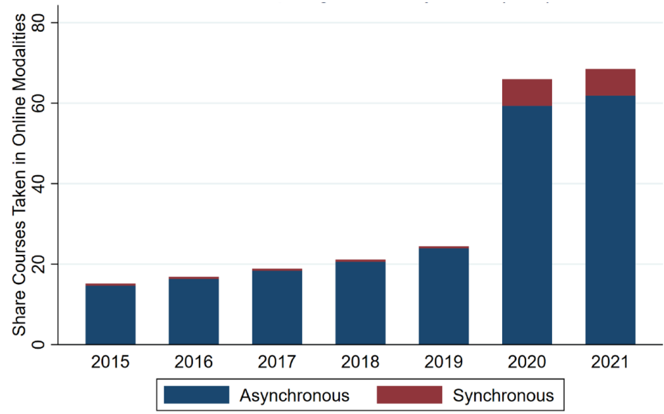
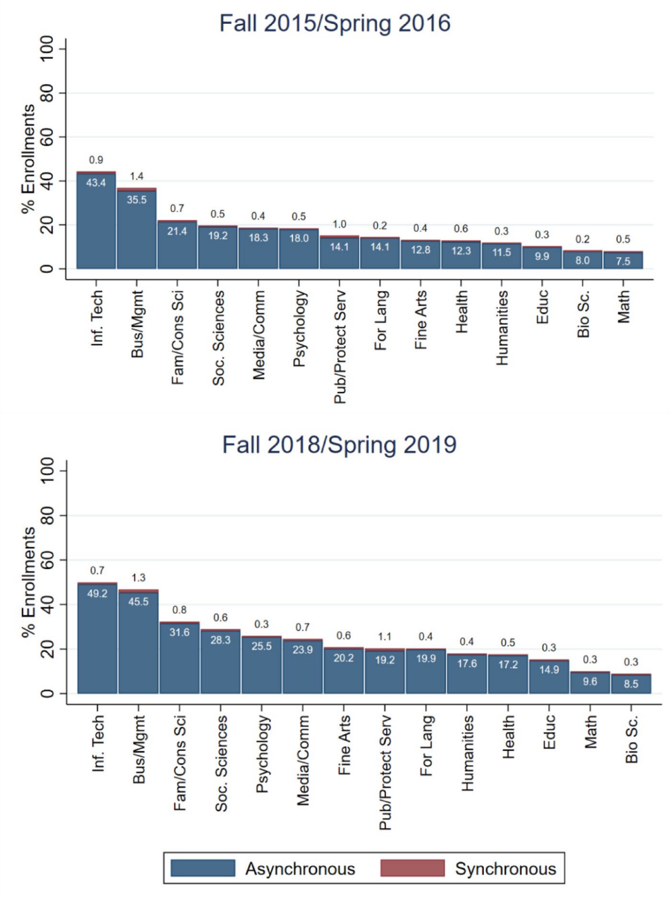
- Online enrollment rose from about 15% in 2015-16 to 21% in 2018-19, then to about two-thirds of enrollments in 2020-21 and 2021-22; synchronous instruction grew from less than 1% pre-pandemic to roughly 7% of total enrollments in 2021-22.
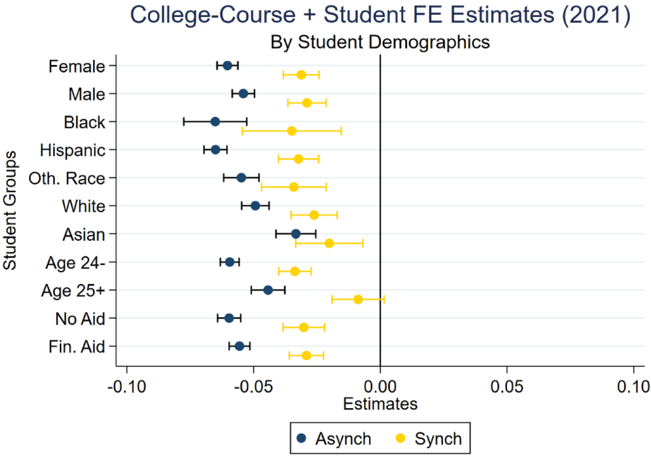
- In fully controlled models, the asynchronous/face-to-face pass gap fell from 8.3 percentage points in 2015 to 7.1 in 2018 and 5.8 in 2021; the synchronous/face-to-face gap fell from 12.0 points in 2015 to 8.7 in 2018 and 3.1 in 2021.
- As of 2021-22, synchronous students were 3.1 percentage points less likely to pass than face-to-face students, while asynchronous students were 5.8 percentage points less likely.
- Gaps were especially large for Hispanic and Black students, while Asian students had the smallest gaps; older students (25+) had smaller online/face-to-face gaps, especially in synchronous courses, where their gap was not significantly different from face-to-face.
Methods
- The study uses student-course-level administrative data from the California Community Colleges Chancellor’s Office for 2015-16 through 2021-22, focusing on fall and spring terms; descriptive analyses use roughly 29 million enrollment records, and main regressions use nearly 10 million student-course enrollments across 112 campuses in 2015, 2018, and 2021.
- The main outcome is course passing, defined as earning a C or better or a Pass designation; modality is classified hierarchically as asynchronous, synchronous, or face-to-face, with courses having multiple components assigned to the most-online mode.
- Main models are linear probability models with college-course-term fixed effects and student-term fixed effects, plus section controls; subgroup analyses stratify by sex, race/ethnicity, age, and need-based financial aid use.
Limitations
- The paper states that course passing relies on subjective grades, so standards may vary across courses, instructors, and time; future work should use more objective outcomes.
- The paper states that generalizability is limited to the California Community Colleges system and may not extend to other state systems or four-year universities; identification relies on within-student and within-course variation, so courses and students lacking modality variation do not contribute, especially for pre-pandemic synchronous courses.
- The paper also cautions that face-to-face pass rates dropped about 1.5 percentage points between 2018 and 2021, so narrowing gaps do not clearly show that overall asynchronous passing improved over that period; the text makes evident that the design is observational and depends on fixed-effects assumptions, though the authors report sorting tests suggesting some results may be conservative.
Model-written summary. Check it against the paper before relying on it.
Integrity signals
Registry
Cites
Statistics
Figures

Verification
Claims the paper makes
12 Valid · 2 Not valid · 19 Not checked · 110 Own results and interpretations
The cited sources support only part of this claim — read each source’s verdict below.
In the paper
“Many of these studies-including several high-quality randomized control trials-have looked at four-year institutions, generally finding null to negative effects of online course-taking (Altindag et al., Forthcoming;Bettinger et al., 2017;Figlio et al., 2013;Kofoed et al., 2024;Krieg & Henson, 2016; see Xu & Xu, 2020, for a review).”
§ Online Student Performance Under Synchronous and Asynchronous Instruction in California Community Colleges > Prior Evidence on Performance Gaps in Online Learning
What the sources say
- Not matchedcites Altindag et al., Forthcoming
This doesn’t read as a citation we can look up.
- Supportedcites Bettinger et al., 2017 matched to “Virtual Classrooms: How Online College Courses Affect Student Success” (2017) source
The literature discussion reports that prior randomized studies at relatively selective public four-year colleges found negative or, at best, null effects of online courses. Bettinger et al. also find negative effects in their own study of a nonselective for-profit university; the paper identifies its own design as instrumental variables, not a randomized trial. (LLM, conf=0.90)
- Supportedcites Figlio et al., 2013 matched to “Is It Live or Is It Internet? Experimental Estimates of the Effects of Online Instruction on Student Learning” (2013) source
The Abstract describes random assignment to online and live sections of a university course, and the Conclusion identifies the institution as a major university. In “III. The Data and the Results,” the overall difference is not statistically distinguishable from zero, while some subgroups perform significantly worse with online instruction. This supports the cited paper’s contribution to the multi-study statement, not a claim that this paper alone establishes the general pattern. (LLM, conf=0.91)
plain- Asserted: passes — The authors put it forward as true.
- Checkable: passes — It can be checked against evidence.
- Load-bearing: unclear — It is unclear whether the paper’s conclusions depend on it.
- Based: passes — The paper gives a reason why it holds.
- Not matched
The cited sources support only part of this claim — read each source’s verdict below.
In the paper
“Additionally, instructors in asynchronous courses may grapple with the task of fostering a sense of community due to the absence of real-time student engagement with peers and instructors (Garrison et al., 2003;Richardson et al., 2015).”
§ Online Student Performance Under Synchronous and Asynchronous Instruction in California Community Colleges > Challenges and Affordances in Online Learning
What the sources say
- Not matchedcites Garrison et al., 2003
An author–year citation the paper’s reference list doesn’t settle. We don’t search these by name.
- Partly supportedcites Richardson et al., 2015 matched to “Conceptualizing and investigating instructor presence in online learning environments” (2015) sourceExperimental — accuracy not yet measured
The Introduction reports that online students feel disconnected from peers and instructors and miss real-time feedback; the Discussion says the study offers instructors guidance on increasing a course’s sense of community. The paper does not specifically attribute that difficulty to an absence of real-time engagement in asynchronous courses, as the citing sentence does. The indexed passages provide section labels but no page numbers. (LLM, conf=0.84)
hedgedstates a possible cause- Asserted: passes — The authors put it forward as true.
- Checkable: passes — It can be checked against evidence.
- Load-bearing: unclear — It is unclear whether the paper’s conclusions depend on it.
- Based: passes — The paper gives a reason why it holds.
- Not matched
The cited sources support only part of this claim — read each source’s verdict below.
In the paper
“Institutions also scaled up student-facing supports, such as by adding or expanding virtual academic counseling, providing students with access to technology such as laptops or hotspots, and implementing new communication and case management tools to better track and assist students (Hart et al. 2021b;Hart et al., 2025a).”
§ Online Student Performance Under Synchronous and Asynchronous Instruction in California Community Colleges > Prior Evidence on Performance Gaps in Online Learning
What the sources say
- Partly supportedcites Hart et al. 2021b matched to “COVID-19 and Community College Instructional Responses” (2021) sourceExperimental — accuracy not yet measured
The Discussion and Research Question 2 sections report adoption of virtual counseling and distribution of laptops or Chromebooks and hotspots. The cited paper does not report implementing new communication or case-management tools to track and assist students, so that part of the sentence is unsupported by this source. Page numbers were not available in our copy. (LLM, conf=0.87)
- Partly supportedcites Hart et al., 2025a matched to ““I Don’t Think the System Will Ever be the Same”: Distance Education Leaders’ Predictions and Recommendations for the Use of Online Learning in Community Colleges Post-COVID” (2025) sourceExperimental — accuracy not yet measured
The section “A game-changer: new techniques to improve engagement in online courses” (page unavailable) describes increased outreach to struggling students using their preferred communication methods, including texts. It does not report expanded virtual academic counseling, provision of laptops or hotspots, or new case-management tools to track students. (LLM, conf=0.85)
plain- Asserted: passes — The authors put it forward as true.
- Checkable: passes — It can be checked against evidence.
- Load-bearing: passes — The paper’s conclusions depend on it.
- Based: passes — The paper gives a reason why it holds.
- Partly supported
Every source the paper cites for this claim was checked and supports it.
In the paper
“Some of the best evidence on synchronous course use comes from a randomized controlled study at West Point during the pandemic, which found that students randomly assigned to synchronous online versions of courses had lower course grades than those assigned to face-to-face sections (Kofoed et al., 2024).”
§ Online Student Performance Under Synchronous and Asynchronous Instruction in California Community Colleges > Prior Evidence on Performance Gaps in Online Learning
What the sources say
- Supportedcites Kofoed et al., 2024 matched to “Zooming to Class? Experimental Evidence on College Students’ Online Learning during COVID-19” (2024) source
The Introduction reports a randomized trial at West Point during COVID-19 in which students were assigned within class hours to online or in-person sections; it finds that online instruction lowered final grades. The Institutional Details section says attendance was required at every class period, supporting the description of the online sections as synchronous. (LLM, conf=0.90)
plainstates a cause- Asserted: passes — The authors put it forward as true.
- Checkable: passes — It can be checked against evidence.
- Load-bearing: passes — The paper’s conclusions depend on it.
- Based: passes — The paper gives a reason why it holds.
- Supported
The cited sources support only part of this claim — read each source’s verdict below.
In the paper
“Community colleges across California made substantial investments in support for online learning during the pandemic (Hart et al., 2025a;Kurlaender et al., 2024).”
§ Online Student Performance Under Synchronous and Asynchronous Instruction in California Community Colleges > 1 3 Discussion
What the sources say
- Partly supportedcites Hart et al., 2025a matched to ““I Don’t Think the System Will Ever be the Same”: Distance Education Leaders’ Predictions and Recommendations for the Use of Online Learning in Community Colleges Post-COVID” (2025) sourceExperimental — accuracy not yet measured
The ‘Implications for practice and policy’ section (page unavailable) says the California Community Colleges system first purchased some software products during the pandemic, and the Discussion (page unavailable) notes online resources and coursework created then. These support pandemic-era investment in online learning, but the paper does not establish that investments in support were substantial across California community colleges. (LLM, conf=0.85)
- Supportedcites Kurlaender et al., 2024 matched to “From the Disruption of the Pandemic, a Path Forward for Community Colleges” (2024) source
In “Removing Barriers: State and Federal Dollars for Expanded Supports” (page not provided), the paper says colleges provided technology for online education and that the great majority invested in training faculty to teach online. It also says nearly all colleges continued to use a significant share of recovery funding for professional development in online instruction. (LLM, conf=0.92)
plain- Asserted: passes — The authors put it forward as true.
- Checkable: passes — It can be checked against evidence.
- Load-bearing: unclear — It is unclear whether the paper’s conclusions depend on it.
- Based: passes — The paper gives a reason why it holds.
- Partly supported
62 more claims
Create a free account to see all 143 claims and to verify the 2 references still open.
- Probably not a substantial claim. 45
- It may state two separate claims as one. 40
Citations
Cites
In search of higher persistence rates in distance education online programs
Rovai, A. P. (2003) · The Internet and Higher Education · doi:10.1016/s1096-7516(02)00158-6 · Cited by 699 · cited 1×
“…the pace of their learning in online instruction may pose difficulties, particularly for those with limited experience with self-directed learning (Rovai, 2003; Guglielmino & Guglielmino, 2003; Bambara et al., 2009; Schulz & Ketcham, 2014; Bork & Rucks-Ahidiana, 2013; Nash, 2005; Doherty, 2006).”
Xu, D., & Jaggars, S. S. (2014) · The Journal of Higher Education · doi:10.1080/00221546.2014.11777343 · Cited by 568
Self-citationDoes Your Cohort Matter? Measuring Peer Effects in College Achievement
Carrell, S. E., Fullerton, R. L., & West, J. E. (2009) · Journal of Labor Economics · doi:10.1086/600143 · Cited by 550
Virtual Classrooms: How Online College Courses Affect Student Success
Bettinger, E. P., Fox, L., Loeb, S., & Taylor, E. S. (2017) · American Economic Review · doi:10.1257/aer.20151193 · Cited by 441 · cited 1×
“…like community colleges in terms of outcomes like course passing and course completion (e.g., Xu & Jaggars, 2011, 2013; Johnson & Mejia, 2014; Bettinger, Fox, Loeb, & Taylor, 2017; Hart, Friedmann & Hill, 2018), these studies were conducted prior to pandemic and many of them drew on data…”
Choosing Between Online and Face-to-Face Courses: Community College Student Voices
Jaggars, S. S. (2014) · American Journal of Distance Education · doi:10.1080/08923647.2014.867697 · Cited by 382
Figlio, D., Rush, M., & Yin, L. (2013) · Journal of Labor Economics · doi:10.1086/669930 · Cited by 367
Xu, D., & Jaggars, S. S. (2013) · Economics of Education Review · doi:10.1016/j.econedurev.2013.08.001 · Cited by 359 · cited 1×
“…asynchronous in nature – at open-access institutions like community colleges in terms of outcomes like course passing and course completion (e.g., Xu & Jaggars, 2011, 2013; Johnson & Mejia, 2014; Bettinger, Fox, Loeb, & Taylor, 2017; Hart, Friedmann & Hill, 2018), these studies were…”
Self-citationXu, D., & Jaggars, S. S. (2011) · Educational Evaluation and Policy Analysis · doi:10.3102/0162373711413814 · Cited by 239 · cited 2×
“…asynchronous in nature – at open-access institutions like community colleges in terms of outcomes like course passing and course completion (e.g., Xu & Jaggars, 2011, 2013; Johnson & Mejia, 2014; Bettinger, Fox, Loeb, & Taylor, 2017; Hart, Friedmann & Hill, 2018), these studies were…”
Self-citationJaggars, S., & Bailey, T. R. (2010) · Columbia University · doi:10.7916/d85m63sm · Cited by 222
Conceptualizing and investigating instructor presence in online learning environments
Richardson, J. C., Koehler, A. A., Besser, E. D., Caskurlu, S., Lim, J., & Mueller, C. M. (2015) · The International Review of Research in Open and Distributed Learning · doi:10.19173/irrodl.v16i3.2123 · Cited by 217 · cited 1×
“Additionally, instructors in asynchronous courses may grapple with the task of fostering a sense of community due to the absence of real-time student engagement with peers and instructors (Richardson et al., 2015; Garrison et al., 2003).”
The Community of Inquiry Theoretical Framework
Garrison, D. R., & Akyol, Z. (2015) · Routledge eBooks · doi:10.4324/9780203803738.ch7 · Cited by 184
Does online learning impede degree completion? A national study of community college students
Shea, P., & Bidjerano, T. (2014) · Computers & Education · doi:10.1016/j.compedu.2014.02.009 · Cited by 182
Ortagus, J. C. (2016) · The Internet and Higher Education · doi:10.1016/j.iheduc.2016.09.002 · Cited by 154 · cited 3×
“While performance decrements associated with asynchronous online education in open-access institutions have been well documented (Xu & Xu, 2019; Sublett, 2019), our study suggests that the student performance gap between asynchronous and face-to-face classes may have been narrowing prior to the COVID-19 pandemic.”
Bird, K. A., Castleman, B. L., & Lohner, G. (2022) · AERA Open · doi:10.1177/23328584221081220 · Cited by 140
Online Course-taking and Student Outcomes in California Community Colleges
Hart, C. M. D., Friedmann, E., & Hill, M. (2018) · Education Finance and Policy · doi:10.1162/edfp_a_00218 · Cited by 136 · cited 1×
“…in terms of outcomes like course passing and course completion (e.g., Xu & Jaggars, 2011, 2013; Johnson & Mejia, 2014; Bettinger, Fox, Loeb, & Taylor, 2017; Hart, Friedmann & Hill, 2018), these studies were conducted prior to pandemic and many of them drew on data from a decade ago or more.”
Self-citationZooming to Class? Experimental Evidence on College Students’ Online Learning during COVID-19
Kofoed, M. S., Gebhart, L., Gilmore, D., & Moschitto, R. (2024) · American Economic Review: Insights · doi:10.1257/aeri.20230077 · Cited by 125
An analysis of multiple factors affecting retention in Web-based community college courses
Doherty, W. (2006) · The Internet and Higher Education · doi:10.1016/j.iheduc.2006.08.004 · Cited by 124 · cited 1×
“…the pace of their learning in online instruction may pose difficulties, particularly for those with limited experience with self-directed learning (Rovai, 2003; Guglielmino & Guglielmino, 2003; Bambara et al., 2009; Schulz & Ketcham, 2014; Bork & Rucks-Ahidiana, 2013; Nash, 2005; Doherty, 2006).”
Online Learning in the Virginia Community College System
Jaggars, S. S., & Xu, D. (2010) · PubMed · doi:10.7916/d80v89vm · Cited by 116
Self-citationBambara, C. S., Harbour, C. P., Davies, T. G., & Athey, S. (2009) · Community College Review · doi:10.1177/0091552108327187 · Cited by 105 · cited 1×
“…the pace of their learning in online instruction may pose difficulties, particularly for those with limited experience with self-directed learning (Rovai, 2003; Guglielmino & Guglielmino, 2003; Bambara et al., 2009; Schulz & Ketcham, 2014; Bork & Rucks-Ahidiana, 2013; Nash, 2005; Doherty, 2006).”
Bulman, G. B., & Fairlie, R. W. (2022) · Education Finance and Policy · doi:10.1162/edfp_a_00384 · Cited by 81
Effectiveness of synchronous and asynchronous online learning: a meta-analysis
Zeng, H., & Luo, J. (2024) · Interactive Learning Environments · doi:10.1080/10494820.2023.2197953 · Cited by 64
Hong, J., Liu, Y., Liu, Y., & Zhao, L. (2021) · Frontiers in Psychology · doi:10.3389/fpsyg.2021.738695 · Cited by 62
Altindag, D. T., Filiz, E. S., & Tekin, E. (2025) · Educational Evaluation and Policy Analysis · doi:10.3102/01623737241274802 · Cited by 60
Xu, D., & Xu, Y. (2020) · Higher education · doi:10.1007/978-3-030-31365-4_10 · Cited by 50
Self-citationOnline or in Person? Examining College Decisions to Reopen during the COVID-19 Pandemic in Fall 2020
Felson, J., & Adamczyk, A. (2021) · Socius Sociological Research for a Dynamic World · doi:10.1177/2378023120988203 · Cited by 49 · cited 1×
“The use of online courses in postsecondary institutions was growing rapidly prior to the emergence of COVID-19 (Ortagus, 2017) and increased further during the pandemic (Felson & Adamczyk, 2021).”
The Educational Impact of Online Learning: How Do University Students Perform in Subsequent Courses?
Krieg, J. M., & Henson, S. E. (2016) · Education Finance and Policy · doi:10.1162/edfp_a_00196 · Cited by 44
COVID-19 and Community College Instructional Responses
Hart, C. M. D., Xu, D., Hill, M., & Alonso, E. (2021) · Online Learning · doi:10.24059/olj.v25i1.2568 · Cited by 40 · cited 1×
“…the other hand, synchronous instruction often requires a stable internet connection and access to reliable technology, as well as a quiet and distraction-free environment for effective participation and the ability to reliably schedule time to attend classes (Hart et al., 2021; Hart et al., 2022).”
Self-citationRole Ambiguity in Online Courses: An Analysis of Student and Instructor Expectations
Bork, R. J. H., & Rucks-Ahidiana, Z. (2013) · Columbia University · doi:10.7916/d8c24tgv · Cited by 39 · cited 1×
“…the pace of their learning in online instruction may pose difficulties, particularly for those with limited experience with self-directed learning (Rovai, 2003; Guglielmino & Guglielmino, 2003; Bambara et al., 2009; Schulz & Ketcham, 2014; Bork & Rucks-Ahidiana, 2013; Nash, 2005; Doherty, 2006).”
Selection into Online Community College Courses and Their Effects on Persistence
Huntington-Klein, N., Cowan, J., & Goldhaber, D. (2017) · Research in Higher Education · doi:10.1007/s11162-016-9425-z · Cited by 37
Shlomo, A., & Rosenberg‐Kima, R. B. (2024) · International Journal of Science Education · doi:10.1080/09500693.2024.2355673 · Cited by 34
Libasin, Z., Azudin, A. R., Idris, N. A., et al. (2021) · International Journal of Academic Research in Progressive Education and Development · doi:10.6007/ijarped/v10-i2/10131 · Cited by 33
Shea, P., & Bidjerano, T. (2016) · Online Learning · doi:10.24059/olj.v20i3.984 · Cited by 32
Li, Q., Zhou, X., Bostian, B., & Xu, D. (2021) · Online Learning · doi:10.24059/olj.v25i3.2362 · Cited by 28
Self-citationPalacios, A. M. G., & Wood, J. L. (2016) · Community College Journal of Research and Practice · doi:10.1080/10668926.2015.1087893 · Cited by 26
Sublett, C. (2019) · Community College Journal of Research and Practice · doi:10.1080/10668926.2018.1530620 · Cited by 19
Xu, D., & Xu, Y. (2020) · Higher education · doi:10.1007/978-3-030-11743-6_10-1 · Cited by 17
Self-citationHart, C. M. D., Hill, M., Alonso, E., & Xu, D. (2025) · The Journal of Higher Education · doi:10.1080/00221546.2024.2347810 · Cited by 17 · cited 8×
“In addition, colleges invested effort into developing norms around use of synchronous platforms such as Zoom (Hart et al., 2022), which may have resulted in improved quality of delivery of synchronous courses during the pandemic.”
InfluentialSelf-citationExamining Distance Education Coursetaking and Time-to-Completion among Community College Students
Sublett, C. (2019) · Community College Journal of Research and Practice · doi:10.1080/10668926.2018.1453889 · Cited by 9
Is Big Data Better? LMS Data and Prediction Accuracy in Postsecondary Education
Bird, K., Castleman, B., Song, Y., & Yu, R. (2025) · Journal of Research on Educational Effectiveness · doi:10.1080/19345747.2024.2308306 · Cited by 5
From the Disruption of the Pandemic, a Path Forward for Community Colleges
Kurlaender, M., Cooper, S., Rodriguez, F., & Bush, E. (2024) · Change: The Magazine of Higher Learning · doi:10.1080/00091383.2024.2349456 · Cited by 3
Hart, C. M. D., Xu, D., Alonso, E., & Hill, M. (2025) · Research in Higher Education · doi:10.1007/s11162-024-09819-1 · Cited by 3
Self-citation
Research works printed but not linked: 4
- 16. In M. G. Moore & W. G. Anderson (Eds.), Handbook of Distance Education (pp. 113-128).
- 17. Guglielmino, L. M., & Guglielmino, P. J. (2003). Identifying learners who are ready for e-learning and supporting their success. In G. M. Piskurich (Ed.), Preparing Learners for e-Learning (pp. 19-33). Jossey-Bass/Pfeiffer.
- 24. Hill, M.S. (2019).Nontraditional and the new normal: Three studies on nontraditional student pathways in high- ereducation (22622181). [Doctoral dissertation, University of California, Davis].ProQuestDissertation and Theses. h t t p s : / / w w w . p r o / s -2
- 35. Nash, R. D. (2005). Course completion rates among distance learners: Identifying possible methods to improve retention. Online Journal of Distance Learning Administration, 8(4), 1-21.
Cited by
Mamedov, N. (2026) · Journal of Education, Learning, and Management · doi:10.69739/jelm.v3i2.2222
“Asynchronous learning offers students flexibility and allows students to adequately manage their time in completing high school work in addition to supplementary career-oriented activities (Hart et al. , 2026).”
Metadata
- Authors
- Hart, C. M. D., Baker, R., Hill, M., Alonso, E., & Xu, D.
- Affiliations
- University of California, Davis (US)
- University of Pennsylvania (US)
- University of California, Irvine (US)
- Corresponding author
- Hart, Cassandra M. D.
- Venue
- Research in Higher Education
- Published
- 2026-03-21
- Volume
- 67
- Issue
- 3
- ISSN
- 0361-0365 (ISSN-L)
- 1573-188X
- OpenAlex
- W7139995768
- Semantic Scholar
- fc9dbc69bb63946fd1694bd9c6799d06cd9eb7df
- Cited by
- 0
- References
- 37
- FWCI
- 0.00
- Type
- journal article
- Language
- en
- Open access
- hybrid
- doi.org
- Licence
- cc-by
- creativecommons.org/licenses/by/4.0 (tdm)
- creativecommons.org/licenses/by/4.0 (vor)
- Locations
- Research in Higher Education (publishedVersion, cc-by)
- Scholarly Commons (University of the Pacific) (submittedVersion, cc-by)
- Funders
- Institute of Education Sciences (R305A210455)
- Topics
- Social Sciences › Education › Online and Blended Learning
- Social Sciences › Education › Education during COVID-19 pandemic
- Social Sciences › Education › Higher Education Research Studies
- Keywords
- online learning, synchronous teaching, asynchronous teaching, student performance, face-to-face teaching, California community colleges, COVID-19 pandemic, educational equity, racial and ethnic disparities, financial aid, student subgroups, course modality
About these checks
Registry, retraction, Cites and statistics results are computed, not judged, with one exception: a printed reference that no index lists is read once by a model before it counts as a citation error. Claims are extracted by a model and kept only when their quote appears verbatim in the text; each cited source is then checked, with a model’s help, for whether it says what the claim relies on. Those verdicts can be wrong — read the claim’s quote and the cited source before relying on one.
The claim verdicts this report counts are experimental: their accuracy is not yet measured.
A language model drew the claims from the paper on 2026-10-01, under version 3 of the claim definition (model deepseek-v4.1-flash, prompt extract-v3).
A second model labelled each claim on 2026-10-01 (model jev-1.13-20260917, definition revision gold-guideline-v0.2).
Cited sources are checked with a language model’s help (gpt-6-sol).
Statistics and arithmetic are recomputed, not judged.
Confidence bands are shown only for fields calibrated on our annotated test set. None is calibrated yet, so no band is shown.
What counts as a claim ›How we measure confidence ›How we check this ›
Are you an author, or do you see a problem with this page? Request a review
Data sources
Bibliographic data: Semantic Scholar, OpenAlex, Crossref.
Contains information from the Semantic Scholar Academic Graph Datasets, made available under the ODC Attribution License (ODC-BY 1.0).
Semantic Scholar’s data is described in: Kinney, R., et al. (2023). The Semantic Scholar Open Data Platform. arXiv:2301.10140.
