

Unrestricted permutation forces extrapolation: variable importance requires at least one more model, or there is no free variable importance
Open accessThe DOI matches its Crossref record; 49 of the 52 references it cites were found in a registry or an index.
Abstract
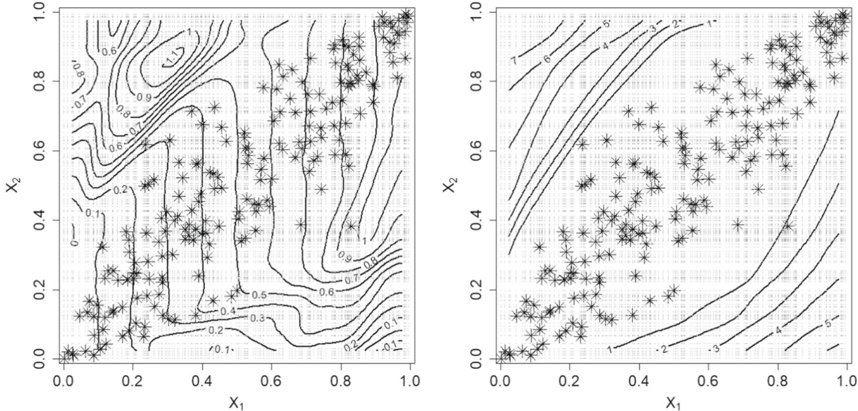
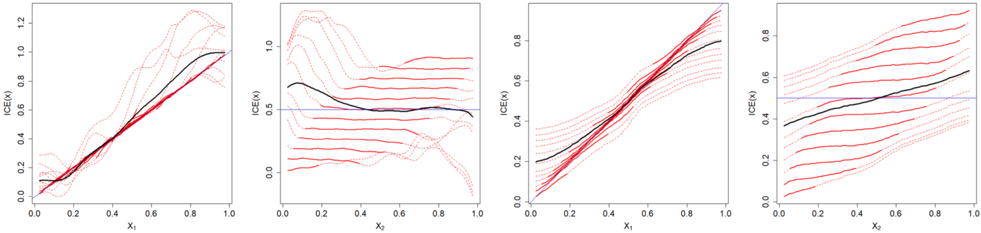
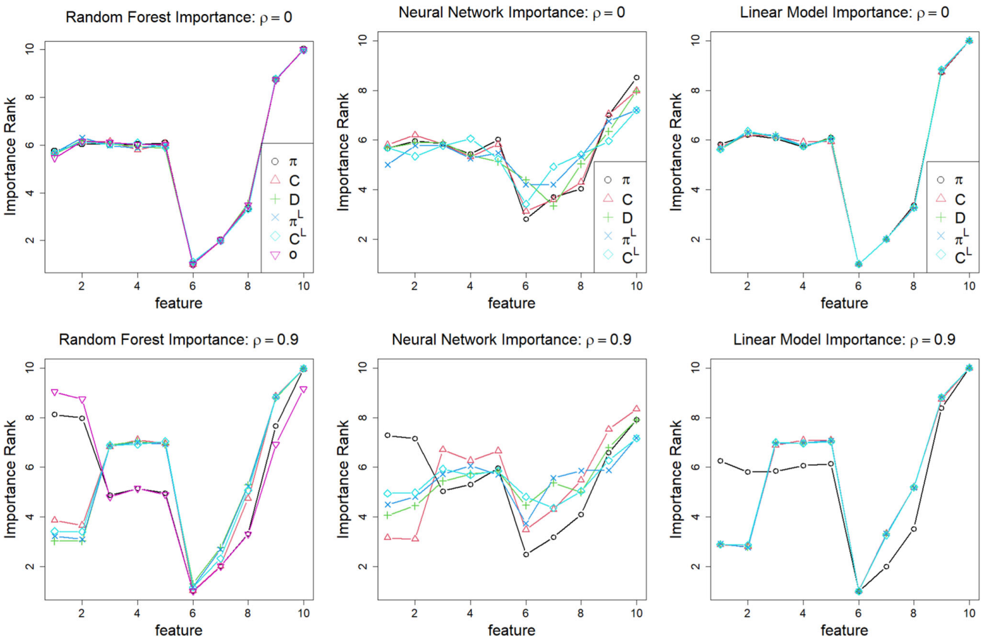
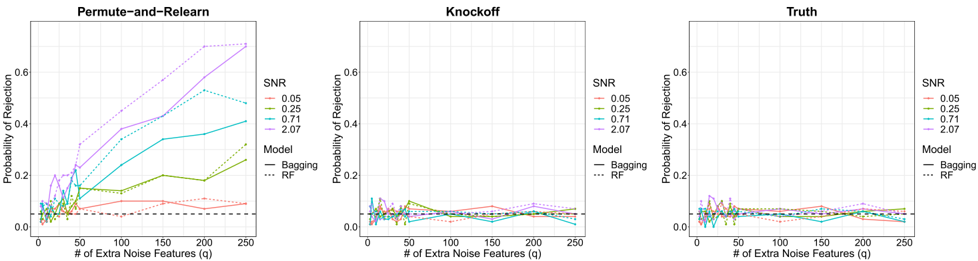
This paper reviews and advocates against the use of permute-and-predict (PaP) methods for interpreting black box functions. Methods such as the variable importance measures proposed for random forests, partial dependence plots, and individual conditional expectation plots remain popular because they are both model-agnostic and depend only on the pre-trained model output, making them computationally efficient and widely available in software. However, numerous studies have found that these tools can produce diagnostics that are highly misleading, particularly when there is strong dependence among features. The purpose of our work here is to (i) review this growing body of literature, (ii) provide further demonstrations of these drawbacks along with a detailed explanation as to why they occur, and (iii) advocate for alternative measures that involve additional modeling. In particular, we describe how breaking dependencies between features in hold-out data places undue emphasis on sparse regions of the feature space by forcing the original model to extrapolate to regions where there is little to no data. We explore these effects across various model setups and find support for previous claims in the literature that PaP metrics can vastly over-emphasize correlated features in both variable importance measures and partial dependence plots. As an alternative, we discuss and recommend more direct approaches that involve measuring the change in model performance after muting the effects of the features under investigation.
Overview
The claims and statistics of this paper haven’t been checked yet.
Free: it reads the open-access text and checks the first 5 claims that cite a source we can check. Create a free account to check every claim.
Integrity signals
Registry
Cites
Statistics
Figures
Verification
Claims the paper makes
The claims and statistics of this paper haven’t been checked yet.
Free: it reads the open-access text and checks the first 5 claims that cite a source we can check. Create a free account to check every claim.
Claims other papers make about this one
Each is checked against this paper’s own text: does it say what the citing paper says it does?
The cited source says what the claim attributes to it.
In the citing paper
“However, these methods can be misleading when correlations exist between input variables 107,109 .”
From Machine learning in concrete science: applications, challenges, and best practices (2022) · cites this paper as [107]
Self-check
Percentages, sums and reported differences re-computed from the paper’s own numbers.
The self-check needs the paper’s full text.
Citations
Cites
Breiman, L. (2001) · Machine Learning · doi:10.1023/a:1010933404324 · Cited by 133,538 · cited 3×
“Breiman (2001) designed the method specifically for use with random forests and considered out-of-bag (OOB) loss in which variable importance is averaged over trees, measured with that part of the data not used to construct the corresponding tree.”
MethodGreedy function approximation: A gradient boosting machine
Friedman, J. H. (2001) · The Annals of Statistics · doi:10.1214/aos/1013203451 · Cited by 30,731
A Unified Approach to Interpreting Model Predictions
Lundberg, S., & Lee, S.-I. (2017) · arXiv · doi:10.48550/arxiv.1705.07874 · Cited by 23,707 · cited 3×
“Saliency (Simonyan et al., 2013) obtains derivatives with respect to x , while LIME (Ribeiro et al., 2016) approximates this with a LASSO method localized to the point of interest by a kernel; Shapley values can also be used for individual predictions (Lundberg and Lee, 2017).”
BackgroundMethod"Why Should I Trust You?": Explaining the Predictions of Any Classifier
Ribeiro, M. T., Singh, S., & Guestrin, C. (2016) · Proceedings of the 22nd ACM SIGKDD International Conference on Knowledge Discovery and Data Mining · doi:10.1145/2939672.2939778 · Cited by 17,555
Generalized Additive Models: An Introduction with R
Wood, S. N. (2017) · doi:10.1201/9781315370279 · Cited by 13,852
Rudin, C. (2019) · Nature Machine Intelligence · doi:10.1038/s42256-019-0048-x · Cited by 10,561 · cited 1×
“As a consequence, many researchers have suggested methods to “X-ray the black box” in order to provide insight into which input features are important and how they effect predictions; a task so precarious that others have advocated against the practice altogether (Rudin, 2019).”
BackgroundNelsen, R. B. (1999) · Lecture Notes in Statistics · doi:10.1007/978-1-4757-3076-0 · Cited by 7,744
Deep Inside Convolutional Networks: Visualising Image Classification Models and Saliency Maps
Simonyan, K., Vedaldi, A., & Zisserman, A. (2013) · arXiv · doi:10.48550/arxiv.1312.6034 · Cited by 5,370 · cited 1×
“Saliency (Simonyan et al., 2013) obtains derivatives with respect to x , while LIME (Ribeiro et al., 2016) approximates this with a LASSO method localized to the point of interest by a kernel; Shapley values can also be used for individual predictions (Lundberg and Lee, 2017).”
MethodTesting Statistical Hypotheses
(2021) · Wiley Series in Probability and Statistics · doi:10.1002/9781119243830.ch12 · Cited by 5,106
Wood, S. N. (2006) · doi:10.1201/9781420010404 · Cited by 4,953
Research works printed but not linked: 1
- Tan, S., Caruana, R., Hooker, G., Koch, P., Gordo, A.: Learning global additive explanations for neural nets using model distillation. arXiv preprint arXiv:1801.08640 (2018) · arXiv
Cited by
Items 301–400 of 511
How do I explain that decision? A new approach combining counterfactuals and sensitivity analyses
Lu, X., & Borgonovo, E. (2026) · European Journal of Operational Research · doi:10.1016/j.ejor.2026.04.035 · Cited by 1
Phase-Alternation and Tree-Initialization to Facilitate Interpretable Rule-based Machine Learning
Lipschutz-Villa, G., Bandhey, H., Dinh, K., Heider, M., Kamoun, M., & Urbanowicz, R. J. (2026) · Genetic and Evolutionary Computation Conference (GECCO) · doi:10.1145/3795095.3805127 · Cited by 1
“…relying on ‘model explanation’ or ‘feature importance estimation’ strategies, such as Shapley values, LIME, or permutation feature importance for ‘black-box’ model interpretation, provide only a limited, estimated, and potentially biased understanding of model decision making [25, 27, 46].”
Ibebuchi, C. C. (2026) · Machine Learning Science and Technology · doi:10.1088/2632-2153/ae8a13 · Cited by 1
“Several alternative XAI methods also exist, including permutation importance [19], partial dependence plots [20], individual conditional expectation curves [20], local interpretable model-agnostic explanations [21], saliency-based attribution methods [22], and integrated-gradient approaches [23].”
Kaya, H., Ekinci, F., Selçuk, A. Y., Koçkar, N., DEMİR, Ö., Ugurlu, G., Güzel, M. S., & Güzel, M. S. (2026) · Physica B Condensed Matter · doi:10.1016/j.physb.2026.419022 · Cited by 1
More than Black Boxes: Machine Learning Models’ Capacity to Capture Housing Submarket Patterns
Quiroz, J. C. R., & Duarte, C. R. M. (2026) · Urban Science · doi:10.3390/urbansci10080440 · Cited by 2
Jeong, N., Ullah, Z., Byun, J., Kang, J. S., & Son, M. (2026) · Chemical Engineering Journal Advances · doi:10.1016/j.ceja.2026.101434 · Cited by 1
Jungsatidkul, P., & Innate, S. (2026) · Forecasting · doi:10.3390/forecast8060100 · Cited by 1
Explaining Neural Networks with Functional DataUsing PCA and Feature Importance.
Goode, K., Ries, D., & Zollweg, J. (2020) · OSTI OAI (U.S. Department of Energy Office of Scientific and Technical Information) · doi:10.2172/1831575 · Cited by 1
LeBlanc, N. M., & Pavey, S. A. (2022) · Molecular Ecology Resources · doi:10.1111/1755-0998.13701 · Cited by 1
“When permuting features in a Random Forest, a new model must be trained on the permuted data to reduce bias in the resulting significance values (Hooker et al., 2021).”
MethodThe Importance of Forecasting in Industrial Enterprise Management Using Machine Learning
Vorobev, A., & Kudinov, V. A. (2022) · Scientific and Technical Information Processing · doi:10.3103/s0147688222050173 · Cited by 1
Bao, T., Vu, T., Tuệ, N. T., Quy, T. Đ., Thi, T. H. N., Tóth, G., Homoki, Z., Kovács, T., & Duong, V.-H. (2023) · Journal of Radioanalytical and Nuclear Chemistry · doi:10.1007/s10967-023-09281-w · Cited by 1
fmeffects: An R Package for Forward Marginal Effects
Löwe, H., Scholbeck, C. A., Heumann, C., Bischl, B., & Casalicchio, G. (2025) · The R Journal · doi:10.32614/rj-2024-024 · Cited by 1
Lande, I. B. (2020) · NORA - Norwegian Open Research Archives · Cited by 1
Do not explain without context: addressing the blind spot of model explanationsPreprint
Woźnica, K., Pȩkala, K., Baniecki, H., Kretowicz, W., Sienkiewicz, E., & Biecek, P. (2021) · arXiv (Cornell University) · doi:10.48550/arxiv.2105.13787 · Cited by 1
Spooner, A., Mohammadi, G., Sachdev, P. S., Brodaty, H., & Sowmya, A. (2022) · arXiv (Cornell University) · doi:10.48550/arxiv.2207.02380 · Cited by 1
Algorithm-Agnostic Interpretations for ClusteringPreprint
Scholbeck, C. A., Funk, H., & Casalicchio, G. (2022) · arXiv (Cornell University) · doi:10.48550/arxiv.2209.10578 · Cited by 1
“In SL, there are valid arguments against space-filling designs due to resulting in model extrapolations, i.e., predictions in areas where the model was not trained with enough data [26], [27].”
BackgroundA Generalized Variable Importance Metric and Estimator for Black Box Machine Learning ModelsPreprint
Khan, M. K. A., Saarela, O., & Kustra, R. (2022) · arXiv (Cornell University) · doi:10.48550/arxiv.2212.09931 · Cited by 1
T-Explainer: uma abordagem para a explicabilidade em Aprendizado de Máquina baseada em gradientes
Ortigossa, E. S. (2024) · Digital Library of Theses and Dissertations (Universidade de São Paulo) · doi:10.11606/t.55.2024.tde-11072024-171752 · Cited by 1
Targeted Learning for Variable ImportancePreprint
Wang, X., Zhou, Y., & Hooker, G. (2024) · arXiv (Cornell University) · doi:10.48550/arxiv.2411.02221 · Cited by 1
“Following Hooker et al. [2021], the 10-dimensional covariate vector X is sampled from a multivariate normal distribution with mean vector 0 and covariance matrix Σ .”
InfluentialSelf-citationSaliency Methods are Encoders: Analysing Logical Relations Towards InterpretationPreprint
Schwenke, L., & Atzmueller, M. (2024) · arXiv (Cornell University) · doi:10.48550/arxiv.2412.16204 · Cited by 1
An Explainable AI Handbook for Psychologists: Methods, Opportunities, and ChallengesPreprint
Lavelle-Hill, R. E., Smith, G., Deininger, H., & Murayama, K. (2025) · OSF Preprints (OSF Preprints) · doi:10.31219/osf.io/wgx34_v4 · Cited by 1
Interpretable Network-assisted Random Forest+Preprint
Tang, T. M., Levina, E., & Zhu, J. (2025) · arXiv (Cornell University) · doi:10.48550/arxiv.2509.15611 · Cited by 1
Machine Learning and Deep Learning in Ecology – from predictions to mechanistic inference
Pichler, M. (2024) · University of Regensburg Publication Server (University of Regensburg) · doi:10.5283/epub.58680 · Cited by 1
Zhou, Z. (2021) · eCommons (Cornell University) · doi:10.7298/6cj0-wd06 · Cited by 1
Ghosal, I. (2021) · eCommons (Cornell University) · doi:10.7298/cgs3-q187 · Cited by 1
Trustworthy Additive Explanations of Machine Learning Models through Increased Alignment
Laberge, G. (2024) · PolyPublie (École Polytechnique de Montréal) · Cited by 1
Measuring Variable Importance via Accumulated Local EffectsPreprint
Zhu, J., & Apley, D. W. (2025) · arXiv (Cornell University) · doi:10.48550/arxiv.2512.21124 · Cited by 1
“…and conditional distributions often give drastically different results and are each subject to serious shortcomings that a number of recent works have brought to light, e.g., Frye et al. (2020), Janzing et al. (2020), Kumar et al. (2020), Sundararajan and Najmi (2020), and Hooker et al. (2021).”
InfluentialRejeb, S. (2023) · theses.fr (ABES) · doi:10.70675/aeb9e3eez67f6z4165za735z0d64818f8c5e · Cited by 1
Trustworthy Feature Importance Avoids Unrestricted PermutationsPreprint
Borgonovo, E., Cappelli, F., Lu, X., Plischke, E., & Rudin, C. D. (2026) · arXiv (Cornell University) · doi:10.48550/arxiv.2604.11253 · Cited by 1
“The left panels of Figure 3 report, respectively, the estimates of b ν j , b ν GCMR j and b τ ′ , GCMR j on the vertical axis; the right panels corresponds to the importance-ranking (as the information displayed in Hooker et al. (2021)).”
InfluentialZheng, J., Zhang, X., Gu, Y., Wang, D., Wang, Y., Shen, X., Zhang, H., Li, Y., & Yu, D. (2026) · arXiv (Cornell University) · doi:10.48550/arxiv.2608.05655 · Cited by 1
“…an input correlated with others biases importance upward unless the permutation is made conditional (Strobl et al. 2008), and unrestricted permutation forces the model to extrapolate off the data manifold, so an honest estimate needs at least one additional model (Hooker, Mentch, and Zhou 2021).”
Pan, C., Meng, A., & Suk, Y. (2026) · arXiv (Cornell University) · doi:10.48550/arxiv.2608.21165 · Cited by 1
“When they are correlated, the averaging step forces the model to extrapolate into regions of the covariate space where little or no data exist, and the resulting curves can be badly misleading (Hooker et al., 2021; Molnar et al., 2022, 2023).”
$¶$ILCRO: Making Importance Landscapes Flat AgainPreprint
Moens, V., Yu, S., & Salimi‐Khorshidi, G. (2020) · arXiv (Cornell University) · doi:10.48550/arxiv.2001.09696
Coleman, T. (2021) · D-Scholarship@Pitt (University of Pittsburgh)
Adapting Statistical Learning Method for Spatial Applications
Wai, T. H. (2020) · ResearchWorks at the University of Washington (University of Washington)
(2022) · Geoscientific model development · doi:10.5194/gmd-2021-426-cec1
Melton, J. R. (2022) · Geoscientific model development · doi:10.5194/gmd-2021-426-ac1
(2022) · Geoscientific model development · doi:10.5194/gmd-2021-426-rc2
Authors' reply to Reviewers (Julie Loisel and #2)
Melton, J. R. (2022) · Geoscientific model development · doi:10.5194/gmd-2021-426-ac2
(2022) · Geoscientific model development · doi:10.5194/gmd-2021-426-rc1
Réseaux bayésiens et valeurs de Shapley
Ali, M. H., Biannic, Y. L., & Wuillemin, P.-H. (2021) · HAL
Modeling wildfire activity in the western United States with machine learningPreprint
Buch, J., Williams, P., Juang, C. S., Hansen, W. D., & Gentine, P. (2022) · ESS Open Archive · doi:10.1002/essoar.10512545.1
Buch, J. (2023) · doi:10.5194/egusphere-2022-1148-ac1
Misra, S., D'souza, G., & Truong, D. (2022) · Collegiate Aviation Review International · doi:10.22488/okstate.22.100218
“…dependency among the attributes or features used for the model development, they might over-emphasize or under-emphasize some features depending on how those features correlate with other features, which is commonly referred to as the high-correlation variable problem (Hooker et al., 2019).”
BackgroundVergis, E., & Genius, M. (2023) · SSRN Electronic Journal · doi:10.2139/ssrn.4601690
Breathing new life into asthma research: a review of machine learning and multi-omics approaches
Fontanella, S., Cucco, A., & Čustović, A. (2023) · Minerva Respiratory Medicine · doi:10.23736/s2784-8477.23.02068-5
Fiddes, S. L. (2023) · doi:10.5194/egusphere-2023-531-ac1
Fiddes, S. L. (2023) · doi:10.5194/egusphere-2023-531-ac2
Multi-choice Explanations: A New Cooperative Game Structure for XAIPreprint
Fryer, D., Lowing, D., Strümke, I., & Nguyen, H. D. (2023) · HAL
COVID-19 Learning Intervention Impact: Data-Driven EvaluationPreprint
Elizondo, M., Yu, J., Payan, D., Li, F., & Tešić, J. (2024) · doi:10.36227/techrxiv.171392833.35385517/v1
Regression Trees Know Calculus
Wycoff, N. (2025) · neural information processing systems · doi:10.52202/085713-0790
Global Censored Quantile Random ForestPreprint
Zhou, S., & Peng, L. (2024) · arXiv (Cornell University) · doi:10.48550/arxiv.2410.12209
“As elucidated by Hooker et al. [2021], the impact of features of interest can be muted through techniques such as removal, permutation, or resampling from the estimated conditional distribution given the remaining features.”
BackgroundMethodInfluentialSelf-citationRies, D. (2024) · Geoscientific model development · doi:10.5194/gmd-2024-133-ac2
Suboptimal Shapley Value ExplanationsPreprint
Lu, X. (2025) · arXiv (Cornell University) · doi:10.48550/arxiv.2502.12209
“However, Frye et al. [2020] and Hooker et al. [2021] argue that random sampling operation ignores inherent feature dependency.”
An Explainable AI Handbook for Psychologists: Methods, Opportunities, and ChallengesPreprint
Lavelle-Hill, R. E., Smith, G., Deininger, H., & Murayama, K. (2024) · OSF Preprints (OSF Preprints) · doi:10.31219/osf.io/wgx34_v1
Contributions on dimensionality reduction and interpretable machine learning
Pachón-García, C. (2025) · UPCommons institutional repository (Universitat Politècnica de Catalunya) · doi:10.5821/dissertation-2117-429995
Linders, G. M., Krapp, L. S., & Schnell, S. (2025) · PsyArXiv (OSF Preprints) · doi:10.31234/osf.io/v4krw_v1
Khvostikov, S. A., Bartalev, S. A., Егоров, В. А., & Stytsenko, E. A. (2025) · Sovremennye problemy distantsionnogo zondirovaniya Zemli iz kosmosa · doi:10.21046/2070-7401-2025-22-4-64-75
Machine learning based radiomics analysis of SPECT images in predicting neuroendocrine tumors
Ghazizadeh, M., Amoui, M., Deevband, M. R., Aryana, K., Karamian, F., Divband, A., Mahboubi‐Fooladi, Z., Montazerabadi, A., Jafari, E., Zirak, A., et al. (2025) · Biomedical Engineering Advances · doi:10.1016/j.bea.2025.100197
Cutler, M. C., Bickmore, J. D., Transtrum, M. K., Pedersen, K., Proksch, S., Farrer, E., & Gee, K. L. (2025) · The Journal of the Acoustical Society of America · doi:10.1121/10.0039709
Ying, 赵. Z., & Xia, 王. W. (2025) · Acta Optica Sinica · doi:10.3788/aos251425
TRIP: A Nonparametric Test to Diagnose Biased Feature Importance ScoresPreprint
Foote, A. S., & Kriz̧anc, D. (2025) · arXiv (Cornell University) · doi:10.48550/arxiv.2507.07276
“In the presence of correlated or dependent features, the newly generated points can deviate considerably from the training distribution, potentially being entirely unrealistic [Hooker et al. , 2021; Hooker, 2007].”
InfluentialAdaptive Node Feature Selection For Graph Neural NetworksPreprint
Navarro, M., Azizpour, A., & Segarra, S. (2025) · arXiv (Cornell University) · doi:10.48550/arxiv.2510.03096
“Moreover, while permutation tests are typically found to be very effective (Khan et al., 2025), permuting features that are correlated may result in overestimated importance scores (Hooker et al., 2021).”
One Permutation Is All You Need: Fast, Deterministic Feature Importance and Model Stress-TestingPreprint
Dorador, A. (2025) · arXiv (Cornell University) · doi:10.48550/arxiv.2512.13892
“In that sense, the criticism that classical permutation methods [Breiman, 2001a] have received [Strobl et al., 2008, Hooker et al., 2021, Delicado and Pe˜na, 2023] for ignoring feature interdependence when estimating direct VI is undeserved.”
Blesch, K. (2024) · Media (https://www.suub.uni-bremen.de/) · doi:10.26092/elib/2929
Liu, Y., Xiao, J., Li, X., & Li, Y. (2026) · Agricultural and Forest Meteorology · doi:10.1016/j.agrformet.2026.111453
Increasing the Confidence of In Silico Modelling in Toxicology
Belfield, S. (2024) · Liverpool John Moores University · doi:10.24377/ljmu.t.00022954
Wallace, M. L., Mentch, L., Wheeler, B. J., Tapia, A. L., Richards, M., Zhou, S., Yi, L., Redline, S. S., & Buysse, D. J. (2024) · Figshare · doi:10.6084/m9.figshare.26598260
Self-citationPobreza en Argentina : un análisis predictivo utilizando herramientas de machine learning
Dabús, A. (2020) · San Andres Digital Repository (University of San Andrés)
정주연 (2023) · Seoul National University Open Repository (Seoul National University)
Interpreting Bayesian network-based Clustering
Alejandre Jiménez, V. (2023) · Archivo Digital UPM (Universidad Politécnica de Madrid)
Increasing Retention in Insurtechs Through Churn Prediction
Rapp Farnes, J., & Christiansen, O. (2021) · Lund University Publications Student Papers (Lund University)
Murray, D., & Murray, D. (2024) · UA Campus Repository (The University of Arizona)
鄒, 彦., スウ, ゲ., & Zou, Y. (2023) · Terrestrial Environment Research Center (University of Tsukuba)
An Analysis of Neural Rationale Models andInfluence Functions for Interpretable MachineLearning
Zheng, Y. (2023) · DSpace@MIT (Massachusetts Institute of Technology)
Hlongwane, R. (2025) · Open University of Cape Town (University of Cape Town)
Rahimiaghdam, S. (2023) · OpenMETU (Middle East Technical University)
Isolating variable effects in supervised machine learning illustrated in educational data mining
Filho, R. L. C. S. (2024) · LA Referencia (Red Federada de Repositorios Institucionales de Publicaciones Científicas)
Explaining AI Without Code: A User Study on Explainable AIPreprint
Abarca, N., Carvallo, A., Moncada, C. L., & Bravo-Márquez, F. (2026) · arXiv (Cornell University) · doi:10.48550/arxiv.2602.11159
“The system incorporates three XAI techniques: Partial Dependence Plots (PDP) [Hooker et al., 2019], Permutation Feature Importance (PFI) [Molnar et al., 2020], and KernelSHAP [Aas et al., 2019], to provide global and local explanations of tabular classification models.”
Assessing the Reliability of Saliency Maps for 3D Point Cloud Semantic Segmentation ModelsPreprint
Ciprián-Sánchez, J. F., Burmeister, J.-M., Zwadsich, B., Cech, T., Richter, R., & Döllner, J. (2026) · SSRN Electronic Journal · doi:10.2139/ssrn.6259846
Khan, M. K. A. (2025) · TSpace (University of Toronto)
Aitalaakso, J. (2025) · Tampere University Institutional Repository (Tampere University)
xplainfi: Feature Importance and Statistical Inference for Machine Learning in R
Burk, L., Ewald, F. K., Casalicchio, G., Wright, M. N., & Bischl, B. (2026) · The R Journal · doi:10.32614/rj-2026-054
Synergistic Effect of a Combined 10-MDP/γ-MPTS Primer on Glass-Ceramic Bonding: A Multimodal Study
Liu, J., Xu, Y., Lin, Z., Tu, S., Chen, C., & Xie, H. (2026) · International Dental Journal · doi:10.1016/j.identj.2026.109505
“31 Nevertheless, both analyses consistently emphasized the dominant influence of etching conditions and primer composition on bonding strength, maintaining mechanistic consistency.”
ДОСЛІДЖЕННЯ СТАБІЛЬНОСТІ ПОЯСНЕНЬ ДЛЯ АНСАМБЛЕВИХ МОДЕЛЕЙ МАШИННОГО НАВЧАННЯ
ДЕМКІВСЬКА, Т., & Volivach, A. (2026) · Наука і техніка сьогодні · doi:10.52058/2786-6025-2026-2(56)-1720-1729
A hybrid machine learning framework for explaining VR360 smart factory training adoption
Vongvit, R., & Kongwattananan, A. (2026) · The International Journal of Advanced Manufacturing Technology · doi:10.1007/s00170-026-17916-x
“A substantial increase in prediction error following the permutation of a feature indicates that the model strongly depends on that feature for accurate prediction [34].”
Zhang, Y., Lu, Y., Zhai, G., & Zhai, W. (2026) · Transportation Research Part D Transport and Environment · doi:10.1016/j.trd.2026.105360
Efficient and interpretable crash prediction models : An application to a French highway network
Véran, T. (2022) · theses.fr (ABES) · doi:10.70675/da454afez2f6cz459azb6f8z6fee5b765954
Machine learning to understand and engineer the structural kinome
Reveguk, I. (2023) · theses.fr (ABES) · doi:10.70675/bac5b968z5ac5z406czaa3az3ea700df1ec8
Towards Reliable Post Hoc Explanations for Machine Learning on Tabular Data and their Applications
Ayad, C. W. (2024) · theses.fr (ABES) · doi:10.70675/9e4de1adz26e2z41d1z9451z80421221b06d
Metadata
- Authors
- Hooker, G., Mentch, L., & Zhou, S.
- Affiliations
- University of California, Berkeley (US)
- University of Pittsburgh (US)
- Corresponding author
- Hooker, Giles
- Venue
- Statistics and Computing
- Published
- 2021-10-29
- Volume
- 31
- Issue
- 6
- ISSN
- 0960-3174 (ISSN-L)
- 1573-1375
- OpenAlex
- W3209434414
- Cited by
- 264
- References
- 52
- Citations by year
- 2026: 73 · 2025: 51 · 2024: 49 · 2023: 61 · 2022: 28 · 2021: 2
- FWCI
- 12.32
- Type
- journal article
- Language
- en
- Open access
- hybrid
- doi.org
- Licence
- cc-by
- creativecommons.org/licenses/by/4.0 (tdm)
- creativecommons.org/licenses/by/4.0 (vor)
- Locations
- Statistics and Computing (publishedVersion, cc-by)
- arXiv (Cornell University) (submittedVersion)
- arXiv (Cornell University)
- Funders
- Directorate for Mathematical and Physical Sciences (1712554, 1712041, 2015400)
- Topics
- Physical Sciences › Computer Science › Artificial Intelligence › Explainable Artificial Intelligence (XAI)
- Physical Sciences › Mathematics › Statistics and Probability › Statistical Methods and Inference
- Physical Sciences › Computer Science › Artificial Intelligence › Machine Learning and Data Classification
- Keywords
- feature importance, partial dependence plots, individual conditional expectation, random forest, feature dependence, extrapolation, model interpretability, black-box models
About these checks
Registry, retraction, Cites and statistics results are computed, not judged, with one exception: a printed reference that no index lists is read once by a model before it counts as a citation error. Claims are extracted by a model and kept only when their quote appears verbatim in the text; each cited source is then checked, with a model’s help, for whether it says what the claim relies on. Those verdicts can be wrong — read the claim’s quote and the cited source before relying on one.
Statistics and arithmetic are recomputed, not judged.
Confidence bands are shown only for fields calibrated on our annotated test set. None is calibrated yet, so no band is shown.
What counts as a claim ›How we measure confidence ›How we check this ›
Are you an author, or do you see a problem with this page? Request a review
Data sources
Bibliographic data: Semantic Scholar, OpenAlex, Crossref.
Contains information from the Semantic Scholar Academic Graph Datasets, made available under the ODC Attribution License (ODC-BY 1.0).
Semantic Scholar’s data is described in: Kinney, R., et al. (2023). The Semantic Scholar Open Data Platform. arXiv:2301.10140.
