

Poverty and economic decision making: a review of scarcity theory
Open accessThe DOI matches its Crossref record; 93 of the 94 references it cites were found in a registry or an index; 70 of the 216 sources its claims cite were checked for support.
Abstract
Poverty is associated with a wide range of counterproductive economic behaviors. Scarcity theory proposes that poverty itself induces a scarcity mindset, which subsequently forces the poor into suboptimal decisions and behaviors. The purpose of our work is to provide an integrated, up-to-date, critical review of this theory.
Overview
CoChat Summary
TL;DR
This paper is a critical review of scarcity theory applied to poverty and economic decision making. It finds the strongest support for attentional focus/neglect and trade-off thinking, but evidence for the cognitive-load pathway is mixed and the theory does not fully fit the available data.
Key findings
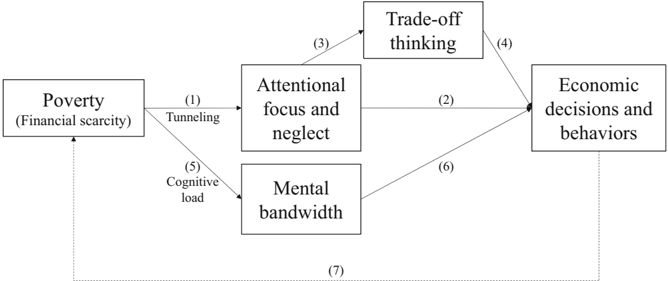
- The review covers three propositions: poverty leads to attentional focus and neglect causing overborrowing; poverty induces trade-off thinking and more consistent consumption decisions; and poverty reduces mental bandwidth, increasing time discounting and risk aversion.
- The literature “predominantly confirms” the first and second propositions, but methodological issues prevent a firm conclusion; evidence for the third proposition was “not conclusive.”
- For attention, lab studies consistently show greater focus on scarcity-related demands and overborrowing, but evidence for attentional neglect is weaker; the paper notes that the Shah et al. (2012) findings were replicated in Shah et al. (2019), though with smaller effect sizes.
- For mental bandwidth, the initial Mani et al. (2013a) effects were striking, including a reported 13–14 IQ-point difference in fluid intelligence in the lab and a 9–10 IQ-point decline in the field, but replication studies were mixed; for example, Dalton et al. (2019) found no fluid-intelligence effect and Carvalho et al. (2016) found no effect before vs. after payday.
- For economic decisions, the review says financial scarcity consistently increases temporal discounting, but evidence that it increases risk aversion is mixed; the paper also states that current evidence does not support cognitive load as the mechanism behind these effects.
Methods
- Narrative literature review of empirical studies testing scarcity theory in poverty, organized around three mechanisms: attention/tunneling, trade-off thinking, and cognitive load/mental bandwidth.
- The paper synthesizes lab experiments, cross-sectional and quasi-experimental studies, and natural/field experiments; it explicitly notes that nearly all cross-sectional and quasi-experimental studies use income as the poverty measure, which may not match scarcity theory’s subjective poverty definition.
- The analysis is qualitative and comparative, summarizing results and methodological issues rather than conducting a meta-analysis.
Limitations
- The paper states that methodological issues prevent a firm conclusion about several propositions, especially trade-off thinking and cognitive-bandwidth effects.
- It says the theory lacks precision in defining key mechanisms and predicting outcomes, and that the evidence does not fully accord with the theory.
- Evident from the text: the review relies heavily on studies with different designs, measures, and operationalizations of poverty/scarcity, making direct comparison difficult; it also notes a mismatch between subjective scarcity and the common use of income as a proxy, which may limit inference.
Model-written summary of a shortened version of the paper’s full text (it is longer than we read). Check it against the paper before relying on it.
Integrity signals
Registry
Cites
Statistics
Figures
Verification
Claims the paper makes
60 Valid · 3 Not valid · 117 Not checked · 94 Own results and interpretations
At least one cited source doesn’t support this claim or points to a different paper, and none confirmed it — see the verdicts below.
In the paper
“Similarly, students with higher levels of financial anxiety paid relatively high attention to money-related cues (Shapiro and Burchell 2012).”
What the sources say
- Disputedcites Shapiro and Burchell 2012 matched to “Measuring financial anxiety.” (2012) sourceExperimental — accuracy not yet measured
The Discussion (page unavailable) says the dot-probe results showed avoidance rather than vigilance toward financial words, particularly among financially anxious participants. Although Study 1 found a processing bias for financial words, the paper says that test cannot establish whether the bias reflects attention toward or avoidance of them. (LLM, conf=0.88)
Checked by a reasoning model — may be wrong.
plainstates an association- Asserted: passes — The authors put it forward as true.
- Checkable: passes — It can be checked against evidence.
- Load-bearing: unclear — It is unclear whether the paper’s conclusions depend on it.
- Based: passes — The paper gives a reason why it holds.
- Disputed
The cited sources support only part of this claim — read each source’s verdict below.
In the paper
“While the field is fast-growing, the literature lacks an up-to-date, integrative, and critical review of (the evidence for) all key aspects of scarcity theory.”
What the sources say
- Not checked — no full text of the sourcecites Shah et al. 2015 matched to “Scarcity Frames Value” (2015) source
- Not matchedcites Zhao and Tomm 2018
An author–year citation the paper’s reference list doesn’t settle. We don’t search these by name.
- Partly supportedcites Adamkovic ˇ and Martonc ˇik 2017 matched to “A Review of Consequences of Poverty on Economic Decision-Making: A Hypothesized Model of a Cognitive Mechanism” (2017) sourceExperimental — accuracy not yet measured
The Conclusion (page unavailable) says earlier research consisted of partial studies that overlooked relationships across a broader framework, supporting the need for an integrative account. But the paper addresses poverty and economic decision-making; it does not establish that the literature lacks an up-to-date, critical review of all key aspects of scarcity theory. (LLM, conf=0.83)
plain- Asserted: passes — The authors put it forward as true.
- Checkable: unclear — It is unclear whether it could be checked against evidence.
- Load-bearing: passes — The paper’s conclusions depend on it.
- Based: passes — The paper gives a reason why it holds.
The sources with a verdict support this claim; the rest weren’t checked yet, have no full text we could read, or their verdicts aren’t rated yet.
In the paper
“Poverty is associated with a wide range of counterproductive economic behaviors.”
- Also stated in: § 1 Introduction · plain
“Poverty is associated with seemingly irrational and counterproductive behaviors in several areas of economic life, both in developed and developing countries.”
What the sources say
- Not matchedcites Shurtleff 2009
An author–year citation the paper’s reference list doesn’t settle. We don’t search these by name.
- Supportedcites Banerjee and Duflo 2007 matched to “The Economic Lives of the Poor” (2007) source
The sections “Why Don’t the Poor Save More?” and “Why Don’t the Poor Eat More?” describe several economic choices the authors regard as potentially disadvantageous, including limited saving despite costly debt and spending choices that may displace better nutrition. “Why Don’t the Poor Invest More in Education?” discusses another such choice. Together, these passages support the broad paraphrase; they do not establish that poverty causes the behaviors. (LLM, conf=0.88)
- Not checked — no full text of the sourcecites Skiba and Tobacman 2008 matched to “Payday Loans, Uncertainty and Discounting: Explaining Patterns of Borrowing, Repayment, and Default” (2008) source
plainstates an association- Asserted: passes — The authors put it forward as true.
- Checkable: passes — It can be checked against evidence.
- Load-bearing: passes — The paper’s conclusions depend on it.
- Based: passes — The paper gives a reason why it holds.
- Also stated in: § 1 Introduction · plain
Every source the paper cites for this claim was checked and supports it.
In the paper
“Importantly, exploiting ecological variation in financial scarcity around harvest, they found that participants were less susceptible to the endowment effect pre-harvest (when farmers face relative financial scarcity) than post-harvest (when farmers face relative abundance).”
What the sources say
- Supportedcites Fehr et al. (2019) matched to “Poverty, Seasonal Scarcity and Exchange Asymmetries” (2019) source
The Introduction reports that farmers were about 10 percentage points more likely to trade an endowed item during the pre-harvest hungry season than after harvest, reducing the exchange asymmetry by more than 50 percent. It also identifies the hungry season as a period of relative scarcity and harvest as a period of relative abundance. (LLM, conf=0.94)
plainstates a cause- Asserted: passes — The authors put it forward as true.
- Checkable: passes — It can be checked against evidence.
- Load-bearing: passes — The paper’s conclusions depend on it.
- Based: passes — The paper gives a reason why it holds.
- Supported
Every source the paper cites for this claim was checked and supports it.
In the paper
“Fehr et al. (2019) found that facing financial scarcity reduces exchange asymmetries (also known as the endowment effect).”
What the sources say
- Supportedcites Fehr et al. (2019) matched to “Poverty, Seasonal Scarcity and Exchange Asymmetries” (2019) source
The Conclusion states that exchange asymmetries were significantly smaller when resources were more scarce. It identifies this as a finding from trading common household items in a low-income setting. (LLM, conf=0.94)
plainstates a cause- Asserted: passes — The authors put it forward as true.
- Checkable: passes — It can be checked against evidence.
- Load-bearing: passes — The paper’s conclusions depend on it.
- Based: passes — The paper gives a reason why it holds.
- Supported
149 more claims · 31 with their cited sources checked
Create a free account to see all 274 claims and to verify the 2 references still open.
- It may state two separate claims as one. 92
- Probably not a substantial claim. 33
Citations
Cites
Prospect Theory: An Analysis of Decision under Risk
Kahneman, D., & Tversky, A. (1979) · Econometrica · doi:10.2307/1914185 · Cited by 48,524
Prospect theory: An analysis of decision under risk
Kahneman, D., & Tversky, A. (1988) · Decision, Probability and Utility · doi:10.1017/cbo9780511609220.014 · Cited by 32,474 · cited 3×
“(2012) examined this hypothesis using an experiment called ‘‘Family Feud.’’ In this game, participants earned points for guessing popular answers to survey questions. Participants were allocated either small or large time budgets. Furthermore, some participants got a preview of questions of future rounds, others not.…”
MethodResultInfluentialThe Framing of Decisions and the Psychology of Choice
Tversky, A., & Kahneman, D. (1981) · Science · doi:10.1126/science.7455683 · Cited by 18,497
(2011) · Cited by 14,317
Diamond, A. (2013) · Annual Review of Psychology · doi:10.1146/annurev-psych-113011-143750 · Cited by 13,268 · cited 1×
“Executive control comprises three basic functions: (1) working memory operations to keep information retrievable, (2) inhibitory control to override impulses and automatic responses, and (3) cognitive flexibility to switch between tasks and perspectives (Diamond 2013).”
Well-being : the foundations of hedonic psychology
Kahneman, D. J., Diener, E. F., & Schwarz, N. (1999) · Cited by 8,305
Foundations of Behavioral Research
Stockton, R., & Kerlinger, F. N. (1974) · American Educational Research Journal · doi:10.2307/1162206 · Cited by 7,347
Anomalies: The Endowment Effect, Loss Aversion, and Status Quo Bias
Kahneman, D., Knetsch, J. L., & Thaler, R. H. (1991) · Journal of Economic Perspectives · doi:10.1257/jep.5.1.193 · Cited by 5,019
The Economic Importance of Financial Literacy: Theory and Evidence
Lusardi, A., & Mitchell, O. S. (2014) · Journal of Economic Literature · doi:10.1257/jel.52.1.5 · Cited by 4,698
Heuristics and Biases: The Psychology of Intuitive Judgment
Bottom, W. P., Gilovich, T., Griffin, D., & Kahneman, D. (2004) · The Academy of Management Review · doi:10.2307/20159081 · Cited by 3,536
Research works printed but not linked: 3
- Joy, E. E. (2017). For the poor, does attentional bias or worry explain the relationship between financial stressors and poor cognitive performance? (master's thesis). Washburn University. https://wuir.washburn.edu/handle/10425/409.
- Plantinga, A. (2014). Decisions under poverty: The effects of scarcity on cognitive mindset and financial decisions (Master's thesis). Tilburg University. http://arno.uvt.nl/show.cgi?fid=135541.
- Sheehy-Skeffington, J., & Rea, J. (2017). How poverty affects people's decision-making processes . York: Joseph Rowntree Foundation.
Cited by
Ngo, T. T. A., Nguyen, H. L. T., Nguyen, H. P., Mai, H. T. A., Mai, T. H. T., & Hoang, P. L. (2024) · Heliyon · doi:10.1016/j.heliyon.2024.e35743 · Cited by 73
“Additionally, it supports the scarcity theory of Bruijn [153], defining scarcity as a condition where resources fall short of perceived necessity, significantly impacting decision-making processes.”
BackgroundHow Effective Is (More) Money? Randomizing Unconditional Cash Transfer Amounts in the USPreprint
Jaroszewicz, A., Jachimowicz, J., Hauser, O., & Jamison, J. (2022) · SSRN Electronic Journal · doi:10.2139/ssrn.4154000 · Cited by 100
Qamruzzaman, M., Karim, S., & Kor, S. (2023) · Environmental Science and Pollution Research · doi:10.1007/s11356-023-25954-1 · Cited by 65
Everyday administrative burdens and inequality
Martin, L., Delaney, L. D., & Doyle, O. (2023) · Public Administration Review · doi:10.1111/puar.13709 · Cited by 72
Fuel poverty and financial distress
Burlinson, A., Giulietti, M., Law, C., & Liu, H. (2021) · Energy Economics · doi:10.1016/j.eneco.2021.105464 · Cited by 60
“(de Bruijn and Antonides, 2021: 10).”
ResultOverspending, debt, and poverty
Achtziger, A. (2022) · Current Opinion in Psychology · doi:10.1016/j.copsyc.2022.101342 · Cited by 65
Poor and Rational: Decision-Making under Scarcity
Fehr, D., Fink, G., & Jack, B. K. (2022) · Journal of Political Economy · doi:10.1086/720466 · Cited by 64
What If We Are the WEIRD Ones? A Call (and Roadmap) for More Non-WEIRD Entrepreneurship Research
Shepherd, D. A., Wincent, J., & Chase, S. R. (2025) · Entrepreneurship Theory and Practice · doi:10.1177/10422587251347051 · Cited by 48
“…research in non-rich contexts can build on non-mainstream entrepreneurship studies (e.g., Dzingirai, 2021; Morris & Tucker, 2023; Okolie et al., 2022) and literatures from various disciplines (e.g., Bossuroy et al., 2022; De Bruijn & Antonides, 2022; Sabol et al., 2021; Wang et al., 2022).”
Effects of financial anxiety and employability on emotional exhaustion and performance
Jawahar, I. M. “., Mohammed, Z. J., & Schreurs, B. H. J. (2022) · Journal of Vocational Behavior · doi:10.1016/j.jvb.2022.103761 · Cited by 46
Tong, S., Sun, B., Zhang, L., et al. (2024) · Expert Systems with Applications · doi:10.1016/j.eswa.2024.123364 · Cited by 31
Young, J., & Vega, S. H. (2024) · Energy Research & Social Science · doi:10.1016/j.erss.2024.103693 · Cited by 42
Caballero, N. D. L. P., & Ploner, M. (2022) · Energy Research & Social Science · doi:10.1016/j.erss.2022.102734 · Cited by 34
van der Veer, A., Madern, T., & van Lenthe, F. J. (2024) · International Journal of Behavioral Nutrition and Physical Activity · doi:10.1186/s12966-024-01576-9 · Cited by 43
Global 100% energy transition by 2050: A fiction in developing economies?
Afful‐Dadzie, A. (2021) · Joule · doi:10.1016/j.joule.2021.06.024 · Cited by 33
Financial scarcity and cognitive performance: A meta-analysis
de Almeida, F., Scott, I. J., Soro, J. C., Fernandes, D. V. D. H., Amaral, A. R., Catarino, M. M. R. S., Arêde, A., & Ferreira, M. B. (2024) · Journal of Economic Psychology · doi:10.1016/j.joep.2024.102702 · Cited by 53
“According to the central tenets of the theory, scarcity leads to a) attentional focus on scarcity pertinent information, b) increased trade-off thinking while c) reducing mental bandwidth (de Bruijn & Antonides, 2022; Mullainathan & Shafir, 2013).”
BackgroundResultThe persistence of cognitive biases in financial decisions across economic groups
Ruggeri, K., Ashcroft-Jones, S., Landini, G. A. R., Al-Zahli, N., Alexander, N., Andersen, M. H., Bibilouri, K., Büsch, K., Cafarelli, V., Chen, J., et al. (2023) · Scientific Reports · doi:10.1038/s41598-023-36339-2 · Cited by 37
Honestly hungry: Acute hunger does not increase unethical economic behaviour
Elbæk, C. T., Mitkidis, P., Aarøe, L., & Otterbring, T. (2022) · Journal of Experimental Social Psychology · doi:10.1016/j.jesp.2022.104312 · Cited by 25
Understanding and supporting the motivation of students from low-income families
Alivernini, F., Manganelli, S., Lucidi, F., & Cavicchiolo, E. (2023) · Contemporary Educational Psychology · doi:10.1016/j.cedpsych.2023.102177 · Cited by 37
The Perceived Economic Scarcity Scale: A valid tool with greater predictive utility than income
Auger, V., Sommet, N., & Normand, A. (2024) · British Journal of Social Psychology · doi:10.1111/bjso.12719 · Cited by 27
Civai, C., Elbæk, C. T., & Capraro, V. (2024) · Current Opinion in Psychology · doi:10.1016/j.copsyc.2024.101931 · Cited by 22
Chen, H., & Chao, C. (2025) · British Food Journal · doi:10.1108/bfj-07-2024-0680 · Cited by 27
Fokus Penelitian Berpikir Kritis Siswa dalam Pembelajaran Ekonomi: Bibliometrik Analisis 2019-2023
Triansyah, F. A., Suwatno, S., & Supardi, E. (2023) · Jurnal Simki Pedagogia · doi:10.29407/jsp.v6i1.226 · Cited by 17
Scarcity and the Mindsets of Social Welfare Recipients: Evidence from a Field Experiment
Madsen, J. K., Bækgaard, M., & Kvist, J. (2022) · Journal of Public Administration Research and Theory · doi:10.1093/jopart/muac043 · Cited by 26
Place-Based Child Opportunity at Birth and Child Development from Infancy to Age 4
Putnick, D. L., Bell, E. M., Tyris, J. N., McAdam, J., Ghassabian, A., Mendola, P., Sundaram, R., & Yeung, E. H. (2024) · The Journal of Pediatrics · doi:10.1016/j.jpeds.2024.113909 · Cited by 16
Denti, L., Sturén, E., & Johansson, L. (2024) · Frontiers in Psychology · doi:10.3389/fpsyg.2023.1333735 · Cited by 23
Labor education, cash transfers and student development: Evidence from China
Li, B., & Lu, S. (2023) · International Review of Financial Analysis · doi:10.1016/j.irfa.2023.102565 · Cited by 19
Machín, L., Brunet, G., Fajardo, G., Bonilla, L., da Costa, M. I. F., González, F., Bentancor, S., Girona, A., Verdier, S., Curutchet, M. R., et al. (2024) · Food Quality and Preference · doi:10.1016/j.foodqual.2024.105146 · Cited by 18
Negative economic shocks and the compliance to social norms
Bogliacino, F., Charris, R., Gómez, C. E., & Montealegre, F. (2024) · Judgment and Decision Making · doi:10.1017/jdm.2024.1 · Cited by 16
Income inequality in the uptake of environmentally friendly products
Maglicic, M., & de Vasconcelos, V. V. L. (2025) · iScience · doi:10.1016/j.isci.2025.112277 · Cited by 24
“30,31 32–34 On a societal level, the effects of income inequality on adoption are still poorly understood, especially as they interact with social aspects of adoption.”
Using Natural Gas Resources to De-Risk Renewable Energy Investments in Lower-Income Countries
Olleik, M., Hamie, H., & Auer, H. (2022) · Energies · doi:10.3390/en15051651 · Cited by 13
“Lower-income countries have limited financial capabilities [5] and tend to undertake energy planning based on the theory of scarcity [10] rather than optimally.”
BackgroundSocial security, relative deprivation, digital capacity, and household financial investment behavior
Jiao, L., Lu, S., Chen, C., & Yu, F. (2024) · International Review of Financial Analysis · doi:10.1016/j.irfa.2024.103771 · Cited by 15
Indelible imprint: CEOs’ poverty experience and corporate labor income share
Wang, L., Hu, J., Yao, D. T., & Skibniewski, M. J. (2025) · Journal of Business Research · doi:10.1016/j.jbusres.2025.115539 · Cited by 12
Cheng, L., & Sun, X. (2025) · Habitat International · doi:10.1016/j.habitatint.2025.103538 · Cited by 15
A multifaceted poverty reduction program has economic and behavioral consequences
Li, W., Leng, Z., Yi, J., & Zhong, S. (2023) · Proceedings of the National Academy of Sciences · doi:10.1073/pnas.2219078120 · Cited by 20
Backman, B., Dunn, M., George, N. A., Whiteside, B., & McKay, F. H. (2023) · Journal of Studies in International Education · doi:10.1177/10283153231178135 · Cited by 14
An Exploration of Contemporary Trends in Finance Research
Mani, M. (2024) · Journal of the Knowledge Economy · doi:10.1007/s13132-024-02373-2 · Cited by 12
“Understanding the neural basis of these biases can provide insights into decision-making processes and potential interventions to mitigate their effects (Babu et al., 2021; De Bruijn & Antonides, 2022; Herbert, 2018; Ron-ningstam & Baskin-Sommers, 2022).”
TheHomer economicusnarrative: from cognitive psychology to individual public policies
Lecouteux, G. (2023) · Journal of Economic Methodology · doi:10.1080/1350178x.2023.2192222 · Cited by 13
The duality of poverty: a replication of Mani et al. (2013) in Colombia
González-Arango, F., Corredor, J., López-Ardila, M. A., Contreras-González, M. C., Herrera-Santofimio, J., & González, J. J. (2021) · Theory and Decision · doi:10.1007/s11238-021-09836-x · Cited by 13
The Neural Response Process of Cognitive Decision Making: An ERP Study
Gao, X., Gao, L., Li, Y., & Sui, X. (2023) · Brain Sciences · doi:10.3390/brainsci13040648 · Cited by 17
Does worrying about money motivate counterproductive work behavior? A time-lagged study
Abedini, M., Schreurs, B. H. J., Jawahar, I. M. “., & Hamstra, M. R. W. (2024) · Journal of Managerial Psychology · doi:10.1108/jmp-04-2023-0223 · Cited by 12
Bruns, S., Dalheimer, B., & Mußhoff, O. (2021) · Agricultural Economics · doi:10.1111/agec.12686 · Cited by 10
The Impact of Scarcity on Pro-environmental Behavior in the COVID-19 Pandemic
Sachdeva, S. S., Wu, J. S.-T., & Zhao, J. (2021) · Frontiers in Sustainable Cities · doi:10.3389/frsc.2021.767501 · Cited by 14
Parents, but not their children, demonstrate greater delay discounting with resource scarcity
Button, A. M., Paluch, R. A., Schechtman, K. B., Wilfley, D. E., Geller, N. L., Quattrin, T., Cook, S. R., Eneli, I., & Epstein, L. H. (2023) · BMC Public Health · doi:10.1186/s12889-023-16832-z · Cited by 12
Scarcity and InattentionPreprint
Kalil, A., Mayer, S. E., & Shah, R. (2022) · SSRN Electronic Journal · doi:10.2139/ssrn.4138637 · Cited by 13
“In this article, we follow the terminology of previous research (De Bruijn & Antonides, 2021; Mani et al., 2013; Mullainathan & Shafir, 2013; A. K. Shah et al., 2015) in using the term “scarcity” to mean scarcity of cognitive bandwidth brought about by factors that divert cognitive bandwidth from…”
BackgroundMethodInfluentialA “Sludge Audit” for Health System Colorectal Cancer Screening Services
(2023) · The American Journal of Managed Care · doi:10.37765/ajmc.2023.89402 · Cited by 10
de Bruijn, E.-J., Antonides, G., & Madern, T. (2022) · Frontiers in Psychology · doi:10.3389/fpsyg.2022.1090024 · Cited by 21
Self-citationScholten, L., Betkó, J., Gesthuizen, M., Fransen, G. A. J., de Vet, R., & Wolf, J. (2023) · Social Science & Medicine · doi:10.1016/j.socscimed.2023.115781 · Cited by 14
"If you don't buy it, it's gone!": The effect of perceived scarcity on panic buying
Cao, C., Chu, C., & Yang, J. (2023) · Electronic Research Archive · doi:10.3934/era.2023279 · Cited by 13
Need for uniqueness moderates the effectiveness of different types of scarcity appeals
Wang, Y., Kong, S., Li, M., & Liu, L. (2022) · Frontiers in Psychology · doi:10.3389/fpsyg.2022.890350 · Cited by 20
Being good and doing good in behavioral policymaking
Mills, S. (2024) · Public Administration Review · doi:10.1111/puar.13908 · Cited by 20
“…load is ‘ scarcity theory, ’ which argues that the relative scarcity or abundance of resources (e.g., money, time, social capital) impacts how these resources are used (e.g., Barto ˇ s et al., 2021; De Bruijn & Antonides, 2022; Israel et al., 2021; Schmidt et al., 2019; Shah et al., 2012).”
A Simple Mitigation Model of Poverty Reduction in Indonesia
Prasetyo, P. E., & Thomas, P. (2021) · Open Journal of Business and Management · doi:10.4236/ojbm.2021.96152 · Cited by 8
“According to Bruijn and Antonides (2021), poverty leads to empowerment and triggers trade-off thinking, although methodological problems prevent firm conclusions.”
BackgroundMethodInfluentialLegare, C. H., Bürger, O., Johnson, T. P., Mor, N., & Saldanha, N. A. (2022) · The Lancet Regional Health - Southeast Asia · doi:10.1016/j.lansea.2022.04.002 · Cited by 11
Jia, X., Wang, T., & Chen, C. (2022) · Frontiers in Psychology · doi:10.3389/fpsyg.2022.946167 · Cited by 9
The effects of scarcity mindset on envy: the mediating role of the sense of control
Ren, M., Zou, S., Zhu, S., Shi, M., Li, W., & Ding, D. (2023) · Current Psychology · doi:10.1007/s12144-023-04872-y · Cited by 12
“They are more likely to engage in behaviours that are directed toward immediate rewards for the object of envy rather than toward self-improvement and efforts of their own (de Bruijn & Antonides, 2022 ).”
Decker, C., Hanley, N. D., Czajkowski, M., Morrison, T. A., Keyyu, J. D., Munishi, L. K., Lankester, F. J., & Cleaveland, S. (2021) · Ecological Economics · doi:10.1016/j.ecolecon.2021.107189 · Cited by 10
Huang, M., & Ye, Y. (2024) · Health Communication · doi:10.1080/10410236.2024.2358279 · Cited by 13
“An alternative explanation may stem from scarcity theory: being poor induces a scarcity mind-set, which subsequently prompts the poor into less-than-optimal decisions and behaviors (De Bruijn & Antonides, 2022).”
Resource Constraints Lead to Biased Attention but Decrease Unethical Behavior
Børsting, C. K., Elbæk, C. T., Mitkidis, P., & Hochman, G. (2024) · Journal of Behavioral Decision Making · doi:10.1002/bdm.2402 · Cited by 8
The Psychology of Poverty: Current and Future Directions
Park, Y., Ho, Y. W., Hallez, K., Kaur, S., Srinivasan, M., & Zhao, J. (2024) · Current Directions in Psychological Science · doi:10.1177/09637214241283163 · Cited by 16
“Work on scarcity has largely focused on testing for the bandwidth tax (for a recent review, see de Bruijn & Antonides, 2022).”
Low Self-Concept Clarity Induces Scarcity Perceptions: The Subsequent Effects on Prosocial Behavior
Sun, Y., Wang, X., Su, S., Chen, W., & Jiang, T. (2024) · Personality and Social Psychology Bulletin · doi:10.1177/01461672241294103 · Cited by 9
“…given that scarcity perceptions substantially affect individuals’ cognitive function, attention allocation, and decision-making, often negatively (de Bruijn & Antonides, 2022; Shah et al., 2012), understanding how they may be induced will yield important theoretical and practical implications.”
Slum‐Based CAV Networks: Networking in Unyielding Poverty Situations
Simba, A., Braune, É., & Dabić, M. (2025) · Strategic Change · doi:10.1002/jsc.2673 · Cited by 8
Rethinking adaptation interventions in agricultural systems for sustainability
Vallury, S., Nelson, D. R., & Cook, N. J. (2025) · Current Opinion in Environmental Sustainability · doi:10.1016/j.cosust.2025.101571 · Cited by 11
The Scarcity–Prosociality Link: Ambiguous, Yet Thought-provoking
Krishnan, L. (2022) · Psychology and Developing Societies · doi:10.1177/09713336221080648 · Cited by 6
“Writing about scarcity theory, de Bruijn and Antonides (2021) mention that although there is some evidence of reduced cognitive bandwidth under scarcity, and its effect on decisionmaking, such effects are not exhibited consistently in research.”
BackgroundPersistent poverty and child dental caries: time-varying exposure analysis
Matsuyama, Y., Isumi, A., Doi, S. K., & Fujiwara, T. (2023) · Journal of Epidemiology & Community Health · doi:10.1136/jech-2022-220073 · Cited by 8
DeLiema, M., Völker, J., & Worley, A. (2023) · Victims & Offenders · doi:10.1080/15564886.2023.2244468 · Cited by 9
“Alternatively, living in a state of financial insecurity and uncertainty can hamper reasoned decision making (de Bruijn & Antonides, 2022).”
BackgroundScarcity Captures Attention and Induces Neglect: Eyetracking and Behavoral EvidencePreprint
Tomm, B. M., Shafir, E. B., & Zhao, J. (2023) · PsyArXiv (OSF Preprints) · doi:10.31234/osf.io/c9jq6 · Cited by 9
Fu, T., Wang, Y., Jiang, J., & Meng, L. (2024) · Journal of Business Research · doi:10.1016/j.jbusres.2024.114998 · Cited by 7
Perceiving Low Social Mobility Induces Zero-Sum Beliefs About Social Hierarchies
Wang, X., Zhuo, Y., Chen, W., Du, H., & Chen, Z. (2024) · Personality and Social Psychology Bulletin · doi:10.1177/01461672241290390 · Cited by 11
“Such a scarcity mindset leads to particular cognitive patterns, such as increased cognitive tunneling and time discounting, which were once thought to stem from an actual lack of resources (De Bruijn & Antonides, 2022).”
Verdeau, B., BARBOT, A. D., & Monnery-Patris, S. (2025) · Appetite · doi:10.1016/j.appet.2025.107903 · Cited by 11
From saviour to partner: reflections on relational needs-based organising in India
Lazarus, J., Mathur, V., & Franchi, M. (2025) · Development in Practice · doi:10.1080/09614524.2025.2517667 · Cited by 8
“Perceptions of scarcity and unsafety drastically curtail capacities for identifying and imagining alternative possibilities and longer time frames (Bruijn and Antonides 2022; Fieulaine and Apos-tolidis 2015; Laajaj 2017).”
Szászi, B., Pálfi, B., Neszveda, G., Taka, A., Szécsi, P., Blattman, C., Jamison, J., & Sheridan, M. A. (2023) · Cortex · doi:10.1016/j.cortex.2023.07.009 · Cited by 8
“However this hypothesis would be consistent with prior theories (De Bruijn & Antonides, 2022) which emphasized the possibility that the impact of increased cash availability on cognitive function is derived from a decrease in the need for individuals to attend to and thus be distracted by monetary…”
ResultMoleskis, M., Solomou, P., Ikinci, M., & Zachariadis, T. (2025) · Frontiers in Sustainable Energy Policy · doi:10.3389/fsuep.2025.1464660 · Cited by 12
Family wealth and adolescent physical health
Jones, E. J., Miller, P. L., Gibson‐Davis, C. M., Hanson, J. L., & Votruba‐Drzal, E. (2025) · Health Psychology Review · doi:10.1080/17437199.2025.2451232 · Cited by 5
“…precarity may force adolescents and their families to focus on current socioeconomic and psychosocial challenges and thus have less bandwidth to attend to future possibilities (de Bruijn & Antonides, 2022; Shah et al., 2012) that may be relevant to their health (Griskevicius et al., 2011).”
Emergent poverty traps at multiple levels impede social mobility
Dupont, C., & Roy, D. (2025) · Humanities and Social Sciences Communications · doi:10.1057/s41599-025-06089-9 · Cited by 13
Hu, J., Chen, H., & Zhao, Y. (2025) · Tourism Management · doi:10.1016/j.tourman.2025.105347 · Cited by 6
Li, G., Xie, S., Huang, H., & Wang, K. (2026) · Journal of Retailing and Consumer Services · doi:10.1016/j.jretconser.2026.104749 · Cited by 6
Structural barriers and policy pathways for a just clean energy transition
Hoehnke, H., Wussow, M., Zanocco, C. M., Carley, S. R., Konisky, D. M., & Neumann, D. (2026) · Nature Reviews Clean Technology · doi:10.1038/s44359-026-00157-2 · Cited by 8
“…generation subsidies such as feed-in tariffs or renewable energy credits provide long-term payments over 15–25 years, they tend to be less effective than upfront cost subsidies, due in part to the high discounting of future cashflows, particularly among low-income households 64,65,69,78,131,132 .”
Social structure as a form of collective intelligence: a new framework
Brooker, J. S., van Leeuwen, E. J. C., & Clay, Z. (2026) · Philosophical Transactions of the Royal Society B Biological Sciences · doi:10.1098/rstb.2024.0443 · Cited by 6
He, X., Qiu, B., Deng, Y., Wang, Z., Cao, X., Zheng, X., Zhu, J., & Zhang, W. (2024) · The Journal of Psychology · doi:10.1080/00223980.2023.2296946 · Cited by 6
“Studies regarding the effect of resource scarcity on cognitive functions have shown mixed results (for a review, see de Bruijn & Antonides, 2022).”
ResultDirty Entrepreneurship: The Intersectionality of Entrepreneurs’ Dirty Recycling Businesses
Shepherd, D. A., Parida, V., & Wincent, J. (2024) · Entrepreneurship Theory and Practice · doi:10.1177/10422587241304707 · Cited by 8
“Although some argue that the scarcity mindset leads to biased decision making (De Bruijn & Antonides, 2022; Morris et al., 2020; Morris & Tucker, 2023), perhaps it is rational.”
From poverty trap to commodity trap: entrepreneurship and well-being among the poor
Morris, M. H., Soleimanof, S., Calle, M., & Tucker, R. L. (2025) · Small Business Economics · doi:10.1007/s11187-025-01045-y · Cited by 11
“Resource scarcity, one of the most prominent disadvantages of poverty (De Bruijn & Antonides, 2022; Jachimowicz, et al., 2022; Wilson, 2011), places entrepreneurs in a constant state of uncertainty about whether they can meet their basic needs (Roux et al., 2015).”
Finding meaning in complex care nursing in a hospital setting
Borghmans, F., Laletas, S., Fernandes, V., & Newnham, H. H. (2024) · Nursing Inquiry · doi:10.1111/nin.12633 · Cited by 9
Kportorgbi, H. K., Aboagye‐Otchere, F., & Kwakye, T. O. (2024) · Journal of Global Responsibility · doi:10.1108/jgr-02-2023-0013 · Cited by 9
Kasujja, R., Birungi, P., Bhamidipati, K., Assefa, F. B., Kim, H., Peterson, K. M., Kohrt, B. A., & Bershteyn, A. (2025) · JAMA Network Open · doi:10.1001/jamanetworkopen.2025.5242 · Cited by 8
Hoid, D., Guo, Z., He, Z., Wu, J., & Wu, Z. (2024) · Developmental Science · doi:10.1111/desc.13485 · Cited by 6
The Psychology of Poverty: Where Do We Stand?
Haushofer, J., & Salicath, D. (2023) · National Bureau of Economic Research · doi:10.3386/w31977 · Cited by 15
Pulk, K., & Post, T. (2025) · Frontiers in Behavioral Economics · doi:10.3389/frbhe.2025.1379577 · Cited by 7
Zhu, H., You, F., Gruber, T., Dong, H., Cheng, P., & de Bont, C. J. P. M. (2025) · JMIR Public Health and Surveillance · doi:10.2196/69496 · Cited by 7
Scarcity affects cognitive biases: The case of the illusion of causality
Vinas, A., Blanco, F., & Matute, H. (2023) · Acta Psychologica · doi:10.1016/j.actpsy.2023.104007 · Cited by 8
Zhang, L., Xu, M., Du, X., Yang, Q., & Qiao, L. (2023) · Neuropsychologia · doi:10.1016/j.neuropsychologia.2023.108739 · Cited by 5
The Effect of Scarcity and Information Avoidance on Debt Management Behavior
Barrafrem, K., Kienzler, M., Västfjäll, D., & Tinghög, G. (2024) · Journal of Financial Counseling and Planning · doi:10.1891/jfcp-2022-0062 · Cited by 4
The impact of U.S. economic sanctions on corporate innovation and fraud
Bazrafshan, A. (2024) · Public Administration and Development · doi:10.1002/pad.2077 · Cited by 4
Shu, L., Gong, T., Wang, Y., Li, Q., & Xie, Z. (2024) · BMC Psychology · doi:10.1186/s40359-024-02173-y · Cited by 4
Mehmood, Y., Qadar, A., & Waheed, A. (2022) · Journal of Asian and African Studies · doi:10.1177/00219096221076112 · Cited by 4
“The income of the households indicates the welfare status and purchasing power that help them make a better decision at the time of need (de Bruijn and Antonides, 2021).”
BackgroundSayyidina, N. A., Iranto, D., & Suparno, S. (2023) · Journal of Business and Economics Research (JBE) · doi:10.47065/jbe.v4i2.3559 · Cited by 4
“This logic of thinking was put forward by Ragnar Nurkse in 1953, which said, "A poor country is poor because it is poor "(de Bruijn & Antonides, 2022).”
BackgroundDoes a founder’s cultural imprint affect corporate ESG performance?
Chen, Y., Jiang, E. J., & Mo, P. L. L. (2025) · Research in International Business and Finance · doi:10.1016/j.ribaf.2025.102800 · Cited by 4
Zheng, Y., Zheng, Y., & Liu, X. (2025) · Education Sciences · doi:10.3390/educsci15030298 · Cited by 6
“…tuition reductions, study material subsidies) and indirect resource compensation (e.g., after-school tutoring, psychological counseling services), can significantly alleviate their cognitive load, thereby exerting a significant impact on their noncognitive abilities (De Bruijn & Antonides, 2022).”
Viera, M. E. D., van den Berg, M., Handgraaf, M. J. J., & Donovan, J. (2022) · Economics & Human Biology · doi:10.1016/j.ehb.2022.101215 · Cited by 5
“Living in poverty and moderate levels of stress can also lead to normative rationality or positive outcomes (Bruijn, 2021).”
BackgroundInfluentialVinas, A., Blanco, F., & Matute, H. (2025) · Scientific Reports · doi:10.1038/s41598-025-01043-w · Cited by 6
Fading Silver Linings: Financial Stress Trajectories and Expectations of the Future
Graham, B. A. (2025) · Journal of Business and Psychology · doi:10.1007/s10869-025-10043-6 · Cited by 4
“For instance, as financial stress diminishes, individuals may regain cognitive and emotional bandwidth, allowing them to make more strategic financial decisions, such as saving, investing, or pursuing higher-paying job opportunities (De Bruijn & Antonides, 2022).”
The effects of time and money scarcity on regulatory focus: The mediating role of sense of control
Wu, Y., Feng, J., Chen, W., & Chen, Y. (2025) · Acta Psychologica · doi:10.1016/j.actpsy.2025.105251 · Cited by 4
Metadata
- Authors
- de Bruijn, E.-J., & Antonides, G.
- Affiliations
- Leiden University (NL)
- Wageningen University & Research (NL)
- Corresponding author
- de Bruijn, Ernst-Jan
- Venue
- Theory and Decision
- Published
- 2021-03-09
- Volume
- 92
- Issue
- 1
- Pages
- 5-37
- ISSN
- 0040-5833 (ISSN-L)
- 1573-7187
- OpenAlex
- W3134877833
- Cited by
- 277
- References
- 93
- Citations by year
- 2026: 55 · 2025: 82 · 2024: 70 · 2023: 35 · 2022: 27 · 2021: 8
- FWCI
- 194.72
- Type
- book chapter
- Language
- en
- Open access
- hybrid
- doi.org
- Licence
- cc-by
- creativecommons.org/licenses/by/4.0 (tdm)
- creativecommons.org/licenses/by/4.0 (vor)
- Locations
- Theory and Decision (publishedVersion, cc-by)
- Leiden Repository (Leiden University) (submittedVersion)
- Socio-Environmental Systems Modeling (submittedVersion, cc-by)
- SSRN Electronic Journal (submittedVersion)
- RePEc: Research Papers in Economics (submittedVersion)
- Data Archiving and Networked Services (DANS) (submittedVersion, other-oa)
- Data Archiving and Networked Services (DANS) (submittedVersion, cc-by)
- Funders
- Nederlandse Organisatie voor Wetenschappelijk Onderzoek (023.005.060)
- Topics
- Social Sciences › Decision Sciences › General Decision Sciences › Decision-Making and Behavioral Economics
- Social Sciences › Economics, Econometrics and Finance › Finance › Financial Literacy, Pension, Retirement Analysis
- Social Sciences › Sociology and Political Science › Income, Poverty, and Inequality
- Keywords
- poverty, scarcity theory, scarcity mindset, economic decision-making, attentional focus, overborrowing, consumer choice, delay discounting, risk aversion, financial scarcity
About these checks
Registry, retraction, Cites and statistics results are computed, not judged, with one exception: a printed reference that no index lists is read once by a model before it counts as a citation error. Claims are extracted by a model and kept only when their quote appears verbatim in the text; each cited source is then checked, with a model’s help, for whether it says what the claim relies on. Those verdicts can be wrong — read the claim’s quote and the cited source before relying on one.
The claim verdicts this report counts are experimental: their accuracy is not yet measured.
A language model drew the claims from the paper on 2026-10-10, under version 3 of the claim definition (model deepseek-v4.1-flash, prompt extract-v3).
A second model labelled each claim on 2026-10-10 (model jev-1.13-20260917, definition revision gold-guideline-v0.2).
Cited sources are checked with a language model’s help (gpt-6-sol).
Statistics and arithmetic are recomputed, not judged.
Confidence bands are shown only for fields calibrated on our annotated test set. None is calibrated yet, so no band is shown.
What counts as a claim ›How we measure confidence ›How we check this ›
Are you an author, or do you see a problem with this page? Request a review
Data sources
Bibliographic data: Semantic Scholar, OpenAlex, Crossref.
Contains information from the Semantic Scholar Academic Graph Datasets, made available under the ODC Attribution License (ODC-BY 1.0).
Semantic Scholar’s data is described in: Kinney, R., et al. (2023). The Semantic Scholar Open Data Platform. arXiv:2301.10140.
