

Poverty and economic decision making: a review of scarcity theory
Open accessThe DOI matches its Crossref record; 93 of the 94 references it cites were found in a registry or an index; 70 of the 216 sources its claims cite were checked for support.
Abstract
Poverty is associated with a wide range of counterproductive economic behaviors. Scarcity theory proposes that poverty itself induces a scarcity mindset, which subsequently forces the poor into suboptimal decisions and behaviors. The purpose of our work is to provide an integrated, up-to-date, critical review of this theory.
Overview
CoChat Summary
TL;DR
This paper is a critical review of scarcity theory applied to poverty and economic decision making. It finds the strongest support for attentional focus/neglect and trade-off thinking, but evidence for the cognitive-load pathway is mixed and the theory does not fully fit the available data.
Key findings
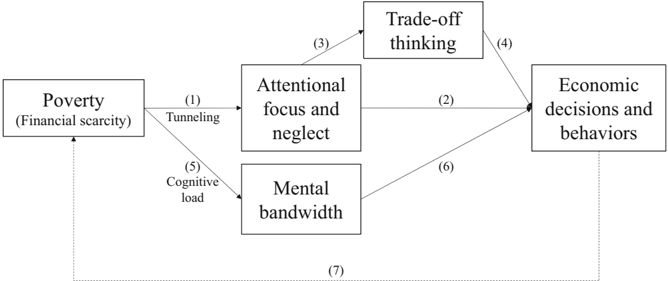
- The review covers three propositions: poverty leads to attentional focus and neglect causing overborrowing; poverty induces trade-off thinking and more consistent consumption decisions; and poverty reduces mental bandwidth, increasing time discounting and risk aversion.
- The literature “predominantly confirms” the first and second propositions, but methodological issues prevent a firm conclusion; evidence for the third proposition was “not conclusive.”
- For attention, lab studies consistently show greater focus on scarcity-related demands and overborrowing, but evidence for attentional neglect is weaker; the paper notes that the Shah et al. (2012) findings were replicated in Shah et al. (2019), though with smaller effect sizes.
- For mental bandwidth, the initial Mani et al. (2013a) effects were striking, including a reported 13–14 IQ-point difference in fluid intelligence in the lab and a 9–10 IQ-point decline in the field, but replication studies were mixed; for example, Dalton et al. (2019) found no fluid-intelligence effect and Carvalho et al. (2016) found no effect before vs. after payday.
- For economic decisions, the review says financial scarcity consistently increases temporal discounting, but evidence that it increases risk aversion is mixed; the paper also states that current evidence does not support cognitive load as the mechanism behind these effects.
Methods
- Narrative literature review of empirical studies testing scarcity theory in poverty, organized around three mechanisms: attention/tunneling, trade-off thinking, and cognitive load/mental bandwidth.
- The paper synthesizes lab experiments, cross-sectional and quasi-experimental studies, and natural/field experiments; it explicitly notes that nearly all cross-sectional and quasi-experimental studies use income as the poverty measure, which may not match scarcity theory’s subjective poverty definition.
- The analysis is qualitative and comparative, summarizing results and methodological issues rather than conducting a meta-analysis.
Limitations
- The paper states that methodological issues prevent a firm conclusion about several propositions, especially trade-off thinking and cognitive-bandwidth effects.
- It says the theory lacks precision in defining key mechanisms and predicting outcomes, and that the evidence does not fully accord with the theory.
- Evident from the text: the review relies heavily on studies with different designs, measures, and operationalizations of poverty/scarcity, making direct comparison difficult; it also notes a mismatch between subjective scarcity and the common use of income as a proxy, which may limit inference.
Model-written summary of a shortened version of the paper’s full text (it is longer than we read). Check it against the paper before relying on it.
Integrity signals
Registry
Cites
Statistics
Figures
Verification
Claims the paper makes
60 Valid · 3 Not valid · 117 Not checked · 94 Own results and interpretations
At least one cited source doesn’t support this claim or points to a different paper, and none confirmed it — see the verdicts below.
In the paper
“Similarly, students with higher levels of financial anxiety paid relatively high attention to money-related cues (Shapiro and Burchell 2012).”
What the sources say
- Disputedcites Shapiro and Burchell 2012 matched to “Measuring financial anxiety.” (2012) sourceExperimental — accuracy not yet measured
The Discussion (page unavailable) says the dot-probe results showed avoidance rather than vigilance toward financial words, particularly among financially anxious participants. Although Study 1 found a processing bias for financial words, the paper says that test cannot establish whether the bias reflects attention toward or avoidance of them. (LLM, conf=0.88)
Checked by a reasoning model — may be wrong.
plainstates an association- Asserted: passes — The authors put it forward as true.
- Checkable: passes — It can be checked against evidence.
- Load-bearing: unclear — It is unclear whether the paper’s conclusions depend on it.
- Based: passes — The paper gives a reason why it holds.
- Disputed
The cited sources support only part of this claim — read each source’s verdict below.
In the paper
“While the field is fast-growing, the literature lacks an up-to-date, integrative, and critical review of (the evidence for) all key aspects of scarcity theory.”
What the sources say
- Not checked — no full text of the sourcecites Shah et al. 2015 matched to “Scarcity Frames Value” (2015) source
- Not matchedcites Zhao and Tomm 2018
An author–year citation the paper’s reference list doesn’t settle. We don’t search these by name.
- Partly supportedcites Adamkovic ˇ and Martonc ˇik 2017 matched to “A Review of Consequences of Poverty on Economic Decision-Making: A Hypothesized Model of a Cognitive Mechanism” (2017) sourceExperimental — accuracy not yet measured
The Conclusion (page unavailable) says earlier research consisted of partial studies that overlooked relationships across a broader framework, supporting the need for an integrative account. But the paper addresses poverty and economic decision-making; it does not establish that the literature lacks an up-to-date, critical review of all key aspects of scarcity theory. (LLM, conf=0.83)
plain- Asserted: passes — The authors put it forward as true.
- Checkable: unclear — It is unclear whether it could be checked against evidence.
- Load-bearing: passes — The paper’s conclusions depend on it.
- Based: passes — The paper gives a reason why it holds.
The sources with a verdict support this claim; the rest weren’t checked yet, have no full text we could read, or their verdicts aren’t rated yet.
In the paper
“Poverty is associated with a wide range of counterproductive economic behaviors.”
- Also stated in: § 1 Introduction · plain
“Poverty is associated with seemingly irrational and counterproductive behaviors in several areas of economic life, both in developed and developing countries.”
What the sources say
- Not matchedcites Shurtleff 2009
An author–year citation the paper’s reference list doesn’t settle. We don’t search these by name.
- Supportedcites Banerjee and Duflo 2007 matched to “The Economic Lives of the Poor” (2007) source
The sections “Why Don’t the Poor Save More?” and “Why Don’t the Poor Eat More?” describe several economic choices the authors regard as potentially disadvantageous, including limited saving despite costly debt and spending choices that may displace better nutrition. “Why Don’t the Poor Invest More in Education?” discusses another such choice. Together, these passages support the broad paraphrase; they do not establish that poverty causes the behaviors. (LLM, conf=0.88)
- Not checked — no full text of the sourcecites Skiba and Tobacman 2008 matched to “Payday Loans, Uncertainty and Discounting: Explaining Patterns of Borrowing, Repayment, and Default” (2008) source
plainstates an association- Asserted: passes — The authors put it forward as true.
- Checkable: passes — It can be checked against evidence.
- Load-bearing: passes — The paper’s conclusions depend on it.
- Based: passes — The paper gives a reason why it holds.
- Also stated in: § 1 Introduction · plain
Every source the paper cites for this claim was checked and supports it.
In the paper
“Importantly, exploiting ecological variation in financial scarcity around harvest, they found that participants were less susceptible to the endowment effect pre-harvest (when farmers face relative financial scarcity) than post-harvest (when farmers face relative abundance).”
What the sources say
- Supportedcites Fehr et al. (2019) matched to “Poverty, Seasonal Scarcity and Exchange Asymmetries” (2019) source
The Introduction reports that farmers were about 10 percentage points more likely to trade an endowed item during the pre-harvest hungry season than after harvest, reducing the exchange asymmetry by more than 50 percent. It also identifies the hungry season as a period of relative scarcity and harvest as a period of relative abundance. (LLM, conf=0.94)
plainstates a cause- Asserted: passes — The authors put it forward as true.
- Checkable: passes — It can be checked against evidence.
- Load-bearing: passes — The paper’s conclusions depend on it.
- Based: passes — The paper gives a reason why it holds.
- Supported
Every source the paper cites for this claim was checked and supports it.
In the paper
“Fehr et al. (2019) found that facing financial scarcity reduces exchange asymmetries (also known as the endowment effect).”
What the sources say
- Supportedcites Fehr et al. (2019) matched to “Poverty, Seasonal Scarcity and Exchange Asymmetries” (2019) source
The Conclusion states that exchange asymmetries were significantly smaller when resources were more scarce. It identifies this as a finding from trading common household items in a low-income setting. (LLM, conf=0.94)
plainstates a cause- Asserted: passes — The authors put it forward as true.
- Checkable: passes — It can be checked against evidence.
- Load-bearing: passes — The paper’s conclusions depend on it.
- Based: passes — The paper gives a reason why it holds.
- Supported
149 more claims · 31 with their cited sources checked
Create a free account to see all 274 claims and to verify the 2 references still open.
- It may state two separate claims as one. 92
- Probably not a substantial claim. 33
Citations
Cites
Prospect Theory: An Analysis of Decision under Risk
Kahneman, D., & Tversky, A. (1979) · Econometrica · doi:10.2307/1914185 · Cited by 48,524
Prospect theory: An analysis of decision under risk
Kahneman, D., & Tversky, A. (1988) · Decision, Probability and Utility · doi:10.1017/cbo9780511609220.014 · Cited by 32,474 · cited 3×
“(2012) examined this hypothesis using an experiment called ‘‘Family Feud.’’ In this game, participants earned points for guessing popular answers to survey questions. Participants were allocated either small or large time budgets. Furthermore, some participants got a preview of questions of future rounds, others not.…”
MethodResultInfluentialThe Framing of Decisions and the Psychology of Choice
Tversky, A., & Kahneman, D. (1981) · Science · doi:10.1126/science.7455683 · Cited by 18,497
(2011) · Cited by 14,317
Diamond, A. (2013) · Annual Review of Psychology · doi:10.1146/annurev-psych-113011-143750 · Cited by 13,268 · cited 1×
“Executive control comprises three basic functions: (1) working memory operations to keep information retrievable, (2) inhibitory control to override impulses and automatic responses, and (3) cognitive flexibility to switch between tasks and perspectives (Diamond 2013).”
Well-being : the foundations of hedonic psychology
Kahneman, D. J., Diener, E. F., & Schwarz, N. (1999) · Cited by 8,305
Foundations of Behavioral Research
Stockton, R., & Kerlinger, F. N. (1974) · American Educational Research Journal · doi:10.2307/1162206 · Cited by 7,347
Anomalies: The Endowment Effect, Loss Aversion, and Status Quo Bias
Kahneman, D., Knetsch, J. L., & Thaler, R. H. (1991) · Journal of Economic Perspectives · doi:10.1257/jep.5.1.193 · Cited by 5,019
The Economic Importance of Financial Literacy: Theory and Evidence
Lusardi, A., & Mitchell, O. S. (2014) · Journal of Economic Literature · doi:10.1257/jel.52.1.5 · Cited by 4,698
Heuristics and Biases: The Psychology of Intuitive Judgment
Bottom, W. P., Gilovich, T., Griffin, D., & Kahneman, D. (2004) · The Academy of Management Review · doi:10.2307/20159081 · Cited by 3,536
Research works printed but not linked: 3
- Joy, E. E. (2017). For the poor, does attentional bias or worry explain the relationship between financial stressors and poor cognitive performance? (master's thesis). Washburn University. https://wuir.washburn.edu/handle/10425/409.
- Plantinga, A. (2014). Decisions under poverty: The effects of scarcity on cognitive mindset and financial decisions (Master's thesis). Tilburg University. http://arno.uvt.nl/show.cgi?fid=135541.
- Sheehy-Skeffington, J., & Rea, J. (2017). How poverty affects people's decision-making processes . York: Joseph Rowntree Foundation.
Cited by
Items 101–200 of 278
Pajic, S., Buengeler, C., Hartog, D. N. D., & Boer, D. (2025) · PLoS ONE · doi:10.1371/journal.pone.0323415 · Cited by 4
Brunet, G., Fajardo, G., da Costa, M. I. F., Bonilla, L., González, F., Bentancor, S., Verdier, S., Curutchet, M. R., Girona, A., Pochellú, L., et al. (2025) · Appetite · doi:10.1016/j.appet.2025.108267 · Cited by 7
Bazrafshan, A. (2024) · Journal of Intellectual Capital · doi:10.1108/jic-01-2024-0026 · Cited by 4
Scarcity Mindsets and Generational Differences in India: The Role of Cognitive and Affective Factors
Tripathi, R. C., Pande, N., Tripathi, V. N., Shankar, S., Pande, A., & Bahadur, R. (2022) · Psychology and Developing Societies · doi:10.1177/09713336221080628 · Cited by 6
Influence of Economic Scarcity on Race Perception
Antunes, R. D. A., Gonçalves, E. D. S., Bernardino, L. G., Casalecchi, J. G. S., Grebot, I. B. D. F., & de Moraes, R. (2023) · Psychological Reports · doi:10.1177/00332941231169666 · Cited by 3
“This may explain our results, since scarcity demands and alters mental functions (de Bruijn, Antonides, 2022; Mani et al., 2013; Shah et al., 2012) that can compete with and impair those cognitive resources that exert executive control on racial biases (see Kubota et al., 2012; Richeson et al.,…”
Downey, H., Lemos, R. F., Curran, K. M., Serrano, E. L., Davis, G. C., & Stein, J. S. (2023) · Behavioural Processes · doi:10.1016/j.beproc.2023.104928 · Cited by 6
Technology, capital, and sustainability: Frontiers in just transitions for African mining
Tomassi, O. D., & Kinyondo, A. (2024) · Resources Policy · doi:10.1016/j.resourpol.2024.105348 · Cited by 6
Starting a cultural collective for mothers of children with disabilities: A case study
Raknes, S., Sæbjørnsen, S. E. N., Aarlie, H., Bromstad, T. N., Makuu, M. J., Yamala, C., & Hean, S. C. P. D. (2024) · African Journal of Disability · doi:10.4102/ajod.v13i0.1367 · Cited by 7
“The fact that the caregivers focus on immediate financial needs aligns with De Bruijn and Antonides (2022) findings, and the focus on economic independence resonates with the autonomy concept in SDT (Ryan & Deci 2000).”
Time poverty inhibits employees’ knowledge sharing by suppressing their future orientation
Li, Z., Li, N., & Sun, X. (2025) · Knowledge Management Research & Practice · doi:10.1080/14778238.2025.2488883 · Cited by 4
“A scarcity mindset depletes cognitive resources and impairs future-oriented thinking, making it harder to balance current and future demands (De Bruijn & Antonides, 2022; Mani et al., 2013).”
Rockwell, M. S., Chang, B., Zagarese, V., Turner, J. K., Southworth, A., Wu, Y., Yeaton, P., Li, L., Stein, J. S., Parker, S. H., et al. (2024) · Family Medicine and Community Health · doi:10.1136/fmch-2024-002933 · Cited by 4
The impact of emotion valence and scarcity on the price-quality effect
Zhao, N., Sun, Y., Shi, M., & Chen, Y. (2025) · Scientific Reports · doi:10.1038/s41598-025-97263-1 · Cited by 4
“A previous study showed that scarcity induced cognitive capacity, in which individuals focused on limited cues, such as price, and ignored other cues 38 .”
Ma, Y., & Wang, H. (2025) · Journal of Behavioral and Experimental Economics · doi:10.1016/j.socec.2025.102436 · Cited by 4
Income and boredom: Evidence from 30 countries
Pirla, S., Navarro‐Martinez, D., Pfattheicher, S., & Quoidbach, J. (2025) · Journal of Economic Psychology · doi:10.1016/j.joep.2025.102847 · Cited by 5
Carbuccia, L., Heim, A., Barone, C., & Chevallier, C. (2025) · Nature Human Behaviour · doi:10.1038/s41562-025-02293-4 · Cited by 3
“Third, poverty-induced cognitive scarcity may reduce low-SES parents’ cognitive bandwidth available for early childcare decision-making, leading them to rely on heuristics such as defaulting to parental care, an option more common in low-SES and immigrant families’ social networks 46–48 .”
Srinivasan, J. (2025) · Water Security · doi:10.1016/j.wasec.2025.100192 · Cited by 4
Scarcity mindset as a predictor of cryptocurrency investments
Rooney, G., & Loibl, C. (2025) · Journal of Economic Psychology · doi:10.1016/j.joep.2025.102867 · Cited by 2
Towards the study of world misinformation
Ronzani, P. (2025) · Harvard Kennedy School Misinformation Review · doi:10.37016/mr-2020-191 · Cited by 4
“…conditions are absorbed into a constant survival struggle, diverting their attention to immediate needs (Burlacu et al., 2022; Burlacu et al., 2023; De Bruijn & Antonides, 2021) and leaving fewer resources for activities like information verification, a luxury often taken for granted in more…”
Gong, P., Tang, H., & Sheng, Y. (2026) · Frontiers in Sustainable Food Systems · doi:10.3389/fsufs.2025.1753236 · Cited by 2
Shahriar, A. Z. M., Shepherd, D. A., & Zaman, R. A. (2026) · Entrepreneurship Theory and Practice · doi:10.1177/10422587261419795 · Cited by 5
Poverty and Decision-Making: Impact and Mechanism
Wang, Y. (2022) · Advances in Social Science, Education and Humanities Research/Advances in social science, education and humanities research · doi:10.2991/assehr.k.220131.005 · Cited by 3
Dewies, M., Schop-Etman, A., Merkelbach, I., Rohde, K. I. M., & Denktaş, S. (2022) · Behavioural Public Policy · doi:10.1017/bpp.2022.7 · Cited by 4
You get what you pay for? The mechanisms and moderators of price-quality effect
Na, Z. H. A. O., Xuezhe, Q. I. N., Yaqian, L. I. U., & Ling, S. U. N. (2022) · Advances in Psychological Science · doi:10.3724/sp.j.1042.2022.02372 · Cited by 3
Khateeb, F. R. (2023) · Management Matters · doi:10.1108/manm-06-2023-0023 · Cited by 5
Pheiffer, D. C., & Mphidi, A. J. (2024) · International Journal of Social Science Research and Review · doi:10.47814/ijssrr.v7i4.2005 · Cited by 2
“This is when the influence of the alienation theory comes into play (De Bruijn & Antonides, 2021).”
BackgroundRelaxed minds for healthier food choice at school: A field experiment in southern Mexico
Viera, M. E. D., Mecheva, M. D. V., Nguyen, T., & van den Berg, M. (2024) · Appetite · doi:10.1016/j.appet.2024.107529 · Cited by 3
Financial scarcity and financial avoidance: an eye-tracking and behavioral experiment
Hilbert, L. P., Noordewier, M. K., Seck, L., & DIJK, W. W. V. (2024) · Psychological Research · doi:10.1007/s00426-024-02019-7 · Cited by 6
“…such as worry and shame (De Bruijn & Antonides, Trying to pay one’s expenses when having little money can lead to a feeling of financial scarcity, which is the subjective experience that financial resources are insufficient to meet demands (Shah et al., 2012 ; De Bruijn & Antonides, 2022 ).”
BackgroundMolenaar, J. M., Leung, K. Y., van der Meer, L., Klein, P. P. F., Struijs, J. N., & Jong, J. C. K. (2024) · European Journal of Public Health · doi:10.1093/eurpub/ckae184 · Cited by 3
“Arguably, perceiving your circumstances through the lens of limited resources impacts decision-making and behaviour (e.g. favouring short-term over long-term considerations), increases uncertainties and stress, and thus exacerbates pre-existing vulnerabilities [40–43].”
The invisible family load and the gender earnings gap in Kenya
Vitellozzi, S., Cecchi, F., & Rapallini, C. (2024) · European Economic Review · doi:10.1016/j.euroecorev.2024.104934 · Cited by 6
Obeid, C., Oenema, A., Aoun, A., Awad, L., Kremers, S., & Gubbels, J. S. (2025) · Journal of Human Nutrition and Dietetics · doi:10.1111/jhn.70053 · Cited by 2
Evolutionary Game Selection Leads to Emergent Inequality
Mengesha, I., & Roy, D. (2025) · Lecture notes in computer science · doi:10.1007/978-3-031-97557-8_21 · Cited by 2
Tweeting the economy: Analyzing social media sentiments and macroeconomic indicators
Fitriani, I. N., & Agus, A. A. (2023) · Journal of Innovation in Business and Economics · doi:10.22219/jibe.v7i02.28227 · Cited by 5
“Behavioral Economics is a branch of economics that examines the impact of psychological factors on economic decisions made by individuals or groups (de Bruijn & Antonides, 2022; Vlaev et al., 2019).”
BackgroundMethodological Individualism in Behavioral Economics
Dold, M. (2023) · Springer eBooks · doi:10.1007/978-3-031-41512-8_29 · Cited by 3
Improving Purchasing Decisions with the Role of Product and Price Combinations
Hendratmoko, H., Mutiarawati, E. V., Sitorus, A. C., & Harun, M. Z. M. (2024) · Jurnal Manajemen · doi:10.46806/jm.v13i2.1211 · Cited by 3
“(Bijmolt et al., 2021; Browning et al., 2021; de Bruijn & Antonides, 2022; Jindal, 2022; Shrestha et al., 2021).”
BackgroundGahari, R. R. M., & Hasmarini, M. I. (2024) · Journal of Economics Research and Policy Studies · doi:10.53088/jerps.v4i2.1034 · Cited by 1
“The theory of the poverty cycle states that decreased productivity leads to lower income, negatively affecting consumption, savings, and investment (De Bruijn & Antonides, 2022).”
BackgroundInfluentialBeyond fads and magic bullets: The promise of behavioral approaches in development economics
Flechtner, S. (2024) · Journal of Economic Surveys · doi:10.1111/joes.12663 · Cited by 5
Ethical Implications of Invasive Methods in Neuromarketing Research
Kaur, G., Sharma, S., & Reepu, R. (2024) · Advances in marketing, customer relationship management, and e-services book series · doi:10.4018/979-8-3693-8222-6.ch002 · Cited by 1
Motivaciones y desafíos de mujeres propietarias de negocio de la Ciudad de México y zona conurbada
Herrera, C. A. H. (2024) · Revista Científica Integración · doi:10.36881/ri.v8i2.893 · Cited by 2
Aguring, J., Rollo, C. R., Libdan, I., et al. (2025) · Psychology and Education A Multidisciplinary Journal · doi:10.70838/pemj.370609 · Cited by 1
Njuguna, C. W., Mistri, P., Long, L. C., Chetty-Makkan, C. M., Maughan‐Brown, B., Buttenheim, A. M., Schmucker, L., Pascoe, S. J. S., Thirumurthy, H., O’Connor, C., et al. (2025) · AIDS and Behavior · doi:10.1007/s10461-025-04808-6 · Cited by 1
Du, Y., Tong, L., Wu, W., & Wang, C. (2025) · Management and Organization Review · doi:10.1017/mor.2025.21 · Cited by 2
“…of considerable engagement in social initiatives, and that their prior experiences not only shape their cognitions and beliefs concerning altruistic intent but also influence their perception of resource allocation (Choi, Shin, & Kim, 2023; De Bruijn & Antonides, 2022; Griskevicius et al., 2013).”
InfluentialThe Food Choices of Uruguayan Consumers Through the Lens of the Food Systems Framework
Ares, G., Giménez, A., & Girona, A. (2025) · Elsevier eBooks · doi:10.1016/b978-0-443-29139-5.00020-3 · Cited by 1
Wilson, C. J. (2025) · Behavioural Brain Research · doi:10.1016/j.bbr.2025.115829 · Cited by 1
van der Veer, A., Madern, T., Kamphuis, C. B. M., & van Lenthe, F. J. (2025) · BMC Public Health · doi:10.1186/s12889-025-24556-5 · Cited by 2
Do Moral Views Change during a Crisis? An Experiment on Health Care Priority Setting
Strand, L., Gustavsson, E., & Tinghög, G. (2025) · Medical Decision Making · doi:10.1177/0272989x251391177 · Cited by 1
Wu, Y., & Sato, S. (2025) · Youth · doi:10.3390/youth5040134 · Cited by 1
“Studies on financial poverty have shown that a scarcity mindset reduces mental bandwidth, encompassing cognitive capacity and executive control (De Bruijn & Antonides, 2022).”
Humans are more prosocial in poor foraging environments
Vogel, T. A., Priestley, L., Cutler, J., Hogg, T., Khalighinejad, N., Garrett, N., Apps, M. A. J., Rushworth, M. F. S., & Lockwood, P. L. (2026) · Nature Communications · doi:10.1038/s41467-025-66880-9 · Cited by 3
“For example, scarcity theory proposes that being in a poor environment induces a scarcity mindset 70 , which results in suboptimal decisions and behaviours.”
Government Audits and Rural Revitalization: Causal Evidence From China
Yan, Y., Chen, L., Xu, A., & Wei, Y. (2026) · SAGE Open · doi:10.1177/21582440251414766 · Cited by 2
“For instance, a “scarcity mindset” can impair households’ ability to make sound judgments in resource allocation and risk management (de Bruijn & Antonides, 2022), further reducing overall social welfare.”
D’Adamo, I., Desideri, S., Gastaldi, M., Iannilli, M., & Marinangeli, F. (2026) · Journal of strategy and management · doi:10.1108/jsma-07-2025-0283 · Cited by 2
Otto, A., Bruyn, S. D., & Goris, B. (2026) · Social Sciences · doi:10.3390/socsci15070466 · Cited by 1
The unintended detrimental effects of pursuing a professional vocation: The case of veterinarians
Palma, M. A., Zhang, P., Cornell, K. K., Salois, M. J., Bain, B., & Neill, C. L. (2023) · PLoS ONE · doi:10.1371/journal.pone.0284583 · Cited by 1
Using Household Living Aid for Entrepreneurship: What Does the B40 Think?
Zolkifly, N. H., Habidin, N. F., & Baharom, S. N. (2023) · International Journal of Academic Research in Accounting Finance and Management Sciences · doi:10.6007/ijarafms/v13-i2/18031 · Cited by 1
“…is aligned with the theory of scarcity whereby when the financial resources are limited or inadequate, it influences the economic decision-making of the poor (De Bruijn & Antonides, 2021); thus other alternative resources shall be used to fill in the gap or it is allocated for other priorities.”
Saputra, R., Syarifudin, A., & Lidyawati, Y. (2024) · Journal of Public Health · doi:10.1093/pubmed/fdae150 · Cited by 1
Poverty alleviation interventions by social workers through facilitation of financial capabilities
Bambeni, N., & Engelbrecht, L. K. (2024) · Knowledge pathing · doi:10.4102/aosis.2024.bk473.02 · Cited by 1
Schulz, J., Miyamoto, A., & Nückles, M. (2025) · International Journal of Educational Research · doi:10.1016/j.ijer.2025.102542 · Cited by 4
Šatara, E., & Havírová, Z. (2022) · PROGNOSTICKÉ PRÁCE - PP (FORESIGHT ANALYSIS AND RECOMMENDATIONS - FAR) · doi:10.31577/ppfar.2022.14.004 · Cited by 1
Muhammad, T., Ngah, B. B., & Al-Shaghdari, F. M. O. (2022) · International Journal of Islamic Business & Management · doi:10.46281/ijibm.v6i1.1981 · Cited by 2
“De Bruijn and Antonides (2022) concluded that vulnerable households include those unfamiliar with financial products.”
BackgroundIntroduction to the special issue on “Poverty and Economic Decision-Making”
Vieider, F. M., & Wengström, E. (2021) · Theory and Decision · doi:10.1007/s11238-021-09854-9 · Cited by 1
Hawes, D. (2022) · Carleton University's Institutional Repository (MacOdrum Library, Carleton University) · doi:10.22215/etd/2022-15050 · Cited by 2
Income Inequality in the Uptake of Environmentally Friendly ProductsPreprint
Maglicic, M., & Vasconcelos, V. (2023) · SSRN Electronic Journal · doi:10.2139/ssrn.4424391 · Cited by 1
Resource constraints lead to biased attention but decrease unethical behaviorPreprint
Børsting, C. K., Elbaek, C. T., Mitkidis, P., & Hochman, G. (2023) · Research Square · doi:10.21203/rs.3.rs-2980995/v1 · Cited by 1
Resource constraints lead to biased attention but decrease unethical behaviorPreprint
Børsting, C. K., Elbaek, C. T., Mitkidis, P., & Hochman, G. (2023) · Research Square · doi:10.21203/rs.3.rs-2980995/v2 · Cited by 1
The Psychology of Poverty: Where Do We Stand?Preprint
Haushofer, J., & Salicath, D. (2023) · SSRN Electronic Journal · doi:10.2139/ssrn.4675165 · Cited by 1
Ruggeri, K., Landini, G. A. R., Büsch, K., Cafarelli, V., Doubravová, B., Gürol, D. M., Miralem, M., Nilsson, F., Ashcroft-Jones, S., & Stock, F. (2024) · OSF Preprints (OSF Preprints) · doi:10.31219/osf.io/f8hyk · Cited by 2
Zhu, H., You, F., Gruber, T., Dong, H., Cheng, P., & de Bont, C. J. P. M. (2024) · doi:10.2196/preprints.69496 · Cited by 2
Amankwa-Poku, F. A., & Kijima, Y. (2025) · SSRN Electronic Journal · doi:10.2139/ssrn.5125982 · Cited by 1
Self-Exclusion in the Attention Economy: Identity-Driven Withdrawal from Status and Leadership RolesPreprint
Ferdinand (2025) · Research Square · doi:10.21203/rs.3.rs-6886028/v1 · Cited by 2
Muin, M. F. (2022) · East Java Economic Journal · doi:10.53572/ejavec.v6i1.75 · Cited by 1
“Hal ini dapat dipahami karena kemiskinan menggambarkan lemahnya daya beli seseorang akibat dari ketidak mampuannya untuk memperoleh sejumlah barang dan jasa melalui pembelian (de Bruijn & Antonides, 2021; Jensen, 2009; Skeffington & Rea, 2017).”
BackgroundPoor but not by choice(s): The persistence of cognitive biases across economic groupsPreprint
Ruggeri, K., Ashcroft-Jones, S., Landini, G. A. R., et al. (2022) · doi:10.31234/osf.io/mrxy6
Financial-Scarcity-Related Cues’ Impact on the Cognitive Performance of the Poor: a Meta-analysisPreprint
Szécsi, P., & Szászi, B. (2022) · doi:10.31234/osf.io/akfuh
Scarcity Mindset Affects Attention Allocation: Effects, Consequences and Interventions
刘, 畅. (2023) · Advances in Social Sciences · doi:10.12677/ass.2023.1210833
Molenaar, J. M., Leung, K. Y., van der Meer, L., et al. (2023) · SSRN Electronic Journal · doi:10.2139/ssrn.4614930
Sofro, A., Aidha, S. D. N., & Khikmah, K. N. (2023) · E3S Web of Conferences · doi:10.1051/e3sconf/202345003004
The Labor Productivity Cost of Worrying About an Epidemic
Apenbrink, C. (2020) · AEA Randomized Controlled Trials · doi:10.1257/rct.6558
The Labor Productivity Cost of Worrying About an Epidemic
Apenbrink, C. (2020) · AEA Randomized Controlled Trials · doi:10.1257/rct.6558-2.2
ILLIQUIDITY TRAP: OVER-INDEBTED SUBJECTS AND THEIR COGNITIVE CONSEQUENCES
Toro-García, G. L., Cobo, S. B., & Castellanos, A. A. (2024) · Revista de Administração de Empresas · doi:10.1590/s0034-759020240103x · Cited by 3
Relaxed minds for healthier food choice at school: A field experiment in southern MexicoPreprint
Viera, M. E. D., Mecheva, M. D. V., Nguyen, T., & van den Berg, M. (2024) · Research Square · doi:10.21203/rs.3.rs-3869301/v1
Hacker, E., Sharma, R. P., Aked, J., et al. (2024) · doi:10.19088/clarissa.2024.001
Randomized Controlled Trial of Counseling Approach for Long-Term Welfare Recipients in Switzerland
Kessler, D., Steger, S. R., & Keller, P. (2024) · Research on Social Work Practice · doi:10.1177/10497315241232120 · Cited by 1
“…negatively impact mental health and well-being (Dackehag et al., 2020; Ridley et al., 2020; Shahidi et al., 2019) and lead to contra-productive behaviors like not applying for jobs due to low con fi dence in own competence (de Bruijn & Antonides, 2022; Haushofer & Fehr, 2014; Ridley et al., 2020).”
The mediation and moderation effect of risk preferences on time preference and financial literacyPreprint
Mudzingiri, C., Sunge, R., Katuka, B., & Miya, N. W. (2024) · Research Square · doi:10.21203/rs.3.rs-3987720/v1
Sarip, A., Yusof, S. K. M., Shaari, R., Royo, M. A., & Samah, I. H. A. (2024) · International Journal of Academic Research in Business and Social Sciences · doi:10.6007/ijarbss/v14-i2/20924
Jiang, Y., Jia, H. U., Liangyu, F. E. N. G., & Qidan, R. E. N. (2024) · Advances in Psychological Science · doi:10.3724/sp.j.1042.2024.00728 · Cited by 1
How Money Scarcity Influences Individuals’ Cognitive Control
Wang, Q., Liu, S., Wang, F., & Shi, W. (2024) · SAGE Open · doi:10.1177/21582440241253740 · Cited by 5
“Poverty may not only induce individual negative emotions and stress but also challenge individual cognitive systems, such as attention and memory (De Bruijn & Antonides, 2022; Mani et al., 2020; Ong et al., 2019).”
Casey, S. (2024) · Australian Journal of Social Issues · doi:10.1002/ajs4.338 · Cited by 1
Bok, S., Shum, J., & Lee, M. (2024) · Cogent Psychology · doi:10.1080/23311908.2024.2359827 · Cited by 1
Successful Surfing in Capital Market: Phenomenological Study of Indonesian “Warren Buffett”
Denie, J., Surachman, Indrawati, N. K., & Rahayu, M. (2024) · Revista de Gestão Social e Ambiental · doi:10.24857/rgsa.v18n6-128 · Cited by 1
“…a great influence in making investment decisions in the stock market include: Industry attractiveness, historical data, expected dividends, financial indicators, minimized losses and opportunities for capital gains (Sahu et al., 2020; Bruijn & Antonides, 2022; Yuan et al., 2021; Liu et al., 2021).”
Background喻, 寒. (2024) · Advances in Psychology · doi:10.12677/ap.2024.146444
A Life-Span Perspective on the Effects of Early-Life Adversity on Cognitive Aging
Manavbasi, I. E., & Stine‐Morrow, E. A. L. (2024) · Oxford University Press eBooks · doi:10.1093/oxfordhb/9780197677131.013.25
Distracted Minds: How Poverty Induced Distress Affects Adolescents' Cognitive FunctionPreprint
Sharafi, Z. (2024) · SSRN Electronic Journal · doi:10.2139/ssrn.4989688
Franses, P. H. (2024) · Cambridge University Press eBooks · doi:10.1017/9781009428033.003
The Role Of Financial Inclusion In Promoting Banking Profitability
Al-Sadi, A. S. M. S., & AL-Hakeem, H. F. H. (2024) · INTERNATIONAL JOURNAL OF PROFESSIONAL STUDIES · doi:10.37648/ijps.v18i01.010
Panic Buying: A Theoretical and Conceptual Review
Korkmaz, İ. (2024) · Güncel Pazarlama Yaklaşımları ve Araştırmaları Dergisi · doi:10.54439/gupayad.1564427
“In this respect, the basis of scarcity theory is that scarcity motivates an understanding how people think and make decisions and impacts on behaviour (de Bruijn & Antonides, 2022).”
Macaulay, L., O’Dolan, C., Swingler, J., Torrens, C., MacLean, A., Turner, K. M., Avenell, A., Cotton, S. C., Dombrowski, S. U., Gray, C. M., et al. (2024) · medRxiv · doi:10.1101/2024.12.13.24318555 · Cited by 2
Social work in the 21st century: Scholarship and praxis reimagined towards vulnerability
Shokane, A. L., Keet, A. C. S., Nadesan, V., Ditlhake, K. J., Ditlhake, N., Engelbrecht, L. K., van Straaten, M. M., Heunis, C., Ncube, A., Szarzynski, J., et al. (2024) · Knowledge pathing · doi:10.4102/aosis.2024.bk473 · Cited by 2
Modeling spiritual aspects in the formation of a perfect family among B40 Group society
Fadzilah, N. N. B. M. A., Xuan, O. W., Ting, L. C., & Muda, N. (2024) · Cogent Arts and Humanities · doi:10.1080/23311983.2024.2445930 · Cited by 2
Shimokawa, T., & Nakazato, S. (2025) · SSRN Electronic Journal · doi:10.2139/ssrn.5081561
Wahyuningsih, R. D., Salsabila, A. E., Farhan, A., Sulistyowenny, S., Putri, E. R. S. P. B. A., & Muslihati, M. (2024) · Jurnal Perencanaan Pembangunan The Indonesian Journal of Development Planning · doi:10.36574/jpp.v8i3.613
Constrained, Systematic Search Strategy
Fiet, J. O. (2025) · Springer eBooks · doi:10.1007/978-3-031-79014-0_43
Scarcity Mindset as Predictor of High-Risk Investments1Preprint
Rooney, G., & Loibl, C. (2025) · SSRN Electronic Journal · doi:10.2139/ssrn.5157305
Why Poverty in the Present Matters for Intergenerational Concern and the Future of Humanity
Law, K. F., Syropoulos, S., Signorini, A., Capozzoli, C. J., Young, L., & O’Connor, B. B. (2026) · Personality and Social Psychology Bulletin · doi:10.1177/01461672261469612 · Cited by 5
Metadata
- Authors
- de Bruijn, E.-J., & Antonides, G.
- Affiliations
- Leiden University (NL)
- Wageningen University & Research (NL)
- Corresponding author
- de Bruijn, Ernst-Jan
- Venue
- Theory and Decision
- Published
- 2021-03-09
- Volume
- 92
- Issue
- 1
- Pages
- 5-37
- ISSN
- 0040-5833 (ISSN-L)
- 1573-7187
- OpenAlex
- W3134877833
- Cited by
- 277
- References
- 93
- Citations by year
- 2026: 55 · 2025: 82 · 2024: 70 · 2023: 35 · 2022: 27 · 2021: 8
- FWCI
- 194.72
- Type
- book chapter
- Language
- en
- Open access
- hybrid
- doi.org
- Licence
- cc-by
- creativecommons.org/licenses/by/4.0 (tdm)
- creativecommons.org/licenses/by/4.0 (vor)
- Locations
- Theory and Decision (publishedVersion, cc-by)
- Leiden Repository (Leiden University) (submittedVersion)
- Socio-Environmental Systems Modeling (submittedVersion, cc-by)
- SSRN Electronic Journal (submittedVersion)
- RePEc: Research Papers in Economics (submittedVersion)
- Data Archiving and Networked Services (DANS) (submittedVersion, other-oa)
- Data Archiving and Networked Services (DANS) (submittedVersion, cc-by)
- Funders
- Nederlandse Organisatie voor Wetenschappelijk Onderzoek (023.005.060)
- Topics
- Social Sciences › Decision Sciences › General Decision Sciences › Decision-Making and Behavioral Economics
- Social Sciences › Economics, Econometrics and Finance › Finance › Financial Literacy, Pension, Retirement Analysis
- Social Sciences › Sociology and Political Science › Income, Poverty, and Inequality
- Keywords
- poverty, scarcity theory, scarcity mindset, economic decision-making, attentional focus, overborrowing, consumer choice, delay discounting, risk aversion, financial scarcity
About these checks
Registry, retraction, Cites and statistics results are computed, not judged, with one exception: a printed reference that no index lists is read once by a model before it counts as a citation error. Claims are extracted by a model and kept only when their quote appears verbatim in the text; each cited source is then checked, with a model’s help, for whether it says what the claim relies on. Those verdicts can be wrong — read the claim’s quote and the cited source before relying on one.
The claim verdicts this report counts are experimental: their accuracy is not yet measured.
A language model drew the claims from the paper on 2026-10-10, under version 3 of the claim definition (model deepseek-v4.1-flash, prompt extract-v3).
A second model labelled each claim on 2026-10-10 (model jev-1.13-20260917, definition revision gold-guideline-v0.2).
Cited sources are checked with a language model’s help (gpt-6-sol).
Statistics and arithmetic are recomputed, not judged.
Confidence bands are shown only for fields calibrated on our annotated test set. None is calibrated yet, so no band is shown.
What counts as a claim ›How we measure confidence ›How we check this ›
Are you an author, or do you see a problem with this page? Request a review
Data sources
Bibliographic data: Semantic Scholar, OpenAlex, Crossref.
Contains information from the Semantic Scholar Academic Graph Datasets, made available under the ODC Attribution License (ODC-BY 1.0).
Semantic Scholar’s data is described in: Kinney, R., et al. (2023). The Semantic Scholar Open Data Platform. arXiv:2301.10140.
