

Poverty and economic decision making: a review of scarcity theory
Open accessThe DOI matches its Crossref record; 93 of the 94 references it cites were found in a registry or an index; 70 of the 216 sources its claims cite were checked for support.
Abstract
Poverty is associated with a wide range of counterproductive economic behaviors. Scarcity theory proposes that poverty itself induces a scarcity mindset, which subsequently forces the poor into suboptimal decisions and behaviors. The purpose of our work is to provide an integrated, up-to-date, critical review of this theory.
Overview
CoChat Summary
TL;DR
This paper is a critical review of scarcity theory applied to poverty and economic decision making. It finds the strongest support for attentional focus/neglect and trade-off thinking, but evidence for the cognitive-load pathway is mixed and the theory does not fully fit the available data.
Key findings
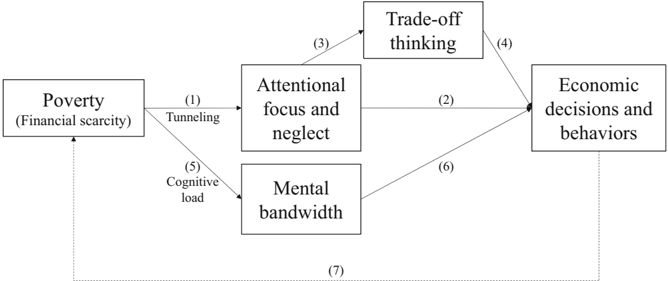
- The review covers three propositions: poverty leads to attentional focus and neglect causing overborrowing; poverty induces trade-off thinking and more consistent consumption decisions; and poverty reduces mental bandwidth, increasing time discounting and risk aversion.
- The literature “predominantly confirms” the first and second propositions, but methodological issues prevent a firm conclusion; evidence for the third proposition was “not conclusive.”
- For attention, lab studies consistently show greater focus on scarcity-related demands and overborrowing, but evidence for attentional neglect is weaker; the paper notes that the Shah et al. (2012) findings were replicated in Shah et al. (2019), though with smaller effect sizes.
- For mental bandwidth, the initial Mani et al. (2013a) effects were striking, including a reported 13–14 IQ-point difference in fluid intelligence in the lab and a 9–10 IQ-point decline in the field, but replication studies were mixed; for example, Dalton et al. (2019) found no fluid-intelligence effect and Carvalho et al. (2016) found no effect before vs. after payday.
- For economic decisions, the review says financial scarcity consistently increases temporal discounting, but evidence that it increases risk aversion is mixed; the paper also states that current evidence does not support cognitive load as the mechanism behind these effects.
Methods
- Narrative literature review of empirical studies testing scarcity theory in poverty, organized around three mechanisms: attention/tunneling, trade-off thinking, and cognitive load/mental bandwidth.
- The paper synthesizes lab experiments, cross-sectional and quasi-experimental studies, and natural/field experiments; it explicitly notes that nearly all cross-sectional and quasi-experimental studies use income as the poverty measure, which may not match scarcity theory’s subjective poverty definition.
- The analysis is qualitative and comparative, summarizing results and methodological issues rather than conducting a meta-analysis.
Limitations
- The paper states that methodological issues prevent a firm conclusion about several propositions, especially trade-off thinking and cognitive-bandwidth effects.
- It says the theory lacks precision in defining key mechanisms and predicting outcomes, and that the evidence does not fully accord with the theory.
- Evident from the text: the review relies heavily on studies with different designs, measures, and operationalizations of poverty/scarcity, making direct comparison difficult; it also notes a mismatch between subjective scarcity and the common use of income as a proxy, which may limit inference.
Model-written summary of a shortened version of the paper’s full text (it is longer than we read). Check it against the paper before relying on it.
Integrity signals
Registry
Cites
Statistics
Figures
Verification
Claims the paper makes
60 Valid · 3 Not valid · 117 Not checked · 94 Own results and interpretations
At least one cited source doesn’t support this claim or points to a different paper, and none confirmed it — see the verdicts below.
In the paper
“Similarly, students with higher levels of financial anxiety paid relatively high attention to money-related cues (Shapiro and Burchell 2012).”
What the sources say
- Disputedcites Shapiro and Burchell 2012 matched to “Measuring financial anxiety.” (2012) sourceExperimental — accuracy not yet measured
The Discussion (page unavailable) says the dot-probe results showed avoidance rather than vigilance toward financial words, particularly among financially anxious participants. Although Study 1 found a processing bias for financial words, the paper says that test cannot establish whether the bias reflects attention toward or avoidance of them. (LLM, conf=0.88)
Checked by a reasoning model — may be wrong.
plainstates an association- Asserted: passes — The authors put it forward as true.
- Checkable: passes — It can be checked against evidence.
- Load-bearing: unclear — It is unclear whether the paper’s conclusions depend on it.
- Based: passes — The paper gives a reason why it holds.
- Disputed
The cited sources support only part of this claim — read each source’s verdict below.
In the paper
“While the field is fast-growing, the literature lacks an up-to-date, integrative, and critical review of (the evidence for) all key aspects of scarcity theory.”
What the sources say
- Not checked — no full text of the sourcecites Shah et al. 2015 matched to “Scarcity Frames Value” (2015) source
- Not matchedcites Zhao and Tomm 2018
An author–year citation the paper’s reference list doesn’t settle. We don’t search these by name.
- Partly supportedcites Adamkovic ˇ and Martonc ˇik 2017 matched to “A Review of Consequences of Poverty on Economic Decision-Making: A Hypothesized Model of a Cognitive Mechanism” (2017) sourceExperimental — accuracy not yet measured
The Conclusion (page unavailable) says earlier research consisted of partial studies that overlooked relationships across a broader framework, supporting the need for an integrative account. But the paper addresses poverty and economic decision-making; it does not establish that the literature lacks an up-to-date, critical review of all key aspects of scarcity theory. (LLM, conf=0.83)
plain- Asserted: passes — The authors put it forward as true.
- Checkable: unclear — It is unclear whether it could be checked against evidence.
- Load-bearing: passes — The paper’s conclusions depend on it.
- Based: passes — The paper gives a reason why it holds.
The sources with a verdict support this claim; the rest weren’t checked yet, have no full text we could read, or their verdicts aren’t rated yet.
In the paper
“Poverty is associated with a wide range of counterproductive economic behaviors.”
- Also stated in: § 1 Introduction · plain
“Poverty is associated with seemingly irrational and counterproductive behaviors in several areas of economic life, both in developed and developing countries.”
What the sources say
- Not matchedcites Shurtleff 2009
An author–year citation the paper’s reference list doesn’t settle. We don’t search these by name.
- Supportedcites Banerjee and Duflo 2007 matched to “The Economic Lives of the Poor” (2007) source
The sections “Why Don’t the Poor Save More?” and “Why Don’t the Poor Eat More?” describe several economic choices the authors regard as potentially disadvantageous, including limited saving despite costly debt and spending choices that may displace better nutrition. “Why Don’t the Poor Invest More in Education?” discusses another such choice. Together, these passages support the broad paraphrase; they do not establish that poverty causes the behaviors. (LLM, conf=0.88)
- Not checked — no full text of the sourcecites Skiba and Tobacman 2008 matched to “Payday Loans, Uncertainty and Discounting: Explaining Patterns of Borrowing, Repayment, and Default” (2008) source
plainstates an association- Asserted: passes — The authors put it forward as true.
- Checkable: passes — It can be checked against evidence.
- Load-bearing: passes — The paper’s conclusions depend on it.
- Based: passes — The paper gives a reason why it holds.
- Also stated in: § 1 Introduction · plain
Every source the paper cites for this claim was checked and supports it.
In the paper
“Importantly, exploiting ecological variation in financial scarcity around harvest, they found that participants were less susceptible to the endowment effect pre-harvest (when farmers face relative financial scarcity) than post-harvest (when farmers face relative abundance).”
What the sources say
- Supportedcites Fehr et al. (2019) matched to “Poverty, Seasonal Scarcity and Exchange Asymmetries” (2019) source
The Introduction reports that farmers were about 10 percentage points more likely to trade an endowed item during the pre-harvest hungry season than after harvest, reducing the exchange asymmetry by more than 50 percent. It also identifies the hungry season as a period of relative scarcity and harvest as a period of relative abundance. (LLM, conf=0.94)
plainstates a cause- Asserted: passes — The authors put it forward as true.
- Checkable: passes — It can be checked against evidence.
- Load-bearing: passes — The paper’s conclusions depend on it.
- Based: passes — The paper gives a reason why it holds.
- Supported
Every source the paper cites for this claim was checked and supports it.
In the paper
“Fehr et al. (2019) found that facing financial scarcity reduces exchange asymmetries (also known as the endowment effect).”
What the sources say
- Supportedcites Fehr et al. (2019) matched to “Poverty, Seasonal Scarcity and Exchange Asymmetries” (2019) source
The Conclusion states that exchange asymmetries were significantly smaller when resources were more scarce. It identifies this as a finding from trading common household items in a low-income setting. (LLM, conf=0.94)
plainstates a cause- Asserted: passes — The authors put it forward as true.
- Checkable: passes — It can be checked against evidence.
- Load-bearing: passes — The paper’s conclusions depend on it.
- Based: passes — The paper gives a reason why it holds.
- Supported
149 more claims · 31 with their cited sources checked
Create a free account to see all 274 claims and to verify the 2 references still open.
- It may state two separate claims as one. 92
- Probably not a substantial claim. 33
Citations
Cites
Prospect Theory: An Analysis of Decision under Risk
Kahneman, D., & Tversky, A. (1979) · Econometrica · doi:10.2307/1914185 · Cited by 48,524
Prospect theory: An analysis of decision under risk
Kahneman, D., & Tversky, A. (1988) · Decision, Probability and Utility · doi:10.1017/cbo9780511609220.014 · Cited by 32,474 · cited 3×
“(2012) examined this hypothesis using an experiment called ‘‘Family Feud.’’ In this game, participants earned points for guessing popular answers to survey questions. Participants were allocated either small or large time budgets. Furthermore, some participants got a preview of questions of future rounds, others not.…”
MethodResultInfluentialThe Framing of Decisions and the Psychology of Choice
Tversky, A., & Kahneman, D. (1981) · Science · doi:10.1126/science.7455683 · Cited by 18,497
(2011) · Cited by 14,317
Diamond, A. (2013) · Annual Review of Psychology · doi:10.1146/annurev-psych-113011-143750 · Cited by 13,268 · cited 1×
“Executive control comprises three basic functions: (1) working memory operations to keep information retrievable, (2) inhibitory control to override impulses and automatic responses, and (3) cognitive flexibility to switch between tasks and perspectives (Diamond 2013).”
Well-being : the foundations of hedonic psychology
Kahneman, D. J., Diener, E. F., & Schwarz, N. (1999) · Cited by 8,305
Foundations of Behavioral Research
Stockton, R., & Kerlinger, F. N. (1974) · American Educational Research Journal · doi:10.2307/1162206 · Cited by 7,347
Anomalies: The Endowment Effect, Loss Aversion, and Status Quo Bias
Kahneman, D., Knetsch, J. L., & Thaler, R. H. (1991) · Journal of Economic Perspectives · doi:10.1257/jep.5.1.193 · Cited by 5,019
The Economic Importance of Financial Literacy: Theory and Evidence
Lusardi, A., & Mitchell, O. S. (2014) · Journal of Economic Literature · doi:10.1257/jel.52.1.5 · Cited by 4,698
Heuristics and Biases: The Psychology of Intuitive Judgment
Bottom, W. P., Gilovich, T., Griffin, D., & Kahneman, D. (2004) · The Academy of Management Review · doi:10.2307/20159081 · Cited by 3,536
Research works printed but not linked: 3
- Joy, E. E. (2017). For the poor, does attentional bias or worry explain the relationship between financial stressors and poor cognitive performance? (master's thesis). Washburn University. https://wuir.washburn.edu/handle/10425/409.
- Plantinga, A. (2014). Decisions under poverty: The effects of scarcity on cognitive mindset and financial decisions (Master's thesis). Tilburg University. http://arno.uvt.nl/show.cgi?fid=135541.
- Sheehy-Skeffington, J., & Rea, J. (2017). How poverty affects people's decision-making processes . York: Joseph Rowntree Foundation.
Cited by
Items 201–278 of 278
Nigeria's 2023 Currency Redesign Crisis: Evidential Photos and Comments
Nwigwe, C. (2025) · Emerald Group Publishing Limited eBooks · doi:10.1108/978-1-83662-074-720251003
(2025) · IGI Global eBooks · doi:10.4018/979-8-3693-8120-5.ch004
Returning to normality after Covid-19: what was the role of the EITC Program?Preprint
Peleg, A., & Strawczynski, M. (2025) · SSRN Electronic Journal · doi:10.2139/ssrn.5162471
Saving Goals of Ghanaian Cocoa Farmers: A Cluster Analysis
Wahbi, A., & Mußhoff, O. (2025) · International Journal of Rural Management · doi:10.1177/09730052251335085
“Among these are saving too little, borrowing too much under unfavourable conditions or spending money on temptation goods (de Bruijn and Antonides 2022).”
Elpidorou, A. (2025) · doi:10.1093/9780197564363.001.0001 · Cited by 21
Elpidorou, A. (2025) · Oxford University Press eBooks · doi:10.1093/9780197564363.002.0005
Elpidorou, A. (2025) · Oxford University Press eBooks · doi:10.1093/9780197564363.003.0015
Boredom as Cognitive Allostasis
Elpidorou, A. (2025) · Oxford University Press eBooks · doi:10.1093/9780197564363.003.0008 · Cited by 1
Elpidorou, A. (2025) · Oxford University Press eBooks · doi:10.1093/9780197564363.003.0012 · Cited by 1
Elpidorou, A. (2025) · Oxford University Press eBooks · doi:10.1093/9780197564363.003.0003
Conclusion: The Aesthetics of Boredom
Elpidorou, A. (2025) · Oxford University Press eBooks · doi:10.1093/9780197564363.003.0014
Introduction: Painful Thoughts
Elpidorou, A. (2025) · Oxford University Press eBooks · doi:10.1093/9780197564363.003.0001
Elpidorou, A. (2025) · Oxford University Press eBooks · doi:10.1093/9780197564363.002.0004
Elpidorou, A. (2025) · Oxford University Press eBooks · doi:10.1093/9780197564363.003.0011
Elpidorou, A. (2025) · Oxford University Press eBooks · doi:10.1093/9780197564363.003.0010
Elpidorou, A. (2025) · Oxford University Press eBooks · doi:10.1093/9780197564363.002.0006
Elpidorou, A. (2025) · Oxford University Press eBooks · doi:10.1093/9780197564363.002.0007
Elpidorou, A. (2025) · Oxford University Press eBooks · doi:10.1093/9780197564363.003.0013
Elpidorou, A. (2025) · Oxford University Press eBooks · doi:10.1093/9780197564363.003.0004
Elpidorou, A. (2025) · Oxford University Press eBooks · doi:10.1093/9780197564363.003.0007
Elpidorou, A. (2025) · Oxford University Press eBooks · doi:10.1093/9780197564363.003.0005
Patience across Payday: The Role of Scarcity in Commitment Decisions
Dykstra, H. (2025) · Journal of Political Economy Microeconomics · doi:10.1086/737238
The Relationship Between Financial Scarcity and Perceived Control Across 51 Societies
Hilbert, L. P., Noordewier, M. K., Romano, A., & DIJK, W. W. V. (2025) · Social Psychological and Personality Science · doi:10.1177/19485506251357034 · Cited by 1
“One such threat might be financial scarcity (Cannon et al., 2019; Fritsche & Jugert, 2017), defined as the subjective experience of lacking financial resources to meet demands (de Bruijn & Antonides, 2022; Haushofer & Fehr, 2014; Shah et al., 2012).”
Wenxin, G. (2025) · Loisir et Société / Society and Leisure · doi:10.1080/07053436.2025.2524214
“The problem of poverty leads people to focus on the needs associated with scarcity, triggering trade-off thinking, where specific costs are weighed against other possible costs, leading to more consistent consumption decisions (De Bruijn & Antonides, 2022).”
Zhu, H., You, F., Liu, E., Gruber, T., Dong, H., & De Bont, C. (2026) · Scientific Reports · doi:10.1038/s41598-026-71861-z
Low take-up of social benefits and what local municipalities think about it in Hungary
Nándori, E. S. (2025) · Hungarian Studies · doi:10.1556/044.2025.00293
The Impact of Applying Green Marketing on Business Performance
Alghizzawi, M., Al-Gasawneh, J. A., Alamro, A., et al. (2025) · Advances in Science, Technology & Innovation/Advances in science, technology & innovation · doi:10.1007/978-3-031-84889-6_18
Ambrey, C. L. (2025) · Psychology Health & Medicine · doi:10.1080/13548506.2025.2569100
Individual Versus Institutional Philanthropy: Crowdfunding During Crises
Garimella, A., Wu, A., Subramanyam, R., & Ahsen, M. E. (2025) · Production and Operations Management · doi:10.1177/10591478251390971
“When faced with unemployment, people tend to conserve their limited resources to ensure they can meet their basic needs, such as housing, food, and healthcare (De Bruijn and Antonides, 2022).”
Wang, Z., He, X., Su, Y., Bu, L., & Wang, Y. (2025) · Frontiers in Psychology · doi:10.3389/fpsyg.2025.1665380
“…and far-reaching influences on human development, with measurable effects across multiple life domains including physical health (Torpy et al., 2007), mental well-being (Marbin et al., 2022), cognitive functioning (Mani et al., 2013), and economic decision-making (De Bruijn and Antonides, 2022).”
Sunyík, V., Grežo, M., & Adamus, M. (2025) · Journal of Behavioral and Experimental Economics · doi:10.1016/j.socec.2025.102481
Launching Under Pressure: How Resource Scarcity Affects Design Decisions and Resource Management
Letting, C., & Menold, J. (2025) · Journal of Mechanical Design · doi:10.1115/1.4070399 · Cited by 1
Socioeconomic Status and Risk-Taking Anomalies: Evidence from Online GamblingPreprint
Gainsbury, S., Heirene, R. M., Je, H., Shaw, E., & Tymula, A. A. (2025) · SSRN Electronic Journal · doi:10.2139/ssrn.5747923
Szécsi, P., Bognar, M., & Szászi, B. (2025) · Royal Society Open Science · doi:10.1098/rsos.251758
WHAT LEADS TO ONLINE FINANCIAL FRAUD VICTIMIZATION AMONG CONSUMERS: AN EMPIRICAL ANALYSIS
Zainuddin, M. T., Nazarie, W. N. F. W. M., & Khadir, N. A. A. (2025) · Advanced International Journal of Business Entrepreneurship and SMEs · doi:10.35631/aijbes.726026
Cognitive Bandwidth and Food Safety
Ikuemonisan, E. S. (2026) · African Journal of Agricultural Science and Food Research · doi:10.62154/ajasfr.2025.021.01022
“From a development psychology perspective, Scarcity Theory robustly explains how poverty leads to short-termist, neglectful behaviours in domains like finance and diet (de Bruijn & Antonides, 2021; van der Veer et al., 2024).”
InfluentialShort-Term Financial Stress and Decision-Making: Evidence from Market Vendors in Addis Ababa
Blom, S. (2026) · Economic Development and Cultural Change · doi:10.1086/740831
Seyb, S., Williams, T. A., & Shepherd, D. A. (2026) · Journal of Business Venturing · doi:10.1016/j.jbusvent.2026.106580
Scarcity mindset’s positive association with using alternative financial services
Rooney, G., & Loibl, C. (2026) · PLoS ONE · doi:10.1371/journal.pone.0339127
“The scarcity mindset, defined as an individual not having what they feel that they need [5], has been developed in the context of decision-making among low-income individuals [13, 14].”
InfluentialEconomic shocks, food insufficiency and mental health: Evidence from the COVID-19 pandemic
Pan, Y., Fan, L., & Goetz, S. J. (2026) · PLoS ONE · doi:10.1371/journal.pone.0344745 · Cited by 1
Cardiovascular Health and Financial Hardship: Protocol for a Qualitative Citizen Science Study
Niewold, D., van Gestel, E. C. E., Abidi, L., Tiemstra, K., Thoolen, M., & Nagelhout, G. (2026) · JMIR Research Protocols · doi:10.2196/89101
Problematising Theoretical Approaches to Employment Decision-Making in Poverty Contexts
Ramadhani, A., & Hora, O. (2026) · International Scientific Conference Region in the Development of Society · doi:10.11118/978-80-7701-082-5-0285
The Distributional Costs of Effective Consumer RegulationPreprint
Katz, T. K., & Marotta‐Wurgler, F. (2026) · SSRN Electronic Journal · doi:10.2139/ssrn.6570378 · Cited by 2
When resources run short: the inhibitory effect of economic scarcity on third-party punishment
Liang, H., & Li, J. (2026) · Frontiers in Psychology · doi:10.3389/fpsyg.2026.1801512
“Such a mindset narrows attentional focus toward the acquisition of pressing resources, thereby influencing attentional allocation and behavioral decision-making (De Bruijn and Antonides, 2022).”
Folias, L. E., Wayagi, E. O., Msodoka, F. A., Mambosasa, M., & Kachola, S. D. (2026) · Cogent Food & Agriculture · doi:10.1080/23311932.2026.2652536
A Computational Framework for Intelligent Decision Making Using Behavioural and Creative Models
Jadiya, S., & Mishra, S. (2026) · IEEE International Conference on AI Engineering and Innovations (AIEI) · doi:10.1109/aiei69164.2026.11497180
Arroyave, J. P., Molina, A. R., Rotter-Zimbrón, M., & Díaz, G. M. C. (2026) · Theory and Decision · doi:10.1007/s11238-026-10141-8
The Concept of Money Management Across Poverty Levels
Warmath, D., LeBaron‐Black, A. B., Mottola, G. R., & Schindler, K. A. (2026) · Journal of Family and Economic Issues · doi:10.1007/s10834-025-10058-4
“De Bruijn and Antonides ( 2022 ) posit that poverty is associated with unhealthy financial behaviors which may be driven by scarcity mindset may be induced by poverty itself.”
Ziyue, P. E. N. G., & Su, J. (2026) · Journal of Adult Development · doi:10.1007/s10804-026-09565-x
System for housing habitability index: A decision tool for social aid program
Hapsari, R. I., Budiprasetyo, G., Andoko, B. S., et al. (2026) · AIP conference proceedings · doi:10.1063/5.0335064
Chandrakumar, D., Rodda, S. N., Thornton, L. K., & Gainsbury, S. (2026) · doi:10.2196/preprints.101430
Proverbs, Poverty and Inequality
Bovi, M. (2026) · SpringerBriefs in economics · doi:10.1007/978-3-032-25194-7_5
Bruns, S., Hermann, D., & Mußhoff, O. (2026) · Agricultural Economics · doi:10.1111/agec.70124
Rofiuddin, M., Istighfaransyah, A., & Yahya, A. H. (2026) · Dalwa Islamic Economic Studies Jurnal Ekonomi Syariah · doi:10.38073/dies.v5i1.4666
“This finding is consistent with the scarcity theory proposed by De Bruijn and Antonides (2022), which argues that financial constraints consume cognitive capacity and reduce individuals’ planning and self -control abilities.”
Berkins, S., Saha, S., Jasper, A., Livingstone, R. S., John, S. M., Mohan, V. R., Koshy, B., & Banerjee, A. (2026) · bioRxiv (Cold Spring Harbor Laboratory) · doi:10.64898/2026.06.08.730782
“Our findings also align with views of the cognition scarcity theory described in resource-constrained settings [37].”
Schulz, J., & Nückles, M. (2026) · World Development Perspectives · doi:10.1016/j.wdp.2026.100800
Welfare debt relief: Impact on employment, benefit receipt, and mental health
de Bruijn, E.-J., Vethaak, H., Koning, P. W. C., & Knoef, M. G. (2026) · Journal of Public Economics · doi:10.1016/j.jpubeco.2026.105695 · Cited by 3
Self-citationThe effect of risk communication on financial decisions based on income level
Oicata, C. O. B., Sandoval-Escobar, M., & Bohórquez, R. M. (2026) · Suma de Negocios · doi:10.14349/sumneg/2026.v17.n36.a4
“On the other hand, de Bruijn and Antonides (2022) contend poverty involves the use of cognitive resources when receiving information about risks.”
Chandrakumar, D., Rodda, S. N., Thornton, L. K., & Gainsbury, S. (2026) · JMIR Formative Research · doi:10.2196/101430
Xiao, H., Liu, Z., Xiao, H., He, Z., Zeng, T., Zhu, H., & Ruan, L. (2026) · Sustainability · doi:10.3390/su18136609 · Cited by 1
Psicología del consumidor: procesos, decisiones y nuevas tendencias
Leiva, M. L., Morales, L. J., Cevasco, J., & Sánchez, F. J. (2026) · CES Psicología · doi:10.21615/cesp.7940
Amankwa-Poku, F. A., & Kijima, Y. (2026) · Journal of African Economies · doi:10.1093/jae/ejag010 · Cited by 1
From financial scarcity to risk and time preferences: the role of executive functions
Huang, J., & Haibo, Z. (2026) · Frontiers in Psychology · doi:10.3389/fpsyg.2026.1782444 · Cited by 1
Le, T., Gilleen, J., Lee, A. J., & Maharani, A. (2026) · BMJ Public Health · doi:10.1136/bmjph-2025-004693
“54 55 To mitigate the magnitude of these recall errors, we parameterised our individual childhood indicators into broad dichotomous categories rather than continuous metrics, which has been documented to provide a more stable and reliable reflection of general early-life socioeconomic environments.”
Shaiq, M. A., & Samie, A. (2026) · Journal of Social Sciences & Humanities · doi:10.62810/jssh.v3i3.182
“…have recently resulted in the production of a vast body of theoretical and empirical literature (Jula & Beriso, 2023; Hallegatte et al., 2020; Mhlanga, 2021; Bruijn & Antonides, 2022; Qamruzzaman, Karim & Kor, 2023; ESCAP, 2007; Asogwa, Umeh & Okwoche, 2012; Zafar et al., 2021; Cui et al., 2023).”
Does the law matter for the poor? Evaluating the response to a child begging regulation
Adriaenssens, S., & Soare, T.-M. (2026) · Sociology · doi:10.1177/00380385261462743
Consumption as disempowerment: enduring tradeoffs and eroding social capital in subsistence context
Shaikh, J. M., & Jagadale, S. R. (2026) · Journal of Consumer Marketing · doi:10.1108/jcm-11-2025-8564
VanRiper, F., Tillias, D., & Kramer, S. B. (2026) · World Development Sustainability · doi:10.1016/j.wds.2026.100364
Socio-cognitive process of financial agency in women farmers’ indebtedness
Cuadra, J. M., Lacsi, Z. S., Galusan, C. D., Punayan, J. T., Castillon, M. T. C., & Payla, E. (2026) · Review of Behavioral Finance · doi:10.1108/rbf-10-2025-0441
Macaulay, L., O’Dolan, C., Swingler, J., Torrens, C., MacLean, A., Turner, K. M., Avenell, A., Cotton, S. C., Dombrowski, S. U., Gray, C. M., et al. (2026) · BMJ Open · doi:10.1136/bmjopen-2025-113802
Informational stress in cognitive systems: a review and conceptual synthesis
Ասրիյան, Է., & Gevorgyan, R. (2026) · Frontiers in Network Physiology · doi:10.3389/fnetp.2026.1913737 · Cited by 1
Kravitz, C., Chaparro, M. P., & Langellier, B. A. (2026) · Journal of Nutrition Education and Behavior · doi:10.1016/j.jneb.2026.09.007
Ahmad-Nazmi, A. N., Lye, C.-T., & Ying, T. L. (2026) · Social Sciences & Humanities Open · doi:10.1016/j.ssaho.2026.103701
Dou, G., Li, Y., Zhang, M., Dan, P., & Liu, F. (2026) · Frontiers in Psychology · doi:10.3389/fpsyg.2026.1870851
Bækgaard, M., Kim, M., & Martin, L. (2026) · International Public Management Journal · doi:10.1080/10967494.2026.2718928
Murniati, N., Hutama, S., Suryaman, R. A., et al. (2026) · Gorontalo Development Review · doi:10.32662/golder.v9i1.4605
Nasution, D. A. S., Ridwan, M., & Batubara, M. (2026) · Journal of Islamic Economics Lariba · doi:10.20885/jielariba.vol12.iss3.art1
Metadata
- Authors
- de Bruijn, E.-J., & Antonides, G.
- Affiliations
- Leiden University (NL)
- Wageningen University & Research (NL)
- Corresponding author
- de Bruijn, Ernst-Jan
- Venue
- Theory and Decision
- Published
- 2021-03-09
- Volume
- 92
- Issue
- 1
- Pages
- 5-37
- ISSN
- 0040-5833 (ISSN-L)
- 1573-7187
- OpenAlex
- W3134877833
- Cited by
- 277
- References
- 93
- Citations by year
- 2026: 55 · 2025: 82 · 2024: 70 · 2023: 35 · 2022: 27 · 2021: 8
- FWCI
- 194.72
- Type
- book chapter
- Language
- en
- Open access
- hybrid
- doi.org
- Licence
- cc-by
- creativecommons.org/licenses/by/4.0 (tdm)
- creativecommons.org/licenses/by/4.0 (vor)
- Locations
- Theory and Decision (publishedVersion, cc-by)
- Leiden Repository (Leiden University) (submittedVersion)
- Socio-Environmental Systems Modeling (submittedVersion, cc-by)
- SSRN Electronic Journal (submittedVersion)
- RePEc: Research Papers in Economics (submittedVersion)
- Data Archiving and Networked Services (DANS) (submittedVersion, other-oa)
- Data Archiving and Networked Services (DANS) (submittedVersion, cc-by)
- Funders
- Nederlandse Organisatie voor Wetenschappelijk Onderzoek (023.005.060)
- Topics
- Social Sciences › Decision Sciences › General Decision Sciences › Decision-Making and Behavioral Economics
- Social Sciences › Economics, Econometrics and Finance › Finance › Financial Literacy, Pension, Retirement Analysis
- Social Sciences › Sociology and Political Science › Income, Poverty, and Inequality
- Keywords
- poverty, scarcity theory, scarcity mindset, economic decision-making, attentional focus, overborrowing, consumer choice, delay discounting, risk aversion, financial scarcity
About these checks
Registry, retraction, Cites and statistics results are computed, not judged, with one exception: a printed reference that no index lists is read once by a model before it counts as a citation error. Claims are extracted by a model and kept only when their quote appears verbatim in the text; each cited source is then checked, with a model’s help, for whether it says what the claim relies on. Those verdicts can be wrong — read the claim’s quote and the cited source before relying on one.
The claim verdicts this report counts are experimental: their accuracy is not yet measured.
A language model drew the claims from the paper on 2026-10-10, under version 3 of the claim definition (model deepseek-v4.1-flash, prompt extract-v3).
A second model labelled each claim on 2026-10-10 (model jev-1.13-20260917, definition revision gold-guideline-v0.2).
Cited sources are checked with a language model’s help (gpt-6-sol).
Statistics and arithmetic are recomputed, not judged.
Confidence bands are shown only for fields calibrated on our annotated test set. None is calibrated yet, so no band is shown.
What counts as a claim ›How we measure confidence ›How we check this ›
Are you an author, or do you see a problem with this page? Request a review
Data sources
Bibliographic data: Semantic Scholar, OpenAlex, Crossref.
Contains information from the Semantic Scholar Academic Graph Datasets, made available under the ODC Attribution License (ODC-BY 1.0).
Semantic Scholar’s data is described in: Kinney, R., et al. (2023). The Semantic Scholar Open Data Platform. arXiv:2301.10140.
