

The DOI matches its Crossref record; 9 of the 9 references it cites were found in a registry or an index.
Rapamycin not dietary restriction improves resilience against pathogens: a meta-analysis
Published version of a preprint
Abstract
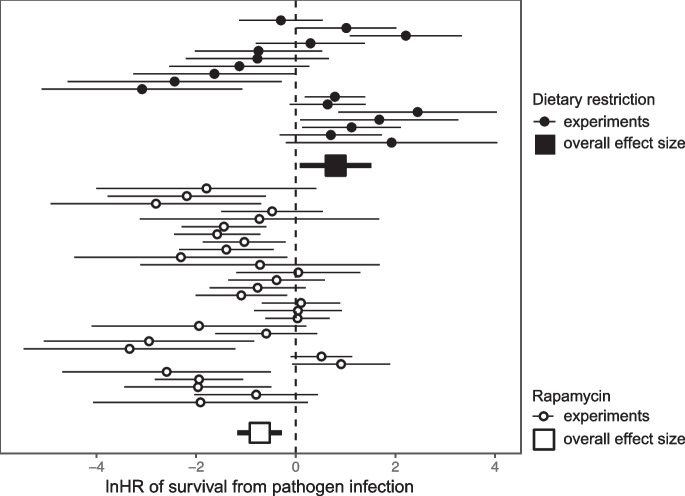
Dietary restriction (DR) and rapamycin both increase lifespan across a number of taxa. Despite this positive effect on lifespan and other aspects of health, reductions in some physiological functions have been reported for DR, and rapamycin has been used as an immunosuppressant. Perhaps surprisingly, both interventions have been suggested to improve immune function and delay immunosenescence. The immune system is complex and consists of many components. Therefore, arguably, the most holistic measurement of immune function is survival from an acute pathogenic infection. We reanalysed published post-infection short-term survival data of mice ( n = 1223 from 23 studies comprising 46 effect sizes involving DR ( n = 17) and rapamycin treatment ( n = 29) and analysed these results using meta-analysis. Rapamycin treatment significantly increased post infection survival rate (lnHR = − 0.72; CI = − 1.17, -0.28; p = 0.0015). In contrast, DR reduced post-infection survival (lnHR = 0.80; CI = 0.08, 1.52; p = 0.03). Importantly, the overall effect size of rapamycin treatment was significantly lower ( p < 0.001) than the estimate from DR studies, suggesting opposite effects on immune function. Our results show that immunomodulation caused by rapamycin treatment is beneficial to the survival from acute infection. For DR, our results are based on a smaller number of studies, but do warrant caution as they indicate possible immune costs of DR. Our quantitative synthesis suggests that the geroprotective effects of rapamycin extend to the immune system and warrants further clinical trials of rapamycin to boost immunity in humans.
Overview
The claims and statistics of this paper haven’t been checked yet.
Run the check — free, no account needed. It reads the open-access text and checks the sources it cites.
Integrity signals
Registry
Cites
Statistics
Figures
Verification
Claims the paper makes
The claims and statistics of this paper haven’t been checked yet.
Run the check — free, no account needed. It reads the open-access text and checks the sources it cites.
Claims other papers make about this one
Each is checked against this paper’s own text: does it say what the citing paper says it does?
In the citing paper
“A recent meta-analysis suggests that mice treated with rapamycin have increased survival following an acute pathogenic challenge 86.”
From Targeting the biology of aging with mTOR inhibitors (2023) · cites this paper as [86]
Self-check
Percentages, sums and reported differences re-computed from the paper’s own numbers.
The self-check needs the paper’s full text.
Citations
Cites
López-Otín, C., Blasco, M. A., Partridge, L., Serrano, M., & Kroemer, G. (2013) · Cell · doi:10.1016/j.cell.2013.05.039 · Cited by 14,982
mTOR is a key modulator of ageing and age-related disease
Johnson, S. C., Rabinovitch, P. S., & Kaeberlein, M. (2013) · Nature · doi:10.1038/nature11861 · Cited by 1,676 · cited 4×
“Conversely, should pro-longevity treatments simultaneously reduce the capacity to fight-off infection, the beneficial impact of DR and rapamycin on healthspan could be negated by reduced survival following naturally occurring infections [15].”
BackgroundInfluentialAge-dependent dysregulation of innate immunity
Shaw, A. C., Goldstein, D. R., & Montgomery, R. R. (2013) · Nature Reviews Immunology · doi:10.1038/nri3547 · Cited by 1,061
Methodological issues and advances in biological meta-analysis
Nakagawa, S., & Santos, E. S. A. (2012) · Evolutionary Ecology · doi:10.1007/s10682-012-9555-5 · Cited by 1,032
An aged immune system drives senescence and ageing of solid organs
Yousefzadeh, M. J., Flores, R. R., Zhu, Y., Schmiechen, Z. C., Brooks, R. W., Trussoni, C. E., Cui, Y., Angelini, L., Lee, K.-A., McGowan, S. J., et al. (2021) · Nature · doi:10.1038/s41586-021-03547-7 · Cited by 972 · cited 3×
“More broadly immunosenescence is thought to underlie several pathologies that appear during ageing, including cancer [10], autoimmune disease [5] and ineffective clearance and accumulation of senescent cells [7, 11].”
BackgroundImmunosenescence: emerging challenges for an ageing population
Aw, D., Silva, A. B., & Palmer, D. B. (2007) · Immunology · doi:10.1111/j.1365-2567.2007.02555.x · Cited by 880
mTOR inhibition improves immune function in the elderly
Mannick, J. B., Del Giudice, G., Lattanzi, M., Valiante, N. M., Praestgaard, J., Huang, B., Lonetto, M. A., Maecker, H. T., Kovarik, J., Carson, S., et al. (2014) · Science Translational Medicine · doi:10.1126/scitranslmed.3009892 · Cited by 786
Influenza virus-related critical illness: pathophysiology and epidemiology
Kalil, A. C., & Thomas, P. G. (2019) · Critical Care · doi:10.1186/s13054-019-2539-x · Cited by 524
Mechanisms underlying T cell ageing
Goronzy, J. J., & Weyand, C. M. (2019) · Nature Reviews Immunology · doi:10.1038/s41577-019-0180-1 · Cited by 506
Research works printed but not linked: 53
- Chung HY, Kim HJ, Kim KW, Choi JS, Yu BP. Molecular inflammation hypothesis of aging based on the anti-aging mechanism of calorie restriction. Microsc Res Tech. 2002;59:264–72. https://doi.org/10.1002/jemt.10203. · DOI
- Gavazzi G, Krause K-H. Ageing and infection. Lancet Infect Dis. 2002;2:659–66. https://doi.org/10.1016/S1473-3099(02)00437-1. · DOI · Paper page
- Nikolich-Žugich J, Messaoudi I. Mice and flies and monkeys too: caloric restriction rejuvenates the aging immune system of non-human primates. Exp Gerontol, Metabolism, Aging and Longevity. 2005;40:884–93. https://doi.org/10.1016/j.exger.2005.06.007. · DOI
- Ritz BW, Gardner EM. Malnutrition and energy restriction differentially affect viral immunity. J Nutr. 2006;136:1141–4. https://doi.org/10.1093/jn/136.5.1141. · DOI
- Baylis D, Bartlett DB, Patel HP, Roberts HC. Understanding how we age: insights into inflammaging. Longev Heal. 2013;2:8. https://doi.org/10.1186/2046-2395-2-8. · DOI
- Foster AD, Sivarapatna A, Gress RE. The aging immune system and its relationship with cancer. Aging Health. 2011;7:707–18. https://doi.org/10.2217/ahe.11.56. · DOI
- Fontana L, Partridge L, Longo VD. Extending healthy life span—from yeast to humans. Science. 2010;328:321–6. https://doi.org/10.1126/science.1172539. · DOI · Paper page
- Katewa SD, Kapahi P. Dietary restriction and aging, 2009. Aging Cell. 2010;9:105–12. https://doi.org/10.1111/j.1474-9726.2010.00552.x. · DOI
- Garratt M, Nakagawa S, Simons MJP. Comparative idiosyncrasies in life extension by reduced mTOR signalling and its distinctiveness from dietary restriction. Aging Cell. 2016;15:737–43. https://doi.org/10.1111/acel.12489. · DOI
- Cox LS, Mattison JA. Increasing longevity through caloric restriction or rapamycin feeding in mammals: common mechanisms for common outcomes? Aging Cell. 2009;8:607–13. https://doi.org/10.1111/j.1474-9726.2009.00509.x. · DOI
- Green CL, Lamming DW, Fontana L. Molecular mechanisms of dietary restriction promoting health and longevity. Nat Rev Mol Cell Biol. 2022;23:56–73. https://doi.org/10.1038/s41580-021-00411-4. · DOI · Paper page
- Bjedov I, Toivonen JM, Kerr F, Slack C, Jacobson J, Foley A, Partridge L. Mechanisms of life span extension by rapamycin in the fruit fly Drosophila melanogaster. Cell Metab. 2010;11:35–46. https://doi.org/10.1016/j.cmet.2009.11.010. · DOI · Paper page
- Miller RA, Harrison DE, Astle CM, Fernandez E, Flurkey K, Han M, Javors MA, Li X, Nadon NL, Nelson JF, Pletcher S, Salmon AB, Sharp ZD, Van Roekel S, Winkleman L, Strong R. Rapamycin-mediated lifespan increase in mice is dose and sex dependent and metabolically distinct from dietary restriction. Aging Cell. 2014;13:468–77. https://doi.org/10.1111/acel.12194. · DOI
- Unnikrishnan A, Kurup K, Salmon AB, Richardson A. Is rapamycin a dietary restriction mimetic? J Gerontol Ser A. 2020;75:4–13. https://doi.org/10.1093/gerona/glz060. · DOI
- Jolly CA. Dietary restriction and immune function. J Nutr. 2004;134:1853–6. https://doi.org/10.1093/jn/134.8.1853. · DOI
- Saunders RN, Metcalfe MS, Nicholson ML. Rapamycin in transplantation: a review of the evidence. Kidney Int. 2001;59:3–16. https://doi.org/10.1046/j.1523-1755.2001.00460.x. · DOI
- Speakman JR, Mitchell SE. Caloric restriction. Mol Aspects Med, Caloric Restriction. 2011;32:159–221. https://doi.org/10.1016/j.mam.2011.07.001. · DOI
- Camell CD, Yousefzadeh MJ, Zhu Y, Prata LGPL, Huggins MA, Pierson M, Zhang L, O’Kelly RD, Pirtskhalava T, Xun P, Ejima K, Xue A, Tripathi U, Espindola-Netto JM, Giorgadze N, Atkinson EJ, Inman CL, Johnson KO, Cholensky SH, Carlson TW, LeBrasseur NK, Khosla S, O’Sullivan MG, Allison DB, Jameson SC, Meves A, Li M, Prakash YS, Chiarella SE, Hamilton SE, Tchkonia T, Niedernhofer LJ, Kirkland JL, Robbins PD. Senolytics reduce coronavirus-related mortality in old mice. Science. 2021;373:eabe4832. https://doi.org/10.1126/science.abe4832. · DOI · Paper page
- Goldberg EL, Romero-Aleshire MJ, Renkema KR, Ventevogel MS, Chew WM, Uhrlaub JL, Smithey MJ, Limesand KH, Sempowski GD, Brooks HL, Nikolich-Žugich J. Lifespan-extending caloric restriction or mTOR inhibition impair adaptive immunity of old mice by distinct mechanisms. Aging Cell. 2015;14:130–8. https://doi.org/10.1111/acel.12280. · DOI
- Castle SC. Clinical relevance of age-related immune dysfunction. Clin Infect Dis. 2000;31:578–85. https://doi.org/10.1086/313947. · DOI
- Mejia P, Treviño-Villarreal JH, Hine C, Harputlugil E, Lang S, Calay E, Rogers R, Wirth D, Duraisingh MT, Mitchell JR. Dietary restriction protects against experimental cerebral malaria via leptin modulation and T-cell mTORC1 suppression. Nat Commun. 2015;6:6050. https://doi.org/10.1038/ncomms7050. · DOI
- Canivet C, Menasria R, Rhéaume C, Piret J, Boivin G. Valacyclovir combined with artesunate or rapamycin improves the outcome of herpes simplex virus encephalitis in mice compared to antiviral therapy alone. Antiviral Res. 2015;123:105–13. https://doi.org/10.1016/j.antiviral.2015.09.007. · DOI
- Huang C-T, Hung C-Y, Chen T-C, Lin C-Y, Lin Y-C, Chang C-S, He Y-C, Huang Y-L, Dutta A. Rapamycin adjuvant and exacerbation of severe influenza in an experimental mouse model. Sci Rep. 2017;7:4136. https://doi.org/10.1038/s41598-017-04365-6. · DOI
- Birkisdóttir MB, Jaarsma D, Brandt RMC, Barnhoorn S, van Vliet N, Imholz S, van Oostrom CT, Nagarajah B, Portilla Fernández E, Roks AJM, Elgersma Y, van Steeg H, Ferreira JA, Pennings JLA, Hoeijmakers JHJ, Vermeij WP, Dollé MET. Unlike dietary restriction, rapamycin fails to extend lifespan and reduce transcription stress in progeroid DNA repair-deficient mice. Aging Cell. 2021;20: e13302. https://doi.org/10.1111/acel.13302. · DOI · Paper page
- Messaoudi I, Fischer M, Warner J, Park B, Mattison J, Ingram DK, Totonchy T, Mori M, Nikolich-Žugich J. Optimal window of caloric restriction onset limits its beneficial impact on T-cell senescence in primates. Aging Cell. 2008;7:908–19. https://doi.org/10.1111/j.1474-9726.2008.00440.x. · DOI · Paper page
- Pae M, Meydani SN, Wu D. The role of nutrition in enhancing immunity in aging. Aging Dis. 2011;3:91–129.
- González O, Tobia C, Ebersole J, Novak M. Caloric restriction and chronic inflammatory diseases. Oral Dis. 2012;18:16–31. https://doi.org/10.1111/j.1601-0825.2011.01830.x. · DOI
- Abe T, Nakajima A, Satoh N, Ohkoshi M, Sakuragi S, Koizumi A. Suppression of experimental autoimmune uveoretinitis by dietary calorie restriction. Jpn J Ophthalmol. 2001;45:46–52. https://doi.org/10.1016/S0021-5155(00)00303-8. · DOI
- Chacón F, Cano P, Lopez-Varela S, Jiménez V, Marcos A, Esquifino AI. Chronobiological features of the immune system. Effect of calorie restriction. Eur J Clin Nutr. 2002;56:S69–72. https://doi.org/10.1038/sj.ejcn.1601491. · DOI
- Sun D, Muthukumar AR, Lawrence RA, Fernandes G. Effects of calorie restriction on polymicrobial peritonitis induced by cecum ligation and puncture in young C57BL/6 mice. Clin Diagn Lab Immunol 2001;8:1003–11. https://doi.org/10.1128/CDLI.8.5.1003-1011.2001 · DOI
- Clinthorne JF, Adams DJ, Fenton JI, Ritz BW, Gardner EM. Short-term re-feeding of previously energy-restricted C57BL/6 male mice restores body weight and body fat and attenuates the decline in natural killer cell function after primary influenza infection. J Nutr. 2010;140:1495–501. https://doi.org/10.3945/jn.110.122408. · DOI
- Clinthorne JF, Beli E, Duriancik DM, Gardner EM. NK cell maturation and function in C57BL/6 mice are altered by caloric restriction. J Immunol. 2013;190:712–22. https://doi.org/10.4049/jimmunol.1201837. · DOI
- Naylor C, Petri WA. Leptin regulation of immune responses. Trends Mol Med. 2016;22:88–98. https://doi.org/10.1016/j.molmed.2015.12.001. · DOI
- Goldberg EL, Smithey MJ, Lutes LK, Uhrlaub JL, Nikolich-Žugich J. Immune memory–boosting dose of rapamycin impairs macrophage vesicle acidification and curtails glycolysis in effector CD8 cells, impairing defense against acute infections. J Immunol. 2014;193:757–63. https://doi.org/10.4049/jimmunol.1400188. · DOI · Paper page
- Liu Q, Zhou Y, Yang Z. The cytokine storm of severe influenza and development of immunomodulatory therapy. Cell Mol Immunol. 2016;13:3–10. https://doi.org/10.1038/cmi.2015.74. · DOI
- Chen C, Liu Yu, Liu Yang, Zheng P. mTOR regulation and therapeutic rejuvenation of aging hematopoietic stem cells. Sci Signal 2009; 2. https://doi.org/10.1126/scisignal.2000559 · DOI · Paper page
- Keating R, Hertz T, Wehenkel M, Harris TL, Edwards BA, McClaren JL, Brown SA, Surman S, Wilson ZS, Bradley P, Hurwitz J, Chi H, Doherty PC, Thomas PG, McGargill MA. The kinase mTOR modulates the antibody response to provide cross-protective immunity to lethal infection with influenza virus. Nat Immunol. 2013;14:1266–76. https://doi.org/10.1038/ni.2741. · DOI
- Liepkalns JS, Pandey A, Hofstetter AR, Kumar A, Jones EN, Cao W, Liu F, Levine MZ, Sambhara S, Gangappa S. Rapamycin does not impede survival or induction of antibody responses to primary and heterosubtypic influenza infections in mice. Viral Immunol. 2016;29:487–93. · DOI
- Bischof E, Siow RC, Zhavoronkov A, Kaeberlein M. The potential of rapalogs to enhance resilience against SARS-CoV-2 infection and reduce the severity of COVID-19. Lancet Healthy Longev. 2021;2:e105–11. https://doi.org/10.1016/S2666-7568(20)30068-4. · DOI
- Hurez V, Dao V, Liu A, Pandeswara S, Gelfond J, Sun L, Bergman M, Orihuela CJ, Galvan V, Padrón Á, Drerup J, Liu Y, Hasty P, Sharp ZD, Curiel TJ. Chronic mTOR inhibition in mice with rapamycin alters T, B, myeloid, and innate lymphoid cells and gut flora and prolongs life of immune-deficient mice. Aging Cell. 2015;14:945–56. https://doi.org/10.1111/acel.12380. · DOI
- Hinojosa CA, Mgbemena V, Van Roekel S, Austad SN, Miller RA, Bose S, Orihuela CJ. Enteric-delivered rapamycin enhances resistance of aged mice to pneumococcal pneumonia through reduced cellular senescence. Exp Gerontol. 2012;47:958–65. https://doi.org/10.1016/j.exger.2012.08.013. · DOI
- Juricic P, Lu Y-X, Leech T, Drews LF, Paulitz J, Lu J, Nespital T, Azami S, Regan JC, Funk E, Fröhlich J, Grönke S, Partridge L. Long-lasting geroprotection from brief rapamycin treatment in early adulthood by persistently increased intestinal autophagy. Nat Aging 2022; 1–13. https://doi.org/10.1038/s43587-022-00278-w · DOI · Paper page
- Simons MJP, Hartshorne L, Trooster S, Thomson J, Tatar M. 2019. Age-dependent effects of reduced mTor signalling on life expectancy through distinct physiology. preprint bioRxiv. https://doi.org/10.1101/719096 · DOI
- Shindyapina AV, Cho Y, Kaya A, Tyshkovskiy A, Castro JP, Gordevicius J, Poganik JR, Horvath S, Peshkin L, Gladyshev VN. Preprint bioRxiv. Rapamycin treatment during development extends lifespan and healthspan. 2022. https://doi.org/10.1101/2022.02.18.481092. · DOI
- Bitto A, Ito TK, Pineda VV, LeTexier NJ, Huang HZ, Sutlief E, Tung H, Vizzini N, Chen B, Smith K, Meza D, Yajima M, Beyer RP, Kerr KF, Davis DJ, Gillespie CH, Snyder JM, Treuting PM, Kaeberlein M. Transient rapamycin treatment can increase lifespan and healthspan in middle-aged mice. eLife 2016;5:e16351. https://doi.org/10.7554/eLife.16351 · DOI · Paper page
- Shamseer L, Moher D, Clarke M, Ghersi D, Liberati A, Petticrew M, Shekelle P, Stewart LA. Preferred reporting items for systematic review and meta-analysis protocols (PRISMA-P) 2015: elaboration and explanation. BMJ. 2015;349:g7647. https://doi.org/10.1136/bmj.g7647. · DOI · Paper page
- Ohkusu-Tsukada K, Tsukada T, Isobe K. Accelerated development and aging of the immune system in p53-deficient mice. J Immunol Baltim Md. 1999;1950(163):1966–72.
- Davies WL, Smith SC, Pond WL, Rasmussen AF, Clark PF. Effect of dietary restriction on susceptibility of mice to infection with Theiler’s GDVII virus. Proc Soc Exp Biol Med. 1949;72:528–31. https://doi.org/10.3181/00379727-72-17488. · DOI
- Swindell WR. Meta-analysis of 29 experiments evaluating the effects of rapamycin on life span in the laboratory mouse. J Gerontol Ser A. 2017;72:1024–32. https://doi.org/10.1093/gerona/glw153. · DOI
- Therneau TM, Grambsch PM (2000) Modeling survival data: extending the cox model. Springer, New York · DOI · Paper page
- Swindell WR. Dietary restriction in rats and mice: a meta-analysis and review of the evidence for genotype-dependent effects on lifespan. Ageing Res Rev. 2012;11:254–70. https://doi.org/10.1016/j.arr.2011.12.006. · DOI
- Fornefett J, Krause J, Klose K, Fingas F, Hassert R, Eisenberg T, Schrödl W, Grunwald T, Müller U, Baums CG. Comparative analysis of clinics, pathologies and immune responses in BALB/c and C57BL/6 mice infected with Streptobacillus moniliformis. Microbes Infect. 2018;20:101–10. https://doi.org/10.1016/j.micinf.2017.10.001. · DOI
- Viechtbauer W. Conducting meta-analyses in R with the metafor Package. J Stat Softw. 2010;36:1–48. https://doi.org/10.18637/jss.v036.i03. · DOI · Paper page
Cited by
Sorted by citations
Targeting the biology of aging with mTOR inhibitors
Mannick, J. B., & Lamming, D. W. (2023) · Nature Aging · doi:10.1038/s43587-023-00416-y · Cited by 372
Metadata
- Authors
- Phillips, E. J., & Simons, M. J. P.
- ORCID
- Simons, Mirre J. P.
- Venue
- GeroScience
- Published
- 2022-11-18
- Volume
- 45
- Issue
- 2
- Pages
- 1263-1270
- ISSN
- 2509-2715
- 2509-2723
- PMC
- PMC9886774
- Cited by
- 21
- References
- 9
- Language
- en
- Funders
- Wellcome Trust (216405/Z/19/Z)
- Academy of Medical Sciences (SBF004\1085)
About these checks
Registry, retraction, Cites and statistics results are computed, not judged, with one exception: a printed reference that no index lists is read once by a model before it counts as a citation error. Claims are extracted by a model and kept only when their quote appears verbatim in the text; each cited source is then checked, with a model’s help, for whether it says what the claim relies on. Those verdicts can be wrong — read the claim’s quote and the cited source before relying on one.
Statistics and arithmetic are recomputed, not judged.
Confidence bands are shown only for fields calibrated on our annotated test set. None is calibrated yet, so no band is shown.
What counts as a claim ›How we measure confidence ›How we check this ›
Are you an author, or do you see a problem with this page? Request a review
