

The HeDiCom framework: higher education teachers' digital competencies for the future
Open accessThe DOI matches its Crossref record; 48 of the 48 references it cites were found in a registry or an index.
Abstract
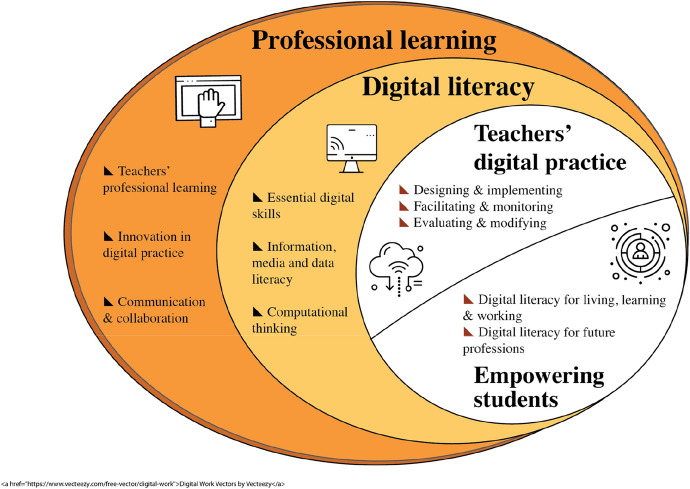
There is little consensus about the nature of teachers’ digital competencies in Higher Education. Moreover, existing digital competence frameworks have largely been developed for teachers in secondary education. In response to this, the current study focuses on developing and validating a framework of digital competencies for teachers in Higher Education. First, a review was conducted to determine the state of digital competence research regarding dimensions and definition of digital competence. In a next step, similarities and differences between existing digital competence frameworks were identified. Based on the outcomes of the review and the framework comparison, a framework was developed in an iterative process through expert meetings with policy makers, experts in the field of educational technology, and validated with practitioners. The new framework includes four dimensions of teachers’ digital competencies: (1) Teaching practice, (2) Empowering students for a digital society, (3) Teachers’ digital literacy, and (4) Teachers’ professional development. The resulting Higher Education Digital Competence (HeDiCom) framework will provide guidance and clearer expectations of teachers’ digital competency. Ultimately, improving teachers’ digital competencies will contribute to improving the quality of digital competencies of the students.
Overview
The claims and statistics of this paper haven’t been checked yet.
Free: it reads the open-access text and checks the first 5 claims that cite a source we can check. Create a free account to check every claim.
Integrity signals
Registry
Cites
Statistics
Figures
Verification
Claims the paper makes
The claims and statistics of this paper haven’t been checked yet.
Free: it reads the open-access text and checks the first 5 claims that cite a source we can check. Create a free account to check every claim.
Claims other papers make about this one
Each is checked against this paper’s own text: does it say what the citing paper says it does?
The source backs part of the claim, not all of it — or backs it for a different population, condition or comparison.
In the citing paper
“Existing studies show that the focus of research on university teachers’ digital competence is shifting from whether they can use digital tools to whether they can develop stable, reflective, and transferable digital teaching practices within specific disciplinary and instructional contexts (4–7).”
From Reframing faculty development for digital transformation and generative AI in higher education (2026) · cites this paper as [4]
Experimental — accuracy not yet measuredThe source backs part of the claim, not all of it — or backs it for a different population, condition or comparison.
In the citing paper
“Relevant research has shown that the development of teachers’ digital competence is jointly shaped by career stage, institutional environment, resource support, and opportunities for professional learning; therefore, tiered support is more effective than uniform training in improving the efficiency of faculty development (4).”
From Reframing faculty development for digital transformation and generative AI in higher education (2026) · cites this paper as [4]
Experimental — accuracy not yet measuredThe source backs part of the claim, not all of it — or backs it for a different population, condition or comparison.
In the citing paper
“In constructing its framework, HeDiCom has already incorporated ethical competence in digital society as a key dimension, indicating that digitally mature teachers must not only be capable of innovation, but also be able to discern technological risks (4).”
From Reframing faculty development for digital transformation and generative AI in higher education (2026) · cites this paper as [4]
Experimental — accuracy not yet measuredThe source backs part of the claim, not all of it — or backs it for a different population, condition or comparison.
In the citing paper
“Only in this way can teachers truly develop digital teaching innovation capacities that are disciplinary, transferable, and demonstrable (4, 14).”
From Reframing faculty development for digital transformation and generative AI in higher education (2026) · cites this paper as [4]
Experimental — accuracy not yet measuredThe source backs part of the claim, not all of it — or backs it for a different population, condition or comparison.
In the citing paper
“The HeDiCom framework explicitly states that the mature form of faculty digital competence is manifested not merely in individual technical proficiency, but in the ability to embed digital practices into teaching innovation, student empowerment, and systems of professional learning for faculty (4).”
From Reframing faculty development for digital transformation and generative AI in higher education (2026) · cites this paper as [4]
Experimental — accuracy not yet measured
4 more claims about this paper
Create a free account to see every claim other papers make about this one.
Self-check
Percentages, sums and reported differences re-computed from the paper’s own numbers.
The self-check needs the paper’s full text.
Citations
Cites
Wing, J. M. (2006) · Communications of the ACM · doi:10.1145/1118178.1118215 · Cited by 8,102
Systematic Reviews in the Social Sciences: A Practical Guide
Petticrew, M., & Roberts, H. (2006) · doi:10.1002/9780470754887 · Cited by 3,586
From digital literacy to digital competence: the teacher digital competency (TDC) framework
Falloon, G. (2020) · Educational Technology Research and Development · doi:10.1007/s11423-020-09767-4 · Cited by 1,372
European Framework for the Digital Competence of Educators: DigCompEdu
(2017) · RePEc: Research Papers in Economics · doi:10.2760/178382 · Cited by 1,276
Carretero, S., Riina, V., & Punie, Y. (2017) · RePEc: Research Papers in Economics · doi:10.2760/38842 · Cited by 1,074 · cited 1×
“Carretero et al. (2017) for instance indicate that teachers must be able to analyze and compare both the information and the sources of digital content for reliability and credibility.”
BackgroundKebritchi, M., Lipschuetz, A., & Santiague, L. (2017) · Journal of Educational Technology Systems · doi:10.1177/0047239516661713 · Cited by 967 · cited 2×
“To become a competent online teacher, there is a need for professional development and sufficient time to design and practice online and blended learning environments (see also Kebritchi et al., 2017).”
BackgroundSpante, M., Hashemi, S. S., Lundin, M., & Algers, A. (2018) · Cogent Education · doi:10.1080/2331186x.2018.1519143 · Cited by 832 · cited 2×
“According to Spante et al. (2018), also the assessment of a specific digital competence requires the understanding of related constructs.”
BackgroundMethodThe current landscape of learning analytics in higher education
Viberg, O., Hatakka, M., Bälter, O., & Mavroudi, A. (2018) · Computers in Human Behavior · doi:10.1016/j.chb.2018.07.027 · Cited by 766 · cited 1×
“A review by Viberg et al. (2018) for instance shows that there is much potential for using and analyzing this data to improve the learning process, but that this rarely takes place in practice.”
BackgroundDigital competence – an emergent boundary concept for policy and educational research
Ilomäki, L., Paavola, S., Lakkala, M., & Kantosalo, A. (2016) · Education and Information Technologies · doi:10.1007/s10639-014-9346-4 · Cited by 689 · cited 3×
“Moreover, it is expected that students will soon enter the workforce and there is a need for them to perform as knowledge workers, which requires a high level of digital competence (Ilomäki et al., 2016).”
BackgroundMethodInfluentialDigital competence in higher education research: a systematic literature review
Zhao, Y., Pinto Llorente, A. M., & Sánchez Gómez, M. C. (2021) · Computers & Education · doi:10.1016/j.compedu.2021.104212 · Cited by 653 · cited 8×
“According to Zhao et al. (2021), the most frequently identified competencies were the use of digital technologies, knowledge of digital technologies, the Internet and technological related capacities, digital experiences and attitudes.”
BackgroundInfluential
Research works printed but not linked: 3
- 17. Howard, S. K., Tondeur, J., Hutchison, N., Scherer, R., & Siddiq, F. (2022). A t(r)opical journey: Using text mining to explore teachers' experiences in the Great Online Transition. In Society for information tech- nology & teacher education international conference.
- 32. Redecker, C., & Punie, Y. (2017). Digital competence of educators: DigCompEdu. Publications Office of the European Union. https:// doi. org/ 10. 2760/ 159770 · doi:10.2760/159770
- 37. Schleicher, A. (2020). The impact of COVID-19 on education: Insights from "Education at a Glance 2020." OECD Publishing.
Cited by
Items 101–200 of 229
Dewy, M. S., Mulyana, D. I., Zulkarnain, S. A. B., Isnaini, M., Simamora, Y., & Imannuel, M. F. (2025) · JURNAL TEKNOLOGI INFORMASI & KOMUNIKASI DALAM PENDIDIKAN · doi:10.24114/jtikp.v12i1.67216 · Cited by 1
Xiangyu, W., Xiaoyun, W., & Yao, P. (2026) · Research Square · doi:10.21203/rs.3.rs-9435821/v1 · Cited by 1
Reframing faculty development for digital transformation and generative AI in higher education
Hou, Z., Chen, J., & Zhang, H. (2026) · Frontiers in Medicine · doi:10.3389/fmed.2026.1864520
Enhancing teacher training for infographic creation and evaluation
Olefirenko, N. V., Пономарьова, Н. О., Андрієвська, В. М., Gulich, O. O., & Гайдусь, А. (2025) · CTE Workshop Proceedings · doi:10.55056/cte.919
“More recently, Tondeur et al. [26] developed the Higher Education Digital Competence (HeDiCom) framework, which includes four dimensions of teachers’ digital competencies: teaching practice, empowering students for a digital society, teachers’ digital literacy, and teachers’ professional…”
والى, د. ر. ع. ع. ا. ا. (2025) · مجلة دراسات وبحوث التربية النوعية · doi:10.21608/jsezu.2025.420909
ФОРМУВАННЯ ЦИФРОВОЇ КОМПЕТЕНТНОСТІ ВИКЛАДАЧА В УМОВАХ ПОСТПАНДЕМІЧНОЇ ГІБРИДНОЇ ОСВІТИ
Смолінська, Г. (2025) · Вісник науки та освіти · doi:10.52058/2786-6165-2025-7(37)-1650-1666
Thi, T. N., Xuan, C. P., La, M. D., Le, H. T. T., yen, D. T., Trieu, S. N., & Trung, T. (2025) · SSRN Electronic Journal · doi:10.2139/ssrn.5563834
Karalar, H., Altan, B. A., & Yorulmaz, A. (2025) · Mehmet Akif Ersoy üniversitesi eğitim fakültesi dergisi. · doi:10.21764/maeuefd.1715751
Febiansyah, H., Sari, L. I., Probonegoro, W. A., Isnanto, B., & Nur, M. (2025) · BESIRU Jurnal Pengabdian Masyarakat · doi:10.62335/besiru.v2i10.1908
Jin, J., Siribanpitak, P., & Chaemchoy, S. (2025) · Edelweiss Applied Science and Technology · doi:10.55214/2576-8484.v9i11.10875
“It includes awareness of intellectual property, data privacy, algorithmic bias, and the necessity of responsible online conduct to navigate the political and social risks inherent in digital platforms [28, 29].”
MICROLEARNING AS A STRATEGY FOR ENHANCING DIGITAL COMPETENCY AMONG BS IT PRACTICUM STUDENTS
Siosan, R. J. P. (2025) · International Journal of Apllied Mathematics · doi:10.12732/ijam.v38i1s.1066
“…education institutions face increasing pressure to ensure that graduates possess not only technical expertise but also digital literacy, critical thinking, and adaptability needed to succeed in technology-driven environments (Saltos-Rivas et al., 2021; Zhao et al., 2021; Tondeur et al., 2023).”
Waktu Kerja Guru: Perbandingan di Era Digital dan Tempo Dulu
Effiyanti, T., & Retnawati, H. (2024) · Didaktika Jurnal Kependidikan · doi:10.58230/27454312.854
“Dalam dunia pendidikan, penggunaan IT akan sangat membantu dalam pengembangan, perencanaan, penentuan strategi, dan implementasi program pembelajaran (Pettersson, 2018) yang tentunya akan berimplikasi pada peningkatan kualitas layanan akademik siswa atau mahasiswa (Tondeur et al., 2023).”
Varela Fontenele, Z. (2023) · Repository of Digital Objects for Teaching Research and Culture (University of Valencia)
Watts, L. M. (2024) · ScholarWorks (Walden University)
Dai, H. (2025) · Contemporary Education Frontiers · doi:10.18063/cef.v3i4.985
Eksplorasi Literasi Digital Dosen Bahasa Inggris Maritim di Politeknik Pelayaran Sorong
Sulistiono, A., Sumarta, R. P., Yulianingsih, L., Hafita, Y. A., Adiputra, K. H. P., & Adiputra, K. H. P. (2025) · Syntax Literate Jurnal Ilmiah Indonesia · doi:10.36418/syntax-literate.v10i9.61598
Ihrai, L., Lalami, A. E. O., Merabti, A., Sfendla, A., & Abderrahmani, A. E. (2025) · Multidisciplinary Science Journal · doi:10.31893/multiscience.2026330
“The second part included 36 questions selected from a literature review (Desjardins, 2005; Tondeur et al., 2023).”
Kılınç, S. (2023) · OpenMETU (Middle East Technical University)
Digital agency in onderwijs en samenleving: op naar kritisch en bewust technologiegebruik
Saab, N. (2025) · Leiden Repository (Leiden University) · Cited by 2
Digital competencies in teachers and students during the pandemic: a systematic review
Davila, Y. V. C., Ccuro, F. E. M., Vizcarra, F. G. A., Cueva, P. D. M., & Velásquez, Y. V. S. M. (2025) · LACCEI International Multiconference on Entrepreneurship, Innovation and Regional Development (LEIRD) · doi:10.18687/leird2025.1.1.1091 · Cited by 1
Vargas-Angulo, S. M., Peña, Y. K. H., & Torres, J. P. S. (2025) · Education Sciences · doi:10.3390/educsci16010012
Chakravarty, D., & Satpathy, I. (2026) · IGI Global eBooks · doi:10.4018/979-8-3373-5956-4.ch001
Culture and technology acceptance model at Arab higher education institutions
Abu-Tineh, A. M. H., Alazaizeh, M., Ghamrawi, N., Alshaboul, Y. M. K., & Shal, T. (2026) · Educational Research for Policy and Practice · doi:10.1007/s10671-026-09413-5
“Higher education institutions globally have prioritized improving students' digital competencies to prepare them for the new learning paradigm and the future workforce (Tondeur et al., 2023).”
Gürültü, E. (2024) · Dspace Repository (Marmara Üniversitesi)
Minőségbiztosítás a felsőoktatásban, a változó ökoszisztéma hatása a tárgyfejlesztésre
Tarpataki, E. (2026) · CUB Ph.D. Dissertations (Corvinus University of Budapest) · doi:10.14267/phd.2026007
Manalo, L. G. (2026) · International Journal on Studies in Education · doi:10.46328/ijonse.5746
Xu, Y., Sun, C., & Cheng, W. (2026) · Research Square · doi:10.21203/rs.3.rs-8924262/v1
Teacher Attitudes and Barriers to GeoGebra Adoption in Secondary Mathematics Education
Vlachoni, G., Antonopoulou, H., Καρανικόλα, Ζ., & Halkiopoulos, C. (2026) · Emerging Science Journal · doi:10.28991/esj-2025-sied1-028
Безбар’єрність як пріоритет державної освітньої політики у сфері дошкільної освіти
Mostepanyuk, V., & Б., Л. В. (2026) · doi:10.70286/isu-08.04.2026
Artificial Intelligence Generators as Tools for Developing Academic Skills among University students
Škugor, A., Bičvić, D. M., & Borovac, T. (2026) · Acta Iadertina · doi:10.15291/ai.5044
Teacher digital competence in business schools: Challenges from the student’s perception
Peláez, A., Baltà, J., & Palau, R. (2026) · Journal of Management and Business Education · doi:10.35564/jmbe.2026.0004
“Beyond individual skill, several structural conditions documented in higher education help explain weaker performance in the advanced dimensions: (i) incentive misalignment (promotion/appraisal that privileges research over digital pedagogy and constrains institutional digital innovation; Vicente et al., 2020); (ii) t…”
InfluentialBLENDED LEARNING У ПРОФЕСІЙНІЙ ПІДГОТОВЦІ ВИКЛАДАЧА: АНАЛІЗ МІЖНАРОДНИХ ОСВІТНІХ ПРАКТИК
Попов, М., & Скринник, В. (2026) · Перспективи та інновації науки · doi:10.52058/2786-4952-2026-3(61)-1092-1109
Shermully, W. K. Z. (2025) · LA Referencia (Red Federada de Repositorios Institucionales de Publicaciones Científicas)
de Quispe, Y. R. M. J. V. (2024) · LA Referencia (Red Federada de Repositorios Institucionales de Publicaciones Científicas)
Zhukabayeva, T. K., Zholshiyeva, L., Baumuratova, D., & Abdrakhmanov, K. (2026) · IEEE Access · doi:10.1109/access.2026.3686966
“The university ensures equal opportunities for all students by implementing comprehensive strategies that uphold best practices and inclusivity [18], [19], [20], [21].”
Dratsiou, I., Konstantinidis, S. T., Bikos, K., & Bamidis, P. D. (2026) · Frontiers in Education · doi:10.3389/feduc.2026.1794610
Esquivel, C. E. A. L. C., Andrade, D. S. M., & Rodríguez, T. R. (2026) · Revista Multidisciplinaria Investigación Contemporánea · doi:10.58995/redlic.rmic.v4.n3.a221
多模视听语料库在对外汉语教学中的应用探索: 以 “为什么” 和 “怎么” 的语用教学为例
Nie, L., & Rovira-Esteva, S. (2026) · Chinese as a Second Language Research · doi:10.1515/caslar-2026-2005
Li, A., Liu, D.-H., & Li, Y. (2025) · International Conference on Information Education and Artificial Intelligence (ICIEAI) · doi:10.1145/3799457.3799551
“…and data dashboards, systematic reviews of higher-education teacher digital teaching skills demonstrate a heterogeneous approach to developing these skills in institutions of higher education, and only a fragile trust in data-informed teaching methods across their teaching communities [8] [9].”
Huang, X. (2026) · International Journal of Mobile and Blended Learning · doi:10.4018/ijmbl.410609
Castañeda, L., Vanaclocha, N., Velasco, J. R., Ruiz-Martinez, P. M., Ruiz‐Martínez, A., & Pereira, E. (2026) · Research in Learning Technology · doi:10.25304/rlt.v34.3583
Galán, A. J. S. (2026) · Revista Científica Horizontes Multidisciplinarios · doi:10.65705/rhomu.v3i2.120
Ünlü, D., Öztürk, G., & Yıldırır, H. E. (2026) · Journal of Educational Technology and Online Learning · doi:10.31681/jetol.1918581
Lestari, Y. B., Yusra, K., Susanti, N. W. M., Hadi, M., & Windaputri, E. N. (2026) · Research Square · doi:10.21203/rs.3.rs-9422000/v1
Ghosh, S., Chauhan, G. S., & Kotwal, R. (2026) · Humanities and Social Sciences Communications · doi:10.1057/s41599-026-07768-x
Salendab, F. A., Lumangco, R. A., Elevado, L. C., & Millendez, G. J. T. (2026) · IGI Global eBooks · doi:10.4018/979-8-3373-5806-2.ch010
Frashëri, E., & Vangjell, E. (2026) · Journal of Educational Technology Development and Exchange · doi:10.18785/jetde.1902.09
Mikula, L. (2026) · Education Journal · doi:10.11648/j.edu.20261503.12
DIGITAL COMPETENCE OF HIGHER EDUCATION TEACHERS: STRUCTURE AND DEVELOPMENT PATHWAYS
Dementieva, T. (2026) · Перспективи та інновації науки · doi:10.52058/2786-4952-2026-5(63)-96-108
Maxmudov, Q. (2026) · MAKTABGACHA VA MAKTAB TA’LIMI JURNALI · doi:10.5281/zenodo.20770897
El rol docente ante el desafío de integrar TIC en educación superior
Alí, S. M. (2026) · El FARO Revista Digital de Docencia Universitaria · doi:10.63790/ffxrtf02
Mapping out digital skills gaps for widening integration of XR resources in healthcare education
Antoniou, P. E., Konstantinidis, S. T., Dratsiou, I., Raikos, A., & Bamidis, P. (2026) · International Conference of the Immersive Learning Research Network (iLRN) · doi:10.56198/gq9b8h90
Competencias digitales docentes para la inclusión
Castro, F. L. C., Ponte, J. J. C., Moreira, E. G. V., García, G. P. Z., & Roldan, J. M. C. (2026) · Sinergia Académica · doi:10.51736/sa1128
ORTAKAYA, Ü. İ., & Erikli, S. (2026) · Süleyman Demirel Üniversitesi insan ve toplum bilimleri dergisi. · doi:10.35237/suitder.1755148
Madalińska-Michalak, J., Thi, L. N. T., & Hoang, N. T. (2026) · Kwartalnik Pedagogiczny · doi:10.31338/2657-6007.kp.2026-1.8
Xiao, M. (2026) · Education Innovation Practice · doi:10.31110/2616-650x-vol14i6-021
Wang, R. (2026) · International Conference on Integrated Circuits and Communication Systems (ICICACS) · doi:10.1109/icicacs68679.2026.11578478
“Therefore, this method delivers interpretability and insights into behavior of teaching but lacks the capability for modeling non-linear dependencies and adapt to changing patterns of data [10].”
Milanti, A. A., Juniarti, C., & Gufron, H. (2026) · Jurnal Pedagogi dan Pembelajaran · doi:10.23887/jp2.v9i1.103474
E-kursuse loomine ja rakendamine loomekõrgkoolis Moodle'iga alustavate õppejõudude toetamiseks
Kasemets, J. (2026) · DSpace repository (University of Tartu)
Tretko, V., Bilan, L., Pliushch, V., Ткачук, А. І., & Skyba, K. (2026) · EDUWEB · doi:10.46502/issn.1856-7576/2026.20.02.5
DIGITAL COMPETENCY AND PEDAGOGICAL INNOVATION: INSIGHTS FROM A SYSTEMATIC REVIEW
Sera, M. R. J., & ., D. S. (2026) · International Journal of Multidisciplinary Research & Reviews · doi:10.56815/ijmrr.v5i7.2026.56-64
Sürdürülebilir Liderlik ve Dijital Yetkinlikler: Örgütsel Performans Üzerindeki Stratejik Etkiler
Gültekin, Z. (2026) · Özgür Yayınları eBooks · doi:10.58830/ozgur.pub1380.c5584
Nandedkar, T., Kshirsagar, N., & Mukherjee, P. (2026) · IEEE International Conference on Intelligent Technologies for a Sustainable and Inclusive Future (ICITSIF) · doi:10.1109/icitsif69060.2026.11608693
“HeDiCom (Higher Education Digital Competence) Framework [10] was developed by a European research consortium to build higher digital skills and competencies amongst the teachers of higher education, like as colleges and universities, with respect to teaching, learning, and overall academic…”
Dudar, O., & Shchogolev, Y. (2026) · Scientia et societus · doi:10.69587/ss/1.2026.102
“These results are consistent with the conclusions of J. Tondeur et al .”
Bi, Y., & Chang, Y. (2026) · International Journal of Learning Teaching and Educational Research · doi:10.26803/ijlter.25.7.14
Age, T. J., & Machaba, M. F. (2026) · Frontiers in Education · doi:10.3389/feduc.2026.1851918
Lin, W. A. N. G., & Yanfen (2026) · US-China Education Review A · doi:10.17265/2161-623x/2026.07.002
“Furthermore, Tondeur et al. (2023) emphasized that digital literacy does not develop in isolation from teaching practice; rather, it is closely tied to specific instructional contexts and professional development trajectories.”
Stambekova, Z., Zhumabayeva, A., Zhussupova, Z., & Базарбаевна, Ж. С. (2026) · International Journal of Evaluation and Research in Education (IJERE) · doi:10.11591/ijere.v15i4.39363
Belényesi, E., Korpics, M. K., Méhes, T., & Kukoda, A. G. (2026) · Trends in Higher Education · doi:10.3390/higheredu5030076
“Likewise, the pedagogical scaffolding applied in the intervention aligns with the HeDiCom framework [11], which emphasizes that meaningful digital competence emerges through well-designed instructional practices rather than through technology access alone.”
Malini, E., Bahrun, B., Ismail, I., & Ilmiadin, I. (2026) · Al-Madrasah Jurnal Pendidikan Madrasah Ibtidaiyah · doi:10.35931/am.v10i3.5875
Zhai, L. D. (2026) · Advanced Electromagnetics · doi:10.7716/aem.v15i3.3775
“Therefore, systematically exploring the scientific connotation of vocational teachers’ AI teaching application ability, constructing an effective improvement path and training system has urgent practical significance and important theoretical value [3,4].”
Morales-Jácome, E. E., & Guevara-Minango, C. B. (2026) · Research Club Scientia · doi:10.65415/x40qcv91
Kursih, U., Senowarsito, S., & Harjito, H. (2026) · Jurnal Ragam Pengabdian · doi:10.62710/ke03rr08
“The development of artificial intelligence has further increased the need for teachers to possess digital competence and twenty-first-century skills for responsible technology use (Ng et al., 2023; Tondeur et al., 2023).”
Digital Transformation Strategy for Higher Education: Soft System Methodology Analysis
Danar, O. R., Ramadhani, G. Z., Djati, D. H., & Nashihah, D. (2025) · Didaktika Jurnal Kependidikan · doi:10.58230/27454312.1883
Strategi Manajemen Pendidikan Islam Dalam Menghadapi Transformasi Digital Di Era Society 5.0
Supriyanto, Hidayah, I. U., & Dinata, F. R. (2026) · Afeksi Jurnal Penelitian dan Evaluasi Pendidikan · doi:10.59698/afeksi.v7i1.1104
The problem with defining teachers’ digital competency for deep learning: A rhetorical absurdity
Prestridge, S., Prasse, D., Jacobsen, M., Friesen, S., Moynihan, D., Slykhuis, D. A., Bescherer, C., Drossel, K., Bruillard, É., Ge, X., et al. (2026) · Computers and Education Open · doi:10.1016/j.caeo.2026.100419
Сауанова, К., Bidakhmet, Z., Omarova, G., Сагындыкова, Ш., & Vorogushina, M. (2026) · Encyclopedia · doi:10.3390/encyclopedia6090185
“…layer, established during the earliest period and retained throughout the subsequent phases, is concerned with defining what teacher digital competence is: it establishes the core vocabulary of digital literacy, digital competence, and ICT competence, and the frameworks that formalise them [35,36].”
Khoerunnisa, I., Fathurochman, A., Afrialdo, W., Fahrudin, M., Salsabilla, M., Salsabila, Z., & Sari, I. I. W. (2025) · Indonesian Journal of Teaching in Science · doi:10.17509/ijotis.v5i2.96520
Competence, professionalism, and organizational commitment of Chinese university teachers
Lin, Z., & Mauhay, R. C. A. (2026) · International Journal of Research Studies in Management · doi:10.5861/ijrsm.2026.26110
Laureño, E. C., & Dones, M. Q. D. (2026) · International Journal of Social Science Management and Economics Research · doi:10.61421/ijssmer.2026.4408
Ordoñez, P. C., Beltrán, J. E. P., & Pérez-Peregrino, L.-E. (2026) · Cultura Educación y Sociedad · doi:10.17981/cultedusoc.17.1.2026.6859
“…persisten brechas entre el conocimiento teórico del marco y su aplicación efectiva en práctica docente, debido a limitaciones institucionales, ausencia de procesos de capacitación continuos y la escasa disponibilidad de recursos tecnológicos (Tondeur et al., 2023; Cabero-Almenara et al., 2023).”
Orozco, D. G. Á., García, A. G. R., López, O. A. A., & Manjarrez, N. I. R. (2026) · Ibero Ciencias - Revista Científica y Académica · doi:10.63371/ic.v5.n3.a1564
Pannon Digitális Pedagógia 2025.
(2025) · repository of the Library and Information Centre, Hungarian Academy of Sciences (REAL-J)
Bergania, J. (2025) · Dinkum Journal of Social Innovations · doi:10.71017/djsi.4.12.d-0543
Santos, L. A. S., González, L. J. B., Canaría, W. A. B., López, C. A. L., & Montiel, A. G. (2026) · doi:10.63969/y23pnk05
Estilos de Aprendizaje Aplicados a Plataformas Digitales en Educación Superior
Sánchez, R. M. O. (2026) · Ibero Ciencias - Revista Científica y Académica · doi:10.63371/ic.v5.n3.a1595
“Sin embargo, su impacto también depende del desarrollo de competencias que integren metodologías activas, evaluación formativa y recursos tecnológicos pertinentes (Tondeur et al., 2023; Saltos-Rivas et al., 2023).”
Enhancing Teaching, Learning and Curriculum Design through Education Frameworks: Literature Review
Ramputh, T., Farrell, A., & O’Regan, L. (2025) · Maynooth University ePrints and eTheses Archive (Maynooth University)
Digital Technology Use During Teaching Internship: Profiles and Predictors Among Preservice Teachers
Yuste, L., Hervás, N. M., Pistón, A. C., & Padilla-Bautista, L. (2026) · Education Sciences · doi:10.3390/educsci16091535
Digital tools and meaningful learning in Peruvian higher technological education
Pfuño-Ramos, E., & Arce-Huamani, M. A. (2026) · Frontiers in Education · doi:10.3389/feduc.2026.1924552
Talitha, S., Mulyati, Y., Kurniawan, K., Anshori, D. S., & Damaianti, V. S. (2024) · Jurnal Ilmu Sosial Mamangan · doi:10.22202/mamangan.v13i2.10320
Dizon, A. R. A., Santiago, F. P., & Javier, C. G. (2026) · International Journal of Evaluation and Research in Education (IJERE) · doi:10.11591/ijere.v15i5.39642
“Research in higher education has shown that structured instructional content and competency-based pedagogies can significantly influence students’ ability to acquire complicated abilities [26] – [28].”
Polin, K., Yiğitcanlar, T., Washington, T., & Hossain, S. T. (2026) · Urban Governance · doi:10.1177/26643286261493872
“…traditions further complicates governance, suggesting that effective frameworks must move beyond imported models and support context-sensitive, co-designed pedagogical approaches that re fl ect local realities (Aloqlah, 2025; Knox et al., 2019; Mukhlis et al., 2024; Tondeur et al., 2023).”
Merhej, M., & Albahloul, A. (2026) · Research Square · doi:10.21203/rs.3.rs-10610789/v1
Dumeedae, H., & Pisuwan, W. (2026) · Al-HIKMAH Journal
The JISC Digital Capability Framework: Development, Implementation, Evidence, and Future Directions
Ahuja, H. (2025) · Library Waves
Idris, M., & Kob, C. G. C. (2026) · Journal of Islamic Social Economics and Development
Duša, M. (2025) · University of Maribor digital library (University of Maribor)
Metadata
- Authors
- Tondeur, J., Howard, S., Van Zanten, M., Gorissen, P., Van der Neut, I., Uerz, D., & Kral, M.
- Affiliations
- Vrije Universiteit Brussel (BE)
- HAN University of Applied Sciences (NL)
- Corresponding author
- Tondeur, Jo
- Venue
- Educational technology research and development
- Published
- 2023-02
- Volume
- 71
- Issue
- 1
- Pages
- 33-53
- ISSN
- 1042-1629 (ISSN-L)
- 1556-6501
- PMC
- PMC10032264
- OpenAlex
- W4360985255
- Cited by
- 115
- References
- 47
- Citations by year
- 2026: 54 · 2025: 30 · 2024: 24 · 2023: 7
- FWCI
- 26.99
- Type
- journal article
- Language
- en
- Open access
- hybrid
- doi.org
- Licence
- cc-by
- creativecommons.org/licenses/by/4.0 (tdm)
- creativecommons.org/licenses/by/4.0 (vor, 49 d)
- Locations
- Educational Technology Research and Development (publishedVersion, cc-by)
- PubMed Central (publishedVersion, cc-by)
- PubMed (publishedVersion)
- VUBIR (Vrije Universiteit Brussel) (submittedVersion, cc-by)
- Research Online (University of Wollongong) (submittedVersion)
- Topics
- Social Sciences › Education › Digital literacy in education
- Social Sciences › Education › Digital Storytelling and Education
- Social Sciences › Education › Higher Education Teaching and Evaluation
- Keywords
- digital competence of teachers, higher education teachers, digital competence framework, digital literacy, teacher professional development, teaching practice, framework validation
About these checks
Registry, retraction, Cites and statistics results are computed, not judged, with one exception: a printed reference that no index lists is read once by a model before it counts as a citation error. Claims are extracted by a model and kept only when their quote appears verbatim in the text; each cited source is then checked, with a model’s help, for whether it says what the claim relies on. Those verdicts can be wrong — read the claim’s quote and the cited source before relying on one.
Statistics and arithmetic are recomputed, not judged.
Confidence bands are shown only for fields calibrated on our annotated test set. None is calibrated yet, so no band is shown.
What counts as a claim ›How we measure confidence ›How we check this ›
Are you an author, or do you see a problem with this page? Request a review
Data sources
Bibliographic data: Semantic Scholar, OpenAlex, Crossref.
Contains information from the Semantic Scholar Academic Graph Datasets, made available under the ODC Attribution License (ODC-BY 1.0).
Semantic Scholar’s data is described in: Kinney, R., et al. (2023). The Semantic Scholar Open Data Platform. arXiv:2301.10140.
