

The HeDiCom framework: higher education teachers' digital competencies for the future
Open accessThe DOI matches its Crossref record; 48 of the 48 references it cites were found in a registry or an index.
Abstract
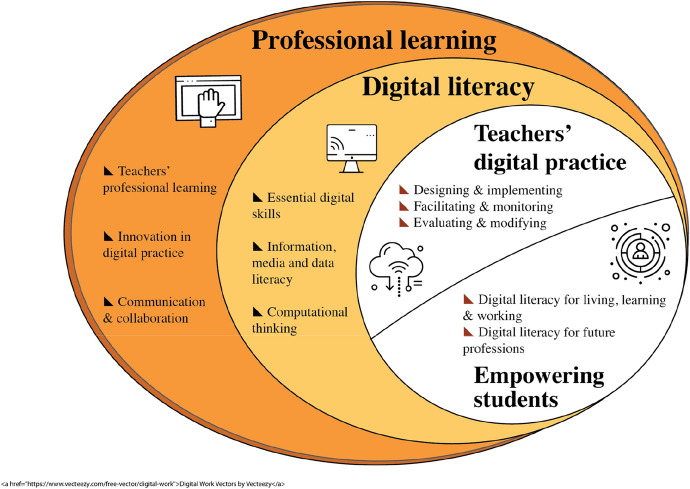
There is little consensus about the nature of teachers’ digital competencies in Higher Education. Moreover, existing digital competence frameworks have largely been developed for teachers in secondary education. In response to this, the current study focuses on developing and validating a framework of digital competencies for teachers in Higher Education. First, a review was conducted to determine the state of digital competence research regarding dimensions and definition of digital competence. In a next step, similarities and differences between existing digital competence frameworks were identified. Based on the outcomes of the review and the framework comparison, a framework was developed in an iterative process through expert meetings with policy makers, experts in the field of educational technology, and validated with practitioners. The new framework includes four dimensions of teachers’ digital competencies: (1) Teaching practice, (2) Empowering students for a digital society, (3) Teachers’ digital literacy, and (4) Teachers’ professional development. The resulting Higher Education Digital Competence (HeDiCom) framework will provide guidance and clearer expectations of teachers’ digital competency. Ultimately, improving teachers’ digital competencies will contribute to improving the quality of digital competencies of the students.
Overview
The claims and statistics of this paper haven’t been checked yet.
Free: it reads the open-access text and checks the first 5 claims that cite a source we can check. Create a free account to check every claim.
Integrity signals
Registry
Cites
Statistics
Figures
Verification
Claims the paper makes
The claims and statistics of this paper haven’t been checked yet.
Free: it reads the open-access text and checks the first 5 claims that cite a source we can check. Create a free account to check every claim.
Claims other papers make about this one
Each is checked against this paper’s own text: does it say what the citing paper says it does?
The source backs part of the claim, not all of it — or backs it for a different population, condition or comparison.
In the citing paper
“Existing studies show that the focus of research on university teachers’ digital competence is shifting from whether they can use digital tools to whether they can develop stable, reflective, and transferable digital teaching practices within specific disciplinary and instructional contexts (4–7).”
From Reframing faculty development for digital transformation and generative AI in higher education (2026) · cites this paper as [4]
Experimental — accuracy not yet measuredThe source backs part of the claim, not all of it — or backs it for a different population, condition or comparison.
In the citing paper
“Relevant research has shown that the development of teachers’ digital competence is jointly shaped by career stage, institutional environment, resource support, and opportunities for professional learning; therefore, tiered support is more effective than uniform training in improving the efficiency of faculty development (4).”
From Reframing faculty development for digital transformation and generative AI in higher education (2026) · cites this paper as [4]
Experimental — accuracy not yet measuredThe source backs part of the claim, not all of it — or backs it for a different population, condition or comparison.
In the citing paper
“In constructing its framework, HeDiCom has already incorporated ethical competence in digital society as a key dimension, indicating that digitally mature teachers must not only be capable of innovation, but also be able to discern technological risks (4).”
From Reframing faculty development for digital transformation and generative AI in higher education (2026) · cites this paper as [4]
Experimental — accuracy not yet measuredThe source backs part of the claim, not all of it — or backs it for a different population, condition or comparison.
In the citing paper
“Only in this way can teachers truly develop digital teaching innovation capacities that are disciplinary, transferable, and demonstrable (4, 14).”
From Reframing faculty development for digital transformation and generative AI in higher education (2026) · cites this paper as [4]
Experimental — accuracy not yet measuredThe source backs part of the claim, not all of it — or backs it for a different population, condition or comparison.
In the citing paper
“The HeDiCom framework explicitly states that the mature form of faculty digital competence is manifested not merely in individual technical proficiency, but in the ability to embed digital practices into teaching innovation, student empowerment, and systems of professional learning for faculty (4).”
From Reframing faculty development for digital transformation and generative AI in higher education (2026) · cites this paper as [4]
Experimental — accuracy not yet measured
4 more claims about this paper
Create a free account to see every claim other papers make about this one.
Self-check
Percentages, sums and reported differences re-computed from the paper’s own numbers.
The self-check needs the paper’s full text.
Citations
Cites
Wing, J. M. (2006) · Communications of the ACM · doi:10.1145/1118178.1118215 · Cited by 8,102
Systematic Reviews in the Social Sciences: A Practical Guide
Petticrew, M., & Roberts, H. (2006) · doi:10.1002/9780470754887 · Cited by 3,586
From digital literacy to digital competence: the teacher digital competency (TDC) framework
Falloon, G. (2020) · Educational Technology Research and Development · doi:10.1007/s11423-020-09767-4 · Cited by 1,372
European Framework for the Digital Competence of Educators: DigCompEdu
(2017) · RePEc: Research Papers in Economics · doi:10.2760/178382 · Cited by 1,276
Carretero, S., Riina, V., & Punie, Y. (2017) · RePEc: Research Papers in Economics · doi:10.2760/38842 · Cited by 1,074 · cited 1×
“Carretero et al. (2017) for instance indicate that teachers must be able to analyze and compare both the information and the sources of digital content for reliability and credibility.”
BackgroundKebritchi, M., Lipschuetz, A., & Santiague, L. (2017) · Journal of Educational Technology Systems · doi:10.1177/0047239516661713 · Cited by 967 · cited 2×
“To become a competent online teacher, there is a need for professional development and sufficient time to design and practice online and blended learning environments (see also Kebritchi et al., 2017).”
BackgroundSpante, M., Hashemi, S. S., Lundin, M., & Algers, A. (2018) · Cogent Education · doi:10.1080/2331186x.2018.1519143 · Cited by 832 · cited 2×
“According to Spante et al. (2018), also the assessment of a specific digital competence requires the understanding of related constructs.”
BackgroundMethodThe current landscape of learning analytics in higher education
Viberg, O., Hatakka, M., Bälter, O., & Mavroudi, A. (2018) · Computers in Human Behavior · doi:10.1016/j.chb.2018.07.027 · Cited by 766 · cited 1×
“A review by Viberg et al. (2018) for instance shows that there is much potential for using and analyzing this data to improve the learning process, but that this rarely takes place in practice.”
BackgroundDigital competence – an emergent boundary concept for policy and educational research
Ilomäki, L., Paavola, S., Lakkala, M., & Kantosalo, A. (2016) · Education and Information Technologies · doi:10.1007/s10639-014-9346-4 · Cited by 689 · cited 3×
“Moreover, it is expected that students will soon enter the workforce and there is a need for them to perform as knowledge workers, which requires a high level of digital competence (Ilomäki et al., 2016).”
BackgroundMethodInfluentialDigital competence in higher education research: a systematic literature review
Zhao, Y., Pinto Llorente, A. M., & Sánchez Gómez, M. C. (2021) · Computers & Education · doi:10.1016/j.compedu.2021.104212 · Cited by 653 · cited 8×
“According to Zhao et al. (2021), the most frequently identified competencies were the use of digital technologies, knowledge of digital technologies, the Internet and technological related capacities, digital experiences and attitudes.”
BackgroundInfluential
Research works printed but not linked: 3
- 17. Howard, S. K., Tondeur, J., Hutchison, N., Scherer, R., & Siddiq, F. (2022). A t(r)opical journey: Using text mining to explore teachers' experiences in the Great Online Transition. In Society for information tech- nology & teacher education international conference.
- 32. Redecker, C., & Punie, Y. (2017). Digital competence of educators: DigCompEdu. Publications Office of the European Union. https:// doi. org/ 10. 2760/ 159770 · doi:10.2760/159770
- 37. Schleicher, A. (2020). The impact of COVID-19 on education: Insights from "Education at a Glance 2020." OECD Publishing.
Cited by
Items 201–229 of 229
Ayumi, N. F., & Subarshini, B. (2025) · PATHALOGY Journal · doi:10.64538/pathalogy.v1i2.160 · Cited by 1
Erwahyudin, D. D., Katni, K., Laksana, S. D., Sumaryanti, L., & Yani, C. D. (2026) · BIS Humanities and Social Science · doi:10.31603/bishss.465
Lestari, S. D., Sugiarto, D., & Susanto, J. (2025) · Impact Journal - Management Business and Finance
Xingren, G., & bin Ibrahim, A. B. (2026) · Frontiers in Management and Social Insights
KETERAMPILAN DALAM PENGGUNAAN TEKNOLOGI PEMBELAJARAN BAHASA ARAB
Hanief, S., Harisca, R., & Abdilah, H. I. (2025) · Qolamuna: Keislaman, Pendidikan, Literasi dan Humaniora · Cited by 1
Azka, B. P., Dharma, R., & Putra, R. B. (2025) · Impact Journal - Management Business and Finance
Kurniawan, B. (2025) · Impact Journal - Management Business and Finance
Suárez, B. A. D. L. H., León, J. K. L., Morán, I. L., & Olivero, D. E. (2026) · Polo del Conocimiento · doi:10.23857/pc.v11i6.11815
Hashemi, S. S., Bergdahl, N., Cederqvist, A., Edstrand, E., Lundin, M., & Sjöberg, J. (2026) · Lecture notes of the Institute for Computer Sciences, Social Informatics and Telecommunications Engineering · doi:10.1007/978-3-032-39734-8_22
Samat, C., Rattanachaithada, R., & Kwangmuang, P. (2026) · Social Sciences & Humanities Open · doi:10.1016/j.ssaho.2026.103796
Sorsszerű véletlenek. Hogyan lesz valakiből fordításkutató?
Klaudy, K. (2026) · Fordítástudomány · doi:10.35924/fordtud.28.si.1
Teacher Well-Being Management for Enhancing Student Well-Being in Primary Schools
Kursih, U., Senowarsito, & Harjito (2026) · Indonesian Journal of Islamic Educational Review · doi:10.58230/zzyfna71
“Digital competence frameworks emphasize teachers’ capacity to use technology effectively for pedagogical and professional purposes (Ng et al., 2023; Tondeur et al., 2023).”
Technológiai kompetencia a tolmácsképzésben
Tóth, B. F., & Móricz, K. A. (2026) · Fordítástudomány · doi:10.35924/fordtud.28.si.10
Assessing digital competences in higher education teachers: a case study
Javier, Q. C. Y., Alejandra, B. P. M., Colmenarez, M., & Molero, D. A. L. (2026) · Frontiers in Education · doi:10.3389/feduc.2026.1985613 · Cited by 1
Improving Teachers’ Digital Competence at Nanjing Xiaozhuang University
Yang, Z., & Yimsakul, P. (2026) · New Horizon of Education · doi:10.63944/yrms04.nhe
“The HeDiCom framework connects digital teaching practice with student empowerment, teachers’ digital literacy, and continuing professional development [6] .”
de Oliveira, M. L. G. (2026) · Educação & Inovação · doi:10.64326/educao.v2i16.591
Wang, X., & Xiaoyun, W. (2026) · Frontiers in Psychology · doi:10.3389/fpsyg.2026.1973587
“DSE task themes drew on computer self-efficacy and teacher digital-competence research (Compeau and Higgins, 1995; Hatlevik and Hatlevik, 2018; Tondeur et al., 2023).”
A systematic review of digital competence in physics education in the era of industry 4.0
Nurazmi, N., & Bancong, H. (2026) · Discover Education · doi:10.1007/s44217-026-02294-z
“Specifically, it connects technological affordances, pedagogical approaches, teacher competence frameworks, and contextual implementation conditions to explain how digital competence is developed and enacted in physics education [46, 57, 77, 81].”
Xolmatova, M. (2025) · Eurasian Journal of Academic Research · doi:10.70413/ejar-v05-i09-ps-096
Haoming, Y., Agustini, K., & Sudarma, I. K. (2026) · Jurnal Paedagogy · doi:10.33394/jp.v13i4.21770
Al-Nuaimi, I. T. I., Alnuaimy, A. N. H., & Jebur, H. H. (2026) · WSEAS Transactions on Information Science and Applications archive · doi:10.37394/23209.2027.24.4
Rebko, O. V. (n.d.) · CyberLeninK (CyberLeninka)
Rohman, A. S. A., & Baharun, H. (2025) · Afkarina: Jurnal Studi Keislaman dan Sosial · doi:10.33650/afkarina.v10i2.16394
Cuong, L. M., Hien, L. T. T., Trần, T. H. Y., Dung, T. T. P., Hoa, N. T., & Ngu, P. N. H. (2026) · International Journal of Learning Teaching and Educational Research · doi:10.26803/ijlter.25.10.6
Technological Self- Efficacy and Classroom Technology Use of Early Childhood Teachers
Awid, A. R., Balmocena, J., Cadayday, R., Palomar, M. R. M., Sojor, C., & Velez, J. M. (2026) · International Journal of Education, Research, and Innovation Perspectives · doi:10.5281/zenodo.23841216
Abdullah, S. I. S. S., Fairos, N. F. S. A., Mahat, J., Ghazali, N., Kushnir, I., Zakaria, N. S., Razali, F. B., Ponrahono, Z., & Nasri, N. M. (2026) · Discover Environment · doi:10.1007/s44274-026-01150-z
A Bibliometric Analysis of Digital and Information Literacy Research in Higher EducationPreprint
Hariry, A. F., & imami, M. K. W. (2026) · Research Square · doi:10.21203/rs.3.rs-11293687/v1
Zheng, J. (2026) · Discover Artificial Intelligence · doi:10.1007/s44163-026-02420-8
Dueñas, E. Y. P. (2026) · HOMERO · doi:10.64492/s0gq1n40
Metadata
- Authors
- Tondeur, J., Howard, S., Van Zanten, M., Gorissen, P., Van der Neut, I., Uerz, D., & Kral, M.
- Affiliations
- Vrije Universiteit Brussel (BE)
- HAN University of Applied Sciences (NL)
- Corresponding author
- Tondeur, Jo
- Venue
- Educational technology research and development
- Published
- 2023-02
- Volume
- 71
- Issue
- 1
- Pages
- 33-53
- ISSN
- 1042-1629 (ISSN-L)
- 1556-6501
- PMC
- PMC10032264
- OpenAlex
- W4360985255
- Cited by
- 115
- References
- 47
- Citations by year
- 2026: 54 · 2025: 30 · 2024: 24 · 2023: 7
- FWCI
- 26.99
- Type
- journal article
- Language
- en
- Open access
- hybrid
- doi.org
- Licence
- cc-by
- creativecommons.org/licenses/by/4.0 (tdm)
- creativecommons.org/licenses/by/4.0 (vor, 49 d)
- Locations
- Educational Technology Research and Development (publishedVersion, cc-by)
- PubMed Central (publishedVersion, cc-by)
- PubMed (publishedVersion)
- VUBIR (Vrije Universiteit Brussel) (submittedVersion, cc-by)
- Research Online (University of Wollongong) (submittedVersion)
- Topics
- Social Sciences › Education › Digital literacy in education
- Social Sciences › Education › Digital Storytelling and Education
- Social Sciences › Education › Higher Education Teaching and Evaluation
- Keywords
- digital competence of teachers, higher education teachers, digital competence framework, digital literacy, teacher professional development, teaching practice, framework validation
About these checks
Registry, retraction, Cites and statistics results are computed, not judged, with one exception: a printed reference that no index lists is read once by a model before it counts as a citation error. Claims are extracted by a model and kept only when their quote appears verbatim in the text; each cited source is then checked, with a model’s help, for whether it says what the claim relies on. Those verdicts can be wrong — read the claim’s quote and the cited source before relying on one.
Statistics and arithmetic are recomputed, not judged.
Confidence bands are shown only for fields calibrated on our annotated test set. None is calibrated yet, so no band is shown.
What counts as a claim ›How we measure confidence ›How we check this ›
Are you an author, or do you see a problem with this page? Request a review
Data sources
Bibliographic data: Semantic Scholar, OpenAlex, Crossref.
Contains information from the Semantic Scholar Academic Graph Datasets, made available under the ODC Attribution License (ODC-BY 1.0).
Semantic Scholar’s data is described in: Kinney, R., et al. (2023). The Semantic Scholar Open Data Platform. arXiv:2301.10140.
