

Intolerance of uncertainty and mental wellbeing: serial mediation by rumination and fear of COVID-19.
Open accessThe DOI matches its Crossref record, with a small difference in title or year; 44 of the 45 references it cites were found in a registry or an index.
Abstract
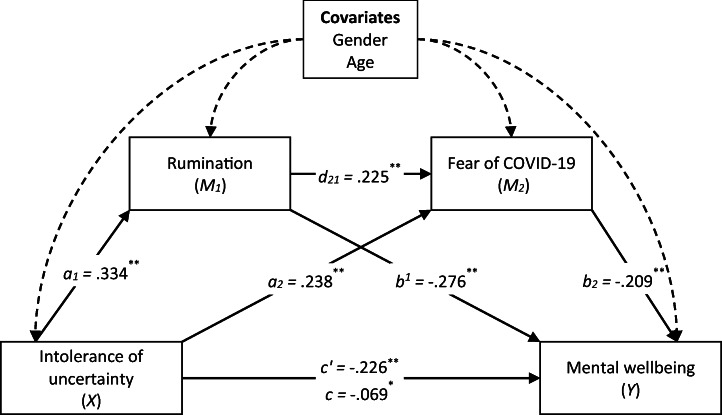
The novel coronavirus-2019 (COVID-19) pandemic has become globally widespread with millions of confirmed cases and many countries implementing various levels of quarantine. Therefore, it is important to investigate the psychological consequences of this process, given the unique situation that has been experienced globally. Therefore, the present study examined whether intolerance of uncertainty was related to mental wellbeing and whether this relationship was mediated by rumination and fear of COVID-19. The sample comprised 1772 Turkish individuals (aged between 18 and 73 years) from 79 of 81 cities in Turkey, who completed measures of mental wellbeing, intolerance of uncertainty, rumination, and fear of COVID-19. Results of serial mediation analyses showed that intolerance of uncertainty had a significant direct effect on mental wellbeing. Rumination and fear of COVID-19, in combination, serially mediated the association between intolerance of uncertainty and mental wellbeing. The findings are discussed within the framework of the psychological consequences of the COVID-19 pandemic and related literature.
Overview
The claims and statistics of this paper haven’t been checked yet.
Free: it reads the open-access text and checks the first 5 claims that cite a source we can check. Create a free account to check every claim.
Integrity signals
Registry
Cites
Statistics
Figures
Verification
Claims the paper makes
The claims and statistics of this paper haven’t been checked yet.
Free: it reads the open-access text and checks the first 5 claims that cite a source we can check. Create a free account to check every claim.
Claims other papers make about this one
Each is checked against this paper’s own text: does it say what the citing paper says it does?
The source backs part of the claim, not all of it — or backs it for a different population, condition or comparison.
In the citing paper
“This is due to the fact that people tend to be more anxious if they keep ruminating on a particular thought, given the fact that we conducted this study at the time when the entire country was under lockdown (Satici et al., 2020).”
From Knowledge of COVID-19 and Its Influence on Mindfulness, Cognitive Emotion Regulation and Psychological Flexibility in the Indian Community (2020) · cites this paper as Satici et al., 2020
Experimental — accuracy not yet measuredThe source backs part of the claim, not all of it — or backs it for a different population, condition or comparison.
In the citing paper
“It can be considered as a sub-trait of anxiety [44] (that is, in its turn, a facet of neuroticism), which has often been found in association with stress, distress, insomnia, psychosomatic symptoms, and other clinical conditions in several recent studies carried out on COVID-19 among the general population and HCWs (e.g., [45,51,52,53,54,55,56]).”
From Associations between Personality Traits, Intolerance of Uncertainty, Coping Strategies, and Stress in Italian Frontline and Non-Frontline HCWs during the COVID-19 Pandemic—A Multi-Group Path-Analysis (2021) · cites this paper as [54]
Experimental — accuracy not yet measuredThe source backs part of the claim, not all of it — or backs it for a different population, condition or comparison.
In the citing paper
“Uncertainty of disease condition [59], rapid changes of recommendations [60], and amplification of information during the pandemic could lead to confusion, which in turn results in lower satisfaction.”
From Digital health literacy, online information-seeking behaviour, and satisfaction of Covid-19 information among the university students of East and South-East Asia (2022) · cites this paper as [59]
Experimental — accuracy not yet measured
Self-check
Percentages, sums and reported differences re-computed from the paper’s own numbers.
The self-check needs the paper’s full text.
Citations
Cites
(2013) · Cited by 44,563
(2017) · Cited by 16,319
Nolen-Hoeksema, S., Wisco, B. E., & Lyubomirsky, S. (2008) · Perspectives on Psychological Science · doi:10.1111/j.1745-6924.2008.00088.x · Cited by 5,172
The Warwick-Edinburgh Mental Well-being Scale (WEMWBS): development and UK validation
Tennant, R., Hiller, L., Fishwick, R., Platt, S., Joseph, S., Weich, S., Parkinson, J., Secker, J., & Stewart-Brown, S. (2007) · Health and Quality of Life Outcomes · doi:10.1186/1477-7525-5-63 · Cited by 5,031
Responses to depression and their effects on the duration of depressive episodes
Nolen-Hoeksema, S. (1991) · Journal of Abnormal Psychology · doi:10.1037/0021-843x.100.4.569 · Cited by 4,529
The Fear of COVID-19 Scale: Development and Initial Validation
Ahorsu, D. K., Lin, C.-Y., Imani, V., Saffari, M., Griffiths, M. D., & Pakpour, A. H. (2022) · International Journal of Mental Health and Addiction · doi:10.1007/s11469-020-00270-8 · Cited by 4,332
Self-citationRumination reconsidered: a psychometric analysis.
Treynor, W., Gonzalez, R., & Nolen-Hoeksema, S. (2003) · Cognitive Therapy and Research · doi:10.1023/a:1023910315561 · Cited by 3,808
Fearing the unknown: A short version of the Intolerance of Uncertainty Scale
Carleton, R. N., Norton, M. A. P. J., & Asmundson, G. J. G. (2007) · Journal of Anxiety Disorders · doi:10.1016/j.janxdis.2006.03.014 · Cited by 2,288
Explaining the gender difference in depressive symptoms.
Nolen-Hoeksema, S., Larson, J., & Grayson, C. (1999) · Journal of Personality and Social Psychology · doi:10.1037/0022-3514.77.5.1061 · Cited by 1,543
Garfin, D. R., Silver, R. C., & Holman, E. A. (2020) · Health Psychology · doi:10.1037/hea0000875 · Cited by 1,270
Stewart-Brown, S., Tennant, A., Tennant, R., Platt, S., Parkinson, J., & Weich, S. (2009) · Health and Quality of Life Outcomes · doi:10.1186/1477-7525-7-15 · Cited by 1,251
Satici, B., Gocet-Tekin, E., Deniz, M. E., & Satici, S. A. (2021) · International Journal of Mental Health and Addiction · doi:10.1007/s11469-020-00294-0 · Cited by 922
Waterman, A. S., Schwartz, S. J., Zamboanga, B. L., Ravert, R. D., Williams, M. K., Bede Agocha, V., Yeong Kim, S., & Brent Donnellan, M. (2010) · The Journal of Positive Psychology · doi:10.1080/17439760903435208 · Cited by 722
Mamun, M. A., & Griffiths, M. D. (2020) · Asian Journal of Psychiatry · doi:10.1016/j.ajp.2020.102073 · Cited by 690
Self-citationLyubomirsky, S., Caldwell, N. D., & Nolen-Hoeksema, S. (1998) · Journal of Personality and Social Psychology · doi:10.1037//0022-3514.75.1.166 · Cited by 585
Different types of well-being? A cross-cultural examination of hedonic and eudaimonic well-being
Disabato, D. J., Goodman, F. R., Kashdan, T. B., Short, J. L., & Jarden, A. (2016) · Psychological Assessment · doi:10.1037/pas0000209 · Cited by 583
Fear of COVID 2019: first suicidal case in India!
Goyal, K., Chauhan, P., Chhikara, K., Gupta, P., & Singh, M. P. (2020) · Asian Journal of Psychiatry · doi:10.1016/j.ajp.2020.101989 · Cited by 559
van Jaarsveld, D. D., Walker, D. D., & Skarlicki, D. P. (2010) · Journal of Management · doi:10.1177/0149206310368998 · Cited by 511
The fear of COVID-19 and its role in preventive behaviours
Pakpour, A. H., & Griffiths, M. D. (2020) · Journal of Concurrent Disorders · doi:10.54127/wcic8036 · Cited by 448
Self-citationThe fear of COVID-19 and its role in preventive behaviors
Pakpour, A. H., & Griffiths, M. D. (2020) · Nottingham Trent University's Institutional Repository (Nottingham Trent Repository) · Cited by 384
Yip, P. S. F., Cheung, Y. T., Chau, P. H., & Law, Y. W. (2010) · Crisis · doi:10.1027/0227-5910/a000015 · Cited by 363
Main, A., Zhou, Q., Ma, Y., Luecken, L. J., & Liu, X. (2011) · Journal of Counseling Psychology · doi:10.1037/a0023632 · Cited by 361
Bonanno, G. A., Ho, S. M. Y., Chan, J. C. K., Kwong, R. S. Y., Cheung, C. K. Y., Wong, C. P. Y., & Wong, V. C. W. (2008) · Health Psychology · doi:10.1037/0278-6133.27.5.659 · Cited by 329
Schimmenti, A., Billieux, J., & Starcevic, V. (2020) · PubMed Central · doi:10.36131/cn20200202 · Cited by 313
Predictive factors of psychological disorder development during recovery following SARS outbreak
Mihashi, M., Otsubo, Y., Yinjuan, X., Nagatomi, K., Hoshiko, M., & Ishitake, T. (2009) · Health Psychology · doi:10.1037/a0013674 · Cited by 290
Rumination, negative cognition, and their interactive effects on depressed mood.
Ciesla, J. A., & Roberts, J. E. (2007) · Emotion · doi:10.1037/1528-3542.7.3.555 · Cited by 230
BELİRSİZLİĞE TAHAMMÜLSÜZLÜK ÖLÇEĞİ (BTÖ-12) TÜRKÇE FORMU: GEÇERLİK VE GÜVENİRLİK ÇALIŞMASI
SARIÇAM, H. (2014) · Route Educational and Social Science Journal · doi:10.17121/ressjournal.109 · Cited by 208
Is valuing positive emotion associated with life satisfaction?
Bastian, B., Kuppens, P., De Roover, K., & Diener, E. (2014) · Emotion · doi:10.1037/a0036466 · Cited by 198
Cassandra’s regret: The psychology of not wanting to know.
Gigerenzer, G., & Garcia-Retamero, R. (2017) · Psychological Review · doi:10.1037/rev0000055 · Cited by 177
Hong, R. Y., & Lee, S. S. M. (2015) · Psychological Assessment · doi:10.1037/pas0000074 · Cited by 170
Nothing is safe: Intolerance of uncertainty is associated with compromised fear extinction learning
Morriss, J., Christakou, A., & van Reekum, C. M. (2016) · Biological Psychology · doi:10.1016/j.biopsycho.2016.05.001 · Cited by 152
Foundational frameworks of positive psychology: Mapping well-being orientations.
Lambert, L., Passmore, H.-A., & Holder, M. D. (2015) · Canadian Psychology / Psychologie canadienne · doi:10.1037/cap0000033 · Cited by 147
Zullow, H. M., Oettingen, G., Peterson, C., & Seligman, M. E. (1988) · American Psychologist · doi:10.1037//0003-066x.43.9.673 · Cited by 144
Rumination moderates the effects of daily events on negative mood: Results from a diary study.
Genet, J. J., & Siemer, M. (2012) · Emotion · doi:10.1037/a0028070 · Cited by 141
McAllister, T. W., & Trzepacz, P. T. (1992) · Journal of Neuropsychiatry · doi:10.1176/jnp.4.1.106 · Cited by 120
Bravo, A. J., Kelley, M. L., Mason, R., Ehlke, S. J., Vinci, C., & Redman, J. C. (2020) · Traumatology · doi:10.1037/trm0000198 · Cited by 52
The Turkish Version of the Ruminative Response Scale: An Examination of Its Reliability and Validity
Erdur‐Baker, Ö., & Bugay, A. (2012) · OpenMETU (Middle East Technical University) · Cited by 45
Wozniak, J. D., Caudle, H. E., Harding, K., Vieselmeyer, J., & Mezulis, A. H. (2020) · Psychological Trauma: Theory, Research, Practice, and Policy · doi:10.1037/tra0000505 · Cited by 41
Fergus, T. A. (2013) · Psychological Assessment · doi:10.1037/a0034103 · Cited by 37
Yıldız, B., & İskender, M. (2019) · Current Psychology · doi:10.1007/s12144-018-0112-4 · Cited by 36
Hollingsworth, D. W., Gauthier, J. M., McGuire, A. P., Peck, K. R., Hahn, K. S., & Connolly, K. M. (2018) · Journal of Black Psychology · doi:10.1177/0095798418809201 · Cited by 34
Can Beck's theory of depression and the response style theory be integrated?
Pössel, P. (2011) · Journal of Counseling Psychology · doi:10.1037/a0025092 · Cited by 22
Jose, R., Holman, E. A., & Silver, R. C. (2017) · Health Psychology · doi:10.1037/hea0000518 · Cited by 16
Christ, N. M., Contractor, A. A., Wang, X., & Elhai, J. D. (2020) · Psychological Trauma Theory Research Practice and Policy · doi:10.1037/tra0000579 · Cited by 15
Research works printed but not linked: 1
- Keldal G Turkish version of the Warwick-Edinburgh Mental Well-Being Scale: A validity and reliability study Journal of Happiness & Well-Being 2015 3 1 103 115
Cited by
Bakioğlu, F., Korkmaz, O., & Ercan, H. (2021) · International Journal of Mental Health and Addiction · doi:10.1007/s11469-020-00331-y · Cited by 812
“For example, in a study conducted by Satici et al. (2020b), a positive relationship was found between the fear of COVID-19 and intolerance of uncertainty.”
BackgroundMethodResultInfluentialParedes, M. R., Apaolaza, V., Fernandez-Robin, C., Hartmann, P., & Yañez-Martinez, D. (2021) · Personality and Individual Differences · doi:10.1016/j.paid.2020.110455 · Cited by 383
“) increase stress-related symptoms, affecting mental well-being (Duan & Zhu, 2020; Satici et al., 2020).”
Arslan, G., Yıldırım, M., Tanhan, A., Buluş, M., & Allen, K.-A. (2021) · International Journal of Mental Health and Addiction · doi:10.1007/s11469-020-00337-6 · Cited by 355
“The reported increase in mental health issues due to physical distancing, quarantining processes, and social isolation makes further research in this area critical in order to systematically investigate, understand, and tailor appropriate interventions (Harper et al. 2020; Satici et al. 2020; Tanhan et al. 2020).”
BackgroundInfluentialChtourou, H., Trabelsi, K., H'mida, C., Boukhris, O., Glenn, J. M., Brach, M., Bentlage, E., Bott, N., Shephard, R. J., Ammar, A., et al. (2020) · Frontiers in Psychology · doi:10.3389/fpsyg.2020.01708 · Cited by 243
On the Nature of Fear and Anxiety Triggered by COVID-19
Coelho, C. M., Suttiwan, P., Arato, N., & Zsido, A. N. (2020) · Frontiers in Psychology · doi:10.3389/fpsyg.2020.581314 · Cited by 236
Metadata
- Authors
- Satici, B., Saricali, M., Satici, S. A., & Griffiths, M. D.
- Affiliations
- Nottingham Trent University (GB)
- Corresponding author
- Griffiths, Mark D.
- Venue
- International Journal of Mental Health and Addiction
- Published
- 2020-05-15
- Volume
- 20
- Issue
- 5
- Pages
- 2731-2742
- ISSN
- 1557-1874 (ISSN-L)
- 1557-1882
- PMC
- PMC7228430
- OpenAlex
- W3025803203
- Cited by
- 580
- References
- 45
- Citations by year
- 2026: 21 · 2025: 37 · 2024: 73 · 2023: 100 · 2022: 163 · 2021: 141 · 2020: 40
- FWCI
- 44.44
- Type
- journal article
- Language
- en
- Open access
- hybrid
- doi.org
- Licence
- cc-by
- creativecommons.org/licenses/by/4.0 (tdm)
- creativecommons.org/licenses/by/4.0 (vor)
- Locations
- International Journal of Mental Health and Addiction (publishedVersion, cc-by)
- PubMed Central (publishedVersion, cc-by)
- PubMed (publishedVersion)
- Nottingham Trent University's Institutional Repository (Nottingham Trent Repository) (acceptedVersion)
- Yildiz Technical University - AVESIS (submittedVersion, cc-by-nc-nd)
- Funders
- Nottingham Trent University
- Topics
- Social Sciences › Psychology › Clinical Psychology › COVID-19 and Mental Health
- Social Sciences › Psychology › Experimental and Cognitive Psychology › Anxiety, Depression, Psychometrics, Treatment, Cognitive Processes
- Social Sciences › Psychology › Clinical Psychology › Mindfulness and Compassion Interventions
- Keywords
- intolerance of uncertainty, psychological well-being, rumination, fear of COVID-19, COVID-19 pandemic, serial mediation, Turkish adults
About these checks
Registry, retraction, Cites and statistics results are computed, not judged, with one exception: a printed reference that no index lists is read once by a model before it counts as a citation error. Claims are extracted by a model and kept only when their quote appears verbatim in the text; each cited source is then checked, with a model’s help, for whether it says what the claim relies on. Those verdicts can be wrong — read the claim’s quote and the cited source before relying on one.
Statistics and arithmetic are recomputed, not judged.
Confidence bands are shown only for fields calibrated on our annotated test set. None is calibrated yet, so no band is shown.
What counts as a claim ›How we measure confidence ›How we check this ›
Are you an author, or do you see a problem with this page? Request a review
Data sources
Bibliographic data: Semantic Scholar, OpenAlex, Crossref.
Contains information from the Semantic Scholar Academic Graph Datasets, made available under the ODC Attribution License (ODC-BY 1.0).
Semantic Scholar’s data is described in: Kinney, R., et al. (2023). The Semantic Scholar Open Data Platform. arXiv:2301.10140.
