

Intolerance of uncertainty and mental wellbeing: serial mediation by rumination and fear of COVID-19.
Open accessThe DOI matches its Crossref record, with a small difference in title or year; 44 of the 45 references it cites were found in a registry or an index.
Abstract
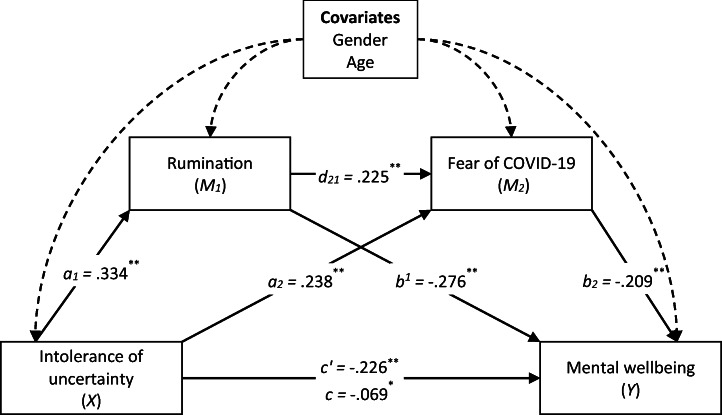
The novel coronavirus-2019 (COVID-19) pandemic has become globally widespread with millions of confirmed cases and many countries implementing various levels of quarantine. Therefore, it is important to investigate the psychological consequences of this process, given the unique situation that has been experienced globally. Therefore, the present study examined whether intolerance of uncertainty was related to mental wellbeing and whether this relationship was mediated by rumination and fear of COVID-19. The sample comprised 1772 Turkish individuals (aged between 18 and 73 years) from 79 of 81 cities in Turkey, who completed measures of mental wellbeing, intolerance of uncertainty, rumination, and fear of COVID-19. Results of serial mediation analyses showed that intolerance of uncertainty had a significant direct effect on mental wellbeing. Rumination and fear of COVID-19, in combination, serially mediated the association between intolerance of uncertainty and mental wellbeing. The findings are discussed within the framework of the psychological consequences of the COVID-19 pandemic and related literature.
Overview
The claims and statistics of this paper haven’t been checked yet.
Free: it reads the open-access text and checks the first 5 claims that cite a source we can check. Create a free account to check every claim.
Integrity signals
Registry
Cites
Statistics
Figures
Verification
Claims the paper makes
The claims and statistics of this paper haven’t been checked yet.
Free: it reads the open-access text and checks the first 5 claims that cite a source we can check. Create a free account to check every claim.
Claims other papers make about this one
Each is checked against this paper’s own text: does it say what the citing paper says it does?
The source backs part of the claim, not all of it — or backs it for a different population, condition or comparison.
In the citing paper
“This is due to the fact that people tend to be more anxious if they keep ruminating on a particular thought, given the fact that we conducted this study at the time when the entire country was under lockdown (Satici et al., 2020).”
From Knowledge of COVID-19 and Its Influence on Mindfulness, Cognitive Emotion Regulation and Psychological Flexibility in the Indian Community (2020) · cites this paper as Satici et al., 2020
Experimental — accuracy not yet measuredThe source backs part of the claim, not all of it — or backs it for a different population, condition or comparison.
In the citing paper
“It can be considered as a sub-trait of anxiety [44] (that is, in its turn, a facet of neuroticism), which has often been found in association with stress, distress, insomnia, psychosomatic symptoms, and other clinical conditions in several recent studies carried out on COVID-19 among the general population and HCWs (e.g., [45,51,52,53,54,55,56]).”
From Associations between Personality Traits, Intolerance of Uncertainty, Coping Strategies, and Stress in Italian Frontline and Non-Frontline HCWs during the COVID-19 Pandemic—A Multi-Group Path-Analysis (2021) · cites this paper as [54]
Experimental — accuracy not yet measuredThe source backs part of the claim, not all of it — or backs it for a different population, condition or comparison.
In the citing paper
“Uncertainty of disease condition [59], rapid changes of recommendations [60], and amplification of information during the pandemic could lead to confusion, which in turn results in lower satisfaction.”
From Digital health literacy, online information-seeking behaviour, and satisfaction of Covid-19 information among the university students of East and South-East Asia (2022) · cites this paper as [59]
Experimental — accuracy not yet measured
Self-check
Percentages, sums and reported differences re-computed from the paper’s own numbers.
The self-check needs the paper’s full text.
Citations
Cites
(2013) · Cited by 44,563
(2017) · Cited by 16,319
Nolen-Hoeksema, S., Wisco, B. E., & Lyubomirsky, S. (2008) · Perspectives on Psychological Science · doi:10.1111/j.1745-6924.2008.00088.x · Cited by 5,172
The Warwick-Edinburgh Mental Well-being Scale (WEMWBS): development and UK validation
Tennant, R., Hiller, L., Fishwick, R., Platt, S., Joseph, S., Weich, S., Parkinson, J., Secker, J., & Stewart-Brown, S. (2007) · Health and Quality of Life Outcomes · doi:10.1186/1477-7525-5-63 · Cited by 5,031
Responses to depression and their effects on the duration of depressive episodes
Nolen-Hoeksema, S. (1991) · Journal of Abnormal Psychology · doi:10.1037/0021-843x.100.4.569 · Cited by 4,529
The Fear of COVID-19 Scale: Development and Initial Validation
Ahorsu, D. K., Lin, C.-Y., Imani, V., Saffari, M., Griffiths, M. D., & Pakpour, A. H. (2022) · International Journal of Mental Health and Addiction · doi:10.1007/s11469-020-00270-8 · Cited by 4,332
Self-citationRumination reconsidered: a psychometric analysis.
Treynor, W., Gonzalez, R., & Nolen-Hoeksema, S. (2003) · Cognitive Therapy and Research · doi:10.1023/a:1023910315561 · Cited by 3,808
Fearing the unknown: A short version of the Intolerance of Uncertainty Scale
Carleton, R. N., Norton, M. A. P. J., & Asmundson, G. J. G. (2007) · Journal of Anxiety Disorders · doi:10.1016/j.janxdis.2006.03.014 · Cited by 2,288
Explaining the gender difference in depressive symptoms.
Nolen-Hoeksema, S., Larson, J., & Grayson, C. (1999) · Journal of Personality and Social Psychology · doi:10.1037/0022-3514.77.5.1061 · Cited by 1,543
Garfin, D. R., Silver, R. C., & Holman, E. A. (2020) · Health Psychology · doi:10.1037/hea0000875 · Cited by 1,270
Research works printed but not linked: 1
- Keldal G Turkish version of the Warwick-Edinburgh Mental Well-Being Scale: A validity and reliability study Journal of Happiness & Well-Being 2015 3 1 103 115
Cited by
Bakioğlu, F., Korkmaz, O., & Ercan, H. (2021) · International Journal of Mental Health and Addiction · doi:10.1007/s11469-020-00331-y · Cited by 812
“For example, in a study conducted by Satici et al. (2020b), a positive relationship was found between the fear of COVID-19 and intolerance of uncertainty.”
BackgroundMethodResultInfluentialParedes, M. R., Apaolaza, V., Fernandez-Robin, C., Hartmann, P., & Yañez-Martinez, D. (2021) · Personality and Individual Differences · doi:10.1016/j.paid.2020.110455 · Cited by 383
“) increase stress-related symptoms, affecting mental well-being (Duan & Zhu, 2020; Satici et al., 2020).”
Arslan, G., Yıldırım, M., Tanhan, A., Buluş, M., & Allen, K.-A. (2021) · International Journal of Mental Health and Addiction · doi:10.1007/s11469-020-00337-6 · Cited by 355
“The reported increase in mental health issues due to physical distancing, quarantining processes, and social isolation makes further research in this area critical in order to systematically investigate, understand, and tailor appropriate interventions (Harper et al. 2020; Satici et al. 2020; Tanhan et al. 2020).”
BackgroundInfluentialChtourou, H., Trabelsi, K., H'mida, C., Boukhris, O., Glenn, J. M., Brach, M., Bentlage, E., Bott, N., Shephard, R. J., Ammar, A., et al. (2020) · Frontiers in Psychology · doi:10.3389/fpsyg.2020.01708 · Cited by 243
On the Nature of Fear and Anxiety Triggered by COVID-19
Coelho, C. M., Suttiwan, P., Arato, N., & Zsido, A. N. (2020) · Frontiers in Psychology · doi:10.3389/fpsyg.2020.581314 · Cited by 236
Systematic Review and Meta-Analysis of Fear of COVID-19
Luo, F., Ghanei Gheshlagh, R., Dalvand, S., Saedmoucheshi, S., & Li, Q. (2021) · Frontiers in Psychology · doi:10.3389/fpsyg.2021.661078 · Cited by 209
Liu, C. H., Erdei, C., & Mittal, L. (2021) · Psychiatry Research · doi:10.1016/j.psychres.2020.113552 · Cited by 208
“Beyond the direct effects of the disease, everyday routines and the marking of major life milestones have been dramatically altered for almost all Americans for much of 2020, with this experience characterized by heightened stress due to the uncertainty of the current situation (Estes and Thompson, 2020; Preis et al.,…”
BackgroundSmith, B. M., Twohy, A. J., & Smith, G. S. (2020) · Journal of Contextual Behavioral Science · doi:10.1016/j.jcbs.2020.09.005 · Cited by 194
Moore, S. E., Wierenga, K. L., Prince, D. M., Gillani, B., & Mintz, L. J. (2021) · Journal of Homosexuality · doi:10.1080/00918369.2020.1868184 · Cited by 193
Alimoradi, Z., Ohayon, M. M., Griffiths, M. D., Lin, C.-Y., & Pakpour, A. H. (2022) · BJPsych Open · doi:10.1192/bjo.2022.26 · Cited by 181
Self-citationDo we experience pandemic fatigue? current state, predictors, and prevention
Haktanır, A., Can, N., Seki, T., Kurnaz, M. F., & Dilmaç, B. (2021) · Current Psychology · doi:10.1007/s12144-021-02397-w · Cited by 172
Fear of COVID-19, mindfulness, humor, and hopelessness: a multiple mediation analysis
Saricali, M., Satici, S. A., Satici, B., Gocet-Tekin, E., & Griffiths, M. D. (2022) · International Journal of Mental Health and Addiction · doi:10.1007/s11469-020-00419-5 · Cited by 146
“For instance, hopelessness is negatively associated with life satisfaction (Kliem et al. 2018), is a negative predictor of quality of life among older adults (Scogin et al. 2016), and is a negative predictor of resilience towards stressful events (Hjemdal et al. 2012).”
BackgroundSelf-citationGonzález-Sanguino, C., Ausín, B., Castellanos, M. A., Saiz, J., & Muñoz, M. (2021) · Progress in Neuro-Psychopharmacology and Biological Psychiatry · doi:10.1016/j.pnpbp.2020.110219 · Cited by 136
Zhou, Y., MacGeorge, E. L., & Myrick, J. G. (2020) · International Journal of Environmental Research and Public Health · doi:10.3390/ijerph17176315 · Cited by 142
“These findings align with the negative effects of rumination in regard to other stressors, including natural disasters [37,38], and with recent research from Turkey showing that rumination about COVID-19 had a negative impact on well-being [33].”
ResultDeniz, M. E. (2021) · Personality and Individual Differences · doi:10.1016/j.paid.2021.110824 · Cited by 124
“Furthermore, another study also conducted in Turkey, such as this current study was, determined that fear of COVID-19 could similarly increase levels of depression, anxiety and stress (Satici, Gocet-Tekin, Deniz, & Satici, 2020).”
Sauer, K. S., Jungmann, S. M., & Witthöft, M. (2020) · International Journal of Environmental Research and Public Health · doi:10.3390/ijerph17197241 · Cited by 110
“In the context of the COVID-19 pandemic, results also indicate associations between intolerance of uncertainty and mental well-being [40], COVID-19 related distress [19], and depressive, generalized anxiety, and health anxiety symptoms [41,42].”
BackgroundNurunnabi, M., Almusharraf, N., & Aldeghaither, D. S. (2020) · Journal of Public Health Research · doi:10.4081/jphr.2020.2010 · Cited by 129
Intolerance of uncertainty and emotion regulation: A meta-analytic and systematic review
Sahib, A., Chen, J., Cárdenas, D., & Calear, A. L. (2023) · Clinical Psychology Review · doi:10.1016/j.cpr.2023.102270 · Cited by 102
Liu, C., Huang, N., Fu, M., Zhang, H., Feng, X. L., & Guo, J. (2021) · Risk Management and Healthcare Policy · doi:10.2147/rmhp.s302521 · Cited by 114
“Second, it could be explained that individuals had a high level of intolerance of uncertainty in the context of the COVID-19 pandemic with high infectivity and uncertainty, and then they might tend to attach more importance to the control of the unknowing risk.(31) Third, the incidence and uncontrollability of COVID-1…”
BackgroundConfirming validity of The Fear of COVID-19 Scale in Japanese with a nationwide large-scale sample
Midorikawa, H., Aiba, M., Lebowitz, A., Taguchi, T., Shiratori, Y., Ogawa, T., Takahashi, A., Takahashi, S., Nemoto, K., Arai, T., et al. (2021) · PLoS ONE · doi:10.1371/journal.pone.0246840 · Cited by 108
“The US and New Zealand, Spain, Russia, Israel and Pakistan were distributed between 15–19 points [22, 25–27, 46, 47], and Asian countries such as Iran, Bangladesh and Turkey had scores above 20 [21, 24, 48].”
BackgroundRamalho, S. M., Trovisqueira, A., de Lourdes, M., Gonçalves, S. F., Ribeiro, I., Vaz, A., Machado, P. P. P., & Conceição, E. (2021) · Eating and Weight Disorders - Studies on Anorexia Bulimia and Obesity · doi:10.1007/s40519-021-01128-1 · Cited by 111
Maftei, A., & Holman, A.-C. (2022) · Ethics & Behavior · doi:10.1080/10508422.2020.1843171 · Cited by 86
“Recent results have also suggested that intolerance of uncertainty might be a significant factor related to the radical changes in one’s routine during this pandemic (Satici et al., 2020), and, therefore, a critical factor for lockdown compliance and the general individual and public reaction to the coronavirus crisis.”
BackgroundKorkmaz, H., & Güloğlu, B. (2021) · Personality and Individual Differences · doi:10.1016/j.paid.2021.110952 · Cited by 112
“Further studies indicated that intolerance of uncertainty was identified as a potent factor for the fear of COVID-19 and well-being (Bakioglu et al., 2020; Deniz, 2020; Satici et al., 2020).”
BackgroundGiusti, L., Salza, A., Mammarella, S., Bianco, D., Ussorio, D., Casacchia, M., & Roncone, R. (2020) · Frontiers in Psychiatry · doi:10.3389/fpsyt.2020.574812 · Cited by 82
“More than 50% of our sample showed an “intolerance-ofuncertainty” style of thinking, variable recently studied during the pandemic COVID-19 outbreak (32).”
BackgroundPak, H., Süsen, Y., Nazlıgül, M. D., & Griffiths, M. D. (2021) · International Journal of Mental Health and Addiction · doi:10.1007/s11469-021-00489-z · Cited by 93
“Current studies support these claims and have established a significant correlation between uncertainty and fear in the case of COVID-19 (i.e., fear of COVID-19) and fear for one’s own and loved ones’ health (e.g., Mertens et al. 2020; Satici et al. 2020).”
BackgroundResultInfluentialSelf-citationVoitsidis, P., Nikopoulou, V. A., Holeva, V., Parlapani, E., Sereslis, K., Tsipropoulou, V., Karamouzi, P., Giazkoulidou, A., Tsopaneli, N., & Diakogiannis, I. (2021) · Psychology and Psychotherapy: Theory, Research and Practice · doi:10.1111/papt.12315 · Cited by 78
“Recently, fear of COVID-19 was found to mediate the relationship between IU and mental well-being (Satici et al., 2020).”
BackgroundFactors affecting Brazilians’ self-rated health during the COVID-19 pandemic
Szwarcwald, C. L., Damacena, G. N., Barros, M. B. D. A., Malta, D. C., Júnior, P. R. B. D. S., Azevedo, L. O., Machado, Í. E., Lima, M. G., Romero, D. E., Gomes, C. S., et al. (2021) · Cadernos de Saúde Pública · doi:10.1590/0102-311x00182720 · Cited by 78
Htay, M. N. N., Parial, L. L., Tolabing, M. C., Dadaczynski, K., Okan, O., Leung, A. Y. M., & Su, T. T. (2022) · PLOS ONE · doi:10.1371/journal.pone.0266276 · Cited by 78
“Uncertainty of disease condition [59], rapid changes of recommendations [60], and amplification of information during the pandemic could lead to confusion, which in turn results in lower satisfaction.”
BackgroundAssessing the Impact of Street-View Greenery on Fear of Neighborhood Crime in Guangzhou, China
Jing, F., Liu, L., Zhou, S., Song, J., Wang, L., Zhou, H., Wang, Y., & Ruo-fei, M. (2021) · International Journal of Environmental Research and Public Health · doi:10.3390/ijerph18010311 · Cited by 83
“Mediation analysis was undertaken in four steps following Baron and Kenny [55] and previous research [56].”
MethodGündoğan, S. (2021) · Current Psychology · doi:10.1007/s12144-021-01525-w · Cited by 102
Millroth, P., & Frey, R. (2021) · Journal of Anxiety Disorders · doi:10.1016/j.janxdis.2021.102454 · Cited by 91
Mertens, G., Duijndam, S., Smeets, T., & Lodder, P. (2021) · Journal of Anxiety Disorders · doi:10.1016/j.janxdis.2021.102415 · Cited by 74
Chen, H., & Qi, R. (2022) · International Journal of Contemporary Hospitality Management · doi:10.1108/ijchm-08-2021-1016 · Cited by 98
Ye, B., Zhou, X., Im, H., Liu, M., Wang, X. Q., & Yang, Q. (2020) · Frontiers in Public Health · doi:10.3389/fpubh.2020.560983 · Cited by 82
Stănculescu, E. (2021) · International Journal of Mental Health and Addiction · doi:10.1007/s11469-020-00428-4 · Cited by 81
“…previous studies have been conducted on this topic from the perspective of positive psychology (i.e. the relationship between fear of COVID-19 and mindfulness, hopelessness and humour (Saricali et al. (2020)); the association between fear of COVID-19 and life satisfaction (Satici et al. (2020a))).”
BackgroundResultInfluentialIntolerance of uncertainty over COVID-19 pandemic and its effect on anxiety and depressive symptoms
Del Valle, M. V., Andrés, M. L., Urquijo, S., Yerro-Avincetto, M., López-Morales, H., & Canet-Juric, L. (2020) · Revista Interamericana de Psicología/Interamerican Journal of Psychology · doi:10.30849/ripijp.v54i2.1335 · Cited by 70
“This is consistent with what was reported by Revista Interamericana de Psicología/Interamerican Journal of Psychology 2020, Vol., 54, No. 2, e1335 ARTICLE | 11 Satici et al. (2020), who found that IU had a significant direct effect on mental wellbeing during the COVID-19 pandemic.”
ResultThe Psychological Vulnerability of French University Students to the COVID-19 Confinement
Vigouroux, S. L., Goncalves, A., & Charbonnier, É. (2021) · Health Education & Behavior · doi:10.1177/1090198120987128 · Cited by 90
“In support of this argument, Satici et al. (2020) demonstrated that the inability to tolerate uncertainty in the COVID-19 pandemic can trigger fear of virus and impact negatively on psychological well-being.”
BackgroundDepression and anxiety in healthcare professionals during the COVID-19 pandemic
Weibelzahl, S., Reiter, J., & Duden, G. S. (2021) · Epidemiology and Infection · doi:10.1017/s0950268821000303 · Cited by 87
“This is significantly mediated by rumination and fear [19].”
BackgroundZhuo, L., Wu, Q., Le, H., Li, H., Zheng, L., Ma, G., & Tao, H. (2021) · International Journal of Environmental Research and Public Health · doi:10.3390/ijerph18030981 · Cited by 68
“379, which is similar to that of Turkish samples during the novel COVID-19 pandemic period [24], which is seriously higher than that of adult individual samples in Mexico during the H1N1 pandemic in 2009 [46].”
BackgroundResultInfluentialReizer, A., Galperin, B. L., Chavan, M., Behl, A., & Pereira, V. (2022) · Journal of Business Research · doi:10.1016/j.jbusres.2022.03.037 · Cited by 68
“…psychological distress, and several studies have supported this argument by suggesting that fear of COVID-19 (e.g. Ahorsu et al., 2020; Reizer et al., 2020) and IU (Rettie & Daniels, 2021; Reizer et al., 2021; Satici et al., 2020) predict anxiety, depression, and feelings of psychological distress.”
BackgroundResultFear of COVID-19 predicts vaccination willingness 14 months later
Mertens, G., Lodder, P., Smeets, T., & Duijndam, S. (2021) · Journal of Anxiety Disorders · doi:10.1016/j.janxdis.2022.102574 · Cited by 58
“…to prevent infection was included because it relates to self-efficacy beliefs (i.e., a person ’ s belief in their ability to exert control over a situation or their own behaviors), which is a relevant factor in several psychological models of health behavior (Maloney et al., 2011; Schwarzer, 2008).”
Feizizadeh, B., Omarzadeh, D., Ronagh, Z., Sharifi, A., Blaschke, T., & Lakes, T. (2021) · The Science of The Total Environment · doi:10.1016/j.scitotenv.2021.148272 · Cited by 75
Riva, G., Bernardelli, L., Castelnuovo, G., Lernia, D. D., Tuena, C., Clementi, A., Pedroli, E., Malighetti, C., Sforza, F., Wiederhold, B. K., et al. (2021) · International Journal of Environmental Research and Public Health · doi:10.3390/ijerph18158188 · Cited by 66
Akbari, M., Spada, M. M., Nikčević, A. V., & Zamani, E. (2021) · Clinical Psychology & Psychotherapy · doi:10.1002/cpp.2628 · Cited by 59
Pandemic panic? Results of a 14-month longitudinal study on fear of COVID-19
Mertens, G., Lodder, P., Smeets, T., & Duijndam, S. (2022) · Journal of Affective Disorders · doi:10.1016/j.jad.2022.11.008 · Cited by 67
“Indeed, other studies have also found that these factors are related to increased fear of COVID-19 (e.g., Broche-Pérez et al., 2020; Jungmann & Witthöft, 2020; Satici et al., 2020; Wheaton et al., 2021).”
BackgroundDubey, N., Podder, P., & Pandey, D. (2020) · Frontiers in Psychology · doi:10.3389/fpsyg.2020.589365 · Cited by 56
Storch, E. A., Sheu, J. C., Guzick, A. G., Schneider, S. C., Cepeda, S. L., Rombado, B. R., Gupta, R., Hoch, C. T., & Goodman, W. K. (2021) · Psychiatry Research · doi:10.1016/j.psychres.2020.113597 · Cited by 56
Rasheed, N., Fatima, I., & Tariq, O. (2022) · Acta Psychologica · doi:10.1016/j.actpsy.2022.103618 · Cited by 82
Mehrsafar, A. H., Zadeh, A. M., Gazerani, P., Sánchez, J. C. J., Nejat, M., Tabesh, M. R., & Abolhasani, M. (2021) · Frontiers in Psychology · doi:10.3389/fpsyg.2021.630414 · Cited by 71
“…physical and mental challenges for athletes (Mehrsafar et al., 2020), including an increase in fear of COVID-19 (Alsalhe et al., 2020), rumination (Satici et al., 2020), anxiety and depression (Gouttebarge et al., 2020), gambling problems (Håkansson et al., 2020), sleep and eating disorders…”
Korte, C., Friedberg, R. D., Wilgenbusch, T., Paternostro, J. K., Brown, K., Kakolu, A., Tiller-Ormord, J., Baweja, R., Cassar, M., Barnowski, A., et al. (2022) · Journal of Clinical Psychology in Medical Settings · doi:10.1007/s10880-021-09816-x · Cited by 54
“High levels of IU are associated with rumination and catastrophizing (Read et al., 2013; Satici et al., 2020).”
BackgroundIntolerance of uncertainty and reactions to the COVID-19 pandemic
Bavolar, J., Kacmar, P., Hricova, M., Schrötter, J., Kovacova-Holevova, B., Köverova, M., & Raczova, B. (2023) · The Journal of General Psychology · doi:10.1080/00221309.2021.1922346 · Cited by 54
“While some recent studies have explored similar topics (Bakio glu et al., 2020; Luo et al., 2020; Parlapani et al., 2020; Rettie & Daniels, 2020; Satici et al., 2020; Tull et al., 2020; Voitsidis et al., 2020), their results have only focused on selected reactions to the COVID-19 pandemic.”
ResultSkalski‐Bednarz, S. B., Konaszewski, K., Büssing, A., & Surżykiewicz, J. (2022) · Frontiers in Psychiatry · doi:10.3389/fpsyt.2021.810274 · Cited by 61
“(40), according to which the relation between intolerance of uncertainty and wellbeing was serially mediated by persistent thinking and fear of COVID-19.”
BackgroundAllan, N. P., Volarov, M., Koscinski, B., Pizzonia, K. L., Potter, K., Accorso, C., Saulnier, K. G., Ashrafioun, L., Stecker, T. A., Suhr, J. A., et al. (2021) · Psychiatry Research · doi:10.1016/j.psychres.2021.114144 · Cited by 59
Impact of COVID-19 First Wave on Psychological and Psychosocial Dimensions: A Systematic Review
Filindassi, V., Pedrini, C., Sabadini, C., Duradoni, M., & Guazzini, A. (2022) · COVID · doi:10.3390/covid2030022 · Cited by 60
“Several studies found that quarantine [310,359], living in regions with higher COVID-19 prevalence [309], loneliness [214,329,396,397], risk perception [3,122], conspiracy beliefs [45], suspected infection [71], spending time searching for information about COVID-19 [71], searching information on social media [3,359],…”
BackgroundInfluentialLi, Q., Luo, R., Zhang, X., Meng, G., Dai, B., & Liu, X. (2021) · International Journal of Environmental Research and Public Health · doi:10.3390/ijerph18062864 · Cited by 60
“As expected, our study found that COVID-19 IU was positively associated with negative emotions, which is consistent with previous findings [4,57,58].”
ResultTemsah, M.-H. A., Alenezi, S., Alarabi, M., Aljamaan, F., Alhasan, K. A., Assiri, R., Bassrawi, R. K., Alshahrani, F. S., Alhaboob, A. A. N., Alaraj, A., et al. (2022) · International Journal of Environmental Research and Public Health · doi:10.3390/ijerph19041944 · Cited by 58
Caycho‐Rodríguez, T., Tomás, J. M., Vilca, L. W., Carbajal‐León, C., Cervigni, M., Gallegos, M., Martino, P., Barés, I., Calandra, M., Anacona, C. A. R., et al. (2021) · Frontiers in Psychology · doi:10.3389/fpsyg.2021.695989 · Cited by 62
Li, Y., & Samp, J. A. (2021) · Journal of Social and Personal Relationships · doi:10.1177/02654075211006199 · Cited by 55
“The COVID-19 pandemic has also evoked heightened uncertainty over close relationships and people’s own health (Satici et al., 2020).”
BackgroundIntolerance of uncertainty and mental health in Brazil during the Covid-19 pandemic
Seco Ferreira, D. C., Lisboa Oliveira, W., Costa Delabrida, Z. N., Faro, A., Cerqueira-Santos, E., Universidade Federal de Sergipe, B., Universidade Federal de Sergipe, B., Universidade Federal de Sergipe, B., Universidade Federal de Sergipe, B., & Universidade Federal de Sergipe, B. (2020) · Suma Psicológica · doi:10.14349/sumapsi.2020.v27.n1.8 · Cited by 47
“And finally, following the results obtained by Bakioğlu et al., (2020) and Satici et al. (2020), more work investigating possible variables mediating the effects of IU on mental health, such as optimism, worry and hope, should be conducted.”
ResultBaerg, L., & Bruchmann, K. (2022) · Acta Psychologica · doi:10.1016/j.actpsy.2022.103534 · Cited by 46
Evli, M., & Şimşek, N. (2022) · Archives of Psychiatric Nursing · doi:10.1016/j.apnu.2022.07.008 · Cited by 54
“Rumination, fear, and intolerance of uncertainty arise due to these emotional negativities, and individuals' mental states are negatively affected (Satici et al., 2020).”
Lardone, A., Sorrentino, P., Giancamilli, F., Palombi, T., Simper, T. N., Mandolesi, L., Lucidi, F., Chirico, A., & Galli, F. (2020) · PeerJ · doi:10.7717/peerj.10611 · Cited by 53
Blanuša, J., Barzut, V., & Knežević, J. (2021) · Frontiers in Psychology · doi:10.3389/fpsyg.2021.647972 · Cited by 49
Bachem, R., Tsur, N., Levin, Y., Abu‐Raiya, H., & Maercker, A. (2020) · Frontiers in Psychiatry · doi:10.3389/fpsyt.2020.589914 · Cited by 52
“Emerging initial findings in a number of countries have documented evidence that high levels of COVID-19 related fear correlated substantially with elevated depression (2, 5), stress (6) poorer sleep quality (7), and lower mental wellbeing (8) in the general population.”
BackgroundSit, S. M.-M., Lam, T.-H., Lai, A. Y. K., Wong, B. Y.-M., Wang, M. P., & Ho, S.-Y. (2021) · Translational Behavioral Medicine · doi:10.1093/tbm/ibab018 · Cited by 53
“For perceived harms, our findings on the associations between fear of COVID-19 and poor personal well-being are consistent with recent reports showing associations of fear of COVID-19 with increased anxiety and depression [1, 10, 11, 14], negative emotions, and overall decreased physical well-being and quality of life…”
ResultRaffaelli, Q., Mills, C., de Stefano, N.-A., Mehl, M. R., Chambers, K., Fitzgerald, S. A., Wilcox, R. R., Christoff, K., Andrews, E. S., Grilli, M. D., et al. (2021) · Scientific Reports · doi:10.1038/s41598-021-98138-x · Cited by 63
Yenen, E. T., & ÇARKIT, E. (2021) · Current Psychology · doi:10.1007/s12144-021-02306-1 · Cited by 59
Anxiety disorders, COVID-19 fear, and vaccine hesitancy
McNeil, A., & Purdon, C. L. (2022) · Journal of Anxiety Disorders · doi:10.1016/j.janxdis.2022.102598 · Cited by 56
“In the context of COVID-19, intolerance of uncertainty has been shown to have a direct negative relationship on mental wellbeing, and this relationship is exacerbated by rumination and COVID-19 fear (Satici et al., 2020).”
del-Valle, M. V., López-Morales, H., Andrés, M. L., Yerro-Avincetto, M., Gelpi Trudo, R., Urquijo, S., & Canet-Juric, L. (2022) · Journal of Anxiety Disorders · doi:10.1016/j.janxdis.2022.102531 · Cited by 45
Sousa, H., Ribeiro, Ó. M., Costa, E. M., Frontini, R., Paúl, C., Amado, L., Miranda, V. M. P., Ribeiro, F., & de Figueiredo, D. M. P. (2020) · Seminars in Dialysis · doi:10.1111/sdi.12914 · Cited by 51
Geier, M. T., & Morris, J. (2022) · Applied Psychology Health and Well-Being · doi:10.1111/aphw.12359 · Cited by 68
Doğanülkü, H. A., Korkmaz, O., Griffiths, M. D., & Pakpour, A. H. (2021) · BMC Psychology · doi:10.1186/s40359-021-00681-9 · Cited by 42
“Intolerance of uncertainty is also associated with individuals’ mental health and is one of the important predictors of psychological wellbeing [27].”
BackgroundInfluentialSelf-citationHatun, O., & Kurtça, T. T. (2022) · Current Psychology · doi:10.1007/s12144-022-02824-6 · Cited by 56
Beato, A. F., da Costa, L. P., & Nogueira, R. (2021) · International Journal of Environmental Research and Public Health · doi:10.3390/ijerph18042017 · Cited by 41
“The global COVID-19 pandemic has resulted in psychological chaos, uncontrollability, and constant uncertainty led by radical restrictions and recurring changes in individuals’ daily routines [62].”
BackgroundMatta, S., Rogova, N., & Luna-Cortés, G. (2021) · Personality and Individual Differences · doi:10.1016/j.paid.2021.111352 · Cited by 48
Repercussion of COVID-19 Pandemic on Brazilians’ Quality of Life: A Nationwide Cross-Sectional Study
Teotônio, I. M. S. N., Hecht, M. M., Castro, L. C., Gandolfi, L., Pratesi, R., Nakano, E. Y., Zandonadi, R. P., & Pratesi, C. B. (2020) · International Journal of Environmental Research and Public Health · doi:10.3390/ijerph17228554 · Cited by 47
“The economic uncertainty both during and after the pandemic aggravates these factors [9].”
BackgroundGullo, S., Gelo, O. C. G., Bassi, G., Lo Coco, G., Lagetto, G., Esposito, G., Pazzagli, C., Salcuni, S., Freda, M. F., Mazzeschi, C., et al. (2023) · Current Psychology · doi:10.1007/s12144-022-03071-5 · Cited by 38
Bongelli, R., Canestrari, C., Fermani, A., Muzi, M., Riccioni, I., Bertolazzi, A., & Burro, R. (2021) · Healthcare · doi:10.3390/healthcare9081086 · Cited by 38
Getting Comfortable with Uncertainty: The Road to Creativity in Preschool Children
Evans, N. S., Todaro, R. D., Golinkoff, R. M., & Hirsh‐Pasek, K. (2022) · Creativity theory and action in education · doi:10.1007/978-3-030-98729-9_13 · Cited by 39
Zhou, R., Chen, H., Zhu, L., Chen, Y., Chen, B., Li, Y., Chen, Z., Zhu, H., & Wang, H. (2021) · Frontiers in Psychiatry · doi:10.3389/fpsyt.2021.645938 · Cited by 46
Fear of COVID-19: Psychological distress and coping among university students in Ghana
Oti-Boadi, M., Malm, E. K., Dey, N. E. Y., & Oppong, S. (2021) · Current Psychology · doi:10.1007/s12144-021-02267-5 · Cited by 46
“The lack of certainty about COVID-19 and its future impact has also been found to be associated with feelings of unpredictability of events, and fears (Satici et al., 2020).”
BackgroundResultDymecka, J., Gerymski, R., Iszczuk, A., & Bidzan, M. (2021) · International Journal of Environmental Research and Public Health · doi:10.3390/ijerph182413111 · Cited by 48
“Several studies have also shown that fear of COVID-19 can act as a mediator between intolerance to uncertainty and psychological well-being [48] and between perceived health status and mental health, insomnia and preventive behaviors [49].”
BackgroundCarnahan, N. D., Carter, M. M., & Sbrocco, T. (2021) · International Journal of Cognitive Therapy · doi:10.1007/s41811-021-00123-9 · Cited by 44
Intimate Partner Violence and Mental Health during Lockdown of the COVID-19 Pandemic
Glowacz, F., Schmits, É., & Dziewa, A. (2022) · International Journal of Environmental Research and Public Health · doi:10.3390/ijerph19052535 · Cited by 48
“Very recent research has shown that COVID-19-related IU played a fundamental role in psychopathological symptoms (depression and anxiety) in the population during confinement [9,56,57].”
BackgroundAnxiety among older adults during the COVID-19 pandemic
Gosselin, P., Castonguay, C., Goyette, M., Lambert, R., Brisson, M., Landreville, P., & Grenier, S. (2022) · Journal of Anxiety Disorders · doi:10.1016/j.janxdis.2022.102633 · Cited by 32
Sommovigo, V., Bernuzzi, C., Finstad, G. L., Setti, I., Gabanelli, P., Giorgi, G., & Fiabane, E. (2023) · International Journal of Environmental Research and Public Health · doi:10.3390/ijerph20021266 · Cited by 48
“Thus, there is evidence that fear of COVID-19 can severely affect mental well-being [56], exacerbate pre-existing mental health complications, and elicit stress reactions [57,58].”
BackgroundMevorach, T., Cohen, J., & Apter, A. (2021) · International Journal of Environmental Research and Public Health · doi:10.3390/ijerph18062852 · Cited by 40
“Research into the effects of uncertainty on the public has found that they are correlated with lower levels of medical compliance [25,26] and lower levels of mental well-being [27].”
BackgroundSilva, A. J., & Silva, D. (2021) · Personality and Individual Differences · doi:10.1016/j.paid.2021.111462 · Cited by 39
Martínez-González, N., Atienza, F. L., Tomás-Marco, I., Duda, J. L., & Balaguer, I. (2021) · Frontiers in Psychology · doi:10.3389/fpsyg.2020.612825 · Cited by 41
Shigemoto, Y. (2022) · Psychological Trauma Theory Research Practice and Policy · doi:10.1037/tra0001061 · Cited by 41
Towards a theory of well-being in digital sports viewing behavior
Rejikumar, G., Jose, A., Mathew, S., Chacko, D. P., & Ajitha, A. A. (2021) · Journal of Services Marketing · doi:10.1108/jsm-06-2020-0247 · Cited by 44
Charbonnier, É., Trémolière, B., Baussard, L., Goncalves, A., Lespiau, F., Philippe, A. G., & Vigouroux, S. L. (2022) · Computers in Human Behavior Reports · doi:10.1016/j.chbr.2022.100175 · Cited by 43
Xu, J., & Yang, X. (2023) · Current Psychology · doi:10.1007/s12144-022-04214-4 · Cited by 45
“…period (such as uncertainty, isolation, fear, social distance, etc.) enhanced the symptoms of anxiety and stress, thus affecting mental health (Fiorillo & Gorwood, 2020; Holmes et al., 2020; Pfefferbaum & North, 2020; Waris et al., 2020; Duan & Zhu, 2020; Satici et al., 2022; Rasheed et al., 2022).”
Coping during socio-political uncertainty
Khoury-Malhame, M. E., Malhab, S. B., Chaaya, R., Sfeir, M., & Khoury, S. E. (2024) · Frontiers in Psychiatry · doi:10.3389/fpsyt.2023.1267603 · Cited by 40
“These findings are in line with previous occurrences of earlier pandemics, where individuals’ intolerance of uncertainty and anxiety and depression levels were positively correlated, and inversely related to wellbeing (24, 26, 27).”
BackgroundMethodResultInfluentialAlHadi, A. N., Alarabi, M., & Mansoor, K. M. A. (2021) · BMC Psychiatry · doi:10.1186/s12888-021-03370-4 · Cited by 37
“Similarly, two groups of Turkish researchers published studies on the relationship between IU and mental wellbeing during the COVID-19 pandemic [58, 59].”
Regnoli, G. M., Tiano, G., & De Rosa, B. (2024) · European Journal of Investigation in Health, Psychology and Education · doi:10.3390/ejihpe14040054 · Cited by 33
“…Intolerance of Uncertainty as risk factors for mental health in populations that were directly exposed to war contexts or the COVID-19 pandemic [59–63 ,72, Hypotheses from 3 to 6 are graphically represented in Figure 1. our knowledge, no study has currently explored the relationship between these…”
BackgroundResultBrivio, E., Oliveri, S., Guiddi, P., & Pravettoni, G. (2021) · BMC Public Health · doi:10.1186/s12889-021-11168-y · Cited by 39
“protection, fear of contagion, and concern for caregivers [52].”
BackgroundZsido, A. N., Arató, N., Inhóf, O., Matuz-Budai, T., Pakai-Stecina, D. T., & Lábadi, B. (2022) · Acta Psychologica · doi:10.1016/j.actpsy.2022.103538 · Cited by 46
“A recent study (Satici et al., 2020) showed the crucial mediating role of rumination between intolerance of uncertainty and fear of COVID-19, arguing that the prominent focus on negative emotions has a grave impact on mental well-being.”
Examining the Relationship between Fear of COVID-19 and Spiritual Well-Being
KASAPOĞLU, F. (2020) · Spiritual Psychology and Counseling · doi:10.37898/spc.2020.5.3.121 · Cited by 39
The Social Lives of Infectious Diseases: Why Culture Matters to COVID-19
Bayeh, R., Yampolsky, M. A., & Ryder, A. G. (2021) · Frontiers in Psychology · doi:10.3389/fpsyg.2021.648086 · Cited by 40
Metadata
- Authors
- Satici, B., Saricali, M., Satici, S. A., & Griffiths, M. D.
- Affiliations
- Nottingham Trent University (GB)
- Corresponding author
- Griffiths, Mark D.
- Venue
- International Journal of Mental Health and Addiction
- Published
- 2020-05-15
- Volume
- 20
- Issue
- 5
- Pages
- 2731-2742
- ISSN
- 1557-1874 (ISSN-L)
- 1557-1882
- PMC
- PMC7228430
- OpenAlex
- W3025803203
- Cited by
- 580
- References
- 45
- Citations by year
- 2026: 21 · 2025: 37 · 2024: 73 · 2023: 100 · 2022: 163 · 2021: 141 · 2020: 40
- FWCI
- 44.44
- Type
- journal article
- Language
- en
- Open access
- hybrid
- doi.org
- Licence
- cc-by
- creativecommons.org/licenses/by/4.0 (tdm)
- creativecommons.org/licenses/by/4.0 (vor)
- Locations
- International Journal of Mental Health and Addiction (publishedVersion, cc-by)
- PubMed Central (publishedVersion, cc-by)
- PubMed (publishedVersion)
- Nottingham Trent University's Institutional Repository (Nottingham Trent Repository) (acceptedVersion)
- Yildiz Technical University - AVESIS (submittedVersion, cc-by-nc-nd)
- Funders
- Nottingham Trent University
- Topics
- Social Sciences › Psychology › Clinical Psychology › COVID-19 and Mental Health
- Social Sciences › Psychology › Experimental and Cognitive Psychology › Anxiety, Depression, Psychometrics, Treatment, Cognitive Processes
- Social Sciences › Psychology › Clinical Psychology › Mindfulness and Compassion Interventions
- Keywords
- intolerance of uncertainty, psychological well-being, rumination, fear of COVID-19, COVID-19 pandemic, serial mediation, Turkish adults
About these checks
Registry, retraction, Cites and statistics results are computed, not judged, with one exception: a printed reference that no index lists is read once by a model before it counts as a citation error. Claims are extracted by a model and kept only when their quote appears verbatim in the text; each cited source is then checked, with a model’s help, for whether it says what the claim relies on. Those verdicts can be wrong — read the claim’s quote and the cited source before relying on one.
Statistics and arithmetic are recomputed, not judged.
Confidence bands are shown only for fields calibrated on our annotated test set. None is calibrated yet, so no band is shown.
What counts as a claim ›How we measure confidence ›How we check this ›
Are you an author, or do you see a problem with this page? Request a review
Data sources
Bibliographic data: Semantic Scholar, OpenAlex, Crossref.
Contains information from the Semantic Scholar Academic Graph Datasets, made available under the ODC Attribution License (ODC-BY 1.0).
Semantic Scholar’s data is described in: Kinney, R., et al. (2023). The Semantic Scholar Open Data Platform. arXiv:2301.10140.
