

Deep Industrial Image Anomaly Detection: A Survey
Open accessThe DOI matches its Crossref record; 198 of the 229 references it cites were found in a registry or an index, and 4 are not checked yet; 26 of the 64 sources its claims cite were checked for support.
Abstract
The recent rapid development of deep learning has laid a milestone in industrial image anomaly detection (IAD). In this paper, we provide a comprehensive review of deep learning-based image anomaly detection techniques, from the perspectives of neural network architectures, levels of supervision, loss functions, metrics and datasets. In addition, we extract the promising setting from industrial manufacturing and review the current IAD approaches under our proposed setting. Moreover, we highlight several opening challenges for image anomaly detection. The merits and downsides of representative network architectures under varying supervision are discussed. Finally, we summarize the research findings and point out future research directions.
Verified 2026-11-25 · 4 references not checked yet
Overview
CoChat Summary
TL;DR
This survey reviews deep learning-based industrial image anomaly detection (IAD) across network architectures, supervision levels, loss functions, metrics, and datasets, and proposes an industrial manufacturing setting for evaluation. It finds memory-bank methods strongest for image-level detection, reconstruction-based methods stronger for pixel-level segmentation, and highlights open challenges in datasets, metrics, efficiency, and real-line deployment.
Key findings
- The survey covers 20 IAD datasets and 6 metrics, compared with 9 datasets/3 metrics in Tao et al. and 7 datasets/1 metric in Cui et al. (Table 1); it also states that most deep learning IAD methods are more than 97% accurate.
- Memory bank-based approaches are the most effective neural network design for image-level anomaly detection, but they are inadequate at pixel-level anomalies; ensemble learning can dramatically improve state-of-the-art methods, and SSPCAB can be seamlessly integrated into cutting-edge methods to significantly enhance reconstruction-based methods.
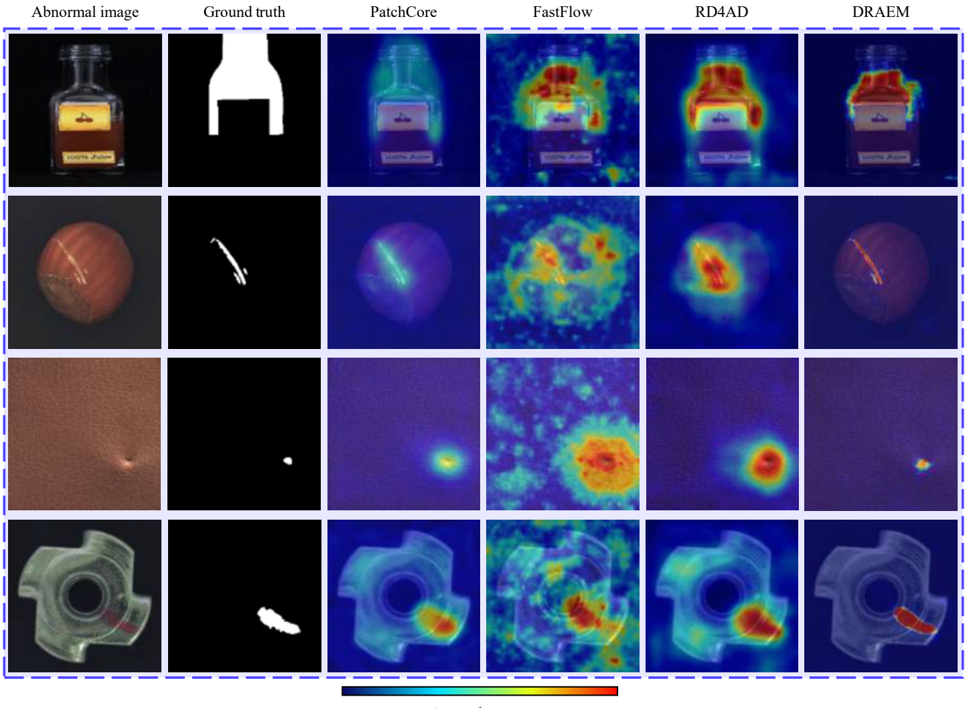
- Without ensemble learning, MemSeg achieved the SOTA result on image-level anomaly classification, attributed mainly to its U-Net framework; DRAEM also uses U-Net and outperformed other methods on pixel-level anomaly segmentation. AU-PR is more valuable than AU-ROC for segmentation tasks, and reconstruction-based methods outperform other methods on pixel AU-PR.
- The gap between few-shot IAD and vanilla IAD is narrowing; segmentation modules are beneficial for anomaly detection even when trained with artificially generated anomalies. Future directions include multi-modality IAD datasets, inference speed, industrial pretrained models, fully supervised pixel-level datasets, abnormal synthesis, lightweight models, and unifying industrial and medical IAD.
Methods
- Literature review/survey; no new primary experiments. It reviews deep learning IAD from the perspectives of neural network architectures, levels of supervision, loss functions, metrics, and datasets, and extracts a promising industrial manufacturing setting.
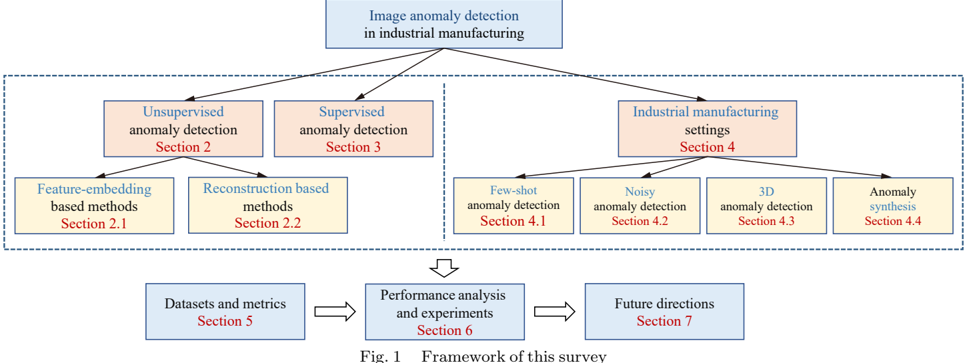
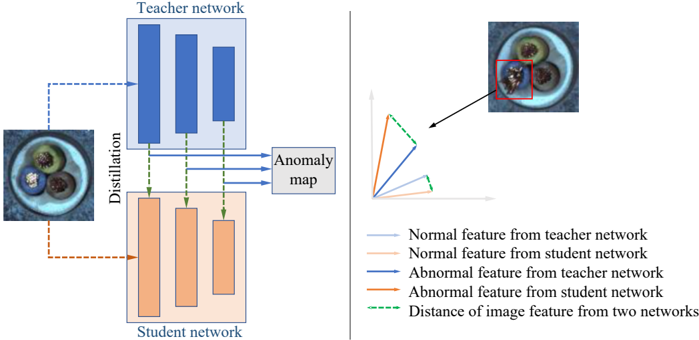
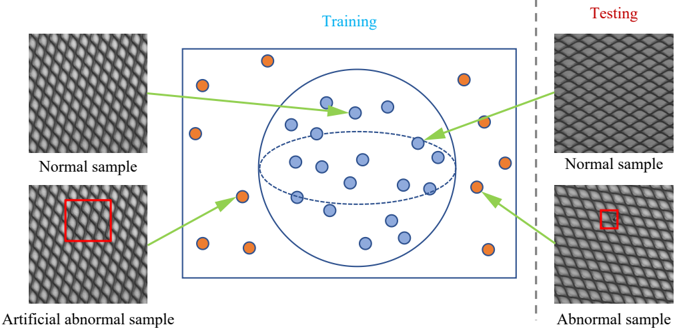
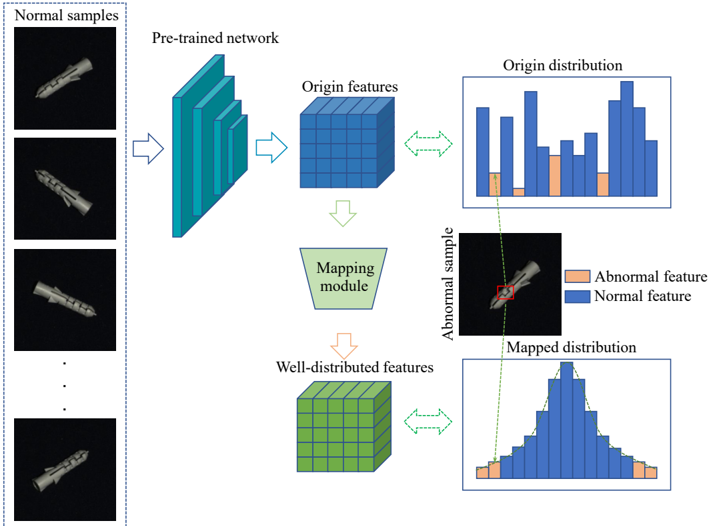
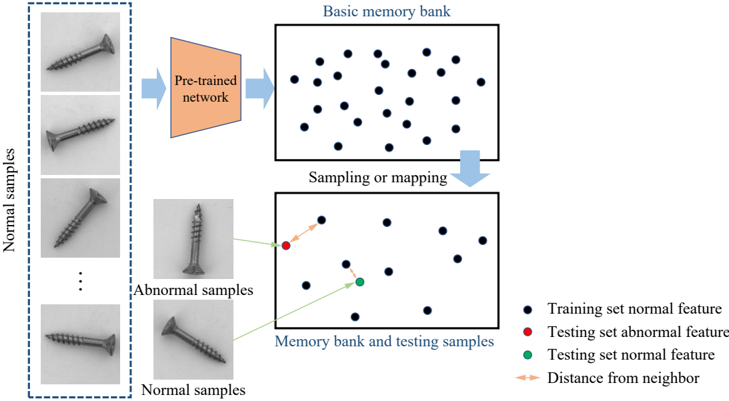
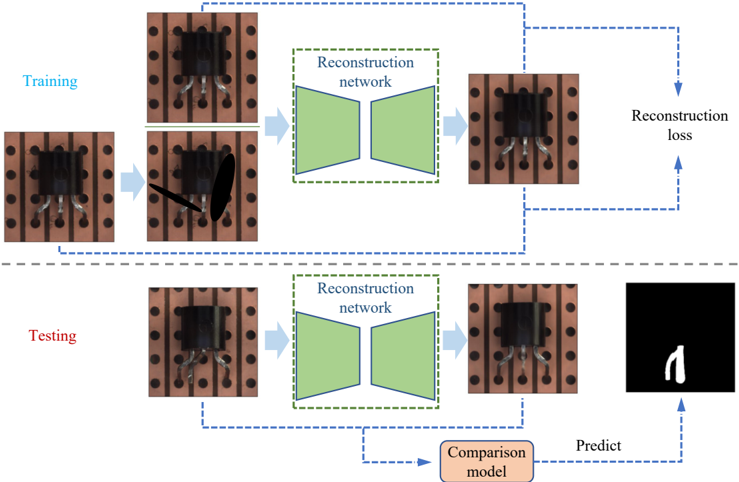
- Taxonomy: unsupervised anomaly detection is divided into feature-embedding methods (teacher-student, one-class classification, distribution map, memory bank) and reconstruction-based methods (autoencoder, GAN, transformer, diffusion); supervised anomaly detection is also reviewed. Industrial settings covered are few-shot anomaly detection, noisy anomaly detection, 3D anomaly detection, and anomaly synthesis.
- Performance analysis: statistical comparison of current IAD methods on MVTec AD using image AUROC and pixel AUROC/AUPR. Results are reported from original papers, with some reproduced by the authors and marked with *.
Limitations
- The paper states that the public cannot access real-world anomalous datasets due to privacy concerns; most open-source IAD datasets generate anomalies from anomaly-free products, so their abnormalities may not occur in actual production lines, and multiple-domain IAD datasets are lacking.
- The paper states that there is no uniform assessment for image-level and pixel-level IAD performance; most metrics shrink the anomalous mask to the feature-map size, reducing assessment precision, and the validity of common metrics for IAD remains to be explored. It also notes that most noisy anomaly detection methods have not been verified on real industrial image datasets, and most 3D IAD methods are specialized for RGB-D images while real-world 3D manufacturing data consists of point clouds.
- Evident from the text: the survey’s performance tables contain many missing entries and rely largely on reported results, with only some reproduced; no new benchmark experiments are conducted. The paper also states that current algorithms often focus on detection accuracy while ignoring storage size and efficiency.
Model-written summary. Check it against the paper before relying on it.
Integrity signals
Registry
Cites
Statistics
Figures







Verification
Claims the paper makes
18 Valid · 21 Not valid · 26 Not checked · 62 Own results and interpretations
Every source the paper cites for this claim was checked and supports it.
In the paper
“FCDD [35] is an unsupervised method that synthesizes abnormal samples for training the OCC model.”
What the sources say
- Supportedcites [35] [35] - T. Reiss, Y. Hoshen. Mean-shifted contrastive loss for anomaly detection, [Online], Available: https://arxiv.org/ abs/2106.03844, 2021. source
Section 4.2 (pp. 7–8) describes generating synthetic anomalies with confetti noise for FCDD and evaluates it in an unsupervised setting. Section 3 (p. 4) confirms that synthetic anomalies can be used for training when known anomalies are unavailable. Synthetic anomalies are an option, not a requirement of FCDD. (LLM, conf=0.87)
plainstates a cause- Asserted: passes — The authors put it forward as true.
- Checkable: passes — It can be checked against evidence.
- Load-bearing: unclear — It is unclear whether the paper’s conclusions depend on it.
- Based: passes — The paper gives a reason why it holds.
- Supported
The cited sources support only part of this claim — read each source’s verdict below.
In the paper
“PaDiM requires the batch-inverse of the multidimensional covariance tensor, which makes it challenging to scale up to larger CNNs due to the increased feature size.”
What the sources say
- Partly supportedcites [73] [73] - J. Jang, E. Hwang, S. H. Park. N-pad: Neighboring pixelbased industrial anomaly detection, [Online], Available: https://arxiv.org/abs/2210.08768, 2022. sourceExperimental — accuracy not yet measured
“Learning of the normality” (p. 3) says PaDiM estimates a covariance matrix for each patch and makes it invertible. “Ablative studies” (pp. 4–5) says larger embedding vectors increase computational and memory complexity. The copy does not say that PaDiM requires a batch-inverse operation or that this makes scaling to larger CNNs challenging; “Scalability gain” (p. 6) instead describes choosing the backbone and embedding size to fit resource limits. (LLM, conf=0.85)
plainstates a cause- Asserted: passes — The authors put it forward as true.
- Checkable: passes — It can be checked against evidence.
- Load-bearing: unclear — It is unclear whether the paper’s conclusions depend on it.
- Based: passes — The paper gives a reason why it holds.
- Partly supported
Every source the paper cites for this claim was checked and supports it.
In the paper
“Since the relative positions of the features of each image layer do not change during the convolution process, FCDD yields more interpretable results than alternative methods.”
What the sources say
- Supportedcites [35] [35] - T. Reiss, Y. Hoshen. Mean-shifted contrastive loss for anomaly detection, [Online], Available: https://arxiv.org/ abs/2106.03844, 2021. source
Section 3 (p. 3) says convolutional layers preserve the relative positions of receptive fields and that FCDD’s fully convolutional network preserves spatial information. The Introduction (p. 1) reports that FCDD’s anomaly heatmaps are less noisy and more structured than those of the baselines, while Section 4.2 (p. 8) reports better quantitative explanation performance than its competitors. (LLM, conf=0.90)
plainstates a cause- Asserted: passes — The authors put it forward as true.
- Checkable: passes — It can be checked against evidence.
- Load-bearing: unclear — It is unclear whether the paper’s conclusions depend on it.
- Based: passes — The paper gives a reason why it holds.
- Supported
Every source the paper cites for this claim was checked and supports it.
In the paper
“The performance of these methods is outstanding, but they depend on pre-trained models such as ResNet [7] VGG [8] and EfficientNet [9] .”
What the sources say
- Supportedcites [7] [7] - K. Simonyan. A. Zisserman. Very deep convolutional networks for large-scale image recognition. In Proceedings of the 3rd International Conference on Learning Representations, San Diego, USA, 2015. DOI: 10.48550/arXiv.1409. 1556. source
This is an identification citation: reference [7] marks 'ResNet', and our copy is the ResNet paper — Sec. 3.3 (Network Architectures) defines the residual nets (18/34-layer, and ResNet-50/101/152 in Table 1) and Sec. 4.1 reports their ImageNet 2012 pre-training on 1.28M images. The appendix 'A. Object Detection Baselines' further shows these ImageNet classification models being used as pre-trained initializations for downstream tasks, matching the claim's framing of ResNet as a pre-trained model. The claim's assertion about teacher-student methods is the citing authors' own, not attributed to this source. (LLM, conf=0.88)
- Supportedcites [8] [8] - M. X. Tan, Q. Le. EfficientNet: Rethinking model scaling for convolutional neural networks. In Proceedings of the 36th International conference on machine learning, Long Beach, USA, pp. 6105 -6114, 2019. source
The citation is attached to VGG as an example of a pre-trained model, not to the broader claim about teacher-student methods. In “Generalisation of Very Deep Features” (pp. 11–12), the paper identifies its method as VGG and describes using its ConvNets pre-trained on ILSVRC. (LLM, conf=0.92)
- Supportedcites [9] [9] - P. Bergmann, M. Fauser, D. Sattlegger, C. Steger. Uninformed students: Student-teacher anomaly detection with discriminative latent embeddings. In Proceedings of IEEE/CVF Conference on Computer Vision and Pattern Recognition, Seattle, USA, pp. 4182 -4191, 2020. DOI: 10. 1109/CVPR42600.2020.00424. source
Citation [9] is attached to EfficientNet as an example of a pre-trained model. Section 5.3 (p. 8) identifies the authors’ EfficientNet models and describes using ImageNet-pretrained checkpoints for transfer learning. (LLM, conf=0.90)
plainstates a cause- Asserted: passes — The authors put it forward as true.
- Checkable: passes — It can be checked against evidence.
- Load-bearing: unclear — It is unclear whether the paper’s conclusions depend on it.
- Based: passes — The paper gives a reason why it holds.
- Supported
The cited sources support only part of this claim — read each source’s verdict below.
In the paper
“Few-shot anomaly detection (FSAD) [139, 140] is still in its infancy.”
What the sources say
- Not checked — no full text of the sourcecites [139] [139] - A. M. Kamoona, A. K. Gostar, A. Bab-Hadiashar, R. Hoseinnezhad. Anomaly detection of defect using energy of point pattern features within random finite set framework, [Online], Available: https://arxiv.org/abs/2108. 12159, 2021. source
- Partly supportedcites [140] [140] - C. Q. Huang, H. Y. Guan, A. F. Jiang, Y. Zhang, M. Spratling, Y. F. Wang. Registration based few-shot anomaly detection. In Proceedings of the 17th European Conference on Computer Vision, Springer, Tel Aviv, Israel, pp. 303 -319, 2022. DOI: 10.1007/978-3-031-200533 \_ 18. sourceExperimental — accuracy not yet measured
The few-shots learning experiments (p. 9) show that this paper studies anomaly detection with limited normal samples, supporting its citation as an example of FSAD. That passage does not assess whether FSAD is still in its infancy, so the maturity claim is not supported by this source. (LLM, conf=0.82)
plain- Asserted: passes — The authors put it forward as true.
- Checkable: passes — It can be checked against evidence.
- Load-bearing: unclear — It is unclear whether the paper’s conclusions depend on it.
- Based: passes — The paper gives a reason why it holds.
46 more claims · 2 with their cited sources checked
Create a free account to see all 127 claims and to verify the 23 references still open.
- It may state two separate claims as one. 26
- Probably not a substantial claim. 64
Self-check
Percentages, sums and reported differences re-computed from the paper’s own numbers.
Each contradiction between two passages listed here was confirmed by an independent check.
Rated minor: it would not touch a result — a value no result rests on, a p-value that stays on the same side of the significance level, or a conflict that is clerical, resolved elsewhere in the paper, or outside its own findings.
In the paper
§ 2.1.4 Memory bank · p. 8
“Npad [74] allows for the possibility of marginal misalignment”
§ 2.1.4 Memory bank · p. 8
“| N-pad [71] | Mahalanobis distance, log- likelihood | ResNet | The paper allows for possible edge misalignment by estimating a nominal distribution for each pixel using the pixel ′ s neighborhood features. |”
Rated minor: it would not touch a result — a value no result rests on, a p-value that stays on the same side of the significance level, or a conflict that is clerical, resolved elsewhere in the paper, or outside its own findings.
In the paper
§ 2.1.4 Memory bank · p. 8
“The primary distinction between memory bank-based methods and OCC-based methods, is that memory-based methods, such as SVDD, require additional memory space to store image features.”
§ 2.1.2 One-class classification · p. 4
“SVDD [34] is a classic algorithm in the OCC problem”
Rated minor: it would not touch a result — a value no result rests on, a p-value that stays on the same side of the significance level, or a conflict that is clerical, resolved elsewhere in the paper, or outside its own findings.
In the paper
§ 4.3 3D anomaly detection · p. 15
“Since the release of MVTec 3D-AD [6] dataset”
§ 5 Datasets and metrics · p. 16
“| MVTec 3D-AD [174] | 10 | 2 904 | 948 | 3 852 | Segmentation mask | Real |”
Rated minor: it would not touch a result — a value no result rests on, a p-value that stays on the same side of the significance level, or a conflict that is clerical, resolved elsewhere in the paper, or outside its own findings.
In the paper
§ 2.1.2 One-class classification · p. 4
“with the exception of MemSeg [18] , the training of other methods relies on SVDD and cross-entropy loss.”
§ 2.1.2 One-class classification · p. 5
“| CPC-AD [33] | InfoNCE | - | The paper applies contrastive predictive coding (CPC) model to AD and gets an anomaly score through pixel-wise loss. |”
Citations
Cites
Deep Residual Learning for Image Recognition
He, K., Zhang, X., Ren, S., & Sun, J. (2016) · 2016 IEEE Conference on Computer Vision and Pattern Recognition (CVPR) · doi:10.1109/cvpr.2016.90 · Cited by 235,474 · cited 20×
“CFA [69] SVDD ResNet The paper improves PatchCore so that image features are distributed on a hypersphere.”
InfluentialVery Deep Convolutional Networks for Large-Scale Image Recognition
Simonyan, K., & Zisserman, A. (2014) · arXiv · doi:10.48550/arxiv.1409.1556 · Cited by 114,148 · cited 1×
“The performance of these methods is outstanding, but they depend on pre-trained models such as ResNet [7] VGG [8] and EfficientNet [ ?”
U-Net: Convolutional Networks for Biomedical Image SegmentationPreprint
Ronneberger, O., Fischer, P., & Brox, T. (2015) · International Conference on Medical Image Computing and Computer-Assisted Intervention · doi:10.48550/arxiv.1505.04597 · Cited by 105,821
U-Net: Convolutional Networks for Biomedical Image Segmentation
Ronneberger, O., Fischer, P., & Brox, T. (2015) · Lecture notes in computer science · doi:10.1007/978-3-319-24574-4_28 · Cited by 99,404 · cited 8×
“DREAM [91] L 2 , SSIM, Focal - ThepaperdesignsamethodtogenerateabnormalimagesandusesU-Net[92]todistinguishanomaliesafterreconstruction.”
InfluentialAn Image is Worth 16x16 Words: Transformers for Image Recognition at Scale
Dosovitskiy, A., Beyer, L., Kolesnikov, A., Weissenborn, D., Zhai, X., Unterthiner, T., Dehghani, M., Minderer, M., Heigold, G., Gelly, S., et al. (2020) · arXiv · doi:10.48550/arxiv.2010.11929 · Cited by 47,472
Squeeze-and-Excitation Networks
Hu, J., Shen, L., & Sun, G. (2018) · 2018 IEEE/CVF Conference on Computer Vision and Pattern Recognition · doi:10.1109/cvpr.2018.00745 · Cited by 35,667 · cited 3×
“This paper replaces the SE-layer in SSPCAB with transformer architecture.”
Swin Transformer: Hierarchical Vision Transformer using Shifted Windows
Liu, Z., Lin, Y., Cao, Y., Hu, H., Wei, Y., Zhang, Z., Lin, S., & Guo, B. (2021) · 2021 IEEE/CVF International Conference on Computer Vision (ICCV) · doi:10.1109/iccv48922.2021.00986 · Cited by 35,534 · cited 3×
“NF methods extract features from normal images from a pre-trained model, such as ResNet [59] or Swin Transformer [60], and transform the feature distribution as a Gaussian distribution during the training phase.”
CBAM: Convolutional Block Attention Module
Woo, S., Park, J., Lee, J.-Y., & Kweon, I. S. (2018) · Lecture Notes in Computer Science · doi:10.1007/978-3-030-01234-2_1 · Cited by 25,853
Grad-CAM: Visual Explanations from Deep Networks via Gradient-Based Localization
Selvaraju, R. R., Cogswell, M., Das, A., Vedantam, R., Parikh, D., & Batra, D. (2017) · 2017 IEEE International Conference on Computer Vision (ICCV) · doi:10.1109/iccv.2017.74 · Cited by 24,513
Unpaired image-to-image translation using cycle-consistent adversarial networks
Zhu, J.-Y., Park, T., Isola, P., & Efros, A. A. (2017) · 2017 IEEE International Conference on Computer Vision (ICCV) · doi:10.1109/iccv.2017.244 · Cited by 23,602
Research works printed but not linked: 4
- [11] - G. D. Wang, S. M. Han, E. R. Ding, D. Huang. Studentteacher feature pyramid matching for anomaly detection. In Proceedings of 32nd British Machine Vision Conference 2021, 2021.
- [85] - Z. Y. Li, N. Li, K. T. Jiang, Z. H. Ma, X. Wei, X. P. Hong, Y. H. Gong. Superpixel masking and inpainting for selfsupervised anomaly detection. In Proceedings of the 31st British Machine Vision Conference 2020, BMVC, 2020.
- [146] - J. Yoon, K. Sohn, C. L. Li, S. Ö . Arik, C. Y. Lee, T. Pfister. Self-supervise, refine, repeat: Improving unsupervised anomaly detection. Transactions on Machine Learning Research, to be published.
- [162] - M. Bi ń kowski, D. J. Sutherland, M. Arbel, A. Gretton. Demystifying MMD GANs. In Proceedings of the 6th International Conference on Learning Representations, Vancouver, Canada, 2018.
Cited by
Items 101–200 of 442
LR-IAD: Mask-Free Industrial Anomaly Detection with Logical Reasoning
Zeng, P., Pang, F., Wang, Z., & Yang, A. (2025) · Proceedings · doi:10.1109/icdm65498.2025.00097 · Cited by 16
“Traditional industrial anomaly detection methods have historically relied on classical image processing and statistical techniques to identify manufacturing defects [18], [19].”
Enhancing industrial anomaly detection with Mamba-inspired feature fusion
Pei, M., Zhou, X., Huang, Y., Zhang, F., Pei, M., Yang, Y., Zheng, S., & Xin, M. (2024) · Journal of Visual Communication and Image Representation · doi:10.1016/j.jvcir.2024.104368 · Cited by 10
Industrial Image Anomaly Detection via Synthetic-Anomaly Contrastive Distillation
Li, J., Li, M., Huang, S., Wang, G., & Zhao, X. (2025) · Sensors · doi:10.3390/s25123721 · Cited by 6
“Unsupervised learning has consequently emerged as a promising solution, demonstrating notable efficacy in scenarios with limited annotated data [2].”
Blind Localization and Clustering of Anomalies in Textures
Ardelean, A.-T., & Weyrich, T. (2024) · IEEE/CVF Conference on Computer Vision and Pattern Recognition Workshops (CVPRW) · doi:10.1109/cvprw63382.2024.00394 · Cited by 12
“Notably, a large number of relevant works [21, 24, 31, 39], including surveys [35, 43], use the term of unsupervised anomaly detection while referring to the second category described above.”
BackgroundZhong, J., & Liu, W. (2025) · IEEE Transactions on Instrumentation and Measurement · doi:10.1109/tim.2025.3545883 · Cited by 6
“However, it poses a great challenge in modeling due to the high complexity involved in training strategy and dataset, making it still under exploration and research [32].”
Generative adversarial local density-based unsupervised anomaly detection
Li, X., Peng, J., Li, W., Song, Z., & Du, X. (2025) · PLoS ONE · doi:10.1371/journal.pone.0315721 · Cited by 5
SplatPose+: Real-Time Image-Based Pose-Agnostic 3D Anomaly Detection
Liu, Y., Hu, Y. S., Chen, Y., & Zelek, J. (2025) · Lecture notes in computer science · doi:10.1007/978-3-031-92805-5_24 · Cited by 10
UMLLA-AD: Mamba-Driven Adaptive Feature Selection for Industrial Anomaly Detection
Fang, T., Wang, J., Ye, M., & Huang, Y. (2025) · International Conference on Multimedia Retrieval · doi:10.1145/3731715.3733458 · Cited by 4
Self-citationAn on-line global-local defect detection framework for wide cold-rolled strip steel
Jiang, P., Xu, Z.-Y., Fan, W., & Zhang, J. (2025) · Engineering applications of artificial intelligence · doi:10.1016/j.engappai.2025.111872 · Cited by 2
U-ResNet, a Novel Network Fusion Method for Image Classification and Segmentation
Li, W., Gao, Z., & Song, Y. (2025) · Italian National Conference on Sensors · doi:10.3390/s25175600 · Cited by 3
“As a core research direction of computer vision (CV), image processing underpins key applications in different fields, such as medical diagnosis [1], autonomous driving [2], industrial inspection [3], etc.”
Visual anomaly detection algorithms: Development and Frontier review
Huang, J., Quan, W., & Li, X. (2025) · Journal of Visual Communication and Image Representation · doi:10.1016/j.jvcir.2025.104585 · Cited by 7
Chen, Y., Huang, G., Liao, X., Yuan, X., Ling, B. W., Zeng, A., Pun, C., & Li, Y. (2025) · IEEE Transactions on Consumer Electronics · doi:10.1109/tce.2025.3615986 · Cited by 4
“Therefore, anomalies can be identified by the differences between the input and output data distributions [3].”
Mrčela, L., & Kostanjčar, Z. (2025) · IEEE Access · doi:10.1109/access.2025.3617799 · Cited by 4
“For example, various algorithms detect anomalies in time series [9], images [10], videos [11], graphs [12], or tabular data [13], each assuming a different data structure.”
SymmFlow: Unsupervised anomaly detection via symmetric normalizing flow
Zhang, Z., Kang, D., Ye, B.-H., & Lai, J.-H. (2025) · Computers in industry (Print) · doi:10.1016/j.compind.2025.104393 · Cited by 1
AnomalyControl: Highly-Aligned Anomalous Image Generation with Controlled Diffusion Model
Duan, Y., Xu, W., Wu, Q., Xie, G.-S., Zhao, F., & Shan, C. (2025) · ACM International Conference on Multimedia (ACM MM) · doi:10.1145/3746027.3755274 · Cited by 9
“Image anomaly detection has a wide range of applications in the industrial field [21].”
Self-citationMultimodal Industrial Anomaly Detection via Attention-Enhanced Memory-Guided Network
Liu, S., Luan, X., & Li, Y. (2025) · IEEE Transactions on Multimedia · doi:10.1109/tmm.2025.3632646 · Cited by 8
“AD is a critical aspect of industrial quality control, aiming at identifying anomalies in a product to ensure the quality and reliability of the product [8].”
Krassnig, P. J., & Gruber, D. P. (2026) · Journal of Intelligent Manufacturing · doi:10.1007/s10845-025-02778-z · Cited by 14
“Additional approaches are based on the syn-thetization of defects in both image and/or feature spaces, showing improved detection performance on image and pixel-level tasks J. Liu et al. (2024); Zavrtanik, Kristan, and Skoˇcaj (2022).”
InfluentialUnsupervised anomaly detection with a stacked transformer diffusion reconstruction framework
Du, M., Xu, H., Shang, F., Wang, Z., Hu, Y., & Xie, L. (2026) · Expert Systems with Applications · doi:10.1016/j.eswa.2026.131764 · Cited by 4
Tout, K., Samet, N., & Bouteille, P. (2023) · e-Journal of Nondestructive Testing · doi:10.58286/28510 · Cited by 5
Active Learning in Feature Extraction for Glass-in-Glass Detection
Rapcewicz, J., & Malesa, M. (2024) · Electronics · doi:10.3390/electronics13112049 · Cited by 4
Back to the Metrics: Exploration of Distance Metrics in Anomaly Detection
Lin, Y., & Li, X. (2024) · Applied Sciences · doi:10.3390/app14167016 · Cited by 7
Li, S., Chen, W., Xing, K., Wang, H., Zhang, Y., & Kang, M. (2025) · Knowledge-Based Systems · doi:10.1016/j.knosys.2025.113124 · Cited by 3
Self-citationSR-NET: a lightweight enhanced feature extraction network for fabric defect detection
Li, W., Chen, M., Zhang, L., & Tian, J. (2025) · Textile Research Journal · doi:10.1177/00405175241293349 · Cited by 3
“Liu et al. 35 proposed that by studying small sample learning, we can reduce the cost of data collection and data annotation for industrial products, and study what kind of data is most valuable for industrial image anomaly detection.”
Zhao, Q., Wang, Y., Lin, Y., Yan, S., Song, W., Wang, B., Huang, J., Chang, Y., Qi, L., & Zhang, W. (2023) · Computer Communications · doi:10.1016/j.comcom.2023.12.031 · Cited by 5
Improving Image Anomaly Localization: A Multi-branch and Skip Connection Framework
Pei, M., Liu, N., Tan, X., Zhou, X., Yang, Y., & Xia, S. (2024) · Circuits Systems and Signal Processing · doi:10.1007/s00034-024-02855-3 · Cited by 3
“This technique has important research significance and application value in the fields such as industrial defect detection [18], medical image analysis [14], and hyperspectral image processing [5, 6].”
Synthetically Generated Images for Industrial Anomaly Detection
Wagenstetter, M., Gospodnetić, P., Bosnar, L., Fulir, J., Kreul, D., Rushmeier, H., Aicher, T., Hellmich, A., & Ihlenfeldt, S. (2024) · IEEE International Conference on Emerging Technologies and Factory Automation (ETFA) · doi:10.1109/etfa61755.2024.10710816 · Cited by 5
“Current unsupervised AD models can be divided into feature embedding and reconstruction based methods [24].”
BackgroundREDAD: A Reliable Distillation for Image Anomaly Detection
Hu, W., Yu, W., Tang, Y., Xie, Y., & Zhang, W. (2025) · IEEE Transactions on Instrumentation and Measurement · doi:10.1109/tim.2025.3551571 · Cited by 4
“To address this issue, unsupervised AD (UAD) methods have emerged as a preferred solution as they minimize the need for extensive annotated data [6].”
InfluentialComparison of unsupervised image anomaly detection models for sheet metal glue lines
Chen, S., Bandaru, S., Marti, S., Bekar, E. T., & Skoogh, A. (2025) · Engineering Applications of Artificial Intelligence · doi:10.1016/j.engappai.2025.110740 · Cited by 5
Memoryless Multimodal Anomaly Detection via Student-Teacher Network and Signed Distance Learning
Sun, Z., Li, X., Li, Y., & Ma, Y. (2024) · Lecture notes in computer science · doi:10.1007/978-981-97-8858-3_31 · Cited by 3
MemADet: A Representative Memory Bank Approach for Industrial Image Anomaly Detection
Li, M., He, J., Ying, Z., Li, G., & Zhou, M. (2024) · Conference proceedings/Conference proceedings - IEEE International Conference on Systems, Man, and Cybernetics · doi:10.1109/smc54092.2024.10831766 · Cited by 3
“For the anomaly detection of industrial images, numerous methods [13], [14] exist.”
PatchCLIP: Enhencing CLIP with Pair-Images for Zero-Shot Anomaly Detection
Bai, Y., Dong, Y., Ma, H., Yu, B., Chen, Z., Ma, L., & Tian, G. (2024) · China Automation Congress (CAC) · doi:10.1109/cac63892.2024.10865319 · Cited by 3
“The main challenges of anomaly detection arise from the inherent uncertainty and variability of anomaly patterns [1], [2].”
Si, J., & Kim, S. (2025) · IEEE Access · doi:10.1109/access.2025.3551371 · Cited by 2
“Defects on texture surfaces not only affect the aesthetic value of the products but also impact their performance and safety, making effective management of these defects a significant challenge and opportunity for manufacturers [1].”
Moon, A.-S., Lee, K., & Lee, J. (2025) · IEEE Access · doi:10.1109/access.2025.3585843 · Cited by 4
“This transition from 2D to 3D anomaly detection was crucial, as it enabled the identification of defects in intricate geometries, internal structures, and surface irregularities that 2D methods could not detect [1].”
Fully Unsupervised Anomaly Detection in Industrial Images with Unknown Data Contamination
Wüest, M., & Huber, L. G. (2025) · IEEE Swiss Conference on Data Science (SDS) · doi:10.1109/sds66131.2025.00013 · Cited by 3
“As a result, most current IAD methods are trained on normal images, detecting anomalies by comparison with the learned normal representations [1]–[3].”
Task-oriented semantic communication towards industrial anomaly detection
Lin, C., Zhang, P., Wang, R., & Yang, Z. (2025) · Journal of the Franklin Institute · doi:10.1016/j.jfranklin.2025.107886 · Cited by 3
DFM: Differentiable Feature Matching for Anomaly Detection
Wu, S., Wang, Y., Liu, X., Yang, Y., Wang, R., Guo, G., Doermann, D., & Zhang, B. (2025) · IEEE Computer Society Conference on Computer Vision and Pattern Recognition/Proceedings - IEEE Computer Society Conference on Computer Vision and Pattern Recognition/Proceedings · doi:10.1109/cvpr52734.2025.01418 · Cited by 18
“In addition to unsupervised anomaly detection, several other related tasks have been proposed and widely studied, including few-shot anomaly detection and continual anomaly detection [26].”
Anomalous Samples for Few-Shot Anomaly Detection
Abdali, A., Boguslawski, B., Drumetz, L., & Gripon, V. (2025) · Procedia Computer Science · doi:10.1016/j.procs.2025.07.122 · Cited by 2
Hybrid CAE-DSVDD for unsupervised vibration-based damage detection in in situ steel truss bridge
Park, S., & Kim, S.-J. (2025) · Structural Health Monitoring · doi:10.1177/14759217251369727 · Cited by 4
Wu, W., & Pan, C. (2025) · Frontiers in Public Health · doi:10.3389/fpubh.2025.1624345 · Cited by 4
HSS-IAD: A Heterogeneous Same-Sort Industrial Anomaly Detection Dataset
Wang, Q., Gao, S., Hu, J., Yu, J., Tong, X., You, L., & Zhang, W. (2025) · IEEE International Conference on Multimedia and Expo (ICME) · doi:10.1109/icme59968.2025.11208914 · Cited by 7
“For example, an automaker manufactures several types of workpieces, such as steel plates with different carbon content, castings, and magnetic tiles, but does not produce fruits or toothbrushes [7].”
Ma, Y., Lin, S., & Wen, B. (2025) · IEEE Journal of Selected Topics in Signal Processing · doi:10.1109/jstsp.2025.3631405 · Cited by 3
“1) Anomaly Detection: Anomaly detection (AD) aims to detect the outlier or novel items, which is a hot and significant topic in industry [27].”
Ali, U., Zia, A., Rehman, A., Ramzan, U., Hassan, Z., Sattar, T., Wang, J., & Xiang, W. (2025) · International Conference on Digital Image Computing: Techniques and Applications · doi:10.1109/dicta68720.2025.11302453 · Cited by 4
“Early work in IAD established two dominant paradigms: reconstruction-based and feature-embedding-based approaches [11].”
Self-citationKairosAD: A SAM-Based Model for Industrial Anomaly Detection on Embedded Devices
Khan, U. F., Fummi, F., & Capogrosso, L. (2026) · Lecture notes in computer science · doi:10.1007/978-3-032-10185-3_4 · Cited by 8
SCAD: A self-constrained solution to automate context-guided zero-shot image anomaly detection
Wang, S., Wang, G., Liu, X., Liu, J., Liu, J., & Wang, S. (2026) · Neural Networks · doi:10.1016/j.neunet.2026.108577 · Cited by 2
Self-citationRobust Anomaly Detection in Industrial Environments via Meta-Learning
Aqeel, M., Sharifi, S., Cristani, M., & Setti, F. (2025) · IEEE International Conference on Computer Vision Workshops · doi:10.1109/iccvw69036.2025.00155 · Cited by 6
“Except for this watermark, it is identical to the accepted version; the final published version of the proceedings is available on IEEE Xplore. unaddressed, may lead to costly disruptions or hazards [16].”
Sundaravadivel, P., Isaac, R. A., Kumaran, U., & Priyanga, G. (2026) · Discover Artificial Intelligence · doi:10.1007/s44163-026-01252-w · Cited by 4
“Traditional computer vision methods—heavily dependent on handcrafted features and large labeled datasets—often fail under real-world factory conditions marked by class imbalance and unseen defect types, as noted by Liu et al. [1] and Zipfel [10].”
Zhang, Q., Zhang, Y., Wei, Z., Zhong, S., Chen, Y., & Feng, G. (2026) · IEEE Journal of Selected Topics in Applied Earth Observations and Remote Sensing · doi:10.1109/jstars.2026.3686333 · Cited by 3
“In addition, although pretrained models developed for natural images demonstrate strong performance in generic segmentation tasks [56], [57], their direct application to remote sensing imagery is hampered by domain discrepancies— such as resolution differences, variations in object scale, and…”
Yu, R., Guo, B., & Li, H. (2025) · IEEE/CVF International Conference on Computer Vision (ICCV) · doi:10.1109/iccv51701.2025.02095 · Cited by 9
“Meanwhile, despite numerous 2D anomaly detection datasets designed [38], only several datasets [6, 15, 17, 18, 22, 25, 29, 40, 48, 56, 62, 74] are suitable for industrial scenarios and only one [53] is related to integrated circuits production.”
Industrial Image Anomaly Detection Method Based on Improved MAE
He, H., Xu, Y., Zhang, C., Guo, B., Xu, Z., Jin, J., Kong, C., & Huang, J. (2023) · International Conference on Automation and Computing (ICAC) · doi:10.1109/icac57885.2023.10275293 · Cited by 3
“Although industrial image anomaly detection technology has made significant progress in the past few years, there are still some challenges and limitations[2].”
BackgroundA Brief Survey on Graph Anomaly Detection
Song, C., Niu, L., & Lei, M. (2024) · Procedia Computer Science · doi:10.1016/j.procs.2024.08.145 · Cited by 4
Alcacer, A., & Epifanio, I. (2024) · PLoS ONE · doi:10.1371/journal.pone.0311418 · Cited by 7
Low-shot Visual Anomaly Detection with Multimodal Large Language Models
Schiele, T., Kern, D., DeSilva, A., & Klauck, U. (2024) · Procedia Computer Science · doi:10.1016/j.procs.2024.09.439 · Cited by 4
Anomaly detection applied to the classification of cytology images
Marta, C. B., Doblaré, M., Heras, J., Mata, G., & Ramírez, T. (2025) · Biomedical Signal Processing and Control · doi:10.1016/j.bspc.2025.107625 · Cited by 3
Outlier Exposure in Visual Industrial Anomaly Detection - Survey
Shi, Y. H., Xu, R., & Qi, Z. (2024) · IEEE ... International Conference on Data Mining workshops · doi:10.1109/icdmw65004.2024.00008 · Cited by 5
“[2]–[5] focused on unsupervised anomaly detection algorithms, yet neither explored OE’s potential impact.”
A Case Study of Anomaly Detection in Tinplate Lids: Supervised vs Unsupervised Approaches
Velesaca, H. O., Sappa, A. D., & Holgado-Terriza, J. A. (2025) · International Conference on Automation, Robotics and Applications · doi:10.1109/icara64554.2025.10977607 · Cited by 5
“This selection is supported by its demonstrated state-of-the-art (SOTA) performance on MVTec AD datasets [24].”
Out-of-distribution detection in 3D applications: A review
Li, Z., Kang, X., West, J., & Khoshelham, K. (2026) · Neurocomputing · doi:10.1016/j.neucom.2026.134503 · Cited by 4
Melgar, P. C., Chambi, L. H., & Torres, R. S. (2025) · International Journal of Advanced Computer Science and Applications · doi:10.14569/ijacsa.2025.0160577 · Cited by 3
“In this study [10], a comprehensive review of deep learning-based anomaly detection techniques is presented, analyzing neural network architectures, supervision levels, loss functions, metrics and datasets.”
Gao, Z., Guo, J., Chen, L., Wang, K., Chen, Y., Ke, Y., & Yang, S. (2025) · Journal of the Franklin Institute · doi:10.1016/j.jfranklin.2025.107816 · Cited by 6
IPD: An Industrial Pipeline Dataset for Anomaly Detection and Localization
Papadam, D. R., Mentesidis, P., Zamioudis, A., Mygdalis, V., Psarras, D., & Pitas, I. (2025) · European Signal Processing Conference (EUSIPCO) · doi:10.23919/eusipco63237.2025.11226092 · Cited by 2
“According to a recent survey [7], current industrial AD/AL research is split in two main categories: i ) feature-embedding based methods, and ii ) reconstruction based methods.”
Arndt, T., Conzen, M., Elsen, I., Ferrein, A., Galla, O., KöSe, H., Schiffer, S., & Tschesche, M. (2023) · International Conference on PErvasive Technologies Related to Assistive Environments (PETRA) · doi:10.1145/3594806.3596558 · Cited by 4
“An overview of the most common methods can be found in [3, 9, 16].”
MethodInspecting Bridges and Critical Infrastructure: An AI and Blockchain Approach
Mancini, A., & Galdelli, A. (2024) · Communications in computer and information science · doi:10.1007/978-3-031-56776-6_12 · Cited by 2
Performance Evaluation of Anomaly Detection with a New Battery Surface Anomaly Dataset
Zhou, Y., Ying, Z., Lv, H., Li, X., You, J., Chen, Y., & Tan, K. (2024) · Lecture notes in computer science · doi:10.1007/978-981-97-8795-1_15 · Cited by 3
Dual-Path Frequency Discriminators for Few-Shot Anomaly DetectionPreprint
Bai, Y., Zhang, J., Dong, Y., Cao, Y., & Tian, G. (2024) · SSRN Electronic Journal · doi:10.2139/ssrn.4862099 · Cited by 3
Advanced Color Pseudo Anomaly to Enhance Learning of Convolutional Neural Network Models
Shah, R. A., & Kim, H. (2023) · IEEE International Conference on Consumer Electronics-Asia (ICCE-Asia) · doi:10.1109/icce-asia59966.2023.10326338 · Cited by 1
Can I Trust My Anomaly Detection System? A Case Study Based on Explainable AI
Rashid, M., Amparore, E. G., Ferrari, E., & Verda, D. (2024) · Communications in computer and information science · doi:10.1007/978-3-031-63803-9_13 · Cited by 1
“A broader recent review on AD systems is [11].”
BackgroundAll-in-one electrical atrial substrate indicators with deep anomaly detection
Bindini, L., Pagani, S., Bernardini, A., Grossi, B., Giomi, A., Frontera, A., & Frasconi, P. (2024) · Biomedical Signal Processing and Control · doi:10.1016/j.bspc.2024.106737 · Cited by 2
Machine Learning and IoT for Predicting the Productivity of MRI Equipment
de Miranda, P. B. C., Monte, L. D. A., do Nascimento, A. C. A., Basgalupp, M. P., & Coelho, J. L. (2024) · International Joint Conference on Neural Networks (IJCNN) · doi:10.1109/ijcnn60899.2024.10650835 · Cited by 1
“These anomalies can signal potential issues or failures [14].”
BackgroundMethod of Identification of Combat Vehicles Based on Yolo
Nazarkevych, M., & Oleksiv, N. (2024) · Vìsnik Nacìonalʹnogo unìversitetu Lʹvìvsʹka polìtehnìka Serìâ Ìnformacìjnì sistemi ta merežì · doi:10.23939/sisn2024.15.087 · Cited by 1
Alzabidi, E., & Fındık, O. (2024) · Communications in computer and information science · doi:10.1007/978-3-031-73420-5_5 · Cited by 1
Adaptive Continual Learning for Defect Detection in Dynamic Textile Manufacturing
Harith, S., Rajapakse, C., Mahanama, T. V., & Asanka, D. (2024) · International Conference on Advancements in Computing (ICAC) · doi:10.1109/icac64487.2024.10850925 · Cited by 2
“However, the effectiveness of these frameworks varies across different production settings, highlighting the need for more robust methodologies to ensure consistent performance [17] [24] [25].”
Point-plane better than point-point: for embedding-based USAD
Zhao, Z., Zhang, Y., Yu, Z., & Zhu, L. (2025) · International Conference on Video and Image Processing (ICVIP) · doi:10.1117/12.3059124 · Cited by 2
Shoda, K., Kasahara, J. Y. L., An, Q., & Yamashita, A. (2025) · IEEE Robotics and Automation Letters · doi:10.1109/lra.2025.3580317 · Cited by 1
“T HE safety and operational integrity of manufacturing plants and building infrastructures are critically dependent on regular inspection protocols [1], [2].”
Okazaki, S., Kaminishi, K., Wang, Y., Fujiu, T., Nakata, Y., Hamamoto, S., Yokose, K., Hara, T., Umeda, Y., & Ota, J. (2026) · Computers in Industry · doi:10.1016/j.compind.2026.104481 · Cited by 2
A Lightweight Anomaly Detection Model in Aero Turbine Borescope Using Unsupervised Deep Learning
Ha, S., Lercel, D. J., & Nanda, G. (2025) · IEEE Aerospace Conference (AERO) · doi:10.1109/aero63441.2025.11068398 · Cited by 1
“- [20], [25].”
Adapted-MoE: Mixture of Experts with Test-Time Adaption for Anomaly Detection
Lei, T., Chen, S., Wang, B., Jiang, Z., & Zou, N. (2025) · Lecture notes in computer science · doi:10.1007/978-981-96-9891-2_36 · Cited by 10
RGB-D indoor scene parsing via wavelet sub-band guided transformer
Xie, W., Liu, H., & Li, J. (2025) · Applied Soft Computing · doi:10.1016/j.asoc.2025.113675 · Cited by 2
LA-EAD: Simple and Effective Methods for Improving Logical Anomaly Detection Capability
Li, Z., Yang, Z., Zhang, L., Yang, L., & Liu, J. (2025) · Sensors · doi:10.3390/s25165016 · Cited by 3
Self-citationWeakly Supervised Defect Localization with Residual Features
Minamoto, G., Ito, S., Yamaguchi, O., & Takimoto, T. (2025) · Proceedings - International Conference on Image Processing · doi:10.1109/icip55913.2025.11084485 · Cited by 1
Kim, Y. (2026) · Engineering Applications of Artificial Intelligence · doi:10.1016/j.engappai.2026.114744 · Cited by 1
Design of Image Semantic Communication System Based on Deep Learning
Li, J., Lin, B., Han, X., Mei, X., Xiong, W., Hu, Y., & Lyv, F. (2025) · IEEE/CIC International Conference on Communications in China (ICCC) · doi:10.1109/iccc65529.2025.11148867 · Cited by 1
“Recent studies have demonstrated the effectiveness of deep autoencoders, convolutional neural network (CNN), and transformer-based architectures in learning compact and discriminative visual representations from complex datasets [8]–[10].”
BeltDiff: Diffusion-based self-labeled generation system for conveyor belt damage detection
Zhuang, P., Cai, Y., Liu, X., Zheng, X., Xiao, F., & Li, J. (2025) · Engineering Applications of Artificial Intelligence · doi:10.1016/j.engappai.2025.112287 · Cited by 2
Multimodal Industrial Anomaly Detection via Geometric Prior
Li, M., He, J., Li, G., Li, J., Wan, J., & Han, D. (2025) · IEEE Transactions on Circuits and Systems for Video Technology · doi:10.1109/tcsvt.2025.3613708 · Cited by 6
“This reduces reliance on pre-trained models but makes it di ffi cult to extract advanced semantic features [20].”
InfluentialMLG-STPM: Meta-Learning Guided STPM for Robust Industrial Anomaly Detection Under Label Noise
Huang, Y.-H., Lo, S., Chen, Z., & Wang, J.-K. (2025) · Sensors · doi:10.3390/s25196255 · Cited by 1
“Feature Embedding-based Methods: These methods map images into a feature space using pretrained or specially trained networks [3,5].”
Self-citationAPSAM: Adaptive Progressive Learning for Segment Anything Model in anomaly detection
Wang, X., Wu, S., Wu, J., & Li, J. (2025) · Image and Vision Computing · doi:10.1016/j.imavis.2025.105782 · Cited by 3
Singh, R., & Kashyap, R. L. (2025) · Elsevier eBooks · doi:10.1016/b978-0-44-333759-8.00016-2 · Cited by 2
HFMM-Net: A Hybrid Fusion Mamba Network for Efficient Multimodal Industrial Defect Detection
Zhao, G. Z., Tan, L., He, M., & Wu, Q. (2025) · Information · doi:10.3390/info16121018 · Cited by 3
Unsupervised Anomaly Detection Improves Imitation Learning for Autonomous Racing
Geng, Y., Zhou, Y. M., Zhang, Y., Zhang, Z. R., Yang, K., Ruble, T., Vidal, G., & Ruchkin, I. (2025) · IEEE/RSJ International Conference on Intelligent Robots and Systems (IROS) · doi:10.1109/iros60139.2025.11246113 · Cited by 3
“Amajor challenge in preparing IL datasets is the absence of labels that indicate the quality of a video frame, especially in autonomous driving [7].”
Bi-Grid Reconstruction for Image Anomaly Detection
Feng, A., Huang, H., Wei, G., & Sun, W. (2025) · IEEE Transactions on Image Processing · doi:10.1109/tip.2025.3644787 · Cited by 1
“I MAGE anomaly detection and localization aim to identify and precisely segment abnormal regions in images, with applications spanning industrial inspection [1], medical imaging [2], and video surveillance [3].”
APG-Net: Adaptive Prototype Guidance Network for Multi-Sensor Industrial Anomaly Detection
Liu, S., Luan, X., & Li, Y. (2026) · IEEE Transactions on Circuits and Systems for Video Technology · doi:10.1109/tcsvt.2025.3650677 · Cited by 2
“Anomaly detection is a core component that ensures product quality, improves e ffi ciency, and reduces costs [1], [2].”
Jin, L., Gao, X., Wang, J., & Yuan, S. (2026) · Scientific Reports · doi:10.1038/s41598-025-29849-8 · Cited by 4
“Particularly in complex educational scenarios requiring personalized content delivery and responsive service adjustments, such fixed patterns lacked the flexibility to adapt to sudden network changes or surges in user requests 8 .”
Self-citationEntropy-increasing linear attention for multi-class unsupervised anomaly detection
Liu, T., Gao, H., Tan, Y., Li, J., & Zhao, J. (2026) · Pattern Recognition · doi:10.1016/j.patcog.2026.113089 · Cited by 2
IA-CLIP: A Single-Source Industrial Anomaly Detection Method for Multi-Target Domain Generalization
Guo, Y., Xu, G., & Yin, J. (2026) · IEEE Transactions on Automation Science and Engineering · doi:10.1109/tase.2026.3656353 · Cited by 2
“In industrial anomaly detection (IAD), methodologies are typically classified into unsupervised (trained using a large number of normal samples), few-shot, and zero-shot paradigms, depending on the availability of labeled training data [20], [21], [22], [23], [24], [25].”
Jia, X., & Chen, X. D. (2026) · Advanced Engineering Informatics · doi:10.1016/j.aei.2026.104387 · Cited by 5
Zhang, W., Lü, K., Wang, J., Liang, H., Gao, C., & Xue, J. (2026) · IEEE Transactions on Image Processing · doi:10.1109/tip.2026.3659292 · Cited by 4
“Traditional industrial anomaly detection has predominantly relied on manual visual inspection, which su ff ers from high error rates and considerable labor costs [10].”
Self-citationBai, Y., Zhang, J., Cao, Y., Lu, G., He, Q., Li, X., & Tian, G. (2025) · IEEE International Conference on Computer Vision Workshops · doi:10.1109/iccvw69036.2025.00374 · Cited by 3
“Anomaly detection (AD) has found extensive applications in various domains [6, 29, 30, 44], where it plays a crucial role.”
Spectral-to-Spatial Distillation: Denoising Framework for Real-Time Anomalous Sound Detection
Shoda, K., Kasahara, J. Y. L., Igaue, T., Kanda, S., Asama, H., An, Q., & Yamashita, A. (2026) · IEEE/SICE International Symposium on System Integration (SII) · doi:10.1109/sii64115.2026.11404617 · Cited by 1
“While visual anomaly detection using images plays a significant role in this domain [1], anomaly detection based on acoustic signals is equally crucial, as it can non-intrusively identify internal machine failures that are not visible [2].”
Nicolae, A., & Korodi, A. (2026) · Applied Sciences · doi:10.3390/app16052457 · Cited by 2
Rizzo, A., Parmiggiani, N., Bulgarelli, A. A., Macaluso, A., Burigana, C., Burns, E., Cappelli, L., Cardone, V. F., Farsian, F., Gallego, S., et al. (2026) · Astronomy and Computing · doi:10.1016/j.ascom.2026.101090 · Cited by 4
Niyomugaba, A., & Mrozek, D. (2025) · IEEE International Conference on Big Data (BigData) · doi:10.1109/bigdata66926.2025.11402325 · Cited by 1
“In modern industrial systems, non-stationary visual data, such as industrial camera streams generated by edge-deployed sensors, is essential for uninterrupted, continual monitoring and operational efficiency in manufacturing and inspection processes [1].”
CRAD-HOPE: brain-inspired nested learning framework for few-shot anomaly detection
Cao, W., Cao, J., & Wu, W. (2026) · Journal of King Saud University - Computer and Information Sciences · doi:10.1007/s44443-026-00577-x · Cited by 2
“Recent surveys (Cao et al. 2024; Liu et al. 2024; Ruff et al. 2021) highlight that the primary goal is to identify samples deviating from normal patterns, typically trained in an unsupervised manner using only normal data due to the scarcity and diversity of anomalies.”
Metadata
- Authors
- Liu, J., Xie, G., Wang, J., Li, S., Wang, C., Zheng, F., & Jin, Y.
- Affiliations
- Southern University of Science and Technology (CN)
- University of Surrey (GB)
- Tencent (China) (CN)
- Bielefeld University (DE)
- Corresponding author
- Zheng, Feng
- Jin, Yaochu
- Venue
- Machine Intelligence Research
- Published
- 2024-01-15
- Volume
- 21
- Issue
- 1
- Pages
- 104-135
- ISSN
- 1476-8186 (ISSN-L)
- 2731-538X
- 2731-5398
- OpenAlex
- W4390875033
- Semantic Scholar
- 230c875f7563abf2e11bc79c0ae8855bfa52123c
- Cited by
- 463
- References
- 172
- Citations by year
- 2026: 193 · 2025: 178 · 2024: 81
- FWCI
- 92.07
- Type
- journal article
- Language
- en
- Open access
- hybrid
- doi.org
- Licence
- cc-by
- creativecommons.org/licenses/by/4.0 (tdm)
- creativecommons.org/licenses/by/4.0 (vor)
- Locations
- Machine Intelligence Research (publishedVersion, cc-by)
- arXiv (Cornell University) (submittedVersion, cc-by-nc-sa)
- PUB – Publications at Bielefeld University (Bielefeld University) (submittedVersion, cc-by)
- arXiv (Cornell University)
- Funders
- National Natural Science Foundation of China (62206122, 62122035)
- Bundesministerium für Bildung und Forschung
- Universität Bielefeld
- Topics
- Physical Sciences › Engineering › Industrial and Manufacturing Engineering › Industrial Vision Systems and Defect Detection
- Physical Sciences › Computer Science › Artificial Intelligence › Anomaly Detection Techniques and Applications
- Physical Sciences › Engineering › Civil and Structural Engineering › Infrastructure Maintenance and Monitoring
- Keywords
- deep learning, neural network architecture, supervised and unsupervised learning, loss functions, evaluation metrics, manufacturing industry, quality inspection
About these checks
Registry, retraction, Cites and statistics results are computed, not judged, with one exception: a printed reference that no index lists is read once by a model before it counts as a citation error. Claims are extracted by a model and kept only when their quote appears verbatim in the text; each cited source is then checked, with a model’s help, for whether it says what the claim relies on. Those verdicts can be wrong — read the claim’s quote and the cited source before relying on one.
The claim verdicts this report counts are experimental: their accuracy is not yet measured.
A language model drew the claims from the paper on 2026-10-10, under version 3 of the claim definition (model deepseek-v4.1-flash, prompt extract-v3).
A second model labelled each claim on 2026-10-10 (model jev-1.13-20260917, definition revision gold-guideline-v0.2).
Cited sources are checked with a language model’s help (gpt-6-sol and qwen3.8-omni-flash).
Statistics and arithmetic are recomputed, not judged.
Confidence bands are shown only for fields calibrated on our annotated test set. None is calibrated yet, so no band is shown.
What counts as a claim ›How we measure confidence ›How we check this ›
Are you an author, or do you see a problem with this page? Request a review
Data sources
Bibliographic data: Semantic Scholar, OpenAlex, Crossref.
Contains information from the Semantic Scholar Academic Graph Datasets, made available under the ODC Attribution License (ODC-BY 1.0).
Semantic Scholar’s data is described in: Kinney, R., et al. (2023). The Semantic Scholar Open Data Platform. arXiv:2301.10140.
