

Deep Industrial Image Anomaly Detection: A Survey
Open accessThe DOI matches its Crossref record; 198 of the 229 references it cites were found in a registry or an index, and 4 are not checked yet; 26 of the 64 sources its claims cite were checked for support.
Abstract
The recent rapid development of deep learning has laid a milestone in industrial image anomaly detection (IAD). In this paper, we provide a comprehensive review of deep learning-based image anomaly detection techniques, from the perspectives of neural network architectures, levels of supervision, loss functions, metrics and datasets. In addition, we extract the promising setting from industrial manufacturing and review the current IAD approaches under our proposed setting. Moreover, we highlight several opening challenges for image anomaly detection. The merits and downsides of representative network architectures under varying supervision are discussed. Finally, we summarize the research findings and point out future research directions.
Verified 2026-11-25 · 4 references not checked yet
Overview
CoChat Summary
TL;DR
This survey reviews deep learning-based industrial image anomaly detection (IAD) across network architectures, supervision levels, loss functions, metrics, and datasets, and proposes an industrial manufacturing setting for evaluation. It finds memory-bank methods strongest for image-level detection, reconstruction-based methods stronger for pixel-level segmentation, and highlights open challenges in datasets, metrics, efficiency, and real-line deployment.
Key findings
- The survey covers 20 IAD datasets and 6 metrics, compared with 9 datasets/3 metrics in Tao et al. and 7 datasets/1 metric in Cui et al. (Table 1); it also states that most deep learning IAD methods are more than 97% accurate.
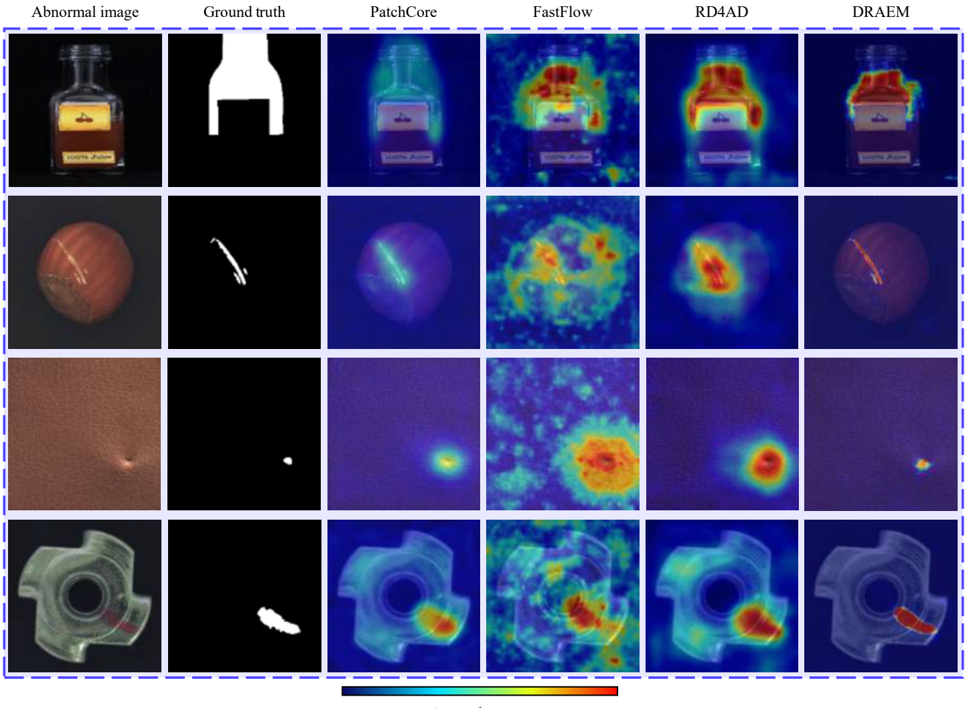
- Memory bank-based approaches are the most effective neural network design for image-level anomaly detection, but they are inadequate at pixel-level anomalies; ensemble learning can dramatically improve state-of-the-art methods, and SSPCAB can be seamlessly integrated into cutting-edge methods to significantly enhance reconstruction-based methods.
- Without ensemble learning, MemSeg achieved the SOTA result on image-level anomaly classification, attributed mainly to its U-Net framework; DRAEM also uses U-Net and outperformed other methods on pixel-level anomaly segmentation. AU-PR is more valuable than AU-ROC for segmentation tasks, and reconstruction-based methods outperform other methods on pixel AU-PR.
- The gap between few-shot IAD and vanilla IAD is narrowing; segmentation modules are beneficial for anomaly detection even when trained with artificially generated anomalies. Future directions include multi-modality IAD datasets, inference speed, industrial pretrained models, fully supervised pixel-level datasets, abnormal synthesis, lightweight models, and unifying industrial and medical IAD.
Methods
- Literature review/survey; no new primary experiments. It reviews deep learning IAD from the perspectives of neural network architectures, levels of supervision, loss functions, metrics, and datasets, and extracts a promising industrial manufacturing setting.
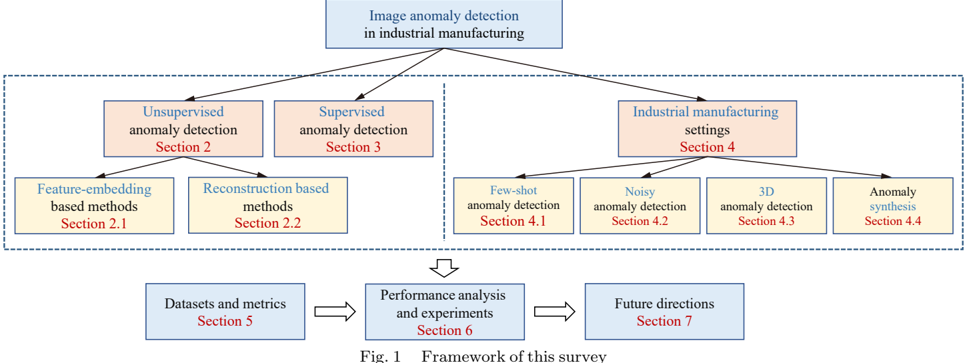
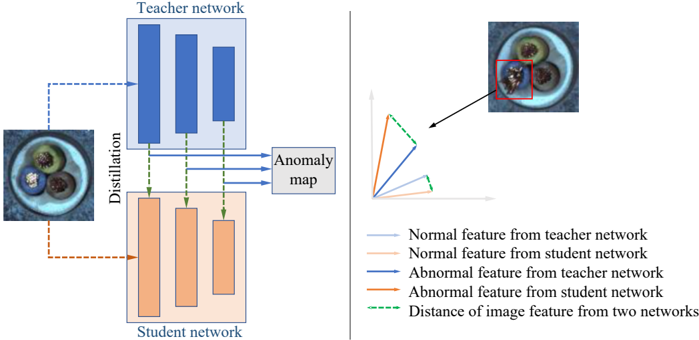
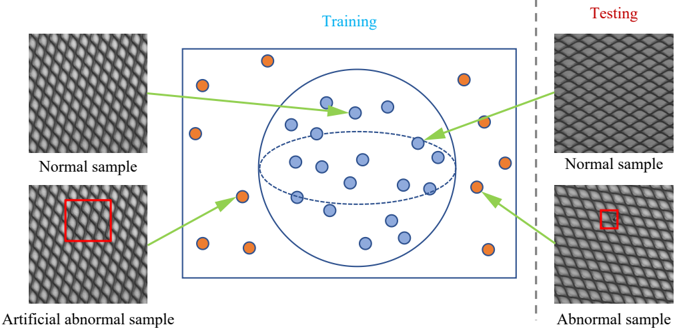
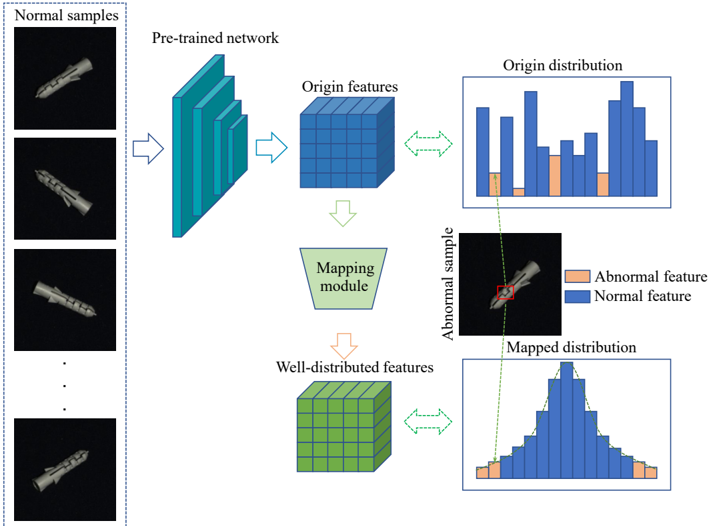
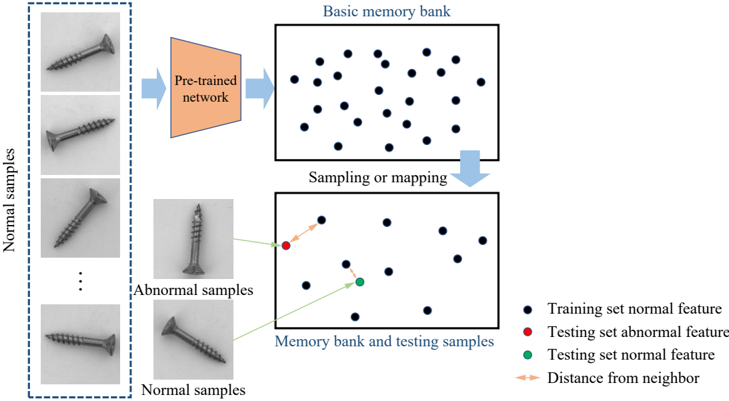
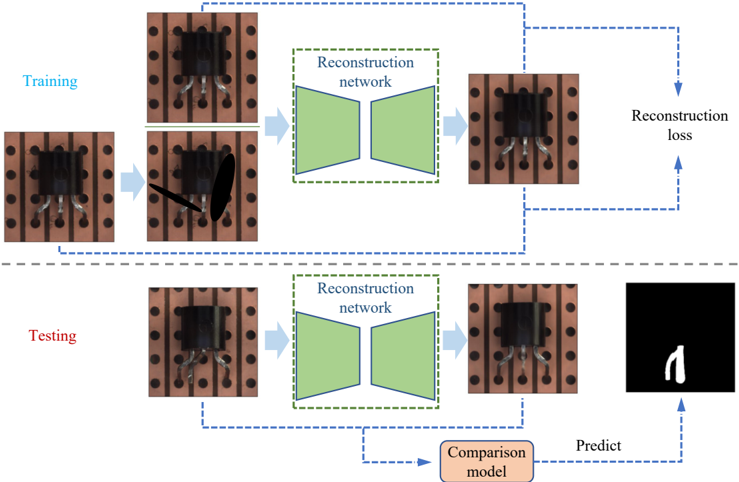
- Taxonomy: unsupervised anomaly detection is divided into feature-embedding methods (teacher-student, one-class classification, distribution map, memory bank) and reconstruction-based methods (autoencoder, GAN, transformer, diffusion); supervised anomaly detection is also reviewed. Industrial settings covered are few-shot anomaly detection, noisy anomaly detection, 3D anomaly detection, and anomaly synthesis.
- Performance analysis: statistical comparison of current IAD methods on MVTec AD using image AUROC and pixel AUROC/AUPR. Results are reported from original papers, with some reproduced by the authors and marked with *.
Limitations
- The paper states that the public cannot access real-world anomalous datasets due to privacy concerns; most open-source IAD datasets generate anomalies from anomaly-free products, so their abnormalities may not occur in actual production lines, and multiple-domain IAD datasets are lacking.
- The paper states that there is no uniform assessment for image-level and pixel-level IAD performance; most metrics shrink the anomalous mask to the feature-map size, reducing assessment precision, and the validity of common metrics for IAD remains to be explored. It also notes that most noisy anomaly detection methods have not been verified on real industrial image datasets, and most 3D IAD methods are specialized for RGB-D images while real-world 3D manufacturing data consists of point clouds.
- Evident from the text: the survey’s performance tables contain many missing entries and rely largely on reported results, with only some reproduced; no new benchmark experiments are conducted. The paper also states that current algorithms often focus on detection accuracy while ignoring storage size and efficiency.
Model-written summary. Check it against the paper before relying on it.
Integrity signals
Registry
Cites
Statistics
Figures







Verification
Claims the paper makes
18 Valid · 21 Not valid · 26 Not checked · 62 Own results and interpretations
Every source the paper cites for this claim was checked and supports it.
In the paper
“FCDD [35] is an unsupervised method that synthesizes abnormal samples for training the OCC model.”
What the sources say
- Supportedcites [35] [35] - T. Reiss, Y. Hoshen. Mean-shifted contrastive loss for anomaly detection, [Online], Available: https://arxiv.org/ abs/2106.03844, 2021. source
Section 4.2 (pp. 7–8) describes generating synthetic anomalies with confetti noise for FCDD and evaluates it in an unsupervised setting. Section 3 (p. 4) confirms that synthetic anomalies can be used for training when known anomalies are unavailable. Synthetic anomalies are an option, not a requirement of FCDD. (LLM, conf=0.87)
plainstates a cause- Asserted: passes — The authors put it forward as true.
- Checkable: passes — It can be checked against evidence.
- Load-bearing: unclear — It is unclear whether the paper’s conclusions depend on it.
- Based: passes — The paper gives a reason why it holds.
- Supported
The cited sources support only part of this claim — read each source’s verdict below.
In the paper
“PaDiM requires the batch-inverse of the multidimensional covariance tensor, which makes it challenging to scale up to larger CNNs due to the increased feature size.”
What the sources say
- Partly supportedcites [73] [73] - J. Jang, E. Hwang, S. H. Park. N-pad: Neighboring pixelbased industrial anomaly detection, [Online], Available: https://arxiv.org/abs/2210.08768, 2022. sourceExperimental — accuracy not yet measured
“Learning of the normality” (p. 3) says PaDiM estimates a covariance matrix for each patch and makes it invertible. “Ablative studies” (pp. 4–5) says larger embedding vectors increase computational and memory complexity. The copy does not say that PaDiM requires a batch-inverse operation or that this makes scaling to larger CNNs challenging; “Scalability gain” (p. 6) instead describes choosing the backbone and embedding size to fit resource limits. (LLM, conf=0.85)
plainstates a cause- Asserted: passes — The authors put it forward as true.
- Checkable: passes — It can be checked against evidence.
- Load-bearing: unclear — It is unclear whether the paper’s conclusions depend on it.
- Based: passes — The paper gives a reason why it holds.
- Partly supported
Every source the paper cites for this claim was checked and supports it.
In the paper
“Since the relative positions of the features of each image layer do not change during the convolution process, FCDD yields more interpretable results than alternative methods.”
What the sources say
- Supportedcites [35] [35] - T. Reiss, Y. Hoshen. Mean-shifted contrastive loss for anomaly detection, [Online], Available: https://arxiv.org/ abs/2106.03844, 2021. source
Section 3 (p. 3) says convolutional layers preserve the relative positions of receptive fields and that FCDD’s fully convolutional network preserves spatial information. The Introduction (p. 1) reports that FCDD’s anomaly heatmaps are less noisy and more structured than those of the baselines, while Section 4.2 (p. 8) reports better quantitative explanation performance than its competitors. (LLM, conf=0.90)
plainstates a cause- Asserted: passes — The authors put it forward as true.
- Checkable: passes — It can be checked against evidence.
- Load-bearing: unclear — It is unclear whether the paper’s conclusions depend on it.
- Based: passes — The paper gives a reason why it holds.
- Supported
Every source the paper cites for this claim was checked and supports it.
In the paper
“The performance of these methods is outstanding, but they depend on pre-trained models such as ResNet [7] VGG [8] and EfficientNet [9] .”
What the sources say
- Supportedcites [7] [7] - K. Simonyan. A. Zisserman. Very deep convolutional networks for large-scale image recognition. In Proceedings of the 3rd International Conference on Learning Representations, San Diego, USA, 2015. DOI: 10.48550/arXiv.1409. 1556. source
This is an identification citation: reference [7] marks 'ResNet', and our copy is the ResNet paper — Sec. 3.3 (Network Architectures) defines the residual nets (18/34-layer, and ResNet-50/101/152 in Table 1) and Sec. 4.1 reports their ImageNet 2012 pre-training on 1.28M images. The appendix 'A. Object Detection Baselines' further shows these ImageNet classification models being used as pre-trained initializations for downstream tasks, matching the claim's framing of ResNet as a pre-trained model. The claim's assertion about teacher-student methods is the citing authors' own, not attributed to this source. (LLM, conf=0.88)
- Supportedcites [8] [8] - M. X. Tan, Q. Le. EfficientNet: Rethinking model scaling for convolutional neural networks. In Proceedings of the 36th International conference on machine learning, Long Beach, USA, pp. 6105 -6114, 2019. source
The citation is attached to VGG as an example of a pre-trained model, not to the broader claim about teacher-student methods. In “Generalisation of Very Deep Features” (pp. 11–12), the paper identifies its method as VGG and describes using its ConvNets pre-trained on ILSVRC. (LLM, conf=0.92)
- Supportedcites [9] [9] - P. Bergmann, M. Fauser, D. Sattlegger, C. Steger. Uninformed students: Student-teacher anomaly detection with discriminative latent embeddings. In Proceedings of IEEE/CVF Conference on Computer Vision and Pattern Recognition, Seattle, USA, pp. 4182 -4191, 2020. DOI: 10. 1109/CVPR42600.2020.00424. source
Citation [9] is attached to EfficientNet as an example of a pre-trained model. Section 5.3 (p. 8) identifies the authors’ EfficientNet models and describes using ImageNet-pretrained checkpoints for transfer learning. (LLM, conf=0.90)
plainstates a cause- Asserted: passes — The authors put it forward as true.
- Checkable: passes — It can be checked against evidence.
- Load-bearing: unclear — It is unclear whether the paper’s conclusions depend on it.
- Based: passes — The paper gives a reason why it holds.
- Supported
The cited sources support only part of this claim — read each source’s verdict below.
In the paper
“Few-shot anomaly detection (FSAD) [139, 140] is still in its infancy.”
What the sources say
- Not checked — no full text of the sourcecites [139] [139] - A. M. Kamoona, A. K. Gostar, A. Bab-Hadiashar, R. Hoseinnezhad. Anomaly detection of defect using energy of point pattern features within random finite set framework, [Online], Available: https://arxiv.org/abs/2108. 12159, 2021. source
- Partly supportedcites [140] [140] - C. Q. Huang, H. Y. Guan, A. F. Jiang, Y. Zhang, M. Spratling, Y. F. Wang. Registration based few-shot anomaly detection. In Proceedings of the 17th European Conference on Computer Vision, Springer, Tel Aviv, Israel, pp. 303 -319, 2022. DOI: 10.1007/978-3-031-200533 \_ 18. sourceExperimental — accuracy not yet measured
The few-shots learning experiments (p. 9) show that this paper studies anomaly detection with limited normal samples, supporting its citation as an example of FSAD. That passage does not assess whether FSAD is still in its infancy, so the maturity claim is not supported by this source. (LLM, conf=0.82)
plain- Asserted: passes — The authors put it forward as true.
- Checkable: passes — It can be checked against evidence.
- Load-bearing: unclear — It is unclear whether the paper’s conclusions depend on it.
- Based: passes — The paper gives a reason why it holds.
46 more claims · 2 with their cited sources checked
Create a free account to see all 127 claims and to verify the 23 references still open.
- It may state two separate claims as one. 26
- Probably not a substantial claim. 64
Self-check
Percentages, sums and reported differences re-computed from the paper’s own numbers.
Each contradiction between two passages listed here was confirmed by an independent check.
Rated minor: it would not touch a result — a value no result rests on, a p-value that stays on the same side of the significance level, or a conflict that is clerical, resolved elsewhere in the paper, or outside its own findings.
In the paper
§ 2.1.4 Memory bank · p. 8
“Npad [74] allows for the possibility of marginal misalignment”
§ 2.1.4 Memory bank · p. 8
“| N-pad [71] | Mahalanobis distance, log- likelihood | ResNet | The paper allows for possible edge misalignment by estimating a nominal distribution for each pixel using the pixel ′ s neighborhood features. |”
Rated minor: it would not touch a result — a value no result rests on, a p-value that stays on the same side of the significance level, or a conflict that is clerical, resolved elsewhere in the paper, or outside its own findings.
In the paper
§ 2.1.4 Memory bank · p. 8
“The primary distinction between memory bank-based methods and OCC-based methods, is that memory-based methods, such as SVDD, require additional memory space to store image features.”
§ 2.1.2 One-class classification · p. 4
“SVDD [34] is a classic algorithm in the OCC problem”
Rated minor: it would not touch a result — a value no result rests on, a p-value that stays on the same side of the significance level, or a conflict that is clerical, resolved elsewhere in the paper, or outside its own findings.
In the paper
§ 4.3 3D anomaly detection · p. 15
“Since the release of MVTec 3D-AD [6] dataset”
§ 5 Datasets and metrics · p. 16
“| MVTec 3D-AD [174] | 10 | 2 904 | 948 | 3 852 | Segmentation mask | Real |”
Rated minor: it would not touch a result — a value no result rests on, a p-value that stays on the same side of the significance level, or a conflict that is clerical, resolved elsewhere in the paper, or outside its own findings.
In the paper
§ 2.1.2 One-class classification · p. 4
“with the exception of MemSeg [18] , the training of other methods relies on SVDD and cross-entropy loss.”
§ 2.1.2 One-class classification · p. 5
“| CPC-AD [33] | InfoNCE | - | The paper applies contrastive predictive coding (CPC) model to AD and gets an anomaly score through pixel-wise loss. |”
Citations
Cites
Deep Residual Learning for Image Recognition
He, K., Zhang, X., Ren, S., & Sun, J. (2016) · 2016 IEEE Conference on Computer Vision and Pattern Recognition (CVPR) · doi:10.1109/cvpr.2016.90 · Cited by 235,474 · cited 20×
“CFA [69] SVDD ResNet The paper improves PatchCore so that image features are distributed on a hypersphere.”
InfluentialVery Deep Convolutional Networks for Large-Scale Image Recognition
Simonyan, K., & Zisserman, A. (2014) · arXiv · doi:10.48550/arxiv.1409.1556 · Cited by 114,148 · cited 1×
“The performance of these methods is outstanding, but they depend on pre-trained models such as ResNet [7] VGG [8] and EfficientNet [ ?”
U-Net: Convolutional Networks for Biomedical Image SegmentationPreprint
Ronneberger, O., Fischer, P., & Brox, T. (2015) · International Conference on Medical Image Computing and Computer-Assisted Intervention · doi:10.48550/arxiv.1505.04597 · Cited by 105,821
U-Net: Convolutional Networks for Biomedical Image Segmentation
Ronneberger, O., Fischer, P., & Brox, T. (2015) · Lecture notes in computer science · doi:10.1007/978-3-319-24574-4_28 · Cited by 99,404 · cited 8×
“DREAM [91] L 2 , SSIM, Focal - ThepaperdesignsamethodtogenerateabnormalimagesandusesU-Net[92]todistinguishanomaliesafterreconstruction.”
InfluentialAn Image is Worth 16x16 Words: Transformers for Image Recognition at Scale
Dosovitskiy, A., Beyer, L., Kolesnikov, A., Weissenborn, D., Zhai, X., Unterthiner, T., Dehghani, M., Minderer, M., Heigold, G., Gelly, S., et al. (2020) · arXiv · doi:10.48550/arxiv.2010.11929 · Cited by 47,472
Squeeze-and-Excitation Networks
Hu, J., Shen, L., & Sun, G. (2018) · 2018 IEEE/CVF Conference on Computer Vision and Pattern Recognition · doi:10.1109/cvpr.2018.00745 · Cited by 35,667 · cited 3×
“This paper replaces the SE-layer in SSPCAB with transformer architecture.”
Swin Transformer: Hierarchical Vision Transformer using Shifted Windows
Liu, Z., Lin, Y., Cao, Y., Hu, H., Wei, Y., Zhang, Z., Lin, S., & Guo, B. (2021) · 2021 IEEE/CVF International Conference on Computer Vision (ICCV) · doi:10.1109/iccv48922.2021.00986 · Cited by 35,534 · cited 3×
“NF methods extract features from normal images from a pre-trained model, such as ResNet [59] or Swin Transformer [60], and transform the feature distribution as a Gaussian distribution during the training phase.”
CBAM: Convolutional Block Attention Module
Woo, S., Park, J., Lee, J.-Y., & Kweon, I. S. (2018) · Lecture Notes in Computer Science · doi:10.1007/978-3-030-01234-2_1 · Cited by 25,853
Grad-CAM: Visual Explanations from Deep Networks via Gradient-Based Localization
Selvaraju, R. R., Cogswell, M., Das, A., Vedantam, R., Parikh, D., & Batra, D. (2017) · 2017 IEEE International Conference on Computer Vision (ICCV) · doi:10.1109/iccv.2017.74 · Cited by 24,513
Unpaired image-to-image translation using cycle-consistent adversarial networks
Zhu, J.-Y., Park, T., Isola, P., & Efros, A. A. (2017) · 2017 IEEE International Conference on Computer Vision (ICCV) · doi:10.1109/iccv.2017.244 · Cited by 23,602
Research works printed but not linked: 4
- [11] - G. D. Wang, S. M. Han, E. R. Ding, D. Huang. Studentteacher feature pyramid matching for anomaly detection. In Proceedings of 32nd British Machine Vision Conference 2021, 2021.
- [85] - Z. Y. Li, N. Li, K. T. Jiang, Z. H. Ma, X. Wei, X. P. Hong, Y. H. Gong. Superpixel masking and inpainting for selfsupervised anomaly detection. In Proceedings of the 31st British Machine Vision Conference 2020, BMVC, 2020.
- [146] - J. Yoon, K. Sohn, C. L. Li, S. Ö . Arik, C. Y. Lee, T. Pfister. Self-supervise, refine, repeat: Improving unsupervised anomaly detection. Transactions on Machine Learning Research, to be published.
- [162] - M. Bi ń kowski, D. J. Sutherland, M. Arbel, A. Gretton. Demystifying MMD GANs. In Proceedings of the 6th International Conference on Learning Representations, Vancouver, Canada, 2018.
Cited by
Items 301–400 of 442
MGAN: Multi-Granularity Attention Network for Unsupervised Defect Detection
Cai, X., & Yuan, Z. (2025) · IEEE International Conference on Frontiers Technology of Information and Computer (ICFTIC) · doi:10.1109/icftic68075.2025.11325045
“With the growing adoption of vision-based automatic inspection, data-driven approaches have become mainstream in quality control [1].”
A Training-Free Anomaly Detection Framework for Photovoltaic Panels Using DINO-Based Memory Banks
Lin, C. E., Lv, H., Zhang, Y., & Gong, Y. (2025) · International Conference on Intelligent Power and Systems (ICIPS) · doi:10.1109/icips67876.2025.11331993
“These models have shown exceptional promise in industrial image anomaly detection by providing features that are robust and transferable with minimal or no fine-tuning [8], [15], [29].”
PIM-AD: A PIM Architecture for CNN-Based Anomaly Detection
Lin, F., Ma, D., Xiong, Z., Tang, C., & Zhao, Z. (2025) · International Conference on Machine Learning and Computer Application (ICMLCA) · doi:10.1109/icmlca66850.2025.11336794
“The anomaly detection finds abnormal points from massive data to find potential risks, improving the safety and reliability of the system [1-2].”
Anomaly Detection of TP4056 Charging Module Based on Improved SimpleNet
Chen, S., Fan, R., & Li, X. (2025) · Journal of big data and computing. · doi:10.62517/jbdc.202501418
Niaz, A., Umraiz, M., Zaidi, S. F. A., Akram, F., & Choi, K. N. (2026) · Neural Computing and Applications · doi:10.1007/s00521-025-11775-5
A Deep-Supervised Knowledge Distillation Method for Industrial Anomaly Detection
He, Y., Sun, L., Li, Y., Liu, G., & Zhang, J. (2025) · International Conference on Signal Processing Systems (ICSPS) · doi:10.1109/icsps66615.2025.11347646
“In recent years, with the widespread success of deep learning models—particularly convolutional neural networks (CNNs)— across various computer vision (CV) tasks, a growing number of deep learning-based anomaly detection methods [1], [2] have been widely applied in diverse industrial scenarios.”
CLIP-Core: A Few-Sample Anomaly Detection Method for Surface Defects
Liang, X., Rao, J., & Lin, S. (2026) · IEEE Access · doi:10.1109/access.2026.3660103
“However, in real-world production environments, collecting new anomaly samples is often challenging, and the cost of annotation is prohibitively high [1].”
Wang, T., Li, Y., Ding, Y., et al. (2026) · Computational Materials Science · doi:10.1016/j.commatsci.2026.114585
Velesaca, H. O., Sappa, A. D., & Holgado-Terriza, J. A. (2026) · Communications in computer and information science · doi:10.1007/978-3-032-17915-9_2
Onorato, G., Tarantelli, K., Guida, A., et al. (2026) · SSRN Electronic Journal · doi:10.2139/ssrn.6301415
Anomaly detection via reconstructing representations from masked compact embedding
Zhuang, J., Tang, X., Ye, J., Cui, X., Li, Y., & Feng, P. (2026) · Computer Vision and Image Understanding · doi:10.1016/j.cviu.2026.104711
Liu, Y., Liu, D., Wang, Q., et al. (2026) · SSRN Electronic Journal · doi:10.2139/ssrn.6350437
Song, J., & Kim, H. S. (2026) · Mathematics · doi:10.3390/math14050868
Siddiqui, M. A., Kalra, M., & Krishna, C. R. (2026) · Concurrency and Computation Practice and Experience · doi:10.1002/cpe.70605
Xiong, Z., & Li, Y. (2026) · Journal of Engineering and Applied Science · doi:10.1186/s44147-026-00950-7
Dynamic multi-scale feature distillation with global–local decoupling for fabric anomaly detection
Zhang, Z., Qiu, C., Wang, X., Da, F., & Gai, S. (2026) · Measurement · doi:10.1016/j.measurement.2026.121132 · Cited by 1
Bae, J., Shin, J. H., & Lee, S. J. (2026) · SSRN Electronic Journal · doi:10.2139/ssrn.6408213
PAPL: Particle-based adaptive prompt learning for zero-shot industrial anomaly detection
Ma, R., Li, C., Chen, J., Feng, Y., & Xie, J. (2026) · Pattern Recognition · doi:10.1016/j.patcog.2026.113489
A Complete Framework for Automatic Condition Evaluation of Trains' External Surface
Nicodème, C., You, B., & Sovanleng, L. Y. (2025) · IEEE International Conference on Intelligent Transportation Systems (ITSC) · doi:10.1109/itsc60802.2025.11423729
“Since abnormal data are typically scarce in practice, most anomaly detection (AD) methods adopt an unsupervised learning approach [10].”
Transferring Vision-Language Models for Zero-Shot Anomaly Detection via Adaptive Feature Fusion
Quan, C., Shi, C., Qin, L., & Wu, G. (2025) · International Symposium on Artificial Intelligence and Big Data (AIBDF) · doi:10.1109/aibdf67964.2025.11440857
“This limitation is particularly challenging in real-world scenarios, as collecting comprehensive labeled datasets for anomaly detection (AD) is typically infeasible in practical settings [3].”
InfluentialAn aerial color image anomaly dataset for search missions in complex forested terrain
Nathan, R. J. A. A., Geßner, M., Özkan, N., Bock, M., Youssef, M., Mews, M., Piltz, B., Berger, R., & Bimber, O. (2026) · Scientific Data · doi:10.1038/s41597-026-07101-w
“Advances in deep learning [49, 50, 51, 52, 53] and model-based frameworks [1, 54, 55, 56, 57] have significantly improved the robustness, generalization, and real-time applicability of anomaly detection systems.”
Hierarchical Interaction Distillation for Industrial Anomaly Detection from Cross-Type Perspective
Liao, X., Huang, G., Chen, Y., & Chen, X. (2025) · IEEE International Conference on Computer and Communications (ICCC) · doi:10.1109/iccc68654.2025.11438131
“Industrial anomaly detection is widely used to identify product defects in manufacturing [1].”
Prabhu, S. M., & Karim, R. (2026) · Lecture notes in mechanical engineering · doi:10.1007/978-3-032-03725-1_37
Park, J., Lee, J.-H., Kim, N., Park, C., Hwang, J., Ra, S., & Gwak, J. (2026) · The Journal of Korean Institute of Information Technology · doi:10.14801/jkiit.2026.24.3.45
Design and Implementation of a Parts Defect System Based on the Spring Boot Framework
Du, X., & He, X. (2026) · International Conference on Neural Networks, Information and Communication Engineering (NNICE) · doi:10.1109/nnice68970.2026.11465292
“Traditional manual inspection faces issues such as low efficiency, high subjectivity, high rates of misjudgment and omission, and heavy labor intensity, making it difficult to meet the high-efficiency demands of modern production lines [1] .”
Few-shot learning : data selection, performance prediction and applications
Abdali, A. (2025) · theses.fr (ABES) · doi:10.70675/60836175zf57az4146z8674z787e90df0598 · Cited by 1
Yawale, N. M., Khalsa, N. N., Akarte, S. P., & Chaudhari, A. A. (2026) · Multimedia Tools and Applications · doi:10.1007/s11042-026-21530-0
Jia, X., & Chen, X. D. (2026) · IEEE Transactions on Industrial Informatics · doi:10.1109/tii.2026.3678824
Adaptive Multimodal Large Model for Automated Surface Defect Detection in Industrial Parts
Xi, W., & Li, J. (2025) · International Conference on Signal Processing and Intelligent Computing (SPIC) · doi:10.1109/spic68204.2025.11470914
Probabilistic unsupervised surface defect detection in high-mix bearing manufacturing
Hopkins, A., & Gao, R. X. (2026) · Journal of Manufacturing Processes · doi:10.1016/j.jmapro.2026.04.025
Scale-aware modulation network for unsupervised medical anomaly detection
Cao, H., Sun, S., & Yan, H. (2026) · Neurocomputing · doi:10.1016/j.neucom.2026.133672 · Cited by 2
ComNet: A Complementary Prototypes-Guided Reconstruction Framework for Multi-Class Anomaly Detection
Wang, X., Huang, X., Yan, F., Guo, H., Zeng, Z., & Lu, J. (2026) · IEEE International Conference on Acoustics Speech and Signal Processing · doi:10.1109/icassp55912.2026.11464285
Unsupervised Anomaly Detection in Industry: Progress, Trends, and Future AvenuesPreprint
Wang, X., Chen, B., Niu, T., Wan, Z., Li, K., & Zhang, H. (2026) · SSRN Electronic Journal · doi:10.2139/ssrn.6661514
García, B. B., Aguilera-Martos, I., Rodríguez-Barroso, N., Herrera, F., & Luengo, J. (2026) · Neurocomputing · doi:10.1016/j.neucom.2026.133775
RoCA: Robust Contrastive Adaptation for unsupervised anomaly detection
Tan, X., Chen, C., Gao, H., Yu, Y., & Liang, R. (2026) · Pattern Recognition · doi:10.1016/j.patcog.2026.113843 · Cited by 3
Slot-Consistent Scene Graphs for Unsupervised Anomaly Detection in Grid-Structured Industrial Images
Wei, X. (2026) · International Conference on Electronics Technology and Artificial Intelligence (ETAI) · doi:10.1109/etai68332.2026.11485187
Enhancing Reverse Distillation with Core Exemplar Learning for Unified Multi-Class Anomaly Detection
Lim, H., Kim, M. U., Lee, H. J., Kang, S., Chon, K.-W., & Lee, H. (2026) · IEEE Winter Conference on Applications of Computer Vision · doi:10.1109/wacv61042.2026.00732
“Anomaly detection is crucial in various fields, including industrial inspection, medical imaging, autonomous driving, and security surveillance [1, 18, 32, 35].”
Wittmann, A. M., Seeböck, P., Heger, K. A., Egger, D., Langs, G., & Waldstein, S. M. (2026) · Journal of Ophthalmology · doi:10.1155/joph/9792133
“Few-shot anomaly detection ofers a potential solution by enabling rapid model adaptation to new scenarios with minimal data from the target domain [84].”
InfluentialHuman knowledge integrated multi-modal learning for single source domain generalization
Banerjee, A., Thakur, K., & Gupta, S. (2026) · IEEE Winter Conference on Applications of Computer Vision · doi:10.1109/wacv61042.2026.00235 · Cited by 1
“2) for causal cover evaluation and a novel VLM based technique for generalized image classification with DR as the example.”
Enhancing Industrial AI Usability Through Human-AI Interaction
Hammarström, M., Gahm, L. B., Ahmed, M. U., Barua, S., Begüm, WEITEN, E., & Aurel, D. (2025) · International Conference on Computer and Information Technology (ICCIT) · doi:10.1109/iccit68739.2025.11490217
“In parallel, Industry 4.0 has spurred the integration of AI into industrial processes, where predictive maintenance and anomaly detection have become key application areas [4]–[6].”
InfluentialWang, H., Li, N., Ni, Z., Yi, J., Zhu, T., Liu, Y., & Yan, Y. (2026) · Nondestructive Testing And Evaluation · doi:10.1080/10589759.2026.2669839
Point-Supervised Segment Anything Model for Salient Welding Seam Defect Detection
Li, W., Li, S., Su, Q., Liang, L., Guo, P., & Wu, T. (2026) · IEEE Transactions on Industrial Informatics · doi:10.1109/tii.2026.3691456
“…characterization [4], [5], they face two fundamental challenges: the scarcity of comprehensive defect datasets from real-world production environments, where normal samples typically exceed 95% [6], and the prohibitive cost of obtaining pixel-level annotations required for supervised training.”
Self-citationFrom comparison to discrimination: A one-step framework for 3D anomaly detection and localization
Lv, X., Cao, M., Xie, Q., & Peng, S. (2026) · Image and Vision Computing · doi:10.1016/j.imavis.2026.106032
Digital twin architecture for data-guided intelligent production platforms
Liang, J. S. (2026) · Advances in Mechanical Engineering · doi:10.1177/16878132261450793
“…defect discovery falls under the classification of anomaly discovery activity, with numerous algorithms already available in the past researches 59,60 ; (2) discovery of process—another source of information for recognizing workshop status is the process, which helps to comprehend several…”
Zhu, J., Fan, Y., Han, G., Shi, X., Deng, F., & Chen, J. (2026) · Artificial Intelligence Review · doi:10.1007/s10462-026-11591-w · Cited by 1
Maximizing the performance of reverse distillation in anomaly detection
Ge, C., Yu, H., Chen, J., Shum, P. P., Mo, J., Chen, N., & Yu, X. (2026) · Neurocomputing · doi:10.1016/j.neucom.2026.134142 · Cited by 2
Real Time Anomaly Detection in Industrial Manufacturing
Kokkari, R., Melmatti, M., Kapale, S., Chougula, S., Muchandi, A., & Patil, A. (2026) · International Conference on Communications and Signal Processing (ICCSP) · doi:10.1109/iccsp68173.2026.11539686
Zhan, X., Yao, R., Qi, Y., et al. (2026) · Measurement · doi:10.1016/j.measurement.2026.122146
A Method for Anomaly Detection of Train Components Based on Feature Reconstruction
Yang, Z., Xiaorong, G., Luo, L., & Jianqiang, G. (2025) · IEEE Far East NDT New Technology & Application Forum (FENDT) · doi:10.1109/fendt66689.2025.11547363
“This methodology overcomes the limitations of traditional detection approaches that rely solely on feature dissimilarity comparisons, instead employing generative modeling to deeply explore the latent distribution patterns of normal samples[1].”
Differentiating malignancy from liver parenchyma in Ex-Vivo OCT images using anomaly detection
Krispel, U., Pamler, A., Girmen, C., König, N., Schmitt, R., Eggeling, E., Büsker, S., Beetz, O., Oldhafer, F., Truhn, D., et al. (2026) · Scientific Reports · doi:10.1038/s41598-026-54850-0
“Semi-supervised learning has also been applied in image-based anomaly detection tasks 32 , where models are trained on “good” examples and used to detect anomalies.”
LaRHP: latent-aware reconstruction via hypersphere projection for industrial image anomaly detection
Raouf, S. M., & Amirmazlaghani, M. (2026) · Scientific Reports · doi:10.1038/s41598-026-54714-7
Task-aware text prompt fusion with contrastive learning for zero-shot anomaly detection
Lu, M., Xu, K., Fan, L., & Chai, Y. (2026) · Expert Systems with Applications · doi:10.1016/j.eswa.2026.133303
Wang, B., Hao, F., Bai, J., Hao, H., Dong, X., Ma, D., & Kong, H. (2026) · International Conference on Multimedia Retrieval · doi:10.1145/3805622.3810734
SaF-AD: Saliency-Adaptive and Feature-Consistent Diffusion for Industrial Anomaly Detection
Liu, Y., Zhang, Y., Luo, Z., Xu, K., Xu, Y., & Yao, L. (2026) · International Conference on Multimedia Retrieval · doi:10.1145/3805622.3810806
Industrial Defect Detection via Parameter-Efficient Fine-Tuning Integrated with Gabor Texture PriorPreprint
Chen, M. (2026) · Research Square · doi:10.21203/rs.3.rs-10012120/v1
Memory-guided diffusion framework for pose-based Video Anomaly Detection
Bai, X., Hou, Y., & Bai, C. (2026) · Knowledge-Based Systems · doi:10.1016/j.knosys.2026.116409
Hierarchical feature fusion and recurrent refinement for anomaly detection
Sun, Q., & Guo, Q. (2026) · Knowledge-Based Systems · doi:10.1016/j.knosys.2026.116421
FG-DiTAD: A Feature Guided Diffusion Transformer for Anomaly Detection
Du, M., Zhao, J., Zhang, L., Qin, Z., Xie, L., & Hu, Y. (2026) · Knowledge-Based Systems · doi:10.1016/j.knosys.2026.116462
Active Verification for Missing-Annotation-Aware Tiny Surface Defect Detection in Resistors
Zhang, C., Yu, M., 张, 东., Zhan, J., Yu, S., Ma, J., & Xie, M. (2026) · Sensors · doi:10.3390/s26123912
“Proto-type distillation extends this idea to object detection [18], and prototype-guided anomaly localization applies it to industrial anomaly detection [19,20], anchoring more stable class centers and tightening intra-class feature cohesion.”
Liu, Y., Liu, D., Wang, Q., Yu, Q., Li, J., & Guo, Y. (2026) · SSRN Electronic Journal · doi:10.2139/ssrn.6981432
Trustworthy AI for Unbalanced Industrial Data Classification
Yousefimehr, B., & Ghatee, M. (2026) · International Biennial Conference on Advances in Artificial Intelligence and Data Science (IBAAIDS) · doi:10.1109/ibaaids66771.2026.11567391
“Recent work has recognized the need for unified frameworks that jointly address data imbalance, prediction reliability, and model transparency [18].”
Hardware free industrial anomaly detection using physics informed thermal proxies from RGB
Chanda, H., & Sultana, N. (2026) · Scientific Reports · doi:10.1038/s41598-026-59103-8
“Thermal Infrared Imaging is a method for detecting subsurface defects that cannot be seen with optical cameras, based on Stefan-Boltzmann Law, which correlates surface emissivity with material composition and structural integrity 2,23 .”
Ying, W. A. N. G. (2026) · SSRN Electronic Journal · doi:10.2139/ssrn.7011192
A YOLO-based Method for Object Contour Detection and Recognition in Video Sequences
Nazarkevych, M., Kostiak, M., Oleksiv, N., et al. (2024) · doi:10.55056/ceur-ws.org/vol-3654/paper5.pdf
“One of the main tasks arising from video surveillance is detection [4], tracking [5] and identification [6] of moving objects.”
BackgroundLogiCo: A Unified Framework for Logical and Structural Anomaly Detection
Zhang, X., Xu, M., & Zhou, X. J. (2026) · Lecture notes in computer science · doi:10.1007/978-3-032-37550-6_14 · Cited by 1
Deep learning-based camera lens dirt detection
Xi, X., Zhang, C., Gan, Y., Tan, A., Guo, F., & Wang, Y. (2026) · International Conference on Computer Supported Cooperative Work in Design (CSCWD) · doi:10.1109/cscwd68734.2026.11581668
“Industrial visual anomaly detection has recently shifted towards training with only normal samples [13] [14].”
MultiCAD: A Continual-Learning-Based Multi-Class Anomaly Detection Method
Guo, Y., Xu, G., & Yin, J. (2026) · International Conference on Computer Supported Cooperative Work in Design (CSCWD) · doi:10.1109/cscwd68734.2026.11581659
“Unsupervised industrial anomaly detection has emerged as a crucial technique in modern manufacturing and has received considerable attention in recent years [1].”
Dong, S., Zheng, B., Pan, L., & Liu, S. (2026) · International Conference on Computer Supported Cooperative Work in Design (CSCWD) · doi:10.1109/cscwd68734.2026.11582572
“Machine learning (ML) has enabled many latency-sensitive services that run close to data sources, such as industrial inspection and autonomous driving perception [1][2][3].”
A dispersion-regularized normal image restoration network for anomaly detection and localization
Pang, J., & Li, C. (2026) · Knowledge-Based Systems · doi:10.1016/j.knosys.2026.116591
Vision expert guided inspection for industrial anomaly detection
Zhu, X., Cui, W., Tao, Y., & Wang, X. (2026) · PLoS ONE · doi:10.1371/journal.pone.0353291
Region-Prompt-Guided Anomaly Detection With Entropy-Based Consistency Modeling
Shi, Y., Xu, R., & Qi, Z. (2026) · IEEE Transactions on Image Processing · doi:10.1109/tip.2026.3709516
“Under CSPDarkNet53M with Layer Proj = [2,4,6], [6,6,3] further improves I-AUROC from 97.1 to 97.5 and AUPRO from 96.5 to 96.6, while adding only 1.9M parameters and 0.9G FLOPs.”
InfluentialX-Distill: Cross-Architecture Vision Distillation for Visuomotor Learning
Shao, M., Zhang, F.-H., Zhang, G., Cheng, B.-Y., Xue, Z.-R., & Xu, H.-Z. (2026) · IEEE Robotics and Automation Letters · doi:10.1109/lra.2026.3711479 · Cited by 3
“This discrepancy in data requirements keeps CNNs popular in many specialized domains, such as medical diagnostics [19] or manufacturing quality control [20], where large labeled datasets are often unavailable.”
Deployment-Oriented Memory-Based Visual Inspection of Injection-Molded Parts
Raza, M. M., Ali, B. B., Qureshi, M. S., Rizvi, O., Anees, M., Khalid, A., Wasay, M. A., Hassan, W., & Ahsan, U. (2026) · Lecture notes in networks and systems · doi:10.1007/978-3-032-26217-2_16
FreeDehaze: Towards Training-Free Real-World Image Dehazing via Diffusion Degradation Prior
Wu, J., Ma, Y., Ren, W., Jin, Z. J., & Cao, X. (2026) · IEEE Transactions on Image Processing · doi:10.1109/tip.2026.3710485
“Advancements in deep learning [31], [32], [33], [34], [35], [36] have shifted the focus of single-image dehazing to deep network methods.”
Ye, F., Song, X., Li, S., Yuan, M., Wang, W., Mu, T., & Pan, D. (2026) · Engineering Applications of Artificial Intelligence · doi:10.1016/j.engappai.2026.115605
Self-citationNicolson, A., Pröll, S., Lunelli, R., Blankenburg, H., Pramstaller, P. P., Fuchsberger, C., Bauer, A., & Dlaska, C. (2026) · medRxiv · doi:10.64898/2026.07.10.26357749
Application of Normalizing Flows for Detecting Rare Events in Gamma-Ray Astronomy
Kryukov, A. P., Razumov, A. Y., Demichev, A. P., et al. (2026) · Physics of Particles and Nuclei · doi:10.1134/s1063779626700644
“Among other applications, NFs were successfully used for anomaly detection; see, e.g., [7] and references therein.”
Relation-Aware Representation Learning for Label-Free Unified Multi-Class Anomaly Detection
Kim, H., Heo, J., Kim, J., Lee, J., & Seo, W. (2026) · Asia Conference on Computer Vision, Image Processing and Pattern Recognition (CVIPPR) · doi:10.1109/cvippr69607.2026.11604494
“Unsupervised anomaly detection (UAD) aims to learn normal patterns from normal-only data and identify abnormal samples at inference time [1], [2].”
Pose-robust and context-aware industrial few-shot anomaly detection via deformable alignment
He, W., Yang, F., Li, W., Yu, S. C., Chen, Z., & Ying, M. (2026) · Measurement Science and Technology · doi:10.1088/1361-6501/ae8d48
Liu, X., Wang, Y., Ning, J., & Hou, W. (2026) · Expert Systems with Applications · doi:10.1016/j.eswa.2026.133701
IMMoE: Incomplete Multi-view Anomaly Detection via Mixture of View Experts Fusion
Hu, L. (2026) · Lecture notes in computer science · doi:10.1007/978-3-032-37041-9_3 · Cited by 1
Knowledge Graph–Augmented Reasoning for Robust Multi-modal Document Attack Detection
Li, T. F., Zhang, X., Tian, J., Feng, Y., Li, Y. F., Ma, Z., & Ma, J. (2026) · Lecture notes in computer science · doi:10.1007/978-981-92-3015-0_15
DINOBANK: Improving 3D Anomaly Detection via DINOv2-guided Feature Bank
Zhang, L., & Wang, D. (2026) · International Conference on Image and Graphics Processing (ICIGP) · doi:10.1109/icigp68997.2026.11619694
“Anomaly detection (AD) has garnered considerable attention from both academia and industry, aimed at identifying irregular regions in data to support critical applications in industrial quality control, medical imaging, and autonomous driving [1], [2].”
AG-DPF: adaptive gating-based dual-prototype fusion framework for metal anomaly detection
Chen, C. Y. J., Li, Y., Chen, M., Zhang, H., Dong, Z. L. W., & Wei, S. (2026) · Journal of Intelligent Manufacturing · doi:10.1007/s10845-026-02932-1
Semantic-Preserving Dense Localization via DINO-Guided Refinement of CLIP Anomaly Maps
Park, H. (2026) · Electronics · doi:10.3390/electronics15153309
A comprehensive survey on industrial image anomaly detection
Beddawi, C., Haddad, Y., Achkar, C. E., & Makhoul, A. (2026) · Multimedia Tools and Applications · doi:10.1007/s11042-026-21809-2
Liu, B. (2026) · International Conference on Big Data & Artificial Intelligence & Software Engineering (ICBASE) · doi:10.1109/icbase70763.2026.11619505
“Industrial anomaly detection (IAD) is a cornerstone of modern manufacturing quality control [1].”
Lai, Y., Wang, S., Xu, W., Fei, L., Wang, J., & Ning, D. (2026) · Engineering Applications of Artificial Intelligence · doi:10.1016/j.engappai.2026.115711
Self-citationGu, Z., Wang, S., Dong, P., Zhu, H., & Zhu, Q. (2026) · Future Internet · doi:10.3390/fi18080407
Yun, E., Lim, H., Lee, H., Chon, K.-W., & Jeong, M. (2026) · Knowledge-Based Systems · doi:10.1016/j.knosys.2026.116771
Hecht, F., & Grum, M. (2026) · Lecture notes in networks and systems · doi:10.1007/978-3-032-32636-2_13
Nguyen, T., & Ngu, H. C. V. (2026) · SSRN Electronic Journal · doi:10.2139/ssrn.7238889
Text-Guided Multimodal Unified Industrial Anomaly DetectionPreprint
Li, Z., Ye, S., Yu, Z., Xie, W., & Shen, L. (2026) · SSRN Electronic Journal · doi:10.2139/ssrn.7243962 · Cited by 1
Al-Hija’a, A. A., Szekeres, B. J., & Andó, M. (2026) · The International Journal of Advanced Manufacturing Technology · doi:10.1007/s00170-026-18904-x
RFOD: Random Forest-Based Outlier Detection for Mixed-Type Tabular Data
Ang, Y., Yao, P., Bao, Y., Feng, Y., Huang, Q., Tung, A. K. H., & Huang, Z. (2026) · IEEE International Conference on Data Engineering (ICDE) · doi:10.1109/icde65706.2026.00165 · Cited by 1
“Methods that perform well on homogeneous data modalities, such as images or time series [47], [9], [6], often struggle with mixed numerical and categorical features, irregular inter-feature dependencies, and conditional or subset-specific anomalies.”
MSANet: A Multi-Scale Attention Network for Hot-Rolled Steel Surface Defect Classification
Liu, K. (2026) · International Conference on Electronic Technology and Information Science (ICETIS) · doi:10.1109/icetis70504.2026.11633464
“Liu et al. [9] provided a thorough survey of deep industrial image anomaly detection, covering both supervised and unsupervised paradigms.”
Controllable Medical Anomaly Synthesis via Image Editing
Yang, Y., Zhang, H., Shi, L., He, D., Liu, C., & Qiu, J. (2026) · Proceedings - International Conference on Image Processing · doi:10.1109/icip61757.2026.11629912
One-Class Anomaly Detection for Zero-Label Fuel Injector Fault Screening at New Product Introduction
Shah, Y. (2026) · IEEE International Conference on Mechanical and Intelligent Manufacturing Technologies (ICMIMT) · doi:10.1109/icmimt69639.2026.11642816
ONER: End-to-end online experience replay for incremental anomaly detection
Jin, Y., Zhu, J., Wang, G., Li, S., Zhang, J., Liu, X., Liu, Q., & Wang, Y. (2026) · Pattern Recognition · doi:10.1016/j.patcog.2026.114634 · Cited by 4
Self-citation
Metadata
- Authors
- Liu, J., Xie, G., Wang, J., Li, S., Wang, C., Zheng, F., & Jin, Y.
- Affiliations
- Southern University of Science and Technology (CN)
- University of Surrey (GB)
- Tencent (China) (CN)
- Bielefeld University (DE)
- Corresponding author
- Zheng, Feng
- Jin, Yaochu
- Venue
- Machine Intelligence Research
- Published
- 2024-01-15
- Volume
- 21
- Issue
- 1
- Pages
- 104-135
- ISSN
- 1476-8186 (ISSN-L)
- 2731-538X
- 2731-5398
- OpenAlex
- W4390875033
- Semantic Scholar
- 230c875f7563abf2e11bc79c0ae8855bfa52123c
- Cited by
- 463
- References
- 172
- Citations by year
- 2026: 193 · 2025: 178 · 2024: 81
- FWCI
- 92.07
- Type
- journal article
- Language
- en
- Open access
- hybrid
- doi.org
- Licence
- cc-by
- creativecommons.org/licenses/by/4.0 (tdm)
- creativecommons.org/licenses/by/4.0 (vor)
- Locations
- Machine Intelligence Research (publishedVersion, cc-by)
- arXiv (Cornell University) (submittedVersion, cc-by-nc-sa)
- PUB – Publications at Bielefeld University (Bielefeld University) (submittedVersion, cc-by)
- arXiv (Cornell University)
- Funders
- National Natural Science Foundation of China (62206122, 62122035)
- Bundesministerium für Bildung und Forschung
- Universität Bielefeld
- Topics
- Physical Sciences › Engineering › Industrial and Manufacturing Engineering › Industrial Vision Systems and Defect Detection
- Physical Sciences › Computer Science › Artificial Intelligence › Anomaly Detection Techniques and Applications
- Physical Sciences › Engineering › Civil and Structural Engineering › Infrastructure Maintenance and Monitoring
- Keywords
- deep learning, neural network architecture, supervised and unsupervised learning, loss functions, evaluation metrics, manufacturing industry, quality inspection
About these checks
Registry, retraction, Cites and statistics results are computed, not judged, with one exception: a printed reference that no index lists is read once by a model before it counts as a citation error. Claims are extracted by a model and kept only when their quote appears verbatim in the text; each cited source is then checked, with a model’s help, for whether it says what the claim relies on. Those verdicts can be wrong — read the claim’s quote and the cited source before relying on one.
The claim verdicts this report counts are experimental: their accuracy is not yet measured.
A language model drew the claims from the paper on 2026-10-10, under version 3 of the claim definition (model deepseek-v4.1-flash, prompt extract-v3).
A second model labelled each claim on 2026-10-10 (model jev-1.13-20260917, definition revision gold-guideline-v0.2).
Cited sources are checked with a language model’s help (gpt-6-sol and qwen3.8-omni-flash).
Statistics and arithmetic are recomputed, not judged.
Confidence bands are shown only for fields calibrated on our annotated test set. None is calibrated yet, so no band is shown.
What counts as a claim ›How we measure confidence ›How we check this ›
Are you an author, or do you see a problem with this page? Request a review
Data sources
Bibliographic data: Semantic Scholar, OpenAlex, Crossref.
Contains information from the Semantic Scholar Academic Graph Datasets, made available under the ODC Attribution License (ODC-BY 1.0).
Semantic Scholar’s data is described in: Kinney, R., et al. (2023). The Semantic Scholar Open Data Platform. arXiv:2301.10140.
