

Competencies for the artificial intelligence age: visualisation of the state of the art and future perspectives
Open accessThe DOI matches its Crossref record; 91 of the 92 references it cites were found in a registry or an index.
Abstract
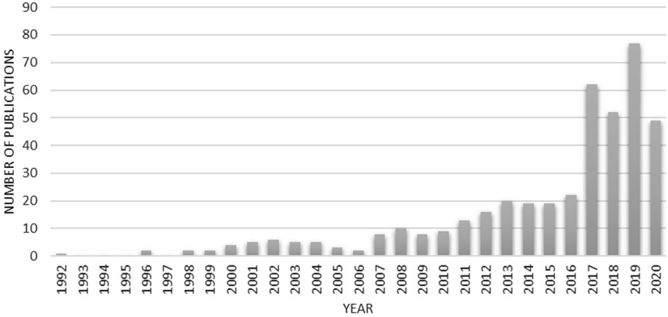
The objective of this paper is to perform an in-depth analysis of the literature on the competencies for implementing and leveraging artificial intelligence (AI) within organisations. From a bibliometric study using SciMat with articles from the Web of Science database, we identified 421 papers published between 1992 and 2020. This study offers a systematisation of the competencies and skills for AI, highlighting the most prominent, basic, specialised and emerging themes, and providing a performance measure analysis of this field. In addition, major challenges and a research agenda are discussed. The organisational challenge is to achieve a workforce with the necessary digital competencies, and to adapt human resource management practices to AI challenges.
Overview
The claims and statistics of this paper haven’t been checked yet.
Free: it reads the open-access text and checks the first 5 claims that cite a source we can check. Create a free account to check every claim.
Integrity signals
Registry
Cites
Statistics
Figures
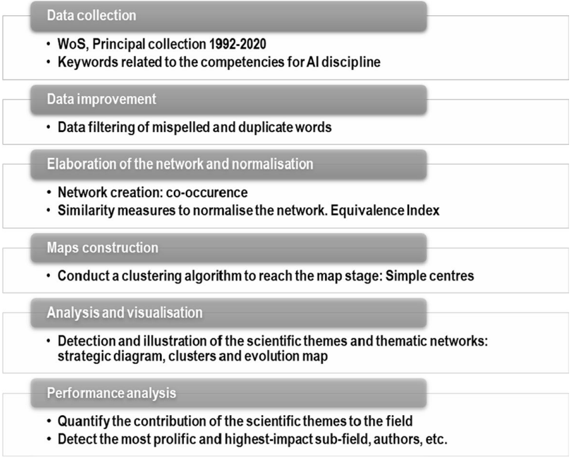
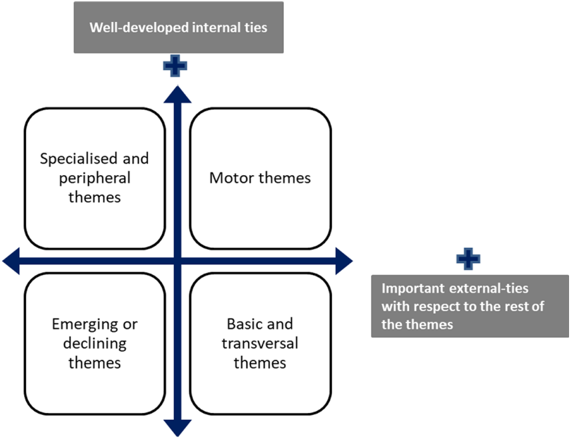
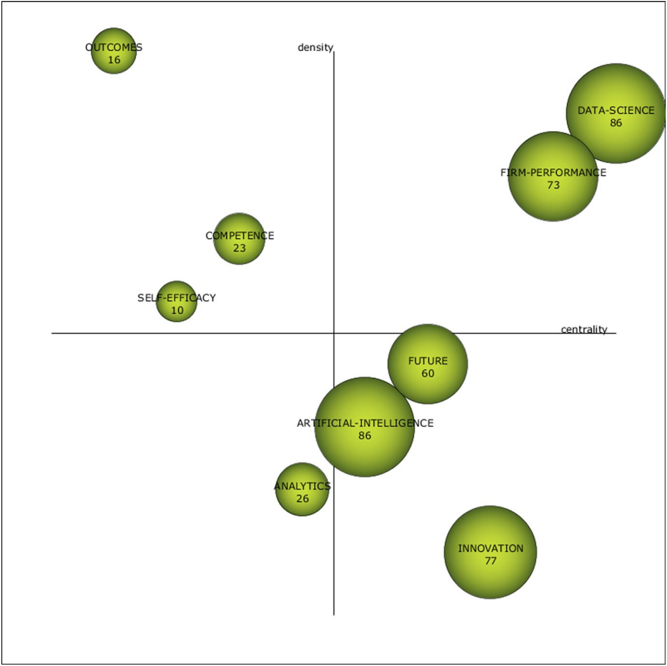
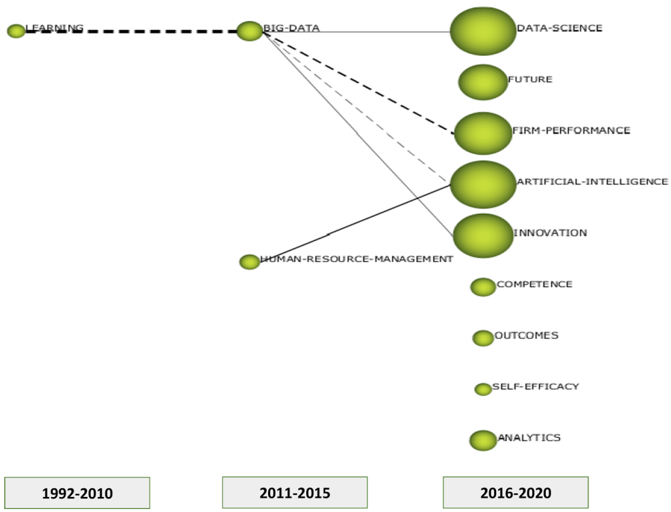
Verification
Claims the paper makes
The claims and statistics of this paper haven’t been checked yet.
Free: it reads the open-access text and checks the first 5 claims that cite a source we can check. Create a free account to check every claim.
Claims other papers make about this one
Each is checked against this paper’s own text: does it say what the citing paper says it does?
The source backs part of the claim, not all of it — or backs it for a different population, condition or comparison.
In the citing paper
“Several potential frameworks for AI literacy and competency in education are beginning to emerge [46][47][48][49].”
From Generative Artificial Intelligence: Implications and Considerations for Higher Education Practice (2023) · cites this paper as [48]
Experimental — accuracy not yet measuredThe source backs part of the claim, not all of it — or backs it for a different population, condition or comparison.
In the citing paper
“Santana and Diaz-Fernandez [48] identified AI competencies for Human Resource Management professionals”
From Generative Artificial Intelligence: Implications and Considerations for Higher Education Practice (2023) · cites this paper as [48]
Experimental — accuracy not yet measured
Self-check
Percentages, sums and reported differences re-computed from the paper’s own numbers.
The self-check needs the paper’s full text.
Citations
Cites
Firm Resources and Sustained Competitive Advantage
Barney, J. (1991) · Journal of Management · doi:10.1177/014920639101700108 · Cited by 48,334 · cited 2×
“Under the RBV, human capital is identified as a key factor in the attainment of a sustainable competitive advantage (Barney 1991), since competencies explain the differences between competitive advantages in human resources (Hayton and McEvoy 2006).”
BackgroundAzuma, R. T. (1997) · Presence: Teleoperators and Virtual Environments · doi:10.1162/pres.1997.6.4.355 · Cited by 10,121 · cited 1×
“…and learning environments are critical for organisations to operationalise knowledge and skills, such as virtual learning environments (VLEs) (Richert et al. 2016), augmented reality (Azuma 1997) and collaborative environments between cobots (service robots) and humans (Calitz et al. 2017).”
BackgroundBibliometric Methods in Management and Organization
Zupic, I., & Čater, T. (2015) · Organizational Research Methods · doi:10.1177/1094428114562629 · Cited by 7,495 · cited 2×
“Co-citation analyses use co-authorship data to assess collaboration (Zupic and Čater 2014).”
BackgroundMethod(2011) · Cited by 5,203
Artificial intelligence in service
Huang, M.-H., & Rust, R. T. (2018) · Journal of Service Research · doi:10.1177/1094670517752459 · Cited by 3,978
Skills, Tasks and Technologies: Implications for Employment and Earnings
Acemoglu, D., & Autor, D. (2011) · Handbook of Labor Economics · doi:10.1016/s0169-7218(11)02410-5 · Cited by 3,799
Science mapping software tools: Review, analysis, and cooperative study among tools
Cobo, M. J., López-Herrera, A. G., Herrera-Viedma, E., & Herrera, F. (2011) · Journal of the American Society for Information Science and Technology · doi:10.1002/asi.21525 · Cited by 3,242 · cited 2×
“Bibliometric studies conducted by means of science mapping offer profound analyses, highlight the intellectual structure and detect relevant topics (Cobo et al. 2011b; Deng et al. 2020).”
BackgroundMethodKaplan, A., & Haenlein, M. (2019) · Business Horizons · doi:10.1016/j.bushor.2018.08.004 · Cited by 3,140
Intelligent Manufacturing in the Context of Industry 4.0: A Review
Zhong, R. Y., Xu, X., Klotz, E., & Newman, S. T. (2017) · Engineering · doi:10.1016/j.eng.2017.05.015 · Cited by 2,913 · cited 1×
“Revolu-tionary changes are emerging (Strandhagen et al. 2017) through the use of smart technologies that enable new and more efficient processes, products and services (Lee et al. 2018; Zhong et al. 2017).”
BackgroundCobo, M. J., López-Herrera, A. G., Herrera-Viedma, E., & Herrera, F. (2011) · Journal of Informetrics · doi:10.1016/j.joi.2010.10.002 · Cited by 2,733 · cited 2×
“Bibliometric studies conducted by means of science mapping offer profound analyses, highlight the intellectual structure and detect relevant topics (Cobo et al. 2011b; Deng et al. 2020).”
BackgroundMethod
Research works printed but not linked: 11
- Cantoni F, Mangia G, Mangia G (2018) Digital revolution equals digital competencies? What we expect for workers' competencies in Industry 4.0, pp 247-258. https:// doi. org/ 10. 4324/ 97804 29425 288-21 · doi:10.4324/9780429425288-21
- Dewhurst M, Willmott P (2014) Manager and machine: the new leadership equation. McKinsey Q. 4:76-86
- Fenech R, Baguant P, Ivanov D (2019) The changing role of human resource management in a era of digital transformation. J Manag Inf Decis Sci 22(2):166–175
- Garfield E (1994) Scientography mapping the tracks of science. Curr Contents Soc Behav Sci 7:5-10
- Gehrke L, Bonse R, Henke M (2016) Towards a management framework for the digital transformation of logistics and manufacturing. In: 23rd EurOMA conference, interaction
- Harkins AM (2008) Leapfrog principles and practices: core components of education 3.0 and 4.0. Futures Res Q 24(1):19-31
- Malik A, Budhwar P, Patel C, Srikanth NR (2020b) May the bots be with you! Delivering HR cost-effec- tiveness and individualised employee experiences in an MNE. Int J Hum Resour Manag. https:// doi. org/ 10. 1080/ 09585 192. 2020b. 18595 82 · doi:10.1080/09585192.2020b.1859582
- Nonaka I, Takeuchi H, Umemoto K (1996) A theory of organizational knowledge creation. Int J Technol Manag 11(7-8):833-845. https:// doi. org/ 10. 1504/ IJTM. 1996. 025472 · doi:10.1504/ijtm.1996.025472
- Rowley C, Warner M (2007) The management of human resources in the Asia pacific: into the 21st cen- tury. Manag Revue 18:374-391. https:// doi. org/ 10. 2307/ 41791 360 · doi:10.2307/41791360
- Ruël H, Bondarouk T, Looise JK (2004) E-HRM: innovation or irritation. An explorative empirical study in five large companies on web-based HRM. Manag Revue 15(3):364-380. https:// doi. org/ 10. 2307/ 41783 479 · doi:10.2307/41783479
- Wasserman T (2013) Oxford english dictionary adds "Crowdsourcing," "Big Data." Mashable. https:// masha ble. com/ 2013/ 06/ 13/ dicti onary-new-words-2013/? europe= true
Cited by
Kanbach, D. K., Heiduk, L., Blueher, G., Schreiter, M., & Lahmann, A. (2024) · Review of Managerial Science · doi:10.1007/s11846-023-00696-z · Cited by 454
“The use of AI is transforming the required skillset of employees (Santana and Díaz-Fernández 2022).”
Generative Artificial Intelligence: Implications and Considerations for Higher Education Practice
Farrelly, T., & Baker, N. (2023) · Education Sciences · doi:10.3390/educsci13111109 · Cited by 414
AI-driven business model innovation: A systematic review and research agenda
Jorzik, P., Klein, S. P., Kanbach, D. K., & Kraus, S. (2024) · Journal of Business Research · doi:10.1016/j.jbusres.2024.114764 · Cited by 176
Balanced scorecard: trends, developments, and future directions
Kumar, S., Lim, W. M., Sureka, R., Jabbour, C. J. C., & Bamel, U. K. (2023) · Review of Managerial Science · doi:10.1007/s11846-023-00700-6 · Cited by 253
Roppelt, J. S., Kanbach, D. K., & Kraus, S. (2024) · Technology in Society · doi:10.1016/j.techsoc.2023.102443 · Cited by 168
Artificial Intelligence-Enabled Business Model Innovation: Competencies and Roles of Top Management
Jorzik, P., Yigit, A., Kanbach, D. K., Kraus, S., & Dabić, M. (2023) · IEEE Transactions on Engineering Management · doi:10.1109/tem.2023.3275643 · Cited by 205
Sedkaoui, S., & Benaichouba, R. (2026) · European Journal of Innovation Management · doi:10.1108/ejim-02-2024-0129 · Cited by 142
Bevilacqua, S., Masárová, J., Perotti, F. A., & Ferraris, A. (2025) · Review of Managerial Science · doi:10.1007/s11846-025-00836-7 · Cited by 190
Jiménez, M. P. F., Lleó, Á., Ruiz‐Palomino, P., & Muñoz‐Villamizar, A. (2024) · Review of Managerial Science · doi:10.1007/s11846-024-00735-3 · Cited by 155
Okada, A., Sherborne, T., Panselinas, G., & Kolionis, G. (2025) · International Journal of Artificial Intelligence in Education · doi:10.1007/s40593-025-00458-w · Cited by 125
“Specifically, AI is positioned as a cultural mediator that simultaneously integrates technical, ethical, and social learning dimensions, addressing critical gaps in empirical research on AI education in diverse cultural contexts (Santana & Díaz-Fernández, 2023a, 2023b; Zhang et al., 2023a, 2023b).”
Haupt, M., Freidank, J., & Haas, A. (2024) · Review of Managerial Science · doi:10.1007/s11846-024-00748-y · Cited by 120
Artificial intelligence enabled product–service innovation: past achievements and future directions
Naeem, R., Kohtamäki, M., & Parida, V. (2024) · Review of Managerial Science · doi:10.1007/s11846-024-00757-x · Cited by 117
Shahzad, M. F., Xu, S., Naveed, W., Nusrat, S., & Zahid, I. (2023) · Heliyon · doi:10.1016/j.heliyon.2023.e21818 · Cited by 60
Kitcharoen, P., Howimanporn, S., & Chookaew, S. (2024) · International Journal of Interactive Mobile Technologies (iJIM) · doi:10.3991/ijim.v18i02.46613 · Cited by 101
Karaköse, T., & Tülübaş, T. (2024) · Educational Process International Journal · doi:10.22521/edupij.2024.131.1 · Cited by 121
“Big data analytics, on the other hand, refers to AI-based systems that ‘allow the collection, management, and analysis of data sets that are too large for conventional database systems’ (Santana & Díaz-Fernández, 2023).”
BackgroundGPT revolution and digital entrepreneurial intentions
Abaddi, S. (2023) · Journal of Entrepreneurship in Emerging Economies · doi:10.1108/jeee-07-2023-0260 · Cited by 98
This (AI)n’t fair? Employee reactions to artificial intelligence (AI) in career development systems
Köchling, A., Wehner, M., & Ruhle, S. A. (2024) · Review of Managerial Science · doi:10.1007/s11846-024-00789-3 · Cited by 79
The role of digital skills in the acceptance of artificial intelligence
Vitezić, V., & Perić, M. (2024) · Journal of Business and Industrial Marketing · doi:10.1108/jbim-04-2023-0210 · Cited by 67
Digital technology and human resource practices: A systematic literature review
Shiferaw, R. M., & Birbirsa, Z. A. (2025) · Heliyon · doi:10.1016/j.heliyon.2025.e41946 · Cited by 66
“The technological revolution of human resource practices thought to have prompted institutional ambidexterity [47,53].”
Liu, Y., Zeng, N., Papadonikolaki, E., Maritshane, K., & Chan, P. (2024) · Project Leadership and Society · doi:10.1016/j.plas.2024.100120 · Cited by 54
Singh, S., Singh, S., Kraus, S., Sharma, A., & Dhir, S. (2024) · Journal of Innovation & Knowledge · doi:10.1016/j.jik.2024.100531 · Cited by 49
Ballerini, J., Yahiaoui, D., Giovando, G., & Ferraris, A. (2023) · Review of Managerial Science · doi:10.1007/s11846-023-00645-w · Cited by 49
“2022), talent capability (Santana and Díaz-Fernández 2022), and technical capability.”
BackgroundSam, S. J. I., & Jasim, K. M. (2023) · Management Review Quarterly · doi:10.1007/s11301-023-00388-8 · Cited by 48
“Regardless of the importance and strategic scope of chatbots in hospitality and related service industries, there is an organizational challenge when it comes to making employees competent enough to use futuristic digital technologies (Santana and Diaz-Fernandez 2022).”
Chookaew, S., Kitcharoen, P., Howimanporn, S., & Panjaburee, P. (2024) · Computers and Education Artificial Intelligence · doi:10.1016/j.caeai.2024.100308 · Cited by 46
Shi, L. (2025) · Human Resource Development Review · doi:10.1177/15344843251332360 · Cited by 37
Liu, Y., Sheng, F., & Liu, R. (2025) · Humanities and Social Sciences Communications · doi:10.1057/s41599-025-05656-4 · Cited by 47
Rigley, E., Bentley, C., Krook, J., & Ramchurn, S. D. (2024) · Global Policy · doi:10.1111/1758-5899.13299 · Cited by 31
“…there are concerns relating to the redesign and replacement of professional roles, unequal job distribution and economic disruption, as well as how these changes are expected to alter the relationships between citizens, governments and markets (Feijóo et al., 2020; Santana & Díaz-Fernández, 2022).”
BackgroundBabu, P. P., & Vasumathi, A. (2023) · Indian Journal of Information Sources and Services · doi:10.51983/ijiss-2023.13.2.3786 · Cited by 45
Entrepreneurship and artificial intelligence: a bibliometric analysis
Redondo-Rodríguez, M. D., Garrido, E. D., Yábar, D. C. P.-B., & Ramón-Jerónimo, M. Á. (2024) · The Journal of Technology Transfer · doi:10.1007/s10961-024-10165-8 · Cited by 30
AI and HRM in Tourism and Hospitality in Egypt: Inevitability, Impact, and Future
Al‐Romeedy, B. S. (2024) · Springer eBooks · doi:10.1007/978-3-031-62369-1_13 · Cited by 29
Competencias digitales y la alfabetización en inteligencia artificial en estudiantes universitarios
de Sánchez, M. C. A. A., Peñaloza, M. Y. M., & Ramírez, P. (2025) · Prohominum · doi:10.47606/acven/ph0312 · Cited by 19
Acosta-Enriquez, B. G., Zapata, L. I. V., Jordan, O. H., Roca, C. L., Cipirán, B. M. C., Villacrez, W. S., & Várgas, C. G. A. P. (2025) · Human Behavior and Emerging Technologies · doi:10.1155/hbe2/5933157 · Cited by 18
Witkowski, A., & Wodecki, A. (2024) · Foundations of Management · doi:10.2478/fman-2024-0009 · Cited by 20
Huy, P. Q., & Phuc, V. K. (2025) · Journal of Global Information Technology Management · doi:10.1080/1097198x.2025.2480972 · Cited by 16
Istudor, N., Socol, A. G., Marinaș, M.-C., & Socol, C. (2024) · Amfiteatru Economic · doi:10.24818/ea/2024/67/703 · Cited by 16
Large language models for competence-based HRM: A case study in the aerospace industry
Barba, G., Corallo, A., Lazoi, M., & Lezzi, M. (2025) · Journal of Innovation & Knowledge · doi:10.1016/j.jik.2025.100780 · Cited by 9
Santiago-Torner, C., Marfil, J. A. C., & Tarrats-Pons, E. (2026) · Sustainability · doi:10.3390/su18084085 · Cited by 16
Bauwens, R., & Batistič, S. (2025) · BRQ Business Research Quarterly · doi:10.1177/23409444251341326 · Cited by 12
Be AIware! An AI Competency Model for K-12 Education
Sattelmaier, L., & Pawlowski, J. Μ. (2025) · Social Sciences & Humanities Open · doi:10.1016/j.ssaho.2025.101838 · Cited by 13
Changes in Legal Education in the Digital Society of Artificial Intelligence
Vučić, F. (2023) · Communications in computer and information science · doi:10.1007/978-3-031-36833-2_12 · Cited by 10
The AI-powered soft skills renaissance: cultivating human abilities in the digital era
Muthukumar, M., Sitharaj, A., Sundaram, M. M., & Dhananjeiyan, B. (2025) · AI and Ethics · doi:10.1007/s43681-025-00912-4 · Cited by 10
“Consequently, individuals are anticipated to transcend the role of simply technology users and instead function as collaborators who adapt their expertise to evolving digital platforms and complex software ecosystems [26].”
Gal, H. C., & Cohen, Y. (2025) · IFAC-PapersOnLine · doi:10.1016/j.ifacol.2025.11.871 · Cited by 8
Sun, L., He, H., & Lin, W. (2025) · SAGE Open · doi:10.1177/21582440251369586 · Cited by 8
Ghosh, V., & Kabra, G. (2025) · Sustainable Futures · doi:10.1016/j.sftr.2025.100926 · Cited by 9
AI for educational innovation: opportunities and challenges amidst protracted crises
Zeid, M. B., & Abouchedid, K. (2025) · Education and Information Technologies · doi:10.1007/s10639-025-13867-0 · Cited by 7
Digital, Technological and AI Skills for Smart Production Work Environment
Cohen, Y., & Gal, H. C. (2024) · IFAC-PapersOnLine · doi:10.1016/j.ifacol.2024.09.269 · Cited by 9
Hernández-Vivanco, A., Vlaisavljevic, V., Gonzalez-Moragas, L., & Santana, M. (2025) · Technological Forecasting and Social Change · doi:10.1016/j.techfore.2025.124182 · Cited by 8
Self-citationAI term aversion in career decision-making: contextual reactions to algorithmic labels
Chacon, A., & Larraín, M. (2025) · Journal of Decision System · doi:10.1080/12460125.2025.2599916 · Cited by 7
Mapping the technological evolution of generative AI: a patent network analysis
Mohammadi, N., Dahooie, J. H., Bengari, A. A., & Rahimi, A. (2025) · Scientific Reports · doi:10.1038/s41598-025-26810-7 · Cited by 8
Business and Management Research on the Motion Picture Industry: A Bibliometric Analysis
Gutzeit, L. J., & Tiberius, V. (2023) · Journalism and Media · doi:10.3390/journalmedia4040076 · Cited by 10
Baako, I. (2026) · International Educational Review · doi:10.58693/ier.413 · Cited by 7
Elo, T., Puumalainen, K., Sjögrén, H., Pätäri, S., & Dana, L. (2025) · Review of Managerial Science · doi:10.1007/s11846-025-00896-9 · Cited by 12
The coopetition management process: a science mapping analysis
Benítez-Núñez, C., Santana, M., Afonso, D. D., & Pérez, P. D. S. (2025) · Review of Managerial Science · doi:10.1007/s11846-025-00867-0 · Cited by 8
Self-citationTraining, Reskilling, Recruiting: The Future of Work in the Age of Generative AI
Marinelli, L., Cioli, A., & Gregori, G. L. (2025) · Emerald Group Publishing Limited eBooks · doi:10.1108/978-1-83549-105-820251013 · Cited by 9
Ghozali, F. A., & Sudarsono, B. (2026) · JTP - Jurnal Teknologi Pendidikan · doi:10.21009/jtp.v28i1.60636 · Cited by 4
Public Acceptance of AI Tools and Devices: The Critical Role of Digital Competence
Cao, M., & Chun, D. (2025) · Asia-pacific Journal of Convergent Research Interchange · doi:10.47116/apjcri.2025.03.04 · Cited by 5
“Finally, variables like user trust, regional culture, and social responsibility could be incorporated to enrich the AIDUA model and explore their effects through mediation or moderation[23][41].”
Makki, M., Mathers, J., Matthews, L., Melsom, J., Biloria, N. M., Raymond, B., Cheung, J., & Ricafort, K. (2025) · Cities · doi:10.1016/j.cities.2024.105369 · Cited by 4
Imam, M. H., & Chowdhury, M. (2025) · doi:10.63125/aq819t42 · Cited by 6
Artificial intelligence and people management in the 21st century
Almeida, F., Silva, A. J., & Lopes, S. L. (2024) · Elsevier eBooks · doi:10.1016/b978-0-12-819471-3.00003-3 · Cited by 4
Mapping the evolution its roles and skills requirements in the age of AI
Adepoju, M. A.-O., & Adepoju, S. A. (2025) · World Journal of Advanced Research and Reviews · doi:10.30574/wjarr.2025.26.3.2410 · Cited by 3
“The workforce transformation requires IT professionals to develop new essential abilities because job descriptions have undergone substantial modification [2].”
InfluentialSinaga, E., Wijoyo, S., Lestary, Y. D., Indaryanto, A., & Harijadi, B. D. (2025) · Jurnal Konseling dan Pendidikan · doi:10.29210/1146300 · Cited by 3
Navigating paradox through strategic agility: A case study from the mobility sector
Boccardelli, P., Bartoli, C., & Gerardi, L. (2025) · Journal of Management & Organization · doi:10.1017/jmo.2025.10042 · Cited by 6
Graca, A. (2025) · Problemy Zarządzania - Management Issues · doi:10.7172/2956-7602.109.3 · Cited by 3
Human Capital Readiness for Cloud–AI–Data Center Ecosystems: A Bibliometric Review
Noor, R., Rahayu, A., Hurriyati, R., Wibowo, L. A., Ramini, N., Miftahuddin, A., Juliana, J., & Ismail, S. (2026) · Human Resources Management and Services · doi:10.18282/hrms6018 · Cited by 3
AI Is Changing Leadership — and Executives Need to Adapt.
Sayyadi, M., & Provitera, M. J. (2024) · Muma Business Review · doi:10.28945/5253 · Cited by 3
Bentley, C., Rigley, E., Krook, J., & Ramchurn, S. D. (2024) · International Journal of Semantic Computing · doi:10.1142/s1793351x24420042 · Cited by 3
Institutionalization of Bioethics in Higher Education Institutions: A Systematic Mapping
Frez-Pulgar, G., Valdés, Y., Negrier-Seguel, V., Gutiérrez-Gutiérrez, F., Cáceres-Senn, M., Glasserman‐Morales, L. D., & Hochstetter-Diez, J. (2025) · Journal of Bioethical Inquiry · doi:10.1007/s11673-025-10442-7 · Cited by 3
A Qualitative Study on Employee Experiences and Attitudes Towards AI Implementation in EnterprisesPreprint
Mitchell, E. (2025) · Preprints.org · doi:10.20944/preprints202512.2235.v1 · Cited by 5
Bibi, M., Guan, T. T., & Yao, H. (2025) · SAGE Open · doi:10.1177/21582440251385786 · Cited by 2
Chookaew, S., & Howimanporn, S. (2025) · International Journal of Engineering Pedagogy (iJEP) · doi:10.3991/ijep.v15i6.55271 · Cited by 2
Estiri, M., Dahooie, J. H., Ghorbani, A., Mohammadi, N., Khanam, M., Moughari, M. M., & Daim, T. U. (2025) · Review of Managerial Science · doi:10.1007/s11846-025-00963-1 · Cited by 4
Huy, P. Q., & Phuc, V. K. (2025) · Applied Artificial Intelligence · doi:10.1080/08839514.2025.2513740 · Cited by 2
AI in Human Resources Management: Systematic Literature Review
Sylejmani, M. (2025) · Contributions to management science · doi:10.1007/978-3-032-02526-5_7 · Cited by 2
Auth, G., Bensberg, F., & Christ, J. P. (2026) · dms – der moderne staat – Zeitschrift für Public Policy Recht und Management · doi:10.3224/dms.vxix.426342 · Cited by 3
Perspectives sur les besoins en compétences pour les usages de l’IA dans l’industrie 4.0 au Québec
Zinopoulos, C., Parent, S., Teyssier‐Roberge, G., Laflamme, A. S., Bruneault, F., Tremblay, S., & Marois, A. (2026) · Ad machina l avenir de l humain au travail · doi:10.1522/radm.no9.2035 · Cited by 2
Li, W., Fang, Z., & Chen, W. (2026) · Journal of the Knowledge Economy · doi:10.1007/s13132-026-03174-5 · Cited by 2
Kusumo, H. K. E., Lemy, D. M., & Lemy, D. M. (2026) · Journal of Business on Hospitality and Tourism · doi:10.22334/jbhost.v12i1.544 · Cited by 2
“…attributes, which are critical for success in the modern day, technology driven workplace, which include the willingness to embrace the use of artificial intelligence, the desire to learn new technologies, and the need for lifelong learning (Santana & Díaz-fernández, 2023) (Jaldemark et al., 2025).”
The Advantages and Challenges Faced by Business Analytics in the Context of Big Data
Dong, X. (2023) · Advances in Economics Management and Political Sciences · doi:10.54254/2754-1169/49/20230494 · Cited by 2
Fitri, D., Ratnasari, S. L., Suyanto, S., & Sultan, Z. (2024) · JKBM (JURNAL KONSEP BISNIS DAN MANAJEMEN) · doi:10.31289/jkbm.v11i1.12844 · Cited by 48
“(Hernandez-de-Menendez 2020; Santana & Díaz-Fernández, 2023) found that personality has a significant effect on employee competency, which in turn affects employee performance.”
Thakur, R. A., Sharma, D., Gupta, S., & Gul, S. (2025) · Social Sciences & Humanities Open · doi:10.1016/j.ssaho.2025.101941 · Cited by 1
Ethics in AI : A Structured Approach to Teaching and Learning with AI in Ethical Contexts
Sadruddin, M. M. (2025) · Wiley eBooks · doi:10.1002/9781394352821.ch12 · Cited by 2
Gretscher, P., Keck, A., Wolff, J., Konig, A. S., & Graf‐Vlachy, L. (2026) · Springer eBooks · doi:10.1007/978-3-658-36874-6_26-1 · Cited by 1
Velarde-Camaqui, D., Peláez‐Sánchez, I. C., & Guerrero, H. M. (2026) · Frontiers in Education · doi:10.3389/feduc.2026.1730207 · Cited by 1
Basics for the Future – Basic Competency Shifts in the AI Era
Schöttl, F., Lanzl, J., & Gimpel, H. (2026) · Business & Information Systems Engineering · doi:10.1007/s12599-026-01001-4 · Cited by 1
Mapping research on competency management in the age of AI: a bibliometric and systematic review
Asemota, M. O. (2026) · Journal of Organizational Effectiveness People and Performance · doi:10.1108/joepp-11-2025-1048 · Cited by 1
Competencias de IA para Diseñadores
Gutiérrez, E. R., Zimbrón, A. H., & Chavarría, C. G. V. (2026) · Cuadernos del Centro de Estudios de Diseño y Comunicación · doi:10.18682/cdc.vi297.13436 · Cited by 1
Artificial intelligence and the reconfiguration of competency management systems in organizations
Asemota, M. O. (2026) · Discover Artificial Intelligence · doi:10.1007/s44163-026-02055-9 · Cited by 1
“However, existing SLRs consistently note that theoretical integration is limited, and explanations for how and why competencies must change in the AI era are often under-developed [13, 42].”
InfluentialDigital technology and Human Resource Practices: A Systematic Literature ReviewPreprint
Balthazaar, D. (2025) · Research Square · doi:10.21203/rs.3.rs-7345845/v1 · Cited by 1
How to Optimize Your Recruitment for Post Pandemic?
Sayyadi, M. (2023) · Muma Business Review · doi:10.28945/5199
Rigley, E., Krook, J., & Bentley, C. (2023) · International Conference on Transdisciplinary AI (TransAI) · doi:10.1109/transai60598.2023.00044 · Cited by 1
Artificial Intelligence, Knowledge Engineering, and Management
Álvares, L. M. A. D. R., & Valentim, M. L. P. (2024) · Advances in business information systems and analytics book series · doi:10.4018/979-8-3693-1058-8.ch003 · Cited by 2
Ensuring AI’s Subservience: A New Dimension of Healthcare Leadership
Khan, K. R., & Khalid, A. (2023) · BIOMEDICA · doi:10.24911/biomedica/5-1131
Kaur, A., Gangwar, V. P., Kaur, P., & Jasrai, L. (2024) · Advances in human resources management and organizational development book series · doi:10.4018/979-8-3693-1343-5.ch011 · Cited by 1
Paving the AI-Powered Path to a Super Smart Society
Premavathi, T., Jain, R., Parmar, K. J., & Palaniappan, D. (2024) · Practice, progress, and proficiency in sustainability · doi:10.4018/979-8-3693-7989-9.ch003
Jelonek, D., Graczyk-Kucharska, M., Olszewski, R., Szafrański, M., & Rzemieniak, M. (2024) · Lecture notes in networks and systems · doi:10.1007/978-3-031-78465-1_10 · Cited by 1
A systematic review on Purpose in Life in Emerging AdulthoodPreprint
Banda, R., Lleó, Á., & García‐Manglano, J. (2025) · SSRN Electronic Journal · doi:10.2139/ssrn.5151864
Yashina, N. I., Pronchatova-Rubtsova, N. N., Кашина, О. И., & Chesnokova, L. (2025) · Lecture notes in networks and systems · doi:10.1007/978-3-031-85608-2_6 · Cited by 1
Transformative Impact of Artificial Intelligence in Data Analytics and Business Intelligence
(2025) · Advances in computational intelligence and robotics book series · doi:10.4018/979-8-3373-0513-4.ch002
A Study of the K-12 Teachers' Competency for the Artificial Intelligence Curriculum in China
Ning, K., Xu, E., Liu, Y., & Feng, X. (2025) · International Conference on Computer Science and Technologies in Education (CSTE) · doi:10.1109/cste64638.2025.11091913
“…the artificial intelligence curriculum plays a significant role in the nation's efforts to advance the field of artificial intelligence and popularize its study, and primary and secondary schools that wish to implement the curriculum must hire teachers who are skilled in its instruction [6][7].”
Eco-Efficient Customer Service
Tavanti, M. (2025) · Springer eBooks · doi:10.1007/978-3-031-93451-3_13
Metadata
- Authors
- Santana, M., & Díaz-Fernández, M.
- Affiliations
- Universidad Pablo de Olavide (ES)
- Corresponding author
- Santana, Mónica
- Venue
- Review of Managerial Science
- Published
- 2022-12-29
- Volume
- 17
- Issue
- 6
- Pages
- 1971-2004
- ISSN
- 1863-6683 (ISSN-L)
- 1863-6691
- OpenAlex
- W4313242364
- Cited by
- 105
- References
- 91
- Citations by year
- 2026: 26 · 2025: 40 · 2024: 23 · 2023: 16
- FWCI
- 18.65
- Type
- journal article
- Language
- en
- Open access
- hybrid
- doi.org
- Licence
- cc-by
- creativecommons.org/licenses/by/4.0 (tdm)
- creativecommons.org/licenses/by/4.0 (vor)
- Locations
- Review of Managerial Science (publishedVersion, cc-by)
- RIO (Universidad Pablo de Olavide) (submittedVersion, cc-by)
- RePEc: Research Papers in Economics (submittedVersion)
- Funders
- andalusian government (PAIDI SEJ602)
- Ministerio de Ciencia, Innovación y Universidades (MCI/AEI/10.13039/501100011033)
- Universidad Pablo de Olavide
- Topics
- Social Sciences › Business, Management and Accounting › Organizational Behavior and Human Resource Management › AI and HR Technologies
- Social Sciences › Business, Management and Accounting › Organizational Behavior and Human Resource Management › Competency Development and Evaluation
- Physical Sciences › Computer Science › Artificial Intelligence › Artificial Intelligence Applications
- Keywords
- artificial intelligence, AI competencies, digital skills, labor force, human resource management, emerging competencies, research agenda
About these checks
Registry, retraction, Cites and statistics results are computed, not judged, with one exception: a printed reference that no index lists is read once by a model before it counts as a citation error. Claims are extracted by a model and kept only when their quote appears verbatim in the text; each cited source is then checked, with a model’s help, for whether it says what the claim relies on. Those verdicts can be wrong — read the claim’s quote and the cited source before relying on one.
Statistics and arithmetic are recomputed, not judged.
Confidence bands are shown only for fields calibrated on our annotated test set. None is calibrated yet, so no band is shown.
What counts as a claim ›How we measure confidence ›How we check this ›
Are you an author, or do you see a problem with this page? Request a review
Data sources
Bibliographic data: Semantic Scholar, OpenAlex, Crossref.
Contains information from the Semantic Scholar Academic Graph Datasets, made available under the ODC Attribution License (ODC-BY 1.0).
Semantic Scholar’s data is described in: Kinney, R., et al. (2023). The Semantic Scholar Open Data Platform. arXiv:2301.10140.
