

Osteocyte Mechanotransduction in Orthodontic Tooth Movement
Open accessThe DOI matches its Crossref record; 109 of the 109 references it cites were found in a registry or an index.
Abstract
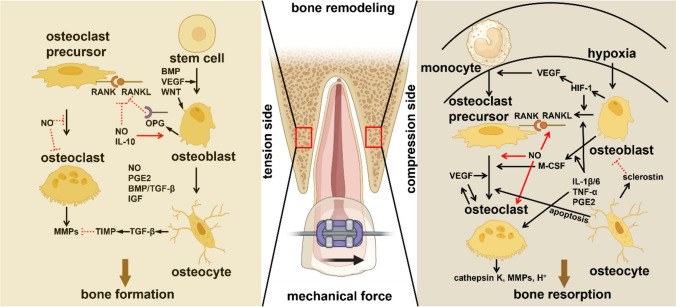
PURPOSE OF REVIEW: Orthodontic tooth movement is characterized by periodontal tissue responses to mechanical loading, leading to clinically relevant functional adaptation of jaw bone. Since osteocytes are significant in mechanotransduction and orchestrate osteoclast and osteoblast activity, they likely play a central role in orthodontic tooth movement. In this review, we attempt to shed light on the impact and role of osteocyte mechanotransduction during orthodontic tooth movement. RECENT FINDINGS: Mechanically loaded osteocytes produce signaling molecules, e.g., bone morphogenetic proteins, Wnts, prostaglandins, osteopontin, nitric oxide, sclerostin, and RANKL, which modulate the recruitment, differentiation, and activity of osteoblasts and osteoclasts. The major signaling pathways activated by mechanical loading in osteocytes are the wingless-related integration site (Wnt)/β-catenin and RANKL pathways, which are key regulators of bone metabolism. Moreover, osteocytes are capable of orchestrating bone adaptation during orthodontic tooth movement. A better understanding of the role of osteocyte mechanotransduction is crucial to advance orthodontic treatment. The optimal force level on the periodontal tissues for orthodontic tooth movement producing an adequate biological response, is debated. This review emphasizes that both mechanoresponses and inflammation are essential for achieving tooth movement clinically. To fully comprehend the role of osteocyte mechanotransduction in orthodontic tooth movement, more knowledge is needed of the biological pathways involved. This will contribute to optimization of orthodontic treatment and enhance patient outcomes.
Overview
The claims and statistics of this paper haven’t been checked yet.
Free: it reads the open-access text and checks the first 5 claims that cite a source we can check. Create a free account to check every claim.
Integrity signals
Registry
Cites
Statistics
Figures
Verification
Claims the paper makes
The claims and statistics of this paper haven’t been checked yet.
Free: it reads the open-access text and checks the first 5 claims that cite a source we can check. Create a free account to check every claim.
Claims other papers make about this one
Each is checked against this paper’s own text: does it say what the citing paper says it does?
In the citing paper
“PGs, which are produced by hepatocytes, are cytokines that regulate the recruitment, differentiation, and activity of osteoblasts and osteoclasts [150].”
From Emerging role of liver-bone axis in osteoporosis (2024) · cites this paper as [150]
Self-check
Percentages, sums and reported differences re-computed from the paper’s own numbers.
The self-check needs the paper’s full text.
Citations
Cites
Wnt/β-catenin signaling and disease
Clevers, H., & Nusse, R. (2012) · Cell · doi:10.1016/j.cell.2012.05.012 · Cited by 5,554 · cited 3×
“The Wnt-sensitive signaling pathway is separated into the canonical signaling pathway which depends on the function of β-catenin (the so-called Wnt/β-catenin pathway) and the non-canonical pathway [65].”
BackgroundInfluentialWNT signaling in bone homeostasis and disease: From human mutations to treatments
Baron, R., & Kneissel, M. (2013) · Nature Medicine · doi:10.1038/nm.3074 · Cited by 2,093 · cited 1×
“Wnt signaling pathways have different roles in skeletal homeostasis [64].”
BackgroundTherapeutic Approaches to Bone Diseases
Rodan, G. A., & Martin, T. J. (2000) · Science · doi:10.1126/science.289.5484.1508 · Cited by 1,767 · cited 3×
“Bone matrix is continuously resorbed (degraded) by osteoclasts and rebuilt by osteoblasts at approximately 1–2 million microscopic sites in every adult skeleton [26].”
BackgroundInfluentialHADJIDAKIS, D. J., & ANDROULAKIS, I. I. (2006) · Annals of the New York Academy of Sciences · doi:10.1196/annals.1365.035 · Cited by 1,360 · cited 4×
“Osteocytes sense and respond to bone tissue strain, resulting in enhanced bone remodeling activity by osteoclasts at locations where bone remodeling is needed [12].”
BackgroundInfluentialBIOMECHANICAL AND MOLECULAR REGULATION OF BONE REMODELING
Robling, A. G., Castillo, A. B., & Turner, C. H. (2006) · Annual Review of Biomedical Engineering · doi:10.1146/annurev.bioeng.8.061505.095721 · Cited by 1,343 · cited 1×
“The balance between bone formation and resorption is affected by several factors, most notably ageing, hormones, and mechanical loading [28].”
BackgroundBone graft materials. An overview of the basic science.
Bauer, T. W., & Muschler, G. F. (2000) · PubMed · Cited by 1,073
Bone Graft Materials: An Overview of the Basic Science
Bauer, T. W., & Muschler, G. F. (2000) · Clinical Orthopaedics and Related Research · doi:10.1097/00003086-200002000-00003 · Cited by 998 · cited 1×
“This process of functional bone adaptation serves to acquire bones that unite a suitable resistance against mechanical failure with a minimum use of material [23, 24].”
BackgroundThree rules for bone adaptation to mechanical stimuli
Turner, C. H. (1998) · Bone · doi:10.1016/s8756-3282(98)00118-5 · Cited by 969 · cited 1×
“Bone is able to adapt its mass and structure to mechanical loading [17].”
BackgroundThe Promise and Perils of Wnt Signaling Through β-Catenin
Moon, R. T., Bowerman, B., Boutros, M., & Perrimon, N. (2002) · Science · doi:10.1126/science.1071549 · Cited by 969 · cited 1×
“The canonical signaling pathway includes critical molecular for cellular metabolism [102].”
BackgroundSclerostin is a delayed secreted product of osteocytes that inhibits bone formation
Poole, K. E. S., Van Bezooijen, R. L., Loveridge, N., Hamersma, H., Papapoulos, S. E., Löwik, C. W., & Reeve, J. (2005) · The FASEB Journal · doi:10.1096/fj.05-4221fje · Cited by 965
Research works printed but not linked: 3
- Pereira Alexandre L Nava Lopes Cançado L Renato Jordão C Absolute orthodontic anchorage: A brief review Int J Appl Dent Sci. 2019 5 152 155
- Robling AG Castillo AB Turner CH Biomechanical and molecular regulation of bone remodeling Annu Rev Biomed Eng 2006 8 455 498 10.1146/annurev.bioeng.8.061505.095721 16834564 · DOI · Paper page
- Wasserman E. Differentially load-regulated gene expression in mouse trabecular osteocytes, Dissertation ETH Zurich, No. 18938, 2010.
Cited by
Emerging role of liver-bone axis in osteoporosis
Gao, H., Peng, X., Li, N., Gou, L., Xu, T., Wang, Y., Qin, J., Liang, H., Ma, P., Li, S., et al. (2024) · Journal of Orthopaedic Translation · doi:10.1016/j.jot.2024.07.008 · Cited by 36
“PGs, which are produced by hepatocytes, are cytokines that regulate the recruitment, differentiation, and activity of osteoblasts and osteoclasts [150].”
BackgroundThe central mechanotransducer in osteoporosis pathogenesis and therapy
Liu, C., Yang, J., Dong, Z., Zhao, S., Tian, Z., Li, Y., Hao, Y., & Wang, M. (2025) · Frontiers in Endocrinology · doi:10.3389/fendo.2025.1658967 · Cited by 25
“Mechanical loading activates Wnt/ b -catenin signaling, promoting osteoblast differentiation, while suppressing RANKL-mediated osteoclastogenesis (40).”
Liao, X.-M., Yang, Z.-J., Li, Y., Cui, Y., Ma, L., Liang, C., Guan, Z., & Hu, J. (2025) · Free Radical Biology and Medicine · doi:10.1016/j.freeradbiomed.2025.05.425 · Cited by 14
Emerging Technologies in Bone Tissue Engineering: A Review
Rastogi, S., Verma, R., Gouru, S. A., Venkatesan, K., Pandian, P. M., Khan, M. I., Deka, T., & Kumar, P. (2025) · Journal of Bionic Engineering · doi:10.1007/s42235-025-00765-x · Cited by 13
Cai, D., Shao, J., & Xiao, Y. (2026) · Dental Research · doi:10.1016/j.dtrs.2026.100025 · Cited by 9
Metadata
- Authors
- Seddiqi, H., Klein-Nulend, J., & Jin, J.
- Affiliations
- Academic Center for Dentistry Amsterdam (NL)
- Corresponding author
- Jin, Jianfeng
- Venue
- Current Osteoporosis Reports
- Published
- 2023-10-04
- Volume
- 21
- Issue
- 6
- Pages
- 731-742
- ISSN
- 1544-1873 (ISSN-L)
- 1544-2241
- PMC
- PMC10724326
- OpenAlex
- W4387326649
- Cited by
- 46
- References
- 109
- Citations by year
- 2026: 26 · 2025: 16 · 2024: 4
- FWCI
- 2.62
- Type
- journal article
- Language
- en
- Open access
- hybrid
- doi.org
- Licence
- cc-by
- creativecommons.org/licenses/by/4.0 (tdm)
- creativecommons.org/licenses/by/4.0 (vor)
- Locations
- Current Osteoporosis Reports (publishedVersion, cc-by)
- PubMed Central (publishedVersion, cc-by)
- PubMed (publishedVersion)
- VU Research Portal (submittedVersion, other-oa)
- Funders
- Health-Holland (LSHM19016, “BB”)
- Topics
- Health Sciences › Dentistry › Orthodontics › Orthodontics and Dentofacial Orthopedics
- Life Sciences › Biochemistry, Genetics and Molecular Biology › Molecular Biology › Bone Metabolism and Diseases
- Life Sciences › Biochemistry, Genetics and Molecular Biology › Cell Biology › Cellular Mechanics and Interactions
- Keywords
- osteocyte mechanotransduction, orthodontic tooth movement, periodontal tissue response, mechanical loading, Wnt/β-catenin signaling, RANKL signaling, bone remodeling, osteoblasts, osteoclasts, sclerostin, RANKL, bone morphogenetic proteins, prostaglandins, osteopontin, nitric oxide, bone adaptation, periodontal inflammation
- MeSH terms
- Humans, Osteoblasts, Osteoclasts, Osteocytes, Tooth Movement Techniques, Bone Remodeling, Mechanotransduction, Cellular
About these checks
Registry, retraction, Cites and statistics results are computed, not judged, with one exception: a printed reference that no index lists is read once by a model before it counts as a citation error. Claims are extracted by a model and kept only when their quote appears verbatim in the text; each cited source is then checked, with a model’s help, for whether it says what the claim relies on. Those verdicts can be wrong — read the claim’s quote and the cited source before relying on one.
Statistics and arithmetic are recomputed, not judged.
Confidence bands are shown only for fields calibrated on our annotated test set. None is calibrated yet, so no band is shown.
What counts as a claim ›How we measure confidence ›How we check this ›
Are you an author, or do you see a problem with this page? Request a review
How to cite
Cite CoChat for the checks on this page, and the paper for its own findings.
- This page
- CoChat. (2026). Citation check: Osteocyte Mechanotransduction in Orthodontic Tooth Movement. https://app.cochat.ai/papers/10.1007/s11914-023-00826-2
- The paper
- Seddiqi, H., Klein-Nulend, J., & Jin, J. (2023). Osteocyte Mechanotransduction in Orthodontic Tooth Movement. Current Osteoporosis Reports. https://doi.org/10.1007/s11914-023-00826-2
Data sources
Bibliographic data: Semantic Scholar, OpenAlex, Crossref.
Contains information from the Semantic Scholar Academic Graph Datasets, made available under the ODC Attribution License (ODC-BY 1.0).
Semantic Scholar’s data is described in: Kinney, R., et al. (2023). The Semantic Scholar Open Data Platform. arXiv:2301.10140.
