

The DOI matches its Crossref record; 119 of the 119 references it cites were found in a registry or an index; 3 of the 66 sources its claims cite were checked for support.
Community Interventions to Promote Mental Health and Social Equity
Open accessAbstract
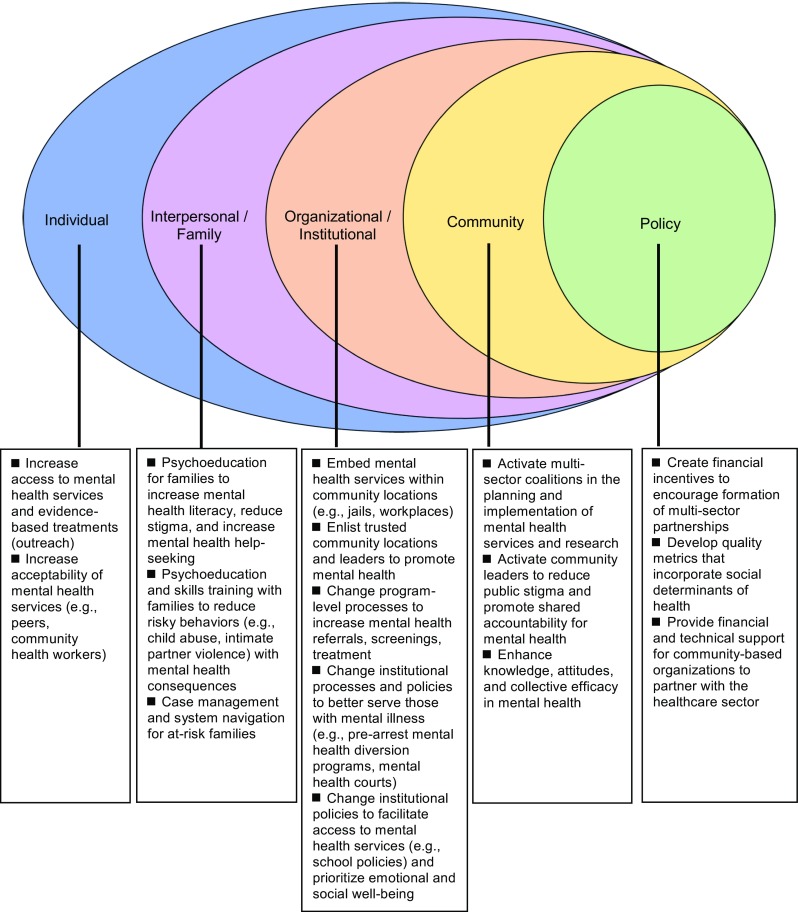
PURPOSE OF REVIEW: We review recent community interventions to promote mental health and social equity. We define community interventions as those that involve multi-sector partnerships, emphasize community members as integral to the intervention, and/or deliver services in community settings. We examine literature in seven topic areas: collaborative care, early psychosis, school-based interventions, homelessness, criminal justice, global mental health, and mental health promotion/prevention. We adapt the social-ecological model for health promotion and provide a framework for understanding the actions of community interventions. RECENT FINDINGS: There are recent examples of effective interventions in each topic area. The majority of interventions focus on individual, family/interpersonal, and program/institutional social-ecological levels, with few intervening on whole communities or involving multiple non-healthcare sectors. Findings from many studies reinforce the interplay among mental health, interpersonal relationships, and social determinants of health. There is evidence for the effectiveness of community interventions for improving mental health and some social outcomes across social-ecological levels. Studies indicate the importance of ongoing resources and training to maintain long-term outcomes, explicit attention to ethics and processes to foster equitable partnerships, and policy reform to support sustainable healthcare-community collaborations.
Overview
AI snapshot
Written from the paper’s full text.
TL;DR
This review synthesizes recent community interventions across seven topic areas and finds evidence for improving mental health and some social outcomes at multiple social-ecological levels. It emphasizes the need for sustained resources and training, equitable community partnerships, and policy reform to support long-term healthcare-community collaborations.
Key findings
- Multi-sector collaborative care: In Community Partners in Care (CPIC), 95 programs across five sectors served a predominantly under-resourced racial/ethnic minority sample (n = 1018; 46% African American, 41% Latino, 74% below federal poverty level); at 6 months, Community Engagement and Planning vs. Resources for Services improved health-related quality of life, increased physical activity, reduced homelessness risk factors, and reduced behavioral health hospitalizations, though main effects diminished over time.
- Early psychosis and justice interventions: The Danish OPUS trial showed significant 2-year benefits for assertive early intervention, but most differences dissipated at 10-year follow-up; Forensic Assertive Community Treatment (n = 35 vs. 35) produced fewer convictions (0.4 ± 0.7 vs. 0.9 ± 1.3, p = .023), fewer days in jail (21.5 ± 25.9 vs. 43.5 ± 59.2, p = .025), and more outpatient mental health treatment days (305.5 ± 92.1 vs. 169.4 ± 139.6, p < .001).
- Housing, global mental health, and prevention: In At Home/Chez Moi (n = 950), Housing First participants entered housing faster (73 vs. 220 days) and retained housing longer (281 vs. 115 days); in Goa, India, the lay-counselor-delivered Healthy Activity Program (n = 495) reduced depression severity, suicidal ideation, disability, days out of work, and intimate partner violence; a South African parenting program (n = 115 dyads) reduced child abuse from 63.0% to 29.5% (p < .001).
- School and community-level prevention: In the FRIENDS trial (41 schools, n = 1343), health-led FRIENDS was more effective than school-led FRIENDS or PSHE for anxiety outcomes, with no effects on math, reading, or writing test scores; Communities That Care (24 communities, n > 14,000) showed reduced substance use, delinquency, and violence at eighth grade, with some effects persisting to age 21 (n = 4002; e.g., increased lifetime abstinence from alcohol, tobacco, and marijuana use, ARR 1.49, 95% CI 1.03, 2.16).
Methods
- Narrative review, not a comprehensive systematic review, focusing on interventions published in peer-reviewed medical journals from 2015 to 2018, with additional studies identified through reference mining and expert recommendations.
- Seven topic areas were selected: multi-sector collaborative care, early psychosis, school-based interventions, homelessness, criminal justice, global mental health, and mental health promotion/prevention; studies were selected for design, outcomes, and/or impact.
- Community interventions were defined as those involving multi-sector partnerships, including community members as integral to the intervention, and/or delivering services in community settings; the review adapts the social-ecological model for health promotion.
Limitations
- Stated: The review highlights major developments and trends rather than providing a comprehensive systematic review, and it excludes substance use interventions, which the authors say warrant a separate review.
- Stated/evident: Most reviewed interventions focused on individual, family/interpersonal, and program/institutional social-ecological levels, with few intervening on whole communities or involving multiple non-healthcare sectors.
- Evident from the text: Several beneficial effects diminished over time (e.g., CPIC, OPUS), some interventions had negative or unexpected results (e.g., London early intervention service referral study; expedited Medicaid enrollment associated with greater jail/prison days), and the authors note the importance of ongoing resources, training, and policy reform to sustain outcomes.
Model-written summary. Check it against the paper before relying on it.
Integrity signals
Registry
Cites
Statistics
Figures
Verification
Claims the paper makes
66 Not checked yet · 10 Own interpretation · 7 No basis given · 3 Own result · 2 Partly supported · accuracy not yet measured
The cited sources support only part of this claim — read each source’s verdict below.
In the paper
“emergency room use (55% vs. 35%, p < .01)”
§ Community Interventions to Promote Mental Health and Social Equity > Criminal Justice
What the sources say
- Supportedcites [79] Grabert BK, Gertner AK, Domino ME, Cuddeback GS, Morrissey JP. Expedited Medicaid enrollment, service use, and recidivism at 36 months among released prisoners with severe mental illness. Psychiatr Serv. 2017;68:1079–82. source
Table 1 (page not available in our copy) reports emergency department use by 12 months in 55% of the expedited Medicaid group versus 35% of controls. The Results report a significant adjusted difference at that follow-up (p < .01). (LLM, conf=0.94)
- Partly supportedcites [80] Morrissey JP, Domino ME, Cuddeback GS. Expedited Medicaid enrollment, mental health service use, and criminal recidivism among released prisoners with severe mental illness. Psychiatr Serv. 2016;67:842–9. sourceExperimental — accuracy not yet measured
The Results report significantly higher emergency department use for medical conditions in the expedited-Medicaid referral group than in controls (p<.01), and give the control rate as 35.2%. They describe an adjusted difference of approximately 15 percentage points, but the passages in our copy do not establish the claimed 55% intervention-group rate. (LLM, conf=0.85)
plaindirectn = 3,086 ·- Asserted: passes — The authors put it forward as true.
- Checkable: passes — It can be checked against evidence.
- Load-bearing: passes — The paper’s conclusions depend on it.
- Based: passes — The paper gives a reason why it holds.
- Supported
None of the sources cited for this claim have been checked yet.
In the paper
“International lay health worker interventions, a parenting intervention to reduce child abuse, a whole-school cognitive behavioral therapy prevention program, adapted ACT teams for early psychosis and justice-involved populations, Housing First services, and multi-sector collaborative care and prevention services are examples of effective community interventions.”
§ Community Interventions to Promote Mental Health and Social Equity > Conclusions
plaindirect- Asserted: passes — The authors put it forward as true.
- Checkable: passes — It can be checked against evidence.
- Load-bearing: passes — The paper’s conclusions depend on it.
- Based: passes — The paper gives a reason why it holds.
A result the paper reports from its own data — it cites no other source for it, so there is none to check. The quote shows it is in the paper.
In the paper
“Most interventions reviewed here included one non-healthcare sector collaborator as opposed to collaborating with communities more broadly.”
§ Community Interventions to Promote Mental Health and Social Equity > Discussion > Actions of Community Interventions by Social-Ecological Level
plain- Asserted: passes — The authors put it forward as true.
- Checkable: passes — It can be checked against evidence.
- Load-bearing: unclear — It is unclear whether the paper’s conclusions depend on it.
- Based: passes — The paper gives a reason why it holds.
- Rests on an assumption: The studies selected for this review are representative of recent community interventions in the seven topic areas.
A result the paper reports from its own data — it cites no other source for it, so there is none to check. The quote shows it is in the paper.
In the paper
“We found only a small number of studies that intervened at the level of whole communities.”
§ Community Interventions to Promote Mental Health and Social Equity > Discussion > Actions of Community Interventions by Social-Ecological Level
plain- Asserted: passes — The authors put it forward as true.
- Checkable: passes — It can be checked against evidence.
- Load-bearing: unclear — It is unclear whether the paper’s conclusions depend on it.
- Based: passes — The paper gives a reason why it holds.
- Rests on an assumption: The studies selected for this review are representative of recent community interventions in the seven topic areas.
None of the sources cited for this claim have been checked yet.
In the paper
“Other studies acted at the community level by directly providing or influencing resources on a large scale, through cash/food transfers or land revitalization efforts”
§ Community Interventions to Promote Mental Health and Social Equity > Discussion > Actions of Community Interventions by Social-Ecological Level
plain- Asserted: passes — The authors put it forward as true.
- Checkable: passes — It can be checked against evidence.
- Load-bearing: unclear — It is unclear whether the paper’s conclusions depend on it.
- Based: passes — The paper gives a reason why it holds.
The paper states this without a source or data behind it here, so there is nothing to check it against. The quote shows it is in the paper.
In the paper
“International lay health worker interventions, a parenting intervention to reduce child abuse, a whole-school cognitive behavioral therapy prevention program, adapted ACT teams for early psychosis and justice-involved populations, Housing First services, and multi-sector collaborative care and prevention services are examples of effective community interventions.”
§ Community Interventions to Promote Mental Health and Social Equity > Conclusions
plaindirect- Asserted: passes — The authors put it forward as true.
- Checkable: passes — It can be checked against evidence.
- Load-bearing: passes — The paper’s conclusions depend on it.
- Based: passes — The paper gives a reason why it holds.
None of the sources cited for this claim have been checked yet.
In the paper
“International lay health worker interventions, a parenting intervention to reduce child abuse, a whole-school cognitive behavioral therapy prevention program, adapted ACT teams for early psychosis and justice-involved populations, Housing First services, and multi-sector collaborative care and prevention services are examples of effective community interventions.”
§ Community Interventions to Promote Mental Health and Social Equity > Conclusions
plaindirect- Asserted: passes — The authors put it forward as true.
- Checkable: passes — It can be checked against evidence.
- Load-bearing: passes — The paper’s conclusions depend on it.
- Based: passes — The paper gives a reason why it holds.
The paper states this without a source or data behind it here, so there is nothing to check it against. The quote shows it is in the paper.
In the paper
“International lay health worker interventions, a parenting intervention to reduce child abuse, a whole-school cognitive behavioral therapy prevention program, adapted ACT teams for early psychosis and justice-involved populations, Housing First services, and multi-sector collaborative care and prevention services are examples of effective community interventions.”
§ Community Interventions to Promote Mental Health and Social Equity > Conclusions
plaindirect- Asserted: passes — The authors put it forward as true.
- Checkable: passes — It can be checked against evidence.
- Load-bearing: passes — The paper’s conclusions depend on it.
- Based: passes — The paper gives a reason why it holds.
The paper states this without a source or data behind it here, so there is nothing to check it against. The quote shows it is in the paper.
In the paper
“A second group of interventions intervened at the interpersonal level (e.g., parent and family interventions).”
§ Community Interventions to Promote Mental Health and Social Equity > Discussion > Actions of Community Interventions by Social-Ecological Level
plain- Asserted: passes — The authors put it forward as true.
- Checkable: passes — It can be checked against evidence.
- Load-bearing: unclear — It is unclear whether the paper’s conclusions depend on it.
- Based: passes — The paper gives a reason why it holds.
None of the sources cited for this claim have been checked yet.
In the paper
“International lay health worker interventions, a parenting intervention to reduce child abuse, a whole-school cognitive behavioral therapy prevention program, adapted ACT teams for early psychosis and justice-involved populations, Housing First services, and multi-sector collaborative care and prevention services are examples of effective community interventions.”
§ Community Interventions to Promote Mental Health and Social Equity > Conclusions
plaindirect- Asserted: passes — The authors put it forward as true.
- Checkable: passes — It can be checked against evidence.
- Load-bearing: passes — The paper’s conclusions depend on it.
- Based: passes — The paper gives a reason why it holds.
- It may state two separate claims as one. 27
- The quote only partly states this claim. 1
- Probably not a substantial claim. 8
The cited sources support only part of this claim — read each source’s verdict below.
In the paper
“19.7% of those screened reported moderate depression (PHQ-9 ≥ 10), in which the authors noted is higher than is seen in African American community samples”
§ Community Interventions to Promote Mental Health and Social Equity > Multi-sector Collaborative Care
What the sources say
- Partly supportedcites [38] Hankerson SH, Lee YA, Brawley DK, Braswell K, Wickramaratne PJ, Weissman MM. Screening for depression in African-American churches. Am J Prev Med. 2015;49:526–33. sourceExperimental — accuracy not yet measured
Split into 2 atoms — 1 confirmed, 1 partially supported, 0 disputed, 0 misattributed, 0 unverifiable. Expand the claim to see per-atom verdicts.
plain- Asserted: passes — The authors put it forward as true.
- Checkable: passes — It can be checked against evidence.
- Load-bearing: passes — The paper’s conclusions depend on it.
- Based: passes — The paper gives a reason why it holds.
It may state two separate claims as one.
- Partly supported
The paper states this without a source or data behind it here, so there is nothing to check it against. The quote shows it is in the paper.
In the paper
“There are recent examples of effective interventions in each topic area.”
§ Community Interventions to Promote Mental Health and Social Equity > Abstract > Recent Findings
plain- Asserted: passes — The authors put it forward as true.
- Checkable: passes — It can be checked against evidence.
- Load-bearing: passes — The paper’s conclusions depend on it.
- Based: unclear — It is unclear why the paper says it holds.
It may state two separate claims as one. The quote only partly states this claim.
- Rests on an assumption: The studies selected for this review are representative of recent community interventions in the seven topic areas.
The paper states this without a source or data behind it here, so there is nothing to check it against. The quote shows it is in the paper.
In the paper
“The majority of interventions focus on individual, family/interpersonal, and program/institutional social-ecological levels, with few intervening on whole communities or involving multiple non-healthcare sectors.”
§ Community Interventions to Promote Mental Health and Social Equity > Abstract > Recent Findings
plain- Asserted: passes — The authors put it forward as true.
- Checkable: passes — It can be checked against evidence.
- Load-bearing: passes — The paper’s conclusions depend on it.
- Based: passes — The paper gives a reason why it holds.
It may state two separate claims as one.
- Rests on an assumption: The studies selected for this review are representative of recent community interventions in the seven topic areas.
None of the sources cited for this claim have been checked yet.
In the paper
“There is evidence for the effectiveness of community interventions in multiple topic areas and acting at all social-ecological levels.”
§ Community Interventions to Promote Mental Health and Social Equity > Conclusions
plaindirect- Asserted: passes — The authors put it forward as true.
- Checkable: passes — It can be checked against evidence.
- Load-bearing: passes — The paper’s conclusions depend on it.
- Based: passes — The paper gives a reason why it holds.
It may state two separate claims as one.
The paper states this without a source or data behind it here, so there is nothing to check it against. The quote shows it is in the paper.
In the paper
“Studies indicate the importance of ongoing resources and training to maintain long-term outcomes and the need for policy reform to support healthcare-community partnerships.”
§ Community Interventions to Promote Mental Health and Social Equity > Conclusions
hedged- Asserted: passes — The authors put it forward as true.
- Checkable: passes — It can be checked against evidence.
- Load-bearing: passes — The paper’s conclusions depend on it.
- Based: passes — The paper gives a reason why it holds.
Probably not a substantial claim.
- Rests on an assumption: Community-based organizations, social services, and healthcare agencies have different funding streams and incentives.
A conclusion the paper draws from its own results — it cites no other source for it, so there is none to check. The quote shows it is in the paper.
In the paper
“Findings from many studies reinforce the interplay among mental health, interpersonal relationships, and social determinants of health.”
§ Community Interventions to Promote Mental Health and Social Equity > Abstract > Recent Findings
plaincorrelational- Asserted: passes — The authors put it forward as true.
- Checkable: passes — It can be checked against evidence.
- Load-bearing: fails — The paper’s conclusions may not depend on it.
- Based: fails — The paper may give no reason why it holds.
Probably not a substantial claim. The paper’s conclusions may not depend on it. The paper may give no reason why it holds.
A conclusion the paper draws from its own results — it cites no other source for it, so there is none to check. The quote shows it is in the paper.
In the paper
“Multi-sector and community-based mental healthcare approaches can help address health and social inequities by promoting social well-being and addressing structural determinants of mental health”
§ Community Interventions to Promote Mental Health and Social Equity > Introduction
plainconditional- Asserted: passes — The authors put it forward as true.
- Checkable: passes — It can be checked against evidence.
- Load-bearing: passes — The paper’s conclusions depend on it.
- Based: fails — The paper may give no reason why it holds.
Probably not a substantial claim. The paper may give no reason why it holds. It may state two separate claims as one.
A conclusion the paper draws from its own results — it cites no other source for it, so there is none to check. The quote shows it is in the paper.
In the paper
“explicit attention to ethics and processes to foster equitable partnerships”
§ Community Interventions to Promote Mental Health and Social Equity > Abstract > Summary
plaincorrelational- Asserted: passes — The authors put it forward as true.
- Checkable: passes — It can be checked against evidence.
- Load-bearing: passes — The paper’s conclusions depend on it.
- Based: passes — The paper gives a reason why it holds.
Probably not a substantial claim.
A conclusion the paper draws from its own results — it cites no other source for it, so there is none to check. The quote shows it is in the paper.
In the paper
“policy reform to support sustainable healthcare-community collaborations”
§ Community Interventions to Promote Mental Health and Social Equity > Abstract > Summary
plaincorrelational- Asserted: passes — The authors put it forward as true.
- Checkable: passes — It can be checked against evidence.
- Load-bearing: passes — The paper’s conclusions depend on it.
- Based: passes — The paper gives a reason why it holds.
Probably not a substantial claim.
In the paper
“Sub-group analyses and follow-up studies at 12 and 36 months support some significant beneficial effects of CEP over RS, with main effects seen predominantly during the first 6 months post-intervention and diminishing over time”
§ Community Interventions to Promote Mental Health and Social Equity > Multi-sector Collaborative Care
What the sources say
- Not checked yetcites [25, 27–34, 35•]
plaindirect- Asserted: passes — The authors put it forward as true.
- Checkable: passes — It can be checked against evidence.
- Load-bearing: passes — The paper’s conclusions depend on it.
- Based: passes — The paper gives a reason why it holds.
It may state two separate claims as one.
In the paper
“A 2015 Cochrane review described three assumptions that underlie community interventions”
§ Community Interventions to Promote Mental Health and Social Equity > Introduction
What the sources say
- Not checked yetcites [2•]
plain- Asserted: passes — The authors put it forward as true.
- Checkable: passes — It can be checked against evidence.
- Load-bearing: fails — The paper’s conclusions may not depend on it.
- Based: passes — The paper gives a reason why it holds.
Probably not a substantial claim. The paper’s conclusions may not depend on it. It may state two separate claims as one.
A conclusion the paper draws from its own results — it cites no other source for it, so there is none to check. The quote shows it is in the paper.
In the paper
“Similar to CPIC, both of these studies suggest the importance of resources to sustain lasting change.”
§ Community Interventions to Promote Mental Health and Social Equity > Early Intervention Services for Psychosis
hedgedcorrelational- Asserted: passes — The authors put it forward as true.
- Checkable: passes — It can be checked against evidence.
- Load-bearing: unclear — It is unclear whether the paper’s conclusions depend on it.
- Based: passes — The paper gives a reason why it holds.
It may state two separate claims as one.
In the paper
“Studies have demonstrated that Housing First yields quicker and more sustained housing retention compared to continuum housing approaches”
§ Community Interventions to Promote Mental Health and Social Equity > Homeless Services
What the sources say
- Not checked yetcites [66••]
boosteddirect- Asserted: passes — The authors put it forward as true.
- Checkable: passes — It can be checked against evidence.
- Load-bearing: passes — The paper’s conclusions depend on it.
- Based: passes — The paper gives a reason why it holds.
It may state two separate claims as one.
In the paper
“participants in Housing First, compared with usual care, more quickly entered housing (within 73 vs. 220 days), retained housing for longer durations (281 vs. 115 days), and rated the quality of their housing more positively at 2-year follow-up”
§ Community Interventions to Promote Mental Health and Social Equity > Homeless Services
What the sources say
- Not checked yetcites [67••]
plaindirect- Asserted: passes — The authors put it forward as true.
- Checkable: passes — It can be checked against evidence.
- Load-bearing: passes — The paper’s conclusions depend on it.
- Based: passes — The paper gives a reason why it holds.
It may state two separate claims as one.
In the paper
“Children in the Head Start REDI intervention vs. control group were significantly more likely to follow optimal developmental trajectories in social behavior, aggressive-oppositional behavior, learning engagement, attention problems, student-teacher closeness, and peer rejection.”
§ Community Interventions to Promote Mental Health and Social Equity > School-Based Interventions
What the sources say
- Not checked yetcites [60] Nix RL, Bierman KL, Heinrichs BS, Gest SD, Welsh JA, Domitrovich CE. The randomized controlled trial of head start REDI: sustained effects on developmental trajectories of social–emotional functioning. J Consult Clin Psychol. 2016;84:310–22. source
plaindirectn = 325- Asserted: passes — The authors put it forward as true.
- Checkable: passes — It can be checked against evidence.
- Load-bearing: passes — The paper’s conclusions depend on it.
- Based: passes — The paper gives a reason why it holds.
It may state two separate claims as one.
In the paper
“In CTC versus control communities, results showed improved individual outcomes at eighth grade: reduced substance use, delinquency, and violence; later initiation of alcohol use, tobacco use, and delinquency; and lower prevalence of risky behaviors”
§ Community Interventions to Promote Mental Health and Social Equity > Mental Health Promotion and Prevention
What the sources say
- Not checked yetcites [103•]
plaindirect- Asserted: passes — The authors put it forward as true.
- Checkable: passes — It can be checked against evidence.
- Load-bearing: passes — The paper’s conclusions depend on it.
- Based: passes — The paper gives a reason why it holds.
It may state two separate claims as one.
In the paper
“Barnett et al. in their 2018 review of LHW interventions describe that LHWs elevate demand for services by increasing awareness of services and mental health literacy and by reducing stigma and barriers to care”
§ Community Interventions to Promote Mental Health and Social Equity > Global Mental Health
What the sources say
- Not checked yetcites [85•]
plaindirect- Asserted: passes — The authors put it forward as true.
- Checkable: passes — It can be checked against evidence.
- Load-bearing: unclear — It is unclear whether the paper’s conclusions depend on it.
- Based: passes — The paper gives a reason why it holds.
It may state two separate claims as one.
In the paper
“The study yielded significant improvements in social outcomes: reduced child abuse (63.0% to 29.5%, p < .001), reduced adolescent delinquency/aggressive behavior, reduced witnessed violence by adolescents, improved positive and involved parenting (adolescent and caregiver self-report), and improved social support (adolescent and caregiver self-report).”
§ Community Interventions to Promote Mental Health and Social Equity > Global Mental Health
What the sources say
- Not checked yetcites [92••]
plaindirectn = 115 ·- Asserted: passes — The authors put it forward as true.
- Checkable: passes — It can be checked against evidence.
- Load-bearing: passes — The paper’s conclusions depend on it.
- Based: passes — The paper gives a reason why it holds.
It may state two separate claims as one.
In the paper
“The study also demonstrated significantly improved mental health outcomes, specifically decreased caregiver substance use, reduced adolescent and caregiver depression, and reduced parenting stress.”
§ Community Interventions to Promote Mental Health and Social Equity > Global Mental Health
What the sources say
- Not checked yetcites [92••]
boosteddirectn = 115 ·- Asserted: passes — The authors put it forward as true.
- Checkable: passes — It can be checked against evidence.
- Load-bearing: passes — The paper’s conclusions depend on it.
- Based: passes — The paper gives a reason why it holds.
It may state two separate claims as one.
In the paper
“They found that TRCs yielded improvements in societal healing, but worsened individuals’ health (worsened psychological health, depression, anxiety, and PTSD).”
§ Community Interventions to Promote Mental Health and Social Equity > Global Mental Health
What the sources say
- Not checked yetcites [94] Cilliers J, Dube O, Siddiqi B. Reconciling after civil conflict increases social capital but decreases individual well-being. Science. 2016;352:787–94. source
plaindirectn = 2,383- Asserted: passes — The authors put it forward as true.
- Checkable: passes — It can be checked against evidence.
- Load-bearing: passes — The paper’s conclusions depend on it.
- Based: passes — The paper gives a reason why it holds.
It may state two separate claims as one.
None of the sources cited for this claim have been checked yet.
In the paper
“Twelve months post-implementation, 81% of the expedited group and 43% of the services as usual group were enrolled in Medicaid, (p < .01).”
§ Community Interventions to Promote Mental Health and Social Equity > Criminal Justice
What the sources say
- Not checked yetcites [79] Grabert BK, Gertner AK, Domino ME, Cuddeback GS, Morrissey JP. Expedited Medicaid enrollment, service use, and recidivism at 36 months among released prisoners with severe mental illness. Psychiatr Serv. 2017;68:1079–82. source
- Not checked yetcites [80] Morrissey JP, Domino ME, Cuddeback GS. Expedited Medicaid enrollment, mental health service use, and criminal recidivism among released prisoners with severe mental illness. Psychiatr Serv. 2016;67:842–9. source
plainn = 3,086 ·- Asserted: passes — The authors put it forward as true.
- Checkable: passes — It can be checked against evidence.
- Load-bearing: passes — The paper’s conclusions depend on it.
- Based: passes — The paper gives a reason why it holds.
It may state two separate claims as one.
None of the sources cited for this claim have been checked yet.
In the paper
“Unexpectedly, there was a significantly greater proportion of those in the intervention versus comparison group that spent any days in jail (43 vs. 34%, p < .01) and state prison (56% vs. 46%, p < .01), with no significant difference in the proportion with any arrests (59% vs. 54%) at follow-up.”
§ Community Interventions to Promote Mental Health and Social Equity > Criminal Justice
What the sources say
- Not checked yetcites [79] Grabert BK, Gertner AK, Domino ME, Cuddeback GS, Morrissey JP. Expedited Medicaid enrollment, service use, and recidivism at 36 months among released prisoners with severe mental illness. Psychiatr Serv. 2017;68:1079–82. source
- Not checked yetcites [80] Morrissey JP, Domino ME, Cuddeback GS. Expedited Medicaid enrollment, mental health service use, and criminal recidivism among released prisoners with severe mental illness. Psychiatr Serv. 2016;67:842–9. source
plain- Asserted: passes — The authors put it forward as true.
- Checkable: passes — It can be checked against evidence.
- Load-bearing: passes — The paper’s conclusions depend on it.
- Based: passes — The paper gives a reason why it holds.
It may state two separate claims as one.
In the paper
“Nearly 40% of jail and prison inmates self-report a history of mental illness, and this prevalence is higher among those with more arrests and time served in a correctional facility”
§ Community Interventions to Promote Mental Health and Social Equity > Criminal Justice
What the sources say
- Not checked yetcites [75] Bronson J, Berzofsky M. Indicators of mental health problems reported by prisoners and jail inmates, 2011–2012, 1–17. Washington, DC: US Department of Justice; 2017.
plaincorrelational- Asserted: passes — The authors put it forward as true.
- Checkable: passes — It can be checked against evidence.
- Load-bearing: unclear — It is unclear whether the paper’s conclusions depend on it.
- Based: passes — The paper gives a reason why it holds.
It may state two separate claims as one.
In the paper
“At 3 months, HAP participants demonstrated significantly reduced depression symptom severity, suicidal ideation, disability, days out of work, and intimate partner violence and significantly higher rates of depression remission and improved behavioral activation compared to the EUC group.”
§ Community Interventions to Promote Mental Health and Social Equity > Global Mental Health
What the sources say
- Not checked yetcites [91•]
boosteddirectn = 495- Asserted: passes — The authors put it forward as true.
- Checkable: passes — It can be checked against evidence.
- Load-bearing: passes — The paper’s conclusions depend on it.
- Based: passes — The paper gives a reason why it holds.
It may state two separate claims as one.
In the paper
“Qualitative interviews with participants indicated that improved family well-being, reduced marital stress and conflict, and women’s increased freedom of movement and decision-making power contributed to the decrease in violence.”
§ Community Interventions to Promote Mental Health and Social Equity > Mental Health Promotion and Prevention
What the sources say
- Not checked yetcites [106•]
hedgeddirect- Asserted: passes — The authors put it forward as true.
- Checkable: passes — It can be checked against evidence.
- Load-bearing: passes — The paper’s conclusions depend on it.
- Based: passes — The paper gives a reason why it holds.
It may state two separate claims as one.
In the paper
“Thrive NYC is an example of large-scale action to promote mental health at the civic level, with a budget of $850 million and 54 initiatives across all public agencies and departments, with special emphases on community partnerships and prevention”
§ Community Interventions to Promote Mental Health and Social Equity > Discussion > Actions of Community Interventions by Social-Ecological Level
What the sources say
- Not checked yetcites [131, 132•]
plain- Asserted: passes — The authors put it forward as true.
- Checkable: passes — It can be checked against evidence.
- Load-bearing: fails — The paper’s conclusions may not depend on it.
- Based: passes — The paper gives a reason why it holds.
Probably not a substantial claim. The paper’s conclusions may not depend on it. It may state two separate claims as one.
None of the sources cited for this claim have been checked yet.
In the paper
“The expertise of community leaders and other stakeholders can be integrated equitably with that of researchers with trust, respect, and two-way knowledge exchange [134, 135].”
§ Community Interventions to Promote Mental Health and Social Equity > Ethical Considerations
What the sources say
- Not checked yetcites [134] Bromley E, Figueroa C, Castillo EG, Kadkhoda F, Chung B, Miranda J, et al. Community partnering for behavioral health equity: public agency and community leaders’ views of its promise and challenge. Ethn Dis. 2018;28:397–406. source
- Not checked yetcites [135] Jones L, Wells K. Strategies for academic and clinician engagement in community-participatory partnered research. JAMA. 2007;297:407–10. source
plain- Asserted: passes — The authors put it forward as true.
- Checkable: fails — It may be too vague to check against evidence.
- Load-bearing: fails — The paper’s conclusions may not depend on it.
- Based: passes — The paper gives a reason why it holds.
Probably not a substantial claim. It may be too vague to check against evidence. The paper’s conclusions may not depend on it.
In the paper
“Similar studies include a large cluster RCT of cash transfers in Kenya’s program for at-risk youth and a cluster RCT of greening urban vacant land; both showed significant improvements in depression outcomes compared to control communities.”
§ Community Interventions to Promote Mental Health and Social Equity > Mental Health Promotion and Prevention
What the sources say
- Not checked yetcites [107•, 110•]
plaindirect- Asserted: passes — The authors put it forward as true.
- Checkable: passes — It can be checked against evidence.
- Load-bearing: passes — The paper’s conclusions depend on it.
- Based: passes — The paper gives a reason why it holds.
It may state two separate claims as one.
In the paper
“By age 21, CTC vs. control communities showed increased likelihood of lifetime abstinence from alcohol, tobacco, and marijuana use (ARR 1.49; 95% CI 1.03, 2.16), increased abstinence from antisocial behavior (ARR 1.18, 95% CI 1.02, 1.37), and decreased lifetime incidence of violence (ARR 0.89, 95% CI 0.79, 0.99).”
§ Community Interventions to Promote Mental Health and Social Equity > Mental Health Promotion and Prevention
What the sources say
- Not checked yetcites [103•]
plaindirectn = 4,002 ·- Asserted: passes — The authors put it forward as true.
- Checkable: passes — It can be checked against evidence.
- Load-bearing: passes — The paper’s conclusions depend on it.
- Based: passes — The paper gives a reason why it holds.
It may state two separate claims as one.
A conclusion the paper draws from its own results — it cites no other source for it, so there is none to check. The quote shows it is in the paper.
In the paper
“LHW interventions extend access and increase acceptability of mental health services by leveraging trusted relationships.”
§ Community Interventions to Promote Mental Health and Social Equity > Discussion > Actions of Community Interventions by Social-Ecological Level
plaindirect- Asserted: passes — The authors put it forward as true.
- Checkable: passes — It can be checked against evidence.
- Load-bearing: unclear — It is unclear whether the paper’s conclusions depend on it.
- Based: passes — The paper gives a reason why it holds.
It may state two separate claims as one.
In the paper
“Fewer results (greater lifetime abstinence from antisocial behavior; greater lifetime abstinence from drug use and violence in male but not female participants) persisted to age 19”
§ Community Interventions to Promote Mental Health and Social Equity > Mental Health Promotion and Prevention
What the sources say
- Not checked yetcites [103•, 104]
plain- Asserted: passes — The authors put it forward as true.
- Checkable: passes — It can be checked against evidence.
- Load-bearing: passes — The paper’s conclusions depend on it.
- Based: passes — The paper gives a reason why it holds.
It may state two separate claims as one.
In the paper
“Policies as varied as mental health insurance parity, assisted outpatient treatment statutes, quality metrics for social determinants of health, value-based payment reforms, and the integration of funds and services for health and social care have the potential to improve access to treatment and improve outcomes”
§ Community Interventions to Promote Mental Health and Social Equity > Discussion > Actions of Community Interventions by Social-Ecological Level
What the sources say
- Not checked yetcites [114–117, 118•, 119–121]
hedgedconditional- Asserted: passes — The authors put it forward as true.
- Checkable: passes — It can be checked against evidence.
- Load-bearing: unclear — It is unclear whether the paper’s conclusions depend on it.
- Based: passes — The paper gives a reason why it holds.
It may state two separate claims as one.
The paper relies on this without support.
The studies selected for this review are representative of recent community interventions in the seven topic areas.
“We highlight major developments and trends, rather than providing a comprehensive systematic review.”
The paper relies on this without support.
Community-based organizations, social services, and healthcare agencies have different funding streams and incentives.
“Community-based organizations, social services, and healthcare agencies also have different funding streams and incentives.”
Claims other papers make about this one
Each is checked against this paper’s own text: does it say what the citing paper says it does?
In the citing paper
“some health and social domains such as education, housing, nutrition, and healthcare, have pervasive influence on low income settings, while lack of supportive environments and community networks may have more detrimental effects in urban areas with high population density or ethnic minorities [50, 51]”
From Prevention and early intervention in youth mental health: is it time for a multidisciplinary and trans-diagnostic model for care? (2020) · cites this paper as [50]
Citations
Cites
Durlak, J. A., Weissberg, R. P., Dymnicki, A. B., Taylor, R. D., & Schellinger, K. B. (2011) · Child Development · doi:10.1111/j.1467-8624.2010.01564.x · Cited by 10,854
An ecological perspective on health promotion programs
McLeroy, K. R., Bibeau, D., Steckler, A., & Glanz, K. (1988) · Health Education Quarterly · doi:10.1177/109019818801500401 · Cited by 8,502
Chronic disease management: what will it take to improve care for chronic illness?
Eh, W. (1998) · PubMed · Cited by 2,095
Towards a common definition of global health
Koplan, J. P., Bond, T. C., Merson, M. H., Reddy, K. S., Rodriguez, M. H., Sewankambo, N. K., & Wasserheit, J. N. (2009) · The Lancet · doi:10.1016/s0140-6736(09)60332-9 · Cited by 1,511
Housing First, Consumer Choice, and Harm Reduction for Homeless Individuals With a Dual Diagnosis
Tsemberis, S., Gulcur, L., & Nakae, M. (2004) · American Journal of Public Health · doi:10.2105/ajph.94.4.651 · Cited by 1,359
Collaborative Care for Depression: A Cumulative Meta-analysis and Review of Longer-term Outcomes
Gilbody, S. (2006) · Archives of Internal Medicine · doi:10.1001/archinte.166.21.2314 · Cited by 1,340
Fazel, S., Khosla, V., Doll, H., & Geddes, J. (2008) · PLoS Medicine · doi:10.1371/journal.pmed.0050225 · Cited by 1,033
Kane, J. M., Robinson, D. G., Schooler, N. R., Mueser, K. T., Penn, D. L., Rosenheck, R. A., Addington, J., Brunette, M. F., Correll, C. U., Estroff, S. E., et al. (2015) · American Journal of Psychiatry · doi:10.1176/appi.ajp.2015.15050632 · Cited by 896
Correll, C. U., Galling, B., Pawar, A., Krivko, A., Bonetto, C., Ruggeri, M., Craig, T. J., Nordentoft, M., Srihari, V. H., Guloksuz, S., et al. (2018) · JAMA Psychiatry · doi:10.1001/jamapsychiatry.2018.0623 · Cited by 826
Domitrovich, C. E., Bradshaw, C. P., Poduska, J. M., Hoagwood, K., Buckley, J. A., Olin, S., Romanelli, L. H., Leaf, P. J., Greenberg, M. T., & Ialongo, N. S. (2008) · Advances in School Mental Health Promotion · doi:10.1080/1754730x.2008.9715730 · Cited by 749
Research works printed but not linked: 3
- World Health Organization. Preamble to the Constitution of the World Health Organization, as adopted by the International Health Conference, New York, 19–22 June 1946; signed on 22 July 1946 by the representatives of 61 States (Official Records of the World Health Organization, no. 2, p. 100) and entered into force on 7 April 1948. WHO, Geneva. 1948.
- National Academies of Sciences, Engineering, and Medicine. Permanent supportive housing: evaluating the evidence for improving health outcomes among people experiencing chronic homelessness. Washington, D.C.: National Academies Press; 2018.
- Bronson J, Berzofsky M. Indicators of mental health problems reported by prisoners and jail inmates, 2011–2012, 1–17. Washington, DC: US Department of Justice; 2017.
Cited by
Sorted by citations
Epidemiology of mental health problems in COVID-19: a review
Hossain, M. M., Tasnim, S., Sultana, A., Faizah, F., Mazumder, H., Zou, L., McKyer, E. L. J., Ahmed, H. U., & Ma, P. (2020) · F1000Research · doi:10.12688/f1000research.24457.1 · Cited by 1,113
Colizzi, M., Lasalvia, A., & Ruggeri, M. (2020) · International Journal of Mental Health Systems · doi:10.1186/s13033-020-00356-9 · Cited by 727
Reframing implementation science to address inequities in healthcare delivery
Baumann, A. A., & Cabassa, L. J. (2020) · BMC Health Services Research · doi:10.1186/s12913-020-4975-3 · Cited by 479
Alderwick, H., Hutchings, A., Briggs, A., & Mays, N. (2021) · BMC Public Health · doi:10.1186/s12889-021-10630-1 · Cited by 386
Mongelli, F., Georgakopoulos, P., & Pato, M. T. (2020) · Focus · doi:10.1176/appi.focus.20190028 · Cited by 331
Anglin, D. M., Ereshefsky, S., Klaunig, M. J., Bridgwater, M. A., Niendam, T. A., Ellman, L. M., DeVylder, J., Thayer, G., Bolden, K. A., Musket, C. W., et al. (2021) · American Journal of Psychiatry · doi:10.1176/appi.ajp.2020.20071091 · Cited by 257
Castaldelli-Maia, J. M., & Bhugra, D. K. (2022) · International Review of Psychiatry · doi:10.1080/09540261.2022.2040450 · Cited by 221
Bueno, H., Deaton, C., Farrero, M., Forsyth, F., Braunschweig, F., Buccheri, S., Dragan, S. R., Gevaert, S., Held, C., Kurpas, D., et al. (2025) · European Heart Journal · doi:10.1093/eurheartj/ehaf191 · Cited by 224
Wiedermann, C. J., Barbieri, V., Plagg, B., Marino, P., Piccoliori, G., & Engl, A. (2023) · Healthcare · doi:10.3390/healthcare11101423 · Cited by 205
O’Connor, R. C., Worthman, C. M., Abanga, M. A., Athanassopoulou, N., Boyce, N., Chan, L. F., Christensen, H. M., Das‐Munshi, J., Downs, J. L., Koenen, K. C., et al. (2023) · The Lancet Psychiatry · doi:10.1016/s2215-0366(23)00058-5 · Cited by 139
The Lancet Psychiatry Commission: transforming mental health implementation research
McGinty, E. E., Alegria, M. M., Beidas, R. S., Braithwaite, J., Kola, L., LESLIE, D. L., Moise, N., Mueller, B., Pincus, H. A., Shidhaye, R. R., et al. (2024) · The Lancet Psychiatry · doi:10.1016/s2215-0366(24)00040-3 · Cited by 137
Self-citationWang, S., Zhang, Y., Ding, W., Meng, Y., Hu, H., Liu, Z., Zeng, X., & Wang, M. (2020) · European Psychiatry · doi:10.1192/j.eurpsy.2020.78 · Cited by 118
Naveed, S., Waqas, A., Chaudhary, A. M. D., Kumar, S., Abbas, N., Amin, R., Jamil, N., & Saleem, S. (2020) · Frontiers in Psychiatry · doi:10.3389/fpsyt.2020.573150 · Cited by 125
Recent Advances on Social Determinants of Mental Health: Looking Fast Forward
Alegria, M. M., Álvarez, K., Cheng, M., & Falgas‐Bagué, I. (2023) · American Journal of Psychiatry · doi:10.1176/appi.ajp.20230371 · Cited by 123
A Comprehensive Analysis of Mental Health Problems in India and the Role of Mental Asylums
Meghrajani, V. R., Marathe, M., Sharma, R., Potdukhe, A., Wanjari, M. B., & Taksande, A. B. (2023) · Cureus · doi:10.7759/cureus.42559 · Cited by 115
Positive Mental Health Literacy: A Concept Analysis
Carvalho, D., Sequeira, C., Querido, A., Tomás, C. C., Morgado, T. M. M., VALENTİM, O. M. M. D. S., Moutinho, L. S. M., Gomes, J. M. F., & Laranjeira, C. (2022) · Frontiers in Psychology · doi:10.3389/fpsyg.2022.877611 · Cited by 78
Cohen, F., & Yaeger, L. (2021) · Implementation Research and Practice · doi:10.1177/2633489521998790 · Cited by 80
Changing the Odds for Vulnerable Children
OECD (2019) · OECD eBooks · doi:10.1787/a2e8796c-en · Cited by 88
Bogdanov, S., Augustinavicius, J., Bass, J., Metz, K. L., Skavenski, S. V. W., Singh, N. S., Moore, Q., Haroz, E. E., Kane, J. C., Doty, B., et al. (2021) · Cambridge Prisms Global Mental Health · doi:10.1017/gmh.2021.27 · Cited by 61
Timakum, T., Xie, Q. S., & Song, M. (2022) · BMC Psychiatry · doi:10.1186/s12888-022-03713-9 · Cited by 55
Lee, C. Y., Kuhn, I. L., McGrath, M., Remes, O., Cowan, A., Duncan, F., Baskin, C., Oliver, E. J., Osborn, D., Dykxhoorn, J. L., et al. (2021) · Health & Social Care in the Community · doi:10.1111/hsc.13413 · Cited by 55
Horgan, S. A., Prorok, J. C., Ellis, K., Mullaly, L., Cassidy, K.-L., Seitz, D. P., & Checkland, C. (2024) · International Journal of Environmental Research and Public Health · doi:10.3390/ijerph21060664 · Cited by 44
Lisnyj, K. T., Pearl, D. L., McWhirter, J. E., & Papadopoulos, A. (2021) · International Journal of Environmental Research and Public Health · doi:10.3390/ijerph18073779 · Cited by 41
Zhang, Y., Wang, S., Ding, W., Meng, Y., Hu, H., Liu, Z., Zeng, X., Guan, Y., & Wang, M. (2020) · Journal of Psychosomatic Research · doi:10.1016/j.jpsychores.2020.110253 · Cited by 43
Basta, M., Micheli, K., Koutra, K., Fountoulaki, M., Dafermos, V., Drakaki, M., Faloutsos, K., Soumaki, E., Anagnostopoulos, D., Papadakis, N., et al. (2022) · Journal of Affective Disorders Reports · doi:10.1016/j.jadr.2022.100334 · Cited by 38
Weobong, B., Ae-Ngibise, K. A., Sakyi, L., & Lund, C. (2023) · PLoS ONE · doi:10.1371/journal.pone.0285324 · Cited by 41
Duncan, F., Baskin, C., McGrath, M., Coker, J. F., Lee, C. Y., Dykxhoorn, J. L., Adams, E. A., Gnani, S., Lafortune, L., Kirkbride, J. B., et al. (2021) · BMC Public Health · doi:10.1186/s12889-021-11741-5 · Cited by 45
Social prescribing for children and young people
Bertotti, M., Hayes, D., Berry, V., Jarvis-Beesley, P., & Husk, K. (2022) · The Lancet Child & Adolescent Health · doi:10.1016/s2352-4642(22)00248-6 · Cited by 38
Pavarini, G., Booysen, C., Jain, T., Lai, J., Manku, K., Foster-Estwick, A., Gatera, G., Omari Juma, D., Karorero, D., Philip-Joe, K., et al. (2023) · Journal of Adolescent Health · doi:10.1016/j.jadohealth.2021.10.037 · Cited by 29
“Anxiety is not cute” analysis of twitter users’ discourses on romanticizing mental illness
Issaka, B., Aidoo, E. A. K., Wood, S. F., & Mohammed, F. Z. (2024) · BMC Psychiatry · doi:10.1186/s12888-024-05663-w · Cited by 34
McGrath, M., Duncan, F., Dotsikas, K., Baskin, C., Crosby, L., Gnani, S., Hunter, R. M., Kaner, E., Kirkbride, J. B., Lafortune, L., et al. (2021) · Journal of Epidemiology & Community Health · doi:10.1136/jech-2020-215574 · Cited by 34
Dhakal, S., Zhang, L., & Lv, X. (2021) · Natural Hazards Review · doi:10.1061/(asce)nh.1527-6996.0000512 · Cited by 34
Models of Care of Schizophrenia in the Community—An International Perspective
Gowda, G. S., & Isaac, M. (2022) · Current Psychiatry Reports · doi:10.1007/s11920-022-01329-0 · Cited by 39
Multilevel network interventions: Goals, actions, and outcomes
Robins, G., Lusher, D., Broccatelli, C., Bright, D., Gallagher, C., Karkavandi, M. A., Matouš, P., Coutinho, J. A., Wang, P., Koskinen, J., et al. (2022) · Soc. Networks · doi:10.1016/j.socnet.2022.09.005 · Cited by 34
Scaling up community-delivered mental health support and care: A landscape analysis
Siddiqui, S., Morris, A., Ikeda, D. J., Balsari, S., Blanke, L., Pearsall, M., Rodriguez, R., Saxena, S., Miller, B. F., Patel, V., et al. (2022) · Frontiers in Public Health · doi:10.3389/fpubh.2022.992222 · Cited by 41
Recovery-Oriented Practices in Community-based Mental Health Services: A Systematic Review
Mousavizadeh, S. N., & Jandaghian-Bidgoli, M. (2023) · Iranian Journal of Psychiatry · doi:10.18502/ijps.v18i3.13013 · Cited by 40
Ådnanes, M., Cresswell‐Smith, J., Melby, L. M. H., Westerlund, H., Šprah, L., Sfetcu, R., Straßmayr, C., & Donisi, V. (2019) · Patient Education and Counseling · doi:10.1016/j.pec.2019.12.002 · Cited by 31
Hashmi, R., Alam, K., Gow, J., & March, S. (2020) · American Journal of Health Promotion · doi:10.1177/0890117120968656 · Cited by 30
Alvidrez, J., & Barksdale, C. L. (2022) · American Journal of Psychiatry · doi:10.1176/appi.ajp.21100969 · Cited by 30
Siddiq, H., Elhaija, A., & Wells, K. B. (2022) · Community Mental Health Journal · doi:10.1007/s10597-022-00994-y · Cited by 36
Self-citationCOVID-19 Infection among Family and Friends: The Psychological Impact on Non-Infected Persons
Khubchandani, J., SHARMA, S. K., Webb, F. J., Wiblishauser, M. J., & Sharma, M. (2022) · Brain Sciences · doi:10.3390/brainsci12091123 · Cited by 27
Purgato, M., Prina, E., Ceccarelli, C., Cadorin, C., Abdulmalik, J. O., Amaddeo, F., Arcari, L., Churchill, R., Jordans, M. J., Lund, C., et al. (2023) · Cochrane Database of Systematic Reviews · doi:10.1002/14651858.cd014722.pub2 · Cited by 27
Urrutia, J., Anderson, B. T., Belouin, S. J., Berger, A. M., Griffiths, R. R., Grob, C. S., Henningfield, J. E., Labate, B. C., Maier, L. J., Maternowska, M. C., et al. (2023) · Journal of Psychoactive Drugs · doi:10.1080/02791072.2023.2258367 · Cited by 29
An empirical study of physical activity and sports affecting mental health of university students
congsheng, L., Kayani, S., & Khalid, . (2022) · Frontiers in Psychology · doi:10.3389/fpsyg.2022.917503 · Cited by 40
Sharing the load: Contagion and tolerance of mood in social networks.
Block, P., & Heyes, S. B. (2020) · Emotion · doi:10.1037/emo0000952 · Cited by 30
Determinants of farmers' biosecurity mindset: A social-ecological model using systems thinking
Pao, H.-N., Jackson, E., Yang, T.-S., Tsai, J.-S., Sung, W. H. T., & Pfeiffer, D. U. (2022) · Frontiers in Veterinary Science · doi:10.3389/fvets.2022.959934 · Cited by 24
Bekteshi, V., & Bellamy, J. L. (2024) · Social Sciences · doi:10.3390/socsci13030138 · Cited by 34
Moro, G. L., Soneson, E., Jones, P. B., & Galante, J. (2020) · International Journal of Environmental Research and Public Health · doi:10.3390/ijerph17249445 · Cited by 26
Nonprofits: A Public Policy Tool for the Promotion of Community Subjective Well-being
Ressler, R. W., Paxton, P. M., Velasco, K., Pivnick, L., Weiss, I., & Eichstaedt, J. C. (2021) · Journal of Public Administration Research and Theory · doi:10.1093/jopart/muab010 · Cited by 26
The mental health consequences of war in northern Ethiopia: why we should be concerned
Dadi, A. F. (2022) · The Lancet Psychiatry · doi:10.1016/s2215-0366(22)00013-x · Cited by 24
Bilal, M. M., Elnour, S. M. B., Elmahdi, Z. Z. M., & Ahmed, E. M. M. (2024) · International Journal of Social Psychiatry · doi:10.1177/00207640231221101 · Cited by 23
Structural Racism in Behavioral Health Presentation and Management
Rainer, T., Lim, J. K., He, Y., Perdomo, J. E., Nash, K. A., Kistin, C. J., Tolliver, D. G., McIntyre, E. A., & Hsu, H. (2023) · Hospital Pediatrics · doi:10.1542/hpeds.2023-007133 · Cited by 22
Climate-Related Natural Disasters: Reflections on an Agenda for Rural Health Research
Bailie, R. S. (2023) · International Journal of Environmental Research and Public Health · doi:10.3390/ijerph20085553 · Cited by 21
Elias, L., Singh, A., & Burgess, R. A. (2020) · Health Policy and Planning · doi:10.1093/heapol/czaa140 · Cited by 20
School counseling prevention programming to address social determinants of mental health
Johnson, K. F., Kim, H., Molina, C. E., Thompson, K., Henry, S., & Zyromski, B. (2023) · Journal of Counseling & Development · doi:10.1002/jcad.12471 · Cited by 20
Xiang, C., Zhao, J., Kamalden, T. F. T., Dong, W., Luo, H., & Ismail, N. (2023) · Humanities and Social Sciences Communications · doi:10.1057/s41599-023-02466-4 · Cited by 21
Duong, T. M. P., de Bruyn, L. L., Kristiansen, P. E., Marshall, G. R., & Wilkes, J. (2024) · Journal of Environmental Planning and Management · doi:10.1080/09640568.2024.2428257 · Cited by 31
Mthiyane, N., Rapulana, A. M., Harling, G., Copas, A. J., & Shahmanesh, M. (2023) · BMJ Open · doi:10.1136/bmjopen-2022-066586 · Cited by 23
Pathways to mental health care for patients with severe mental illness in Tunisia
Khiari, H., Ouali, U., Zgueb, Y., Mrabet, A., & Nacef, F. (2019) · Pan African Medical Journal · doi:10.11604/pamj.2019.34.118.19661 · Cited by 17
Toit, S. D., Haag, K., Skeen, S., Sherr, L., Orkin, M. M., Rudgard, W. E., Marlow, M., Mehbratu, H., Roberts, K. J. S., & Tomlinson, M. (2022) · Psychology Health & Medicine · doi:10.1080/13548506.2022.2108081 · Cited by 16
Talebi, M., Taghipour, A., Raouf-Rahmati, A., Farokhani, E. M., Ghaffariyan-Jam, S., Samarghandi, A., Nemati, M., & Nemati, A. (2024) · BMC Public Health · doi:10.1186/s12889-023-17598-0 · Cited by 16
Xanthopoulou, P., Mbanu, J., Chevalier, A., Webber, M., & Giacco, D. (2022) · Community Mental Health Journal · doi:10.1007/s10597-022-00941-x · Cited by 18
Peng, M., Xiao, T., Carter, B., Chen, P., & Shearer, J. (2022) · International Journal of Environmental Research and Public Health · doi:10.3390/ijerph192315847 · Cited by 16
Carbone, J. T. (2020) · SSM - Population Health · doi:10.1016/j.ssmph.2020.100638 · Cited by 16
Garbi, A., Tiniakos, I., Mikelatou, Z., & Drakatos, I. (2021) · Psych · doi:10.3390/psych3040049 · Cited by 15
Uncertainty and mental health: A qualitative scoping review
Kienzler, H., Massazza, A., Kuykendall, R., Tamimi, N., Hammoudeh, W., & Giacaman, R. (2024) · SSM - Qualitative Research in Health · doi:10.1016/j.ssmqr.2024.100521 · Cited by 21
Community mental healthcare: new developments and innovative strategies
Bajraktarov, S., Kalpak, G., & Jovanović, N. (2020) · Current Opinion in Psychiatry · doi:10.1097/yco.0000000000000629 · Cited by 14
Impact of stopping therapy during the SARS-CoV-2 pandemic in persons with lymphoma
Yang, S., Dong, D., Gu, H., Gale, R. P., Ma, J., & Huang, X. (2020) · Journal of Cancer Research and Clinical Oncology · doi:10.1007/s00432-020-03426-0 · Cited by 14
Closing the Gap: Increasing Community Mental Health Services in Rural Indiana
Schultz, K., Farmer, S., Harrell, S., & Hostetter, C. (2021) · Community Mental Health Journal · doi:10.1007/s10597-020-00737-x · Cited by 17
Adkins‐Jackson, P. B., Vázquez, E., Henry-Ala, F. K., Ison, J. M., Cheney, A. M., Akingbulu, J., Starks, C., Slay, L., Dorsey, A., Marmolejo, C., et al. (2022) · Health Promotion Practice · doi:10.1177/15248399221132581 · Cited by 13
Windarwati, H. D., Susanti, H., Brooks, H. L., Wardani, I. Y., Hasniah, Raya, M., Ati, N. A. L., & Sari, H. (2023) · PLoS ONE · doi:10.1371/journal.pone.0289943 · Cited by 23
Li, C., Yang, F., Yang, B. X., Chen, W.-C., Wang, Q., Huang, H., Liu, Q., Luo, D., Wang, X. Q., & Ruan, J. (2022) · BMC Psychiatry · doi:10.1186/s12888-022-04252-z · Cited by 19
A Critical Gap in Addressing Mental Health in Heat-Health Action Plans Worldwide
Stewart-Ruano, A., Spriggs, R., Lawrance, E., Massazza, A., Czerniewska, A., Reale, A. S., Shumake-Guillemot, J., Keyes, K. M., Horne, Y. O. V., & Parks, R. M. (2025) · Current Environmental Health Reports · doi:10.1007/s40572-025-00486-7 · Cited by 17
Neighborhood poverty prospectively predicts PTSD symptoms six‐months following trauma exposure
Ravi, M., Powers, A. D., Rothbaum, B. O., Stevens, J. S., & Michopoulos, V. (2023) · Mental Health Science · doi:10.1002/mhs2.35 · Cited by 13
Damiano, R. F., Beiram, L., Damiano, B. B. F., Hoffmann, M. S., Moreira‐Almeida, A., Rück, C., Tavares, H., Brunoni, A. R., Miguel, E. C., Menezes, P. R., et al. (2024) · Journal of Affective Disorders · doi:10.1016/j.jad.2024.08.134 · Cited by 12
Alharbi, A., Aljerian, N., Binhotan, M. S., Alghamdi, H. A., Alsultan, A. K., Arafat, M. S., Aldhabib, A., Alaska, Y. A., Alwahbi, E. B., Muaddi, M. A., et al. (2025) · JMIR Public Health and Surveillance · doi:10.2196/64257 · Cited by 13
Moving Towards Racial Equity in the Child and Youth Mental Health Sector in Ontario, Canada
Lucente, G., Kurzawa, J., & Danseco, E. R. (2021) · Administration and Policy in Mental Health and Mental Health Services Research · doi:10.1007/s10488-021-01153-3 · Cited by 12
de Vries, Y. A., Bos, E. H., Roest, A. M., & de Jonge, P. (2023) · Springer eBooks · doi:10.1007/978-3-030-42825-9_89-1 · Cited by 12
Susanti, H., Brooks, H. L., Yulia, I., Windarwati, H. D., Yuliastuti, E., Hasniah, H., & Keliat, B. A. (2024) · International Journal of Mental Health Systems · doi:10.1186/s13033-024-00622-0 · Cited by 11
Im, H., Lee, S., Warsame, A. H., & Isse, M. M. (2025) · International Journal of Environmental Research and Public Health · doi:10.3390/ijerph22050784 · Cited by 11
Kim, H., Choi, H., Jung, Y., Kim, E., Lee, W., & Yi, J. Y. (2023) · BMC Public Health · doi:10.1186/s12889-022-14921-z · Cited by 12
Supporting family meal frequency: Screening Phase results from the Simply Dinner Study
Kerver, J. M., Brophy‐Herb, H. E., Sturza, J. S., Horodynski, M. A. O., Contreras, D. A., Stein, M., Garner, E., Hebert, S., Williams, J. M., Kaciroti, N., et al. (2022) · Appetite · doi:10.1016/j.appet.2022.106009 · Cited by 11
Is mental health in South Africa moving forward?
Morar, T., Breedt, J. E., Mdaka, N., Maaroganye, K., & Robertson, L. J. (2023) · BJPsych International · doi:10.1192/bji.2023.32 · Cited by 10
Im, H., Verbillis-Kolp, S., Atiyeh, S., Bonz, A. G., Eadeh, S., George, N., & Wadu, A. M. (2023) · Health & Social Care in the Community · doi:10.1155/2023/6696415 · Cited by 12
A systematic review of community-based interventions to address perinatal mental health
Scroggins, J. K., Harkins, S., Brown, S., Clair, V. S., LeBron, G. K., & Barcelona, V. (2024) · Seminars in Perinatology · doi:10.1016/j.semperi.2024.151945 · Cited by 11
Bella, G., Borowski, E. C., & Stathopoulos, A. (2024) · Journal of Transport & Health · doi:10.1016/j.jth.2024.101940 · Cited by 10
Nurse-Led Mental Health Interventions for College Students: A Systematic Review
Russell, N. G., Rodney, T. W., Peterson, J. K., Baker, A. S., & Francis, L. (2025) · Preventing Chronic Disease · doi:10.5888/pcd22.240200 · Cited by 19
Adjorlolo, S., Boakye, D. S., Xatse, E. A., Akorli, V. V., Adjorlolo, P. K., Battanis, Y. Y., Frempong, A. B., Ocansey, L. K., & Yeboah, C. (2025) · AIDS Research and Treatment · doi:10.1155/arat/5323539 · Cited by 10
Mental health disparities, mechanisms, and intervention strategies
Guerrero, A. P. S., Chock, S., Lee, A., Sugimoto-Matsuda, J. J., & Kelly, A. (2019) · Current Opinion in Psychiatry · doi:10.1097/yco.0000000000000551 · Cited by 10
Sundberg, L. R., Gotfredsen, A. C., Christianson, M., Wiklund, M., Hurtig, A., & Goicolea, I. (2024) · BMC Health Services Research · doi:10.1186/s12913-024-10757-y · Cited by 14
Peng, M., Xiao, T., Carter, B., Chen, P., & Shearer, J. (2022) · Frontiers in Psychiatry · doi:10.3389/fpsyt.2022.1044594 · Cited by 9
Moulis, L., Le, S. M., Hai, V. V., Hương, D. T., Minh, K. P., Oanh, K. T. H., Rapoud, D., Quillet, C., NhamThi, T. T., Vallo, R., et al. (2023) · Frontiers in Psychiatry · doi:10.3389/fpsyt.2023.1233844 · Cited by 9
Captari, L. E., Choe, E. J. Y., Crabtree, S. A., Sandage, S. J., Gerstenblith, J. A., Stein, L. B., Hydinger, K. R., & Stavros, G. S. (2024) · International Journal of Group Psychotherapy · doi:10.1080/00207284.2024.2329565 · Cited by 9
Peng, M., Xiao, T., Carter, B., & Shearer, J. (2024) · BMJ Open · doi:10.1136/bmjopen-2023-078750 · Cited by 16
Mounting an effective socio-ecological response to non-communicable diseases in Africa’s cities
Mogo, E., Lerno, A., Abdeta, C., & Olufemi, O. (2019) · Cities & Health · doi:10.1080/23748834.2019.1688911 · Cited by 9
Williams, K. D. A., Dougherty, S. A., Utsey, S. O., LaRose, J. G., & Carlyle, K. E. (2022) · Journal of Racial and Ethnic Health Disparities · doi:10.1007/s40615-022-01302-w · Cited by 10
Zuair, A. A. (2025) · JMIR Formative Research · doi:10.2196/68840 · Cited by 8
Gonçalves, S. D., Santos, A., Ramos, C., Valente, F. P., Jesus, L., Alexandre, J. M., & Chyczij, F. (2025) · Psychiatry International · doi:10.3390/psychiatryint6030109 · Cited by 8
McConkey, R. (2023) · Brain Sciences · doi:10.3390/brainsci13121645 · Cited by 8
Koly, K. N., Saba, J., Christopher, E., Hossain, A. N. N., Akter, T., Rahman, Z., Ahmed, H. U., & Eaton, J. (2024) · BMC Health Services Research · doi:10.1186/s12913-024-10742-5 · Cited by 9
Metadata
- Authors
- Castillo, E. G., Ijadi-Maghsoodi, R., Shadravan, S., Moore, E., Mensah, M. O., Docherty, M., Aguilera Nunez, M. G., Barcelo, N., Goodsmith, N., Halpin, L. E., Morton, I., Mango, J., Montero, A. E., Rahmanian Koushkaki, S., Bromley, E., Chung, B., Jones, F., Gabrielian, S., Gelberg, L., Greenberg, J. M., Kalofonos, I., Kataoka, S. H., Miranda, J., Pincus, H. A., Zima, B. T., & Wells, K. B.
- Affiliations
- University of California, Los Angeles (US)
- New York State Psychiatric Institute (US)
- RAND Corporation (US)
- Healthy African American Families II (US)
- Corresponding author
- Castillo, Enrico G.
- ORCID
- Venue
- Current Psychiatry Reports
- Published
- 2019-03-29
- Volume
- 21
- Issue
- 5
- Pages
- 35-35
- ISSN
- 1523-3812 (ISSN-L)
- 1535-1645
- PMC
- PMC6440941
- OpenAlex
- W2927051625
- Semantic Scholar
- 3313f94a641d7640ed5b621180384888e4509dba
- Cited by
- 387
- References
- 119
- Citations by year
- 2026: 53 · 2025: 105 · 2024: 64 · 2023: 61 · 2022: 42 · 2021: 25 · 2020: 18 · 2019: 19
- FWCI
- 4.78
- Type
- journal article
- Language
- en
- Open access
- hybrid
- doi.org
- Licence
- Locations
- Current Psychiatry Reports (publishedVersion, cc-by)
- Europe PMC (PubMed Central) (publishedVersion, cc-by)
- PubMed Central (publishedVersion, cc-by)
- PubMed (publishedVersion)
- eScholarship (California Digital Library) (submittedVersion, cc-by)
- eScholarship (California Digital Library) (submittedVersion)
- Funders
- National Institute on Drug Abuse (K12DA000357)
- National Institute on Minority Health and Health Disparities (R01MD007721)
- Topics
- Health Sciences › Medicine › Public Health, Environmental and Occupational Health › Community Health and Development
- Health Sciences › Medicine › Psychiatry and Mental health › Mental Health Treatment and Access
- Social Sciences › Psychology › Clinical Psychology › Psychiatric care and mental health services
- Keywords
- community-based intervention, mental health promotion, social equity, socio-ecological model, intersectoral collaboration, collaborative care, early psychosis, school-based intervention, homelessness, criminal justice, global mental health, social determinants of health, interpersonal relationships, community-based services
- MeSH terms
- Community Medicine, Health Promotion, Humans, Mental Health, Psychotic Disorders, Schools, Social Environment
About these checks
Registry, retraction, Cites and statistics results are computed, not judged, with one exception: a printed reference that no index lists is read once by a model before it counts as a citation error. Claims are extracted by a model and kept only when their quote appears verbatim in the text; each cited source is then checked, with a model’s help, for whether it says what the claim relies on. Those verdicts can be wrong — read the claim’s quote and the cited source before relying on one.
A language model drew the claims from the paper on 2026-10-09, under version 3 of the claim definition (model deepseek-v4.1-flash, prompt extract-v3).
A second model labelled each claim on 2026-10-09 (model jev-1.13-20260917, definition revision gold-guideline-v0.2).
Cited sources are checked with a language model’s help (gpt-6-sol).
Statistics and arithmetic are recomputed, not judged.
Confidence bands are shown only for fields calibrated on our annotated test set. None is calibrated yet, so no band is shown.
What counts as a claim ›How we measure confidence ›How we check this ›
Are you an author, or do you see a problem with this page? Request a review
