

Feasibility of Spectroscopic Characterization of Algal Lipids: Chemometric Correlation of NIR and FTIR Spectra with Exogenous Lipids in Algal Biomass
Open accessThe DOI matches its Crossref record; 29 of the 29 references it cites were found in a registry or an index.
Abstract
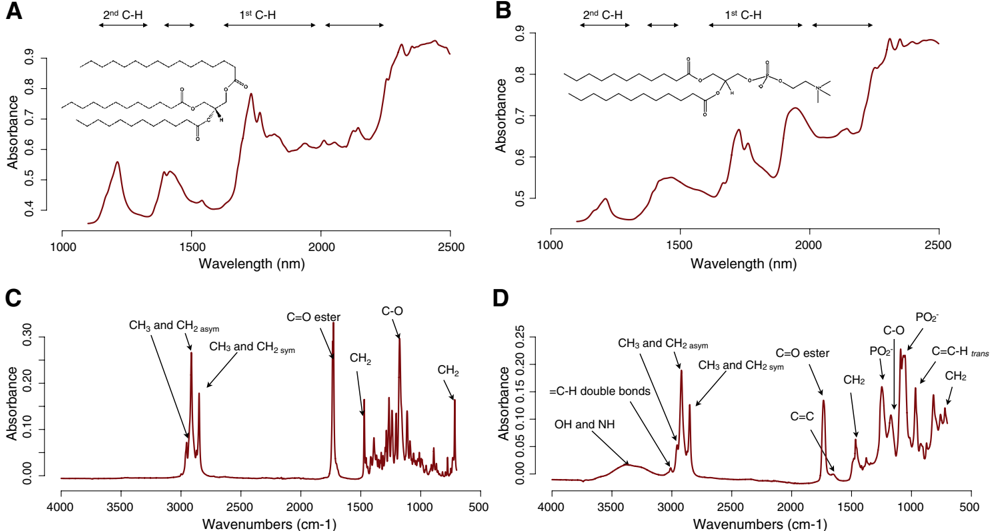
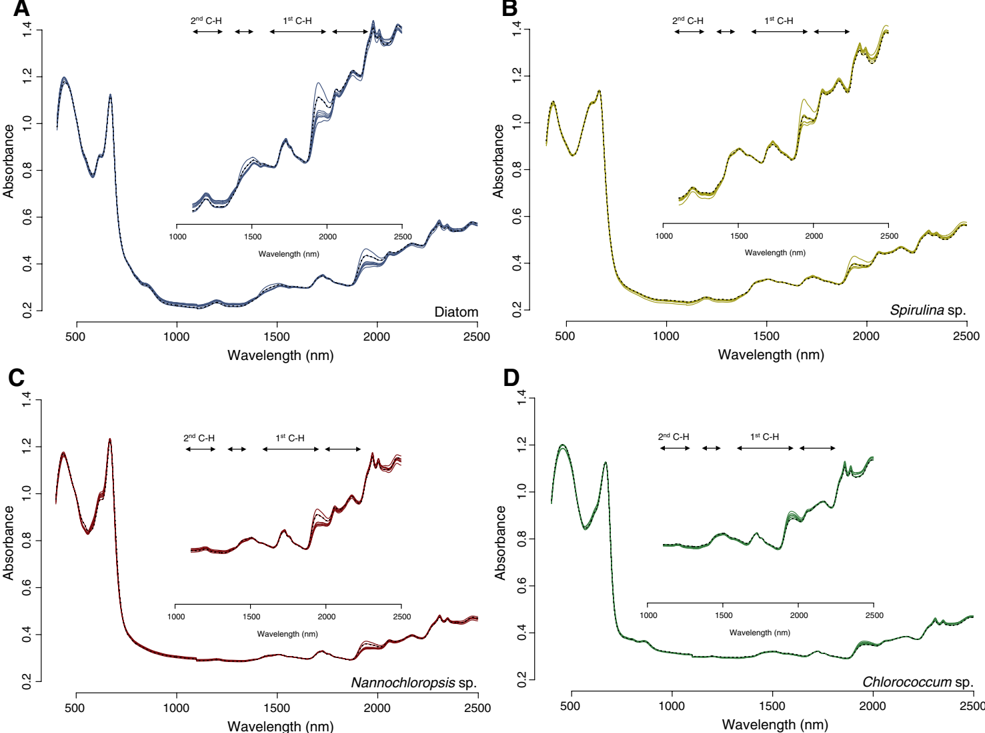
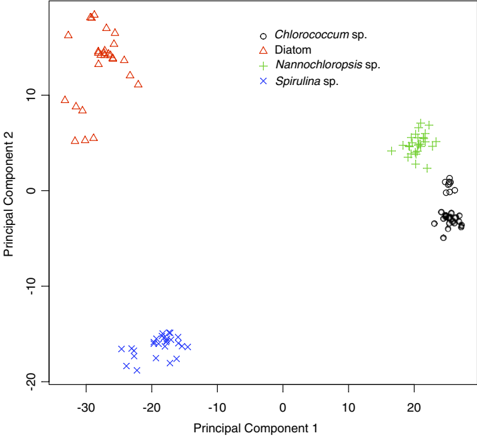
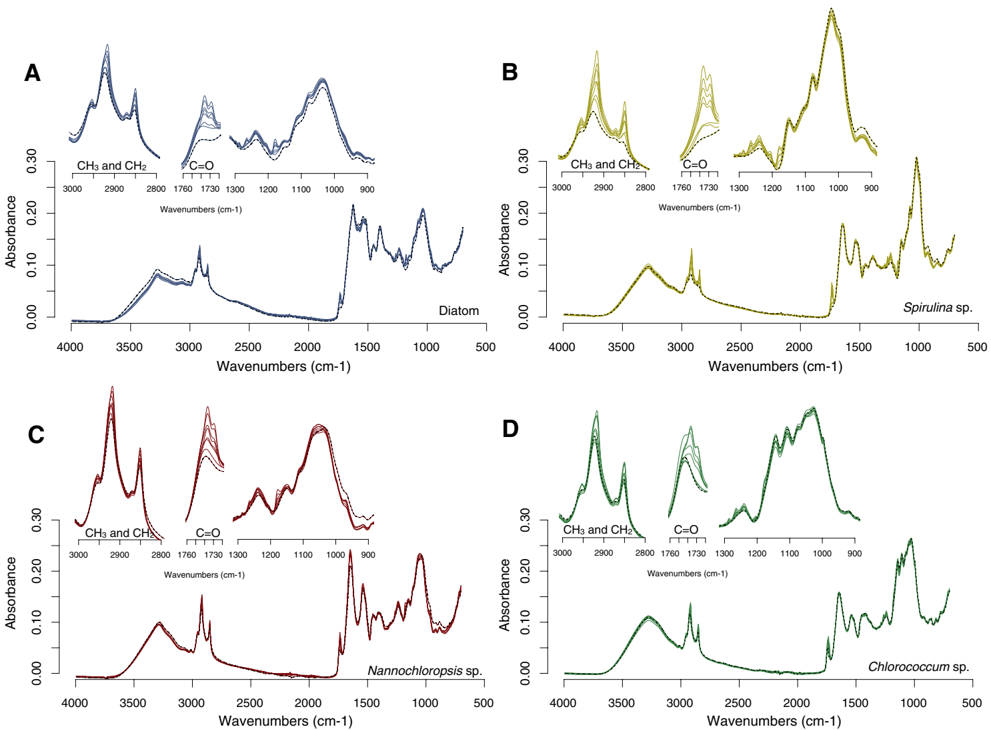
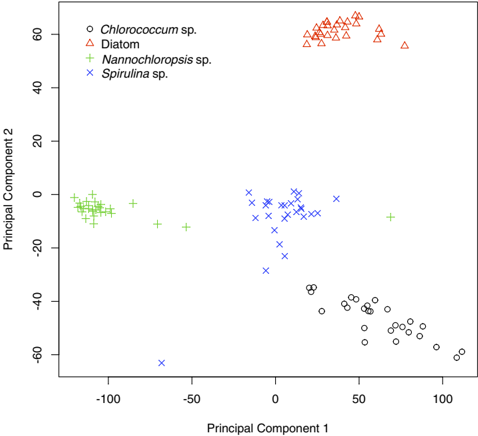
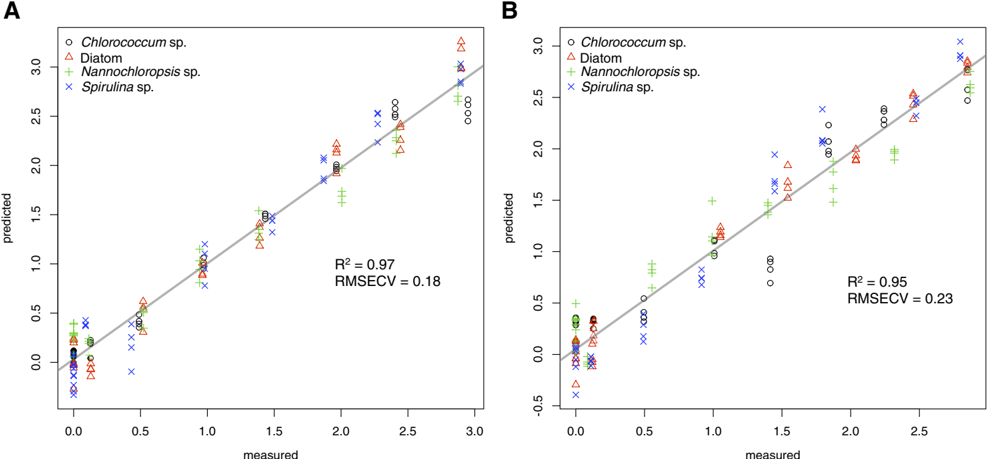
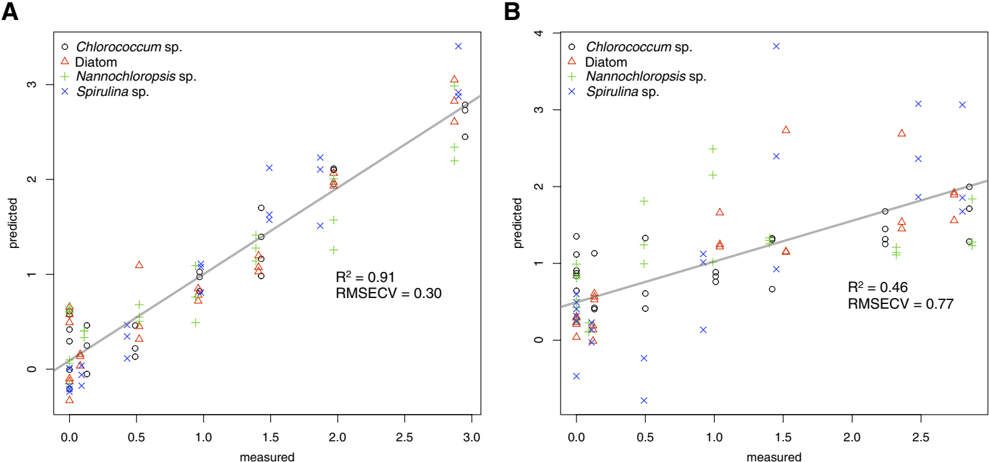
A large number of algal biofuels projects rely on a lipid screening technique for selecting a particular algal strain with which to work. We have developed a multivariate calibration model for predicting the levels of spiked neutral and polar lipids in microalgae, based on infrared (both near-infrared (NIR) and Fourier transform infrared (FTIR)) spectroscopy. The advantage of an infrared spectroscopic technique over traditional chemical methods is the direct, fast, and non-destructive nature of the screening method. This calibration model provides a fast and high-throughput method for determining lipid content, providing an alternative to laborious traditional wet chemical methods. We present data of a study based on nine levels of exogenous lipid spikes (between 1% and 3% (w/w)) of trilaurin as a triglyceride and phosphatidylcholine as a phospholipid model compound in lyophilized algal biomass. We used a chemometric approach to corrrelate the main spectral changes upon increasing phospholipid and triglyceride content in algal biomass collected from single species. A multivariate partial least squares (PLS) calibration model was built and improved upon with the addition of multiple species to the dataset. Our results show that NIR and FTIR spectra of biomass from four species can be used to accurately predict the levels of exogenously added lipids. It appears that the cross-species verification of the predictions is more accurate with the NIR models (R 2 = 0.969 and 0.951 and RMECV = 0.182 and 0.227% for trilaurin and phosphatidylcholine spike respectively), compared with FTIR (R 2 = 0.907 and 0.464 and RMECV = 0.302 and 0.767% for trilaurin and phosphatidylcholine spike, respectively). A fast high-throughput spectroscopic lipid fingerprinting method can be applied in a multitude of screening efforts that are ongoing in the microalgal research community.
Overview
The claims and statistics of this paper haven’t been checked yet.
Free: it reads the open-access text and checks the first 5 claims that cite a source we can check. Create a free account to check every claim.
Integrity signals
Registry
Cites
Statistics
Figures

Verification
Claims the paper makes
The claims and statistics of this paper haven’t been checked yet.
Free: it reads the open-access text and checks the first 5 claims that cite a source we can check. Create a free account to check every claim.
Claims other papers make about this one
Each is checked against this paper’s own text: does it say what the citing paper says it does?
The cited source says what the claim attributes to it.
In the citing paper
“However, the disadvantage of the assays is that they are affected by uneven dye uptake due to the variability of different algal strains and cell wall composition that affected by the growth conditions [21].”
From Review of Methods Used for Microalgal Lipid-Content Analysis (2011) · cites this paper as [21]
The cited source says what the claim attributes to it.
In the citing paper
“Similarly, HPLC (high-performance liquid chromatography), TLC (Thin-layer chromatography) and MS are also powerful techniques for lipid analysis [21].”
From Review of Methods Used for Microalgal Lipid-Content Analysis (2011) · cites this paper as [21]
The check wasn’t confident either way, so it gives no verdict — never disputed.
In the citing paper
“Heraud et al . [64] demonstrated that FTIR spectra for proteins and lipids could be obtained with a micro-FTIR fixed on the large (~200 micron) microalgae Micrasterias hardyi observed in a flow-through cell. In the flow-through cell, the microalgae cell was alive and viable, while changes in proteins and lipids were monitored as nutrient amended media flowed by the microalga.”
From Microalgal process-monitoring based on high-selectivity spectroscopy tools: status and future perspectives (2018) · cites this paper as [64]
Experimental — accuracy not yet measured
Self-check
Percentages, sums and reported differences re-computed from the paper’s own numbers.
The self-check needs the paper’s full text.
Citations
Cites
Microalgal triacylglycerols as feedstocks for biofuel production: perspectives and advances
Hu, Q., Sommerfeld, M., Jarvis, E., Ghirardi, M., Posewitz, M., Seibert, M., & Darzins, A. (2008) · The Plant Journal · doi:10.1111/j.1365-313x.2008.03492.x · Cited by 3,745 · cited 1×
“These four divisions contain good candidates for the potential large-scale algal culture for biofuels production thanks to their inherent high-lipid content and fast growth rates [12].”
BackgroundSteele, D. (1990) · Spectrochimica Acta Part A: Molecular Spectroscopy · doi:10.1016/0584-8539(90)80069-b · Cited by 2,240
Sheehan, J., Dunahay, T., Benemann, J., & Roessler, P. (1998) · doi:10.2172/15003040 · Cited by 1,753
Handbook of Near-Infrared Analysis
Burns, D. A., & Ciurczak, E. W. (2001) · CRC Press eBooks · doi:10.1201/9781003042204 · Cited by 1,466 · cited 1×
“Infrared spectroscopy combined with multivariate calibration methods are widely used in analytical chemistry disciplines [1, 10, 15].”
MethodA user-friendly guide to Multivariate Calibration and Classification
Næs, T., Isaksson, T., Fearn, T., & Davies, T. (2017) · doi:10.1255/978-1-906715-25-0 · Cited by 1,401
Placing microalgae on the biofuels priority list: a review of the technological challenges
Greenwell, H. C., Laurens, L. M. L., Shields, R. J., Lovitt, R. W., & Flynn, K. J. (2010) · Journal of The Royal Society Interface · doi:10.1098/rsif.2009.0322 · Cited by 876
Self-citationMultivariate Analysis of Quality. An Introduction
Martens, H. M. A. M. (2001) · Measurement Science and Technology · doi:10.1088/0957-0233/12/10/708 · Cited by 734
A high throughput Nile red method for quantitative measurement of neutral lipids in microalgae
Chen, W., Zhang, C., Song, L., Sommerfeld, M., & Hu, Q. (2009) · Journal of Microbiological Methods · doi:10.1016/j.mimet.2009.01.001 · Cited by 681 · cited 2×
“However, it is known that this fluorometric method is affected by uneven dye uptake and staining and has been known to cause variability between species and between growth conditions due to differences in cell wall composition, limiting the application of this method [3, 6].”
BackgroundMethodThe promise and challenges of microalgal‐derived biofuels
Pienkos, P. T., & Darzins, A. (2009) · Biofuels, Bioproducts and Biorefining · doi:10.1002/bbb.159 · Cited by 602
Dean, A. P., Sigee, D. C., Estrada, B., & Pittman, J. K. (2010) · Bioresource Technology · doi:10.1016/j.biortech.2010.01.065 · Cited by 523 · cited 1×
“The use of Fourier transform infrared (FTIR) spectroscopy in algal biomass analysis has been useful in monitoring biochemical changes [5, 11, 19].”
MethodFluorometric determination of the neutral lipid content of microalgal cells using Nile Red
Cooksey, K. E., Guckert, J. B., Williams, S. A., & Callis, P. R. (1987) · Journal of Microbiological Methods · doi:10.1016/0167-7012(87)90019-4 · Cited by 361 · cited 1×
“Other methods currently available for screening lipid content in algae are based on fluorescent lipophilic dyes such as Nile red, thin layer chromatography (TLC), and mass spectroscopy (MS) [4, 18, 25].”
MethodFluorescent measurement of microalgal neutral lipids
Elsey, D., Jameson, D., Raleigh, B., & Cooney, M. J. (2007) · Journal of Microbiological Methods · doi:10.1016/j.mimet.2006.11.008 · Cited by 262 · cited 1×
“However, it is known that this fluorometric method is affected by uneven dye uptake and staining and has been known to cause variability between species and between growth conditions due to differences in cell wall composition, limiting the application of this method [3, 6].”
MethodKansiz, M., Heraud, P., Wood, B., Burden, F., Beardall, J., & McNaughton, D. (1999) · Phytochemistry · doi:10.1016/s0031-9422(99)00212-5 · Cited by 238 · cited 1×
“Furthermore, the use of chemometrics in combination with FTIR spectroscopy has been shown to be useful for the discrimination of cyanobacterial strains [14].”
MethodFT-IR Microspectroscopy Enhances Biological and Ecological Analysis of Algae
Murdock, J. N., & Wetzel, D. L. (2009) · Applied Spectroscopy Reviews · doi:10.1080/05704920902907440 · Cited by 223 · cited 1×
“The use of Fourier transform infrared (FTIR) spectroscopy in algal biomass analysis has been useful in monitoring biochemical changes [5, 11, 19].”
MethodVieler, A., Wilhelm, C., Goss, R., Süß, R., & Schiller, J. (2007) · Chemistry and Physics of Lipids · doi:10.1016/j.chemphyslip.2007.06.224 · Cited by 188 · cited 2×
“Similarly, HPLC, TLC, and MS are also powerful techniques for lipid analysis [25].”
MethodCharacterization of the growth and lipid content of the diatom Chaetoceros muelleri
McGinnis, K. M., Dempster, T. A., & Sommerfeld, M. R. (1997) · Journal of Applied Phycology · doi:10.1023/a:1007972214462 · Cited by 178 · cited 1×
“Other methods currently available for screening lipid content in algae are based on fluorescent lipophilic dyes such as Nile red, thin layer chromatography (TLC), and mass spectroscopy (MS) [4, 18, 25].”
MethodMethods of Statistical Analysis
Gouldbn, C. H. (1953) · Journal of AOAC INTERNATIONAL · doi:10.1093/jaoac/36.2.566 · Cited by 148
Hames, B. R., Thomas, S. R., Sluiter, A. D., Roth, C. J., & Templeton, D. W. (2003) · Applied Biochemistry and Biotechnology · doi:10.1385/abab:105:1-3:5 · Cited by 145 · cited 2×
“Nearinfrared (NIR) has been developed as a rapid inexpensive method to monitor chemical composition of corn stover [ 10 ].”
MethodHames, B. R., Thomas, S. R., Sluiter, A. D., Roth, C. J., & Templeton, D. W. (2003) · Biotechnology for Fuels and Chemicals · doi:10.1007/978-1-4612-0057-4_1 · Cited by 91
Zhang, L., & Garcia-Munoz, S. (2009) · Chemometrics and Intelligent Laboratory Systems · doi:10.1016/j.chemolab.2009.03.007 · Cited by 84 · cited 2×
“The prediction uncertainty intervals shown in Table 4 were calculated using the U-deviation [ 27 ] algorithm present in The Unscrambler software.”
MethodThe Structure of Lipids by Spectroscopic and X-Ray Techniques.
Higuchi, W. I. (1966) · Journal of Pharmaceutical Sciences · doi:10.1002/jps.2600550323 · Cited by 79 · cited 1×
“IR spectroscopy has also been important in fundamental lipid research [2] and the oils and fats industry has applied this technique for the determination of trans-isomers in fats.”
BackgroundWolfrum, E. J., & Sluiter, A. D. (2009) · Cellulose · doi:10.1007/s10570-009-9320-2 · Cited by 70 · cited 1×
“It is common to mathematically transform spectral data prior to building calibration models [20, 26 ].”
Self-citationThe Structure of Lipids By Spectroscopic and X-Ray Techniques
Chapman, D. D. (1965) · Cited by 58
山岡, 正. (1999) · Medical Entomology and Zoology · Cited by 57
Analysis of the nutritional status of algae by Fourier transform infrared chemical imaging
Hirschmugl, C. J., Bayarri, Z.-E., Bunta, M., Holt, J. B., & Giordano, M. (2006) · Infrared Physics & Technology · doi:10.1016/j.infrared.2006.01.032 · Cited by 56 · cited 1×
“The use of Fourier transform infrared (FTIR) spectroscopy in algal biomass analysis has been useful in monitoring biochemical changes [5, 11, 19].”
MethodKisner, H. J., Brown, C. W., & Kavarnos, G. J. (1982) · Analytical Chemistry · doi:10.1021/ac00246a008 · Cited by 51 · cited 3×
“Infrared spectroscopy combined with multivariate calibration methods are widely used in analytical chemistry disciplines [1, 10, 15].”
BackgroundMethodHamilton, R., & Cast, J. (1999) · Medical Entomology and Zoology · Cited by 34
Methods of Statistical Analysis
Goulden, C. H. (1953) · Soil Science · doi:10.1097/00010694-195301000-00015 · Cited by 21
Selection of Samples for Calibration
Næs, T., & Isaksson, T. (1994) · NIR news · doi:10.1255/nirn.281 · Cited by 6
Research works printed but not linked: 1
- 7. Esbensen KH (2002) Multivariate data analysis-in practice: an introduction to mutlivariate data analysis and experimental design. CAMO Process AS, Oslo
Cited by
Cuellar‐Bermudez, S. P., Aguilar‐Hernandez, I., Cardenas‐Chavez, D. L., Ornelas‐Soto, N., Romero‐Ogawa, M. A., & Parra‐Saldivar, R. (2015) · Microbial Biotechnology · doi:10.1111/1751-7915.12167 · Cited by 486
“However, some other techniques are currently used: fluorometry, colourimetry, Raman spectroscopy, gas chromatography with mass spectrometric detector, high performance liquid chromatography (HPLC) with pulsed amperometric detection, reverse phase HPLC, UV detection at 205 nm, evaporative light scattering detection, at…”
MethodBiomass for thermochemical conversion: targets and challenges
Tanger, P., Field, J. L., Jahn, C. E., DeFoort, M. W., & Leach, J. E. (2013) · Frontiers in Plant Science · doi:10.3389/fpls.2013.00218 · Cited by 283
An Overview of Algae Biofuel Production and Potential Environmental Impact
Menetrez, M. Y. (2012) · Environmental Science & Technology · doi:10.1021/es300917r · Cited by 276
Govender, T., Ramanna, L., Rawat, I., & Bux, F. (2012) · Bioresource Technology · doi:10.1016/j.biortech.2012.03.024 · Cited by 246
Ansari, F. A., Ravindran, B., Gupta, S. K., Nasr, M., Rawat, I., & Bux, F. (2019) · Journal of Environmental Management · doi:10.1016/j.jenvman.2019.03.123 · Cited by 181
Metadata
- Authors
- Laurens, L. M. L., & Wolfrum, E. J.
- Affiliations
- National Laboratory of the Rockies (US)
- Corresponding author
- Wolfrum, Edward J.
- Venue
- BioEnergy Research
- Published
- 2010-07-27
- Volume
- 4
- Issue
- 1
- Pages
- 22-35
- ISSN
- 1939-1234 (ISSN-L)
- 1939-1242
- OpenAlex
- W2040286588
- Cited by
- 159
- References
- 29
- Citations by year
- 2026: 3 · 2025: 10 · 2024: 6 · 2023: 14 · 2022: 11 · 2021: 14 · 2020: 10 · 2019: 12 · 2018: 12 · 2017: 7 · 2016: 8 · 2015: 11 · 2014: 8 · 2013: 19 · 2012: 7
- FWCI
- 10.16
- Type
- journal article
- Language
- en
- Open access
- hybrid
- doi.org
- Licence
- cc-by-nc
- creativecommons.org/licenses/by-nc/2.0 (tdm)
- Locations
- BioEnergy Research (publishedVersion, cc-by-nc)
- Funders
- U.S. Department of Energy (DE -AC36-08GO28308, DE-AC36-08, DE-AC36, Contract No. DE-AC36-08GO28308, AC36‐08GO28308)
- Laboratory Directed Research and Development (DE-AC36-08GO28308)
- National Renewable Energy Laboratory (Contract No. DE-AC36-08GO28308, DE-AC36-08-GO28308, DE-AC36-08)
- Topics
- Physical Sciences › Chemistry › Analytical Chemistry › Spectroscopy and Chemometric Analyses
- Life Sciences › Biochemistry, Genetics and Molecular Biology › Biophysics › Spectroscopy Techniques in Biomedical and Chemical Research
- Physical Sciences › Energy › Renewable Energy, Sustainability and the Environment › Algal biology and biofuel production
- Keywords
- microalgae, algal lipids, lipid screening, near-infrared spectroscopy, FTIR spectroscopy, multivariate calibration, partial least squares, trilaurin, phosphatidylcholine, neutral lipids, polar lipids, algal biomass, algal biofuels, cross-species validation, lipid fingerprinting
About these checks
Registry, retraction, Cites and statistics results are computed, not judged, with one exception: a printed reference that no index lists is read once by a model before it counts as a citation error. Claims are extracted by a model and kept only when their quote appears verbatim in the text; each cited source is then checked, with a model’s help, for whether it says what the claim relies on. Those verdicts can be wrong — read the claim’s quote and the cited source before relying on one.
Statistics and arithmetic are recomputed, not judged.
Confidence bands are shown only for fields calibrated on our annotated test set. None is calibrated yet, so no band is shown.
What counts as a claim ›How we measure confidence ›How we check this ›
Are you an author, or do you see a problem with this page? Request a review
Data sources
Bibliographic data: Semantic Scholar, OpenAlex, Crossref.
Contains information from the Semantic Scholar Academic Graph Datasets, made available under the ODC Attribution License (ODC-BY 1.0).
Semantic Scholar’s data is described in: Kinney, R., et al. (2023). The Semantic Scholar Open Data Platform. arXiv:2301.10140.
