

A Randomized Trial Investigating the Pharmacokinetics, Pharmacodynamics, and Safety of Subcutaneous Semaglutide Once-Weekly in Healthy Male Japanese and Caucasian Subjects
Open accessThe DOI matches its Crossref record; 39 of the 39 references it cites were found in a registry or an index.
Abstract
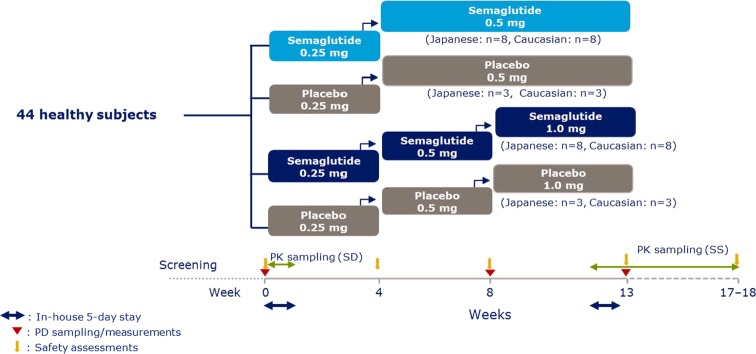
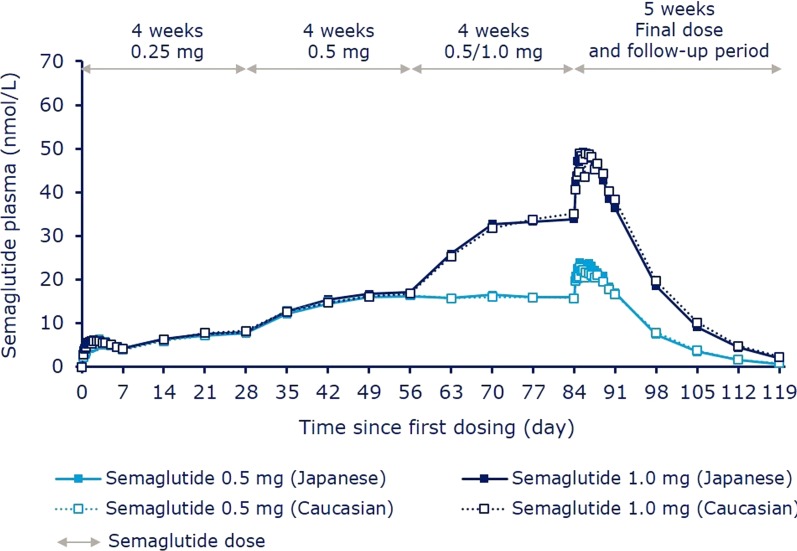
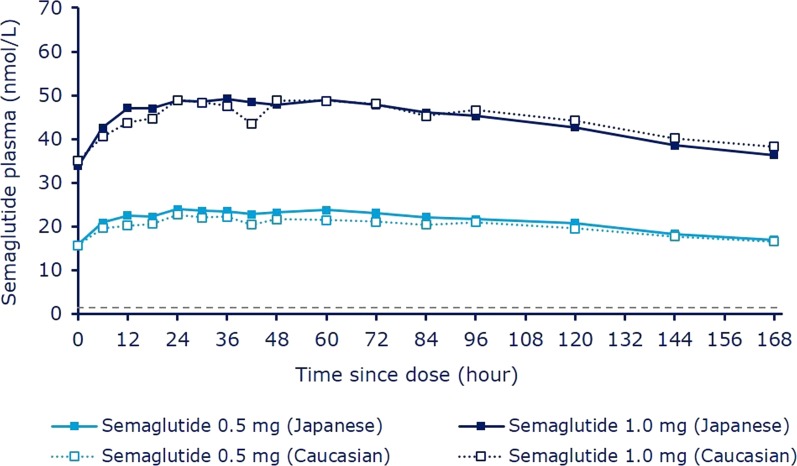
Introduction: Semaglutide is a glucagon-like peptide-1 analogue for once-weekly subcutaneous treatment of type 2 diabetes. This trial compared the pharmacokinetics, pharmacodynamics, and safety of semaglutide in Japanese and Caucasian subjects. Methods: In this single-center, double-blind, parallel-group, 13-week trial, 44 healthy male subjects (22 Japanese, 22 Caucasian) were randomized within each race to semaglutide 0.5 mg ( n = 8), 1.0 mg ( n = 8), placebo 0.5 mg ( n = 3) or 1.0 mg ( n = 3). The primary endpoint was semaglutide exposure at steady state [area under the curve (AUC 0–168h )]. Results: Steady-state exposure of semaglutide was similar for both populations: AUC 0–168h estimated race ratio (ERR), Japanese/Caucasian: 0.5 mg, 1.06; 1.0 mg, 0.99; maximum concentration ( C max ) ERR: 0.5 mg, 1.06; 1.0 mg, 1.02. Exposure after the first dose (0.25 mg) was slightly higher in Japanese versus Caucasian subjects (AUC 0–168h ERR 1.11; C max ERR 1.14). Dose-dependent increases in AUC 0–168h and C max occurred in both populations. Accumulation was as expected, based on the half-life ( t 1/2 , ~ 1 week) and dosing interval of semaglutide. Significant body weight reductions were observed with semaglutide 0.5 mg and 1.0 mg in Japanese (both p ≤ 0.05) and Caucasian (both p ≤ 0.05) subjects versus placebo. No new safety issues were identified. Conclusions: The pharmacokinetic, pharmacodynamic, and safety profiles of semaglutide were similar in Japanese and Caucasian subjects, suggesting that no dose adjustment is required for the clinical use of semaglutide in Japanese subjects. Funding: Novo Nordisk A/S, Denmark. Trial registration: ClinicalTrials.gov identifier NCT02146079. Japanese trial registration number JapicCTI-142550.
Overview
The claims and statistics of this paper haven’t been checked yet.
Free: it reads the open-access text and checks the first 5 claims that cite a source we can check. Create a free account to check every claim.
Integrity signals
Registry
Cites
Statistics
Figures
Verification
Claims the paper makes
The claims and statistics of this paper haven’t been checked yet.
Free: it reads the open-access text and checks the first 5 claims that cite a source we can check. Create a free account to check every claim.
Claims other papers make about this one
Each is checked against this paper’s own text: does it say what the citing paper says it does?
The check wasn’t confident either way, so it gives no verdict — never disputed.
In the citing paper
“In other phase 3 trials, no increase in hypoglycemia risk was observed versus comparator groups, including other GLP-1RAs (18–21, 23, 33–36).”
From Safety of Semaglutide (2021) · cites this paper as [33]
Experimental — accuracy not yet measured
Self-check
Percentages, sums and reported differences re-computed from the paper’s own numbers.
The self-check needs the paper’s full text.
Citations
Cites
Standards of Medical Care in Diabetes
Power, D. (2006) · Diabetes Care · doi:10.2337/diacare.29.02.06.dc05-1593 · Cited by 8,673
Semaglutide and Cardiovascular Outcomes in Patients with Type 2 Diabetes
Marso, S. P., Bain, S. C., Consoli, A., Eliaschewitz, F. G., Jódar, E., Leiter, L. A., Lingvay, I., Rosenstock, J., Seufert, J., Warren, M. L., et al. (2016) · New England Journal of Medicine · doi:10.1056/nejmoa1607141 · Cited by 6,900 · cited 2×
“0% lower risk of the primary composite outcome (death from cardiovascular causes, nonfatal myocardial infarction, or nonfatal stroke) than those who received placebo [29].”
BackgroundThe Physiology of Glucagon-like Peptide 1
Holst, J. J. (2007) · Physiological Reviews · doi:10.1152/physrev.00034.2006 · Cited by 3,371 · cited 2×
“tmax,sema,SS (h) 30 [12; 72] 36 [18; 96] 36 [24; 72] 30 [24; 72]”
BackgroundInzucchi, S. E., Bergenstal, R. M., Buse, J. B., Diamant, M., Ferrannini, E., Nauck, M., Peters, A. L., Tsapas, A., Wender, R., & Matthews, D. R. (2015) · Diabetes Care · doi:10.2337/dc14-2441 · Cited by 3,066 · cited 1×
“GLP-1 receptor agonists have become recognized treatment options for T2D [19], which stimulate insulin and decrease glucagon secretion in a glucose-dependent manner, thereby”
BackgroundA Randomized, Controlled Trial of 3.0 mg of Liraglutide in Weight Management
Pi-Sunyer, X., Astrup, A., Fujioka, K., Greenway, F., Halpern, A., Krempf, M., Lau, D. C. W., le Roux, C. W., Violante Ortiz, R., Jensen, C. B., et al. (2015) · New England Journal of Medicine · doi:10.1056/nejmoa1411892 · Cited by 2,724 · cited 1×
“Weight reduction is a known effect of GLP-1 receptor agonist therapies, and some, such as liraglutide, are licensed to treat individuals with obesity in some countries [37, 38].”
BackgroundGlucagon-like peptide 1 promotes satiety and suppresses energy intake in humans.
Flint, A., Raben, A., Astrup, A., & Holst, J. J. (1998) · Journal of Clinical Investigation · doi:10.1172/jci990 · Cited by 1,402 · cited 1×
“GLP-1 also has effects on appetite and energy intake [13, 14] and is, therefore, an attractive pharmacologic option for the treatment of T2D [15–17].”
BackgroundSelf-citationReduced incretin effect in Type 2 (non-insulin dependent) diabetes
Nauck, M., Stöckmann, F., Ebert, R., & Creutzfeldt, W. (1986) · Diabetologia · doi:10.1007/bf02427280 · Cited by 1,307
Discovery of the once-weekly glucagon-like peptide-1 (GLP-1) analogue semaglutide
Lau, J., Bloch, P., Schäffer, L., Pettersson, I., Spetzler, J., Kofoed, J., Madsen, K., Knudsen, L. B., McGuire, J., Steensgaard, D. B., et al. (2015) · Journal of Medicinal Chemistry · doi:10.1021/acs.jmedchem.5b00726 · Cited by 1,105 · cited 3×
“Semaglutide’s structural modifications from native GLP-1 make it less susceptible to degradation by dipeptidyl peptidase 4 (DPP-4) and, in addition, increase its specific high-affinity binding to albumin [21].”
BackgroundInfluentialNauck, M. A., Kleine, N., �rskov, C., Holst, J. J., Willms, B., & Creutzfeldt, W. (1993) · Diabetologia · doi:10.1007/bf00401145 · Cited by 1,092
Kieffer, T. J., & Francis Habener, J. (1999) · Endocrine Reviews · doi:10.1210/edrv.20.6.0385 · Cited by 1,062 · cited 1×
“Glucagon-like peptide (GLP-1) is an incretin hormone that has a glucose-dependent stimulatory effect on insulin and an inhibitory effect on glucagon secretion from the pancreatic islets [6, 7].”
Background
Research works printed but not linked: 2
- International Conference on Harmonisation Working Group. ICH harmonised tripartite guideline: guideline for good clinical practice E6 (R1). 1996. http://www.ich.org/fileadmin/Public_Web_Site/ICH_Products/Guidelines/Efficacy/E6/E_R1_Guideline.pdf. Accessed Oct 2016.
- Kapitza C Dahl K Jacobsen JB Axelsen MB Flint A Effects of semaglutide on beta cell function and glycaemic control in participants with type 2 diabetes: a randomised, double-blind, placebo-controlled trial Diabetologia 2017 60 1390 1399 10.1007/s00125-017-4289-0 28526920 PMC5491562 · DOI · Paper page
Cited by
Smits, M. M., & Van Raalte, D. H. (2021) · Frontiers in Endocrinology · doi:10.3389/fendo.2021.645563 · Cited by 332
“Moreover, with the maximum oral dosage plasma levels are lower compared with the maximal subcutaneous dose (oral 20 mg yields plasma levels of ~25 nM, subcutaneous 1 mg yields plasma levels of ~45 nM (33, 34)).”
BackgroundA review of lipidation in the development of advanced protein and peptide therapeutics
Menacho‐Melgar, R., Decker, J. S., Hennigan, J. N., & Lynch, M. (2018) · Journal of Controlled Release · doi:10.1016/j.jconrel.2018.12.032 · Cited by 171
“Importantly, initial clinical studies have shown no significant safety concerns for these PEG-based and OEGbased linkers [48,101], though their long-term effects are yet to be evaluated [102].”
Semaglutide as a promising antiobesity drug
Christou, G. A., Katsiki, N., Blundell, J., Fruhbeck, G., & Kiortsis, D. N. (2019) · Obesity Reviews · doi:10.1111/obr.12839 · Cited by 159
The psychophysiology of anxiety.
LADER, M. H. (1983) · PubMed · Cited by 133
Clinical Pharmacokinetics of Semaglutide: A Systematic Review
Yang, X., & Yang, X. (2024) · Drug Design Development and Therapy · doi:10.2147/dddt.s470826 · Cited by 120
“28,33,34 Although the absorption enhancer SNAC can promote the transport and entry of oral semaglutide into the systemic circulation, semaglutide exposure remains relatively low compared to subcutaneous injection.”
BackgroundResultPopulation Pharmacokinetics of Semaglutide for Type 2 Diabetes
Overgaard, R. V., Delff, P. H., Petri, K. C. C., Anderson, T. W., Flint, A., & Ingwersen, S. H. (2019) · Diabetes Therapy · doi:10.1007/s13300-019-0581-y · Cited by 47
Self-citationZhang, R., Hou, Q., Li, B., Deng, L., Yang, Y., Li, T.-X., Yao, X., Yang, L.-L., Lin, X.-L., Liao, Y.-Q., et al. (2022) · Frontiers in Endocrinology · doi:10.3389/fendo.2023.1132004 · Cited by 41
“One pharmacodynamic study reported that semaglutide demonstrated a dose-dependent effect on weight loss (44).”
BackgroundCardioprotective Effects of Semaglutide on Isolated Human Ventricular Myocardium
Krammer, T., Baier, M. J., Hegner, P., Zschiedrich, T., Lukas, D., Wolf, M., Phu, C. L., Lutz, V., Evert, K., Kozakov, K., et al. (2025) · European Journal of Heart Failure · doi:10.1002/ejhf.3644 · Cited by 34
Efeitos adversos da semaglutida comparada à liraglutida: uma revisão integrativa de literatura
de Moraes, A. L. S. M., Vilela, B. S., Souza, B. C., Falleiros, I. D. F. I., Monteiro, I. D. L. P., & Ribeiro, J. S. O. (2022) · Research Society and Development · doi:10.33448/rsd-v11i10.33181 · Cited by 32
Shi, A., Xie, P., Nielsen, L. L., Skjøth, T. V., He, X., & Haugaard, S. P. (2020) · Advances in Therapy · doi:10.1007/s12325-020-01548-y · Cited by 32
Yazawa, R., Ishida, M., Balavarca, Y., & Hennige, A. M. (2023) · Diabetes, Obesity and Metabolism · doi:10.1111/dom.15064 · Cited by 23
“02 kg in DG 2 in the present study at 12 weeks).(41) Key Phase III trials examining semaglutide in Japanese individuals with type 2 diabetes reached bodyweight reductions of 3.”
BackgroundSemaglutide-eye-catching results
Berković, M. C., & Strollo, F. (2023) · World Journal of Diabetes · doi:10.4239/wjd.v14.i4.424 · Cited by 24
Switch-to-Semaglutide Study (STS-Study): a Retrospective Cohort Study
Hepprich, M., Zillig, D., Florian-Reynoso, M. A., Donath, M. Y., & Rudofsky, G. (2021) · Diabetes Therapy · doi:10.1007/s13300-021-01016-y · Cited by 18
“Additionally, different pharmacodynamic effects given the substantially varying biochemical properties and thereby a different effect on appetite, satiety, gastric emptying and insulin compared to the respective GLP-1 analogues are likely causes for the results observed in this study [11, 14, 15].”
ResultBabazadeh, D., Wyatt, S., & Steinberg, F. M. (2025) · Advances in Nutrition · doi:10.1016/j.advnut.2025.100491 · Cited by 16
Mechanisms of Non-alcoholic Fatty Liver Disease and Beneficial Effects of Semaglutide: A Review
Alfawaz, S. A., Burzangi, A. S., & Esmat, A. (2024) · Cureus · doi:10.7759/cureus.67080 · Cited by 16
“In disease-free Caucasian and Japanese individuals, the once-weekly administration of semaglutide leads to dose-dependent increases in exposure for both 0.5 mg and 1 mg doses [129].”
BackgroundInfluentialXie, P., Abildlund, M. T., Bækdal, T. A., He, X., Lyauk, Y. K., Patted, U. R. H., Zu, N., & Shi, A. (2024) · Diabetes Obesity and Metabolism · doi:10.1111/dom.15624 · Cited by 14
“33 The t ½ of oral semaglutide in this trial was 163 h, and the AUC 0-24h,sema,SS was 233, 552 and 1288 (h (cid:1) nmol/L) for 3, 7 and 14 mg, respectively; these values are consistent with the values reported in a phase 1 trial that investigated the PK of 20 and 40 mg doses of oral semaglutide in…”
Semaglutide - properties, action and chromatographic analysis
Wasilewska, B., & Petruczynik, A. (2025) · Journal of Diabetes & Metabolic Disorders · doi:10.1007/s40200-025-01711-8 · Cited by 13
“The LC-MS/MS procedure was also applied in a study of the pharmacokinetics, pharmacodynamics, and safety of once-weekly sub-cutaneous semaglutide in healthy Japanese and Caucasian male subjects [82 ].”
Fineman, M. S., Bryant, C. L. N., Colbert, K., Jozefiak, T. H., Petersen, J. S., Horowitz, M., Vora, J. P., Rayner, C. K., Wabnitz, P. A., & Nimgaonkar, A. (2023) · Diabetes Obesity and Metabolism · doi:10.1111/dom.15066 · Cited by 11
Sillassen, C. D. B., Petersen, J. J., Faltermeier, P., Yucel, D., Siddiqui, F., Andersen, R. K., Graever, L., Bjerg, J. L., Kamp, C. B., Grand, J., et al. (2025) · BMC Medicine · doi:10.1186/s12916-025-04486-0 · Cited by 10
Semaglutide once-weekly: improved efficacy with a new safety warning
Coon, S. A., Crannage, E. F., Kerwin, L. C., & Guyton, J. E. (2018) · Expert Review of Clinical Pharmacology · doi:10.1080/17512433.2018.1534201 · Cited by 10
Arefeva, A., Banko, V. V., Sadovskikh, M. O., & Noskov, S. M. (2023) · Meditsinskiy sovet = Medical Council · doi:10.21518/ms2023-312 · Cited by 10
Bouhajib, M., Tayab, Z. R., Marco, C. D., & Suh, D. (2025) · Journal of Basic and Clinical Physiology and Pharmacology · doi:10.1515/jbcpp-2025-0026 · Cited by 7
Memon, M. Y., Ahsan, T., Jabeen, R., Latif, S., Qasim, S. F., & Imran, P. (2024) · Journal of Family Medicine and Primary Care · doi:10.4103/jfmpc.jfmpc_159_24 · Cited by 5
Zhang, S., Niu, S., An, S., Cai, X., & Lao, X. Q. (2026) · European Journal of Pharmacology · doi:10.1016/j.ejphar.2026.178587 · Cited by 5
IcoSema: unveiling the future of diabetes management from a clinical pharmacology perspective
Seetharaman, R., Monteiro, R. C., Maradia, J., & Tripathi, R. K. (2024) · Journal of Basic and Clinical Physiology and Pharmacology · doi:10.1515/jbcpp-2024-0058 · Cited by 4
Pharmaceutical Peptides: From Synthesis and Mechanistic Pharmacology to Future Biologic Therapeutics
Khan, M. Y., Nawaz, T., Akash, M. S. H., & Amin, A. (2026) · Pharmaceuticals · doi:10.3390/ph19060811 · Cited by 3
“Semaglutide further extends this principle through structural modifications that support once-weekly exposure, and a randomized pharmacokinetic study reported terminal half-life values of approximately 145–167 h at steady state [149].”
Bryant, C. L. N., Colbert, K., Hompesch, M., Chaves, S., Nimgaonkar, A., & Fineman, M. S. (2025) · Diabetes Obesity and Metabolism · doi:10.1111/dom.16664 · Cited by 3
Méndez-Pino, L., Goldblatt, J., Godie, D., Ravi, S., Williams, K., Amcheslavsky, J., Guerra‐Londono, C. E., & Ravikant, N. T. (2026) · Canadian Journal of Anesthesia/Journal canadien d anesthésie · doi:10.1007/s12630-026-03187-3 · Cited by 2
“La cessation de l ’ AR GLP-1 moins de 7 jours avant l ’ intervention n'était pas associée de façon statistiquement signi fi cative à un contenu gastrique résiduel (RCA, 5,23; IC 95 %, 0,67 à 39,38; P = 0,12).”
Tiwari, A., Akbar, S., Joseph, A., Malayandi, R., Chilamakuri, S. N., & Natesan, S. (2026) · Xenobiotica · doi:10.1080/00498254.2026.2683901 · Cited by 1
“Investigation of SEM population pharmacokinetics (PK) for the subcutaneous route of administration has already been performed using PK modelling to identify covariates in healthy children and other populations (Carlsson Petri et al. 2018; Ikushima et al. 2018; Machado et al. 2023).”
de Oliveira, B. V., Franco, P. H. M., Nogueira, M. C., & Faria, M. A. G. (2025) · International Journal of Nutrology · doi:10.54448/ijn25207
“Despite this, there is no data available comparing the pharmacokinetic profile of both formulations with each other [12,13] .”
Albalushi, S., Tran, K. N., Talpeka, A., Karaduman, S., Boujemaa, S., Nguyen, N. B., Nguyen, T. N., & Zarif, Z. (2024) · Digital Access to Scholarship at Harvard (DASH) (Harvard University) · doi:10.53901/tjbs.2024.03.art03
医薬品の安全性評価における人種/民族の影響:システマティックレビュー及びメタアナリシスによる日本人と非日本人集団の比較
SAKURAI, S. (2026) · Institutional Repositories DataBase (IRDB)
Zhang, R., Hou, Q.-C., Li, B.-H., Deng, L., Yang, Y.-M., Li, T.-X., Yao, X.-Q., Yang, L.-L., Lin, X.-L., Liao, Y.-Q., et al. (2023) · doi:10.3389/fendo.2023.1132004.s001
Metadata
- Authors
- Ikushima, I., Jensen, L., Flint, A., Nishida, T., Zacho, J., & Irie, S.
- Affiliations
- Novo Nordisk (Denmark) (DK)
- Novo Nordisk Pharma Ltd. (Japan) (JP)
- SOUSEIKAI Global Clinical Research Center (JP)
- Corresponding author
- Ikushima, Ippei
- Venue
- Advances in Therapy
- Published
- 2018-03-13
- Volume
- 35
- Issue
- 4
- Pages
- 531-544
- ISSN
- 0741-238X (ISSN-L)
- 1865-8652
- PMC
- PMC5910468
- OpenAlex
- W2791854127
- Cited by
- 28
- References
- 39
- Citations by year
- 2026: 3 · 2025: 6 · 2024: 5 · 2023: 5 · 2022: 1 · 2021: 2 · 2020: 1 · 2019: 2 · 2018: 2
- FWCI
- 1.39
- Type
- journal article
- Language
- en
- Open access
- hybrid
- doi.org
- Licence
- cc-by-nc
- creativecommons.org/licenses/by/4.0 (tdm)
- creativecommons.org/licenses/by/4.0 (vor)
- Locations
- Advances in Therapy (publishedVersion, cc-by-nc)
- Europe PMC (PubMed Central) (publishedVersion)
- PubMed Central (publishedVersion, cc-by-nc)
- PubMed (publishedVersion)
- Funders
- Novo Nordisk
- Topics
- Health Sciences › Medicine › Endocrinology, Diabetes and Metabolism › Diabetes Treatment and Management
- Health Sciences › Medicine › Endocrinology, Diabetes and Metabolism › Diabetes Management and Research
- Health Sciences › Medicine › Pediatrics, Perinatology and Child Health › Pharmaceutical studies and practices
- Keywords
- glucagon-like peptide-1 analogues, pharmacokinetics, pharmacodynamics, racial differences, Japanese subjects, dose proportionality, weight loss, type 2 diabetes, dose adjustment, healthy men
- MeSH terms
- Semaglutide, Adult, Body Weight, Diabetes Mellitus, Type 2, Double-Blind Method, Glucagon-Like Peptides, Half-Life, Humans, Hypoglycemic Agents, Injections, Subcutaneous, Male, Middle Aged, Weight Loss, Area Under Curve, White People, Asian People, Glucagon-Like Peptide 1, Young Adult
About these checks
Registry, retraction, Cites and statistics results are computed, not judged, with one exception: a printed reference that no index lists is read once by a model before it counts as a citation error. Claims are extracted by a model and kept only when their quote appears verbatim in the text; each cited source is then checked, with a model’s help, for whether it says what the claim relies on. Those verdicts can be wrong — read the claim’s quote and the cited source before relying on one.
Statistics and arithmetic are recomputed, not judged.
Confidence bands are shown only for fields calibrated on our annotated test set. None is calibrated yet, so no band is shown.
What counts as a claim ›How we measure confidence ›How we check this ›
Are you an author, or do you see a problem with this page? Request a review
Data sources
Bibliographic data: Semantic Scholar, OpenAlex, Crossref.
Contains information from the Semantic Scholar Academic Graph Datasets, made available under the ODC Attribution License (ODC-BY 1.0).
Semantic Scholar’s data is described in: Kinney, R., et al. (2023). The Semantic Scholar Open Data Platform. arXiv:2301.10140.
