

A Randomized Trial Investigating the Pharmacokinetics, Pharmacodynamics, and Safety of Subcutaneous Semaglutide Once-Weekly in Healthy Male Japanese and Caucasian Subjects
Open accessThe DOI matches its Crossref record; 39 of the 39 references it cites were found in a registry or an index.
Abstract
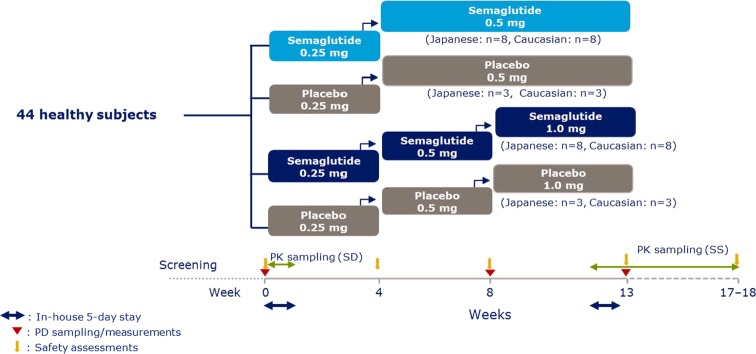
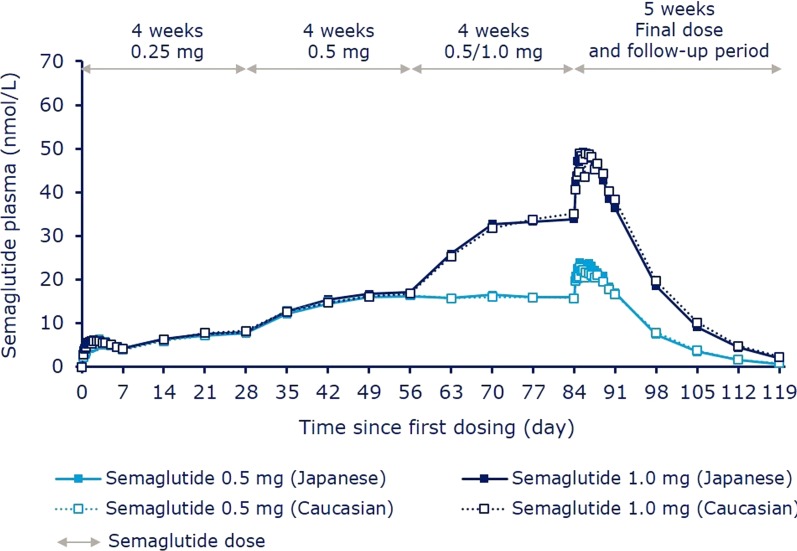
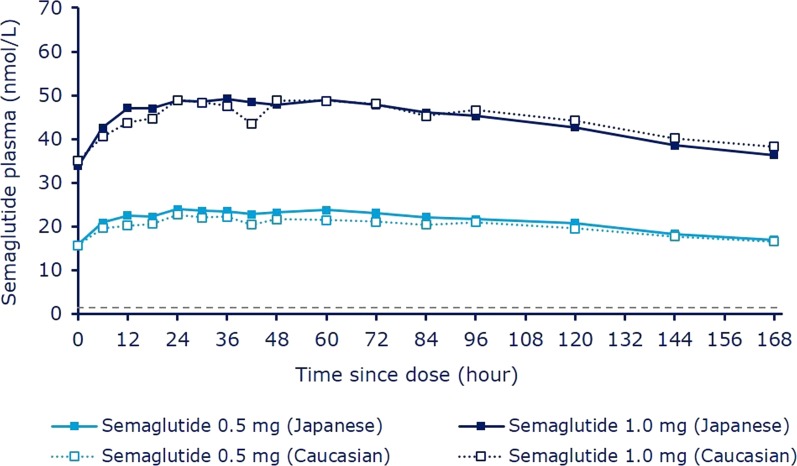
Introduction: Semaglutide is a glucagon-like peptide-1 analogue for once-weekly subcutaneous treatment of type 2 diabetes. This trial compared the pharmacokinetics, pharmacodynamics, and safety of semaglutide in Japanese and Caucasian subjects. Methods: In this single-center, double-blind, parallel-group, 13-week trial, 44 healthy male subjects (22 Japanese, 22 Caucasian) were randomized within each race to semaglutide 0.5 mg ( n = 8), 1.0 mg ( n = 8), placebo 0.5 mg ( n = 3) or 1.0 mg ( n = 3). The primary endpoint was semaglutide exposure at steady state [area under the curve (AUC 0–168h )]. Results: Steady-state exposure of semaglutide was similar for both populations: AUC 0–168h estimated race ratio (ERR), Japanese/Caucasian: 0.5 mg, 1.06; 1.0 mg, 0.99; maximum concentration ( C max ) ERR: 0.5 mg, 1.06; 1.0 mg, 1.02. Exposure after the first dose (0.25 mg) was slightly higher in Japanese versus Caucasian subjects (AUC 0–168h ERR 1.11; C max ERR 1.14). Dose-dependent increases in AUC 0–168h and C max occurred in both populations. Accumulation was as expected, based on the half-life ( t 1/2 , ~ 1 week) and dosing interval of semaglutide. Significant body weight reductions were observed with semaglutide 0.5 mg and 1.0 mg in Japanese (both p ≤ 0.05) and Caucasian (both p ≤ 0.05) subjects versus placebo. No new safety issues were identified. Conclusions: The pharmacokinetic, pharmacodynamic, and safety profiles of semaglutide were similar in Japanese and Caucasian subjects, suggesting that no dose adjustment is required for the clinical use of semaglutide in Japanese subjects. Funding: Novo Nordisk A/S, Denmark. Trial registration: ClinicalTrials.gov identifier NCT02146079. Japanese trial registration number JapicCTI-142550.
Overview
The claims and statistics of this paper haven’t been checked yet.
Free: it reads the open-access text and checks the first 5 claims that cite a source we can check. Create a free account to check every claim.
Integrity signals
Registry
Cites
Statistics
Figures
Verification
Claims the paper makes
The claims and statistics of this paper haven’t been checked yet.
Free: it reads the open-access text and checks the first 5 claims that cite a source we can check. Create a free account to check every claim.
Claims other papers make about this one
Each is checked against this paper’s own text: does it say what the citing paper says it does?
The check wasn’t confident either way, so it gives no verdict — never disputed.
In the citing paper
“In other phase 3 trials, no increase in hypoglycemia risk was observed versus comparator groups, including other GLP-1RAs (18–21, 23, 33–36).”
From Safety of Semaglutide (2021) · cites this paper as [33]
Experimental — accuracy not yet measured
Self-check
Percentages, sums and reported differences re-computed from the paper’s own numbers.
The self-check needs the paper’s full text.
Citations
Cites
Standards of Medical Care in Diabetes
Power, D. (2006) · Diabetes Care · doi:10.2337/diacare.29.02.06.dc05-1593 · Cited by 8,673
Semaglutide and Cardiovascular Outcomes in Patients with Type 2 Diabetes
Marso, S. P., Bain, S. C., Consoli, A., Eliaschewitz, F. G., Jódar, E., Leiter, L. A., Lingvay, I., Rosenstock, J., Seufert, J., Warren, M. L., et al. (2016) · New England Journal of Medicine · doi:10.1056/nejmoa1607141 · Cited by 6,900 · cited 2×
“0% lower risk of the primary composite outcome (death from cardiovascular causes, nonfatal myocardial infarction, or nonfatal stroke) than those who received placebo [29].”
BackgroundThe Physiology of Glucagon-like Peptide 1
Holst, J. J. (2007) · Physiological Reviews · doi:10.1152/physrev.00034.2006 · Cited by 3,371 · cited 2×
“tmax,sema,SS (h) 30 [12; 72] 36 [18; 96] 36 [24; 72] 30 [24; 72]”
BackgroundInzucchi, S. E., Bergenstal, R. M., Buse, J. B., Diamant, M., Ferrannini, E., Nauck, M., Peters, A. L., Tsapas, A., Wender, R., & Matthews, D. R. (2015) · Diabetes Care · doi:10.2337/dc14-2441 · Cited by 3,066 · cited 1×
“GLP-1 receptor agonists have become recognized treatment options for T2D [19], which stimulate insulin and decrease glucagon secretion in a glucose-dependent manner, thereby”
BackgroundA Randomized, Controlled Trial of 3.0 mg of Liraglutide in Weight Management
Pi-Sunyer, X., Astrup, A., Fujioka, K., Greenway, F., Halpern, A., Krempf, M., Lau, D. C. W., le Roux, C. W., Violante Ortiz, R., Jensen, C. B., et al. (2015) · New England Journal of Medicine · doi:10.1056/nejmoa1411892 · Cited by 2,724 · cited 1×
“Weight reduction is a known effect of GLP-1 receptor agonist therapies, and some, such as liraglutide, are licensed to treat individuals with obesity in some countries [37, 38].”
BackgroundGlucagon-like peptide 1 promotes satiety and suppresses energy intake in humans.
Flint, A., Raben, A., Astrup, A., & Holst, J. J. (1998) · Journal of Clinical Investigation · doi:10.1172/jci990 · Cited by 1,402 · cited 1×
“GLP-1 also has effects on appetite and energy intake [13, 14] and is, therefore, an attractive pharmacologic option for the treatment of T2D [15–17].”
BackgroundSelf-citationReduced incretin effect in Type 2 (non-insulin dependent) diabetes
Nauck, M., Stöckmann, F., Ebert, R., & Creutzfeldt, W. (1986) · Diabetologia · doi:10.1007/bf02427280 · Cited by 1,307
Discovery of the once-weekly glucagon-like peptide-1 (GLP-1) analogue semaglutide
Lau, J., Bloch, P., Schäffer, L., Pettersson, I., Spetzler, J., Kofoed, J., Madsen, K., Knudsen, L. B., McGuire, J., Steensgaard, D. B., et al. (2015) · Journal of Medicinal Chemistry · doi:10.1021/acs.jmedchem.5b00726 · Cited by 1,105 · cited 3×
“Semaglutide’s structural modifications from native GLP-1 make it less susceptible to degradation by dipeptidyl peptidase 4 (DPP-4) and, in addition, increase its specific high-affinity binding to albumin [21].”
BackgroundInfluentialNauck, M. A., Kleine, N., �rskov, C., Holst, J. J., Willms, B., & Creutzfeldt, W. (1993) · Diabetologia · doi:10.1007/bf00401145 · Cited by 1,092
Kieffer, T. J., & Francis Habener, J. (1999) · Endocrine Reviews · doi:10.1210/edrv.20.6.0385 · Cited by 1,062 · cited 1×
“Glucagon-like peptide (GLP-1) is an incretin hormone that has a glucose-dependent stimulatory effect on insulin and an inhibitory effect on glucagon secretion from the pancreatic islets [6, 7].”
BackgroundPlasma Insulin Responses to Oral and Intravenous Glucose: Studies in Normal and Diabetic Subjects*
Perley, M. J., & Kipnis, D. M. (1967) · Journal of Clinical Investigation · doi:10.1172/jci105685 · Cited by 917
Garber, A. J., Abrahamson, M. J., Barzilay, J. I., Blonde, L., Bloomgarden, Z. T., Bush, M. A., Dagogo-Jack, S., DeFronzo, R. A., Einhorn, D., Fonseca, V. A., et al. (2016) · Endocrine Practice · doi:10.4158/ep151126.cs · Cited by 878
Determinants of the impaired secretion of glucagon-like peptide-1 in type 2 diabetic patients
Toft-Nielsen, M.-B., Damholt, M. B., Madsbad, S., Hilsted, L. M., Hughes, T. E., Michelsen, B. K., & Holst, J. J. (2001) · The Journal of Clinical Endocrinology & Metabolism · doi:10.1210/jcem.86.8.7750 · Cited by 869
Sorli, C., Harashima, S.-I., Tsoukas, G. M., Unger, J., Karsbøl, J. D., Hansen, T., & Bain, S. C. (2017) · The Lancet Diabetes & Endocrinology · doi:10.1016/s2213-8587(17)30013-x · Cited by 745
The Prevalence of Meeting A1C, Blood Pressure, and LDL Goals Among People With Diabetes, 1988–2010
Stark Casagrande, S., Fradkin, J. E., Saydah, S. H., Rust, K. F., & Cowie, C. C. (2013) · Diabetes Care · doi:10.2337/dc12-2258 · Cited by 719 · cited 1×
“Despite the availability of numerous glucose-lowering drugs, there remains an unmet need for effective diabetes treatment [2], as a significant proportion of individuals with T2D are still not achieving recommended glycemic targets (e.”
BackgroundAhmann, A. J., Capehorn, M., Charpentier, G., Dotta, F., Henkel, E., Lingvay, I., Holst, A. G., Annett, M. P., & Aroda, V. R. (2018) · Diabetes Care · doi:10.2337/dc17-0417 · Cited by 596 · cited 1×
“GLP-1 receptor agonists are known to affect pulse rate [42] and, accordingly, when semaglutide was compared head-to-head with another once-weekly GLP-1 receptor agonist, exenatide extended release, the elevation in pulse rate was not significantly different [26].”
BackgroundThe incretin system and its role in type 2 diabetes mellitus
HOLST, J., VILSBOLL, T., & DEACON, C. (2009) · Molecular and Cellular Endocrinology · doi:10.1016/j.mce.2008.08.012 · Cited by 515 · cited 1×
“Glucagon-like peptide (GLP-1) is an incretin hormone that has a glucose-dependent stimulatory effect on insulin and an inhibitory effect on glucagon secretion from the pancreatic islets [6, 7].”
BackgroundAhrén, B., Masmiquel, L., Kumar, H., Sargin, M., Karsbøl, J. D., Jacobsen, S. H., & Chow, F. (2017) · The Lancet Diabetes & Endocrinology · doi:10.1016/s2213-8587(17)30092-x · Cited by 495
Secretion of glucagon-like peptide-1 (GLP-1) in type 2 diabetes: what is up, what is down?
Nauck, M. A., Vardarli, I., Deacon, C. F., Holst, J. J., & Meier, J. J. (2011) · Diabetologia · doi:10.1007/s00125-010-1896-4 · Cited by 465
Aroda, V. R., Bain, S. C., Cariou, B., Piletič, M., Rose, L., Axelsen, M., Rowe, E., & DeVries, J. H. (2017) · The Lancet Diabetes & Endocrinology · doi:10.1016/s2213-8587(17)30085-2 · Cited by 464
Højberg, P. V., Vilsbøll, T., Rabøl, R., Knop, F. K., Bache, M., Krarup, T., Holst, J. J., & Madsbad, S. (2009) · Diabetologia · doi:10.1007/s00125-008-1195-5 · Cited by 414 · cited 2×
“The effects of GLP-1 are reduced in individuals with T2D [8–11]; however, the ability of GLP-1 to lower blood glucose levels is preserved when it is administered at supraphysiologic levels [12].”
BackgroundMeloni, A. R., DeYoung, M. B., Lowe, C., & Parkes, D. G. (2013) · Diabetes, Obesity and Metabolism · doi:10.1111/j.1463-1326.2012.01663.x · Cited by 407 · cited 1×
“improving glycemic control with a relatively low risk of hypoglycemia [20].”
BackgroundThe Role of Ethnicity in Variability in Response to Drugs: Focus on Clinical Pharmacology Studies
Yasuda, S., Zhang, L., & Huang, S.-M. (2008) · Clinical Pharmacology & Therapeutics · doi:10.1038/clpt.2008.141 · Cited by 393 · cited 1×
“Genetic differences, diet, and other environmental factors can contribute to differences in therapeutic drug response across different regional populations [33].”
Backgroundβ Cell Dysfunction Versus Insulin Resistance in the Pathogenesis of Type 2 Diabetes in East Asians
Yabe, D., Seino, Y., Fukushima, M., & Seino, S. (2015) · Current Diabetes Reports · doi:10.1007/s11892-015-0602-9 · Cited by 328
Robinson, L. E., Holt, T. A., Rees, K., Randeva, H. S., & O'Hare, J. P. (2013) · BMJ Open · doi:10.1136/bmjopen-2012-001986 · Cited by 296 · cited 1×
“GLP-1 receptor agonists are known to affect pulse rate [42] and, accordingly, when semaglutide was compared head-to-head with another once-weekly GLP-1 receptor agonist, exenatide extended release, the elevation in pulse rate was not significantly different [26].”
BackgroundNauck, M. A. (2011) · The American Journal of Medicine · doi:10.1016/j.amjmed.2010.11.002 · Cited by 295
Impaired regulation of the incretin effect in patients with type 2 diabetes
Bagger, J. I., Knop, F. K., Lund, A., Vestergaard, H., Holst, J. J., & Vilsbøll, T. (2011) · The Journal of Clinical Endocrinology & Metabolism · doi:10.1210/jc.2010-2435 · Cited by 219
American Diabetes Association (2016) · Diabetes Care · doi:10.2337/dc16-s008 · Cited by 215
Kapitza, C., Nosek, L., Jensen, L., Hartvig, H., Jensen, C. B., & Flint, A. (2015) · The Journal of Clinical Pharmacology · doi:10.1002/jcph.443 · Cited by 175 · cited 3×
“The resultant half-life of approximately 1 week makes semaglutide appropriate for once-weekly administration [22, 23].”
BackgroundMethodSelf-citationIncretin‐based drugs for type 2 diabetes: Focus on East Asian perspectives
Seino, Y., Kuwata, H., & Yabe, D. (2016) · Journal of Diabetes Investigation · doi:10.1111/jdi.12490 · Cited by 175
Kaku, K., Yamada, Y., Watada, H., Abiko, A., Nishida, T., Zacho, J., & Kiyosue, A. (2018) · Diabetes, Obesity and Metabolism · doi:10.1111/dom.13218 · Cited by 132
Self-citationMarbury, T. C., Flint, A., Jacobsen, J. B., Derving Karsbøl, J., & Lasseter, K. (2017) · Clinical Pharmacokinetics · doi:10.1007/s40262-017-0528-2 · Cited by 130 · cited 1×
“Clinical pharmacology studies have shown that pharmacokinetic properties of semaglutide are not significantly affected by renal function [30] or hepatic impairment [31], suggesting that no dose adjustment is warranted.”
BackgroundSelf-citationSeino, Y., Terauchi, Y., Osonoi, T., Yabe, D., Abe, N., Nishida, T., Zacho, J., & Kaneko, S. (2018) · Diabetes, Obesity and Metabolism · doi:10.1111/dom.13082 · Cited by 127 · cited 2×
“The efficacy and safety of semaglutide in Japanese patients with T2D have previously been reported in larger, phase 3 trials [39, 40].”
BackgroundSelf-citationKapitza, C., Dahl, K., Jacobsen, J. B., Axelsen, M. B., & Flint, A. (2017) · Diabetologia · doi:10.1007/s00125-017-4289-0 · Cited by 117 · cited 1×
“As semaglutide improves b-cell function and corrects insulin secretion [44], these actions may be highly beneficial to Japanese patients [45].”
BackgroundSelf-citationBagger, J. I., Holst, J. J., Hartmann, B., Andersen, B., Knop, F. K., & Vilsbøll, T. (2015) · The Journal of Clinical Endocrinology & Metabolism · doi:10.1210/jc.2015-2335 · Cited by 88 · cited 1×
“GLP-1 also has effects on appetite and energy intake [13, 14] and is, therefore, an attractive pharmacologic option for the treatment of T2D [15–17].”
BackgroundHorowitz, M., Aroda, V. R., Han, J., Hardy, E., & Rayner, C. K. (2017) · Diabetes, Obesity and Metabolism · doi:10.1111/dom.12872 · Cited by 79
Pharmacokinetics and tolerability of semaglutide in people with hepatic impairment
Jensen, L., Kupcova, V., Arold, G., Pettersson, J., & Hjerpsted, J. B. (2018) · Diabetes, Obesity and Metabolism · doi:10.1111/dom.13186 · Cited by 76
Self-citationMukai, N., Doi, Y., Ninomiya, T., Hirakawa, Y., Nagata, M., Yoshida, D., Hata, J., Fukuhara, M., Nakamura, U., Kitazono, T., et al. (2014) · Journal of Diabetes Investigation · doi:10.1111/jdi.12136 · Cited by 53 · cited 1×
“The rising incidence of obesity and a marked decline in physical activity have both exerted an influence on this increasing T2D trend [1].”
BackgroundConway, R., Rodbard, H. W., Lingvay, I., Reed, J. H. C., de la Rosa, R., Rose, L., Sugimoto, D. H., Araki, E., Chu, P.-L., Wijayasinghe, N., et al. (2016) · Canadian Journal of Diabetes · doi:10.1016/j.jcjd.2016.08.116 · Cited by 26
Research works printed but not linked: 2
- International Conference on Harmonisation Working Group. ICH harmonised tripartite guideline: guideline for good clinical practice E6 (R1). 1996. http://www.ich.org/fileadmin/Public_Web_Site/ICH_Products/Guidelines/Efficacy/E6/E_R1_Guideline.pdf. Accessed Oct 2016.
- Kapitza C Dahl K Jacobsen JB Axelsen MB Flint A Effects of semaglutide on beta cell function and glycaemic control in participants with type 2 diabetes: a randomised, double-blind, placebo-controlled trial Diabetologia 2017 60 1390 1399 10.1007/s00125-017-4289-0 28526920 PMC5491562 · DOI · Paper page
Cited by
Smits, M. M., & Van Raalte, D. H. (2021) · Frontiers in Endocrinology · doi:10.3389/fendo.2021.645563 · Cited by 332
“Moreover, with the maximum oral dosage plasma levels are lower compared with the maximal subcutaneous dose (oral 20 mg yields plasma levels of ~25 nM, subcutaneous 1 mg yields plasma levels of ~45 nM (33, 34)).”
BackgroundA review of lipidation in the development of advanced protein and peptide therapeutics
Menacho‐Melgar, R., Decker, J. S., Hennigan, J. N., & Lynch, M. (2018) · Journal of Controlled Release · doi:10.1016/j.jconrel.2018.12.032 · Cited by 171
“Importantly, initial clinical studies have shown no significant safety concerns for these PEG-based and OEGbased linkers [48,101], though their long-term effects are yet to be evaluated [102].”
Semaglutide as a promising antiobesity drug
Christou, G. A., Katsiki, N., Blundell, J., Fruhbeck, G., & Kiortsis, D. N. (2019) · Obesity Reviews · doi:10.1111/obr.12839 · Cited by 159
The psychophysiology of anxiety.
LADER, M. H. (1983) · PubMed · Cited by 133
Clinical Pharmacokinetics of Semaglutide: A Systematic Review
Yang, X., & Yang, X. (2024) · Drug Design Development and Therapy · doi:10.2147/dddt.s470826 · Cited by 120
“28,33,34 Although the absorption enhancer SNAC can promote the transport and entry of oral semaglutide into the systemic circulation, semaglutide exposure remains relatively low compared to subcutaneous injection.”
BackgroundResult
Metadata
- Authors
- Ikushima, I., Jensen, L., Flint, A., Nishida, T., Zacho, J., & Irie, S.
- Affiliations
- Novo Nordisk (Denmark) (DK)
- Novo Nordisk Pharma Ltd. (Japan) (JP)
- SOUSEIKAI Global Clinical Research Center (JP)
- Corresponding author
- Ikushima, Ippei
- Venue
- Advances in Therapy
- Published
- 2018-03-13
- Volume
- 35
- Issue
- 4
- Pages
- 531-544
- ISSN
- 0741-238X (ISSN-L)
- 1865-8652
- PMC
- PMC5910468
- OpenAlex
- W2791854127
- Cited by
- 28
- References
- 39
- Citations by year
- 2026: 3 · 2025: 6 · 2024: 5 · 2023: 5 · 2022: 1 · 2021: 2 · 2020: 1 · 2019: 2 · 2018: 2
- FWCI
- 1.39
- Type
- journal article
- Language
- en
- Open access
- hybrid
- doi.org
- Licence
- cc-by-nc
- creativecommons.org/licenses/by/4.0 (tdm)
- creativecommons.org/licenses/by/4.0 (vor)
- Locations
- Advances in Therapy (publishedVersion, cc-by-nc)
- Europe PMC (PubMed Central) (publishedVersion)
- PubMed Central (publishedVersion, cc-by-nc)
- PubMed (publishedVersion)
- Funders
- Novo Nordisk
- Topics
- Health Sciences › Medicine › Endocrinology, Diabetes and Metabolism › Diabetes Treatment and Management
- Health Sciences › Medicine › Endocrinology, Diabetes and Metabolism › Diabetes Management and Research
- Health Sciences › Medicine › Pediatrics, Perinatology and Child Health › Pharmaceutical studies and practices
- Keywords
- glucagon-like peptide-1 analogues, pharmacokinetics, pharmacodynamics, racial differences, Japanese subjects, dose proportionality, weight loss, type 2 diabetes, dose adjustment, healthy men
- MeSH terms
- Semaglutide, Adult, Body Weight, Diabetes Mellitus, Type 2, Double-Blind Method, Glucagon-Like Peptides, Half-Life, Humans, Hypoglycemic Agents, Injections, Subcutaneous, Male, Middle Aged, Weight Loss, Area Under Curve, White People, Asian People, Glucagon-Like Peptide 1, Young Adult
About these checks
Registry, retraction, Cites and statistics results are computed, not judged, with one exception: a printed reference that no index lists is read once by a model before it counts as a citation error. Claims are extracted by a model and kept only when their quote appears verbatim in the text; each cited source is then checked, with a model’s help, for whether it says what the claim relies on. Those verdicts can be wrong — read the claim’s quote and the cited source before relying on one.
Statistics and arithmetic are recomputed, not judged.
Confidence bands are shown only for fields calibrated on our annotated test set. None is calibrated yet, so no band is shown.
What counts as a claim ›How we measure confidence ›How we check this ›
Are you an author, or do you see a problem with this page? Request a review
Data sources
Bibliographic data: Semantic Scholar, OpenAlex, Crossref.
Contains information from the Semantic Scholar Academic Graph Datasets, made available under the ODC Attribution License (ODC-BY 1.0).
Semantic Scholar’s data is described in: Kinney, R., et al. (2023). The Semantic Scholar Open Data Platform. arXiv:2301.10140.
