

Are informal carers and community care workers effective in managing malnutrition in the older adult community? A systematic review of current evidence
Open accessThe DOI matches its Crossref record; 26 of the 26 references it cites were found in a registry or an index.
Abstract
BACKGROUND: Enhancing the effectiveness of the community and aged care workforce to prevent malnutrition and functional decline is important in reducing hospital and aged care facility demand. OBJECTIVE: To investigate the impact of nutrition-related interventions delivered to or by informal carers and non-clinical community care workers on malnutrition-related health outcomes of community-dwelling older adults (≥65 years). METHODS: Intervention studies were searched for using six electronic databases for English-language publications from January 1980 to 30 May 2012. RESULTS: Nine studies were eligible for inclusion. The strength and quality of the evidence was moderate (six studies with level II intervention evidence, five with positive quality). Types of interventions used were highly varied. The majority of interventions were delivered to informal carers (6 studies), with three of these studies also involving older adult care recipients. Five interventions were targeted at identifying, preventing and/or treating malnutrition specifically (two positive quality, three neutral quality, n=2368). As a result of these interventions, nutritional status improved or stabilized (two positive quality, two neutral quality, n=2333). No study reported an improvement in functional status but two successfully prevented further decline in their participants (two neutral quality, n=1097). CONCLUSION: Interventions targeted at identifying, preventing and/or treating malnutrition were able to improve or prevent decline in nutritional and functional status, without increasing informal carer burden. The findings of this review support the involvement of non-clinical community care workers and informal carers as part of the nutritional care team for community-dwelling older adults.
Overview
The claims and statistics of this paper haven’t been checked yet.
Free: it reads the open-access text and checks the first 5 claims that cite a source we can check. Create a free account to check every claim.
Integrity signals
Registry
Cites
Statistics
Figures
Verification
Claims the paper makes
The claims and statistics of this paper haven’t been checked yet.
Free: it reads the open-access text and checks the first 5 claims that cite a source we can check. Create a free account to check every claim.
Claims other papers make about this one
Each is checked against this paper’s own text: does it say what the citing paper says it does?
The cited source says what the claim attributes to it.
In the citing paper
“Malnutrition-focused interventions delivered via non-telehealth methods such as group education and home visits have shown improvements in health-related outcomes in this patient group [41, 42].”
From Is telehealth effective in managing malnutrition in community-dwelling older adults? A systematic review and meta-analysis. (2018) · cites this paper as [42]
The cited source says what the claim attributes to it.
In the citing paper
“Three relevant systematic literature reviews (SLRs) of high (63,64) or average quality (65) were identified, which examined the effectiveness of training for staff in residential care (64), people with dementia and/or their formal or informal care-givers (63) and informal carers and community care workers (65).”
From ESPEN practical guideline: Clinical nutrition and hydration in geriatrics (2022) · cites this paper as [65]
Self-check
Percentages, sums and reported differences re-computed from the paper’s own numbers.
The self-check needs the paper’s full text.
Citations
Cites
Kaiser, M. J., Bauer, J. M., Rämsch, C., Uter, W., Guigoz, Y., Cederholm, T., Thomas, D. R., Anthony, P. S., Charlton, K. E., Maggio, M., et al. (2010) · Journal of the American Geriatrics Society · doi:10.1111/j.1532-5415.2010.03016.x · Cited by 1,007 · cited 1×
“…(n=12 countries; n=964 community-dwelling participants) using retrospective pooled data of studies which utilized the Mna (Mini nutritional assessment tool), 32% of older adults were classified as at risk of malnutrition, and 6% were classified as malnourished (9.5% males, 5.3% females) (16).”
InfluentialSelf-citationProtein and energy supplementation in elderly people at risk from malnutrition
Milne, A. C., Potter, J., Vivanti, A., & Avenell, A. (2009) · Cochrane Database of Systematic Reviews · doi:10.1002/14651858.cd003288.pub3 · Cited by 849 · cited 2×
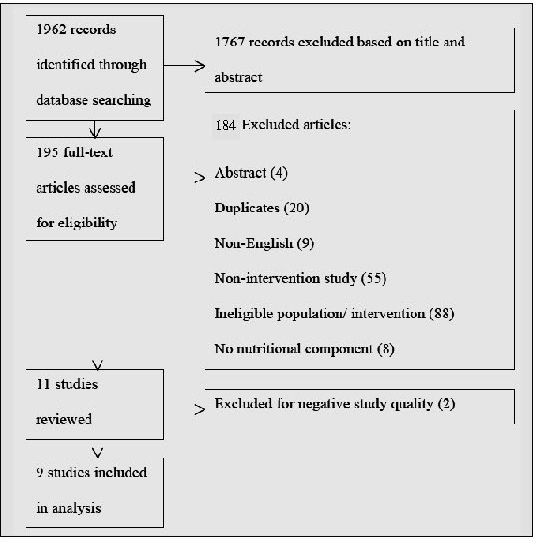
“Non-English (9) Non-intervention study (55) Ineligible population/ intervention (88) No nutritional component (8)”
Nutritional supplementation for hip fracture aftercare in older people
Avenell, A., Smith, T. O., Curtain, J. P., Mak, J. C., & Myint, P. K. (2016) · Cochrane Database of Systematic Reviews · doi:10.1002/14651858.cd001880.pub6 · Cited by 373
Campbell, S. E., Seymour, D. G., & Primrose, W. R. (2004) · Age and Ageing · doi:10.1093/ageing/afh036 · Cited by 354
(2009) · Nutrition & Dietetics · doi:10.1111/j.1747-0080.2009.01383.x · Cited by 305
Effect of nutritional support on clinical outcome in patients at nutritional risk
Johansen, N., Kondrup, J., Plum, L. M., Bak, L., Nørregaard, P., Bunch, E., Bærnthsen, H., Andersen, J. R., Larsen, I. H., & Martinsen, A. (2004) · Clinical Nutrition · doi:10.1016/j.clnu.2003.10.008 · Cited by 206 · cited 1×
“The consequences of malnutrition are significant, 33 including increased risk of pressure ulcers, impaired wound healing, falls, hospitalizations, 34 earlier institutionalization and mortality (6-13).”
Nutritional screening in community-dwelling older adults: a systematic literature review.
Phillips, M. B., Foley, A., Barnard, R., Isenring, E. A., & Miller, M. (2010) · PubMed · Cited by 179
Self-citationPAYETTE, H., BOUTIER, V, COULOMBE, C., & GRAYDONALD, K. (2002) · Journal of the American Dietetic Association · doi:10.1016/s0002-8223(02)80077-3 · Cited by 179
Rivière, S., Guyonnet, S., Voisin, T., Reynish, E. L., Andrieu, S., Lauque, S., Salvà, A., Frisoni, G. B., Nourhashémi, F., Micas, M., et al. (2001) · PubMed · Cited by 171
Lauque, S., Arnaud‐Battandier, F., Gillette, S., Plaze, J., Andrieu, S., Cantet, C., & Vellas, B. (2004) · Journal of the American Geriatrics Society · doi:10.1111/j.1532-5415.2004.52464.x · Cited by 169 · cited 7×
“Where care recipient quality of life (one positive quality study, n=1031 participants in total) and energy and protein intake (one positive quality study, n=91 participants) were measured, improvements in results were found (24, 33).”
InfluentialMalnutrition and pressure ulcer risk in adults in Australian health care facilities
Banks, M., Bauer, J., Graves, N., & Ash, S. (2010) · Nutrition · doi:10.1016/j.nut.2009.09.024 · Cited by 160 · cited 1×
“The consequences of malnutrition are significant, 33 including increased risk of pressure ulcers, impaired wound healing, falls, hospitalizations, 34 earlier institutionalization and mortality (6-13).”
Self-citationMartyn, C. N., Winter, P. D., Coles, S. J., & Edington, J. (1998) · Clinical Nutrition · doi:10.1016/s0261-5614(98)80005-8 · Cited by 110 · cited 1×
“The consequences of malnutrition are significant, 33 including increased risk of pressure ulcers, impaired wound healing, falls, hospitalizations, 34 earlier institutionalization and mortality (6-13).”
Nutritional supplementation for hip fracture aftercare in older people
Avenell, A., & Handoll, H. H. (2010) · Cochrane Database of Systematic Reviews · doi:10.1002/14651858.cd001880.pub5 · Cited by 97
Salva, A., Andrieu, S., Fernandez, E., Schiffrin, E. J., Moulin, J., Decarli, B., Rojano-I-Luque, X., Guigoz, Y., & Vellas, B. (2011) · The Journal of nutrition, health and aging · doi:10.1007/s12603-011-0363-3 · Cited by 89 · cited 8×
“In studies which addressed malnutrition, no significant change in carer burden was found (25, 26) (one positive quality, one neutral quality, n=1097 participants in total).”
InfluentialFerreira, L. S., do Amaral, T. F., Marucci, M. D. F. N., Nascimento, L. F. C., Lebrão, M. L., & Duarte, Y. A. O. (2011) · Nutrition · doi:10.1016/j.nut.2010.11.008 · Cited by 77
Protein and energy supplementation in elderly people at risk from malnutrition
Milne, A., Potter, J., & Avenell, A. (2002) · Cochrane Database of Systematic Reviews · doi:10.1002/14651858.cd003288 · Cited by 68
Evaluation of a brief educational program for dementia carers: The AENEAS Study
Kurz, A., Wagenpfeil, S., Hallauer, J., Schneider‐Schelte, H., Jansen, S., & for the AENEAS Study Group (2010) · International Journal of Geriatric Psychiatry · doi:10.1002/gps.2428 · Cited by 61
Rana, A. K. M. M., Wåhlin, Å., Lundborg, C. S., & Kabir, Z. N. (2008) · Health Promotion International · doi:10.1093/heapro/dan042 · Cited by 59 · cited 4×
“There were four studies identified which provided 155 intervention to the general older adult population (27, 29, 32, 33), and four targeted at older 156”
InfluentialLEGGO, M., BANKS, M., ISENRING, E., STEWART, L., & TWEEDDALE, M. (2008) · Nutrition & Dietetics · doi:10.1111/j.1747-0080.2008.00239.x · Cited by 51 · cited 8×
“Three 186 of four studies that measured nutritional status reported an improvement (24, 25, 32) and 187 Riviere et al.”
InfluentialSelf-citationSupporting Caregivers of Frail Older Adults in an HMO Setting.
Toseland, R. W., McCallion, P., Smith, T., & Banks, S. (2004) · American Journal of Orthopsychiatry · doi:10.1037/0002-9432.74.3.349 · Cited by 48 · cited 7×
“Indeed, two reviews of protein and energy supplementation in older adults at risk of malnutrition reported similar findings as the current review, with the majority of studies showing no change in functional status or quality of life of the participants (34, 35). regarding economic outcomes, results published subseque…”
InfluentialAgreement on Defining Malnutrition
Skipper, A. (2012) · Journal of Parenteral and Enteral Nutrition · doi:10.1177/0148607112441949 · Cited by 34
The Impact of a Caregiver Health Education Program on Health Care Costs
Toseland, R. W., & Smith, T. L. (2006) · Research on Social Work Practice · doi:10.1177/1049731505276045 · Cited by 25 · cited 1×
“(36) reported that the intervention 227 delivered to informal carers resulted in a total health care cost saving of $1,529.”
Paul, A. (2000) · Educational Gerontology · doi:10.1080/03601270050111841 · Cited by 21 · cited 3×
“(27, 28), and two addressed no outcomes (29, 30).”
Hyland, R. M., Wood, C. E., Adamson, A., Mathers, J. C., Hill, M., Seal, C. J., & Moynihan, P. J. (2006) · Journal of Nutrition for the Elderly · doi:10.1300/j052v25n03_10 · Cited by 18 · cited 6×
“…adults however the study only reported qualitative results relating to the experiences of the non-clinical community care workers. hyland et al. (29) refer to a second paper which measured outcomes of interest, including non-clinical community care worker nutrition knowledge; however this was…”
InfluentialLaforest, S., Goldin, B., Nour, K., Roy, M.-A., & Payette, H. (2007) · Canadian Journal on Aging / La Revue canadienne du vieillissement · doi:10.3138/cja.26.4.305 · Cited by 18 · cited 7×
“Of the seven studies which addressed primary outcomes associated with malnutrition in older 158 adult care recipients, five were targeted at identifying, preventing and/or treating malnutrition 159 (24-26, 31, 32).”
InfluentialA Nutrition Training Program for Social Workers Serving the Homebound Elderly
Glanz, K., & Scharf, M. (1985) · The Gerontologist · doi:10.1093/geront/25.5.455 · Cited by 9 · cited 4×
“38) No significant results found in informal carer burden (MBBS), informal carer mental health (other GHQ components), mental component summary of SH-36 or informal carer perceived health status (physical component summary of SF-36) Glanz & Scarf, 1985 (28) N/A N/A N/A”
Influential
Cited by
ESPEN guideline on clinical nutrition and hydration in geriatrics
Volkert, D., Beck, A. M., Cederholm, T., Cruz-Jentoft, A., Goisser, S., Hooper, L., Kiesswetter, E., Maggio, M., Raynaud-Simon, A., Sieber, C. C., et al. (2019) · Clinical Nutrition · doi:10.1016/j.clnu.2018.05.024 · Cited by 1,505
“Literature search identified ten SLRs [78,88,285e292] and four RCTs [281,293e295] relevant to answer the PICO question.”
BackgroundInfluentialESPEN practical guideline: Clinical nutrition and hydration in geriatrics
Volkert, D., Beck, A. M., Cederholm, T., Cruz-Jentoft, A., Hooper, L., Kiesswetter, E., Maggio, M., Raynaud-Simon, A., Sieber, C., Sobotka, L., et al. (2022) · Clinical Nutrition · doi:10.1016/j.clnu.2022.01.024 · Cited by 769
“Three relevant systematic literature reviews (SLRs) of high [63,64] or average quality [65] were identified, which examined the effectiveness of training for staff in residential care [64], people with dementia and/or their formal or informal care-givers [63] and informal carers and community care workers [65].”
BackgroundCrichton, M., Craven, D., Mackay, H., Marx, W., de van der Schueren, M., & Marshall, S. (2018) · Age and Ageing · doi:10.1093/ageing/afy144 · Cited by 175
“There is preliminary research suggesting homecare assistants may be effective in implementing both malnutrition screening and treatment interventions as part of a multidisciplinary malnutrition care team [4, 23].”
BackgroundSelf-citationMarshall, S., Bauer, J., & Isenring, E. (2014) · Journal of Human Nutrition and Dietetics · doi:10.1111/jhn.12167 · Cited by 159
“…communitydwelling older adults is challenging as a result of the limited access of affordable services, and interventions 137ª 2013 The British Dietetic Association Ltd. addressing how to provide treatment in this setting, such as educating caregivers, are needed (Marshall et al., 2013).”
Self-citationIdentifying and Managing Malnutrition, Frailty and Sarcopenia in the Community: A Narrative Review
Roberts, S., Collins, P. F., & Rattray, M. (2021) · Nutrients · doi:10.3390/nu13072316 · Cited by 167
“Further, there is moderate evidence to support the role of domiciliary carers in implementing malnutrition risk screening, education and referral pathways, which may be effective and cost-efficient strategies to manage malnutrition in community-dwelling older adults [145,146].”
Background
Metadata
- Authors
- Marshall, S., Bauer, J., Capra, S., & Isenring, E.
- Affiliations
- The University of Queensland (AU)
- Corresponding author
- Marshall, Skye
- Venue
- The Journal of nutrition, health and aging
- Publisher
- Elsevier BV
- Published
- 2013-10
- Volume
- 17
- Issue
- 8
- Pages
- 645-651
- ISSN
- 1279-7707 (ISSN-L)
- PMC
- PMC12878934
- OpenAlex
- W1995247713
- Cited by
- 42
- References
- 26
- Citations by year
- 2026: 4 · 2025: 1 · 2024: 1 · 2023: 2 · 2022: 1 · 2021: 3 · 2020: 1 · 2019: 3 · 2018: 9 · 2017: 6 · 2016: 7 · 2015: 2 · 2014: 1 · 2013: 1
- FWCI
- 0.40
- Type
- journal article
- Language
- en
- Open access
- hybrid
- doi.org
- Licence
- cc-by-nc-nd
- www.elsevier.com/tdm/userlicense/1.0/ (tdm)
- www.elsevier.com/legal/tdmrep-license (tdm)
- creativecommons.org/licenses/by-nc-nd/4.0/ (vor, 3724 d)
- Locations
- The journal of nutrition health & aging (publishedVersion, cc-by-nc-nd)
- Europe PMC (PubMed Central) (publishedVersion, cc-by-nc-nd)
- PubMed (publishedVersion)
- PubMed Central (publishedVersion, cc-by-nc-nd)
- Figshare (submittedVersion, cc-by)
- Topics
- Health Sciences › Medicine › Physiology (medical) › Nutrition and Health in Aging
- Health Sciences › Medicine › Geriatrics and Gerontology › Geriatric Care and Nursing Homes
- Health Sciences › Nursing › Nutrition and Dietetics › Dietetics, Nutrition, and Education
- Keywords
- malnutrition, community-dwelling older adults, informal caregivers, community care workers, nutrition interventions, nutritional status, functional decline, caregiver burden
- MeSH terms
- Activities of Daily Living, Aged, Delivery of Health Care, Patient Care, Humans, Nutritional Status, Residence Characteristics, Caregivers, Malnutrition
About these checks
Registry, retraction, Cites and statistics results are computed, not judged, with one exception: a printed reference that no index lists is read once by a model before it counts as a citation error. Claims are extracted by a model and kept only when their quote appears verbatim in the text; each cited source is then checked, with a model’s help, for whether it says what the claim relies on. Those verdicts can be wrong — read the claim’s quote and the cited source before relying on one.
Statistics and arithmetic are recomputed, not judged.
Confidence bands are shown only for fields calibrated on our annotated test set. None is calibrated yet, so no band is shown.
What counts as a claim ›How we measure confidence ›How we check this ›
Are you an author, or do you see a problem with this page? Request a review
Data sources
Bibliographic data: Semantic Scholar, OpenAlex, Crossref.
Contains information from the Semantic Scholar Academic Graph Datasets, made available under the ODC Attribution License (ODC-BY 1.0).
Semantic Scholar’s data is described in: Kinney, R., et al. (2023). The Semantic Scholar Open Data Platform. arXiv:2301.10140.
