

Associations of low muscle mass and the metabolic syndrome in Caucasian and Asian middle-aged and older adults
Open accessThe DOI matches its Crossref record; 36 of the 36 references it cites were found in a registry or an index.
Abstract
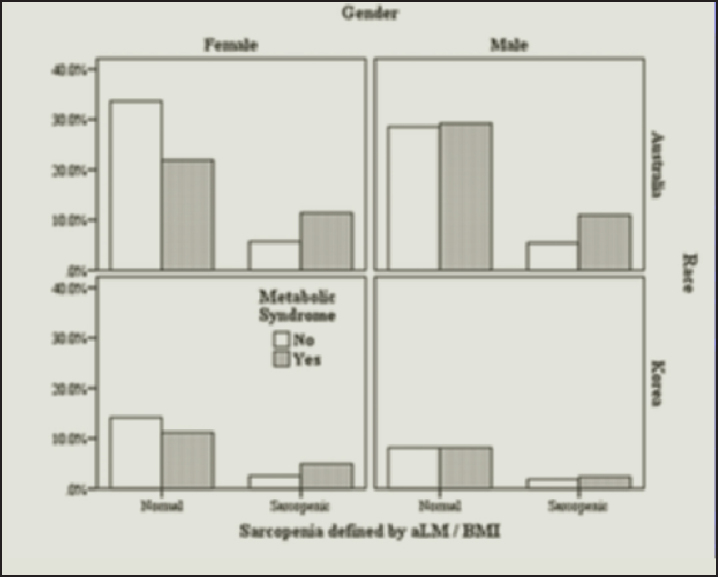
OBJECTIVE: Age-related declines in skeletal muscle mass may confer significant metabolic consequences for older adults. Associations of low muscle mass and metabolic syndrome (MetS) in Caucasians, and comparisons with associations observed in Asian populations, have not been reported. We examined associations of low muscle mass and metabolic syndrome (MetS) in Asian and Caucasian middle-aged and older men and women using criteria for low muscle mass. DESIGN, SETTING AND PARTICIPANTS: Two population-based studies of Australian (Tasmanian Older Adult Cohort Study; TASOAC; N=1005) and Korean (Korean Sarcopenic Obesity Study; KSOS; N=376) community-dwelling adults, mean age 62 and 58 years, respectively. MEASUREMENTS: Appendicular lean mass (aLM) determined by dual-energy X-ray absorptiometry and normalised to height squared (aLM/Ht2), weight (aLM/Wt) or body mass index (aLM/BMI). Participants in the lowest sex-specific 20% for aLM measures were defined as having low muscle mass. MetS was defined according to National Cholesterol Education Program Adult Treatment Panel III criteria. RESULTS: Although Australians demonstrated generally unfavourable anthropometric and metabolic characteristics compared to Koreans, prevalence of MetS was similar (29.5% in Australians and 31.4% in Koreans, respectively). Low aLM/Ht2 was associated with significantly reduced likelihood of MetS in both Australians (OR: 0.30, 95% CI 0.19 - 0.46) and Koreans (OR: 0.31, 95% CI 0.16 - 0.62). Conversely, low aLM/BMI was associated with increased odds for MetS in Australians (OR: 1.78, 95% CI 1.12 - 2.84), but not Koreans (OR: 1.33, 95% CI = 0.67 - 2.64). CONCLUSION: Low aLM/BMI is associated with significantly increased likelihood of MetS in Australian adults, but not Koreans, suggesting potential differences in effects of low muscle mass relative to body mass on cardiometabolic health in Caucasian and Asian middle-aged and older adults. Low muscle mass relative to height is associated with reduced likelihood of MetS in both populations.
Overview
The claims and statistics of this paper haven’t been checked yet.
Free: it reads the open-access text and checks the first 5 claims that cite a source we can check. Create a free account to check every claim.
Integrity signals
Registry
Cites
Statistics
Figures
Verification
Claims the paper makes
The claims and statistics of this paper haven’t been checked yet.
Free: it reads the open-access text and checks the first 5 claims that cite a source we can check. Create a free account to check every claim.
Claims other papers make about this one
Each is checked against this paper’s own text: does it say what the citing paper says it does?
In the citing paper
“Our study comparing Australian and Korean populations observed a potential difference in the effects of low muscle mass on the risk of metabolic syndrome according to ethnicity (91).”
From Health Consequences of Sarcopenic Obesity: A Narrative Review (2020) · cites this paper as [91]
Self-check
Percentages, sums and reported differences re-computed from the paper’s own numbers.
The self-check needs the paper’s full text.
Citations
Cites
Grundy, S. M., Cleeman, J. I., Daniels, S. R., Donato, K. A., Eckel, R. H., Franklin, B. A., Gordon, D. J., Krauss, R. M., Savage, P. J., Smith, S. C., et al. (2005) · Circulation · doi:10.1161/circulationaha.105.169404 · Cited by 11,961 · cited 2×
“Our results also suggest that low muscle mass relative to body mass may be more closely associated with metabolic syndrome and its components in Caucasians than Asians.”
The metabolic syndrome—a new worldwide definition
Alberti, K. G. M., Zimmet, P., & Shaw, J. (2005) · The Lancet · doi:10.1016/s0140-6736(05)67402-8 · Cited by 9,352 · cited 1×
“The metabolic syndrome (MetS), a constellation of risk factors for cardiovascular disease and type 2 diabetes including visceral obesity, dyslipidaemia, hyperglycaemia and hypertension, represents a significant and growing public health challenge internationally (1).”
Epidemiology of Sarcopenia among the Elderly in New Mexico
Baumgartner, R. N., Koehler, K. M., Gallagher, D., Romero, L., Heymsfield, S. B., Ross, R. R., Garry, P. J., & Lindeman, R. D. (1998) · American Journal of Epidemiology · doi:10.1093/oxfordjournals.aje.a009520 · Cited by 4,004 · cited 1×
“The three definitions examined were aLM (kg)/height (m2) (aLM/Ht2) (21), aLM (kg)/weight (kg) x 100 (aLM/Wt) (22), and aLM (kg)/BMI (aLM/BMI) (15).”
Janssen, I., Heymsfield, S. B., & Ross, R. (2002) · Journal of the American Geriatrics Society · doi:10.1046/j.1532-5415.2002.50216.x · Cited by 3,139 · cited 1×
“The three definitions examined were aLM (kg)/height (m2) (aLM/Ht2) (21), aLM (kg)/weight (kg) x 100 (aLM/Wt) (22), and aLM (kg)/BMI (aLM/BMI) (15).”
Studenski, S. A., Peters, K. W., Alley, D. E., Cawthon, P. M., McLean, R. R., Harris, T. B., Ferrucci, L., Guralnik, J. M., Fragala, M. S., Kenny, A. M., et al. (2014) · The Journals of Gerontology: Series A · doi:10.1093/gerona/glu010 · Cited by 2,545
Grundy, S. M., Cleeman, J. I., Daniels, S. R., Donato, K. A., Eckel, R. H., Franklin, B. A., Gordon, D. J., Krauss, R. M., Savage, P. J., Smith, S. C., et al. (2005) · Cardiology in Review · doi:10.1097/01.crd.0000380842.14048.7e · Cited by 1,600
Grundy, S. M. (2008) · Arteriosclerosis, Thrombosis, and Vascular Biology · doi:10.1161/atvbaha.107.151092 · Cited by 1,563 · cited 1×
“MetS prevalence is at least 25% in western countries, attributable to ageing populations and/or high obesity prevalence, but prevalence in Asia is generally lower (2).”
Sarcopenia: alternative definitions and associations with lower extremity function
Newman, A. B., Kupelian, V., Visser, M., Simonsick, E., Goodpaster, B., Nevitt, M., Kritchevsky, S. B., Tylavsky, F. A., Rubin, S. M., Harris, T. B., et al. (2003) · Journal of the American Geriatrics Society · doi:10.1046/j.1532-5415.2003.51534.x · Cited by 981 · cited 1×
“…perhaps unsurprising that the aLM/Ht2 definition is not associated with increased likelihood of MetS; Newman and colleagues have demonstrated that aLM/Ht2 is higher in older adults with higher BMI and so this definition underestimates sarcopenia prevalence in overweight and obese individuals (28).”
Delmonico, M. J., Harris, T. B., Lee, J., Visser, M., Nevitt, M., Kritchevsky, S. B., Tylavsky, F. A., Newman, A. B., & for the Health, A. A. B. C. S. (2007) · Journal of the American Geriatrics Society · doi:10.1111/j.1532-5415.2007.01140.x · Cited by 819 · cited 2×
“…two standard deviations below the mean for a young adult reference population (18); to allow comparability between Australian and Korean middle-aged and older adults, we used the lowest sex-specific 20% of the cohort in the absence of young adult reference data for the Australian population (20).”
Decreased Muscle Strength and Quality in Older Adults With Type 2 Diabetes
Park, S. W., Goodpaster, B. H., Strotmeyer, E. S., de Rekeneire, N., Harris, T. B., Schwartz, A. V., Tylavsky, F. A., & Newman, A. B. (2006) · Diabetes · doi:10.2337/db05-1183 · Cited by 751
Cited by
Health Consequences of Sarcopenic Obesity: A Narrative Review
Roh, E., & Choi, K. M. (2020) · Frontiers in Endocrinology · doi:10.3389/fendo.2020.00332 · Cited by 304
“Our study comparing Australian and Korean populations observed a potential difference in the effects of low muscle mass on the risk of metabolic syndrome according to ethnicity (91).”
BackgroundSelf-citationZhang, H., Lin, S., Gao, T., Zhong, F., Cai, J., Sun, Y., & Ma, A. (2018) · Nutrients · doi:10.3390/nu10030364 · Cited by 188
“, 2015 [26] Korea & Australian community-dwelling Cross-sectional 1381 (54.”
Lee, S. Y., Ahn, S., Kim, Y. J., Ji, M. J., Kim, K. M., Choi, S. H., Jang, H. C., & Lim, S. (2018) · Nutrients · doi:10.3390/nu10060738 · Cited by 175
“Body composition differs between Caucasians and Asians: Asians have a greater tendency for obesity at a lower BMI than Caucasians [22].”
Cheng, K. Y., Chow, S. K., Hung, V. W., Wong, C. H., Wong, R. M., Tsang, C. S., Kwok, T., & Cheung, W. (2021) · Journal of Cachexia Sarcopenia and Muscle · doi:10.1002/jcsm.12825 · Cited by 154
“On the other hand, muscle mass evaluation by DXA is less likely to be affected by ethnicity.(24) However, the availability of a DXA scanner at many clinical setting for the screening of sarcopenia could be limited because of practical reasons (e.”
BackgroundBalogun, S., Winzenberg, T., Wills, K., Scott, D., Jones, G., Aitken, D., & Callisaya, M. L. (2017) · The Journal of nutrition, health and aging · doi:10.1007/s12603-016-0843-6 · Cited by 119
“Furthermore, low ALM relative to BMI is an indication of high body fat percentage (25), hence, the effect of ALMBMI LOW on mortality may potentially be related to obesity rather than sarcopenia.”
Self-citationBody fat, metabolic syndrome and hyperglycemia in South Asians
Misra, A., Soares, M. J., Mohan, V., Anoop, S., Vishnu, A., Vaidya, R., & Pradeepa, R. (2018) · Journal of Diabetes and its Complications · doi:10.1016/j.jdiacomp.2018.08.001 · Cited by 135
Yu, Y., Zhao, Y., Teng, F., Li, J., Guan, Y., Xu, J., Lv, X., Guan, F., Zhang, M., & Chen, L. (2018) · The Journal of nutrition, health and aging · doi:10.1007/s12603-018-1015-7 · Cited by 109
“Decreases in both muscle mass and fiber number are often observed during the aging process (4, 5).”
Comparisons of three different methods for defining sarcopenia: an aspect of cardiometabolic risk
Kim, T. N., Park, M. S., Lee, E. J., Chung, H. S., Yoo, H. J., Kang, H. J., Song, W., Baik, S. H., & Choi, K. M. (2017) · Scientific Reports · doi:10.1038/s41598-017-06831-7 · Cited by 86
Self-citationVella, C. A., Nelson, M. C., Unkart, J., Miljkovic, I., & Allison, M. (2020) · Journal of clinical lipidology · doi:10.1016/j.jacl.2020.01.002 · Cited by 79
“Several investigations suggest that low levels of skeletal muscle mass increase risk of developing metabolic syndrome [7,8,11] and a metabolically-obese phenotype over time [13].”
BackgroundResultScott, D., Cumming, R., Naganathan, V., Blyth, F., Le Couteur, D. G., Handelsman, D. J., Seibel, M., Waite, L. M., & Hirani, V. (2018) · Experimental Gerontology · doi:10.1016/j.exger.2018.04.006 · Cited by 65
“We have reported that low lean mass is associated with approximately 80% increased likelihood of MetS in Australian, but not Korean, older adults (Scott et al., 2016).”
Self-citationTessier, A., Wing, S. S., Rahme, E., Morais, J. A., & Chevalier, S. (2019) · Journal of Cachexia Sarcopenia and Muscle · doi:10.1002/jcsm.12462 · Cited by 65
“triglycerides in participants with lower ALM/BMI, while opposite results were observed for sarcopenia as defined by low ALMI (kg/ht(2)).(59) The presence of chronic diseases may de-”
ResultAzevedo, V. Z., Silaghi, C. A., Maurel, T., Silaghi, H., Ratziu, V., & Pais, R. (2022) · Frontiers in Nutrition · doi:10.3389/fnut.2021.774030 · Cited by 68
Associations of Body Composition with Blood Pressure and Hypertension
Ye, S., Zhu, C., Chen, W., Yang, M., Zheng, W., Gan, D., & Zhu, S. (2018) · Obesity · doi:10.1002/oby.22291 · Cited by 63
“This might also explain why, in some previous studies, the percentage of LBM seems to be a protective factor for metabolic syndrome and cardiovascular disease or risk factors, if fat mass and fat distribution are not controlled for (34,35).”
ResultLandi, F., Calvani, R., Tosato, M., Martone, A. M., Picca, A., Ortolani, E., Savera, G., Salini, S., Ramaschi, M., Bernabei, R., et al. (2017) · The journal of nutrition health & aging · doi:10.1007/s12603-017-0974-4 · Cited by 57
“Studies are also needed to determine the age-related effects of protein quality and quantity on muscle and overall health (50, 51).”
Tak, Y. J., Lee, J. G., Yi, Y. H., Kim, Y. J., Lee, S., Cho, B. M., & Cho, Y. H. (2018) · Nutrients · doi:10.3390/nu10091180 · Cited by 48
“As it is both simple and inexpensive to evaluate, this measurement is widely applied not only to assess hand function after injury and the outcome of hand surgery, but also to reflect general physical health and disability [5,6].”
BackgroundGong, H., Liu, Y., Lyu, X., Dong, L., & Zhang, X. (2021) · Experimental Gerontology · doi:10.1016/j.exger.2021.111668 · Cited by 54
Sanz-Paris, A., Camprubi-Robles, M., Lopez-Pedrosa, J. M., Pereira, S. L., Rueda, R., Ballesteros-Pomar, M. D., Garcia Almeida, J. M., & Cruz-Jentoft, A. J. (2018) · The Journal of nutrition, health and aging · doi:10.1007/s12603-018-0995-7 · Cited by 50
“Even, it has been suggested that potential differences may exist in effects of low muscle relative to either body mass or height on cardiometabolic health in middle-aged and older adults (9).”
BackgroundPark, S., Ryu, S. Y., Park, J., & Choi, S.-W. (2019) · Metabolic Syndrome and Related Disorders · doi:10.1089/met.2019.0059 · Cited by 52
Frailty and the Metabolic Syndrome — Results of the Berlin Aging Study II (BASE-II)
Buchmann, N., Spira, D., König, M., Demuth, I., & Steinhagen‐Thiessen, E. (2019) · The Journal of Frailty & Aging · doi:10.14283/jfa.2019.15 · Cited by 51
“The MetS has already been linked with sarcopenia, another important geriatric syndrome which is closely related to the frailty syndrome (11, 12).”
Yasuda, J., Tomita, T., Arimitsu, T., & Fujita, S. (2020) · The Journal of Nutrition · doi:10.1093/jn/nxaa101 · Cited by 41
“Reduced muscle mass has been reported to be associated with health conditions such as diabetes (1), metabolic syndrome (2), and sarcopenia (3).”
BackgroundPark, C., Lee, E., Kim, H., Lee, Y., Yoon, K. J., & Kim, H. (2022) · Journal of Cachexia Sarcopenia and Muscle · doi:10.1002/jcsm.13096 · Cited by 41
“Low muscle mass has been known to be strongly linked to metabolic syndrome (MS).(31) A recent study among patients with MS for analysing sex difference in gut microbiome demonstrated that a higher abundance of Roseburia was found in men than in women after 3 years of healthy diet intervention.”
BackgroundJun, J. E., Lee, S.-E., Lee, Y., Kim, G., Jin, S., Jee, J. H., & Kim, J. H. (2022) · The Journal of Clinical Endocrinology & Metabolism · doi:10.1210/clinem/dgac662 · Cited by 40
A counterintuitive perspective for the role of fat‐free mass in metabolic health
Lagacé, J., Brochu, M., & Dionne, I. J. (2020) · Journal of Cachexia Sarcopenia and Muscle · doi:10.1002/jcsm.12520 · Cited by 36
“In the articles of Park and Yoon2 and Scott et al.3, individuals with lower FFM index (kg/m2) had lower odds ratios of having the MetS, and, in contrast, participants with lower FFM% had higher odds ratios of having it.”
BackgroundResultInfluentialLagacé, J., Marcotte‐Chénard, A., Paquin, J., Tremblay, D., Brochu, M., & Dionne, I. J. (2021) · Journal of Cachexia Sarcopenia and Muscle · doi:10.1002/jcsm.12856 · Cited by 33
“opment of MetS based solely on the results from the negative association between FFM% and MetS.(4,24)”
BackgroundMethodResultInfluentialSarcopenia and mortality risk in community-dwelling Brazilian older adults
Pereira, C. C., Pagotto, V., de Oliveira, C. M., & Silveira, É. A. (2022) · Scientific Reports · doi:10.1038/s41598-022-22153-9 · Cited by 28
Yasuda, J., Asako, M., Arimitsu, T., & Fujita, S. (2019) · Nutrients · doi:10.3390/nu11030612 · Cited by 30
“Maintaining and increasing muscle mass is important for health improvement, for example through the prevention of metabolic syndromes [1], diabetes [2], and sarcopenia [3].”
BackgroundRodríguez, A. J., Scott, D. S., Khan, B., Khan, N., Hodge, A. M., English, D. R., Giles, G. G., & Ebeling, P. R. (2016) · Calcified Tissue International · doi:10.1007/s00223-016-0157-z · Cited by 24
Self-citationToshima, T., Yoshizumi, T., Inokuchi, S., Kosai‐Fujimoto, Y., Kurihara, T., Yoshiya, S., Mano, Y., Takeishi, K., Itoh, S., Harada, N., et al. (2019) · HPB · doi:10.1016/j.hpb.2019.08.008 · Cited by 22
Kim, T. N., Park, M. S., Lee, E. J., Chung, H. S., Yoo, H. J., Kang, H. J., Song, W., Baik, S. H., & Choi, K. M. (2018) · Diabetes/Metabolism Research and Reviews · doi:10.1002/dmrr.2974 · Cited by 22
“Low muscle mass was defined as being below the sex‐specific lower 20% of the distribution of ASMBMI in the study population.(3) The cut‐off points for low muscle mass in men and women were 0.”
BackgroundSelf-citationDamigou, E., Kouvari, M., & Panagiotakos, D. B. (2023) · Current Opinion in Cardiology · doi:10.1097/hco.0000000000001047 · Cited by 23
Oh, C., & No, J.-K. (2017) · Nutrition Research · doi:10.1016/j.nutres.2017.12.008 · Cited by 21
Bell, J. A., Wade, K. H., O’Keeffe, L. M., Carslake, D., Vincent, E. E., Holmes, M. V., Timpson, N. J., & Smith, G. D. (2021) · PLoS Medicine · doi:10.1371/journal.pmed.1003751 · Cited by 17
Creatinine to Body Weight Ratio Is Associated with Incident Diabetes: Population-Based Cohort Study
Hashimoto, Y., Okamura, T., Hamaguchi, M., Obora, A., Kojima, T., & Fukui, M. (2020) · Journal of Clinical Medicine · doi:10.3390/jcm9010227 · Cited by 18
Comparisons of different indices of low muscle mass in relationship with cardiometabolic disorder
Kim, J. Y., Oh, S., Park, H. Y., Jun, J. H., & Kim, H. J. (2019) · Scientific Reports · doi:10.1038/s41598-018-37347-3 · Cited by 18
Fat-Free Mass, Metabolically Healthy Obesity, and Type 2 Diabetes in Severely Obese Asian Adults
Pramyothin, P., Limpattanachart, V., Dawilai, S., Sarasak, R., Sukaruttanawong, C., Chaiyasoot, K., Keawtanom, S., & Yamwong, P. (2017) · Endocrine Practice · doi:10.4158/ep171792.or · Cited by 17
Hong, S., Oh, M., Kim, Y., & Jeon, J. Y. (2022) · International Journal of Environmental Research and Public Health · doi:10.3390/ijerph191912585 · Cited by 14
“Lower muscle mass in older adults is associated with a higher prevalence of MetS in both Asians and Caucasian [39,40]; Kim et al.”
BackgroundMaltarić, M., Ruščić, P., Kolak, M., Bender, D. V., Kolarić, B., Ćorić, T., Hoejskov, P. S., Bošnir, J., & Kljusurić, J. G. (2023) · International Journal of Environmental Research and Public Health · doi:10.3390/ijerph20064893 · Cited by 15
Kim, Y., Beom, J., Lee, S. Y., Jang, H. C., Kim, K., Kim, M., Shim, G. Y., Won, C. W., & Lim, J. (2024) · Aging Clinical and Experimental Research · doi:10.1007/s40520-024-02898-1 · Cited by 15
“MetS was defined according to the following criteria [20], where at least three of the following conditions had to be present: waist circumference ≥ 90 cm in males and ≥ 85 cm in females (Asian cut-off); systolic blood pres - sure ≥ 130 mm Hg, diastolic blood pressure ≥ 85 mm Hg, or treatment for…”
Tong, Q., Wang, X., Sheng, Y., Chen, S., Lai, B., Lv, R., & Yu, J. (2022) · Journal of Biomedical Research · doi:10.7555/jbr.36.20210143 · Cited by 14
Adiposity in Survivors of Cancer in Childhood: How is it Measured and Why Does it Matter?
Guolla, L., Morrison, K. M., & Barr, R. D. (2020) · Journal of Pediatric Hematology/Oncology · doi:10.1097/mph.0000000000001988 · Cited by 14
The Journal of Cachexia, Sarcopenia and Muscle stays the front‐runner in geriatrics and gerontology
Anker, M. S., Anker, S. D., Coats, A. J. S., & von Haehling, S. (2019) · Journal of Cachexia Sarcopenia and Muscle · doi:10.1002/jcsm.12518 · Cited by 11
Gary, M. A., Tanner, E., Davis, A. A., & McFarlin, B. K. (2018) · Methods · doi:10.1016/j.ymeth.2018.11.012 · Cited by 11
He, J. (2022) · Diabetology & Metabolic Syndrome · doi:10.1186/s13098-021-00776-8 · Cited by 10
Aging, Body Composition, and Cognitive Decline: Shared and Unique Characteristics
Chen, L. (2023) · The journal of nutrition health & aging · doi:10.1007/s12603-023-2022-x · Cited by 10
“A Korean study found nutrient intakes related to muscle loss in men only (11), while another study showed that low muscle mass is associated with a reduced likelihood of metabolic syndrome in both Australian and Korean populations, but this relationship changes when considering body fat (12).”
He, J., Gao, L., & Mai, L. (2023) · Renal Failure · doi:10.1080/0886022x.2023.2251592 · Cited by 9
“Compared to the height-adjusted SMI, the weight-adjusted SMI is more closely associated with metabolic and cardiovascular diseases [7–11], which are both associated with mortality.”
BackgroundBody composition indices in Brazilian adults: age-specific and sex-specific percentile curves
de Carvalho, C. J., Longo, G. Z., Juvanhol, L. L., Kakehasi, A. M., Pereira, P. F., Segheto, K. J., de Freitas, B. A. C., & Ribeiro, A. Q. (2019) · Archives of Endocrinology and Metabolism · doi:10.20945/2359-3997000000124 · Cited by 10
Association between Skeletal Mass Indices and Metabolic Syndrome in Brazilian Adults
de Carvalho, C. J., Longo, G. Z., Kakehasi, A. M., Pereira, P. F., Segheto, K. J., Juvanhol, L. L., & Ribeiro, A. Q. (2020) · Journal of Clinical Densitometry · doi:10.1016/j.jocd.2020.02.003 · Cited by 10
Li, T., Cao, C., Xuan, X., Liu, W., Xiao, X., & Wei, C. (2023) · BMC Endocrine Disorders · doi:10.1186/s12902-023-01518-9 · Cited by 9
“According to numerous research, weight-adjusted appendicular skeletal muscle mass has been linked to IR and cardiometabolic risk factors [12, 48–51].”
BackgroundOh, C., & No, J.-K. (2018) · Journal of Obesity & Metabolic Syndrome · doi:10.7570/jomes.2018.27.4.254 · Cited by 8
Wu, S., & Chen, W. (2021) · Annals of the New York Academy of Sciences · doi:10.1111/nyas.14607 · Cited by 8
“001 HDL (mg/dL) 48 (17) 48 (20) 47 (19) 50 (18) 0.”
de Carvalho, C. J., Longo, G. Z., Kakehasi, A. M., Pereira, P. F., Segheto, K. J., Juvanhol, L. L., & Ribeiro, A. Q. (2020) · British Journal Of Nutrition · doi:10.1017/s0007114520004262 · Cited by 7
“Likewise, studies of this index in the context of cardiometabolic diseases(13,33,34,37) are rare, although these studies already indicate the importance of SMIBMI in identifying of the muscle mass deficit and in predicting cardiometabolic risk.”
BackgroundLagacé, J., Tremblay, D., Paquin, J., Marcotte‐Chénard, A., Brochu, M., & Dionne, I. J. (2019) · Clinical Endocrinology · doi:10.1111/cen.14085 · Cited by 7
Acute Effect of the Timing of Resistance Exercise and Nutrient Intake on Muscle Protein Breakdown
Kume, W., Yasuda, J., & Hashimoto, T. (2020) · Nutrients · doi:10.3390/nu12041177 · Cited by 6
“Enhancement of muscle mass helps in the prevention of metabolic syndromes [24], diabetes [25], and sarcopenia [26].”
BackgroundLee, S. Y., Beom, J., Choi, J. H., Jang, H. C., Kim, E. Y., Kim, K., Kim, M., Shim, G. Y., Won, C. W., & Lim, J. (2023) · BMJ Open · doi:10.1136/bmjopen-2022-070252 · Cited by 22
Bezrukova, G. A., Novikova, T. A., & Mikerov, A. N. (2022) · Sanitarnyj vrač (Sanitary Doctor) · doi:10.33920/med-08-2201-04 · Cited by 4
Lim, C., & changkeun, K. (2020) · Exercise Science · doi:10.15857/ksep.2020.29.1.77 · Cited by 5
“적절한 골격근량(muscle mass)을 유지하는 것은 대사성 증후군[1], 당뇨[2], 노인성 근감소증[3] 등을 예방하여, 정상적인 대사와 독립적인 신체활동을 가능하게 한다.”
Salinas-Mandujano, R. G., Reynoso‐Camacho, R., Salgado, L. M., Ramos‐Gómez, M., Pérez‐Ramírez, I. F., Aguilar-Galarza, A., Moreno‐Celis, U., & Anaya‐Loyola, M. A. (2023) · European Journal of Investigation in Health Psychology and Education · doi:10.3390/ejihpe13100146 · Cited by 7
Mirzayev, J., & Levitt, D. E. (2024) · Strength and conditioning journal · doi:10.1519/ssc.0000000000000854 · Cited by 4
“…syndrome, and SKM mass is associated with increased metabolic syndrome prevalence, underscoring the protective role SKM in metabolic health (2,47,61). mass begins to decrease after age years, and after age 60 years, this decline accelerates to approximately (CSA) is driven by decreased size…”
Shinto, T., Makino, S., Tahara, Y., Nitta, L., Kuwahara, M., Tada, A., Abe, N., Michie, M., & Shibata, S. (2022) · JMIR Public Health and Surveillance · doi:10.2196/35898 · Cited by 3
“Maintaining and increasing muscle mass are critical for preventing various health risks, such as metabolic syndrome, diabetes, and sarcopenia [1-3].”
BackgroundLagacé, J., Brochu, M., & Dionne, I. J. (2019) · Clinical Endocrinology · doi:10.1111/cen.14116 · Cited by 3
Wang, X., Liu, Y., Ren, X., Gu, Y., Mu, J., Zhou, S., Liu, L., Xu, J., Duan, Z., Yuan, L., et al. (2025) · Journal of Endocrinological Investigation · doi:10.1007/s40618-025-02730-1 · Cited by 2
Cho, Y., Kim, E. N., You, J. S., Han, M., & Park, Y. S. (2024) · Life · doi:10.3390/life14060680 · Cited by 3
“All images were semi-automatically analyzed using the Aview ® system (v 1.1.38.6, Coreline Soft Inc., Seoul, Republic of Korea and reviewed by two emergency medicine doctors SMI was calculated as SMA (cm 2 )/BMI (kg/m 2 ) and normalized to the BMI [5,26–28].”
BackgroundMethodInfluentialUltrasound evaluation of muscles in older patients with metabolıc syndrome
İleri, İ., Hafızoğlu, M., Karaduman, D., Atbas, C., Şahiner, Z., Dikmeer, A., Öztürk, Y., Güner, M., Baş, A. O., Balcı, C., et al. (2025) · Irish Journal of Medical Science (1971 -) · doi:10.1007/s11845-025-04004-4 · Cited by 1
“There are different results in studies between sarcopenia and MetS [18, 19].”
Zhang, D., Devarakonda, S. L. S., Roberts, R. A., Greenway, F. L., & Rebello, C. J. (2026) · Current Developments in Nutrition · doi:10.1016/j.cdnut.2026.107707 · Cited by 1
“However, in the other studies, the investigators chose to use % lean mass to form their conclusions because it did not depart from the commonly held belief that lean mass promotes glucose homeostasis [3,4].”
Come in from the Cold: Are Older Adults Who Live in Colder Climates at Greater Risk for Sarcopenia?
Scott, D. S. (2020) · Journal of Clinical Medicine · doi:10.3390/jcm9061859
“These challenges are compounded by the fact that age-related declines in muscle mass and function may vary by ethnicity within and between countries [11,12], and that recommended cut-points for sarcopenia, which have generally been derived from Caucasian populations, are generally not appropriate for other ethnicities…”
BackgroundSelf-citationLi, T., Cao, C., Xuan, X., Liu, W., Xiao, X., & Wei, C. (2023) · Figshare · doi:10.6084/m9.figshare.24719235
Chang, C., Chu, N., Wu, D., Liang, W.-C., Yeh, S.-C., & Chuang, C. (2026) · Journal of International Medical Research · doi:10.1177/03000605261443913
“13 Even within the same population, varying definitions of body composition have resulted in different conclusions.”
Metadata
- Authors
- Scott, D., Park, M. S., Kim, T. N., Ryu, J. Y., Hong, H. C., Yoo, H. J., Baik, S. H., Jones, G., & Choi, K. M.
- Affiliations
- The University of Melbourne (AU)
- Sungshin Women's University (KR)
- Inje University (KR)
- Korea University Guro Hospital (KR)
- University of Tasmania (AU)
- Corresponding author
- Choi, Kyung Mook
- Venue
- The Journal of nutrition, health and aging
- Publisher
- Elsevier BV
- Published
- 2016-03
- Volume
- 20
- Issue
- 3
- Pages
- 248-255
- ISSN
- 1279-7707 (ISSN-L)
- PMC
- PMC12877590
- OpenAlex
- W988132397
- Semantic Scholar
- 217f2e7513ff21a622da46bad2f807aef23b8b8a
- Cited by
- 70
- References
- 36
- Citations by year
- 2026: 2 · 2025: 2 · 2024: 4 · 2023: 8 · 2022: 10 · 2021: 5 · 2020: 12 · 2019: 10 · 2018: 10 · 2017: 5 · 2016: 2
- FWCI
- 4.13
- Type
- journal article
- Language
- en
- Open access
- hybrid
- doi.org
- Licence
- cc-by-nc-nd
- www.elsevier.com/tdm/userlicense/1.0/ (tdm)
- www.elsevier.com/legal/tdmrep-license (tdm)
- creativecommons.org/licenses/by-nc-nd/4.0/ (vor, 2843 d)
- Locations
- The journal of nutrition health & aging (publishedVersion, cc-by-nc-nd)
- Europe PMC (PubMed Central) (publishedVersion, cc-by-nc-nd)
- PubMed (publishedVersion)
- PubMed Central (publishedVersion, cc-by-nc-nd)
- eCite Digital Repository (University of Tasmania) (submittedVersion)
- Figshare (submittedVersion, cc-by)
- Topics
- Health Sciences › Medicine › Physiology (medical) › Nutrition and Health in Aging
- Health Sciences › Medicine › Physiology (medical) › Body Composition Measurement Techniques
- Health Sciences › Medicine › Endocrinology, Diabetes and Metabolism › Diabetes, Cardiovascular Risks, and Lipoproteins
- Keywords
- low muscle mass, metabolic syndrome, appendicular lean mass, sarcopenia, body mass index, skeletal muscle mass, older adults, middle-aged adults, Asian populations, Caucasian population, cardiometabolic health, ethnic differences
- MeSH terms
- Aged, Anthropometry, Australia, Female, Humans, Male, Middle Aged, Obesity, Cohort Studies, Absorptiometry, Photon, Body Mass Index, Prevalence, Muscle, Skeletal, Metabolic Syndrome, White People, Asian People, Sarcopenia, Republic of Korea
About these checks
Registry, retraction, Cites and statistics results are computed, not judged, with one exception: a printed reference that no index lists is read once by a model before it counts as a citation error. Claims are extracted by a model and kept only when their quote appears verbatim in the text; each cited source is then checked, with a model’s help, for whether it says what the claim relies on. Those verdicts can be wrong — read the claim’s quote and the cited source before relying on one.
Statistics and arithmetic are recomputed, not judged.
Confidence bands are shown only for fields calibrated on our annotated test set. None is calibrated yet, so no band is shown.
What counts as a claim ›How we measure confidence ›How we check this ›
Are you an author, or do you see a problem with this page? Request a review
Data sources
Bibliographic data: Semantic Scholar, OpenAlex, Crossref.
Contains information from the Semantic Scholar Academic Graph Datasets, made available under the ODC Attribution License (ODC-BY 1.0).
Semantic Scholar’s data is described in: Kinney, R., et al. (2023). The Semantic Scholar Open Data Platform. arXiv:2301.10140.
