

Associations of low muscle mass and the metabolic syndrome in Caucasian and Asian middle-aged and older adults
Open accessThe DOI matches its Crossref record; 36 of the 36 references it cites were found in a registry or an index.
Abstract
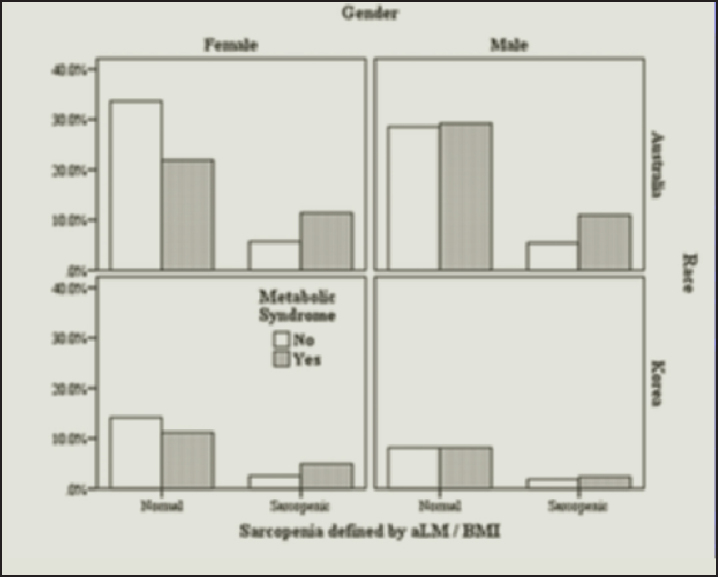
OBJECTIVE: Age-related declines in skeletal muscle mass may confer significant metabolic consequences for older adults. Associations of low muscle mass and metabolic syndrome (MetS) in Caucasians, and comparisons with associations observed in Asian populations, have not been reported. We examined associations of low muscle mass and metabolic syndrome (MetS) in Asian and Caucasian middle-aged and older men and women using criteria for low muscle mass. DESIGN, SETTING AND PARTICIPANTS: Two population-based studies of Australian (Tasmanian Older Adult Cohort Study; TASOAC; N=1005) and Korean (Korean Sarcopenic Obesity Study; KSOS; N=376) community-dwelling adults, mean age 62 and 58 years, respectively. MEASUREMENTS: Appendicular lean mass (aLM) determined by dual-energy X-ray absorptiometry and normalised to height squared (aLM/Ht2), weight (aLM/Wt) or body mass index (aLM/BMI). Participants in the lowest sex-specific 20% for aLM measures were defined as having low muscle mass. MetS was defined according to National Cholesterol Education Program Adult Treatment Panel III criteria. RESULTS: Although Australians demonstrated generally unfavourable anthropometric and metabolic characteristics compared to Koreans, prevalence of MetS was similar (29.5% in Australians and 31.4% in Koreans, respectively). Low aLM/Ht2 was associated with significantly reduced likelihood of MetS in both Australians (OR: 0.30, 95% CI 0.19 - 0.46) and Koreans (OR: 0.31, 95% CI 0.16 - 0.62). Conversely, low aLM/BMI was associated with increased odds for MetS in Australians (OR: 1.78, 95% CI 1.12 - 2.84), but not Koreans (OR: 1.33, 95% CI = 0.67 - 2.64). CONCLUSION: Low aLM/BMI is associated with significantly increased likelihood of MetS in Australian adults, but not Koreans, suggesting potential differences in effects of low muscle mass relative to body mass on cardiometabolic health in Caucasian and Asian middle-aged and older adults. Low muscle mass relative to height is associated with reduced likelihood of MetS in both populations.
Overview
The claims and statistics of this paper haven’t been checked yet.
Free: it reads the open-access text and checks the first 5 claims that cite a source we can check. Create a free account to check every claim.
Integrity signals
Registry
Cites
Statistics
Figures
Verification
Claims the paper makes
The claims and statistics of this paper haven’t been checked yet.
Free: it reads the open-access text and checks the first 5 claims that cite a source we can check. Create a free account to check every claim.
Claims other papers make about this one
Each is checked against this paper’s own text: does it say what the citing paper says it does?
In the citing paper
“Our study comparing Australian and Korean populations observed a potential difference in the effects of low muscle mass on the risk of metabolic syndrome according to ethnicity (91).”
From Health Consequences of Sarcopenic Obesity: A Narrative Review (2020) · cites this paper as [91]
Self-check
Percentages, sums and reported differences re-computed from the paper’s own numbers.
The self-check needs the paper’s full text.
Citations
Cites
Grundy, S. M., Cleeman, J. I., Daniels, S. R., Donato, K. A., Eckel, R. H., Franklin, B. A., Gordon, D. J., Krauss, R. M., Savage, P. J., Smith, S. C., et al. (2005) · Circulation · doi:10.1161/circulationaha.105.169404 · Cited by 11,961 · cited 2×
“Our results also suggest that low muscle mass relative to body mass may be more closely associated with metabolic syndrome and its components in Caucasians than Asians.”
The metabolic syndrome—a new worldwide definition
Alberti, K. G. M., Zimmet, P., & Shaw, J. (2005) · The Lancet · doi:10.1016/s0140-6736(05)67402-8 · Cited by 9,352 · cited 1×
“The metabolic syndrome (MetS), a constellation of risk factors for cardiovascular disease and type 2 diabetes including visceral obesity, dyslipidaemia, hyperglycaemia and hypertension, represents a significant and growing public health challenge internationally (1).”
Epidemiology of Sarcopenia among the Elderly in New Mexico
Baumgartner, R. N., Koehler, K. M., Gallagher, D., Romero, L., Heymsfield, S. B., Ross, R. R., Garry, P. J., & Lindeman, R. D. (1998) · American Journal of Epidemiology · doi:10.1093/oxfordjournals.aje.a009520 · Cited by 4,004 · cited 1×
“The three definitions examined were aLM (kg)/height (m2) (aLM/Ht2) (21), aLM (kg)/weight (kg) x 100 (aLM/Wt) (22), and aLM (kg)/BMI (aLM/BMI) (15).”
Janssen, I., Heymsfield, S. B., & Ross, R. (2002) · Journal of the American Geriatrics Society · doi:10.1046/j.1532-5415.2002.50216.x · Cited by 3,139 · cited 1×
“The three definitions examined were aLM (kg)/height (m2) (aLM/Ht2) (21), aLM (kg)/weight (kg) x 100 (aLM/Wt) (22), and aLM (kg)/BMI (aLM/BMI) (15).”
Studenski, S. A., Peters, K. W., Alley, D. E., Cawthon, P. M., McLean, R. R., Harris, T. B., Ferrucci, L., Guralnik, J. M., Fragala, M. S., Kenny, A. M., et al. (2014) · The Journals of Gerontology: Series A · doi:10.1093/gerona/glu010 · Cited by 2,545
Grundy, S. M., Cleeman, J. I., Daniels, S. R., Donato, K. A., Eckel, R. H., Franklin, B. A., Gordon, D. J., Krauss, R. M., Savage, P. J., Smith, S. C., et al. (2005) · Cardiology in Review · doi:10.1097/01.crd.0000380842.14048.7e · Cited by 1,600
Grundy, S. M. (2008) · Arteriosclerosis, Thrombosis, and Vascular Biology · doi:10.1161/atvbaha.107.151092 · Cited by 1,563 · cited 1×
“MetS prevalence is at least 25% in western countries, attributable to ageing populations and/or high obesity prevalence, but prevalence in Asia is generally lower (2).”
Sarcopenia: alternative definitions and associations with lower extremity function
Newman, A. B., Kupelian, V., Visser, M., Simonsick, E., Goodpaster, B., Nevitt, M., Kritchevsky, S. B., Tylavsky, F. A., Rubin, S. M., Harris, T. B., et al. (2003) · Journal of the American Geriatrics Society · doi:10.1046/j.1532-5415.2003.51534.x · Cited by 981 · cited 1×
“…perhaps unsurprising that the aLM/Ht2 definition is not associated with increased likelihood of MetS; Newman and colleagues have demonstrated that aLM/Ht2 is higher in older adults with higher BMI and so this definition underestimates sarcopenia prevalence in overweight and obese individuals (28).”
Delmonico, M. J., Harris, T. B., Lee, J., Visser, M., Nevitt, M., Kritchevsky, S. B., Tylavsky, F. A., Newman, A. B., & for the Health, A. A. B. C. S. (2007) · Journal of the American Geriatrics Society · doi:10.1111/j.1532-5415.2007.01140.x · Cited by 819 · cited 2×
“…two standard deviations below the mean for a young adult reference population (18); to allow comparability between Australian and Korean middle-aged and older adults, we used the lowest sex-specific 20% of the cohort in the absence of young adult reference data for the Australian population (20).”
Decreased Muscle Strength and Quality in Older Adults With Type 2 Diabetes
Park, S. W., Goodpaster, B. H., Strotmeyer, E. S., de Rekeneire, N., Harris, T. B., Schwartz, A. V., Tylavsky, F. A., & Newman, A. B. (2006) · Diabetes · doi:10.2337/db05-1183 · Cited by 751
Walston, J. D. (2012) · Current Opinion in Rheumatology · doi:10.1097/bor.0b013e328358d59b · Cited by 697
Srikanthan, P., Hevener, A. L., & Karlamangla, A. S. (2010) · PLoS ONE · doi:10.1371/journal.pone.0010805 · Cited by 600 · cited 1×
“…III (42% non-Hispanic White population) indicate that sarcopenia defined as aLM/Ht2 measured by bioelectrical impedance two standard deviations below the mean for a young adult reference population, was associated with insulin resistance, and also with dysglycemia in obese individuals only (25).”
Lim, S., Kim, J. H., Yoon, J. W., Kang, S. M., Choi, S. H., Park, Y. J., Kim, K. W., Lim, J. Y., Park, K. S., & Jang, H. C. (2010) · Diabetes Care · doi:10.2337/dc10-0107 · Cited by 588 · cited 3×
“In an analysis of over 500 adults aged 65 years and over in the Korean Longitudinal Study on Health and Aging (KLoSHA), participants with sarcopenia defined by aLM/Wt had approximately two and a half times increased likelihood of MetS (9).”
Increasing Prevalence of Metabolic Syndrome in Korea
Lim, S., Shin, H., Song, J. H., Kwak, S. H., Kang, S. M., Won Yoon, J., Choi, S. H., Cho, S. I., Park, K. S., Lee, H. K., et al. (2011) · Diabetes Care · doi:10.2337/dc10-2109 · Cited by 585 · cited 1×
“However, countries such as South Korea which have undergone rapid socioenvironmental changes in recent years demonstrate increasingly high fat diets and sedentary behaviour, and may now have a similar prevalence of MetS to that of western countries (3).”
Prevalence and Determinant Factors of Sarcopenia in Patients With Type 2 Diabetes
Kim, T. N., Park, M. S., Yang, S. J., Yoo, H. J., Kang, H. J., Song, W., Seo, J. A., Kim, S. G., Kim, N. H., Baik, S. H., et al. (2010) · Diabetes Care · doi:10.2337/dc09-2310 · Cited by 585
Self-citationKim, T. N., Yang, S. J., Yoo, H. J., Lim, K. I., Kang, H. J., Song, W., Seo, J. A., Kim, S. G., Kim, N. H., Baik, S. H., et al. (2009) · International Journal of Obesity · doi:10.1038/ijo.2009.130 · Cited by 401 · cited 3×
“KSOS: 414 patients with type 2 diabetes and 396 healthy subjects without medical history of diabetes aged between 40 and 88 years, as well as a young reference group of 145 adults aged between 20 and 39 years, were recruited between September 2007 and August 2008 in Seoul, Korea (7, 18).”
Self-citationChung, J.-Y., Kang, H.-T., Lee, D.-C., Lee, H.-R., & Lee, Y.-J. (2013) · Archives of Gerontology and Geriatrics · doi:10.1016/j.archger.2012.09.007 · Cited by 283
Bijlsma, A. Y., Meskers, C. G. M., Ling, C. H. Y., Narici, M., Kurrle, S. E., Cameron, I. D., Westendorp, R. G. J., & Maier, A. B. (2013) · AGE · doi:10.1007/s11357-012-9384-z · Cited by 269 · cited 1×
“The lack of a consensus definition for low muscle mass is a consistent barrier to comparability of studies examining health outcomes associated with sarcopenia (8).”
Sarcopenia of Aging and Its Metabolic Impact
Karakelides, H., & Nair, K. S. (2005) · Current Topics in Developmental Biology · doi:10.1016/s0070-2153(05)68005-2 · Cited by 268 · cited 1×
“Skeletal muscle is the largest insulin-sensitive tissue in the body and so its reduction with age likely plays a direct role in metabolic dysregulation, and may also exacerbate this effect indirectly through reductions in physical activity and subsequent increased adiposity (6).”
Tools in the Assessment of Sarcopenia
Cooper, C., Fielding, R., Visser, M., van Loon, L. J., Rolland, Y., Orwoll, E., Reid, K., Boonen, S., Dere, W., Epstein, S., et al. (2013) · Calcified Tissue International · doi:10.1007/s00223-013-9757-z · Cited by 246 · cited 1×
“Low muscle strength and physical performance is now recognised as an important component of sarcopenia in a number of consensus definitions (33).”
Grip strength and the metabolic syndrome: findings from the Hertfordshire Cohort Study
Sayer, A. A., Syddall, H. E., Dennison, E. M., Martin, H. J., Phillips, D. I. W., Cooper, C., & Byrne, C. D. (2007) · QJM · doi:10.1093/qjmed/hcm095 · Cited by 214 · cited 1×
“In a UK study, lower grip strength was associated with increased risk of individual components of MetS, as well as MetS itself (34).”
Ostlund, R. E., Staten, M., Kohrt, W. M., Schultz, J., & Malley, M. (1990) · New England Journal of Medicine · doi:10.1056/nejm199001253220404 · Cited by 186
Kim, T. N., Park, M. S., Lim, K. I., Yang, S. J., Yoo, H. J., Kang, H. J., Song, W., Seo, J. A., Kim, S. G., Kim, N. H., et al. (2011) · Diabetes Research and Clinical Practice · doi:10.1016/j.diabres.2011.06.013 · Cited by 167 · cited 1×
“Several studies of Korean older adults have investigated associations between low muscle mass and MetS, but these generally demonstrate that definitions of low muscle mass relative to body weight, as opposed to definitions of low muscle mass relative to height, are associated with increased likelihood of MetS (9-14).”
Self-citationCardiometabolic Risk in Younger and Older Adults Across an Index of Ambulatory Activity
Schmidt, M. D., Cleland, V. J., Shaw, K. A.-M., Dwyer, T., & Venn, A. (2009) · American Journal of Preventive Medicine · doi:10.1016/j.amepre.2009.05.020 · Cited by 99 · cited 1×
“Assays were performed on thawed blood samples using an Olympus AU5400 automated analyzer to enzymatically measure fasting glucose, high-density lipoprotein (HDL) cholesterol, and triglycerides (23).”
Penninx, B. W. J. H., Nicklas, B. J., Newman, A. B., Harris, T. B., Goodpaster, B. H., Satterfield, S., de Rekeneire, N., Yaffe, K., Pahor, M., Kritchevsky, S. B., et al. (2009) · The Journals of Gerontology Series A: Biological Sciences and Medical Sciences · doi:10.1093/gerona/gln005 · Cited by 90 · cited 1×
“Furthermore, like sarcopenia, MetS may be an independent risk factor for osteoporosis (30), and incident mobility limitations (31).”
Ethnic and geographic variations in muscle mass, muscle strength and physical performance measures
Woo, J., Arai, H., Ng, T. P., Sayer, A. A., Wong, M. M. H., Syddall, H. E., Yamada, M., Zeng, P., Wu, S., & Zhang, T. M. (2014) · European Geriatric Medicine · doi:10.1016/j.eurger.2014.04.003 · Cited by 83 · cited 3×
“Our results also suggest that low muscle mass relative to body mass may be more closely associated with metabolic syndrome and its components in Caucasians than Asians.”
Lim, K. I., Yang, S. J., Kim, T. N., Yoo, H. J., Kang, H. J., Song, W., Baik, S. H., Choi, D. S., & Choi, K. M. (2010) · Clinical Endocrinology · doi:10.1111/j.1365-2265.2010.03841.x · Cited by 82 · cited 1×
“Several studies of Korean older adults have investigated associations between low muscle mass and MetS, but these generally demonstrate that definitions of low muscle mass relative to body weight, as opposed to definitions of low muscle mass relative to height, are associated with increased likelihood of MetS (9-14).”
Self-citationAdverse effects of coexistence of sarcopenia and metabolic syndrome in Japanese women
Sanada, K., Iemitsu, M., Murakami, H., Gando, Y., Kawano, H., Kawakami, R., Tabata, I., & Miyachi, M. (2012) · European Journal of Clinical Nutrition · doi:10.1038/ejcn.2012.43 · Cited by 72 · cited 1×
“…of the two conditions is associated with higher systolic blood pressure, triglycerides and ankle-brachial pulse wave velocity, suggesting that those with coexisting sarcopenia and MetS are at further increased risk for cardiovascular disease than those with MetS or sarcopenia alone (29).”
Association between metabolic syndrome and osteoporosis: A meta-analysis
Zhou, J., Zhang, Q., Yuan, X., Wang, J., Li, C., Sheng, H., Qu, S., & Li, H. (2013) · Bone · doi:10.1016/j.bone.2013.07.013 · Cited by 69 · cited 1×
“Furthermore, like sarcopenia, MetS may be an independent risk factor for osteoporosis (30), and incident mobility limitations (31).”
Additional role of sarcopenia to waist circumference in predicting the odds of metabolic syndrome
Park, S. H., Park, J. H., Park, H. Y., Jang, H. J., Kim, H. K., Park, J., Shin, K. J., Lee, J. G., & Moon, Y. S. (2013) · Clinical Nutrition · doi:10.1016/j.clnu.2013.08.008 · Cited by 67 · cited 1×
“…sex-specific associations, with sarcopenia defined by the aLM/Wt associated with over three-fold increased risk of MetS in men, but not women, with normal waist circumference, and a two and a half times increased likelihood in sarcopenic women, but not men, with high waist circumference (13).”
Ethnic comparisons of sarcopenia and obesity in diabetes.
Castañeda, C., & Janssen, I. (2005) · PubMed · Cited by 56
Cut Points of Muscle Strength Associated with Metabolic Syndrome in Men
SÉNÉCHAL, M., MCGAVOCK, J. M., CHURCH, T. S., LEE, D.-C., EARNEST, C. P., SUI, X., & BLAIR, S. N. (2014) · Medicine & Science in Sports & Exercise · doi:10.1249/mss.0000000000000266 · Cited by 52 · cited 1×
“A US study also revealed a two-fold increased likelihood of MetS in men aged over 50 years in the lowest 20th percentile for a composite variable of upper- and lower-limb muscle strength (35).”
Factor analysis of the metabolic syndrome among elderly Koreans—the South‐west Seoul Study
Choi, K. M., Lee, J., Kim, K. B., Kim, D. R., Kim, S. G., Shin, D.-H., Kim, N. H., Park, I., Choi, D. S., & Baik, S. H. (2003) · Diabetic Medicine · doi:10.1046/j.1464-5491.2003.00890.x · Cited by 49 · cited 1×
“In our previous study, factor analysis showed that more than one pathophysiological mechanism, including insulin resistance, underlies the MetS in elderly Koreans (4).”
Self-citationKim, K. M., Lim, S., Choi, S. H., Kim, J. H., Shin, C. S., Park, K. S., & Jang, H. C. (2014) · IJC Metabolic & Endocrine · doi:10.1016/j.ijcme.2014.06.001 · Cited by 40 · cited 5×
“…Korean older adults have investigated associations between low muscle mass and MetS, but these generally demonstrate that definitions of low muscle mass relative to body weight, as opposed to definitions of low muscle mass relative to height, are associated with increased likelihood of MetS (9-14).”
InfluentialFrank, A. W., Farthing, J. P., Chilibeck, P. D., Arnold, C. M., Olszynski, W. P., & Kontulainen, S. A. (2015) · The Journal of nutrition, health and aging · doi:10.1007/s12603-014-0476-6 · Cited by 20 · cited 1×
“Secondly, the present study did not explore the influence of muscle quality, including inter-and intra-muscular adipose tissue (IMAT), an ectopic fat depot associated with insulin resistance, and poor muscle function and physical performance (32).”
Cited by
Health Consequences of Sarcopenic Obesity: A Narrative Review
Roh, E., & Choi, K. M. (2020) · Frontiers in Endocrinology · doi:10.3389/fendo.2020.00332 · Cited by 304
“Our study comparing Australian and Korean populations observed a potential difference in the effects of low muscle mass on the risk of metabolic syndrome according to ethnicity (91).”
BackgroundSelf-citationZhang, H., Lin, S., Gao, T., Zhong, F., Cai, J., Sun, Y., & Ma, A. (2018) · Nutrients · doi:10.3390/nu10030364 · Cited by 188
“, 2015 [26] Korea & Australian community-dwelling Cross-sectional 1381 (54.”
Lee, S. Y., Ahn, S., Kim, Y. J., Ji, M. J., Kim, K. M., Choi, S. H., Jang, H. C., & Lim, S. (2018) · Nutrients · doi:10.3390/nu10060738 · Cited by 175
“Body composition differs between Caucasians and Asians: Asians have a greater tendency for obesity at a lower BMI than Caucasians [22].”
Cheng, K. Y., Chow, S. K., Hung, V. W., Wong, C. H., Wong, R. M., Tsang, C. S., Kwok, T., & Cheung, W. (2021) · Journal of Cachexia Sarcopenia and Muscle · doi:10.1002/jcsm.12825 · Cited by 154
“On the other hand, muscle mass evaluation by DXA is less likely to be affected by ethnicity.(24) However, the availability of a DXA scanner at many clinical setting for the screening of sarcopenia could be limited because of practical reasons (e.”
BackgroundBalogun, S., Winzenberg, T., Wills, K., Scott, D., Jones, G., Aitken, D., & Callisaya, M. L. (2017) · The Journal of nutrition, health and aging · doi:10.1007/s12603-016-0843-6 · Cited by 119
“Furthermore, low ALM relative to BMI is an indication of high body fat percentage (25), hence, the effect of ALMBMI LOW on mortality may potentially be related to obesity rather than sarcopenia.”
Self-citation
Metadata
- Authors
- Scott, D., Park, M. S., Kim, T. N., Ryu, J. Y., Hong, H. C., Yoo, H. J., Baik, S. H., Jones, G., & Choi, K. M.
- Affiliations
- The University of Melbourne (AU)
- Sungshin Women's University (KR)
- Inje University (KR)
- Korea University Guro Hospital (KR)
- University of Tasmania (AU)
- Corresponding author
- Choi, Kyung Mook
- Venue
- The Journal of nutrition, health and aging
- Publisher
- Elsevier BV
- Published
- 2016-03
- Volume
- 20
- Issue
- 3
- Pages
- 248-255
- ISSN
- 1279-7707 (ISSN-L)
- PMC
- PMC12877590
- OpenAlex
- W988132397
- Cited by
- 70
- References
- 36
- Citations by year
- 2026: 2 · 2025: 2 · 2024: 4 · 2023: 8 · 2022: 10 · 2021: 5 · 2020: 12 · 2019: 10 · 2018: 10 · 2017: 5 · 2016: 2
- FWCI
- 4.13
- Type
- journal article
- Language
- en
- Open access
- hybrid
- doi.org
- Licence
- cc-by-nc-nd
- www.elsevier.com/tdm/userlicense/1.0/ (tdm)
- www.elsevier.com/legal/tdmrep-license (tdm)
- creativecommons.org/licenses/by-nc-nd/4.0/ (vor, 2843 d)
- Locations
- The journal of nutrition health & aging (publishedVersion, cc-by-nc-nd)
- Europe PMC (PubMed Central) (publishedVersion, cc-by-nc-nd)
- PubMed (publishedVersion)
- PubMed Central (publishedVersion, cc-by-nc-nd)
- eCite Digital Repository (University of Tasmania) (submittedVersion)
- Figshare (submittedVersion, cc-by)
- Topics
- Health Sciences › Medicine › Physiology (medical) › Nutrition and Health in Aging
- Health Sciences › Medicine › Physiology (medical) › Body Composition Measurement Techniques
- Health Sciences › Medicine › Endocrinology, Diabetes and Metabolism › Diabetes, Cardiovascular Risks, and Lipoproteins
- Keywords
- low muscle mass, metabolic syndrome, appendicular lean mass, sarcopenia, body mass index, skeletal muscle mass, older adults, middle-aged adults, Asian populations, Caucasian population, cardiometabolic health, ethnic differences
- MeSH terms
- Aged, Anthropometry, Australia, Female, Humans, Male, Middle Aged, Obesity, Cohort Studies, Absorptiometry, Photon, Body Mass Index, Prevalence, Muscle, Skeletal, Metabolic Syndrome, White People, Asian People, Sarcopenia, Republic of Korea
About these checks
Registry, retraction, Cites and statistics results are computed, not judged, with one exception: a printed reference that no index lists is read once by a model before it counts as a citation error. Claims are extracted by a model and kept only when their quote appears verbatim in the text; each cited source is then checked, with a model’s help, for whether it says what the claim relies on. Those verdicts can be wrong — read the claim’s quote and the cited source before relying on one.
Statistics and arithmetic are recomputed, not judged.
Confidence bands are shown only for fields calibrated on our annotated test set. None is calibrated yet, so no band is shown.
What counts as a claim ›How we measure confidence ›How we check this ›
Are you an author, or do you see a problem with this page? Request a review
Data sources
Bibliographic data: Semantic Scholar, OpenAlex, Crossref.
Contains information from the Semantic Scholar Academic Graph Datasets, made available under the ODC Attribution License (ODC-BY 1.0).
Semantic Scholar’s data is described in: Kinney, R., et al. (2023). The Semantic Scholar Open Data Platform. arXiv:2301.10140.
