

Effectiveness of Self-Compassion Related Therapies: a Systematic Review and Meta-analysis
Open accessThe DOI matches its Crossref record; 73 of the 74 references it cites were found in a registry or an index; 14 of the 58 sources its claims cite were checked for support.
Abstract
This systematic review and meta-analysis investigated whether self-compassion-related therapies, including compassion-focussed therapy, mindfulness-based cognitive therapy and acceptance and commitment therapy, are effective in promoting self-compassion and reducing psychopathology in clinical and subclinical populations. A total of 22 randomised controlled trials met inclusion criteria, with data from up to 1172 individuals included in each quantitative analysis. Effect sizes were the standardised difference in change scores between intervention and control groups. Results indicated that self-compassion-related therapies produced greater improvements in all three outcomes examined: self-compassion (g = 0.52, 95% CIs [0.32, 0.71]), anxiety (g = 0.46, 95% CIs [0.25, 0.66]) and depressive symptoms (g = 0.40, 95% CIs [0.23, 0.57]). However, when analysis was restricted to studies that compared self-compassion-related therapies to active control conditions, change scores were not significantly different between the intervention and control groups for any of the outcomes. Patient status (clinical vs. subclinical) and type of therapy (explicitly compassion-based vs. other compassion-related therapies, e.g. mindfulness) were not moderators of outcome. There was some evidence that self-compassion-related therapies brought about greater improvements in the negative than the positive subscales of the Self-Compassion Scale, although a statistical comparison was not possible. The methodological quality of studies was generally good, although risk of performance bias due to a lack of blinding of participants and therapists was a concern. A narrative synthesis found that changes in self-compassion and psychopathology were correlated in several studies, but this relationship was observed in both intervention and control groups. Overall, this review presents evidence that third-wave therapies bring about improvements in self-compassion and psychopathology, although not over and beyond other interventions. © 2018, The Author(s).
Overview
CoChat Summary
TL;DR
This systematic review and meta-analysis of 22 RCTs found that self-compassion-related therapies improved self-compassion, anxiety, and depressive symptoms relative to control conditions, with medium effects. However, when compared only with active controls, these therapies showed no significant advantage for any outcome.
Key findings
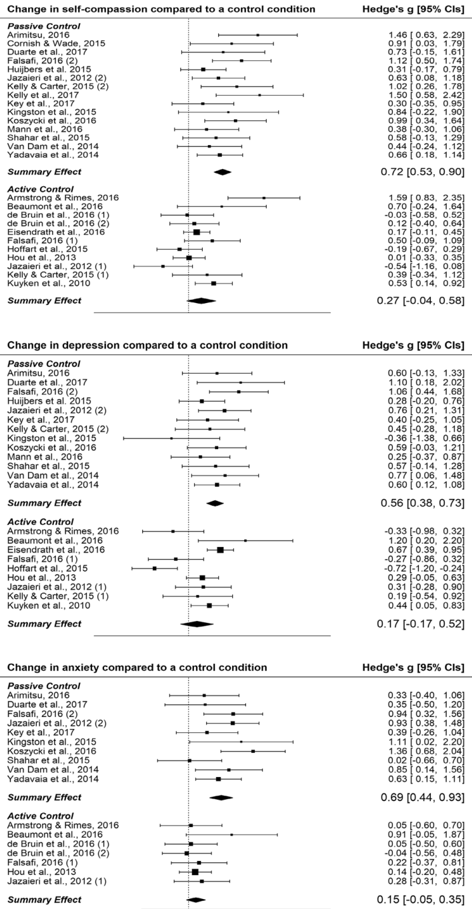
- Across all controls, self-compassion-related therapies produced greater improvements in self-compassion (g = 0.52, 95% CI [0.32, 0.71]), anxiety (g = 0.46, 95% CI [0.25, 0.66]), and depressive symptoms (g = 0.40, 95% CI [0.23, 0.57]).
- When restricted to active control comparisons, effects were not significant: self-compassion g = 0.27 [−0.04, 0.58], p = 0.092; anxiety g = 0.15 [−0.05, 0.35], p = 0.138; depression g = 0.17 [−0.17, 0.52], p = 0.324.
- Type of control was the only significant moderator; patient status (clinical vs. subclinical) and therapy type (explicitly compassion-based vs. other compassion-related therapies) were not moderators. Passive-control studies showed moderate effects: self-compassion g = 0.72, depression g = 0.56, anxiety g = 0.69.
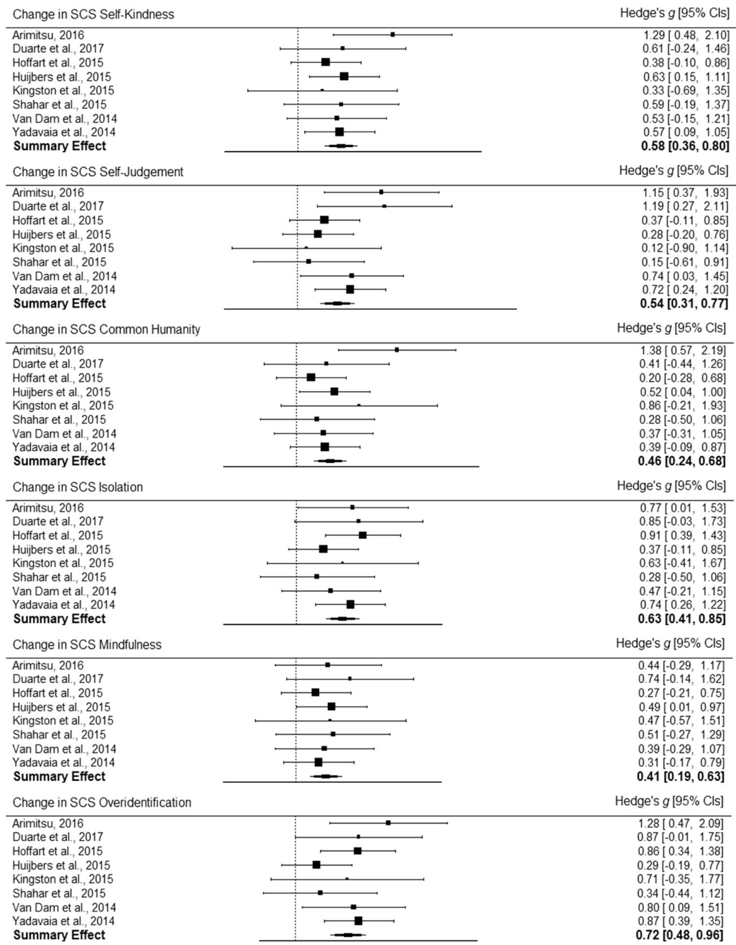
- SCS subscale effects were all significant, with a trend for negative subscales to improve more: over-identification g = 0.72, isolation g = 0.63, self-kindness g = 0.58, self-judgement g = 0.54, common humanity g = 0.46, mindfulness g = 0.41. Narrative synthesis found changes in self-compassion correlated with psychopathology in several studies, but also in control groups.
Methods
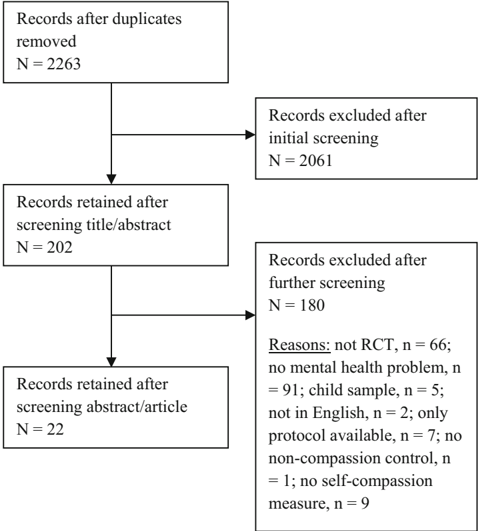
- Systematic review and meta-analysis of RCTs; searched PsycINFO, Medline, Embase, CINAHL, and Cochrane Library in July 2017. Inclusion required adults aged 18+, clinical or subclinical mental health problems, a self-compassion-related intervention with at least one face-to-face therapist session, a standardised self-compassion measure, and English peer-reviewed publication.
- Included 22 RCTs: 13 mindfulness-based therapies, 1 daylong ACT workshop, and 8 compassion-based interventions. Baseline data covered 1,262 participants, median sample size 40; 73.9% female, mean age 40.0 years (SD = 10.7). Eleven studies had active controls and 15 had waitlist/TAU controls.
- Effect sizes were Hedges’ g for standardised difference in change scores between intervention and control, divided by pooled prestudy SD. Multilevel meta-analytic models in R (compute.es, metafor) tested moderators (population, therapy type, control type), heterogeneity (Q, I²), and publication bias (Egger’s test, trim-and-fill).
Limitations
- The paper states that performance bias was a concern due to lack of blinding of participants and therapists, and that active control conditions were not always well matched on social contact. It also notes substantial attrition in some studies, inconsistent intention-to-treat analyses, limited follow-up, and likely insufficient power to detect small moderation effects.
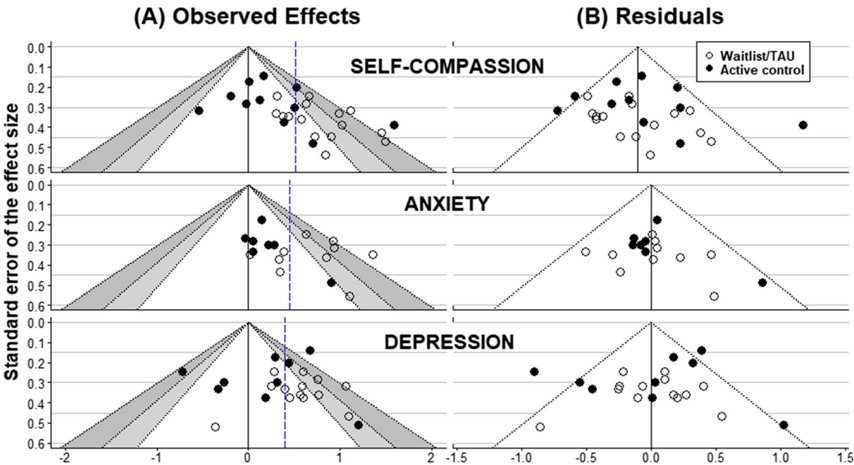
- Evident from the text: heterogeneity was moderate for self-compassion (I² = 60.7%) and depression (I² = 58.9%) and small for anxiety (I² = 44.2%), with residual heterogeneity unexplained in some models. Publication bias was borderline for self-compassion (Egger’s p = 0.136), and trim-and-fill suggested 3 missing studies with a small adjustment (β = 0.08).
- The SCS subscale analysis was based on only 8 studies and 326 people, and all those studies used passive TAU controls, so the authors note it may overestimate true treatment effects.
Model-written summary. Check it against the paper before relying on it.
Integrity signals
Registry
Cites
Statistics
Figures
Verification
Claims the paper makes
14 Valid · 1 Not valid · 28 Not checked · 138 Own results and interpretations
Every source the paper cites for this claim was checked and supports it.
In the paper
“and adolescents ( r = -0.55; Marsh et al. 2018)”
What the sources say
- Supportedcites Marsh et al. 2018 matched to “Self-compassion and Psychological Distress in Adolescents—a Meta-analysis” (2018) source
The Results section reports an inverse association between self-compassion and psychological distress in adolescents, with a pooled correlation of r = −0.55. The paper identifies anxiety, depression, and stress as the distress outcomes; the quoted r is the pooled estimate, not a separate correlation for each outcome. Page numbers were unavailable in our copy. (LLM, conf=0.94)
plainstates an association- Asserted: passes — The authors put it forward as true.
- Checkable: passes — It can be checked against evidence.
- Load-bearing: passes — The paper’s conclusions depend on it.
- Based: passes — The paper gives a reason why it holds.
- Supported
The sources with a verdict support this claim; the rest weren’t checked yet, have no full text we could read, or their verdicts aren’t rated yet.
In the paper
“Also, in addition to depression, anxiety and stress (MacBeth and Gumley 2012), low selfcompassion has been linked to symptomology in people with persecutory delusions (Collett et al. 2016), auditory hallucinations (Dudley et al. 2018), eating disorders (Ferreira et al. 2013), and Cluster C personality disorders (Schanche et al. 2011).”
What the sources say
- Not checked — no full text of the sourcecites MacBeth and Gumley 2012 matched to “Exploring compassion: A meta-analysis of the association between self-compassion and psychopathology” (2012) source
- Not checked — no full text of the sourcecites Collett et al. 2016 matched to “Negative cognitions about the self in patients with persecutory delusions: An empirical study of self-compassion, self-stigma, schematic beliefs, self-esteem, fear of madness, and suicidal ideation” (2016) source
- Supportedcites Dudley et al. 2018 matched to “Mindfulness of voices, self‐compassion, and secure attachment in relation to the experience of hearing voices” (2018) source
The Dudley et al. citation is attached specifically to auditory hallucinations, not the other conditions in the sentence. The Discussion (page not provided) reports that lower self-compassion was significantly associated with greater distress and severity of voices. (LLM, conf=0.92)
plainstates an association- Asserted: passes — The authors put it forward as true.
- Checkable: passes — It can be checked against evidence.
- Load-bearing: passes — The paper’s conclusions depend on it.
- Based: passes — The paper gives a reason why it holds.
The sources with a verdict support this claim; the rest weren’t checked yet, have no full text we could read, or their verdicts aren’t rated yet.
In the paper
“In three of these (Armstrong and Rimes 2016; Hou et al. 2014; Kuyken et al. 2010), the control condition was not closely matched to the intervention in duration of social contact.”
What the sources say
- Not checked — no full text of the sourcecites Armstrong and Rimes 2016 matched to “Mindfulness-Based Cognitive Therapy for Neuroticism (Stress Vulnerability): A Pilot Randomized Study.” (2016) source
- Supportedcites Hou et al. 2014 matched to “The Effects of Mindfulness-Based Stress Reduction Program on the Mental Health of Family Caregivers: A Randomized Controlled Trial” (2014) source
The Intervention section describes eight weekly two-hour group sessions, while the Procedure section says the control group received self-help health education booklets. The Discussion explicitly notes the lack of an active control that could account for the intervention group's social interaction and extra attention. The cited paper therefore supports the claim about its own control condition; it does not establish the same point for the other two studies named in the sentence. (LLM, conf=0.94)
- Not checked — no full text of the sourcecites Kuyken et al. 2010 matched to “How does mindfulness-based cognitive therapy work?” (2010) source
plain- Asserted: passes — The authors put it forward as true.
- Checkable: passes — It can be checked against evidence.
- Load-bearing: unclear — It is unclear whether the paper’s conclusions depend on it.
- Based: passes — The paper gives a reason why it holds.
The cited sources support only part of this claim — read each source’s verdict below.
In the paper
“In four of these studies (Huijbers et al. 2017; Kelly et al. 2017; Key et al. 2017; Kingston et al. 2015), the control groups provided a high level of comparison with the intervention group, since the participants were under the care of an outpatient clinic with consistent psychotherapy and/or pharmacotherapy.”
What the sources say
- Partly supportedcites Huijbers et al. 2017 matched to “Teacher Competence in Mindfulness-Based Cognitive Therapy for Depression and Its Relation to Treatment Outcome” (2017) sourceExperimental — accuracy not yet measured
The Method > Procedure passage describes two underlying randomized trials, including one with a medication-only comparison group. But this teacher-competence study restricted its own sample to participants allocated to MBCT (Method > Participants). Our copy does not establish that its control groups received consistent outpatient psychotherapy or pharmacotherapy, so it supports only part of the attributed description. (LLM, conf=0.86)
- Not checked — no full text of the sourcecites Kelly et al. 2017 matched to “Group‐Based Compassion‐Focused Therapy as an Adjunct to Outpatient Treatment for Eating Disorders: A Pilot Randomized Controlled Trial” (2017) source
- Not checked — no full text of the sourcecites Key et al. 2017 matched to “Mindfulness-based cognitive therapy as an augmentation treatment for obsessive-compulsive disorder.” (2017) source
plain- Asserted: passes — The authors put it forward as true.
- Checkable: passes — It can be checked against evidence.
- Load-bearing: unclear — It is unclear whether the paper’s conclusions depend on it.
- Based: passes — The paper gives a reason why it holds.
- Partly supported
The sources with a verdict support this claim; the rest weren’t checked yet, have no full text we could read, or their verdicts aren’t rated yet.
In the paper
“To correct for these correlated comparisons (Higgins and Green 2011), we used a multilevel meta-analytic model (Konstantopoulos 2011; Weisz et al. 2013).”
What the sources say
- Not matchedcites Higgins and Green 2011
An author–year citation the paper’s reference list doesn’t settle. We don’t search these by name.
- Not checked — no full text of the sourcecites Konstantopoulos 2011 matched to “Fixed effects and variance components estimation in three-level meta-analysis” (2011) source
- Supportedcites Weisz et al. 2013 matched to “Performance of Evidence-Based Youth Psychotherapies Compared With Usual Clinical Care: A Multilevel Meta-analysis” (2013) source
The Method section, under “Data Synthesis: Rationale for, and Description of, the Multilevel Approach,” says that multiple effect sizes per study violated the independence assumption. It states that the authors used a three-level meta-analytic model to account for dependence among effect sizes within studies, matching the attributed methodological example. No page number is provided in our copy. (LLM, conf=0.94)
plain- Asserted: passes — The authors put it forward as true.
- Checkable: passes — It can be checked against evidence.
- Load-bearing: passes — The paper’s conclusions depend on it.
- Based: passes — The paper gives a reason why it holds.
- Not matched
89 more claims · 1 with their cited sources checked
Create a free account to see all 181 claims and to verify the 1 reference still open.
- Probably not a substantial claim. 53
- It may state two separate claims as one. 54
- The quote only partly states this claim. 5
Claims other papers make about this one
Each is checked against this paper’s own text: does it say what the citing paper says it does?
The source backs part of the claim, not all of it — or backs it for a different population, condition or comparison.
In the citing paper
“A number of studies have provided empirical evidence for CFT’s effectiveness in treating a range of conditions, including mood and anxiety disorders (Leaviss and Uttley, 2015; Wilson et al., 2018), substance use disorders (Held et al., 2018), and OCD (Petrocchi et al., 2021).”
From Feasibility and preliminary outcomes of compassion-focused acceptance and commitment therapy delivered via telehealth in a community behavioral health clinic (2025) · cites this paper as Wilson et al., 2018
Experimental — accuracy not yet measuredThe cited source says what the claim attributes to it.
In the citing paper
“Conversely, the findings could be explained through a recent systematic review and meta-analysis that highlighted selfcompassion interventions improving self-compassion and psychopathology, but not over and beyond other interventions (Wilson, Mackintosh, Power, & Chan, 2019), which is consistent with the present findings.”
From When ‘negativity’ becomes obstructive: a novel exploration of the two-factor model of the Self-Compassion Scale and a comparison of self-compassion and self-criticism interventions (2020) · cites this paper as Wilson, Mackintosh, Power, & Chan, 2019
The cited source says what the claim attributes to it.
In the citing paper
“a recent systematic review and meta-analysis that highlighted selfcompassion interventions improving self-compassion and psychopathology, but not over and beyond other interventions (Wilson, Mackintosh, Power, & Chan, 2019)”
From When ‘negativity’ becomes obstructive: a novel exploration of the two-factor model of the Self-Compassion Scale and a comparison of self-compassion and self-criticism interventions (2020) · cites this paper as Wilson, Mackintosh, Power, & Chan, 2019
Statistics that don’t add up
Each reported p-value recomputed from its test statistic and degrees of freedom, each partial η² from its F, and each ratio, mean difference or B printed with a p checked against its own confidence interval.
Rated minor: it would not touch a result — a value no result rests on, a p-value that stays on the same side of the significance level, or a conflict that is clerical, resolved elsewhere in the paper, or outside its own findings.
In the paper
“Q (16) = 28.67, p =0.041”
Reported p = .041 · recomputed p = .026
Rated minor: it would not touch a result — a value no result rests on, a p-value that stays on the same side of the significance level, or a conflict that is clerical, resolved elsewhere in the paper, or outside its own findings.
In the paper
“z =0.80, p =0.380”
Reported p = .38 · recomputed p = .424
Statistics recomputed
Every reported test result, recomputed from its test statistic and degrees of freedom. A result shows as not adding up only once an independent check has confirmed it.
- Doesn’t add upQ(16) = 28.67reported p = .041 · recomputed p = .026
“Q (16) = 28.67, p = .041”
- Doesn’t add upz = 0.8reported p = .38 · recomputed p = .424
“z =0.80, p = .380”
- ConsistentQ(25) = 63.63reported p < .001 · recomputed p < .001
“Q (25) = 63.63, p < .001”
- ConsistentQ(21) = 51.09reported p < .001 · recomputed p < .001
“Q (21) = 51.09, p < .001”
- Consistentz = 0.42reported p = .676 · recomputed p = .674
“z =0.42, p = .676”
Self-check
Percentages, sums and reported differences re-computed from the paper’s own numbers.
Each contradiction between two passages listed here was confirmed by an independent check.
Rated minor: it would not touch a result — a value no result rests on, a p-value that stays on the same side of the significance level, or a conflict that is clerical, resolved elsewhere in the paper, or outside its own findings.
In the paper
§ Data Analyses · p. 7
“Variables were dummy-coded such that positive coefficients for population, therapy type and control type meant a greater effect for clinical populations, CFTand studies with an active control, respectively.”
§ Types of Control, Intervention and Population as Possible Moderators of Outcome · p. 10
“self-compassion, g = 0.72 [0.53, 0.90], p < 0.001; depression, g = 0.56 [0.38, 0.73], p <0.001; anxiety g =0.69, [0.44, 0.93], p <0.001. For studies with an active control condition, effect sizes were not significant, though self-compassion only marginally missed significance, g =0.27 [ -0.04, 0.58], p =0.092.”
Citations
Cites
Statistical Power Analysis for the Behavioral Sciences
Muller, K. (1989) · Technometrics · doi:10.1080/00401706.1989.10488618 · Cited by 99,167
Statistical power analysis for the behavioral sciences
(1990) · Computers, Environment and Urban Systems · doi:10.1016/0198-9715(90)90050-4 · Cited by 65,269
Measuring inconsistency in meta-analyses
Higgins, J. P. T., Thompson, S. G., Deeks, J. J., & Altman, D. G. (2003) · BMJ · doi:10.1136/bmj.327.7414.557 · Cited by 63,139
Bias in meta-analysis detected by a simple, graphical test
Egger, M., Smith, G. D., Schneider, M., & Minder, C. (1997) · BMJ · doi:10.1136/bmj.315.7109.629 · Cited by 56,722 · cited 2×
“funnel plot showing the residuals (Egger et al. 1997).”
Statistical Power Analysis for the Behavioral Sciences (2nd ed.).
Lachenbruch, P. A., & Cohen, J. (1989) · Journal of the American Statistical Association · doi:10.2307/2290095 · Cited by 37,395
The Cochrane Collaboration's tool for assessing risk of bias in randomised trials
Higgins, J. P. T., Altman, D. G., Gotzsche, P. C., Juni, P., Moher, D., Oxman, A. D., Savovic, J., Schulz, K. F., Weeks, L., Sterne, J. A. C., et al. (2011) · BMJ · doi:10.1136/bmj.d5928 · Cited by 33,817
Conducting Meta-Analyses in R with the metafor Package
Viechtbauer, W. (2010) · Journal of Statistical Software · doi:10.18637/jss.v036.i03 · Cited by 20,464
Duval, S., & Tweedie, R. (2000) · Biometrics · doi:10.1111/j.0006-341x.2000.00455.x · Cited by 14,099
Statistical Methods for Meta-Analysis
Wasserman, S., Hedges, L. V., & Olkin, I. (1988) · Journal of Educational Statistics · doi:10.2307/1164953 · Cited by 10,326
Downs, S. H., & Black, N. (1998) · Journal of Epidemiology and Community Health · doi:10.1136/jech.52.6.377 · Cited by 8,252
Research works printed but not linked: 2
- Hou, R. J., Wong, S. Y ., Yip, B. H., Hung, A. T., Lo, H. H., Chan, P. H., … & Ma, S. H. (2014). The effects of mindfulness-based stress reduction program on the mental health of family caregivers: a randomized controlled trial. Psychotherapy and Psychosomatics, 83 , 45 -53. doi: https://doi.org/10.1159/000353278. · DOI · Paper page
- Segal, Z. V ., Williams, J. M. G., & Teasdale, J. D. (2002). Mindfulnessbased cognitive therapy for depression . New York: Guilford.
Cited by
Items 101–200 of 301
Laicher, H., Int-Veen, I., Woloszyn, L., Wiegand, A., Kroczek, A., Sippel, D., Leehr, E. J., Lawyer, G., Albasini, F., Frischholz, C., et al. (2023) · NeuroImage Clinical · doi:10.1016/j.nicl.2023.103525 · Cited by 13
Compassion in mental health: a literature review
Rooney, J. M. (2020) · Mental Health and Social Inclusion · doi:10.1108/mhsi-05-2020-0029 · Cited by 10
Donovan, E., Bluth, K., Scott, H., Mohammed, M., & Cousineau, T. M. (2021) · Journal of American College Health · doi:10.1080/07448481.2021.1891077 · Cited by 15
Self‐compassion and related factors in severe mental illness: A scoping review
Kurebayashi, Y., & Sugimoto, H. (2022) · Perspectives In Psychiatric Care · doi:10.1111/ppc.13017 · Cited by 9
Wu, D., Ye, B., Tang, C., Xue, J., Yang, Q., & Xia, F. (2022) · Psychology Research and Behavior Management · doi:10.2147/prbm.s380874 · Cited by 13
López-del-Hoyo, Y., Fernández-Martínez, S., Perez-Aranda, A., Monreal-Bartolomé, A., Barceló-Soler, A., Camarero-Grados, L., Armas-Landaeta, C., Guzmán-Parra, J., Carbonell, V., Campos, D., et al. (2025) · Journal of Medical Internet Research · doi:10.2196/59653 · Cited by 9
Denneson, L. M., Smolenski, D. J., McDonald, K. L., Shull, S., Hoffmire, C. A., Britton, P. C., Carlson, K. F., & Dobscha, S. K. (2024) · Journal of Affective Disorders · doi:10.1016/j.jad.2024.05.133 · Cited by 11
Zhang, W., Chen, X., Ya, Z., & Shi, X. (2024) · Journal of Youth and Adolescence · doi:10.1007/s10964-024-02122-3 · Cited by 14
Galvin, J., Howes, A., & Richards, G. (2023) · Journal of Autism and Developmental Disorders · doi:10.1007/s10803-023-06157-6 · Cited by 19
Basque, D., Talbot, F., & French, D. J. (2021) · Internet Interventions · doi:10.1016/j.invent.2021.100458 · Cited by 8
Bianchini, G., & Bodell, L. P. (2024) · Archives of Suicide Research · doi:10.1080/13811118.2024.2307894 · Cited by 13
Self-Compassion and Social Anxiety: A Scoping Review
Slivjak, E. T., Majid, F. A., Wrigley, J., Russell, S., Zielony, L., & Arch, J. J. (2024) · Mindfulness · doi:10.1007/s12671-024-02450-2 · Cited by 16
Self-compassion, social cognition, and self-affect in adolescence: A longitudinal study
Talwar, V., Castellanos, M., & Bosacki, S. (2022) · Self and Identity · doi:10.1080/15298868.2022.2030400 · Cited by 11
Andreu, C. I., Navarrete, J., Roca, P., Baños, R., & Cebolla, A. (2022) · Mindfulness · doi:10.1007/s12671-022-02013-3 · Cited by 8
Jones, G. M., Herrmann, F. M., & Nock, M. K. (2023) · JMIR Formative Research · doi:10.2196/49284 · Cited by 9
Kocur, D. J., & Jach, Ł. (2024) · Education and Information Technologies · doi:10.1007/s10639-024-12831-8 · Cited by 11
Self-Compassionate Motivation and Athlete Well-Being: The Critical Role of Distress Tolerance
Walton, C. C., Lewis, K. J., Kirby, J. N., Purcell, R., Rice, S., & Osborne, M. S. (2022) · Journal of Clinical Sport Psychology · doi:10.1123/jcsp.2022-0009 · Cited by 15
Depression, anxiety and worry in young Pacific adults in New Zealand during the COVID-19 pandemic
Siegert, R. J., Narayanan, A., Dipnall, J. F., Gossage, L., Wrapson, W., Sumich, A. L., Mérien, F., Berk, M., Paterson, J. E., & Tautolo, E. (2022) · Australian & New Zealand Journal of Psychiatry · doi:10.1177/00048674221115641 · Cited by 13
Rushforth, A., Kotera, Y., & Kaluževičiūtė, G. (2022) · International Journal of Mental Health and Addiction · doi:10.1007/s11469-022-00856-4 · Cited by 11
Wei, Z., Xia, B., Jiang, L., Zhu, H., Li, L., Wang, L., Zhao, J., Fan, R., Wang, P., & Huang, M. (2024) · Frontiers in Psychiatry · doi:10.3389/fpsyt.2024.1490171 · Cited by 11
Designing Humanoid Avatars in Individualised Virtual Reality for Mental Health Applications
Elliott, T. C., Henry, J. D., & Baghaei, N. (2023) · IEEE International Symposium on Mixed and Augmented Reality Adjunct (ISMAR-Adjunct) · doi:10.1109/ismar-adjunct60411.2023.00069 · Cited by 8
Yang, H. M., Fong, L. H. N., Zhou, H., Chark, R., Fong, D. K. C., Hui, B. P. H., & Wu, A. M. S. (2024) · Current Psychology · doi:10.1007/s12144-024-06659-1 · Cited by 7
Damavandian, A., Golshani, F., Saffarinia, M., & Baghdasarians, A. (2022) · The Journal Of Psychological Science · doi:10.52547/jps.21.112.797 · Cited by 19
Kamboj, S. K., Peniket, M. J., & Simeonov, L. (2023) · PLoS ONE · doi:10.1371/journal.pone.0282861 · Cited by 9
Self-Compassion As A Mediator of The Relationship Between Psychological Inflexibility and Resilience
Büyüköksüz, E., & Tekin, I. (2023) · Spiritual Psychology and Counseling · doi:10.37898/spiritualpc.1276031 · Cited by 12
Garland, E. L., & Jinpa, T. (2024) · Behaviour Research and Therapy · doi:10.1016/j.brat.2024.104494 · Cited by 6
Dai, X., Lu, S., Sullivan, A. A., & Hu, H. (2024) · Journal of Affective Disorders · doi:10.1016/j.jad.2024.07.096 · Cited by 8
Vusio, F., Odentz, K., & Plunkett, C. (2025) · European Child & Adolescent Psychiatry · doi:10.1007/s00787-025-02711-y · Cited by 13
Elliott, T. C., Yang, Y., Knibbe, J., Henry, J. D., & Baghaei, N. (2025) · JMIR Formative Research · doi:10.2196/71004 · Cited by 8
Combining mindfulness and compassion in the treatment of complex trauma – a theoretical exploration
Strand, M., & Stige, S. H. (2021) · European Journal of Trauma & Dissociation · doi:10.1016/j.ejtd.2021.100217 · Cited by 11
Skala Współczucia dla Samego Siebie (SCS-PL)
Kocur, D. J., Flakus, M., & Fopka-Kowalczyk, M. J. (2022) · Przegląd Badań Edukacyjnych · doi:10.12775/pbe.2022.013 · Cited by 14
Analysis of the Predictive Role of Self-Compassion on Emotional Distress during COVID-19 Lockdown
Gutiérrez-Hernández, M. E., Fanjul, L. F., Díaz, A., Oyanadel, C., & Castro, W. P. (2022) · Social Sciences · doi:10.3390/socsci11040151 · Cited by 10
Ciarrochi, J., Hayes, L., Quinlen, G., Sahdra, B. K., Ferrari, M., & Yap, K. (2022) · Springer eBooks · doi:10.1007/978-3-031-06932-1_17 · Cited by 12
Godara, M., & Singer, T. (2024) · Journal of Clinical Medicine · doi:10.3390/jcm13113295 · Cited by 5
O'Boyle-Finnegan, Ú., Graham, C. D., Doherty, N., & Adair, P. (2022) · Journal of Contextual Behavioral Science · doi:10.1016/j.jcbs.2022.05.002 · Cited by 5
Effectiveness of Compassion-Based Interventions for Reducing Stress in Workers: A Systematic Review
Martins, F. J., Palmeira, L., & Matos, M. (2025) · Mindfulness · doi:10.1007/s12671-025-02590-z · Cited by 12
Yarrington, J. S., Metts, A. V., Vargas, J. H., Couto, D. D., Marafon, T., & Cohen, Z. D. (2025) · Journal of Affective Disorders · doi:10.1016/j.jad.2025.119878 · Cited by 8
Patterson, C. W., & Golightly, M. (2022) · Journal of Applied Research in Intellectual Disabilities · doi:10.1111/jar.13045 · Cited by 6
Barbenchon, E. L., & Genin, M. (2024) · Journal of Behavioral and Cognitive Therapy · doi:10.1016/j.jbct.2023.100484 · Cited by 5
Karataş, Z., & TÜCCAR, E. (2024) · Journal of Social Service Research · doi:10.1080/01488376.2024.2407606 · Cited by 7
Aguilera, P., Navarro‐Gil, M., Pérez‐Aranda, A., Armas-Landaeta, C., Beltrán-Ruiz, M., Rodríguez‐Freire, C., Camarero-Grados, L., García‐Campayo, J., & Montero‐Marín, J. (2024) · School Mental Health · doi:10.1007/s12310-024-09722-1 · Cited by 9
Self-compassion as a resource in the parenting role
Żmuda, A. (2024) · Kwartalnik Naukowy Fides et Ratio · doi:10.34766/fetr.v58i2.1267 · Cited by 9
Delgado-Suárez, I., del Hoyo, Y. L., García‐Campayo, J., Pérez‐Aranda, A., Modrego‐Alarcón, M., Beltrán-Ruiz, M., Gascón, S., & Montero‐Marín, J. (2021) · Frontiers in Psychology · doi:10.3389/fpsyg.2021.717736 · Cited by 8
Kleiman, K., Marks, D. R., Block-Lerner, J., Tirch, D., Brady, V., Foote, B., & Silberstein-Tirch, L. (2025) · Frontiers in Psychology · doi:10.3389/fpsyg.2025.1509396 · Cited by 4
Casellas‐Pujol, E., Soler, J., Schmidt, C., Soria-Madrid, A., Elices, M., & Pascual, J. C. (2024) · Journal of Contextual Behavioral Science · doi:10.1016/j.jcbs.2024.100846 · Cited by 7
Büyüköksüz, E., Tekin, I., Arıkan, S., İlkay, Ş., & Erözkan, A. (2025) · BMC Psychology · doi:10.1186/s40359-025-03070-8 · Cited by 9
Ramsey, M., Govind, T., Lam, J. A., Palmer, B. W., Jeste, D. V., & Lee, E. (2023) · Schizophrenia Research · doi:10.1016/j.schres.2023.03.017 · Cited by 7
Meng, H., Wang, X., & Liu, H. (2023) · Frontiers in Psychology · doi:10.3389/fpsyg.2023.1110076 · Cited by 7
Demir, V., & GEN, K. K. (2023) · KADEM Kadın Araştırmaları Dergisi · doi:10.21798/kadem.2023.140 · Cited by 11
Rezapour-Mirsaleh, Y., Abolhasani, F., Amini, R., Rezai, M. J., Choobforoushzadeh, A., & Shameli, L. (2024) · Journal of Religion and Health · doi:10.1007/s10943-024-02045-0 · Cited by 5
Qiang, J., Jin, Y., Li, Y., & Xu, C. L. (2025) · Frontiers in Psychiatry · doi:10.3389/fpsyt.2025.1603860 · Cited by 5
Psychometric Properties of the Self-Compassion Scale in the Polish Population
Holas, P., Shevchuk, Y., & Jankowski, T. (2023) · Roczniki Psychologiczne · doi:10.18290/rpsych2023.0009 · Cited by 4
Garvey, N., Hankey, J. R., Bohr, Y. M., & Barnhardt, J. (2025) · American Indian Culture and Research Journal · doi:10.17953/a3.1482 · Cited by 5
Sourmeh, A., Mashhadi, A., & Shamloo, Z. S. (2020) · doi:10.30699/mci.4.2.21 · Cited by 5
Trajectories of Self-compassion and Psychological Symptoms in Newly Diagnosed Cancer Patients
Wang, J., Hu, Y., Wei, L., Liu, A., Yao, J., Schroevers, M. J., & Zhu, L. (2022) · Mindfulness · doi:10.1007/s12671-021-01809-z · Cited by 6
Cebolla, A., Galiana, L., Navarrete, J., Morón, D. A., Garrote‐Caparrós, E., Sansó, N., Simarro, J. V. C., Juan, M., & Blasco, M. L. (2022) · International Journal of Environmental Research and Public Health · doi:10.3390/ijerph192013137 · Cited by 8
A House with Many Doors – Toward a More Nuanced Self-Compassion Intervention Science
Finlay‐jones, A. L. (2023) · Mindfulness in behavioral health · doi:10.1007/978-3-031-22348-8_24 · Cited by 8
Conversations as Carriers of Meaning to a Common Good
Marujo, H. Á., Neto, L. M., & Wissing, M. P. (2019) · International handbooks of quality-of-life · doi:10.1007/978-3-030-15367-0_6 · Cited by 4
A meta‐analysis of self‐compassion and attachment in adults
Hill, C., Vasiliou, V. S., Sirois, F. M., Hughes, O., & Thompson, A. R. (2025) · Psychology and Psychotherapy Theory Research and Practice · doi:10.1111/papt.12590 · Cited by 9
Gai, Y., & Berle, D. (2025) · Clinical Psychology & Psychotherapy · doi:10.1002/cpp.70125 · Cited by 4
Hidding, M., Veling, W., Pijnenborg, G. H. M., & van der Stouwe, E. C. D. (2025) · Journal of Behavior Therapy and Experimental Psychiatry · doi:10.1016/j.jbtep.2025.102053 · Cited by 4
Sik, H. T., Yu, B. C. L., Chan, R. M. K., Ho, C. Y. Y., & Mak, W. W. S. (2026) · Mindfulness · doi:10.1007/s12671-026-02770-5 · Cited by 3
Colpizzi, I., Berti, C., Sica, C., Alfei, V., & Caudek, C. (2024) · Behavioral Sciences · doi:10.3390/bs14030178 · Cited by 9
Treating emotional neglect: polyvagal and trauma-informed compassion focused therapy
Blanning, S. (2024) · Counselling Psychology Quarterly · doi:10.1080/09515070.2024.2413093 · Cited by 4
Self‐compassion in patients undergoing haemodialysis: A qualitative study
Kemmochi, T., Oka, M., Matsumoto, M., Sato, Y., Sato, M., Fukuda, A., Sadakata, A., & Kimura, K. (2024) · Journal of Renal Care · doi:10.1111/jorc.12516 · Cited by 4
Paetzold, I., Gugel, J., Schick, A., Rauschenberg, C., Hirjak, D., Boecking, B., Doi, L., Schwannauer, M., & Reininghaus, U. (2024) · Psychology and Psychotherapy Theory Research and Practice · doi:10.1111/papt.12565 · Cited by 7
A Triadic Pathway Model of Self-Compassion and Health
Sirois, F. M. (2023) · Mindfulness in behavioral health · doi:10.1007/978-3-031-22348-8_18 · Cited by 4
Self-compassion as a Newly Observed Dimension of the Student's Personality
Krejčová, K., Rymešová, P., & Chýlová, H. (2023) · Journal on Efficiency and Responsibility in Education and Science · doi:10.7160/eriesj.2023.160205 · Cited by 5
A Theory-Based Meta-Analysis: Stress Management Interventions for College Students
Williams, L. D., Lipscomb, T. J., & Tiamuh, Z. (2023) · Journal of Education and Training Studies · doi:10.11114/jets.v11i4.6267 · Cited by 5
Pijakelai, A. A., Akbari, M., Mohammadkhani, S., & Hasani, J. (2023) · Journal of Rational-Emotive & Cognitive-Behavior Therapy · doi:10.1007/s10942-023-00530-1 · Cited by 4
Doost, A. M. S., Hosseinkhanzadeh, A. A., Kousha, M., & Naseh, A. (2023) · Quarterly Journal of Child Mental Health · doi:10.61186/jcmh.9.4.5 · Cited by 4
Yotsidi, V., Ntakolia, C., Rannou, I., Stavrou, P., Ferentinos, P. P., Douzenis, A., Smyrnis, N., Gavriilidou, E., & Gournellis, R. (2024) · Research in Psychotherapy Psychopathology Process and Outcome · doi:10.4081/ripppo.2024.826 · Cited by 3
Hernández, Y. A. T., Parente, F., Faghy, M. A., Roscoe, C. M. P., & Maratos, F. A. (2021) · doi:10.31234/osf.io/dnuk3 · Cited by 3
Bistricky, S. L., Lopez, A. K., Pollard, T. B., Egan, A., Gimenez-Zapiola, M., Pascuzzi, B., Velasquez, K. M., & Graves, M. (2023) · medRxiv · doi:10.1101/2023.04.16.23288655 · Cited by 3
Wang, Y., Gao, Y., & Ju, D. (2025) · Personality and Individual Differences · doi:10.1016/j.paid.2025.113057 · Cited by 3
Aicher, H., Wicki, I. A., Meling, D., Mueller, M. J., Dornbierer, D., & Scheidegger, M. (2025) · Journal of Psychopharmacology · doi:10.1177/02698811251344689 · Cited by 3
Effects of Reappraisal and Self-Compassion Expressive Writing on Emotion Regulation
Jacques, T., & Alves, R. A. (2025) · Quarterly Journal of Experimental Psychology · doi:10.1177/17470218251392569 · Cited by 4
Eşref, N. A. S., TAYTAŞ, M., & Vangölü, M. S. (2025) · BMC Psychology · doi:10.1186/s40359-025-03757-y · Cited by 4
Digital insomnia therapeutic as a workplace performance solution for improving productivity
Russell, J. P., Teotia, A., Kalmbach, D. A., Drake, C., & Cheng, P. (2026) · Sleep Medicine · doi:10.1016/j.sleep.2026.108896 · Cited by 3
Alcaraz‐Córdoba, A., Alcaraz-Córdoba, T., Ibáñez‐Masero, O., Fernández, M. D. R., Ventura‐Miranda, M. I., & Ortega‐Galán, Á. M. (2026) · BMC Medical Education · doi:10.1186/s12909-026-08956-8 · Cited by 3
Sharifpour, E., Amarghan, H. A., Nejat, H., & Iranmanesh, A. (2024) · Health Nexus · doi:10.61838/kman.hn.2.1.1 · Cited by 3
Self-Warmth, Self-Coldness, and Depressive Symptoms Among Sexual Minority Adults
Skipper, C. J., & McLaren, S. (2024) · Journal of Bisexuality · doi:10.1080/15299716.2024.2346847 · Cited by 2
Work-related well-being in early career: A role of self-compassion
Krejčová, K., Krejčí, I., Chýlová, H., Rymešová, P., & Michálek, P. (2024) · Heliyon · doi:10.1016/j.heliyon.2024.e41377 · Cited by 12
Luna, S., & Rodríguez‐Carvajal, R. (2025) · Self and Identity · doi:10.1080/15298868.2025.2451794 · Cited by 8
Yang, J.-J., Wu, J., Zhu, L., Chen, C., Zhou, J.-R., Yang, L., Li, X.-N., Su, Y., Kong, Q.-M., & Si, T. (2025) · Journal of Eating Disorders · doi:10.1186/s40337-025-01371-2 · Cited by 3
Geller, J., Fernandes, A., Srikameswaran, S., Pullmer, R., & Marshall, S. K. (2022) · British Journal of Clinical Psychology · doi:10.1111/bjc.12370 · Cited by 3
The Functional Domain of Self-Criticism
Dinger, U., Löw, C., & Ehrenthal, J. C. (2021) · Depression and personality · doi:10.1007/978-3-030-70699-9_7 · Cited by 3
Fishbein, J. N., Judd, C. M., Genung, S., Stanton, A. L., & Arch, J. (2021) · doi:10.31234/osf.io/4uzg3
Díez, G. G., Martin-Subero, I., Zangri, R. M., Kulis, M., Andreu, C. I., Blanco, I., Roca, P., Cuesta, P., García, C., Garzón, J., et al. (2023) · medRxiv · doi:10.1101/2023.03.03.23286782 · Cited by 3
Effects of a Forest Meditation Therapy Program on Reducing Daily Stress and Promoting CopingPreprint
Yeo, S.-Y., Lee, M., & Shin, W.-S. (2024) · Preprints.org · doi:10.20944/preprints202405.1218.v1 · Cited by 2
Dafters, B., Mackintosh, S., & Irons, C. (2022) · OBM Integrative and Complementary Medicine · doi:10.21926/obm.icm.2204048 · Cited by 3
Södermark, M. (2023) · Linköping University medical dissertations · doi:10.3384/9789180753692 · Cited by 3
Jones, G. M., Castro‐Ramirez, F., Al‐Suwaidi, M., McGuire, T. C., & Herrmann, F. M. (2023) · JMIR Formative Research · doi:10.2196/53268 · Cited by 1
ÖZ ŞEFKAT İLE İNTİHAR BİLİŞLERİ ARASINDAKİ İLİŞKİ: UMUTSUZLUĞUN ARACI ROLÜ
Yücel, M., & Camadan, F. (2024) · Adıyaman üniversitesi sosyal bilimler enstitüsü dergisi/Adıyaman üniversitesi sosyal bilimler enstitisü dergisi · doi:10.14520/adyusbd.1362220 · Cited by 2
Shi, X., Hou, M., Chen, X., & Zhu, Y. (2024) · Nature and Science of Sleep · doi:10.2147/nss.s470557 · Cited by 1
Hamed, W. E., Kamel, N. A., Kappi, A. A., Babegi, A. S., Dailah, H. G., & El-Etreby, R. R. (2024) · BMC Psychiatry · doi:10.1186/s12888-024-06204-1 · Cited by 4
The Role of Self-Compassion for Adjustment to Inflammatory Bowel Disease
Yeates, R., & Rowse, G. (2025) · Springer eBooks · doi:10.1007/978-3-031-89095-6_21 · Cited by 1
Laicher, H., Int-Veen, I., Woloszyn, L., Wiegand, A., Kroczek, A., Sippel, D., Lawyer, G., Torka, F., Nieratschker, V., Rubel, J. A., et al. (2025) · Scientific Reports · doi:10.1038/s41598-025-16344-3 · Cited by 3
Schmelefske, E., Per, M., Anand, L., Khoury, B., & Heath, N. L. (2025) · BMC Complementary Medicine and Therapies · doi:10.1186/s12906-025-04962-3 · Cited by 5
Humphries, M. S. L., & McLaren, S. (2025) · Journal of Bisexuality · doi:10.1080/15299716.2025.2570255 · Cited by 1
Metadata
- Authors
- Wilson, A. C., Mackintosh, K., Power, K., & Chan, S. W. Y.
- Affiliations
- University of Oxford (GB)
- University of Edinburgh (GB)
- University of Stirling (GB)
- Corresponding author
- Chan, Stella W. Y.
- Venue
- Mindfulness
- Published
- 2018-10-24
- Volume
- 10
- Issue
- 6
- Pages
- 979-995
- ISSN
- 1868-8527 (ISSN-L)
- 1868-8535
- OpenAlex
- W2896823781
- Cited by
- 301
- References
- 72
- Citations by year
- 2026: 36 · 2025: 61 · 2024: 48 · 2023: 44 · 2022: 47 · 2021: 38 · 2020: 19 · 2019: 6
- FWCI
- 2.66
- Type
- journal article
- Language
- en
- Open access
- hybrid
- doi.org
- Licence
- cc-by
- creativecommons.org/licenses/by/4.0 (tdm)
- Locations
- Mindfulness (publishedVersion, cc-by)
- Stirling Online Research Repository (University of Stirling) (submittedVersion, cc-by)
- Durham Research Online (Durham University) (submittedVersion, cc-by)
- Edinburgh Research Explorer (University of Edinburgh) (submittedVersion, cc-by)
- Funders
- University of Edinburgh
- Topics
- Social Sciences › Psychology › Clinical Psychology › Mindfulness and Compassion Interventions
- Social Sciences › Psychology › Clinical Psychology › Psychotherapy Techniques and Applications
- Social Sciences › Psychology › Experimental and Cognitive Psychology › Anxiety, Depression, Psychometrics, Treatment, Cognitive Processes
- Keywords
- self-compassion, compassion-focused therapy, mindfulness-based cognitive therapy, acceptance and commitment therapy, third-wave therapies, anxiety, depressive symptoms, psychopathology, Self-Compassion Scale, performance bias
About these checks
Registry, retraction, Cites and statistics results are computed, not judged, with one exception: a printed reference that no index lists is read once by a model before it counts as a citation error. Claims are extracted by a model and kept only when their quote appears verbatim in the text; each cited source is then checked, with a model’s help, for whether it says what the claim relies on. Those verdicts can be wrong — read the claim’s quote and the cited source before relying on one.
The claim verdicts this report counts are experimental: their accuracy is not yet measured.
A language model drew the claims from the paper on 2026-09-30, under version 3 of the claim definition (model deepseek-v4.1-flash, prompt extract-v3).
A second model labelled each claim on 2026-09-30 (model jev-1.13-20260917, definition revision gold-guideline-v0.2).
Cited sources are checked with a language model’s help (gpt-6-sol).
Statistics and arithmetic are recomputed, not judged.
Confidence bands are shown only for fields calibrated on our annotated test set. None is calibrated yet, so no band is shown.
What counts as a claim ›How we measure confidence ›How we check this ›
Are you an author, or do you see a problem with this page? Request a review
Data sources
Bibliographic data: Semantic Scholar, OpenAlex, Crossref.
Contains information from the Semantic Scholar Academic Graph Datasets, made available under the ODC Attribution License (ODC-BY 1.0).
Semantic Scholar’s data is described in: Kinney, R., et al. (2023). The Semantic Scholar Open Data Platform. arXiv:2301.10140.
