

Effectiveness of Self-Compassion Related Therapies: a Systematic Review and Meta-analysis
Open accessThe DOI matches its Crossref record; 73 of the 74 references it cites were found in a registry or an index; 14 of the 58 sources its claims cite were checked for support.
Abstract
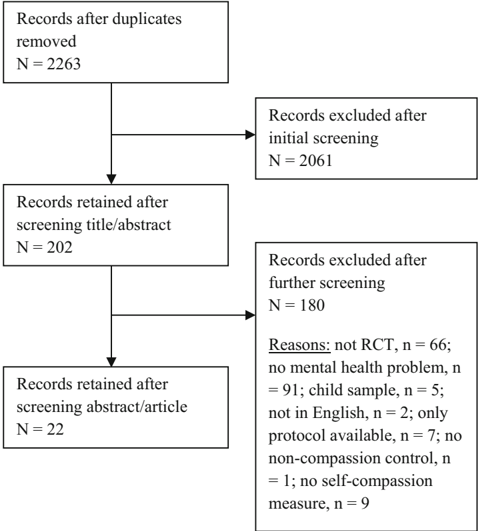
This systematic review and meta-analysis investigated whether self-compassion-related therapies, including compassion-focussed therapy, mindfulness-based cognitive therapy and acceptance and commitment therapy, are effective in promoting self-compassion and reducing psychopathology in clinical and subclinical populations. A total of 22 randomised controlled trials met inclusion criteria, with data from up to 1172 individuals included in each quantitative analysis. Effect sizes were the standardised difference in change scores between intervention and control groups. Results indicated that self-compassion-related therapies produced greater improvements in all three outcomes examined: self-compassion (g = 0.52, 95% CIs [0.32, 0.71]), anxiety (g = 0.46, 95% CIs [0.25, 0.66]) and depressive symptoms (g = 0.40, 95% CIs [0.23, 0.57]). However, when analysis was restricted to studies that compared self-compassion-related therapies to active control conditions, change scores were not significantly different between the intervention and control groups for any of the outcomes. Patient status (clinical vs. subclinical) and type of therapy (explicitly compassion-based vs. other compassion-related therapies, e.g. mindfulness) were not moderators of outcome. There was some evidence that self-compassion-related therapies brought about greater improvements in the negative than the positive subscales of the Self-Compassion Scale, although a statistical comparison was not possible. The methodological quality of studies was generally good, although risk of performance bias due to a lack of blinding of participants and therapists was a concern. A narrative synthesis found that changes in self-compassion and psychopathology were correlated in several studies, but this relationship was observed in both intervention and control groups. Overall, this review presents evidence that third-wave therapies bring about improvements in self-compassion and psychopathology, although not over and beyond other interventions. © 2018, The Author(s).
Overview
CoChat Summary
TL;DR
This systematic review and meta-analysis of 22 RCTs found that self-compassion-related therapies improved self-compassion, anxiety, and depressive symptoms relative to control conditions, with medium effects. However, when compared only with active controls, these therapies showed no significant advantage for any outcome.
Key findings
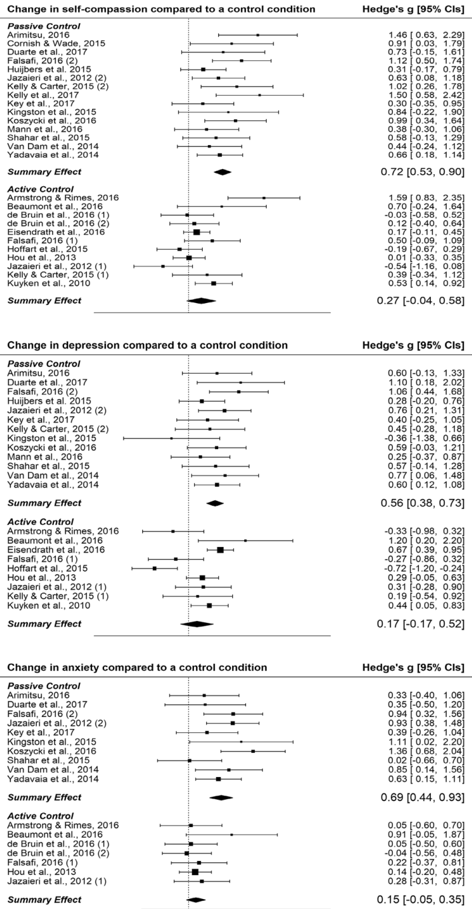
- Across all controls, self-compassion-related therapies produced greater improvements in self-compassion (g = 0.52, 95% CI [0.32, 0.71]), anxiety (g = 0.46, 95% CI [0.25, 0.66]), and depressive symptoms (g = 0.40, 95% CI [0.23, 0.57]).
- When restricted to active control comparisons, effects were not significant: self-compassion g = 0.27 [−0.04, 0.58], p = 0.092; anxiety g = 0.15 [−0.05, 0.35], p = 0.138; depression g = 0.17 [−0.17, 0.52], p = 0.324.
- Type of control was the only significant moderator; patient status (clinical vs. subclinical) and therapy type (explicitly compassion-based vs. other compassion-related therapies) were not moderators. Passive-control studies showed moderate effects: self-compassion g = 0.72, depression g = 0.56, anxiety g = 0.69.
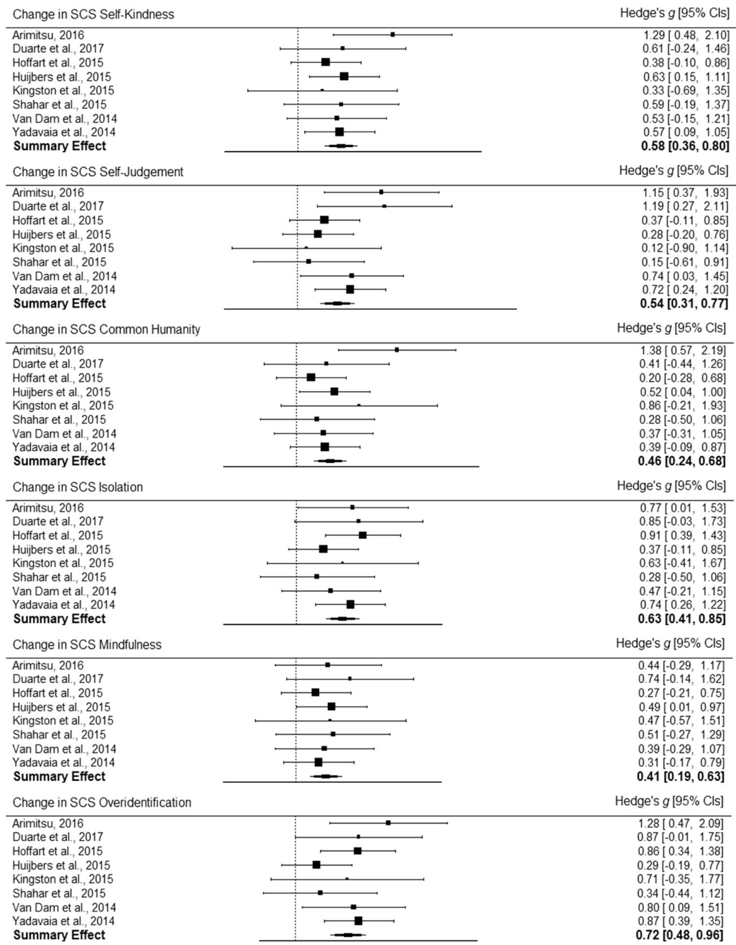
- SCS subscale effects were all significant, with a trend for negative subscales to improve more: over-identification g = 0.72, isolation g = 0.63, self-kindness g = 0.58, self-judgement g = 0.54, common humanity g = 0.46, mindfulness g = 0.41. Narrative synthesis found changes in self-compassion correlated with psychopathology in several studies, but also in control groups.
Methods
- Systematic review and meta-analysis of RCTs; searched PsycINFO, Medline, Embase, CINAHL, and Cochrane Library in July 2017. Inclusion required adults aged 18+, clinical or subclinical mental health problems, a self-compassion-related intervention with at least one face-to-face therapist session, a standardised self-compassion measure, and English peer-reviewed publication.
- Included 22 RCTs: 13 mindfulness-based therapies, 1 daylong ACT workshop, and 8 compassion-based interventions. Baseline data covered 1,262 participants, median sample size 40; 73.9% female, mean age 40.0 years (SD = 10.7). Eleven studies had active controls and 15 had waitlist/TAU controls.
- Effect sizes were Hedges’ g for standardised difference in change scores between intervention and control, divided by pooled prestudy SD. Multilevel meta-analytic models in R (compute.es, metafor) tested moderators (population, therapy type, control type), heterogeneity (Q, I²), and publication bias (Egger’s test, trim-and-fill).
Limitations
- The paper states that performance bias was a concern due to lack of blinding of participants and therapists, and that active control conditions were not always well matched on social contact. It also notes substantial attrition in some studies, inconsistent intention-to-treat analyses, limited follow-up, and likely insufficient power to detect small moderation effects.
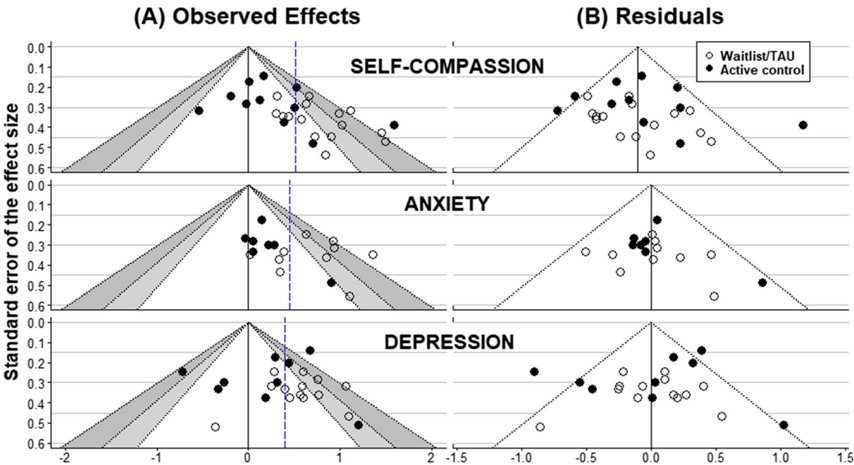
- Evident from the text: heterogeneity was moderate for self-compassion (I² = 60.7%) and depression (I² = 58.9%) and small for anxiety (I² = 44.2%), with residual heterogeneity unexplained in some models. Publication bias was borderline for self-compassion (Egger’s p = 0.136), and trim-and-fill suggested 3 missing studies with a small adjustment (β = 0.08).
- The SCS subscale analysis was based on only 8 studies and 326 people, and all those studies used passive TAU controls, so the authors note it may overestimate true treatment effects.
Model-written summary. Check it against the paper before relying on it.
Integrity signals
Registry
Cites
Statistics
Figures
Verification
Claims the paper makes
14 Valid · 1 Not valid · 28 Not checked · 138 Own results and interpretations
Every source the paper cites for this claim was checked and supports it.
In the paper
“and adolescents ( r = -0.55; Marsh et al. 2018)”
What the sources say
- Supportedcites Marsh et al. 2018 matched to “Self-compassion and Psychological Distress in Adolescents—a Meta-analysis” (2018) source
The Results section reports an inverse association between self-compassion and psychological distress in adolescents, with a pooled correlation of r = −0.55. The paper identifies anxiety, depression, and stress as the distress outcomes; the quoted r is the pooled estimate, not a separate correlation for each outcome. Page numbers were unavailable in our copy. (LLM, conf=0.94)
plainstates an association- Asserted: passes — The authors put it forward as true.
- Checkable: passes — It can be checked against evidence.
- Load-bearing: passes — The paper’s conclusions depend on it.
- Based: passes — The paper gives a reason why it holds.
- Supported
The sources with a verdict support this claim; the rest weren’t checked yet, have no full text we could read, or their verdicts aren’t rated yet.
In the paper
“Also, in addition to depression, anxiety and stress (MacBeth and Gumley 2012), low selfcompassion has been linked to symptomology in people with persecutory delusions (Collett et al. 2016), auditory hallucinations (Dudley et al. 2018), eating disorders (Ferreira et al. 2013), and Cluster C personality disorders (Schanche et al. 2011).”
What the sources say
- Not checked — no full text of the sourcecites MacBeth and Gumley 2012 matched to “Exploring compassion: A meta-analysis of the association between self-compassion and psychopathology” (2012) source
- Not checked — no full text of the sourcecites Collett et al. 2016 matched to “Negative cognitions about the self in patients with persecutory delusions: An empirical study of self-compassion, self-stigma, schematic beliefs, self-esteem, fear of madness, and suicidal ideation” (2016) source
- Supportedcites Dudley et al. 2018 matched to “Mindfulness of voices, self‐compassion, and secure attachment in relation to the experience of hearing voices” (2018) source
The Dudley et al. citation is attached specifically to auditory hallucinations, not the other conditions in the sentence. The Discussion (page not provided) reports that lower self-compassion was significantly associated with greater distress and severity of voices. (LLM, conf=0.92)
plainstates an association- Asserted: passes — The authors put it forward as true.
- Checkable: passes — It can be checked against evidence.
- Load-bearing: passes — The paper’s conclusions depend on it.
- Based: passes — The paper gives a reason why it holds.
The sources with a verdict support this claim; the rest weren’t checked yet, have no full text we could read, or their verdicts aren’t rated yet.
In the paper
“In three of these (Armstrong and Rimes 2016; Hou et al. 2014; Kuyken et al. 2010), the control condition was not closely matched to the intervention in duration of social contact.”
What the sources say
- Not checked — no full text of the sourcecites Armstrong and Rimes 2016 matched to “Mindfulness-Based Cognitive Therapy for Neuroticism (Stress Vulnerability): A Pilot Randomized Study.” (2016) source
- Supportedcites Hou et al. 2014 matched to “The Effects of Mindfulness-Based Stress Reduction Program on the Mental Health of Family Caregivers: A Randomized Controlled Trial” (2014) source
The Intervention section describes eight weekly two-hour group sessions, while the Procedure section says the control group received self-help health education booklets. The Discussion explicitly notes the lack of an active control that could account for the intervention group's social interaction and extra attention. The cited paper therefore supports the claim about its own control condition; it does not establish the same point for the other two studies named in the sentence. (LLM, conf=0.94)
- Not checked — no full text of the sourcecites Kuyken et al. 2010 matched to “How does mindfulness-based cognitive therapy work?” (2010) source
plain- Asserted: passes — The authors put it forward as true.
- Checkable: passes — It can be checked against evidence.
- Load-bearing: unclear — It is unclear whether the paper’s conclusions depend on it.
- Based: passes — The paper gives a reason why it holds.
The cited sources support only part of this claim — read each source’s verdict below.
In the paper
“In four of these studies (Huijbers et al. 2017; Kelly et al. 2017; Key et al. 2017; Kingston et al. 2015), the control groups provided a high level of comparison with the intervention group, since the participants were under the care of an outpatient clinic with consistent psychotherapy and/or pharmacotherapy.”
What the sources say
- Partly supportedcites Huijbers et al. 2017 matched to “Teacher Competence in Mindfulness-Based Cognitive Therapy for Depression and Its Relation to Treatment Outcome” (2017) sourceExperimental — accuracy not yet measured
The Method > Procedure passage describes two underlying randomized trials, including one with a medication-only comparison group. But this teacher-competence study restricted its own sample to participants allocated to MBCT (Method > Participants). Our copy does not establish that its control groups received consistent outpatient psychotherapy or pharmacotherapy, so it supports only part of the attributed description. (LLM, conf=0.86)
- Not checked — no full text of the sourcecites Kelly et al. 2017 matched to “Group‐Based Compassion‐Focused Therapy as an Adjunct to Outpatient Treatment for Eating Disorders: A Pilot Randomized Controlled Trial” (2017) source
- Not checked — no full text of the sourcecites Key et al. 2017 matched to “Mindfulness-based cognitive therapy as an augmentation treatment for obsessive-compulsive disorder.” (2017) source
plain- Asserted: passes — The authors put it forward as true.
- Checkable: passes — It can be checked against evidence.
- Load-bearing: unclear — It is unclear whether the paper’s conclusions depend on it.
- Based: passes — The paper gives a reason why it holds.
- Partly supported
The sources with a verdict support this claim; the rest weren’t checked yet, have no full text we could read, or their verdicts aren’t rated yet.
In the paper
“To correct for these correlated comparisons (Higgins and Green 2011), we used a multilevel meta-analytic model (Konstantopoulos 2011; Weisz et al. 2013).”
What the sources say
- Not matchedcites Higgins and Green 2011
An author–year citation the paper’s reference list doesn’t settle. We don’t search these by name.
- Not checked — no full text of the sourcecites Konstantopoulos 2011 matched to “Fixed effects and variance components estimation in three-level meta-analysis” (2011) source
- Supportedcites Weisz et al. 2013 matched to “Performance of Evidence-Based Youth Psychotherapies Compared With Usual Clinical Care: A Multilevel Meta-analysis” (2013) source
The Method section, under “Data Synthesis: Rationale for, and Description of, the Multilevel Approach,” says that multiple effect sizes per study violated the independence assumption. It states that the authors used a three-level meta-analytic model to account for dependence among effect sizes within studies, matching the attributed methodological example. No page number is provided in our copy. (LLM, conf=0.94)
plain- Asserted: passes — The authors put it forward as true.
- Checkable: passes — It can be checked against evidence.
- Load-bearing: passes — The paper’s conclusions depend on it.
- Based: passes — The paper gives a reason why it holds.
- Not matched
89 more claims · 1 with their cited sources checked
Create a free account to see all 181 claims and to verify the 1 reference still open.
- Probably not a substantial claim. 53
- It may state two separate claims as one. 54
- The quote only partly states this claim. 5
Claims other papers make about this one
Each is checked against this paper’s own text: does it say what the citing paper says it does?
The source backs part of the claim, not all of it — or backs it for a different population, condition or comparison.
In the citing paper
“A number of studies have provided empirical evidence for CFT’s effectiveness in treating a range of conditions, including mood and anxiety disorders (Leaviss and Uttley, 2015; Wilson et al., 2018), substance use disorders (Held et al., 2018), and OCD (Petrocchi et al., 2021).”
From Feasibility and preliminary outcomes of compassion-focused acceptance and commitment therapy delivered via telehealth in a community behavioral health clinic (2025) · cites this paper as Wilson et al., 2018
Experimental — accuracy not yet measuredThe cited source says what the claim attributes to it.
In the citing paper
“Conversely, the findings could be explained through a recent systematic review and meta-analysis that highlighted selfcompassion interventions improving self-compassion and psychopathology, but not over and beyond other interventions (Wilson, Mackintosh, Power, & Chan, 2019), which is consistent with the present findings.”
From When ‘negativity’ becomes obstructive: a novel exploration of the two-factor model of the Self-Compassion Scale and a comparison of self-compassion and self-criticism interventions (2020) · cites this paper as Wilson, Mackintosh, Power, & Chan, 2019
The cited source says what the claim attributes to it.
In the citing paper
“a recent systematic review and meta-analysis that highlighted selfcompassion interventions improving self-compassion and psychopathology, but not over and beyond other interventions (Wilson, Mackintosh, Power, & Chan, 2019)”
From When ‘negativity’ becomes obstructive: a novel exploration of the two-factor model of the Self-Compassion Scale and a comparison of self-compassion and self-criticism interventions (2020) · cites this paper as Wilson, Mackintosh, Power, & Chan, 2019
Statistics that don’t add up
Each reported p-value recomputed from its test statistic and degrees of freedom, each partial η² from its F, and each ratio, mean difference or B printed with a p checked against its own confidence interval.
Rated minor: it would not touch a result — a value no result rests on, a p-value that stays on the same side of the significance level, or a conflict that is clerical, resolved elsewhere in the paper, or outside its own findings.
In the paper
“Q (16) = 28.67, p =0.041”
Reported p = .041 · recomputed p = .026
Rated minor: it would not touch a result — a value no result rests on, a p-value that stays on the same side of the significance level, or a conflict that is clerical, resolved elsewhere in the paper, or outside its own findings.
In the paper
“z =0.80, p =0.380”
Reported p = .38 · recomputed p = .424
Statistics recomputed
Every reported test result, recomputed from its test statistic and degrees of freedom. A result shows as not adding up only once an independent check has confirmed it.
- Doesn’t add upQ(16) = 28.67reported p = .041 · recomputed p = .026
“Q (16) = 28.67, p = .041”
- Doesn’t add upz = 0.8reported p = .38 · recomputed p = .424
“z =0.80, p = .380”
- ConsistentQ(25) = 63.63reported p < .001 · recomputed p < .001
“Q (25) = 63.63, p < .001”
- ConsistentQ(21) = 51.09reported p < .001 · recomputed p < .001
“Q (21) = 51.09, p < .001”
- Consistentz = 0.42reported p = .676 · recomputed p = .674
“z =0.42, p = .676”
Self-check
Percentages, sums and reported differences re-computed from the paper’s own numbers.
Each contradiction between two passages listed here was confirmed by an independent check.
Rated minor: it would not touch a result — a value no result rests on, a p-value that stays on the same side of the significance level, or a conflict that is clerical, resolved elsewhere in the paper, or outside its own findings.
In the paper
§ Data Analyses · p. 7
“Variables were dummy-coded such that positive coefficients for population, therapy type and control type meant a greater effect for clinical populations, CFTand studies with an active control, respectively.”
§ Types of Control, Intervention and Population as Possible Moderators of Outcome · p. 10
“self-compassion, g = 0.72 [0.53, 0.90], p < 0.001; depression, g = 0.56 [0.38, 0.73], p <0.001; anxiety g =0.69, [0.44, 0.93], p <0.001. For studies with an active control condition, effect sizes were not significant, though self-compassion only marginally missed significance, g =0.27 [ -0.04, 0.58], p =0.092.”
Citations
Cites
Statistical Power Analysis for the Behavioral Sciences
Muller, K. (1989) · Technometrics · doi:10.1080/00401706.1989.10488618 · Cited by 99,167
Statistical power analysis for the behavioral sciences
(1990) · Computers, Environment and Urban Systems · doi:10.1016/0198-9715(90)90050-4 · Cited by 65,269
Measuring inconsistency in meta-analyses
Higgins, J. P. T., Thompson, S. G., Deeks, J. J., & Altman, D. G. (2003) · BMJ · doi:10.1136/bmj.327.7414.557 · Cited by 63,139
Bias in meta-analysis detected by a simple, graphical test
Egger, M., Smith, G. D., Schneider, M., & Minder, C. (1997) · BMJ · doi:10.1136/bmj.315.7109.629 · Cited by 56,722 · cited 2×
“funnel plot showing the residuals (Egger et al. 1997).”
Statistical Power Analysis for the Behavioral Sciences (2nd ed.).
Lachenbruch, P. A., & Cohen, J. (1989) · Journal of the American Statistical Association · doi:10.2307/2290095 · Cited by 37,395
The Cochrane Collaboration's tool for assessing risk of bias in randomised trials
Higgins, J. P. T., Altman, D. G., Gotzsche, P. C., Juni, P., Moher, D., Oxman, A. D., Savovic, J., Schulz, K. F., Weeks, L., Sterne, J. A. C., et al. (2011) · BMJ · doi:10.1136/bmj.d5928 · Cited by 33,817
Conducting Meta-Analyses in R with the metafor Package
Viechtbauer, W. (2010) · Journal of Statistical Software · doi:10.18637/jss.v036.i03 · Cited by 20,464
Duval, S., & Tweedie, R. (2000) · Biometrics · doi:10.1111/j.0006-341x.2000.00455.x · Cited by 14,099
Statistical Methods for Meta-Analysis
Wasserman, S., Hedges, L. V., & Olkin, I. (1988) · Journal of Educational Statistics · doi:10.2307/1164953 · Cited by 10,326
Downs, S. H., & Black, N. (1998) · Journal of Epidemiology and Community Health · doi:10.1136/jech.52.6.377 · Cited by 8,252
(2008) · Medical Entomology and Zoology · Cited by 7,477
The Development and Validation of a Scale to Measure Self-Compassion
NEFF, K. D. (2003) · Self and Identity · doi:10.1080/15298860309027 · Cited by 6,436 · cited 15×
“In the analysis of the subscales of the SCS, there was some variability in how modifiable subscales were, with negative subscales appearing to be more amenable to therapeutic change, supporting the view that collapsing the subscales into one total may risk losing clinically relevant information.”
InfluentialSelf-Compassion: An Alternative Conceptualization of a Healthy Attitude Toward Oneself
NEFF, K. (2003) · Self and Identity · doi:10.1080/15298860309032 · Cited by 5,440 · cited 15×
“In the analysis of the subscales of the SCS, there was some variability in how modifiable subscales were, with negative subscales appearing to be more amenable to therapeutic change, supporting the view that collapsing the subscales into one total may risk losing clinically relevant information.”
InfluentialConstruction and factorial validation of a short form of the Self-Compassion Scale
Raes, F., Pommier, E., Neff, K. D., & Van Gucht, D. (2011) · Clinical Psychology & Psychotherapy · doi:10.1002/cpp.702 · Cited by 2,997
(1993) · Medical Entomology and Zoology · Cited by 2,491
A pilot study and randomized controlled trial of the mindful self-compassion program
Neff, K. D., & Germer, C. K. (2013) · Journal of Clinical Psychology · doi:10.1002/jclp.21923 · Cited by 2,253
Exploring compassion: A meta-analysis of the association between self-compassion and psychopathology
MacBeth, A., & Gumley, A. (2012) · Clinical Psychology Review · doi:10.1016/j.cpr.2012.06.003 · Cited by 1,838 · cited 7×
“Also, in addition to depression, anxiety and stress (MacBeth and Gumley 2012), low selfcompassion has been linked to symptomology in people with persecutory delusions (Collett et al.”
InfluentialGilbert, P., & Procter, S. (2006) · Clinical Psychology & Psychotherapy · doi:10.1002/cpp.507 · Cited by 1,822
How important are the common factors in psychotherapy? An update
Wampold, B. E. (2015) · World Psychiatry · doi:10.1002/wps.20238 · Cited by 1,728
Gu, J., Strauss, C., Bond, R., & Cavanagh, K. (2015) · Clinical Psychology Review · doi:10.1016/j.cpr.2015.01.006 · Cited by 1,712
Temperament, personality, and the mood and anxiety disorders.
Clark, L. A., Watson, D., & Mineka, S. (1994) · Journal of Abnormal Psychology · doi:10.1037/0021-843x.103.1.103 · Cited by 1,685
Introducing compassion-focused therapy
Gilbert, P. (2009) · Advances in Psychiatric Treatment · doi:10.1192/apt.bp.107.005264 · Cited by 1,435 · cited 5×
“Typical techniques used in CFT include self-compassionate meditation, imagery, letter writing and dialogic role-play (Gilbert 2009).”
InfluentialMindfulness-based cognitive therapy for depression
(2006) · Buddhist Thought and Applied Psychological Research · doi:10.4324/9780203098899-33 · Cited by 1,324
The Relationship Between Self‐Compassion and Well‐Being: A Meta‐Analysis
Zessin, U., Dickhäuser, O., & Garbade, S. (2015) · Applied Psychology: Health and Well-Being · doi:10.1111/aphw.12051 · Cited by 1,237 · cited 1×
“…large correlations between higher levels of self-compassion and lower levels of depression, anxiety and stress in adults (r = − 0.54; MacBeth and Gumley 2012) and adolescents (r = − 0.55; Marsh et al. 2018), as well as greater overall psychological well-being (r = 0.47; Zessin et al. 2015).”
InfluentialMethodological issues and advances in biological meta-analysis
Nakagawa, S., & Santos, E. S. A. (2012) · Evolutionary Ecology · doi:10.1007/s10682-012-9555-5 · Cited by 1,032
Mindfulness-Based Cognitive Therapy for Depression
Segal, Z. (2023) · PsycTHERAPY Dataset · doi:10.1037/v00751-001 · Cited by 1,029
Mindfulness-based cognitive therapy for depression
Kumari, D., & Satyapal, N. (2025) · Industrial Psychiatry Journal · doi:10.4103/ipj.ipj_127_24 · Cited by 997
A Meta-Analysis of Compassion-Based Interventions: Current State of Knowledge and Future Directions
Kirby, J. N., Tellegen, C. L., & Steindl, S. R. (2017) · Behavior Therapy · doi:10.1016/j.beth.2017.06.003 · Cited by 827 · cited 11×
“While Kirby et al. (2017) exclusively reviewed CFT, a focus on self-compassion is not restricted to one modality of therapy.”
InfluentialHow does mindfulness-based cognitive therapy work?
Kuyken, W., Watkins, E., Holden, E., White, K., Taylor, R. S., Byford, S., Evans, A., Radford, S., Teasdale, J. D., & Dalgleish, T. (2010) · Behaviour Research and Therapy · doi:10.1016/j.brat.2010.08.003 · Cited by 809 · cited 4×
“Given that p = 0.1 is taken as the threshold for significance in Egger’s Table 3 Studies classified by hypothesised moderators Authors (year) Intervention type Type of control Type of population Arimitsu (2016) CFT/CFT equivalent Waitlist/TAU Subclinical Armstrong and Rimes (2016) Mindfulness-based intervention Active…”
InfluentialThe Self-Compassion Scale is a Valid and Theoretically Coherent Measure of Self-Compassion
Neff, K. D. (2016) · Mindfulness · doi:10.1007/s12671-015-0479-3 · Cited by 805
Psychotherapeutic benefits of compassion-focused therapy: an early systematic review
Leaviss, J., & Uttley, L. (2015) · Psychological Medicine · doi:10.1017/s0033291714002141 · Cited by 546
Newby, J. M., McKinnon, A., Kuyken, W., Gilbody, S., & Dalgleish, T. (2015) · Clinical Psychology Review · doi:10.1016/j.cpr.2015.06.002 · Cited by 545
Fixed effects and variance components estimation in three-level meta-analysis
Konstantopoulos, S. (2011) · Research Synthesis Methods · doi:10.1002/jrsm.35 · Cited by 521
Muris, P., & Petrocchi, N. (2017) · Clinical Psychology & Psychotherapy · doi:10.1002/cpp.2005 · Cited by 498 · cited 1×
“Muris and Petrocchi (2017) found that the negative items were more strongly related to psychopathology than the positive items, and Neff (2016) found general trends for improvements in the negative subscales to predict reduced psychopathology and for the positive subscales to predict increased…”
(2013) · Cited by 481
Self-compassion and Psychological Distress in Adolescents—a Meta-analysis
Marsh, I. C., Chan, S. W. Y., & MacBeth, A. (2018) · Mindfulness · doi:10.1007/s12671-017-0850-7 · Cited by 465
Self-citationWeisz, J. R., Kuppens, S., Eckshtain, D., Ugueto, A. M., Hawley, K. M., & Jensen-Doss, A. (2013) · JAMA Psychiatry · doi:10.1001/jamapsychiatry.2013.1176 · Cited by 412 · cited 1×
“To correct for these correlated comparisons (Higgins and Green 2011), we used a multilevel meta-analytic model (Konstantopoulos 2011; Weisz et al. 2013).”
Williams, M. J., Dalgleish, T., Karl, A., & Kuyken, W. (2014) · Psychological Assessment · doi:10.1037/a0035566 · Cited by 321 · cited 1×
“Williams et al. (2014) suggested researchers avoid using total scores because the scale did not fit a one-factor structure, and our analysis indicates that a total score may not fully reflect the differential psychotherapeutic benefits of the six facets.”
Ferreira, C., Pinto-Gouveia, J., & Duarte, C. (2013) · Eating Behaviors · doi:10.1016/j.eatbeh.2013.01.005 · Cited by 293
Self-compassion and well-being in parents of children with autism
Neff, K. D., & Faso, D. J. (2015) · Mindfulness · doi:10.1007/s12671-014-0359-2 · Cited by 291
Mindfulness, Acceptance, and Positive Psychology: The Seven Foundations of Well-Being
Kashdan, T. B., & Ciarrochi, J. (2013) · Cited by 269
Self‐compassion training for binge eating disorder: A pilot randomized controlled trial
Kelly, A. C., & Carter, J. C. (2015) · Psychology and Psychotherapy: Theory, Research and Practice · doi:10.1111/papt.12044 · Cited by 233 · cited 5×
“Given that p = 0.1 is taken as the threshold for significance in Egger’s Table 3 Studies classified by hypothesised moderators Authors (year) Intervention type Type of control Type of population Arimitsu (2016) CFT/CFT equivalent Waitlist/TAU Subclinical Armstrong and Rimes (2016) Mindfulness-based intervention Active…”
InfluentialA Randomized Trial of MBSR Versus Aerobic Exercise for Social Anxiety Disorder
Jazaieri, H., Goldin, P. R., Werner, K., Ziv, M., & Gross, J. J. (2012) · Journal of Clinical Psychology · doi:10.1002/jclp.21863 · Cited by 210 · cited 2×
“Given that p = 0.1 is taken as the threshold for significance in Egger’s Table 3 Studies classified by hypothesised moderators Authors (year) Intervention type Type of control Type of population Arimitsu (2016) CFT/CFT equivalent Waitlist/TAU Subclinical Armstrong and Rimes (2016) Mindfulness-based intervention Active…”
InfluentialArmstrong, L., & Rimes, K. A. (2016) · Behavior Therapy · doi:10.1016/j.beth.2015.12.005 · Cited by 207 · cited 4×
“Given that p = 0.1 is taken as the threshold for significance in Egger’s Table 3 Studies classified by hypothesised moderators Authors (year) Intervention type Type of control Type of population Arimitsu (2016) CFT/CFT equivalent Waitlist/TAU Subclinical Armstrong and Rimes (2016) Mindfulness-based intervention Active…”
InfluentialUsing acceptance and commitment therapy to increase self-compassion: A randomized controlled trial
Yadavaia, J. E., Hayes, S. C., & Vilardaga, R. (2014) · Journal of Contextual Behavioral Science · doi:10.1016/j.jcbs.2014.09.002 · Cited by 188
Eisendrath, S. J., Gillung, E., Delucchi, K. L., Segal, Z. V., Nelson, J. C., McInnes, L. A., Mathalon, D. H., & Feldman, M. D. (2016) · Psychotherapy and Psychosomatics · doi:10.1159/000442260 · Cited by 187 · cited 3×
“Given that p = 0.1 is taken as the threshold for significance in Egger’s Table 3 Studies classified by hypothesised moderators Authors (year) Intervention type Type of control Type of population Arimitsu (2016) CFT/CFT equivalent Waitlist/TAU Subclinical Armstrong and Rimes (2016) Mindfulness-based intervention Active…”
InfluentialFalsafi, N. (2016) · Journal of the American Psychiatric Nurses Association · doi:10.1177/1078390316663307 · Cited by 178 · cited 2×
“Given that p = 0.1 is taken as the threshold for significance in Egger’s Table 3 Studies classified by hypothesised moderators Authors (year) Intervention type Type of control Type of population Arimitsu (2016) CFT/CFT equivalent Waitlist/TAU Subclinical Armstrong and Rimes (2016) Mindfulness-based intervention Active…”
InfluentialHou, R. J., Wong, S. Y.-S., Yip, B. H.-K., Hung, A. T. F., Lo, H. H.-M., Chan, P. H. S., Lo, C. S. L., Kwok, T. C.-Y., Tang, W. K., Mak, W. W. S., et al. (2014) · Psychotherapy and Psychosomatics · doi:10.1159/000353278 · Cited by 150 · cited 1×
“In three of these (Armstrong and Rimes 2016; Hou et al. 2014; Kuyken et al. 2010), the control condition was not closely matched to the intervention in duration of social contact.”
Advances in statistical methods for meta‐analysis
Hedges, L. V. (1984) · New Directions for Program Evaluation · doi:10.1002/ev.1376 · Cited by 142
A wait-list randomized controlled trial of loving-kindness meditation programme for self-criticism
Shahar, B., Szepsenwol, O., Zilcha‐Mano, S., Haim, N., Zamir, O., Levi‐Yeshuvi, S., & Levit‐Binnun, N. (2015) · Clinical Psychology & Psychotherapy · doi:10.1002/cpp.1893 · Cited by 139 · cited 2×
“Given that p = 0.1 is taken as the threshold for significance in Egger’s Table 3 Studies classified by hypothesised moderators Authors (year) Intervention type Type of control Type of population Arimitsu (2016) CFT/CFT equivalent Waitlist/TAU Subclinical Armstrong and Rimes (2016) Mindfulness-based intervention Active…”
Influentialde Bruin, E. I., van der Zwan, J. E., & Bögels, S. M. (2016) · Mindfulness · doi:10.1007/s12671-016-0561-5 · Cited by 133
Kelly, A. C., Wisniewski, L., Martin‐Wagar, C., & Hoffman, E. (2017) · Clinical Psychology & Psychotherapy · doi:10.1002/cpp.2018 · Cited by 112 · cited 9×
“Given that p = 0.1 is taken as the threshold for significance in Egger’s Table 3 Studies classified by hypothesised moderators Authors (year) Intervention type Type of control Type of population Arimitsu (2016) CFT/CFT equivalent Waitlist/TAU Subclinical Armstrong and Rimes (2016) Mindfulness-based intervention Active…”
InfluentialMindfulness-based cognitive therapy as an augmentation treatment for obsessive-compulsive disorder.
Key, B. L., Rowa, K., Bieling, P., McCabe, R., & Pawluk, E. J. (2017) · Clinical Psychology & Psychotherapy · doi:10.1002/cpp.2076 · Cited by 103
(2013) · Cited by 101
Systematic review of practice‐based research on psychological therapies in routine clinic settings
Cahill, J., Barkham, M., & Stiles, W. B. (2010) · British Journal of Clinical Psychology · doi:10.1348/014466509x470789 · Cited by 92
Schanche, E., Stiles, T. C., McCullough, L., Svartberg, M., & Nielsen, G. H. (2011) · Psychotherapy · doi:10.1037/a0022012 · Cited by 88
Langkaas, T. F., Hoffart, A., Øktedalen, T., Ulvenes, P., Hembree, E. A., & Smucker, M. R. (2017) · Behaviour Research and Therapy · doi:10.1016/j.brat.2017.06.007 · Cited by 84
Collett, N., Pugh, K., Waite, F., & Freeman, D. (2016) · Psychiatry Research · doi:10.1016/j.psychres.2016.02.043 · Cited by 81 · cited 2×
“Also, in addition to depression, anxiety and stress (MacBeth and Gumley 2012), low selfcompassion has been linked to symptomology in people with persecutory delusions (Collett et al. 2016), auditory hallucinations (Dudley et al.”
Hoffart, A., Øktedalen, T., & Langkaas, T. F. (2015) · Frontiers in Psychology · doi:10.3389/fpsyg.2015.01273 · Cited by 74
Duarte, C., Pinto‐Gouveia, J., & Stubbs, R. J. (2017) · Clinical Psychology & Psychotherapy · doi:10.1002/cpp.2094 · Cited by 72
Arimitsu, K. (2016) · The Journal of Positive Psychology · doi:10.1080/17439760.2016.1152593 · Cited by 64
Van Dam, N. T., Hobkirk, A. L., Sheppard, S. C., Aviles-Andrews, R., & Earleywine, M. (2014) · Mindfulness · doi:10.1007/s12671-013-0229-3 · Cited by 59
Koszycki, D., Thake, J., Mavounza, C., Daoust, J.-P., Taljaard, M., & Bradwejn, J. (2016) · The Journal of Alternative and Complementary Medicine · doi:10.1089/acm.2015.0108 · Cited by 57 · cited 3×
“Given that p = 0.1 is taken as the threshold for significance in Egger’s Table 3 Studies classified by hypothesised moderators Authors (year) Intervention type Type of control Type of population Arimitsu (2016) CFT/CFT equivalent Waitlist/TAU Subclinical Armstrong and Rimes (2016) Mindfulness-based intervention Active…”
InfluentialHuijbers, M. J., Crane, R. S., Kuyken, W., Heijke, L., van den Hout, I., Donders, A. R. T., & Speckens, A. E. M. (2017) · Mindfulness · doi:10.1007/s12671-016-0672-z · Cited by 54 · cited 6×
“In four of these studies (Huijbers et al. 2017; Kelly et al. 2017; Key et al. 2017; Kingston et al. 2015), the control groups provided a high level of comparison with the intervention group, since the participants were under the care of an outpatient clinic with consistent psychotherapy and/or…”
InfluentialWorking through past wrongdoing: Examination of a self-forgiveness counseling intervention.
Cornish, M. A., & Wade, N. G. (2015) · Journal of Counseling Psychology · doi:10.1037/cou0000080 · Cited by 54
Dudley, J., Eames, C., Mulligan, J., & Fisher, N. (2018) · British Journal of Clinical Psychology · doi:10.1111/bjc.12153 · Cited by 46 · cited 2×
“…and stress (MacBeth and Gumley 2012), low selfcompassion has been linked to symptomology in people with persecutory delusions (Collett et al. 2016), auditory hallucinations (Dudley et al. 2018), eating disorders (Ferreira et al. 2013), and Cluster C personality disorders (Schanche et al. 2011).”
Beaumont, E., Durkin, M., McAndrew, S., & Martin, C. R. (2016) · The Cognitive Behaviour Therapist · doi:10.1017/s1754470x16000209 · Cited by 45
Huijbers, M. J., Spinhoven, P., Spijker, J., Ruhé, H. G., van Schaik, D. J. F., van Oppen, P., Nolen, W. A., Ormel, J., Kuyken, W., van der Wilt, G. J., et al. (2015) · Journal of Affective Disorders · doi:10.1016/j.jad.2015.08.023 · Cited by 43 · cited 4×
“Given that p = 0.1 is taken as the threshold for significance in Egger’s Table 3 Studies classified by hypothesised moderators Authors (year) Intervention type Type of control Type of population Arimitsu (2016) CFT/CFT equivalent Waitlist/TAU Subclinical Armstrong and Rimes (2016) Mindfulness-based intervention Active…”
InfluentialHedges, L. V., & Olkin, I. (1985) · Statistical Methods for Meta-Analysis · doi:10.1016/b978-0-08-057065-5.50006-3 · Cited by 41
[Influential Observations, High Leverage Points, and Outliers in Linear Regression]: Comment
Hoaglin, D. C., & Kempthorne, P. J. (1986) · Statistical Science · doi:10.1214/ss/1177013627 · Cited by 24
Mann, J., Kuyken, W., O’Mahen, H., Ukoumunne, O. C., Evans, A., & Ford, T. (2016) · Mindfulness · doi:10.1007/s12671-016-0543-7 · Cited by 21
Mindfulness-based cognitive therapy for psycho-oncology patients: an exploratory study
Kingston, T., Collier, S., Hevey, D., McCormick, M. M., Besani, C., Cooney, J., & O’Dwyer, A. M. (2015) · Irish Journal of Psychological Medicine · doi:10.1017/ipm.2014.81 · Cited by 20
indicated, N. A. (1992) · Contemporary Psychology: A Journal of Reviews · doi:10.1037/032287 · Cited by 19
(1985)
Research works printed but not linked: 2
- Hou, R. J., Wong, S. Y ., Yip, B. H., Hung, A. T., Lo, H. H., Chan, P. H., … & Ma, S. H. (2014). The effects of mindfulness-based stress reduction program on the mental health of family caregivers: a randomized controlled trial. Psychotherapy and Psychosomatics, 83 , 45 -53. doi: https://doi.org/10.1159/000353278. · DOI · Paper page
- Segal, Z. V ., Williams, J. M. G., & Teasdale, J. D. (2002). Mindfulnessbased cognitive therapy for depression . New York: Guilford.
Cited by
Self-compassion: Theory, method, research, and intervention
Neff, K. D. (2023) · Annual Review of Psychology · doi:10.1146/annurev-psych-032420-031047 · Cited by 931
Lehninger Principles of Biochemistry (5th edition)
Nelson, D. L., & Cox, M. M. (2008) · Cited by 352
Wakelin, K. E., Perman, G., & Simonds, L. M. (2022) · Clinical Psychology & Psychotherapy · doi:10.1002/cpp.2586 · Cited by 170
“…research has only found significant effects when compassion interventions were compared with passive waitlist conditions (Ferrari et al., 2019; Wilson et al., 2019), this study still saw a small positive effect size when self-compassion-related interventions were compared with active control…”
BackgroundMethodResultInfluentialMuris, P., & Otgaar, H. (2020) · Mindfulness · doi:10.1007/s12671-020-01363-0 · Cited by 162
Han, A., & Kim, T. H. (2023) · Mindfulness · doi:10.1007/s12671-023-02148-x · Cited by 119
Metadata
- Authors
- Wilson, A. C., Mackintosh, K., Power, K., & Chan, S. W. Y.
- Affiliations
- University of Oxford (GB)
- University of Edinburgh (GB)
- University of Stirling (GB)
- Corresponding author
- Chan, Stella W. Y.
- Venue
- Mindfulness
- Published
- 2018-10-24
- Volume
- 10
- Issue
- 6
- Pages
- 979-995
- ISSN
- 1868-8527 (ISSN-L)
- 1868-8535
- OpenAlex
- W2896823781
- Cited by
- 301
- References
- 72
- Citations by year
- 2026: 36 · 2025: 61 · 2024: 48 · 2023: 44 · 2022: 47 · 2021: 38 · 2020: 19 · 2019: 6
- FWCI
- 2.66
- Type
- journal article
- Language
- en
- Open access
- hybrid
- doi.org
- Licence
- cc-by
- creativecommons.org/licenses/by/4.0 (tdm)
- Locations
- Mindfulness (publishedVersion, cc-by)
- Stirling Online Research Repository (University of Stirling) (submittedVersion, cc-by)
- Durham Research Online (Durham University) (submittedVersion, cc-by)
- Edinburgh Research Explorer (University of Edinburgh) (submittedVersion, cc-by)
- Funders
- University of Edinburgh
- Topics
- Social Sciences › Psychology › Clinical Psychology › Mindfulness and Compassion Interventions
- Social Sciences › Psychology › Clinical Psychology › Psychotherapy Techniques and Applications
- Social Sciences › Psychology › Experimental and Cognitive Psychology › Anxiety, Depression, Psychometrics, Treatment, Cognitive Processes
- Keywords
- self-compassion, compassion-focused therapy, mindfulness-based cognitive therapy, acceptance and commitment therapy, third-wave therapies, anxiety, depressive symptoms, psychopathology, Self-Compassion Scale, performance bias
About these checks
Registry, retraction, Cites and statistics results are computed, not judged, with one exception: a printed reference that no index lists is read once by a model before it counts as a citation error. Claims are extracted by a model and kept only when their quote appears verbatim in the text; each cited source is then checked, with a model’s help, for whether it says what the claim relies on. Those verdicts can be wrong — read the claim’s quote and the cited source before relying on one.
The claim verdicts this report counts are experimental: their accuracy is not yet measured.
A language model drew the claims from the paper on 2026-09-30, under version 3 of the claim definition (model deepseek-v4.1-flash, prompt extract-v3).
A second model labelled each claim on 2026-09-30 (model jev-1.13-20260917, definition revision gold-guideline-v0.2).
Cited sources are checked with a language model’s help (gpt-6-sol).
Statistics and arithmetic are recomputed, not judged.
Confidence bands are shown only for fields calibrated on our annotated test set. None is calibrated yet, so no band is shown.
What counts as a claim ›How we measure confidence ›How we check this ›
Are you an author, or do you see a problem with this page? Request a review
Data sources
Bibliographic data: Semantic Scholar, OpenAlex, Crossref.
Contains information from the Semantic Scholar Academic Graph Datasets, made available under the ODC Attribution License (ODC-BY 1.0).
Semantic Scholar’s data is described in: Kinney, R., et al. (2023). The Semantic Scholar Open Data Platform. arXiv:2301.10140.
