

The DOI matches its Crossref record; 205 of the 207 references it cites were found in a registry or an index.
Somaclonal variations and their applications in horticultural crops improvement
Open accessAbstract
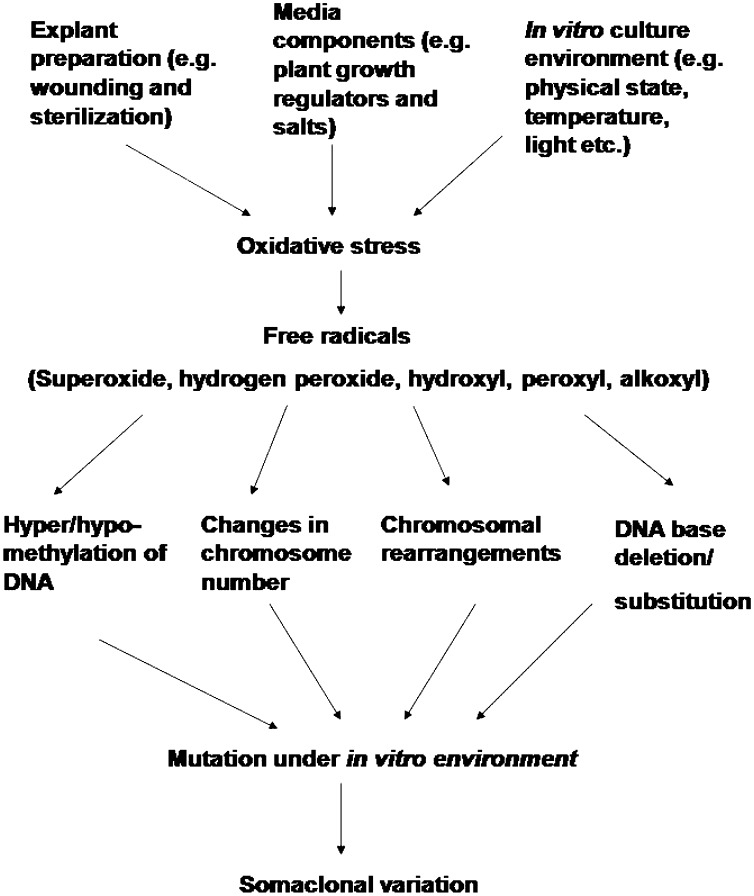
The advancements made in tissue culture techniques has made it possible to regenerate various horticultural species in vitro as micropropagation protocols for commercial scale multiplication are available for a wide range of crops. Clonal propagation and preservation of elite genotypes, selected for their superior characteristics, require high degree of genetic uniformity amongst the regenerated plants. However, plant tissue culture may generate genetic variability, i.e., somaclonal variations as a result of gene mutation or changes in epigenetic marks. The occurrence of subtle somaclonal variation is a drawback for both in vitro cloning as well as germplasm preservation. Therefore, it is of immense significance to assure the genetic uniformity of in vitro raised plants at an early stage. Several strategies have been followed to ascertain the genetic fidelity of the in vitro raised progenies comprising morpho-physiological, biochemical, cytological and DNA-based molecular markers approaches. Somaclonal variation can pose a serious problem in any micropropagation program, where it is highly desirable to produce true-to-type plant material. On the other hand, somaclonal variation has provided a new and alternative tool to the breeders for obtaining genetic variability relatively rapidly and without sophisticated technology in horticultural crops, which are either difficult to breed or have narrow genetic base. In the present paper, sources of variations induced during tissue culture cycle and strategies to ascertain and confirm genetic fidelity in a variety of in vitro raised plantlets and potential application of variants in horticultural crop improvement are reviewed.
Overview
The claims and statistics of this paper haven’t been checked yet.
Run the check — free, no account needed. It reads the open-access text and checks the sources it cites.
Integrity signals
Registry
Cites
Statistics
Figures
Verification
Claims the paper makes
The claims and statistics of this paper haven’t been checked yet.
Run the check — free, no account needed. It reads the open-access text and checks the sources it cites.
Claims other papers make about this one
Each is checked against this paper’s own text: does it say what the citing paper says it does?
The source backs part of the claim, not all of it — or backs it for a different population, condition or comparison.
In the citing paper
“In the case of in vitro-regenerated plants, not all the genetic variations that appear in the somaclones have a phenotypic expression, mainly because these modifications either are not in the coding sequences or do not alter the gene product to such an extent that can be observed in the phenotype [16].”
From Somaclonal Variation—Advantage or Disadvantage in Micropropagation of the Medicinal Plants (2023) · cites this paper as [16]
Experimental — accuracy not yet measuredThe cited source says what the claim attributes to it.
In the citing paper
“Sometimes, due to somatic mutations in the donor plant (that is, due to the chimeras in the explants), the appearance of somaclonal variations can be observed in the regenerants [16].”
From Somaclonal Variation—Advantage or Disadvantage in Micropropagation of the Medicinal Plants (2023) · cites this paper as [16]
The cited source says what the claim attributes to it.
In the citing paper
“Most of these techniques are based on different types of DNA markers, due to the fact that these markers are phenotypically neutral and are not influenced by any developmental changes or environmental factors [16].”
From Somaclonal Variation—Advantage or Disadvantage in Micropropagation of the Medicinal Plants (2023) · cites this paper as [16]
The cited source says what the claim attributes to it.
In the citing paper
“Therefore, the detection of genetic uniformity of in vitro-raised plants at an early stage is desirable [22].”
The cited source says what the claim attributes to it.
In the citing paper
“Notably, plant genotypes significantly influence this process, as their susceptibility to somaclonal variation varies [65,66].”
From Somaclonal Variation and Clonal Fidelity in Commercial Micropropagation: Challenges and Perspectives (2025) · cites this paper as [65]
The cited source says what the claim attributes to it.
In the citing paper
“Understanding these factors is crucial for commercial micropropagation to reduce somaclonal variation and maintain genetic uniformity [64,65].”
From Somaclonal Variation and Clonal Fidelity in Commercial Micropropagation: Challenges and Perspectives (2025) · cites this paper as [65]
Self-check
Percentages, sums and reported differences re-computed from the paper’s own numbers.
The self-check needs the paper’s full text.
Citations
Cites
Sequencing technologies – the next generation
Metzker, M. L. (2010) · Nature Reviews Genetics · doi:10.1038/nrg2626 · Cited by 7,066
Somaclonal variation — a novel source of variability from cell cultures for plant improvement
Larkin, P. J., & Scowcroft, W. R. (1981) · Theoretical and Applied Genetics · doi:10.1007/bf02342540 · Cited by 3,002
Applications of next-generation sequencing technologies in functional genomics
Morozova, O., & Marra, M. A. (2008) · Genomics · doi:10.1016/j.ygeno.2008.07.001 · Cited by 1,222
Retrotransposons of rice involved in mutations induced by tissue culture.
Hirochika, H., Sugimoto, K., Otsuki, Y., Tsugawa, H., & Kanda, M. (1996) · Proceedings of the National Academy of Sciences · doi:10.1073/pnas.93.15.7783 · Cited by 748
Epigenetic aspects of somaclonal variation in plants
Kaeppler, S. M., Kaeppler, H. F., & Rhee, Y. (2000) · Plant Molecular Biology · doi:10.1023/a:1006423110134 · Cited by 743
Somaclonal Variation in Plants: Causes and Detection Methods
Bairu, M. W., Aremu, A. O., & Van Staden, J. (2011) · Plant Growth Regulation · doi:10.1007/s10725-010-9554-x · Cited by 674
Genetic instability of plant tissue cultures: breakdown of normal controls.
Phillips, R. L., Kaeppler, S. M., & Olhoft, P. M. (1994) · Proceedings of the National Academy of Sciences · doi:10.1073/pnas.91.12.5222 · Cited by 582
Tissue culture-derived variation in crop improvement
Jain, S. M. (2001) · Euphytica · doi:10.1023/a:1004124519479 · Cited by 444
An epigenetic view of plant cells cultured in vitro: Somaclonal variation and beyond
Miguel, C., & Marum, L. (2011) · Journal of Experimental Botany · doi:10.1093/jxb/err155 · Cited by 395
Genetic stability of micropropagated almond plantlets, as assessed by RAPD and ISSR markers
Martins, M., Sarmento, D., & Oliveira, M. M. (2004) · Plant Cell Reports · doi:10.1007/s00299-004-0870-3 · Cited by 331
Research works printed but not linked: 17
- Ahloowalia BS (1992) In vitro radiation induced mutants in Chrysanthemum. Mutat Breed Newsl 39:6
- Battistini C, Rosati P (1991) In vitro evaluation of somaclonal strawberry (Fragaria × ananassa ‘Brighton’) variants for susceptibility to Phytophthora cactorum. In: Dale A, Lubby D (eds) The strawberry into the 21st century. Timber Press, Portland, pp 121–123
- Grosser JW, Gmitter FG Jr, Chandler JL (1996) Somaclonal variation in sweet orange—a tool for cultivar improvement. In: Proceedings of International Society of Citriculture VIII Congress, Sun City, South Africa, pp 203–206
- Hwang S (2002) Somaclonal variational approach to breeding Cavendish banana for resistance to Fusarium wilt race 4. In: Global conference on banana and plantain, Bangalore, India, Abstract 57, October 28–31
- Hwang SC, Ko WH (1992) Breeding for resistance to Fusarium wilt of Cavendish banana by using tissue culture method. Spec Publ Taichung Dist Agric Improv Stn 29:229–237
- Iuliana C, Cerasela P (2014) The effect of the ultraviolet radiation on the somaclonal variability for Solanum tuberosum. Rom Biotechnol Lett 19(3):9339–9344
- Jain SM (1997) Micropropagation of selected somaclones of Begonia and Saintpaulia. J Biosci 22:582–592
- Karp A (1992) The role of growth regulators in somaclonal variation. Br Soc Plant Growth Regul Annu Bull 2:1–9
- Khan S, Saeed B, Kauser N (2011) Establishment of genetic fidelity of in vitro raised banana plantlets. Pak J Bot 43:233–242
- Mathur AK (2010) Biotechnological studies in Cymbopogons. In: Akhila A (ed) Essential oil-bearing grasses: the genus Cymbopogon. CRC Press, Taylor & Francis Group, LLC, Boca Raton, pp 107–133
- Mathur AK, Ahuja PS, Pandey B, Kukreja AK, Mathur A (1988) Development of superior strains of an aromatic grass—Cymbopogon winterianus Jowitt—through somaclonal variation. In: International conference on research in plant science and its relevance to future, Abstract, University Press, Delhi, p 160
- Morrison RA, Loh WHT, Green SK, Griggs TD, McLean BT (1989) Tissue culture of tomato and pepper: new tools for plant breeding. Tomato and pepper production in the tropics. In: Proceedings of international symposium on integrated management practices, Tainen, Taiwan. Shanhua, Taiwan, AVRDC, pp 44–50
- Mujib A, Banerjee S, Dev Ghosh P (2007) Callus induction, somatic embryogenesis and chromosomal instability in tissue culture-raised hippeastrum (Hippeastrum hybridum cv. United Nations). Propag Ornam Plants 7:169–174
- Nivas SK, DSouza L (2014) Genetic fidelity in micropropagated plantlets of Anacardium occidentale L. (Cashew) an important fruit tree. Int J Sci Res 3:2142–2146
- Toyoda H, Horikoshi K, Yamano Y, Ouchi S (1991) Selection of Fusarium wilt disease resistance from regenerant derived from callus of strawberry. Plant Cell Rep 10:167–170
- Veitia-Rodriguez N, Francisco-Cardoso J, Perez JN, Garcia-Rodriguez L, Bermudez-Caraballosos I, Garcia-Rodriguez L, Padron-Montesinos Y, Orellana-Perez P, Romero-Quintana C, Hernandez N (2002) Evaluations in field of somaclones of Irish potatoes (Solanum tuberosum Lin.) of the variety Desiree obtained by somaclonal variation and in vitro mutagenesis. Biotechnol Veg 2:21–26
- Vidal BC, Mello MLS, Illg RD, de Campos Vidal B, Campos De, Vidal B (1993) Chromosome number and DNA content in cells of a biotechnologically selected somaclone of garlic (Allium sativum L). Rev Bras Genet 16(2):347–356
Cited by
Sorted by citations
Items 401–438 of 438
In vitro induction and investigation of salinity tolerance in the callus of Vigna spp. (L)
Alsewidi, W. M. M., & Al-Oubaidi, H. K. M. (2024) · Edelweiss Applied Science and Technology · doi:10.55214/25768484.v8i3.1088
Soto‐Contreras, A., Ramírez-Mosqueda, M. A., Iglesias-Andreu, L. G., & Núñez-Pastrana, R. (2024) · Revista Bio Ciencias · doi:10.15741/revbio.11.e1687
Biotechnology for Crop Improvement
Ayiecho, P. O., & Nyabundi, J. O. (2025) · Springer eBooks · doi:10.1007/978-3-031-74998-8_16
Naeem, S., Haider, M. Z., Sami, A., Qureshi, M. A., Bhatti, M. H. T., Irfan, U., Mudasar, M., Tanwir, M. I., Ali, Q., & Shafiq, M. (2025) · Advances in plant breeding strategies · doi:10.1007/978-3-031-78653-2_1
Ahmed, N., El‐Tabakh, M. A. M., Mohamed, H. F., Xu, C., & Huang, L. (2025) · Journal of Ocean University of China · doi:10.1007/s11802-025-5917-9 · Cited by 1
Sutini, S., Pribadi, D. U., & Alfianti, V. M. (2025) · Nusantara Science and Technology Proceedings · doi:10.11594/nstp.2025.4901
A robust method modulated by Ancymidol for the direct regeneration of Galium asperifolium Wall.
Nair, S. S., & Siril, E. A. (2025) · Plant Cell Tissue and Organ Culture (PCTOC) · doi:10.1007/s11240-025-03164-6
Hong, S., Mao, J., Fu, Y., & Zhao, Y. (2025) · Plant Biotechnology Reports · doi:10.1007/s11816-025-01007-6
Say, A., Okumuş, O., & Sümbül, A. (2025) · Özgür Yayınları eBooks · doi:10.58830/ozgur.pub928.c3912
Babanina, S. S., & Yegorova, N. (2025) · Russian Agricultural Sciences · doi:10.3103/s1068367425700831
Rivera, M. P., Thein, M. S., & Watanabe, K. (2025) · Annals of Botany · doi:10.1093/aob/mcaf314
Lizamore, D., Bicknell, R., & Winefield, C. S. (2021) · Figshare · doi:10.6084/m9.figshare.16650107
Lizamore, D., Bicknell, R., & Winefield, C. S. (2021) · Figshare · doi:10.6084/m9.figshare.16650092
Orłowska, R., Zimny, J., Żebrowski, J., Androsiuk, P., & Bednarek, P. T. (2024) · Figshare · doi:10.6084/m9.figshare.24979536
Lizamore, D., Bicknell, R., & Winefield, C. S. (2021) · Figshare · doi:10.6084/m9.figshare.16650113
In vitro mutagenesis for the identification of blast-resistant rice (Oryza sativa L.) genotypes
Mamun, S. M. A. A., Rezve, M., Khan, M. A. I., Jahan, M. S., Sultana, S., Remme, R. N., Adhikary, S. K., & Islam, M. M. (2025) · Plant Cell Tissue and Organ Culture (PCTOC) · doi:10.1007/s11240-025-03320-y
Gu, X., Feng, W., Zhou, Z., Li, W., Zhang, H., Wei, L., Cao, Y., & Hu, S. (2026) · Industrial Crops and Products · doi:10.1016/j.indcrop.2026.122777
Lunkova, M. K., Popova, E., & Титова, М. В. (2026) · Plant Cell Tissue and Organ Culture (PCTOC) · doi:10.1007/s11240-025-03287-w
Rebouças, T. A., Rocha, A. D. J., Ferreira, M. D. S., Oliveira, W. D. D. S., Nascimento, F. G. P. D. S., Santana, W. S., Cerqueira, T. S., de Jesus, J. P. F. L., Amorim, V. B. D. O., dos Santos-Serejo, J. A., et al. (2026) · Plant Cell Tissue and Organ Culture (PCTOC) · doi:10.1007/s11240-026-03354-w
Chen, P., Zheng, W., Xie, Y., Chen, Y., Ge, B., Hu, Y., & Zhu, M. (2026) · Frontiers in Plant Science · doi:10.3389/fpls.2026.1791775 · Cited by 1
Salutgi, U. D., & Singh, D. N. V. (2026) · International Journal of Scientific Research in Science and Technology · doi:10.32628/ijsrst2613181
Self-citationYeşilbaş, M. F., Sözen, E., & Evrenosoğlu, Y. (2026) · International Journal of Agriculture Forestry and Life Sciences · doi:10.66598/ijafls.1888824
Ngure, G. M., & Watanabe, K. N. (2026) · In Vitro Cellular & Developmental Biology - Plant · doi:10.1007/s11627-026-10646-5
Ghaderi, A., Jafari, A., Shirmardi, M., & Vazifeshenas, M. (2026) · Plant Cell Tissue and Organ Culture (PCTOC) · doi:10.1007/s11240-026-03457-4
Araújo, J. L. P., Leão, A. K. M., Dantas, L. A., Neto, A. R., da Silva, F. B., Faria, P. S. A., & Silva, F. G. (2026) · Research Square · doi:10.21203/rs.3.rs-9359674/v1
Dutta, H., & Loushigam, G. L. (2026) · Springer eBooks · doi:10.1007/978-3-032-26227-1_1
Somaclonal variation in Saccharum spp.: unraveling its potential despite current neglect
Munir, S., Jaffar, M. A. B., Yasmeen, S., Khan, M. T., & Khan, I. A. (2026) · Vavilov Journal of Genetics and Breeding · doi:10.18699/vjgb-26-42
A Panax ginseng pangenome reveals two independent alleles underlying yellow berry colorPreprint
Cho, W. H., Liao, X., Ahn, J.-Y., Shim, H., Lee, J.-W., Kim, Y. W., Park, Y. C., Um, Y., Moh, S. H., Hu, H., et al. (2026) · Research Square · doi:10.21203/rs.3.rs-9694379/v1
Balzon, T. A., Monteiro, T. R., Lopes, R., da Cunha, R. N. V., Gomes, H. T., Silva-Cardoso, I. M. D. A., de Souza, A. L. X., Inglis, P. W., & Scherwinski-Pereira, J. E. (2026) · Plant Cell Tissue and Organ Culture (PCTOC) · doi:10.1007/s11240-026-03498-9
Unnikrishnan, A., Krishna, T. P. A., Yogindran, S., & Ceasar, S. A. (2026) · South African Journal of Botany · doi:10.1016/j.sajb.2026.06.003
de Souza, A. R., dos Santos, A. J. A., Crepaldi, G. B., de Matos, E. M., Júnior, O. D. D. C., Carvalho, H. G., de Carvalho, Í. F., & Carvalho, M. L. D. S. (2026) · Research Square · doi:10.21203/rs.3.rs-9497348/v1
Babanina, S. S., & Алексеевна, Е. Н. (2025) · Achievements of Science and Technology in Agro-Industrial Complex · doi:10.53859/02352451_2025_39_1_50
Clonal fidelity assessment in pomegranate using novel DNA markers
Kulkarni, D. S., Patil, P. G., Singh, D. N. V., Awachare, C., Kandepali, S. R., & Marathe, R. A. (2026) · Plant Physiology Reports · doi:10.1007/s40502-026-00982-4
Self-citationEnsuring Clonal Fidelity and Quality Assurance in Woody Plant Micropropagation
Kaçar, Y. A., Şimşek, Ö., Dönmez, D., Isak, M. A., & Hazubska-Przybył, T. (2026) · Springer eBooks · doi:10.1007/978-3-032-28071-8_15
Bharti, M., Shrishti, & Mukherjee, P. (2026) · In Vitro Cellular & Developmental Biology - Plant · doi:10.1007/s11627-026-10697-8
Rai, U. U., Yadav, S., Kaur, A., Sood, R., Haneef, M., & Kosey, S. (2026) · Pharmacological Research - Natural Products · doi:10.1016/j.prenap.2026.100881
PHENOTYPIC CHARACTERIZATION OF SEED PROGENY OBTAINED FROM IN VITRO CUCUMBER REGENERANTS
Velkov, N., & Grozeva, S. (2026) · BIO Web of Conferences · doi:10.1051/bioconf/202626004004 · Cited by 1
Metadata
- Authors
- Krishna, H., Alizadeh, M., Singh, D., Singh, U., Chauhan, N., Eftekhari, M., & Sadh, R. K.
- Affiliations
- Indian Council of Agricultural Research (IN)
- Gorgan University of Agricultural Sciences and Natural Resources (IR)
- Central Institute for Arid Horticulture (IN)
- Corresponding author
- Krishna, Hare
- Venue
- 3 Biotech
- Published
- 2016-02-13
- Volume
- 6
- Issue
- 1
- Pages
- 54-54
- ISSN
- 2190-572X (ISSN-L)
- 2190-5738
- PMC
- PMC4752953
- OpenAlex
- W2286740172
- Cited by
- 436
- References
- 207
- Citations by year
- 2026: 28 · 2025: 40 · 2024: 40 · 2023: 56 · 2022: 60 · 2021: 64 · 2020: 52 · 2019: 35 · 2018: 39 · 2017: 19 · 2016: 3
- FWCI
- 2.90
- Type
- journal article
- Language
- en
- Open access
- hybrid
- doi.org
- Locations
- 3 Biotech (publishedVersion, cc-by)
- PubMed Central (publishedVersion, cc-by)
- PubMed (publishedVersion)
- Funders
- Indian Agricultural Research Institute
- Topics
- Life Sciences › Agricultural and Biological Sciences › Plant Science › Plant tissue culture and regeneration
- Life Sciences › Agricultural and Biological Sciences › Plant Science › Plant Genetic and Mutation Studies
- Life Sciences › Agricultural and Biological Sciences › Plant Science › Banana Cultivation and Research
- Keywords
- somaclonal variation, horticultural crops, micropropagation, genetic fidelity, in vitro regeneration, clonal propagation, germplasm conservation, epigenetic modifications, crop improvement, genetic variation
About these checks
Registry, retraction, Cites and statistics results are computed, not judged, with one exception: a printed reference that no index lists is read once by a model before it counts as a citation error. Claims are extracted by a model and kept only when their quote appears verbatim in the text; each cited source is then checked, with a model’s help, for whether it says what the claim relies on. Those verdicts can be wrong — read the claim’s quote and the cited source before relying on one.
Statistics and arithmetic are recomputed, not judged.
Confidence bands are shown only for fields calibrated on our annotated test set. None is calibrated yet, so no band is shown.
What counts as a claim ›How we measure confidence ›How we check this ›
Are you an author, or do you see a problem with this page? Request a review
