

TNF-α promotes breast cancer cell migration and enhances the concentration of membrane-associated proteases in lipid rafts
Open accessThe DOI matches its Crossref record; 44 of the 44 references it cites were found in a registry or an index.
Abstract
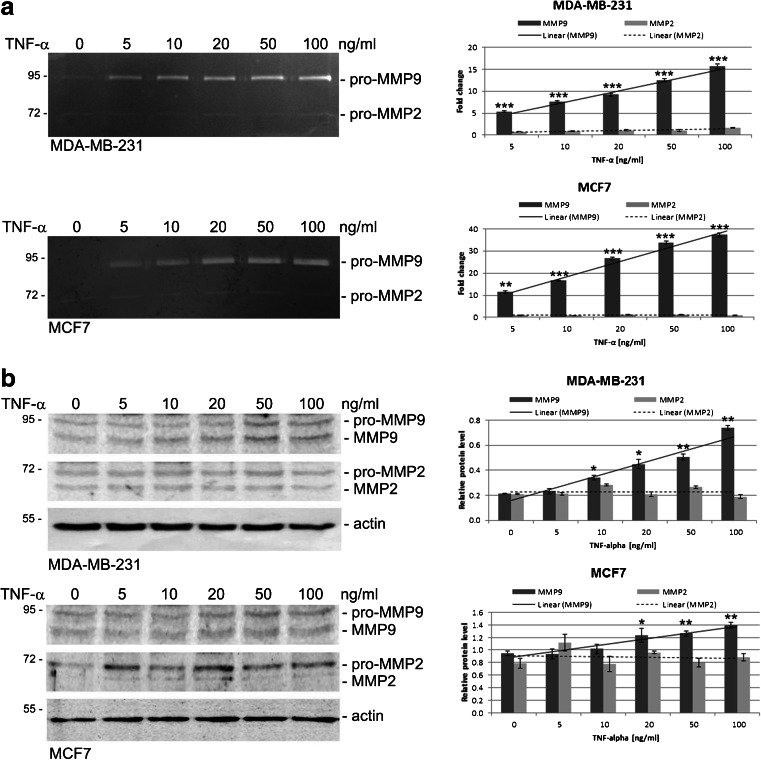
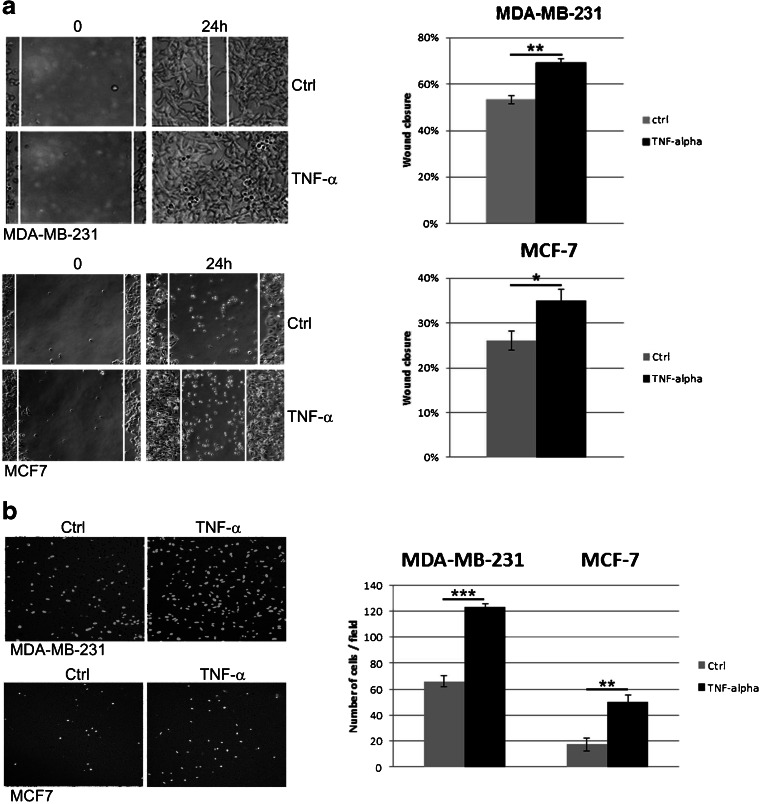
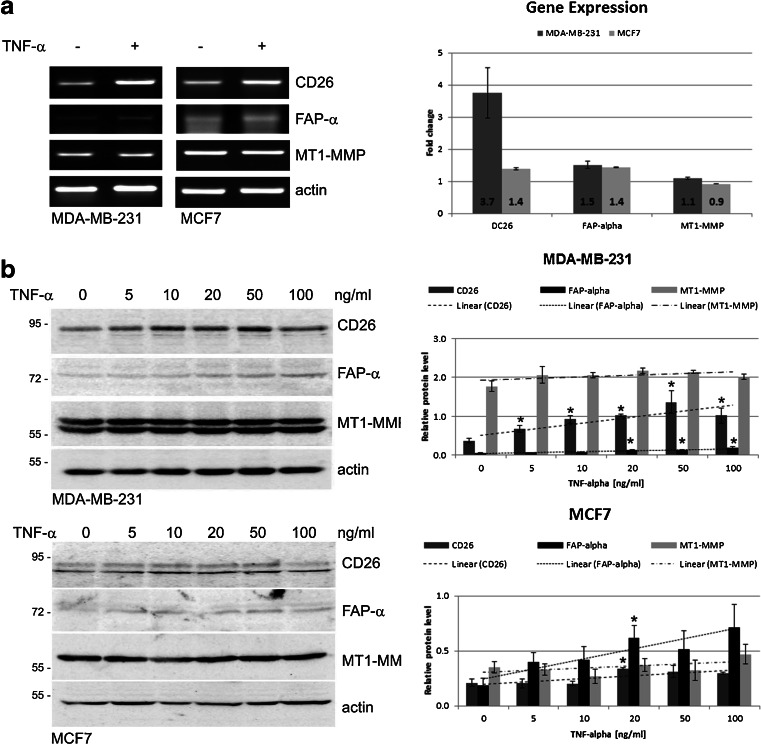
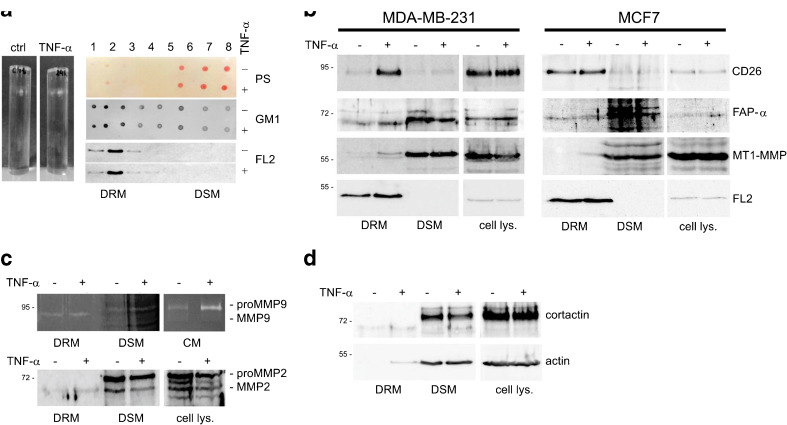
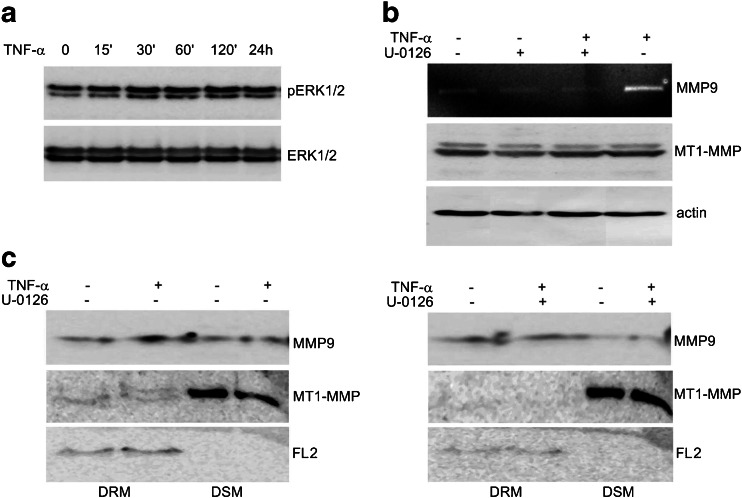
PURPOSE: Tumor progression is associated with cell migration, invasion and metastasis. These processes are accompanied by the activation of specific proteases that are either linked to cellular membranes or are secreted into extracellular spaces. TNF-α is known to play an important role in various aspects of tumor progression. The aim of this work was to assess the effect of TNF-α on the migration of breast cancer cells and, in addition, to assess its association with the location of membrane-associated proteases in lipid rafts. METHODS: Wound scratch healing and Transwell migration assays were used to study the effect of TNF-α on the migration of both hormone-dependent and hormone-independent breast cancer-derived cells, i.e., MCF7 and MDA-MB-231, respectively. The expression and secretion of three matrix metalloproteases, MMP9, MMP2 and MT1-MMP, and two dipeptidyl peptidases, CD26 and FAP-α, was investigated using RT-PCR, Western blotting and gelatin zymography. In addition, activation of the MAPK/ERK signaling pathway was investigated by Western blotting. RESULTS: We found that a TNF-α-induced enhancement of breast cancer cell migration was accompanied by an increased secretion of MMP9, but not MMP2, into the culture media. We also found that TNF-α upregulated the expression of the dipeptidyl peptidases CD26 and FAP-α in a dose-dependent manner and, in addition, enhanced the concentration of all five proteases in lipid rafts in the breast cancer-derived cells tested, regardless of cell type. Furthermore, we found that TNF-α activated the MAPK/ERK signaling pathway by increasing the ERK1/2 phosphorylation level. Application of the MEK/ERK1/2 inhibitor U-0126 resulted in down-regulation of TNF-α-induced MMP9 secretion and abrogation of the enhanced concentration of proteases in the lipid rafts. CONCLUSIONS: From our results we conclude that TNF-α-induced activation of the MAPK/ERK signaling pathway may promote breast cancer cell migration via both upregulation of MMP9, CD26 and FAP-α and concentration of these proteases, as also MT1-MMP and MMP2, in the lipid rafts. TNF-α may serve as a potential therapeutic target in breast cancers susceptible to TNF-α stimulation.
Overview
The claims and statistics of this paper haven’t been checked yet.
Free: it reads the open-access text and checks the first 5 claims that cite a source we can check. Create a free account to check every claim.
Integrity signals
Registry
Cites
Statistics
Figures
Verification
Claims the paper makes
The claims and statistics of this paper haven’t been checked yet.
Free: it reads the open-access text and checks the first 5 claims that cite a source we can check. Create a free account to check every claim.
Claims other papers make about this one
Each is checked against this paper’s own text: does it say what the citing paper says it does?
The source backs part of the claim, not all of it — or backs it for a different population, condition or comparison.
In the citing paper
“Both IL-6 and TNF produced by myeloid cells in the TME can directly stimulate metastasis and invasion (58, 75–78).”
From Tumor-Induced Inflammatory Cytokines and the Emerging Diagnostic Devices for Cancer Detection and Prognosis (2021) · cites this paper as [78]
Experimental — accuracy not yet measured
Self-check
Percentages, sums and reported differences re-computed from the paper’s own numbers.
The self-check needs the paper’s full text.
Citations
Cites
New functions for the matrix metalloproteinases in cancer progression
Egeblad, M., & Werb, Z. (2002) · Nature Reviews Cancer · doi:10.1038/nrc745 · Cited by 6,108
Lipid rafts and signal transduction
Simons, K., & Toomre, D. (2000) · Nature Reviews Molecular Cell Biology · doi:10.1038/35036052 · Cited by 5,371
Extracellular Matrix Degradation and Remodeling in Development and Disease
Lu, P., Takai, K., Weaver, V. M., & Werb, Z. (2011) · Cold Spring Harbor Perspectives in Biology · doi:10.1101/cshperspect.a005058 · Cited by 2,265 · cited 2×
“growth factors and mechanical stress [1, 2].”
BackgroundStrategies for MMP inhibition in cancer: innovations for the post-trial era
Overall, C. M., & López-Otín, C. (2002) · Nature Reviews Cancer · doi:10.1038/nrc884 · Cited by 1,349
TNF-α/NF-κB/Snail pathway in cancer cell migration and invasion
Wu, Y., & Zhou, B. P. (2010) · British Journal of Cancer · doi:10.1038/sj.bjc.6605530 · Cited by 798
Yu, Q., & Stamenkovic, I. (1999) · Genes & Development · doi:10.1101/gad.13.1.35 · Cited by 713 · cited 1×
“Using MMP9 knockout mice, it was found that MMP9 is essential for the migration of smooth muscle and immune cells, and that disruption of MMP9-cell surface interactions can cause a dramatic decrease in cell movement and tumor invasiveness [32, 33].”
BackgroundGelatinase-mediated migration and invasion of cancer cells
Björklund, M., & Koivunen, E. (2005) · Biochimica et Biophysica Acta (BBA) - Reviews on Cancer · doi:10.1016/j.bbcan.2005.03.001 · Cited by 661 · cited 2×
“to be tightly regulated by different biological factors [8, 27].”
BackgroundRamos-DeSimone, N., Hahn-Dantona, E., Sipley, J., Nagase, H., French, D. L., & Quigley, J. P. (1999) · Journal of Biological Chemistry · doi:10.1074/jbc.274.19.13066 · Cited by 591 · cited 1×
“MMP2 and MMP9 are secretory proteins, but small amounts of the enzymes have consistently been found on the surface of various cells, including breast cancer cells [21, 40].”
BackgroundInteraction of membrane/lipid rafts with the cytoskeleton: Impact on signaling and function
Head, B. P., Patel, H. H., & Insel, P. A. (2014) · Biochimica et Biophysica Acta (BBA) - Biomembranes · doi:10.1016/j.bbamem.2013.07.018 · Cited by 511
Mechanisms for pro matrix metalloproteinase activation
MURPHY, G., STANTON, H., COWELL, S., BUTLER, G., KNÄUPER, V., ATKINSON, S., & GAVRILOVIC, J. (1999) · APMIS · doi:10.1111/j.1699-0463.1999.tb01524.x · Cited by 441
Cited by
Cruceriu, D., Baldasici, O., Balacescu, O., & Berindan-Neagoe, I. (2020) · Cellular Oncology · doi:10.1007/s13402-019-00489-1 · Cited by 524
Pro-tumorigenic roles of fibroblast activation protein in cancer: back to the basics
Puré, E., & Blomberg, R. (2018) · Oncogene · doi:10.1038/s41388-018-0275-3 · Cited by 391
“High doses of TNFα yielded increases in ERK1/2 phosphorylation along with modest increases in FAP expression in breast cancer cell lines [42], though similar doses did not yield significant upregulation of FAP by BM-MSCs.”
BackgroundResultKartikasari, A. E. R., Huertas, C. S., Mitchell, A., & Plebanski, M. (2021) · Frontiers in Oncology · doi:10.3389/fonc.2021.692142 · Cited by 343
Crosstalk of Inflammatory Cytokines within the Breast Tumor Microenvironment
Habanjar, O., Bingula, R., Decombat, C., Diab-Assaf, M., Caldefie-Chezet, F., & Delort, L. (2023) · International Journal of Molecular Sciences · doi:10.3390/ijms24044002 · Cited by 263
MMP9: A Tough Target for Targeted Therapy for Cancer
Augoff, K., Hryniewicz-Jankowska, A., Tabola, R., & Stach, K. (2022) · Cancers · doi:10.3390/cancers14071847 · Cited by 255
“reported that the treatment of breast cancer cells with TNF-α, a proinflammatory cytokine, increased MMP9 concentrations in lipid rafts [37].”
BackgroundSelf-citation
Metadata
- Authors
- Wolczyk, D., Zaremba-Czogalla, M., Hryniewicz-Jankowska, A., Tabola, R., Grabowski, K., Sikorski, A. F., & Augoff, K.
- Affiliations
- University of Wrocław (PL)
- Wroclaw Medical University (PL)
- Corresponding author
- Augoff, Katarzyna
- Venue
- Cellular Oncology
- Published
- 2016-04-04
- Volume
- 39
- Issue
- 4
- Pages
- 353-363
- ISSN
- 1570-5870 (ISSN-L)
- 2211-3428
- 2211-3436
- PMC
- PMC4972855
- OpenAlex
- W2342245047
- Cited by
- 116
- References
- 43
- Citations by year
- 2026: 5 · 2025: 14 · 2024: 8 · 2023: 13 · 2022: 18 · 2021: 13 · 2020: 15 · 2019: 10 · 2018: 10 · 2017: 9 · 2016: 1
- FWCI
- 4.17
- Type
- journal article
- Language
- en
- Open access
- gold
- doi.org
- Locations
- Cellular Oncology (publishedVersion, cc-by)
- PubMed Central (publishedVersion, cc-by)
- PubMed (publishedVersion)
- Topics
- Life Sciences › Biochemistry, Genetics and Molecular Biology › Cancer Research › Protease and Inhibitor Mechanisms
- Life Sciences › Biochemistry, Genetics and Molecular Biology › Molecular Biology › TGF-β signaling in diseases
- Life Sciences › Biochemistry, Genetics and Molecular Biology › Molecular Biology › Mechanisms of cancer metastasis
- Keywords
- TNF-α, breast cancer, cell migration, lipid rafts, membrane-associated protease, MMP-9, MMP-2, MT1-MMP, CD26, dipeptidyl peptidase, ERK signaling, ERK1/2 phosphorylation, U0126, tumor progression, metastasis
- MeSH terms
- Breast Neoplasms, Cell Movement, Female, Humans, Peptide Hydrolases, Tumor Necrosis Factor-alpha, Blotting, Western, Signal Transduction, Reverse Transcriptase Polymerase Chain Reaction, Membrane Microdomains, Cell Line, Tumor
About these checks
Registry, retraction, Cites and statistics results are computed, not judged, with one exception: a printed reference that no index lists is read once by a model before it counts as a citation error. Claims are extracted by a model and kept only when their quote appears verbatim in the text; each cited source is then checked, with a model’s help, for whether it says what the claim relies on. Those verdicts can be wrong — read the claim’s quote and the cited source before relying on one.
Statistics and arithmetic are recomputed, not judged.
Confidence bands are shown only for fields calibrated on our annotated test set. None is calibrated yet, so no band is shown.
What counts as a claim ›How we measure confidence ›How we check this ›
Are you an author, or do you see a problem with this page? Request a review
How to cite
Cite CoChat for the checks on this page, and the paper for its own findings.
- This page
- CoChat. (2026). Citation check: TNF-α promotes breast cancer cell migration and enhances the concentration of membrane-associated proteases in lipid rafts. https://app.cochat.ai/papers/10.1007/s13402-016-0280-x
- The paper
- Wolczyk, D., Zaremba-Czogalla, M., Hryniewicz-Jankowska, A., Tabola, R., Grabowski, K., Sikorski, A. F., & Augoff, K. (2016). TNF-α promotes breast cancer cell migration and enhances the concentration of membrane-associated proteases in lipid rafts. Cellular Oncology. https://doi.org/10.1007/s13402-016-0280-x
Data sources
Bibliographic data: Semantic Scholar, OpenAlex, Crossref.
Contains information from the Semantic Scholar Academic Graph Datasets, made available under the ODC Attribution License (ODC-BY 1.0).
Semantic Scholar’s data is described in: Kinney, R., et al. (2023). The Semantic Scholar Open Data Platform. arXiv:2301.10140.
