

The DOI matches its Crossref record; 65 of the 66 references it cites were found in a registry or an index.
A Step Towards Personalized Sports Nutrition: Carbohydrate Intake During Exercise
Open accessAbstract
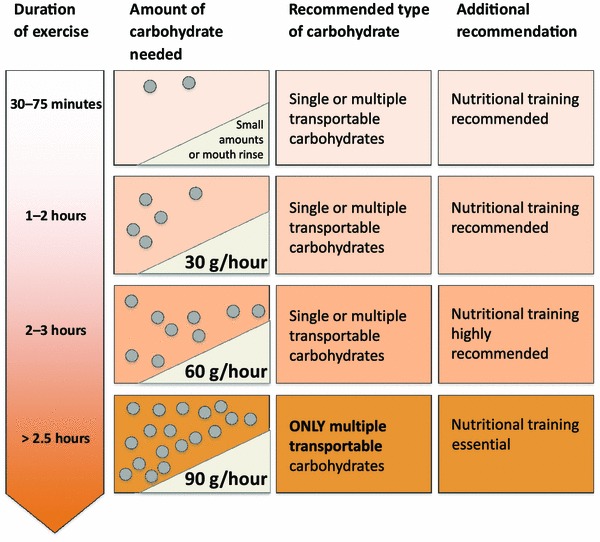
There have been significant changes in the understanding of the role of carbohydrates during endurance exercise in recent years, which allows for more specific and more personalized advice with regard to carbohydrate ingestion during exercise. The new proposed guidelines take into account the duration (and intensity) of exercise and advice is not restricted to the amount of carbohydrate; it also gives direction with respect to the type of carbohydrate. Studies have shown that during exercise lasting approximately 1 h in duration, a mouth rinse or small amounts of carbohydrate can result in a performance benefit. A single carbohydrate source can be oxidized at rates up to approximately 60 g/h and this is the recommendation for exercise that is more prolonged (2-3 h). For ultra-endurance events, the recommendation is higher at approximately 90 g/h. Carbohydrate ingested at such high ingestion rates must be a multiple transportable carbohydrates to allow high oxidation rates and prevent the accumulation of carbohydrate in the intestine. The source of the carbohydrate may be a liquid, semisolid, or solid, and the recommendations may need to be adjusted downward when the absolute exercise intensity is low and thus carbohydrate oxidation rates are also low. Carbohydrate intake advice is independent of body weight as well as training status. Therefore, although these guidelines apply to most athletes, they are highly dependent on the type and duration of activity. These new guidelines may replace the generic existing guidelines for carbohydrate intake during endurance exercise.
Overview
The claims and statistics of this paper haven’t been checked yet.
Run the check — free, no account needed. It reads the open-access text and checks the sources it cites.
Integrity signals
Registry
Cites
Statistics
Figures
Verification
Claims the paper makes
The claims and statistics of this paper haven’t been checked yet.
Run the check — free, no account needed. It reads the open-access text and checks the sources it cites.
Claims other papers make about this one
Each is checked against this paper’s own text: does it say what the citing paper says it does?
The source backs part of the claim, not all of it — or backs it for a different population, condition or comparison.
In the citing paper
“It is important to note, however, that ingestion of large amounts (>1.2 g/min) of a mixture of glucose (polymers) and fructose is likely to be only of practical relevance to highly trained athletes that are able to sustain high‐intensity exercise for a prolonged duration (i.e. > 2.5 h) (Jeukendrup, 2014).”
From Fructose co‐ingestion to increase carbohydrate availability in athletes (2019) · cites this paper as Jeukendrup, 2014
Experimental — accuracy not yet measuredThe source backs part of the claim, not all of it — or backs it for a different population, condition or comparison.
In the citing paper
“Early investigations of CHO ingestion during exercise concluded that maximal oxidation rates plateaued at 60 g/hr, even when larger amounts were ingested (120-180 g/hr; Jeukendrup, 2014).”
From Contemporary Nutrition Strategies to Optimize Performance in Distance Runners and Race Walkers (2019) · cites this paper as Jeukendrup, 2014
Experimental — accuracy not yet measuredThe source backs part of the claim, not all of it — or backs it for a different population, condition or comparison.
In the citing paper
“Besides greater total carbohydrate absorption and oxidation rates, glucose‐fructose mixtures also reduce the risk of gastrointestinal discomfort [68].”
From Carbohydrate Storage and Supplementation Strategies for Peak Performance in Cross-Country Skiing (2026) · cites this paper as [68]
Experimental — accuracy not yet measuredIn the citing paper
“Although the benefits of carbohydrate ingestion during exercise are generally recognized [38–41], carbohydrate supplementation during exercise may not have only positive effects.”
From Periodized Nutrition for Athletes (2017) · cites this paper as [39]
In the citing paper
“In longer events, it is clear that ingesting carbohydrates and increasing exogenous carbohydrate oxidation will result in improved endurance performance in most events [38–41, 68].”
From Periodized Nutrition for Athletes (2017) · cites this paper as [39]
In the citing paper
“Whereas it was generally accepted that exogenous CHO oxidation rates were thought to be limited at approximately 1 g/min due to saturation of intestinal glucose transporters, it is now known that exogenous CHO oxidation rates can increase to 1.8 g/min with the addition of sucrose or fructose to the CHO blend [38].”
From New strategies in sport nutrition to increase exercise performance (2016) · cites this paper as [38]
In the citing paper
“The limiting factor was subsequently found to be intestinal absorption, particularly the sodium-dependent glucose transporter, rather than gastric emptying, hepatic glucose extraction, muscle glucose uptake, or muscle glucose oxidation (Jeukendrup, 2014).”
From Contemporary Nutrition Strategies to Optimize Performance in Distance Runners and Race Walkers (2019) · cites this paper as Jeukendrup, 2014
Self-check
Percentages, sums and reported differences re-computed from the paper’s own numbers.
The self-check needs the paper’s full text.
Citations
Cites
ACSM Position Stand: Exercise and Fluid Replacement
Convertino, V. A., Armstrong, L. E., Coyle, E. F., Mack, G. W., Sawka, M. N., Senay, L. C., & Sherman, W. M. (1996) · Medicine & Science in Sports & Exercise · doi:10.1097/00005768-199610000-00045 · Cited by 1,977
The receptors and cells for mammalian taste
Chandrashekar, J. V., Hoon, M. A., Ryba, N. J. P., & Zuker, C. S. (2006) · Nature · doi:10.1038/nature05401 · Cited by 1,632
Exercise and Fluid Replacement
(2007) · Medicine & Science in Sports & Exercise · doi:10.1249/mss.0b013e31802ca597 · Cited by 1,497
Nutrition and Athletic Performance
(2009) · Medicine & Science in Sports & Exercise · doi:10.1249/mss.0b013e31890eb86 · Cited by 1,084 · cited 5×
“This is reflected in guidelines published by the ACSM, which recommend that athletes should take between 30 and 60 g of carbohydrate during endurance exercise (over 1 h) [30] or 0.7 g/kg per hour [6].”
BackgroundInfluentialThe effects of increasing exercise intensity on muscle fuel utilisation in humans
van Loon, L. J. C., Greenhaff, P. L., Constantin‐Teodosiu, D., Saris, W. H. M., & Wagenmakers, A. J. M. (2001) · The Journal of Physiology · doi:10.1111/j.1469-7793.2001.00295.x · Cited by 897
Carbohydrate sensing in the human mouth: effects on exercise performance and brain activity
Chambers, E. S., Bridge, M., & Jones, D. A. (2009) · The Journal of Physiology · doi:10.1113/jphysiol.2008.164285 · Cited by 625
Carbohydrate intake during exercise and performance
Jeukendrup, A. E. (2004) · Nutrition · doi:10.1016/j.nut.2004.04.017 · Cited by 490
Self-citationCarbohydrate feeding during prolonged strenuous exercise can delay fatigue
Coyle, E. F., Hagberg, J. M., Hurley, B. F., Martin, W. H., Ehsani, A. A., & Holloszy, J. O. (1983) · Journal of Applied Physiology · doi:10.1152/jappl.1983.55.1.230 · Cited by 487
Muscle Glycogen Synthesis after Exercise : an Enhancing Factor localized to the Muscle Cells in Man
BERGSTRÖM, J., & HULTMAN, E. (1966) · Nature · doi:10.1038/210309a0 · Cited by 473
The Relative Value of Fat and Carbohydrate as Sources of Muscular Energy
Krogh, A., & Lindhard, J. (1920) · Biochemical Journal · doi:10.1042/bj0140290 · Cited by 411
Cited by
Sorted by citations
Exercise management in type 1 diabetes: a consensus statement
Riddell, M. C., Gallen, I. W., Smart, C. E., Taplin, C. E., Adolfsson, P., Lumb, A. N., Kowalski, A., Rabasa-Lhoret, R., McCrimmon, R. J., Hume, C., et al. (2017) · The Lancet Diabetes & Endocrinology · doi:10.1016/s2213-8587(17)30014-1 · Cited by 903
Exercise and oxidative stress: Potential effects of antioxidant dietary strategies in sports
Pingitore, A., Lima, G. P. P., Mastorci, F., Quinones, A., Iervasi, G., & Vassalle, C. (2015) · Nutrition · doi:10.1016/j.nut.2015.02.005 · Cited by 511
Periodized Nutrition for Athletes
Jeukendrup, A. E. (2017) · Sports Medicine · doi:10.1007/s40279-017-0694-2 · Cited by 299
Self-citationNutrition and Supplement Update for the Endurance Athlete: Review and Recommendations
Vitale, K., & Getzin, A. R. (2019) · Nutrients · doi:10.3390/nu11061289 · Cited by 320
Hearris, M., Hammond, K., Fell, J., & Morton, J. (2018) · Nutrients · doi:10.3390/nu10030298 · Cited by 252
Metadata
- Authors
- Jeukendrup, A.
- Affiliations
- Gatorade Sports Science Institute (US)
- Corresponding author
- Jeukendrup, Asker
- Venue
- Sports Medicine
- Published
- 2014-05
- Volume
- 44
- Issue
- S1
- Pages
- 25-33
- ISSN
- 0112-1642 (ISSN-L)
- 1179-2035
- PMC
- PMC4008807
- OpenAlex
- W2000960085
- Cited by
- 412
- References
- 66
- Citations by year
- 2026: 46 · 2025: 51 · 2024: 35 · 2023: 45 · 2022: 29 · 2021: 30 · 2020: 41 · 2019: 37 · 2018: 34 · 2017: 20 · 2016: 20 · 2015: 18 · 2014: 5
- FWCI
- 2.08
- Type
- journal article
- Language
- en
- Open access
- hybrid
- doi.org
- Locations
- Sports Medicine (publishedVersion, cc-by)
- Europe PMC (PubMed Central) (publishedVersion, cc-by)
- PubMed Central (publishedVersion, cc-by)
- PubMed (publishedVersion)
- Funders
- PepsiCo
- Gran Sasso Science Institute
- Topics
- Health Sciences › Nursing › Nutrition and Dietetics › Muscle metabolism and nutrition
- Health Sciences › Medicine › Orthopedics and Sports Medicine › Sports Performance and Training
- Health Sciences › Medicine › Physiology (medical) › Thermoregulation and physiological responses
- Keywords
- endurance exercise, mouthwash, exercise duration, exercise intensity
- MeSH terms
- Biomechanical Phenomena, Humans, Motor Skills, Movement, Pelvis, Thorax, Upper Extremity, Lower Extremity, Athletic Performance
About these checks
Registry, retraction, Cites and statistics results are computed, not judged, with one exception: a printed reference that no index lists is read once by a model before it counts as a citation error. Claims are extracted by a model and kept only when their quote appears verbatim in the text; each cited source is then checked, with a model’s help, for whether it says what the claim relies on. Those verdicts can be wrong — read the claim’s quote and the cited source before relying on one.
Statistics and arithmetic are recomputed, not judged.
Confidence bands are shown only for fields calibrated on our annotated test set. None is calibrated yet, so no band is shown.
What counts as a claim ›How we measure confidence ›How we check this ›
Are you an author, or do you see a problem with this page? Request a review
