

The DOI matches its Crossref record; 65 of the 66 references it cites were found in a registry or an index.
A Step Towards Personalized Sports Nutrition: Carbohydrate Intake During Exercise
Open accessAbstract
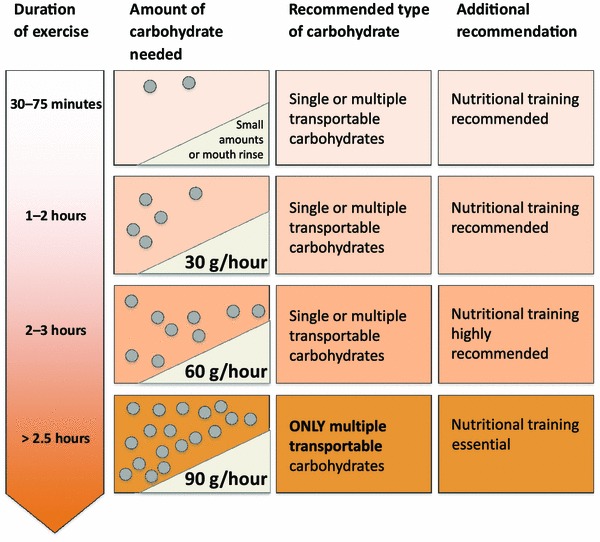
There have been significant changes in the understanding of the role of carbohydrates during endurance exercise in recent years, which allows for more specific and more personalized advice with regard to carbohydrate ingestion during exercise. The new proposed guidelines take into account the duration (and intensity) of exercise and advice is not restricted to the amount of carbohydrate; it also gives direction with respect to the type of carbohydrate. Studies have shown that during exercise lasting approximately 1 h in duration, a mouth rinse or small amounts of carbohydrate can result in a performance benefit. A single carbohydrate source can be oxidized at rates up to approximately 60 g/h and this is the recommendation for exercise that is more prolonged (2-3 h). For ultra-endurance events, the recommendation is higher at approximately 90 g/h. Carbohydrate ingested at such high ingestion rates must be a multiple transportable carbohydrates to allow high oxidation rates and prevent the accumulation of carbohydrate in the intestine. The source of the carbohydrate may be a liquid, semisolid, or solid, and the recommendations may need to be adjusted downward when the absolute exercise intensity is low and thus carbohydrate oxidation rates are also low. Carbohydrate intake advice is independent of body weight as well as training status. Therefore, although these guidelines apply to most athletes, they are highly dependent on the type and duration of activity. These new guidelines may replace the generic existing guidelines for carbohydrate intake during endurance exercise.
Overview
The claims and statistics of this paper haven’t been checked yet.
Run the check — free, no account needed. It reads the open-access text and checks the sources it cites.
Integrity signals
Registry
Cites
Statistics
Figures
Verification
Claims the paper makes
The claims and statistics of this paper haven’t been checked yet.
Run the check — free, no account needed. It reads the open-access text and checks the sources it cites.
Claims other papers make about this one
Each is checked against this paper’s own text: does it say what the citing paper says it does?
The source backs part of the claim, not all of it — or backs it for a different population, condition or comparison.
In the citing paper
“It is important to note, however, that ingestion of large amounts (>1.2 g/min) of a mixture of glucose (polymers) and fructose is likely to be only of practical relevance to highly trained athletes that are able to sustain high‐intensity exercise for a prolonged duration (i.e. > 2.5 h) (Jeukendrup, 2014).”
From Fructose co‐ingestion to increase carbohydrate availability in athletes (2019) · cites this paper as Jeukendrup, 2014
Experimental — accuracy not yet measuredThe source backs part of the claim, not all of it — or backs it for a different population, condition or comparison.
In the citing paper
“Early investigations of CHO ingestion during exercise concluded that maximal oxidation rates plateaued at 60 g/hr, even when larger amounts were ingested (120-180 g/hr; Jeukendrup, 2014).”
From Contemporary Nutrition Strategies to Optimize Performance in Distance Runners and Race Walkers (2019) · cites this paper as Jeukendrup, 2014
Experimental — accuracy not yet measuredThe source backs part of the claim, not all of it — or backs it for a different population, condition or comparison.
In the citing paper
“Besides greater total carbohydrate absorption and oxidation rates, glucose‐fructose mixtures also reduce the risk of gastrointestinal discomfort [68].”
From Carbohydrate Storage and Supplementation Strategies for Peak Performance in Cross-Country Skiing (2026) · cites this paper as [68]
Experimental — accuracy not yet measuredIn the citing paper
“Although the benefits of carbohydrate ingestion during exercise are generally recognized [38–41], carbohydrate supplementation during exercise may not have only positive effects.”
From Periodized Nutrition for Athletes (2017) · cites this paper as [39]
In the citing paper
“In longer events, it is clear that ingesting carbohydrates and increasing exogenous carbohydrate oxidation will result in improved endurance performance in most events [38–41, 68].”
From Periodized Nutrition for Athletes (2017) · cites this paper as [39]
In the citing paper
“Whereas it was generally accepted that exogenous CHO oxidation rates were thought to be limited at approximately 1 g/min due to saturation of intestinal glucose transporters, it is now known that exogenous CHO oxidation rates can increase to 1.8 g/min with the addition of sucrose or fructose to the CHO blend [38].”
From New strategies in sport nutrition to increase exercise performance (2016) · cites this paper as [38]
In the citing paper
“The limiting factor was subsequently found to be intestinal absorption, particularly the sodium-dependent glucose transporter, rather than gastric emptying, hepatic glucose extraction, muscle glucose uptake, or muscle glucose oxidation (Jeukendrup, 2014).”
From Contemporary Nutrition Strategies to Optimize Performance in Distance Runners and Race Walkers (2019) · cites this paper as Jeukendrup, 2014
Self-check
Percentages, sums and reported differences re-computed from the paper’s own numbers.
The self-check needs the paper’s full text.
Citations
Cites
ACSM Position Stand: Exercise and Fluid Replacement
Convertino, V. A., Armstrong, L. E., Coyle, E. F., Mack, G. W., Sawka, M. N., Senay, L. C., & Sherman, W. M. (1996) · Medicine & Science in Sports & Exercise · doi:10.1097/00005768-199610000-00045 · Cited by 1,977
The receptors and cells for mammalian taste
Chandrashekar, J. V., Hoon, M. A., Ryba, N. J. P., & Zuker, C. S. (2006) · Nature · doi:10.1038/nature05401 · Cited by 1,632
Exercise and Fluid Replacement
(2007) · Medicine & Science in Sports & Exercise · doi:10.1249/mss.0b013e31802ca597 · Cited by 1,497
Nutrition and Athletic Performance
(2009) · Medicine & Science in Sports & Exercise · doi:10.1249/mss.0b013e31890eb86 · Cited by 1,084 · cited 5×
“This is reflected in guidelines published by the ACSM, which recommend that athletes should take between 30 and 60 g of carbohydrate during endurance exercise (over 1 h) [30] or 0.7 g/kg per hour [6].”
BackgroundInfluentialThe effects of increasing exercise intensity on muscle fuel utilisation in humans
van Loon, L. J. C., Greenhaff, P. L., Constantin‐Teodosiu, D., Saris, W. H. M., & Wagenmakers, A. J. M. (2001) · The Journal of Physiology · doi:10.1111/j.1469-7793.2001.00295.x · Cited by 897
Carbohydrate sensing in the human mouth: effects on exercise performance and brain activity
Chambers, E. S., Bridge, M., & Jones, D. A. (2009) · The Journal of Physiology · doi:10.1113/jphysiol.2008.164285 · Cited by 625
Carbohydrate intake during exercise and performance
Jeukendrup, A. E. (2004) · Nutrition · doi:10.1016/j.nut.2004.04.017 · Cited by 490
Self-citationCarbohydrate feeding during prolonged strenuous exercise can delay fatigue
Coyle, E. F., Hagberg, J. M., Hurley, B. F., Martin, W. H., Ehsani, A. A., & Holloszy, J. O. (1983) · Journal of Applied Physiology · doi:10.1152/jappl.1983.55.1.230 · Cited by 487
Muscle Glycogen Synthesis after Exercise : an Enhancing Factor localized to the Muscle Cells in Man
BERGSTRÖM, J., & HULTMAN, E. (1966) · Nature · doi:10.1038/210309a0 · Cited by 473
The Relative Value of Fat and Carbohydrate as Sources of Muscular Energy
Krogh, A., & Lindhard, J. (1920) · Biochemical Journal · doi:10.1042/bj0140290 · Cited by 411
Reversal of fatigue during prolonged exercise by carbohydrate infusion or ingestion
Coggan, A. R., & Coyle, E. F. (1987) · Journal of Applied Physiology · doi:10.1152/jappl.1987.63.6.2388 · Cited by 392
Nutrition for endurance sports: Marathon, triathlon, and road cycling
Jeukendrup, A. E. (2011) · Journal of Sports Sciences · doi:10.1080/02640414.2011.610348 · Cited by 388
Self-citationDietary and developmental regulation of intestinal sugar transport
Ferraris, R. P. (2001) · Biochemical Journal · doi:10.1042/0264-6021:3600265 · Cited by 328
Nicholas, C. W., Nuttall, F. E., & Williams, C. (2000) · Journal of Sports Sciences · doi:10.1080/026404100365162 · Cited by 327
Oxidation of combined ingestion of glucose and fructose during exercise
Jentjens, R. L. P. G., Moseley, L., Waring, R. H., Harding, L. K., & Jeukendrup, A. E. (2004) · Journal of Applied Physiology · doi:10.1152/japplphysiol.00974.2003 · Cited by 310
Self-citationThe neural mechanisms of gustation: A distributed processing code
Simon, S. A., de Araujo, I. E., Gutierrez, R., & Nicolelis, M. A. L. (2006) · Nature reviews. Neuroscience · doi:10.1038/nrn2006 · Cited by 305
Nutritional Intake and Gastrointestinal Problems during Competitive Endurance Events
PFEIFFER, B., STELLINGWERFF, T., HODGSON, A. B., RANDELL, R., PÖTTGEN, K., RES, P., & JEUKENDRUP, A. E. (2012) · Medicine & Science in Sports & Exercise · doi:10.1249/mss.0b013e31822dc809 · Cited by 287
Self-citationJeukendrup, A. E., & Jentjens, R. (2000) · Sports Medicine · doi:10.2165/00007256-200029060-00004 · Cited by 279
Self-citationSucrose activates human taste pathways differently from artificial sweetener
Frank, G. K. W., Oberndorfer, T. A., Simmons, A. N., Paulus, M. P., Fudge, J. L., Yang, T. T., & Kaye, W. H. (2008) · NeuroImage · doi:10.1016/j.neuroimage.2007.10.061 · Cited by 274
Haase, L., Cerf-Ducastel, B., & Murphy, C. (2008) · NeuroImage · doi:10.1016/j.neuroimage.2008.09.044 · Cited by 259
Superior Endurance Performance with Ingestion of Multiple Transportable Carbohydrates
CURRELL, K., & JEUKENDRUP, A. E. (2008) · Medicine & Science in Sports & Exercise · doi:10.1249/mss.0b013e31815adf19 · Cited by 243
Self-citationIII. Arbeitsfähigkeit und Ernährung1
Christensen, E. H., & Hansen, O. (1939) · Skandinavisches Archiv Für Physiologie · doi:10.1111/j.1748-1716.1939.tb01320.x · Cited by 239
Food for thought: hedonic experience beyond homeostasis in the human brain
Kringelbach, M. L. (2004) · Neuroscience · doi:10.1016/j.neuroscience.2004.04.035 · Cited by 236
Carbohydrate and exercise performance: The role of multiple transportable carbohydrates
Jeukendrup, A. E. (2010) · Current Opinion in Clinical Nutrition and Metabolic Care · doi:10.1097/mco.0b013e328339de9f · Cited by 212
Self-citationSensory processing in the brain related to the control of food intake
Rolls, E. T. (2007) · Proceedings of The Nutrition Society · doi:10.1017/s0029665107005332 · Cited by 210
Nicholas, C. W., Williams, C., Lakomy, H. K. A., Phillips, G., & Nowitz, A. (1995) · Journal of Sports Sciences · doi:10.1080/02640419508732241 · Cited by 197
Scott, T. R., & Plata‐Saláman, C. R. (1999) · Physiology & Behavior · doi:10.1016/s0031-9384(99)00115-8 · Cited by 186
Cox, G. R., Clark, S. A., Cox, A. J., Halson, S. L., Hargreaves, M., Hawley, J. A., Jeacocke, N., Snow, R. J., Yeo, W. K., & Burke, L. M. (2010) · Journal of Applied Physiology · doi:10.1152/japplphysiol.00950.2009 · Cited by 165
Human Muscle Glycogen Metabolism During Exercise: Effect of Carbohydrate Supplementation
Tsintzas, K., & Williams, C. (1998) · Sports Medicine · doi:10.2165/00007256-199825010-00002 · Cited by 161
The Influence of Carbohydrate-Electrolyte Ingestion on Soccer Skill Performance
Ali, A., Williams, C., Nicholas, C. W., & Foskett, A. (2007) · Medicine & Science in Sports & Exercise · doi:10.1249/mss.0b013e31814fb3e3 · Cited by 161
Carbohydrate in the mouth immediately facilitates motor output
Gant, N., Stinear, C. M., & Byblow, W. D. (2010) · Brain Research · doi:10.1016/j.brainres.2010.04.004 · Cited by 155
Exogenous carbohydrate oxidation during ultraendurance exercise
Jeukendrup, A. E., Moseley, L., Mainwaring, G. I., Samuels, S., Perry, S., & Mann, C. H. (2006) · Journal of Applied Physiology · doi:10.1152/japplphysiol.00981.2004 · Cited by 147
Self-citationEnergy Balance during an Ironman Triathlon in Male and Female Triathletes
Kimber, N. E., Ross, J. J., Mason, S. L., & Speedy, D. B. (2002) · International Journal of Sport Nutrition and Exercise Metabolism · doi:10.1123/ijsnem.12.1.47 · Cited by 142
Effect of carbohydrate feeding frequencies and dosage on muscle glycogen use during exercise
FIELDING, R. A., COSTILL, D. L., FINK, W. J., KING, D. S., HARGREAVES, M., & KOVALESKI, J. E. (1985) · Medicine & Science in Sports & Exercise · doi:10.1249/00005768-198508000-00012 · Cited by 138
Rapid Taste Responses in the Gustatory Cortex during Licking
Stapleton, J. R., Lavine, M., Wolpert, R. L., Nicolelis, M. A. L., & Simon, S. A. (2006) · Journal of Neuroscience · doi:10.1523/jneurosci.0092-06.2006 · Cited by 138
The effect of glucose infusion on glucose kinetics during a 1-h time trial
CARTER, J. M., JEUKENDRUP, A. E., MANN, C. H., & JONES, D. A. (2004) · Medicine & Science in Sports & Exercise · doi:10.1249/01.mss.0000139892.69410.d8 · Cited by 137
Self-citationSawka, M. N. (2007) · Medicine & Science in Sports & Exercise · doi:10.1249/01.mss.0000272779.34140.3b · Cited by 123
Oral carbohydrate sensing and exercise performance
Jeukendrup, A. E., & Chambers, E. S. (2010) · Current Opinion in Clinical Nutrition and Metabolic Care · doi:10.1097/mco.0b013e328339de83 · Cited by 118
Self-citationCarbohydrate ingestion and glycogen utilization in different muscle fibre types in man
Tsintzas, O. K., Williams, C., Boobis, L., & Greenhaff, P. (1995) · The Journal of Physiology · doi:10.1113/jphysiol.1995.sp021046 · Cited by 117
The Role of the Human Orbitofrontal Cortex in Taste and Flavor Processing
Small, D. M., Bender, G., Veldhuizen, M. G., Rudenga, K. J., Nachtigal, D., & Felsted, J. A. (2007) · Annals of the New York Academy of Sciences · doi:10.1196/annals.1401.002 · Cited by 117
Carbohydrate feeding during exercise
Jeukendrup, A. E. (2008) · European Journal of Sport Science · doi:10.1080/17461390801918971 · Cited by 115
Self-citationThe two-hour marathon: who and when?
Joyner, M. J., Ruiz, J. R., & Lucía, A. (2010) · Journal of Applied Physiology · doi:10.1152/japplphysiol.00563.2010 · Cited by 110
Effect of training status on fuel selection during submaximal exercise with glucose ingestion
van Loon, L. J. C., Jeukendrup, A. E., Saris, W. H. M., & Wagenmakers, A. J. M. (1999) · Journal of Applied Physiology · doi:10.1152/jappl.1999.87.4.1413 · Cited by 108
Self-citationMaughan, R. J., Bethell, L., & Leiper, J. B. (1996) · Experimental Physiology · doi:10.1113/expphysiol.1996.sp003981 · Cited by 104
Smith, J. W., Zachwieja, J. J., Péronnet, F., Passe, D. H., Massicotte, D., Lavoie, C., & Pascoe, D. D. (2010) · Journal of Applied Physiology · doi:10.1152/japplphysiol.91394.2008 · Cited by 103
Fate of exogenous glucose during exercise of different intensities in humans
Pirnay, F., Crielaard, J.-M., Pallikarakis, N. E., Lacroix, M., Mosora, F., Krzentowski, G., LUYCKX, A. S., & Lefèbvre, P. (1982) · Journal of Applied Physiology · doi:10.1152/jappl.1982.53.6.1620 · Cited by 94
Neural correlates of evaluative compared with passive tasting
Bender, G., Veldhuizen, M. G., Meltzer, J. A., Gitelman, D. R., & Small, D. M. (2009) · European Journal of Neuroscience · doi:10.1111/j.1460-9568.2009.06819.x · Cited by 91
Exogenous glucose oxidation during exercise in endurance-trained and untrained subjects
Jeukendrup, A. E., Mensink, M., Saris, W. H. M., & Wagenmakers, A. J. M. (1997) · Journal of Applied Physiology · doi:10.1152/jappl.1997.82.3.835 · Cited by 88
Self-citationCarbohydrate Availability and Muscle Energy Metabolism during Intermittent Running
FOSKETT, A., WILLIAMS, C., BOOBIS, L., & TSINTZAS, K. (2008) · Medicine & Science in Sports & Exercise · doi:10.1249/mss.0b013e3181586b2c · Cited by 87
Curvilinear Dose–Response Relationship of Carbohydrate (0–120 g·h−1) and Performance
SMITH, J. W., PASCOE, D. D., PASSE, D. H., RUBY, B. C., STEWART, L. K., BAKER, L. B., & ZACHWIEJA, J. J. (2013) · Medicine & Science in Sports & Exercise · doi:10.1249/mss.0b013e31827205d1 · Cited by 87
Carbohydrate Ingestion Improves Performance of a New Reliable Test of Soccer Performance
Currell, K., Conway, S., & Jeukendrup, A. E. (2009) · International Journal of Sport Nutrition and Exercise Metabolism · doi:10.1123/ijsnem.19.1.34 · Cited by 86
Self-citationTriplett, D., Doyle, J. A., Rupp, J. C., & Benardot, D. (2010) · International Journal of Sport Nutrition and Exercise Metabolism · doi:10.1123/ijsnem.20.2.122 · Cited by 75
Oxidation of Solid versus Liquid CHO Sources during Exercise
Pfeiffer, B., Stellingwerff, T., Zaltas, E., & Jeukendrup, A. E. (2010) · Medicine & Science in Sports & Exercise · doi:10.1249/mss.0b013e3181e0efc9 · Cited by 75
Self-citationROWLANDS, D. S., Thorburn, M. S., Thorp, R. M., Broadbent, S., & Shi, X. (2008) · Journal of Applied Physiology · doi:10.1152/japplphysiol.00878.2007 · Cited by 71
Rowlands, D. S., Swift, M., Ros, M., & Green, J. G. (2012) · Applied Physiology, Nutrition, and Metabolism · doi:10.1139/h2012-013 · Cited by 70
CHO Oxidation from a CHO Gel Compared with a Drink during Exercise
Pfeiffer, B., Stellingwerff, T., Zaltas, E., & Jeukendrup, A. E. (2010) · Medicine & Science in Sports & Exercise · doi:10.1249/mss.0b013e3181e0efe6 · Cited by 69
Self-citationPatterson, S. D., & Gray, S. C. (2007) · International Journal of Sport Nutrition and Exercise Metabolism · doi:10.1123/ijsnem.17.5.445 · Cited by 68
Exogenous CHO Oxidation with Glucose Plus Fructose Intake during Exercise
Hulston, C. J., Wallis, G. A., & Jeukendrup, A. E. (2009) · Medicine & Science in Sports & Exercise · doi:10.1249/mss.0b013e3181857ee6 · Cited by 54
Self-citationJeukendrup, A. E., & McLaughlin, J. (2011) · Nestlé Nutrition Institute Workshop Series · doi:10.1159/000329268 · Cited by 46
Self-citationDeterminants of ball release speed in schoolboy fast-medium bowlers in cricket.
Loram, L. C., McKinon, W., Wormgoor, S., Rogers, G. G., Nowak, I., & Harden, L. M. (2005) · PubMed · Cited by 44
Monitoring Acute Effects on Athletic Performance with Mixed Linear Modeling
Vandenbogaerde, T. J., & Hopkins, W. G. (2010) · Medicine & Science in Sports & Exercise · doi:10.1249/mss.0b013e3181cf7f3f · Cited by 36
Carbohydrate Oxidation from a Drink during Running Compared with Cycling Exercise
Pfeiffer, B., Stellingwerff, T., Zaltas, E., Hodgson, A. B., & Jeukendrup, A. E. (2010) · Medicine & Science in Sports & Exercise · doi:10.1249/mss.0b013e3181ebc488 · Cited by 31
Self-citationDavison, G., McClean, C. M., Brown, J., Madigan, S. M., Gamble, D., Trinick, T., & Duly, E. B. (2008) · Research in Sports Medicine · doi:10.1080/15438620802103155 · Cited by 24
Evidence of a Carbohydrate Dose and Prolonged Exercise Performance Relationship
Smith, J. W., Zachwieja, J. J., Horswill, C. A., Pascoe, D. D., Passe, D. H., Ruby, B. C., & Stewart, L. K. (2010) · Medicine & Science in Sports & Exercise · doi:10.1249/01.mss.0000385615.40977.c3 · Cited by 18
Physiological determinants of best performance in marathon running.
Capelli, C., & Ferretti, G. (2011) · PubMed · doi:10.1152/japplphysiol.01259.2010 · Cited by 1
Cited by
Sorted by citations
Exercise management in type 1 diabetes: a consensus statement
Riddell, M. C., Gallen, I. W., Smart, C. E., Taplin, C. E., Adolfsson, P., Lumb, A. N., Kowalski, A., Rabasa-Lhoret, R., McCrimmon, R. J., Hume, C., et al. (2017) · The Lancet Diabetes & Endocrinology · doi:10.1016/s2213-8587(17)30014-1 · Cited by 903
Exercise and oxidative stress: Potential effects of antioxidant dietary strategies in sports
Pingitore, A., Lima, G. P. P., Mastorci, F., Quinones, A., Iervasi, G., & Vassalle, C. (2015) · Nutrition · doi:10.1016/j.nut.2015.02.005 · Cited by 511
Periodized Nutrition for Athletes
Jeukendrup, A. E. (2017) · Sports Medicine · doi:10.1007/s40279-017-0694-2 · Cited by 299
Self-citationNutrition and Supplement Update for the Endurance Athlete: Review and Recommendations
Vitale, K., & Getzin, A. R. (2019) · Nutrients · doi:10.3390/nu11061289 · Cited by 320
Hearris, M., Hammond, K., Fell, J., & Morton, J. (2018) · Nutrients · doi:10.3390/nu10030298 · Cited by 252
Metadata
- Authors
- Jeukendrup, A.
- Affiliations
- Gatorade Sports Science Institute (US)
- Corresponding author
- Jeukendrup, Asker
- Venue
- Sports Medicine
- Published
- 2014-05
- Volume
- 44
- Issue
- S1
- Pages
- 25-33
- ISSN
- 0112-1642 (ISSN-L)
- 1179-2035
- PMC
- PMC4008807
- OpenAlex
- W2000960085
- Cited by
- 412
- References
- 66
- Citations by year
- 2026: 46 · 2025: 51 · 2024: 35 · 2023: 45 · 2022: 29 · 2021: 30 · 2020: 41 · 2019: 37 · 2018: 34 · 2017: 20 · 2016: 20 · 2015: 18 · 2014: 5
- FWCI
- 2.08
- Type
- journal article
- Language
- en
- Open access
- hybrid
- doi.org
- Locations
- Sports Medicine (publishedVersion, cc-by)
- Europe PMC (PubMed Central) (publishedVersion, cc-by)
- PubMed Central (publishedVersion, cc-by)
- PubMed (publishedVersion)
- Funders
- PepsiCo
- Gran Sasso Science Institute
- Topics
- Health Sciences › Nursing › Nutrition and Dietetics › Muscle metabolism and nutrition
- Health Sciences › Medicine › Orthopedics and Sports Medicine › Sports Performance and Training
- Health Sciences › Medicine › Physiology (medical) › Thermoregulation and physiological responses
- Keywords
- endurance exercise, mouthwash, exercise duration, exercise intensity
- MeSH terms
- Biomechanical Phenomena, Humans, Motor Skills, Movement, Pelvis, Thorax, Upper Extremity, Lower Extremity, Athletic Performance
About these checks
Registry, retraction, Cites and statistics results are computed, not judged, with one exception: a printed reference that no index lists is read once by a model before it counts as a citation error. Claims are extracted by a model and kept only when their quote appears verbatim in the text; each cited source is then checked, with a model’s help, for whether it says what the claim relies on. Those verdicts can be wrong — read the claim’s quote and the cited source before relying on one.
Statistics and arithmetic are recomputed, not judged.
Confidence bands are shown only for fields calibrated on our annotated test set. None is calibrated yet, so no band is shown.
What counts as a claim ›How we measure confidence ›How we check this ›
Are you an author, or do you see a problem with this page? Request a review
