

Prevalence of Dietary Supplement Use by Athletes: Systematic Review and Meta-Analysis
Open accessThe DOI matches its Crossref record; 199 of the 199 references it cites were found in a registry or an index.
Abstract
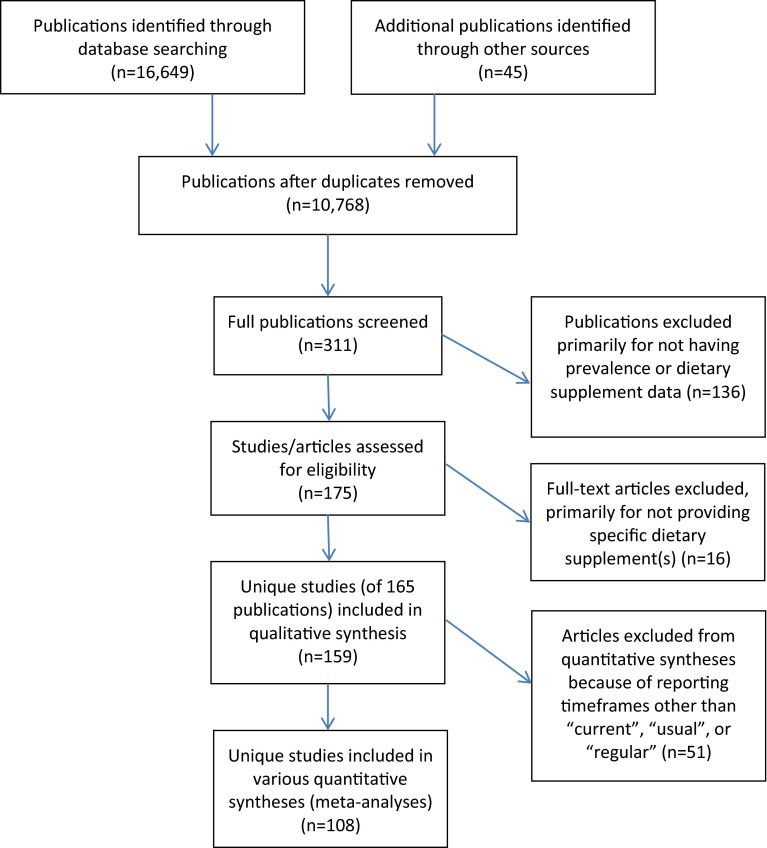
BACKGROUND: Dietary supplements (DSs) are commercially available products consumed as an addition to the usual diet and are frequently ingested by athletes. OBJECTIVE: Our objective was to examine the prevalence of DS use by athletes. DATA SOURCES: PubMed, Ovid MEDLINE, OVID Healthstar, and Cumulative Index to Nursing and Allied Health were searched for original research articles published up to August 2014. Search terms included specific sports, specific DSs, and other terms. STUDY SELECTION: Studies were selected if they were written in English, involved athletes, and provided a quantitative assessment of the proportion of athletes using specific DSs. Percent of athletes using specific DSs. SYNTHESIS OF DATA: Methodological quality of studies was assessed by three reviewers using an 8-point scale that included evaluations for sampling methods, sampling frame, sample size, measurement tools, bias, response rate, statistical presentation, and description of the participant sample. Where there were at least two investigations, meta-analysis was performed to obtain summary (pooled) prevalence estimates (SPEs) on (1) DS use prevalence by sport and sex, (2) DS use prevalence by elite versus non-elite athletic status, and (3) specific DS prevalence for all athletic groups combined. Meta-analyses included evaluations of homogeneity and publication bias. RESULTS: A total of 159 unique studies met the review criteria. Methodological quality was generally low with an average ± standard deviation of 43 ± 16% of available rating points. There was low homogeneity for SPEs when compiled by sport, athletic status, and/or specific DSs. Contributing to the lack of homogeneity were differences in studies' objectives and types of assessments used (e.g., dietary surveys, interviews, questionnaires). Despite these limitations, the data generally indicated that elite athletes used DSs much more than their non-elite counterparts. For most DSs, use prevalence was similar for men and women except that a larger proportion of women used iron while a larger proportion of men used vitamin E, protein, and creatine. No consistent change in use over time was observed because even the earliest investigations showed relatively high use prevalence. CONCLUSION: It was difficult to generalize regarding DS use by athletes because of the lack of homogeneity among studies. Nonetheless, the data suggested that elite athletes used dietary supplements far more than their non-elite counterparts; use was similar for men and women with a few exceptions; use appeared to change little over time; and a larger proportion of athletes used DSs compared with the general US population. Improvements in study methodology should be considered in future studies especially (1) defining DSs for participants; (2) querying for very specific DSs; (3) using a variety of reporting timeframes (e.g., daily, 2-6 times/week, 1 time/week and <1 time/week); (4) reporting the sampling frame, number of individuals solicited, and number responding; (5) reporting characteristics of volunteers (and non-volunteers, if available); and (6) using similar methods on several occasions to examine possible temporal trends among athletes.
Overview
The claims and statistics of this paper haven’t been checked yet.
Free: it reads the open-access text and checks the first 5 claims that cite a source we can check. Create a free account to check every claim.
Integrity signals
Registry
Cites
Statistics
Figures
Verification
Claims the paper makes
The claims and statistics of this paper haven’t been checked yet.
Free: it reads the open-access text and checks the first 5 claims that cite a source we can check. Create a free account to check every claim.
Claims other papers make about this one
Each is checked against this paper’s own text: does it say what the citing paper says it does?
The source backs part of the claim, not all of it — or backs it for a different population, condition or comparison.
In the citing paper
“recent studies show that ~50% of athletes consume some form of micronutrient supplement and between 5–27% are MTEs (Iron, Calcium, Zinc, Selenium or Chromium; [31,40]).”
From The Role of Mineral and Trace Element Supplementation in Exercise and Athletic Performance: A Systematic Review (2019) · cites this paper as [40]
Experimental — accuracy not yet measuredThe source backs part of the claim, not all of it — or backs it for a different population, condition or comparison.
In the citing paper
“the use of dietary supplements to enhance performance or health is not limited to adult populations and is an increasingly popular strategy among young, active individuals (80)”
From Safety of Creatine Supplementation in Active Adolescents and Youth: A Brief Review (2018) · cites this paper as [80]
Experimental — accuracy not yet measuredThe cited source says what the claim attributes to it.
In the citing paper
“A systematic review by Knapik et al. [7] in 2016 reported creatine use in 50 out of 159 (31%) unique studies examining the prevalence of dietary supplement use by athletes of all ages.”
From Creatine Supplementation in Children and Adolescents (2021) · cites this paper as [7]
The check wasn’t confident either way, so it gives no verdict — never disputed.
In the citing paper
“Creatine is not only one of the more popular dietary supplements from a performance perspective, but there is also strong evidence to support its use in clinical settings for a variety of patient populations [1,7].”
From Creatine Supplementation in Children and Adolescents (2021) · cites this paper as [7]
Experimental — accuracy not yet measuredIn the citing paper
“recent studies show that ~50% of athletes consume some form of micronutrient supplement and between 5–27% are MTEs (Iron, Calcium, Zinc, Selenium or Chromium; [31,40]).”
From The Role of Mineral and Trace Element Supplementation in Exercise and Athletic Performance: A Systematic Review (2019) · cites this paper as [40]
2 more claims about this paper
Create a free account to see every claim other papers make about this one.
Self-check
Percentages, sums and reported differences re-computed from the paper’s own numbers.
The self-check needs the paper’s full text.
Citations
Cites
Preferred Reporting Items for Systematic Reviews and Meta-Analyses: the PRISMA statement
Moher, D., Liberati, A., Tetzlaff, J., Altman, D. G., & for the PRISMA Group (2009) · BMJ · doi:10.1136/bmj.b2535 · Cited by 83,823
Preferred Reporting Items for Systematic Reviews and Meta-Analyses: The PRISMA Statement
Moher, D., Liberati, A., Tetzlaff, J., Altman, D. G., & The PRISMA Group (2009) · PLoS Medicine · doi:10.1371/journal.pmed.1000097 · Cited by 64,042 · cited 1×
“This investigation generally followed the Preferred Reporting Items for Systematic Reviews and Meta-Analyses (PRISMA) guidelines [27].”
MethodMeasuring inconsistency in meta-analyses
Higgins, J. P. T., Thompson, S. G., Deeks, J. J., & Altman, D. G. (2003) · BMJ · doi:10.1136/bmj.327.7414.557 · Cited by 63,139
Preferred reporting items for systematic reviews and meta-analyses: the PRISMA Statement.
(2009) · PubMed Central · Cited by 44,859
Wang, G., Ma, R., Qiao, G., Wada, K., Aizawa, Y., & Satoh, T. (2015) · Integrative Medicine International · doi:10.1159/000368408 · Cited by 18,657
Duval, S., & Tweedie, R. (2000) · Biometrics · doi:10.1111/j.0006-341x.2000.00455.x · Cited by 14,099 · cited 1×
“The trim and fill evaluation imputes the number of ‘missing’ studies in the funnel plot and re-computes an adjusted SPE and S95 % CI with the ‘missing’ studies included [31].”
MethodTrumbo (2001) · doi:10.1016/s0002-8223(01)00078-5 · Cited by 4,852
Assessing heterogeneity in meta-analysis: Q statistic or I² index?
Huedo-Medina, T. B., Sánchez-Meca, J., Marín-Martínez, F., & Botella, J. (2006) · Psychological Methods · doi:10.1037/1082-989x.11.2.193 · Cited by 4,256
Cermak, N. M., Res, P. T., de Groot, L. C., Saris, W. H., & van Loon, L. J. (2012) · The American Journal of Clinical Nutrition · doi:10.3945/ajcn.112.037556 · Cited by 827 · cited 2×
“Protein and creatine supplementation have both been demonstrated to increase strength and lean body mass [181, 182].”
BackgroundRadimer, K. (2004) · American Journal of Epidemiology · doi:10.1093/aje/kwh207 · Cited by 818
Research works printed but not linked: 8
- Nutrition Business Journal Global Supplement and Nutrition Industry Report 2014. Nutr Bus J. 2014. http://newhope360.com/site-files/newhope360.com/files/uploads/2014/Global_Report%20summary.pdf . Accessed 23 Aug 2014.
- Campbell ML, MacFadyen KL. Nutrition knowledge. Beliefs and dietary practices of competitive swimmers. Can Home Econ J. 1984;34(1):47–51.
- Bright-See E, Croy J, Brayshaw J, et al. Nutrition briefs and practices of ballet students. J Can Diet Assoc. 1978;39(4):324–31.
- Thibault G, Lambert J, Rivard M, et al. Utilization of ergogenic aids and the attitudes toward safety in marathon runners. In: Katch FI, editor. The 1984 Olympic Scientific Congress proceedings, volume 2 Sports, Health and Nutrition. Champaign: Human Kinetics Publishers Inc; 1986.
- Khoo CS, Rawson NE, Robinson ML, et al. Nutrient intake and eating habits of triathletes. Ann Sports Med. 1987;3:144–50.
- Slavin JL, McNamara EA, Lutter JM. Nutritional practices of women cyclists, including recreational riders and elite riders. In: Katch FI, editor. Sports, health and nutrition. The 1984 Olympic Scientific Congress proceedings, volume 2. Champaign: Human Kinetics Publishers, Inc; 1986. p. 107–11.
- Grandjean AC, editor. Profile on nutrition beliefs and practices of the elite athlete. Human Kinetics: Champaign; 1985.
- Jacobson BH, Sobonya C, Ransone J. Nutrition practices and knowledge of college varsity athletes. J Strength Cond Res. 2001;15(1):63–8.
Cited by
Items 201–300 of 574
van Rensburg, D. C. J., Sparks, I., Fletcher, L., & van Rensburg, A. J. (2018) · South African Journal of Sports Medicine · doi:10.17159/2078-516x/2018/v30i1a2963 · Cited by 13
Dietary supplements and elite athletes: when nature becomes high risk
Garthe, I. (2019) · Current Opinion in Endocrine and Metabolic Research · doi:10.1016/j.coemr.2019.07.004 · Cited by 14
Quality Control of Protein Supplements: A Review
da Costa, B. R. B., Roiffé, R. R., & de la Cruz, M. N. D. S. (2021) · International Journal of Sport Nutrition and Exercise Metabolism · doi:10.1123/ijsnem.2020-0287 · Cited by 13
The Effect of Acute L-carnitine and Carbohydrate Intake on Cycling Performance
Burrus, B. M., Moscicki, B. M., Matthews, T., & Paolone, V. J. (2018) · International journal of exercise science · doi:10.70252/jggv7814 · Cited by 13
Puya-Braza, J. M., & Sánchez-Oliver, A. J. (2018) · Retos · doi:10.47197/retos.v0i34.65027 · Cited by 13
Coso, J. D. (2018) · Nutrición Hospitalaria · doi:10.20960/nh.1851 · Cited by 13
Harnden, C. S., Agu, J., & Gascoyne, T. (2023) · Journal of the International Society of Sports Nutrition · doi:10.1080/15502783.2023.2209056 · Cited by 12
Callis, L. B., Russell, M. A., Hurst, H. T., Hardwicke, J., & Roberts, C. J. (2023) · Nutrients · doi:10.3390/nu15204331 · Cited by 14
López-Domínguez, R., & Sánchez-Oliver, A. J. (2018) · Retos · doi:10.47197/retos.v0i34.65026 · Cited by 13
Sports supplements: use, knowledge, and risks for Algerian athletes
Chebaiki, I. J., Bekadi, A., & Bechikh, M. Y. (2020) · The North African Journal of Food and Nutrition Research · doi:10.51745/najfnr.4.7.231-239 · Cited by 12
Rivera, A. C. S., Ayala-Guzmán, C. I., Roldán, A. B. L., Ramírez, O. D. C., & Ortiz-Hernández, L. (2021) · Revista Española de Nutrición Humana y Dietética · doi:10.14306/renhyd.25.s1.1159 · Cited by 12
Prevalence of Supplement Consumption in Iranian Athletes: A Systematic Review and Meta-Analysis
Halabchi, F., Shab‐Bidar, S., & Selk-Ghaffari, M. (2021) · International Journal of Preventive Medicine · doi:10.4103/ijpvm.ijpvm_189_20 · Cited by 12
Turfus, S. C., Smith, J. O. L., Mansingh, A., Alexander-Lindo, R. L., & Roopchand-Martin, S. (2019) · Performance Enhancement & Health · doi:10.1016/j.peh.2019.07.001 · Cited by 12
Can Muscle Building Supplements Increase Testicular Cancer Risk?
Girardi, K. G., Zheng, T., & Zhu, Y. L. (2022) · Frontiers in Nutrition · doi:10.3389/fnut.2022.778426 · Cited by 11
Moghaddam, H. N., Tamiji, Z., Amini, M., Khoshayand, M. R., Kobarfrad, F., Sadeghi, N., & Hajimahmoodi, M. (2024) · Food Additives & Contaminants Part A · doi:10.1080/19440049.2024.2311218 · Cited by 11
Rashani, S. A. N., Fernando, P. N. J., Pigera, S., Ma, N., Jayawickreme, S. J., & Silva, A. P. D. (2021) · Journal of Exercise and Nutrition · doi:10.53520/2021.10398 · Cited by 11
Aljebeli, S. M., Albuhairan, R. A., Ababtain, N., Almazroa, T., Alqahtani, S., & Philip, W. (2023) · Cureus · doi:10.7759/cureus.41031 · Cited by 11
Attitude towards healthy nutrition and mental toughness: a study of taekwondo athletes
ÖZSARI, A., Kara, M., Dilek, A. N., Uysal, H., Tek, T., & Deli, Ş. C. (2024) · PeerJ · doi:10.7717/peerj.17174 · Cited by 11
Smith, B. L., Carey, C. C., O’Connell, K., Twomey, S., & McCarthy, E. K. (2025) · European Journal of Nutrition · doi:10.1007/s00394-025-03693-y · Cited by 11
Proteomics and metabolomics research in exercise and sport
Al‐Khelaifi, F., Abraham, D., Diboun, I., & Elrayess, M. A. (2019) · Elsevier eBooks · doi:10.1016/b978-0-12-816193-7.00023-3 · Cited by 11
Ulrich, R., Cléret, L., Comstock, R. D., Kanayama, G., Simon, P. D., & Pope, H. G. (2023) · Sports Medicine - Open · doi:10.1186/s40798-023-00658-5 · Cited by 10
Varillas‐Delgado, D. (2025) · Nutrients · doi:10.3390/nu17081379 · Cited by 10
Kao, T., Kazman, J. B., Cheng, Y.-H., Jeffery, D. D., & Deuster, P. A. (2020) · Annals of Epidemiology · doi:10.1016/j.annepidem.2020.08.011 · Cited by 10
Herbs as an Active Ingredient in Sport: Availability and Information on the Internet
Sierra, J. F. G., Arribalzaga, S., Díez, R., López, C., Fernández, N., Garcia, J. J., Diez, M. J., Seco‐Calvo, J., Sierra, M., & Sahagún, A. M. (2022) · Nutrients · doi:10.3390/nu14132764 · Cited by 10
Nutrition knowledge, weight loss practices, and supplement use in senior competition climbers
Gibson-Smith, E., Storey, R., Michael, M. K., & Ranchordas, M. K. (2024) · Frontiers in Nutrition · doi:10.3389/fnut.2023.1277623 · Cited by 10
Hurst, P., Ng, P. Y., Under, L., & Fuggle, C. (2024) · Performance Enhancement & Health · doi:10.1016/j.peh.2024.100278 · Cited by 10
The effect of sports on oral health in Riyadh city: A cross-sectional study
Saffan, A. A., Alshahry, R., Alrwissan, S., Aljanoubi, Z., & Alswailem, R. (2019) · Saudi Journal of Oral Sciences · doi:10.4103/sjos.sjoralsci_75_18 · Cited by 10
Suplementos alimentares: uma fonte de doping não intencional?
da Costa, B. R. B., de la Cruz, M. N. D. S., Roiffé, R. R., & Padilha, M. C. (2021) · Brazilian journal of food technology/Brazilian Journal of Food Technology · doi:10.1590/1981-6723.25619 · Cited by 10
Gallé, F., Valeriani, F., Giorgi, A. D., Angelillo, S., Bargellini, A., Bianco, A., Bianco, L., Caggiano, G., Colucci, M. E., Coniglio, M. A., et al. (2022) · Nutrition · doi:10.1016/j.nut.2022.111902 · Cited by 10
The Effect of Muscle Dysmorphia and Social Physique Anxiety on the Use of Supplements and Drugs
Khorramabadi, Y. (2017) · Zahedan Journal of Research in Medical Sciences · doi:10.5812/zjrms.13541 · Cited by 10
The health-related determinants of eating pattern of high school athletes in Goiás, Brazil
Noll, M. A., Rodrigues, A. P. S., & Silveira, É. A. (2020) · Archives of Public Health · doi:10.1186/s13690-020-0396-3 · Cited by 10
Dietary supplement use and its associated factors among gym users in Southern Brazil
Molz, P., Rossi, R., Schlickmann, D. D. S., dos Santos, C., & Franke, S. I. R. (2022) · Journal of Substance Use · doi:10.1080/14659891.2022.2070869 · Cited by 10
Use of Nutritional Supplements in Amateur Tennis PlayersPreprint
Sánchez-Oliver, A. J., Ordóñez, F. M., Domínguez, R., & López‐Samanes, Á. (2018) · Preprints.org · doi:10.20944/preprints201804.0168.v1 · Cited by 10
Micronutrient supplement intakes among collegiate and masters athletes: A cross-sectional study
Nichols, Q. Z., Ramadoss, R., Stanzione, J. R., & Volpe, S. L. (2023) · Frontiers in Sports and Active Living · doi:10.3389/fspor.2023.854442 · Cited by 9
Prioritized dietary supplement information needs of 307 NCAA division I student athletes
Osterman, S., Gray, V. B., Loy, M., Coffey, A. B., Smallwood, K., & Barrack, M. T. (2020) · Journal of Nutrition Education and Behavior · doi:10.1016/j.jneb.2020.01.007 · Cited by 9
Decoding unintentional doping: A complex systems analysis of supplement use in sport
McLean, S. G., Morrison, M., Naughton, M. R., & Salmon, P. M. (2024) · Performance Enhancement & Health · doi:10.1016/j.peh.2024.100317 · Cited by 9
Vancini, R. L., Rufo-Tavares, W., Oliveira, H. R. D. P., Viana, R. B., Andrade, M. S., Knechtle, B., Nikolaidis, P. Τ., Gentil, P., & de Lira, C. A. B. (2021) · Open Access Journal of Sports Medicine · doi:10.2147/oajsm.s323562 · Cited by 10
Assessing the need to use sport supplements: The mediating role of sports supplement beliefs
Murofushi, Y., Kawata, Y., Nakamura, M., Yamaguchi, S., Sunamoto, S., Fukamachi, H., Aono, H., Kamihigashi, E., Takazawa, Y., Naıto, H., et al. (2023) · Performance Enhancement & Health · doi:10.1016/j.peh.2023.100269 · Cited by 9
Schott, K. D., Seltzer, R. G. N., Zorn, S. P., Frakes, M., Price, M., Valliant, M. W., Ritz, P. P., Gardner, C. D., & Wardenaar, F. C. (2024) · Journal of Athletic Training · doi:10.4085/1062-6050-0098.24 · Cited by 9
Supplement Use Among Athletes: Insights from Gyms in Sarajevo
Čaušević, D., Alexe, C. I., Čović, N., Panaet, E. A., Abazović, E., TODOR, R. M., Rani, B., Lupu, G. S., & Alexe, D. I. (2025) · Applied Sciences · doi:10.3390/app15094747 · Cited by 9
Consumo de suplementos nutricionales y sustancias nocivas en culturismo
Sánchez-Oliver, A. J., Gavira, J. F., Puyana, M. G., & Fernández, J. G. (2017) · LA Referencia (Red Federada de Repositorios Institucionales de Publicaciones Científicas) · Cited by 9
Ulery, J. A., Melton, B. F., Bland, H. W., & Riggs, A. J. (2021) · Journal of Dietary Supplements · doi:10.1080/19390211.2021.1910395 · Cited by 9
Color‐nutrient associations: Implications for product design of dietary supplements
Motoki, K., Yamada, A., & Spence, C. J. (2022) · Journal of Sensory Studies · doi:10.1111/joss.12777 · Cited by 9
Jiménez‐Martínez, P., Ramírez‐Campillo, R., Flández, J., Alix‐Fages, C., Baz-Valle, E., & Colado, J. C. (2022) · Journal of Human Sport and Exercise · doi:10.14198/jhse.2023.182.09 · Cited by 9
Kakutani, Y., KOIWA, A., Kamiya, S., Ono, M., Sasahara, I., & Omi, N. (2019) · Journal of Nutritional Science and Vitaminology · doi:10.3177/jnsv.65.343 · Cited by 9
Knapik, J. J., Trone, D. W., Steelman, R. A., Farina, E. K., & Lieberman, H. R. (2021) · Journal of the International Society of Sports Nutrition · doi:10.1186/s12970-021-00457-x · Cited by 9
Self-citationSapuppo, W., Giacconi, D., Monda, A., Messina, A., Saccenti, D., Mineo, C. M., Casillo, M., Allocca, S., Michelini, G., Grgič, R. G., et al. (2025) · Sports · doi:10.3390/sports13090321 · Cited by 8
Knapik, J. J., Trone, D. W., Steelman, R. A., Farina, E. K., & Lieberman, H. R. (2024) · Nutrients · doi:10.3390/nu16152547 · Cited by 8
Self-citationAnalysis of Protein Content on Commercial Protein Supplement in Indonesia
Kuswari, M., Gifari, N., Nuzrina, R., Justickarin, S., Fathiya, A., & Hutasuhut, F. (2021) · JUARA Jurnal Olahraga · doi:10.33222/juara.v6i2.1225 · Cited by 8
Training, Changes in Nutritional Requirements and Dietary Support of Physical Exercise
Margaritis, I. (2018) · Elsevier eBooks · doi:10.1016/b978-0-12-810422-4.00012-9 · Cited by 9
Hegazy, N., Sayed, H. A. E., Hasan, A. A., & Salem, M. R. (2020) · Open Access Macedonian Journal of Medical Sciences · doi:10.3889/oamjms.2020.5371 · Cited by 8
Community-Based Survey Exploring Use of the Dietary Supplement Creatine by Adult Non-Athletes
Benton, M. J., Spicher, J. M., & McCormick, S. J. (2021) · Nutrients · doi:10.3390/nu13082529 · Cited by 8
Wardenaar, F. C., Schott, K. D., Seltzer, R. G. N., & Gardner, C. D. (2024) · Frontiers in Nutrition · doi:10.3389/fnut.2024.1381731 · Cited by 8
Moty, N., Somanah, J., & Putteeraj, M. (2023) · Psych · doi:10.3390/psych5010009 · Cited by 7
da Costa, B. R. B., Haddad, L. P. E., Freitas, B. T., Marinho, P. A., & Martinis, B. S. D. (2021) · Drug Testing and Analysis · doi:10.1002/dta.3043 · Cited by 7
Smith, K. S., Morris, M. M., Morrow, C. D., Novak, J. R., Roberts, M. D., & Frugé, A. D. (2022) · Microorganisms · doi:10.3390/microorganisms10122344 · Cited by 7
Sports Supplement Consumption in 316 Federated Female Road Cyclists
García-Durán, J., González-Jurado, J. A., & Sánchez-Oliver, A. J. (2024) · Nutrients · doi:10.3390/nu16152563 · Cited by 7
Role of Selected Medicinal Plants in Sports Nutrition and Energy Homeostasis
Končić, M. Z. (2017) · Elsevier eBooks · doi:10.1016/b978-0-12-805413-0.00007-7 · Cited by 7
Üniversiteli Sporcu Öğrencilerin Beslenme Destek Ürünleri Kullanım Durumu
ÖZTÜRK, S. A., Kalkan, İ., DURMAZ, C., Pehlivan, M., Özüpek, G., & BAKMAZ, Z. D. (2020) · AYDIN TIP FAKÜLTESİ KLİNİKLERİ DERGİSİ · doi:10.17932/iau.tfk.2018.008/2020.301/tfk_v03i1002 · Cited by 7
Wessinger, C. M., Inman, C. L., Weinstock, J., & Weiss, E. P. (2021) · International journal of exercise science · doi:10.70252/gqbm6956 · Cited by 7
Prevalence, Information & Attitude towards Using Supplements among University Athletes
Gill, S. A., Zahid, U., Abdullah, U., Shaheen, M., Naseer, A., Butt, Z. I., Zafar, R., Adil, R., Shahid, H., & Arslan, M. (2022) · Journal of Pharmaceutical Research International · doi:10.9734/jpri/2022/v34i49a36422 · Cited by 7
Aspects Regarding the Consumption of Dietary Supplements among the Active Population in Romania
Făgăraș, P. S., Teodorescu, S., Bacârea, A., Petrea, R. G., Ursanu, A.-I., Cozmei, G., Radu, L.-E., & Vanvu, G. (2023) · International Journal of Environmental Research and Public Health · doi:10.3390/ijerph20010850 · Cited by 7
Controlling Behavior, Sex Bias and Coaching Success in Japanese Track and Field
Tsukahara, Y., Kamada, H., Torii, S., Yamasawa, F., & Mącznik, A. K. (2023) · Sports · doi:10.3390/sports11020032 · Cited by 7
Scott, J. M., Lindsey, A. T., Costello, R. B., & Deuster, P. A. (2018) · Nutrition Today · doi:10.1097/nt.0000000000000295 · Cited by 7
Dow, E., Schott, K. D., Morton, L. M., Lybbert, H., Nam, K., Shumate, C., Kulinna, P. H., & Wardenaar, F. C. (2024) · Nutrition Bulletin · doi:10.1111/nbu.12724 · Cited by 6
Vignaud, J., Loiseau, C., Côme, M., Martin, I., Rasoanarivo, R., Hérault, J., Mayer, C., Lépine, O., & Ulmann, L. (2025) · Nutrients · doi:10.3390/nu17020283 · Cited by 6
Horváth, I. L., Kajner, G., Galbács, G., & Csupor, D. (2025) · Journal of Nutritional Science · doi:10.1017/jns.2025.10024 · Cited by 6
Dietary Supplement use and their role in Fitness and Sports Performance
Dhurata Bozo, B. H.-L. (2024) · South Eastern European Journal of Public Health · Cited by 6
Lippi, G., & Sanchis‐Gomar, F. (2020) · Acta bio-medica dell'Ateneo parmense/Acta biomedica · doi:10.23750/abm.v91i4.8460 · Cited by 6
López-Jiménez, A., Morán-Fagúndez, L., Sánchez-Sánchez, A. M., & Fernández‐Pachón, M. (2023) · International Journal of Food Sciences and Nutrition · doi:10.1080/09637486.2023.2246699 · Cited by 6
Siedler, M. R., Rodriguez, C., White, S. J., Tinoco, E., DeHaven, B., Brojanac, A., LaValle, C., Rasco, J., Taylor, L. W., & Tinsley, G. M. (2023) · Nutrients · doi:10.3390/nu15224806 · Cited by 6
Cranberry supplementation improves physiological markers of performance in trained runners
Parenteau, F., Puglia, V. F., Roberts, M., Comtois, A. S., & Bergdahl, A. (2023) · Physical Activity and Nutrition · doi:10.20463/pan.2023.0032 · Cited by 6
McDaid, B., Wardenaar, F. C., Woodside, J. V., Neville, C. E., Tobin, D., Madigan, S. M., & Nugent, A. P. (2024) · Nutrition Bulletin · doi:10.1111/nbu.12696 · Cited by 6
(2019) · International Journal of Food and Nutrition Research · doi:10.28933/ijfnr-2019-05-2205 · Cited by 6
Corr, L. D., Field, A., Pufal, D., Killey, J., Clifford, T., Harper, L. D., & Naughton, R. J. (2020) · International Journal of Sport Nutrition and Exercise Metabolism · doi:10.1123/ijsnem.2020-0057 · Cited by 6
Urinary phenylethylamine metabolites as potential markers for sports drug testing purposes
Krombholz, S., Thomas, A., Piper, T., Lagojda, A., Kuehne, D., & Thevis, M. (2021) · Biomedical Chromatography · doi:10.1002/bmc.5274 · Cited by 6
Karakawa, S., Smriga, M., Arashida, N., Nakayama, A., & Miyano, H. (2022) · Nutrients · doi:10.3390/nu14142838 · Cited by 6
Sierra, J. F. G., Seco‐Calvo, J., Arribalzaga, S., Díez, R., López, C., Fernández, N., Garcia, J. J., Diez, M. J., de la Puente, R., Sierra, M., et al. (2023) · Frontiers in Pharmacology · doi:10.3389/fphar.2023.1305080 · Cited by 7
Carbone, A. (2021) · Digital Commons - East Tennessee State University (East Tennessee State University) · Cited by 6
The Promise of Dietary Supplements
Ghosh, N., & Sen, C. K. (2018) · Elsevier eBooks · doi:10.1016/b978-0-12-813922-6.00066-7 · Cited by 6
Use of nutritional supplements in amateur tennis players
Sánchez-Oliver, A. J., Ordóñez, F. M., Domínguez, R., & López‐Samanes, Á. (2018) · Journal of Physical Education and Sport · doi:10.7752/jpes.2018.02114 · Cited by 7
Mera-Zouain, L., Carballo, J. L., & Guilabert, M. (2022) · Nutrients · doi:10.3390/nu14214481 · Cited by 5
Use of Sport Supplements and Doping Substances by Athletes: Prevalence and Relationships
Hurst, P., Kavussanu, M., Davies, R., Dallaway, N., & Ring, C. (2024) · Journal of Clinical Medicine · doi:10.3390/jcm13237132 · Cited by 5
Bezuglov, E., Vakhidov, T., Malyakin, G. I., Kapralova, E., Emanov, A., Koroleva, E., Manina, M. A., Ильинична, Э. С., & Talibov, O. B. (2024) · Journal of Human Nutrition and Dietetics · doi:10.1111/jhn.70002 · Cited by 5
Wang, H., Ma, H., Yan, H., Pei, Z., Zhao, J., Zhang, H., Zhang, Z., & Lu, W. (2025) · Probiotics and Antimicrobial Proteins · doi:10.1007/s12602-025-10493-7 · Cited by 5
Navigating the Risks Beyond the Label: Unpacking Global Nutritional Supplement Safety
Wardenaar, F. C., Burns, S. F., de Campos, M. V. S., Chan, Y., Claassen-Smithers, A., Dunshea-Mooij, C. A. E., Haddou, S. E., Hoogervorst, D., Jagim, A. R., Garcia, P. R., et al. (2025) · International Journal of Sport Nutrition and Exercise Metabolism · doi:10.1123/ijsnem.2025-0177 · Cited by 5
Alkebbeh, L., Alaryan, T., Saad, M. C., & Alzeer, S. (2022) · Egyptian Journal of Forensic Sciences · doi:10.1186/s41935-022-00312-3 · Cited by 5
Impact of sexual activity prior to a sports competition in amateur athletes
Alonso-Aubin, D. A., Medrano, I. C., Picón-Martínez, M., Gómez‐Tomás, C., Cortell-Tormo, J. M., Cardozo, L. A., & Rebullido, T. R. (2023) · Journal of Physical Education and Sport · doi:10.7752/jpes.2023.04116 · Cited by 5
Parenteau, F., St-Amant, A., & Bergdahl, A. (2024) · Clinical Nutrition Open Science · doi:10.1016/j.nutos.2024.06.006 · Cited by 5
Sánchez-Oliver, A. J., Moreno-Pérez, V., Terrón-Manrique, P., Fernández-Ruiz, V., Quintana-Milla, I., Sánchez‐Sánchez, J., Rodríguez, G., Ramos-Álvarez, J. J., Domínguez, R., & López‐Samanes, Á. (2024) · Nutrients · doi:10.3390/nu16152486 · Cited by 5
Sapuppo, W., Monda, A., Giacconi, D., Grgič, R. G., Saccenti, D., Mineo, C. M., Monda, V., Allocca, S., Casillo, M., Monda, M., et al. (2024) · Sports · doi:10.3390/sports12100270 · Cited by 5
Dietary Supplement Use in Competitive Spanish Football Players and Differences According to Sex
Sousa-Rufino, C., Pareja-Galeano, H., & Martínez‐Ferrán, M. (2025) · Nutrients · doi:10.3390/nu17040602 · Cited by 5
Sports Supplement Use in Road Cycling: A Comparative Analysis by Sex and Competitive Category
García-Durán, J., Romero-García, D., Sanz, J. M. M., González-Jurado, J. A., & Sánchez-Oliver, A. J. (2025) · Sports · doi:10.3390/sports13040122 · Cited by 5
Lafontant, K., Livingston, J., Smith, S., Barbera, M. A. D. S., Gonzalez, C., Kampiyil, S., Nguyen, N. L. N., Johnson, B., Stout, J. R., & Fukuda, D. H. (2025) · Sports · doi:10.3390/sports13100340 · Cited by 5
Sakr, F. M., Hussein, K. A., Atiyah, A. M., Hassan, T. M., & Al-Saboonchi, A. A. (2021) · International journal of human movement and sports sciences · doi:10.13189/saj.2021.090619 · Cited by 5
The Prevalence of Dietary Supplement Usage in Military Aviators
Sammito, S., Erley, O. M., Rose, D.-M., & Güttler, N. (2022) · International Journal of Environmental Research and Public Health · doi:10.3390/ijerph19095017 · Cited by 5
Sleep, nutrition, and supplements: Implications for athletes
Charest, J., & Grandner, M. A. (2024) · Elsevier eBooks · doi:10.1016/b978-0-12-822969-9.00002-x · Cited by 5
Knowledge, Prevalence, and Consequences of Dietary Supplements Intake among Iranian Bodybuilders
Bajool, Y., Hemmatinafar, M., Daryanoosh, F., Jahaniboushehri, N., Jahan, Z., & Imanian, B. (2024) · Current Developments in Nutrition · doi:10.1016/j.cdnut.2024.104437 · Cited by 5
Suplementação alimentar orientada para atletas: uma revisão integrativa
Alves, D., Portela, F. A. S., & Costa, F. N. (2022) · Research Society and Development · doi:10.33448/rsd-v11i16.38086 · Cited by 5
Supplements Contamination; a Real Enemy in Physical Activity & Sports
Bonilla, D. A. (2017) · Journal of Analytical & Pharmaceutical Research · doi:10.15406/japlr.2017.05.00126 · Cited by 5
Metadata
- Authors
- Knapik, J. J., Steelman, R. A., Hoedebecke, S. S., Austin, K. G., Farina, E. K., & Lieberman, H. R.
- Affiliations
- U.S. Army Research Institute of Environmental Medicine (US)
- Defense Center for Public Health - Aberdeen (US)
- Corresponding author
- Knapik, Joseph J.
- Venue
- Sports Medicine
- Published
- 2015-10-06
- Volume
- 46
- Issue
- 1
- Pages
- 103-123
- ISSN
- 0112-1642 (ISSN-L)
- 1179-2035
- PMC
- PMC4697915
- OpenAlex
- W1954905436
- Cited by
- 452
- References
- 198
- Citations by year
- 2026: 40 · 2025: 42 · 2024: 52 · 2023: 56 · 2022: 51 · 2021: 56 · 2020: 52 · 2019: 33 · 2018: 39 · 2017: 24 · 2016: 7
- FWCI
- 9.40
- Type
- journal article
- Language
- en
- Open access
- hybrid
- doi.org
- Locations
- Sports Medicine (publishedVersion, cc-by)
- Europe PMC (PubMed Central) (publishedVersion, cc-by)
- PubMed Central (publishedVersion, cc-by)
- PubMed (publishedVersion)
- Funders
- Center Alliance for Nutrition and Dietary Supplement Research
- Topics
- Social Sciences › Sociology and Political Science › Doping in Sports
- Health Sciences › Medicine › Public Health, Environmental and Occupational Health › Nutrition and Health Studies
- Health Sciences › Medicine › Complementary and alternative medicine › Complementary and Alternative Medicine Studies
- Keywords
- dietary supplements, athletes, supplement use prevalence, elite athletes, sex differences, iron supplementation, vitamin E, protein supplementation, creatine supplementation, sports nutrition, methodological quality
- MeSH terms
- Creatine, Dietary Proteins, Humans, Sex Factors, Vitamin E, Iron, Dietary, Dietary Supplements, Athletes
About these checks
Registry, retraction, Cites and statistics results are computed, not judged, with one exception: a printed reference that no index lists is read once by a model before it counts as a citation error. Claims are extracted by a model and kept only when their quote appears verbatim in the text; each cited source is then checked, with a model’s help, for whether it says what the claim relies on. Those verdicts can be wrong — read the claim’s quote and the cited source before relying on one.
Statistics and arithmetic are recomputed, not judged.
Confidence bands are shown only for fields calibrated on our annotated test set. None is calibrated yet, so no band is shown.
What counts as a claim ›How we measure confidence ›How we check this ›
Are you an author, or do you see a problem with this page? Request a review
Data sources
Bibliographic data: Semantic Scholar, OpenAlex, Crossref.
Contains information from the Semantic Scholar Academic Graph Datasets, made available under the ODC Attribution License (ODC-BY 1.0).
Semantic Scholar’s data is described in: Kinney, R., et al. (2023). The Semantic Scholar Open Data Platform. arXiv:2301.10140.
