

Prevalence of Dietary Supplement Use by Athletes: Systematic Review and Meta-Analysis
Open accessThe DOI matches its Crossref record; 199 of the 199 references it cites were found in a registry or an index.
Abstract
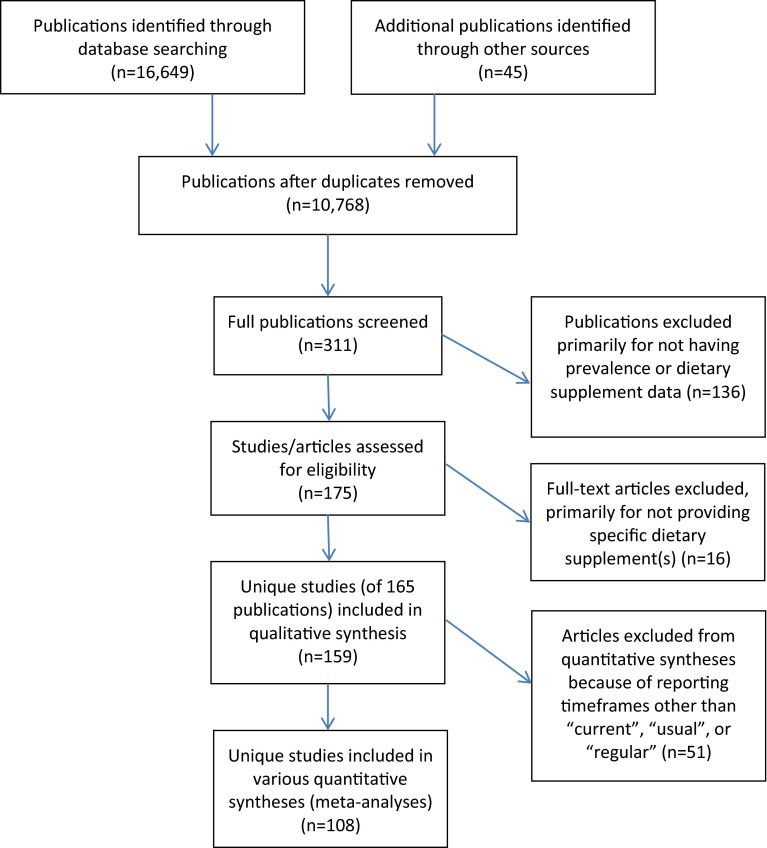
BACKGROUND: Dietary supplements (DSs) are commercially available products consumed as an addition to the usual diet and are frequently ingested by athletes. OBJECTIVE: Our objective was to examine the prevalence of DS use by athletes. DATA SOURCES: PubMed, Ovid MEDLINE, OVID Healthstar, and Cumulative Index to Nursing and Allied Health were searched for original research articles published up to August 2014. Search terms included specific sports, specific DSs, and other terms. STUDY SELECTION: Studies were selected if they were written in English, involved athletes, and provided a quantitative assessment of the proportion of athletes using specific DSs. Percent of athletes using specific DSs. SYNTHESIS OF DATA: Methodological quality of studies was assessed by three reviewers using an 8-point scale that included evaluations for sampling methods, sampling frame, sample size, measurement tools, bias, response rate, statistical presentation, and description of the participant sample. Where there were at least two investigations, meta-analysis was performed to obtain summary (pooled) prevalence estimates (SPEs) on (1) DS use prevalence by sport and sex, (2) DS use prevalence by elite versus non-elite athletic status, and (3) specific DS prevalence for all athletic groups combined. Meta-analyses included evaluations of homogeneity and publication bias. RESULTS: A total of 159 unique studies met the review criteria. Methodological quality was generally low with an average ± standard deviation of 43 ± 16% of available rating points. There was low homogeneity for SPEs when compiled by sport, athletic status, and/or specific DSs. Contributing to the lack of homogeneity were differences in studies' objectives and types of assessments used (e.g., dietary surveys, interviews, questionnaires). Despite these limitations, the data generally indicated that elite athletes used DSs much more than their non-elite counterparts. For most DSs, use prevalence was similar for men and women except that a larger proportion of women used iron while a larger proportion of men used vitamin E, protein, and creatine. No consistent change in use over time was observed because even the earliest investigations showed relatively high use prevalence. CONCLUSION: It was difficult to generalize regarding DS use by athletes because of the lack of homogeneity among studies. Nonetheless, the data suggested that elite athletes used dietary supplements far more than their non-elite counterparts; use was similar for men and women with a few exceptions; use appeared to change little over time; and a larger proportion of athletes used DSs compared with the general US population. Improvements in study methodology should be considered in future studies especially (1) defining DSs for participants; (2) querying for very specific DSs; (3) using a variety of reporting timeframes (e.g., daily, 2-6 times/week, 1 time/week and <1 time/week); (4) reporting the sampling frame, number of individuals solicited, and number responding; (5) reporting characteristics of volunteers (and non-volunteers, if available); and (6) using similar methods on several occasions to examine possible temporal trends among athletes.
Overview
The claims and statistics of this paper haven’t been checked yet.
Free: it reads the open-access text and checks the first 5 claims that cite a source we can check. Create a free account to check every claim.
Integrity signals
Registry
Cites
Statistics
Figures
Verification
Claims the paper makes
The claims and statistics of this paper haven’t been checked yet.
Free: it reads the open-access text and checks the first 5 claims that cite a source we can check. Create a free account to check every claim.
Claims other papers make about this one
Each is checked against this paper’s own text: does it say what the citing paper says it does?
The source backs part of the claim, not all of it — or backs it for a different population, condition or comparison.
In the citing paper
“recent studies show that ~50% of athletes consume some form of micronutrient supplement and between 5–27% are MTEs (Iron, Calcium, Zinc, Selenium or Chromium; [31,40]).”
From The Role of Mineral and Trace Element Supplementation in Exercise and Athletic Performance: A Systematic Review (2019) · cites this paper as [40]
Experimental — accuracy not yet measuredThe source backs part of the claim, not all of it — or backs it for a different population, condition or comparison.
In the citing paper
“the use of dietary supplements to enhance performance or health is not limited to adult populations and is an increasingly popular strategy among young, active individuals (80)”
From Safety of Creatine Supplementation in Active Adolescents and Youth: A Brief Review (2018) · cites this paper as [80]
Experimental — accuracy not yet measuredThe cited source says what the claim attributes to it.
In the citing paper
“A systematic review by Knapik et al. [7] in 2016 reported creatine use in 50 out of 159 (31%) unique studies examining the prevalence of dietary supplement use by athletes of all ages.”
From Creatine Supplementation in Children and Adolescents (2021) · cites this paper as [7]
The check wasn’t confident either way, so it gives no verdict — never disputed.
In the citing paper
“Creatine is not only one of the more popular dietary supplements from a performance perspective, but there is also strong evidence to support its use in clinical settings for a variety of patient populations [1,7].”
From Creatine Supplementation in Children and Adolescents (2021) · cites this paper as [7]
Experimental — accuracy not yet measuredIn the citing paper
“recent studies show that ~50% of athletes consume some form of micronutrient supplement and between 5–27% are MTEs (Iron, Calcium, Zinc, Selenium or Chromium; [31,40]).”
From The Role of Mineral and Trace Element Supplementation in Exercise and Athletic Performance: A Systematic Review (2019) · cites this paper as [40]
2 more claims about this paper
Create a free account to see every claim other papers make about this one.
Self-check
Percentages, sums and reported differences re-computed from the paper’s own numbers.
The self-check needs the paper’s full text.
Citations
Cites
Preferred Reporting Items for Systematic Reviews and Meta-Analyses: the PRISMA statement
Moher, D., Liberati, A., Tetzlaff, J., Altman, D. G., & for the PRISMA Group (2009) · BMJ · doi:10.1136/bmj.b2535 · Cited by 83,823
Preferred Reporting Items for Systematic Reviews and Meta-Analyses: The PRISMA Statement
Moher, D., Liberati, A., Tetzlaff, J., Altman, D. G., & The PRISMA Group (2009) · PLoS Medicine · doi:10.1371/journal.pmed.1000097 · Cited by 64,042 · cited 1×
“This investigation generally followed the Preferred Reporting Items for Systematic Reviews and Meta-Analyses (PRISMA) guidelines [27].”
MethodMeasuring inconsistency in meta-analyses
Higgins, J. P. T., Thompson, S. G., Deeks, J. J., & Altman, D. G. (2003) · BMJ · doi:10.1136/bmj.327.7414.557 · Cited by 63,139
Preferred reporting items for systematic reviews and meta-analyses: the PRISMA Statement.
(2009) · PubMed Central · Cited by 44,859
Wang, G., Ma, R., Qiao, G., Wada, K., Aizawa, Y., & Satoh, T. (2015) · Integrative Medicine International · doi:10.1159/000368408 · Cited by 18,657
Duval, S., & Tweedie, R. (2000) · Biometrics · doi:10.1111/j.0006-341x.2000.00455.x · Cited by 14,099 · cited 1×
“The trim and fill evaluation imputes the number of ‘missing’ studies in the funnel plot and re-computes an adjusted SPE and S95 % CI with the ‘missing’ studies included [31].”
MethodTrumbo (2001) · doi:10.1016/s0002-8223(01)00078-5 · Cited by 4,852
Assessing heterogeneity in meta-analysis: Q statistic or I² index?
Huedo-Medina, T. B., Sánchez-Meca, J., Marín-Martínez, F., & Botella, J. (2006) · Psychological Methods · doi:10.1037/1082-989x.11.2.193 · Cited by 4,256
Cermak, N. M., Res, P. T., de Groot, L. C., Saris, W. H., & van Loon, L. J. (2012) · The American Journal of Clinical Nutrition · doi:10.3945/ajcn.112.037556 · Cited by 827 · cited 2×
“Protein and creatine supplementation have both been demonstrated to increase strength and lean body mass [181, 182].”
BackgroundRadimer, K. (2004) · American Journal of Epidemiology · doi:10.1093/aje/kwh207 · Cited by 818
Research works printed but not linked: 8
- Nutrition Business Journal Global Supplement and Nutrition Industry Report 2014. Nutr Bus J. 2014. http://newhope360.com/site-files/newhope360.com/files/uploads/2014/Global_Report%20summary.pdf . Accessed 23 Aug 2014.
- Campbell ML, MacFadyen KL. Nutrition knowledge. Beliefs and dietary practices of competitive swimmers. Can Home Econ J. 1984;34(1):47–51.
- Bright-See E, Croy J, Brayshaw J, et al. Nutrition briefs and practices of ballet students. J Can Diet Assoc. 1978;39(4):324–31.
- Thibault G, Lambert J, Rivard M, et al. Utilization of ergogenic aids and the attitudes toward safety in marathon runners. In: Katch FI, editor. The 1984 Olympic Scientific Congress proceedings, volume 2 Sports, Health and Nutrition. Champaign: Human Kinetics Publishers Inc; 1986.
- Khoo CS, Rawson NE, Robinson ML, et al. Nutrient intake and eating habits of triathletes. Ann Sports Med. 1987;3:144–50.
- Slavin JL, McNamara EA, Lutter JM. Nutritional practices of women cyclists, including recreational riders and elite riders. In: Katch FI, editor. Sports, health and nutrition. The 1984 Olympic Scientific Congress proceedings, volume 2. Champaign: Human Kinetics Publishers, Inc; 1986. p. 107–11.
- Grandjean AC, editor. Profile on nutrition beliefs and practices of the elite athlete. Human Kinetics: Champaign; 1985.
- Jacobson BH, Sobonya C, Ransone J. Nutrition practices and knowledge of college varsity athletes. J Strength Cond Res. 2001;15(1):63–8.
Cited by
Prevalence of obstructive sleep apnea in the general population: A systematic review
Senaratna, C. V., Perret, J. L., Lodge, C. J., Lowe, A. J., Campbell, B. E., Matheson, M. C., Hamilton, G. S., & Dharmage, S. C. (2017) · Sleep Medicine Reviews · doi:10.1016/j.smrv.2016.07.002 · Cited by 2,581
Kreider, R. B., Kalman, D. S., Antonio, J., Ziegenfuss, T. N., Wildman, R., Collins, R., Candow, D. G., Kleiner, S. M., Almada, A. L., & Lopez, H. L. (2017) · Journal of the International Society of Sports Nutrition · doi:10.1186/s12970-017-0173-z · Cited by 1,057
Athletes and Supplements: Prevalence and Perspectives
Garthe, I., & Maughan, R. J. (2018) · International Journal of Sport Nutrition and Exercise Metabolism · doi:10.1123/ijsnem.2017-0429 · Cited by 383
Domínguez, R., Cuenca, E., Maté-Muñoz, J., García-Fernández, P., Serra-Paya, N., Estevan, M., Herreros, P., & Garnacho-Castaño, M. (2017) · Nutrients · doi:10.3390/nu9010043 · Cited by 227
“In order to enhance the effects of training and improve performance, athletes often turn to nutritional supplements [7].”
BackgroundNew strategies in sport nutrition to increase exercise performance
Close, G. L., Hamilton, D. L., Philp, A., Burke, L. M., & Morton, J. P. (2016) · Free Radical Biology and Medicine · doi:10.1016/j.freeradbiomed.2016.01.016 · Cited by 221
Antioxidants and Exercise Performance: With a Focus on Vitamin E and C Supplementation
Higgins, M., Izadi, A., & Kaviani, M. (2020) · International Journal of Environmental Research and Public Health · doi:10.3390/ijerph17228452 · Cited by 207
Doping in Two Elite Athletics Competitions Assessed by Randomized-Response Surveys
Ulrich, R., Pope, H. G., Cléret, L., Petróczi, A., Nepusz, T., Schaffer, J., Kanayama, G., Comstock, R. D., & Simon, P. (2018) · Sports Medicine · doi:10.1007/s40279-017-0765-4 · Cited by 199
Prevalence and patterns of dietary supplement use in elite Spanish athletes
Baltazar-Martins, G., Brito de Souza, D., Aguilar-Navarro, M., Muñoz-Guerra, J., Plata, M. D. M., & Del Coso, J. (2019) · Journal of the International Society of Sports Nutrition · doi:10.1186/s12970-019-0296-5 · Cited by 148
Bioavailability and metabolism of chlorogenic acids (acyl‐quinic acids) in humans
Clifford, M. N., Kerimi, A., & Williamson, G. (2020) · Comprehensive Reviews in Food Science and Food Safety · doi:10.1111/1541-4337.12518 · Cited by 182
Bailey, R. L. (2020) · Critical Reviews in Food Science and Nutrition · doi:10.1080/10408398.2018.1524364 · Cited by 172
Prohibited Contaminants in Dietary Supplements
Mathews, N. M. (2018) · Sports Health: A Multidisciplinary Approach · doi:10.1177/1941738117727736 · Cited by 169
Jones, A. M., Vanhatalo, A., Seals, D. R., Rossman, M. J., Piknova, B., & Jonvik, K. L. (2021) · Medicine & Science in Sports & Exercise · doi:10.1249/mss.0000000000002470 · Cited by 156
Burke, L. M. (2017) · Sports Medicine · doi:10.1007/s40279-017-0687-1 · Cited by 129
Athletes’ nutritional demands: a narrative review of nutritional requirements
Amawi, A., AlKasasbeh, W., Jaradat, M., Almasri, A., Alobaidi, S., Hammad, A. A., Bishtawi, T., Fataftah, B., Turk, N., Saoud, H. A., et al. (2024) · Frontiers in Nutrition · doi:10.3389/fnut.2023.1331854 · Cited by 154
Polyphenols and Performance: A Systematic Review and Meta-Analysis
Somerville, V., Bringans, C., & Braakhuis, A. (2017) · Sports Medicine · doi:10.1007/s40279-017-0675-5 · Cited by 119
Micronutrients and athletic performance: A review
Beck, K. L., von Hurst, P. R., O'Brien, W. J., & Badenhorst, C. E. (2021) · Food and Chemical Toxicology · doi:10.1016/j.fct.2021.112618 · Cited by 81
Heffernan, S. M., Horner, K., De Vito, G., & Conway, G. E. (2019) · Nutrients · doi:10.3390/nu11030696 · Cited by 130
Prevalence of dietary supplement use by gym members in Portugal and associated factors
Ruano, J., & Teixeira, V. H. (2020) · Journal of the International Society of Sports Nutrition · doi:10.1186/s12970-020-00342-z · Cited by 117
Peeling, P., Castell, L. M., Derave, W., de Hon, O., & Burke, L. M. (2019) · International Journal of Sport Nutrition and Exercise Metabolism · doi:10.1123/ijsnem.2018-0271 · Cited by 116
“A recent systematic review and meta-analysis of 159 unique studies in athlete populations (Knapik et al., 2016) investigated the prevalence of dietary supplement use (de fi ned using the Federal Drug Administration ’ s Dietary Supplement Health and Education Act of 1994; e.g., sports foods, iron,…”
MethodMeyer, N., & Reguant-Closa, A. (2017) · Nutrients · doi:10.3390/nu9040412 · Cited by 92
Butts, J., Jacobs, B., & Silvis, M. (2018) · Sports Health: A Multidisciplinary Approach · doi:10.1177/1941738117737248 · Cited by 100
“Creatine use is widespread but difficult to quantify as the data to date are limited to self-report surveys (limited by response error).(23) The National Collegiate Athletic Association (NCAA) 737248 SPHXXX10.”
BackgroundHeibel, A. B., Perim, P. H. L., Oliveira, L. F., McNaughton, L. R., & Saunders, B. (2018) · Frontiers in Nutrition · doi:10.3389/fnut.2018.00035 · Cited by 92
Supplements with purported effects on muscle mass and strength
Valenzuela, P. L., Morales, J. S., Emanuele, E., Pareja-Galeano, H., & Lucia, A. (2019) · European Journal of Nutrition · doi:10.1007/s00394-018-1882-z · Cited by 91
Knapik, J. J., Trone, D. W., Austin, K. G., Steelman, R. A., Farina, E. K., & Lieberman, H. R. (2016) · Journal of the Academy of Nutrition and Dietetics · doi:10.1016/j.jand.2016.02.015 · Cited by 85
Self-citationZartaloudi, A., Christopoulos, D., Kelesi, Μ., Govina, O., Μαντζώρου, Μ., Αδαμακίδου, Θ., Karvouni, L., Koutelekos, I. G., Evangelou, E., Fasoi, G., et al. (2023) · Diseases · doi:10.3390/diseases11020066 · Cited by 81
Gender Differences in Prevalence and Patterns of Dietary Supplement Use in Elite Athletes
Aguilar-Navarro, M., Baltazar-Martins, G., Brito de Souza, D., Muñoz-Guerra, J., del Mar Plata, M., & Del Coso, J. (2021) · Research Quarterly for Exercise and Sport · doi:10.1080/02701367.2020.1764469 · Cited by 61
The Sleep and Recovery Practices of Athletes
Doherty, R., Madigan, S. M., Nevill, A., Warrington, G., & Ellis, J. G. (2021) · Nutrients · doi:10.3390/nu13041330 · Cited by 78
Position of the Academy of Nutrition and Dietetics: Micronutrient Supplementation
Marra, M. V., & Bailey, R. L. (2018) · Journal of the Academy of Nutrition and Dietetics · doi:10.1016/j.jand.2018.07.022 · Cited by 78
Sport supplement use predicts doping attitudes and likelihood via sport supplement beliefs
Hurst, P., Kavussanu, M., Boardley, I., & Ring, C. (2019) · Journal of Sports Sciences · doi:10.1080/02640414.2019.1589920 · Cited by 62
Muscular Atrophy and Sarcopenia in the Elderly: Is There a Role for Creatine Supplementation?
Dolan, E., Artioli, G. G., Pereira, R. M. R., & Gualano, B. (2019) · Biomolecules · doi:10.3390/biom9110642 · Cited by 72
“These findings underpin creatine’s popularity as an ergogenic aid, and it is one of the most widely used dietary supplements used by athletes competing in a wide variety of sports [66].”
BackgroundJagim, A. R., Harty, P. S., Erickson, J. L., Tinsley, G. M., Garner, D., & Galpin, A. J. (2023) · Frontiers in Sports and Active Living · doi:10.3389/fspor.2023.1239121 · Cited by 73
Forbes, S. C., Candow, D. G., Smith-Ryan, A. E., Hirsch, K. R., Roberts, M. D., VanDusseldorp, T. A., Stratton, M. T., Kaviani, M., & Little, J. P. (2020) · Nutrients · doi:10.3390/nu12020390 · Cited by 56
Wardenaar, F., Brinkmans, N., Ceelen, I., Van Rooij, B., Mensink, M., Witkamp, R., & De Vries, J. (2017) · Nutrients · doi:10.3390/nu9020142 · Cited by 71
Effects of Dietary Supplements on Adaptations to Endurance Training
Rothschild, J. A., & Bishop, D. J. (2019) · Sports Medicine · doi:10.1007/s40279-019-01185-8 · Cited by 71
Prevalence of dietary supplement use among athletes worldwide: a scoping review
Daher, J., Mallick, M., & El Khoury, D. (2022) · Nutrients · doi:10.3390/nu14194109 · Cited by 70
Potential for use of creatine supplementation following mild traumatic brain injury
Ainsley Dean, P. J., Arikan, G., Opitz, B., & Sterr, A. (2017) · Concussion · doi:10.2217/cnc-2016-0016 · Cited by 67
Finamore, A., Benvenuti, L., Santis, A. D., Cinti, S., & Rossi, L. (2022) · Nutrients · doi:10.3390/nu14050945 · Cited by 66
Undeclared doping substances are highly prevalent in commercial sports nutrition supplements
Duiven, E., van Loon, L. J. C., Spruijt, L., Koert, W., & de Hon, O. M. (2021) · Journal of Sports Science and Medicine · doi:10.52082/jssm.2021.328 · Cited by 65
Potential harmful effects of dietary supplements in sports medicine
Deldicque, L., & Francaux, M. (2016) · Current Opinion in Clinical Nutrition & Metabolic Care · doi:10.1097/mco.0000000000000321 · Cited by 50
A Survey on Dietary Supplement Consumption in Amateur and Professional Rugby Players
Sánchez-Oliver, A. J., Domínguez, R., López-Tapia, P., Tobal, F. M., Jodra, P., Montoya, J. J., Guerra-Hernández, E. J., & Ramos-Álvarez, J. J. (2020) · Foods · doi:10.3390/foods10010007 · Cited by 52
Creatine Supplementation in Children and Adolescents
Jagim, A. R., & Kerksick, C. M. (2021) · Nutrients · doi:10.3390/nu13020664 · Cited by 61
“One of the more popular self-reported dietary supplements used among this population is creatine, with evidence of use for performance enhancing purposes beginning in the late 1990’s [7].”
BackgroundDeterminants of eating patterns and nutrient intake among adolescent athletes: a systematic review
Noll, M., de Mendonça, C. R., de Souza Rosa, L. P., & Silveira, E. A. (2017) · Nutrition Journal · doi:10.1186/s12937-017-0267-0 · Cited by 60
Vento, K. A., & Wardenaar, F. C. (2020) · Frontiers in Sports and Active Living · doi:10.3389/fspor.2020.00115 · Cited by 48
Use of Sports Supplements in Competitive Handball Players: Sex and Competitive Level Differences
Muñoz, A., López-Samanes, Á., Domínguez, R., Moreno-Pérez, V., Jesús Sánchez-Oliver, A., & Del Coso, J. (2020) · Nutrients · doi:10.3390/nu12113357 · Cited by 48
Evaluation and Behavior of Spanish Bodybuilders: Doping and Sports Supplements
Sánchez-Oliver, A. J., Puyana, M. G., & Domínguez, R. (2019) · Biomolecules · doi:10.3390/biom9040122 · Cited by 59
Analysis of Nutritional Supplements Consumption by Squash Players
Ventura Comes, A., Sánchez-Oliver, A. J., Martínez-Sanz, J. M., & Domínguez, R. (2018) · Nutrients · doi:10.3390/nu10101341 · Cited by 47
Dietary supplements as a major cause of anti-doping rule violations
Lauritzen, F. (2022) · Frontiers in Sports and Active Living · doi:10.3389/fspor.2022.868228 · Cited by 55
The Biopsychosocial Factors That Impact eSports Players’ Well-Being: A Systematic Review
Shulze, J., Marquez, M., & Ruvalcaba, O. (2021) · Journal of Global Sport Management · doi:10.1080/24704067.2021.1991828 · Cited by 55
Creatine and creatine forms intended for sports nutrition
Andres, S., Ziegenhagen, R., Trefflich, I., Pevny, S., Schultrich, K., Braun, H., Schänzer, W., Hirsch‐Ernst, K. I., Schäfer, B., & Lampen, A. (2017) · Molecular Nutrition & Food Research · doi:10.1002/mnfr.201600772 · Cited by 54
Placentino, U., Sogari, G., Viscecchia, R., De Devitiis, B., & Monacis, L. (2021) · Foods · doi:10.3390/foods10051117 · Cited by 53
Petróczi, A., & Boardley, I. D. (2022) · Frontiers in Sports and Active Living · doi:10.3389/fspor.2022.869704 · Cited by 52
Nutritional supplement practices of professional Ugandan athletes: a cross-sectional study
Muwonge, H., Zavuga, R., Kabenge, P. A., & Makubuya, T. (2017) · Journal of the International Society of Sports Nutrition · doi:10.1186/s12970-017-0198-3 · Cited by 52
Dietary Intake, Body Composition and Iron Status in Experienced and Elite Climbers
Gibson-Smith, E., Storey, R., & Ranchordas, M. (2020) · Frontiers in Nutrition · doi:10.3389/fnut.2020.00122 · Cited by 37
Dietary Supplements: A Gateway to Doping?
Mallick, M., Camacho, C. B., Daher, J., & Khoury, D. T. D. E. (2023) · Nutrients · doi:10.3390/nu15040881 · Cited by 51
Durkalec–Michalski, K., Zawieja, E. E., Zawieja, B. E., Michałowska, P., & Podgórski, T. (2020) · Scientific Reports · doi:10.1038/s41598-020-57590-x · Cited by 40
LeBaron, T. W., Larson, A. J., Ohta, S., Mikami, T., Barlow, J., Bulloch, J., & DeBeliso, M. (2019) · Journal of Lifestyle Medicine · doi:10.15280/jlm.2019.9.1.36 · Cited by 50
Clifford, T., Jeffries, O., Stevenson, E. J., & Davies, K. A. B. (2020) · Critical Reviews in Food Science and Nutrition · doi:10.1080/10408398.2019.1703642 · Cited by 42
Fernández‐Lázaro, D., Mielgo‐Ayuso, J., Soto, M. D. V., Adams, D. P., Gonzalez-Bernal, J. J., & Seco‐Calvo, J. (2021) · Nutrients · doi:10.3390/nu13113969 · Cited by 49
The Role of Sex and Gender in Dermatology - From Pathogenesis to Clinical Implications
Lagacé, F., D’Aguanno, K., Prosty, C. J., Laverde‐Saad, A., Cattelan, L., Ouchene, L., Oliel, S., Genest, G., Doiron, P., Richer, V., et al. (2023) · Journal of Cutaneous Medicine and Surgery · doi:10.1177/12034754231177582 · Cited by 49
Daher, J., Khoury, D. T. D. E., & Dwyer, J. J. M. (2021) · Nutrients · doi:10.3390/nu13113935 · Cited by 49
Sanchez-Martinez, J., Santos-Lozano, A., Garcia-Hermoso, A., Sadarangani, K. P., & Cristi-Montero, C. (2018) · Journal of Science and Medicine in Sport · doi:10.1016/j.jsams.2017.11.003 · Cited by 45
Backhouse, S. H. (2023) · Sports Medicine · doi:10.1007/s40279-023-01933-x · Cited by 46
Sekulic, D., Tahiraj, E., Maric, D., Olujic, D., Bianco, A., & Zaletel, P. (2019) · Journal of the International Society of Sports Nutrition · doi:10.1186/s12970-019-0292-9 · Cited by 31
Tirla, A. G., Islam, F., Islam, M. R., Vicaş, S. I., & Cavalu, S. D. (2022) · Applied Sciences · doi:10.3390/app12178611 · Cited by 45
Nutritional Ergogenic Aids in Combat Sports: A Systematic Review and Meta-Analysis
Vicente-Salar, N., Fuster-Muñoz, E., & Martínez‐Rodríguez, A. (2022) · Nutrients · doi:10.3390/nu14132588 · Cited by 44
Metabolomics profiling of xenobiotics in elite athletes: relevance to supplement consumption
Al‐Khelaifi, F., Diboun, I., Donati, F., Botrè, F., Alsayrafi, M., Georgakopoulos, C. G., Yousri, N. A., Suhre, K., & Elrayess, M. A. (2018) · Journal of the International Society of Sports Nutrition · doi:10.1186/s12970-018-0254-7 · Cited by 44
Evolution of the use of sports supplements
Alonso, M. R., & Fernández‐Garcia, B. (2020) · PharmaNutrition · doi:10.1016/j.phanu.2020.100239 · Cited by 43
Development and validation of the Sports Supplements Beliefs Scale
Hurst, P., Foad, A., Coleman, D. A., & Beedie, C. (2016) · Performance Enhancement & Health · doi:10.1016/j.peh.2016.10.001 · Cited by 42
Howard, M. S., DiDonato, K. L., Janovick, D. L., Schroeder, M. N., Powers, M. F., Azzi, A. G., & Lengel, A. J. (2018) · Journal of the American Pharmacists Association · doi:10.1016/j.japh.2018.05.003 · Cited by 41
The Use of Dietary Supplements in Fitness Practitioners: A Cross-Sectional Observation Study
Mazzilli, M., Macaluso, F., Zambelli, S. D. F., Picerno, P., & Iuliano, E. (2021) · International Journal of Environmental Research and Public Health · doi:10.3390/ijerph18095005 · Cited by 41
Proteins and Minerals in Whey Protein Supplements
González‐Weller, D., Paz, S., Bethencourt-Barbuzano, E., Niebla-Canelo, D., Alejandro-Vega, S., Gutiérrez, A. J., Hardisson, A., Carrascosa, C., & Rubio, C. (2023) · Foods · doi:10.3390/foods12112238 · Cited by 41
Jagim, A. R., Camic, C. L., & Harty, P. S. (2019) · Nutrients · doi:10.3390/nu11040855 · Cited by 35
Mallia, L., Chirico, A., Zelli, A., Galli, F., Palombi, T., Bortoli, L., Conti, C., Diotaiuti, P., Robazza, C., Schena, F. F., et al. (2020) · Frontiers in Psychology · doi:10.3389/fpsyg.2020.00368 · Cited by 40
Maughan, R. J. (2018) · British Journal of Sports Medicine · doi:10.1136/bjsports-2018-099199 · Cited by 40
López-Torres, O., Rodríguez-Longobardo, C., Capel-Escoriza, R., & Fernández-Elías, V. E. (2022) · Nutrients · doi:10.3390/nu15010081 · Cited by 39
Analysis of Sports Supplements Consumption in Young Spanish Elite Dinghy Sailors
Caraballo, I., Domínguez, R., Guerra-Hernandez, E. J., & Sánchez-Oliver, A. J. (2020) · Nutrients · doi:10.3390/nu12040993 · Cited by 39
Moreno-Heredero, B., Veiga, S., Sánchez-Oliver, A. J., Domínguez, R., & Morencos, E. (2022) · Nutrients · doi:10.3390/nu14153218 · Cited by 39
Premature Death in Bodybuilders: What Do We Know?
Smoliga, J. M., Wilber, Z. T., & Robinson, B. T. (2023) · Sports Medicine · doi:10.1007/s40279-022-01801-0 · Cited by 39
Efecto hipolipemiante del consumo de mate en individuos dislipidémicos
Messina, D. N., Avena, V., Kemnitz, M., Corte, C., Balzo, D. D., Mussi, J., & Elizalde, R. P. (2015) · Americanae (AECID Library) · doi:10.13140/rg.2.1.4651.0164 · Cited by 39
Thomas, E., Karsten, B., Şahin, F. N., ERTETİK, G., Martines, F., Leonardi, V., Paoli, A., Gentil, P., Palma, A., & Bianco, A. (2019) · Heliyon · doi:10.1016/j.heliyon.2019.e01508 · Cited by 38
Dietary Supplements for Athletic Performance in Women: Beta-Alanine, Caffeine, and Nitrate
Murphy, M. J., Rushing, B. R., Sumner, S., & Hackney, A. C. (2022) · International Journal of Sport Nutrition and Exercise Metabolism · doi:10.1123/ijsnem.2021-0176 · Cited by 38
Dietary Supplement Use of Turkish Footballers: Differences by Sex and Competition Level
Günalan, E., Çavak, B. Y., Turhan, S., Cebioğlu, İ. K., Domínguez, R., & Sánchez-Oliver, A. J. (2022) · Nutrients · doi:10.3390/nu14183863 · Cited by 38
Tan, R., Cano, L., Lago-Rodríguez, Á., & Domínguez, R. (2022) · International Journal of Environmental Research and Public Health · doi:10.3390/ijerph19020762 · Cited by 37
“Out of these aforementioned supplements, dietary nitrate (NO3), administered most often as concentrated beetroot juice, is the only supplement from a natural food source [9], and the notion that this simple, vegetable-derived strategy can improve athletic performance has intrigued scientists and athletes alike [10].”
BackgroundProtein Supplementation in Sport: Source, Timing, and Intended Benefits
Huecker, M., Sarav, M., Pearlman, M., & Laster, J. (2019) · Current Nutrition Reports · doi:10.1007/s13668-019-00293-1 · Cited by 37
Mettler, S., Bosshard, J. V., Häring, D., & Morgan, G. (2020) · Nutrients · doi:10.3390/nu12092595 · Cited by 37
Dietary practices and supplement use among CrossFit® participants
Brisebois, M. F., Kramer, S., Lindsay, K. G., Wu, C.-T., & Kamla, J. (2022) · Journal of the International Society of Sports Nutrition · doi:10.1080/15502783.2022.2086016 · Cited by 37
Li, L., Liang, X., Xu, T., Xu, F., & Dong, W. (2018) · Molecules · doi:10.3390/molecules23071504 · Cited by 36
Ordóñez, F. M., Domínguez, R., López‐Samanes, Á., Sánchez-Gómez, Á., Jiménez, P. J., & Sánchez-Oliver, A. J. (2021) · BMC Sports Science Medicine and Rehabilitation · doi:10.1186/s13102-021-00278-0 · Cited by 36
Wirnitzer, K., Motevalli, M. S., Tanous, D., Gregori, M., Wirnitzer, G., Leitzmann, C., Hill, L., Rosemann, T. J., & Knechtle, B. (2021) · Nutrients · doi:10.3390/nu13082741 · Cited by 37
Carey, C. C., Doyle, L., & Lucey, A. J. (2023) · Frontiers in Sports and Active Living · doi:10.3389/fspor.2023.1088979 · Cited by 36
Trends in dietary supplement use among athletes selected for doping controls
Lauritzen, F., & Gjelstad, A. (2023) · Frontiers in Nutrition · doi:10.3389/fnut.2023.1143187 · Cited by 36
Safety of Creatine Supplementation in Active Adolescents and Youth: A Brief Review
Jagim, A. R., Stecker, R. A., Harty, P. S., Erickson, J. L., & Kerksick, C. M. (2018) · Frontiers in Nutrition · doi:10.3389/fnut.2018.00115 · Cited by 35
Caldwell, J. A., McGraw, S. M., Thompson, L., & Lieberman, H. R. (2018) · Journal of Nutrition · doi:10.1093/jn/nxy124 · Cited by 35
Self-citationRisk Associated with the Use of Selected Ingredients in Food Supplements
Jędrejko, K., Lazur, J., & Muszyńska, B. (2021) · Chemistry & Biodiversity · doi:10.1002/cbdv.202000686 · Cited by 35
Hurst, P., Ring, C., & Kavussanu, M. (2022) · Journal of Sports Sciences · doi:10.1080/02640414.2022.2053387 · Cited by 35
Hurst, P., Schiphof‐Godart, L., Kavussanu, M., Barkoukis, V., Petróczi, A., & Ring, C. (2023) · International Journal of Drug Policy · doi:10.1016/j.drugpo.2023.104077 · Cited by 34
Jędrejko, K., Catlin, O., Stewart, T., Anderson, A., Muszyńska, B., & Catlin, D. H. (2023) · Drug Testing and Analysis · doi:10.1002/dta.3529 · Cited by 34
Protein Requirements for Master Athletes: Just Older Versions of Their Younger Selves
Moore, D. R. (2021) · Sports Medicine · doi:10.1007/s40279-021-01510-0 · Cited by 33
The Influence of COVID-19 Lockdown Restrictions on Perceived Nutrition Habits in Rugby Union Players
Roberts, C. J., Gill, N., & Sims, S. T. (2020) · Frontiers in Nutrition · doi:10.3389/fnut.2020.589737 · Cited by 33
Russo, I., Gatta, P. A. D., GARNHAM, A. P., Porter, J. A., Burke, L. M., & Costa, R. J. S. (2021) · Frontiers in Nutrition · doi:10.3389/fnut.2020.622270 · Cited by 33
Metadata
- Authors
- Knapik, J. J., Steelman, R. A., Hoedebecke, S. S., Austin, K. G., Farina, E. K., & Lieberman, H. R.
- Affiliations
- U.S. Army Research Institute of Environmental Medicine (US)
- Defense Center for Public Health - Aberdeen (US)
- Corresponding author
- Knapik, Joseph J.
- Venue
- Sports Medicine
- Published
- 2015-10-06
- Volume
- 46
- Issue
- 1
- Pages
- 103-123
- ISSN
- 0112-1642 (ISSN-L)
- 1179-2035
- PMC
- PMC4697915
- OpenAlex
- W1954905436
- Cited by
- 452
- References
- 198
- Citations by year
- 2026: 40 · 2025: 42 · 2024: 52 · 2023: 56 · 2022: 51 · 2021: 56 · 2020: 52 · 2019: 33 · 2018: 39 · 2017: 24 · 2016: 7
- FWCI
- 9.40
- Type
- journal article
- Language
- en
- Open access
- hybrid
- doi.org
- Locations
- Sports Medicine (publishedVersion, cc-by)
- Europe PMC (PubMed Central) (publishedVersion, cc-by)
- PubMed Central (publishedVersion, cc-by)
- PubMed (publishedVersion)
- Funders
- Center Alliance for Nutrition and Dietary Supplement Research
- Topics
- Social Sciences › Sociology and Political Science › Doping in Sports
- Health Sciences › Medicine › Public Health, Environmental and Occupational Health › Nutrition and Health Studies
- Health Sciences › Medicine › Complementary and alternative medicine › Complementary and Alternative Medicine Studies
- Keywords
- dietary supplements, athletes, supplement use prevalence, elite athletes, sex differences, iron supplementation, vitamin E, protein supplementation, creatine supplementation, sports nutrition, methodological quality
- MeSH terms
- Creatine, Dietary Proteins, Humans, Sex Factors, Vitamin E, Iron, Dietary, Dietary Supplements, Athletes
About these checks
Registry, retraction, Cites and statistics results are computed, not judged, with one exception: a printed reference that no index lists is read once by a model before it counts as a citation error. Claims are extracted by a model and kept only when their quote appears verbatim in the text; each cited source is then checked, with a model’s help, for whether it says what the claim relies on. Those verdicts can be wrong — read the claim’s quote and the cited source before relying on one.
Statistics and arithmetic are recomputed, not judged.
Confidence bands are shown only for fields calibrated on our annotated test set. None is calibrated yet, so no band is shown.
What counts as a claim ›How we measure confidence ›How we check this ›
Are you an author, or do you see a problem with this page? Request a review
Data sources
Bibliographic data: Semantic Scholar, OpenAlex, Crossref.
Contains information from the Semantic Scholar Academic Graph Datasets, made available under the ODC Attribution License (ODC-BY 1.0).
Semantic Scholar’s data is described in: Kinney, R., et al. (2023). The Semantic Scholar Open Data Platform. arXiv:2301.10140.
