

Prevalence of Dietary Supplement Use by Athletes: Systematic Review and Meta-Analysis
Open accessThe DOI matches its Crossref record; 199 of the 199 references it cites were found in a registry or an index.
Abstract
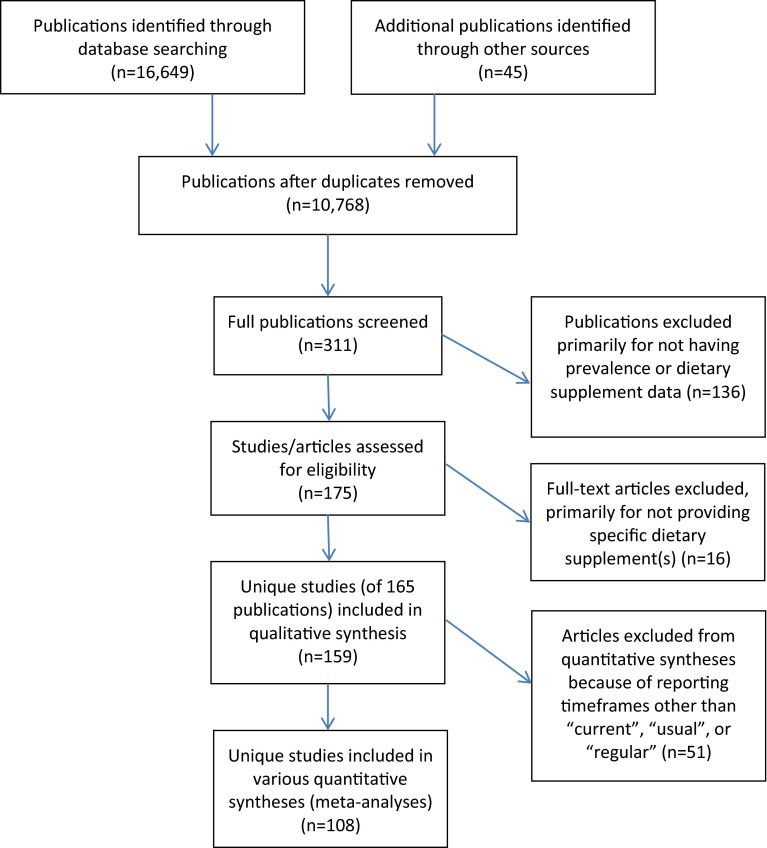
BACKGROUND: Dietary supplements (DSs) are commercially available products consumed as an addition to the usual diet and are frequently ingested by athletes. OBJECTIVE: Our objective was to examine the prevalence of DS use by athletes. DATA SOURCES: PubMed, Ovid MEDLINE, OVID Healthstar, and Cumulative Index to Nursing and Allied Health were searched for original research articles published up to August 2014. Search terms included specific sports, specific DSs, and other terms. STUDY SELECTION: Studies were selected if they were written in English, involved athletes, and provided a quantitative assessment of the proportion of athletes using specific DSs. Percent of athletes using specific DSs. SYNTHESIS OF DATA: Methodological quality of studies was assessed by three reviewers using an 8-point scale that included evaluations for sampling methods, sampling frame, sample size, measurement tools, bias, response rate, statistical presentation, and description of the participant sample. Where there were at least two investigations, meta-analysis was performed to obtain summary (pooled) prevalence estimates (SPEs) on (1) DS use prevalence by sport and sex, (2) DS use prevalence by elite versus non-elite athletic status, and (3) specific DS prevalence for all athletic groups combined. Meta-analyses included evaluations of homogeneity and publication bias. RESULTS: A total of 159 unique studies met the review criteria. Methodological quality was generally low with an average ± standard deviation of 43 ± 16% of available rating points. There was low homogeneity for SPEs when compiled by sport, athletic status, and/or specific DSs. Contributing to the lack of homogeneity were differences in studies' objectives and types of assessments used (e.g., dietary surveys, interviews, questionnaires). Despite these limitations, the data generally indicated that elite athletes used DSs much more than their non-elite counterparts. For most DSs, use prevalence was similar for men and women except that a larger proportion of women used iron while a larger proportion of men used vitamin E, protein, and creatine. No consistent change in use over time was observed because even the earliest investigations showed relatively high use prevalence. CONCLUSION: It was difficult to generalize regarding DS use by athletes because of the lack of homogeneity among studies. Nonetheless, the data suggested that elite athletes used dietary supplements far more than their non-elite counterparts; use was similar for men and women with a few exceptions; use appeared to change little over time; and a larger proportion of athletes used DSs compared with the general US population. Improvements in study methodology should be considered in future studies especially (1) defining DSs for participants; (2) querying for very specific DSs; (3) using a variety of reporting timeframes (e.g., daily, 2-6 times/week, 1 time/week and <1 time/week); (4) reporting the sampling frame, number of individuals solicited, and number responding; (5) reporting characteristics of volunteers (and non-volunteers, if available); and (6) using similar methods on several occasions to examine possible temporal trends among athletes.
Overview
The claims and statistics of this paper haven’t been checked yet.
Free: it reads the open-access text and checks the first 5 claims that cite a source we can check. Create a free account to check every claim.
Integrity signals
Registry
Cites
Statistics
Figures
Verification
Claims the paper makes
The claims and statistics of this paper haven’t been checked yet.
Free: it reads the open-access text and checks the first 5 claims that cite a source we can check. Create a free account to check every claim.
Claims other papers make about this one
Each is checked against this paper’s own text: does it say what the citing paper says it does?
The source backs part of the claim, not all of it — or backs it for a different population, condition or comparison.
In the citing paper
“recent studies show that ~50% of athletes consume some form of micronutrient supplement and between 5–27% are MTEs (Iron, Calcium, Zinc, Selenium or Chromium; [31,40]).”
From The Role of Mineral and Trace Element Supplementation in Exercise and Athletic Performance: A Systematic Review (2019) · cites this paper as [40]
Experimental — accuracy not yet measuredThe source backs part of the claim, not all of it — or backs it for a different population, condition or comparison.
In the citing paper
“the use of dietary supplements to enhance performance or health is not limited to adult populations and is an increasingly popular strategy among young, active individuals (80)”
From Safety of Creatine Supplementation in Active Adolescents and Youth: A Brief Review (2018) · cites this paper as [80]
Experimental — accuracy not yet measuredThe cited source says what the claim attributes to it.
In the citing paper
“A systematic review by Knapik et al. [7] in 2016 reported creatine use in 50 out of 159 (31%) unique studies examining the prevalence of dietary supplement use by athletes of all ages.”
From Creatine Supplementation in Children and Adolescents (2021) · cites this paper as [7]
The check wasn’t confident either way, so it gives no verdict — never disputed.
In the citing paper
“Creatine is not only one of the more popular dietary supplements from a performance perspective, but there is also strong evidence to support its use in clinical settings for a variety of patient populations [1,7].”
From Creatine Supplementation in Children and Adolescents (2021) · cites this paper as [7]
Experimental — accuracy not yet measuredIn the citing paper
“recent studies show that ~50% of athletes consume some form of micronutrient supplement and between 5–27% are MTEs (Iron, Calcium, Zinc, Selenium or Chromium; [31,40]).”
From The Role of Mineral and Trace Element Supplementation in Exercise and Athletic Performance: A Systematic Review (2019) · cites this paper as [40]
2 more claims about this paper
Create a free account to see every claim other papers make about this one.
Self-check
Percentages, sums and reported differences re-computed from the paper’s own numbers.
The self-check needs the paper’s full text.
Citations
Cites
Preferred Reporting Items for Systematic Reviews and Meta-Analyses: the PRISMA statement
Moher, D., Liberati, A., Tetzlaff, J., Altman, D. G., & for the PRISMA Group (2009) · BMJ · doi:10.1136/bmj.b2535 · Cited by 83,823
Preferred Reporting Items for Systematic Reviews and Meta-Analyses: The PRISMA Statement
Moher, D., Liberati, A., Tetzlaff, J., Altman, D. G., & The PRISMA Group (2009) · PLoS Medicine · doi:10.1371/journal.pmed.1000097 · Cited by 64,042 · cited 1×
“This investigation generally followed the Preferred Reporting Items for Systematic Reviews and Meta-Analyses (PRISMA) guidelines [27].”
MethodMeasuring inconsistency in meta-analyses
Higgins, J. P. T., Thompson, S. G., Deeks, J. J., & Altman, D. G. (2003) · BMJ · doi:10.1136/bmj.327.7414.557 · Cited by 63,139
Preferred reporting items for systematic reviews and meta-analyses: the PRISMA Statement.
(2009) · PubMed Central · Cited by 44,859
Wang, G., Ma, R., Qiao, G., Wada, K., Aizawa, Y., & Satoh, T. (2015) · Integrative Medicine International · doi:10.1159/000368408 · Cited by 18,657
Duval, S., & Tweedie, R. (2000) · Biometrics · doi:10.1111/j.0006-341x.2000.00455.x · Cited by 14,099 · cited 1×
“The trim and fill evaluation imputes the number of ‘missing’ studies in the funnel plot and re-computes an adjusted SPE and S95 % CI with the ‘missing’ studies included [31].”
MethodTrumbo (2001) · doi:10.1016/s0002-8223(01)00078-5 · Cited by 4,852
Assessing heterogeneity in meta-analysis: Q statistic or I² index?
Huedo-Medina, T. B., Sánchez-Meca, J., Marín-Martínez, F., & Botella, J. (2006) · Psychological Methods · doi:10.1037/1082-989x.11.2.193 · Cited by 4,256
Cermak, N. M., Res, P. T., de Groot, L. C., Saris, W. H., & van Loon, L. J. (2012) · The American Journal of Clinical Nutrition · doi:10.3945/ajcn.112.037556 · Cited by 827 · cited 2×
“Protein and creatine supplementation have both been demonstrated to increase strength and lean body mass [181, 182].”
BackgroundRadimer, K. (2004) · American Journal of Epidemiology · doi:10.1093/aje/kwh207 · Cited by 818
Research works printed but not linked: 8
- Nutrition Business Journal Global Supplement and Nutrition Industry Report 2014. Nutr Bus J. 2014. http://newhope360.com/site-files/newhope360.com/files/uploads/2014/Global_Report%20summary.pdf . Accessed 23 Aug 2014.
- Campbell ML, MacFadyen KL. Nutrition knowledge. Beliefs and dietary practices of competitive swimmers. Can Home Econ J. 1984;34(1):47–51.
- Bright-See E, Croy J, Brayshaw J, et al. Nutrition briefs and practices of ballet students. J Can Diet Assoc. 1978;39(4):324–31.
- Thibault G, Lambert J, Rivard M, et al. Utilization of ergogenic aids and the attitudes toward safety in marathon runners. In: Katch FI, editor. The 1984 Olympic Scientific Congress proceedings, volume 2 Sports, Health and Nutrition. Champaign: Human Kinetics Publishers Inc; 1986.
- Khoo CS, Rawson NE, Robinson ML, et al. Nutrient intake and eating habits of triathletes. Ann Sports Med. 1987;3:144–50.
- Slavin JL, McNamara EA, Lutter JM. Nutritional practices of women cyclists, including recreational riders and elite riders. In: Katch FI, editor. Sports, health and nutrition. The 1984 Olympic Scientific Congress proceedings, volume 2. Champaign: Human Kinetics Publishers, Inc; 1986. p. 107–11.
- Grandjean AC, editor. Profile on nutrition beliefs and practices of the elite athlete. Human Kinetics: Champaign; 1985.
- Jacobson BH, Sobonya C, Ransone J. Nutrition practices and knowledge of college varsity athletes. J Strength Cond Res. 2001;15(1):63–8.
Cited by
Items 301–400 of 574
Moreno, A. M. (2020) · UPM Digital Archive (Technical University of Madrid) · doi:10.20868/upm.thesis.65780 · Cited by 5
Cardiovascular toxicity associated with supplement use
Corcoran, J. N. (2025) · Clinical Toxicology · doi:10.1080/15563650.2025.2550983 · Cited by 5
From strength to cognition: The expanding role of creatine supplementation in health and disease
Tomczyk, A., Kożuchowska, K., Pilarz, D., Kwiatkowski, F., Olkowski, M. S., Jarosz, K., & Wydrych, A. (2025) · Polish Journal of Public Health · doi:10.12923/2083-4829/2025-0008 · Cited by 4
Drummond, M. D. M., da Silva, R. Â. D., Carvas, N., de Melo, M. S., & Ferreira, M. H. L. (2026) · Translational Sports Medicine · doi:10.1155/tsm2/5557511 · Cited by 4
Assessment Of Knowledge, Attitudes, And Practices on Healthy Dietary Practices Among Sports Students
Shakeel, H., Noreen, S., Rizwan, B., Basharat, S., Arif, U., Mahmood, I., Shahid, S., Khan, A. A., Shah, T., & Gillani, S. N. F. (2022) · Pakistan BioMedical Journal · doi:10.54393/pbmj.v5i8.707 · Cited by 4
del Arco, A., Aguirre-Betolaza, A. M., Malchrowicz-Mośko, E., Gogojewicz, A., & Castañeda-Babarro, A. (2023) · Nutrients · doi:10.3390/nu15224839 · Cited by 4
McClung, H. L., Lieberman, H. R., Thompson, L., Farina, E. K., & Beckner, M. E. (2025) · Journal of Applied Physiology · doi:10.1152/japplphysiol.00197.2025 · Cited by 4
Self-citationGreen Tea and Black Tea for Exercise Recovery: A Systematic Review
Zapata, M., & Hewlings, S. J. (2021) · Strength and conditioning journal · doi:10.1519/ssc.0000000000000650 · Cited by 4
Koohkan, M., Vahidian-Rezazadeh, M., & Delavar, R. (2023) · Asian Journal of Sports Medicine · doi:10.5812/asjsm-134047 · Cited by 4
Bødker, R. L., & Marcussen, M. (2023) · Frontiers in Neurology · doi:10.3389/fneur.2023.1209548 · Cited by 4
Corbett, L. J., Bunch, M. R., Smith, M. B., & Bunch, T. J. (2024) · Current Cardiovascular Risk Reports · doi:10.1007/s12170-024-00735-8 · Cited by 4
Snack and Nutrient Intake Status of Top-Level Female University Athletes: A Cross-Sectional Study
Inaba, H., Hoshino, F., Edama, M., & Omori, G. (2024) · Healthcare · doi:10.3390/healthcare12040468 · Cited by 4
Baharirad, N., Komasi, S., Khatooni, A., Moradi, F., & Soroush, A. (2018) · Current Nutrition & Food Science · doi:10.2174/1573401315666181218150450 · Cited by 4
The Popular Ergogenic Substances in Sport and Physical Activity
Świtała, K. (2023) · Central European Journal of Sport Sciences and Medicine · doi:10.18276/cej.2023.1-07 · Cited by 4
Elias, S. S. M., Zakaria, N. S., Mohamad, M. I., & Nasution, M. N. M. H. (2022) · ACPES Journal of Physical Education Sport and Health (AJPESH) · doi:10.15294/ajpesh.v2i2.61814 · Cited by 4
Nakajima, R., Komoriya, M., & Watanabe, F. (2024) · BMC Public Health · doi:10.1186/s12889-024-17746-0 · Cited by 5
Suplementos deportivos: ¿Cómo definimos a estos productos?
Muñoz-Maldonado, G. E., Ahmed, F. A. O., Díaz-Ochoa, A., Ramírez-Orozco, R. E., & Renaud, V. M. G. (2021) · Lux Médica · doi:10.33064/48lm20213235 · Cited by 4
Kiss, A., Kasza, G., Töreki, K., & Lakner, Z. (2017) · Acta Alimentaria · doi:10.1556/066.2017.46.2.11 · Cited by 4
McDonough, D. J. (2017) · ScholarWorks (Boise State University) · doi:10.18122/b2kx4q · Cited by 4
Tiemtad, P., Ingkaninan, K., Temkitthawon, P., Thimkorn, P., Rattanachaisit, N., Teaktong, T., & Dhippayom, T. (2026) · Phytomedicine · doi:10.1016/j.phymed.2026.157915 · Cited by 3
Type of Diet and Sports Supplements in Padel Players According to Level of Competition and Sex
Toro-Román, V., Muñoz, A., Zoido, A., Sánchez-Alcaraz, B. J., Grijota, F., & Muñoz, D. (2023) · Nutrients · doi:10.3390/nu15163633 · Cited by 3
Sa’dabadi, Z., Daraei, B., Kobarfard, F., Amirahmadi, M., & Kheirollahi, K. (2022) · Iranian journal of pharmaceutical research · doi:10.5812/ijpr-127444 · Cited by 3
Rocha‐Rodrigues, S., Leão, C., Marinho, M., & Afonso, J. R. (2024) · The Journal of Sports Medicine and Physical Fitness · doi:10.23736/s0022-4707.24.16222-6 · Cited by 3
Harrington, R. N. (2025) · Journal of Exercise and Nutrition · doi:10.53520/jen2025.103197 · Cited by 3
Caught in Contamination: Revisiting the Burden of Proof in Doping Sanctions for Supplement Use
Ogama, D. W. (2025) · Beijing Law Review · doi:10.4236/blr.2025.163077 · Cited by 3
Pastina, J. T., & Stewart, L. K. (2025) · Journal of Dietary Supplements · doi:10.1080/19390211.2025.2589784 · Cited by 3
Qudah, T., Iqbal, S., Absi, H. A., Sanal, S., Elkoumi, A., Fino, L., & AbuMweis, S. S. (2025) · Journal of Nutrition and Metabolism · doi:10.1155/jnme/5582105 · Cited by 3
Knowledge Gaps, Sleep Disturbances, and Energy Imbalance Among Female Field Hockey Players
Puchalt-Urbano, X., García, A. C., Huertas, J. R., Sánchez-Oliver, A. J., Torre, C. L.-D. L., Aguilar-Aguilar, E., López‐Soto, P. J., Luque, R. M., & Ordóñez, F. M. (2025) · Nutrients · doi:10.3390/nu17243934 · Cited by 3
Song, W., Ren, C., Dong, Y. N., Tian, F. N., Wang, Y. N., Yan, J. N., Zhang, Y. N., Tang, H. N., & Cui, Z. N. (2025) · International Journal for Vitamin and Nutrition Research · doi:10.31083/ijvnr39821 · Cited by 3
Ma, M., Yan, G., & Huang, G. (2026) · Frontiers in Nutrition · doi:10.3389/fnut.2026.1784740 · Cited by 3
Bürkle, F., Doll, J., Neide, A., Gantz, S., Tsitlakidis, S., & Fischer, C. A. (2022) · Journal of the International Society of Sports Nutrition · doi:10.1080/15502783.2022.2097018 · Cited by 3
Miroshnikov, A. B., Rybakova, P. D., & Meshtel, A. V. (2023) · Medical alphabet · doi:10.33667/2078-5631-2023-29-41-47 · Cited by 4
Azca, R. M., Hıdayatı, N., & Zahra, N. (2025) · DIALEKTIKA Jurnal Ekonomi dan Ilmu Sosial · doi:10.36636/dialektika.v10i1.5619 · Cited by 3
Bezak, S., Baždarić, K., Horvat, L. H., Lončarić, D., Mičetić, V. B., Fijan, S., Pogačar, M. Š., & Pavelić, S. K. (2025) · Foods · doi:10.3390/foods15010061 · Cited by 3
Nyawose, S., Naidoo, R., Naumovski, N., & McKune, A. J. (2022) · South African Journal of Sports Medicine · doi:10.17159/2078-516x/2022/v34i1a14018 · Cited by 3
Cherian, K. S., Gavaravarapu, S. M., Ramesh, B. S., & Yagnambhatt, V. R. (2024) · Sport Sciences for Health · doi:10.1007/s11332-024-01180-1 · Cited by 3
Trends in Protein Supplement Use Among Non-Professional Athletes: Insights from a Survey in Greece
Athanasopoulou, P., Deligiannidou, G.-E., Basdeki, P., Deligianni, E., Kryona, P., Kaltsos, G., Lazari, D. M., Papadopoulos, A. N., Papadimitriou, K., & Kontogiorgis, C. A. (2025) · Physiologia · doi:10.3390/physiologia5020018 · Cited by 3
Dietary Supplements and College Students: Use, Knowledge, and Perception
Homan, E. M. (2018) · OhioLink ETD Center (Ohio Library and Information Network) · Cited by 3
Examining the Therapeutic Potential of Kratom Within the American Drug Regulatory System
Griffin, O. H. (2018) · Springer eBooks · doi:10.1007/978-3-319-76720-8_5 · Cited by 3
Uso do suplemento de creatina em praticantes de atividades físicas: uma revisão integrativa
Florentin, Á. N., de Souza, I. F., Ordoñez, A. M., & Nascimento, C. R. B. (2021) · Revista Eletrônica Acervo Saúde · doi:10.25248/reas.e5890.2021 · Cited by 3
Protein supplement use and prevalence of microalbuminuria in gym members
Parra-Lomelí, H., Trujillo-Hernández, B., Espinoza‐Gómez, F., Vargas-Aguirre, P., Orozco-Martinez, A., Negrete-Cruz, A. M., Guzmán-Esquivel, J., & Delgado‐Enciso, I. (2020) · The Journal of Sports Medicine and Physical Fitness · doi:10.23736/s0022-4707.19.09794-9 · Cited by 3
Rondanelli, M., Perna, S., Peroni, G., Endocrinology and Nutrition Unit, A. D. S. A. P. “. S. M., Faliva, M. A., Endocrinology and Nutrition Unit, A. D. S. A. P. “. S. M., Nichetti, M., Endocrinology and Nutrition Unit, A. D. S. A. P. “. S. M., Iannello, G., General Management, A. D. S. A. P. ‘. S. M., et al. (2020) · Malaysian Journal of Nutrition · doi:10.31246/mjn-2019-0071 · Cited by 3
Acne in patients actively involved in sports: features of medical care
Руслановна, С. Л., Львович, П. А., & Korsunskaya, I. M. (2021) · Russian Journal of Clinical Dermatology and Venereology · doi:10.17116/klinderma20212002182 · Cited by 3
Romanowicz, G. E., Popp, K. L., Dinh, E., Harker, I. R., Leguineche, K., Hughes, J. M., Ackerman, K. E., Bouxsein, M., & Guldberg, R. E. (2024) · medRxiv · doi:10.1101/2024.12.03.24318372 · Cited by 3
Consumo de Suplementos Alimentares e Esteroides Anabolizantes por praticantes de musculação
Guimarães, P. M. C.-R. D. E. (2019) · Portuguese National Funding Agency for Science, Research and Technology (RCAAP Project by FCT) · doi:10.34626/5f3z-6w61 · Cited by 3
Dissemond, J., Havers, T., Held, S., Geisler, S., Kostov, T., Diel, P., Türschmann, S., Parr, M. K., & Isenmann, E. (2025) · Journal of the International Society of Sports Nutrition · doi:10.1080/15502783.2025.2540408 · Cited by 2
Protein intake in adolescent athletes: Nutritional requirements and performance implications
Colecchia, F. P., Padova, M. D., Mancini, S., Polito, R., Basta, A., Grosu, V. T., Limone, P., Messina, G., Monda, M., Monda, A., et al. (2025) · Journal of Physical Education and Sport · doi:10.7752/jpes.2025.04083 · Cited by 2
Preferences in the use of ergogenic AIDS in regular strength trainees
Merchelski, M., Kruszewski, M., Kruszewski, A., Tabęcki, R., Danielik, T., Kuźmicki, S., & Stec, K. (2024) · Journal of Kinesiology and Exercise Sciences · doi:10.5604/01.3001.0054.6639 · Cited by 2
Research on Injury Risk of Elite Male Athletes in Racing Ice Sports based on Blood Indexes
Wang, F., Cui, J., Wu, Y., Chen, H., Hong, P., & Li, X. (2024) · International Journal of Sports Medicine · doi:10.1055/a-2403-9752 · Cited by 2
Choe, J.-P., Kang, M., & Chang, Y. (2025) · Journal of Physical Activity and Health · doi:10.1123/jpah.2025-0364 · Cited by 2
Shahrajabian, M. H., & Sun, W. (2025) · Clinical Phytoscience · doi:10.1186/s40816-025-00409-x · Cited by 2
Nutritional Supplements & Athletes- An Analysis of Potential Side Effects
Gillani, S. M. B., Ahmed, S. I., & Ali, B. (2020) · THE SKY-International Journal of Physical Education and Sports Sciences (IJPESS) · doi:10.51846/the-sky.v4i1.818 · Cited by 2
Oliver, T. E., Kusumpa, S., Lutz, L. J., McClung, J. P., & McClung, H. L. (2024) · Current Developments in Nutrition · doi:10.1016/j.cdnut.2024.104517 · Cited by 2
Elite adolescent male soccer players require further education to improve sports nutrition knowledge
Hart, J., Smith, K., & Jackson, K. (2025) · Academia Nutrition and Dietetics · doi:10.20935/acadnutr7656 · Cited by 2
Nutritive value of chosen special purpose dietary products
Kowalczuk-Vasilev, E., Klebaniuk, R., Samolińska, W., Kiczorowska, B., & Bielak, F. (2018) · Polish Journal of Public Health · doi:10.2478/pjph-2018-0003 · Cited by 2
An Innovative Dietary Supplement Scorecard for Assessing Risk
Rittenhouse, M. A., Kegel, J. L., Attipoe, S., & Deuster, P. A. (2019) · Nutrition Today · doi:10.1097/nt.0000000000000380 · Cited by 2
Prevalence and Attitudes Towards Using Protein Supplements Among Female Gym Users: An Online Survey
Alhussain, M. H., Abdulhalim, W. S., Al‐Harbi, L. N., & Binobead, M. A. (2021) · Current Nutrition & Food Science · doi:10.2174/1573401317666211007125615 · Cited by 2
Daukšienė, J., Burdulienė, K., Daukšys, G., Paulauskaitė, L., & Burdulis, D. (2024) · Chemija · doi:10.6001/chemija.2024.35.1.1 · Cited by 2
Przygodzka, S., Rutkiewicz, M., Gadżała, K., Garbino, K., Brudniak, K., Szuścik, A., & Czyczerska, M. (2025) · Quality in Sport · doi:10.12775/qs.2025.38.57810 · Cited by 2
Havermans, R. C., le Noble, J. L. M. L., & van Lier, I. (2025) · Performance Enhancement & Health · doi:10.1016/j.peh.2025.100332 · Cited by 2
Tarmast, D., Ghosh, A. K., & Chen, C. K. (2017) · International Journal of Applied Exercise Physiology · doi:10.22631/ijaep.v6i3.176 · Cited by 2
Effect of CoQ10 on Anaerobic Performance in Elite Wrestlers
Ebrahimi, M., & Ladary, M. R. (2016) · International Journal of Wrestling Science · doi:10.1080/21615667.2016.1278489 · Cited by 2
Efectos de la suplementación con cafeína sobre la producción de fuerza muscular
Montero, J. I. Á., Ordóñez, F. M., & Herrera, R. D. (2018) · Revista Andaluza de Medicina del Deporte · doi:10.33155/j.ramd.2017.02.001 · Cited by 2
ANÁLISIS DE LA COMPOSICIÓN CORPORAL Y PATRONES DIETÉTICOS EN JUGADORES DE HOCKEY
Vicente-Salar, N., Roche, E., Leyva-Vela, B., & Martínez‐Rodríguez, A. (2021) · Revista Internacional de Medicina y Ciencias de la Actividad Física y del Deporte · doi:10.15366/rimcafd2021.82.006 · Cited by 2
Consumo de suplementos deportivos en remeros universitarios
Monzón, R. P., Jiménez-Alfageme, R., Sospedra, I., Sánchez-Oliver, A. J., Domínguez, R., & Sanz, J. M. M. (2021) · Revista Andaluza de Medicina del Deporte · doi:10.33155/j.ramd.2021.08.002 · Cited by 2
Dietary supplements in sport – side effects
Brożyna-Tkaczyk, K., Tkaczyk, J., & Rutkowska, A. Z. (2019) · DOAJ (DOAJ: Directory of Open Access Journals) · doi:10.5281/zenodo.3407952 · Cited by 2
Dietary supplementation for traumatic brain injury
MohanMarugaRaja, M. K., Devarajan, A., & Dhote, V. V. (2022) · Elsevier eBooks · doi:10.1016/b978-0-12-823347-4.00038-5 · Cited by 2
Knapik, J. J., Trone, D. W., Steelman, R. A., Farina, E. K., & Lieberman, H. R. (2023) · Journal of the International Society of Sports Nutrition · doi:10.1080/15502783.2023.2277246 · Cited by 2
Self-citationBautista, M. A. V., Jacobo, A. B., Ruíz, G. H., Hoyos, A. E. S., & Valenzuela, M. E. C. (2024) · Nutrición clínica y dietética hospitalaria/Nutrición clínica, dietética hospitalaria · doi:10.12873/441vazquez · Cited by 2
Metabolism of exogenous ketones
Stubbs, B. J. (2016) · Oxford University Research Archive (ORA) (University of Oxford) · doi:10.5287/ora-xo2jo7jax · Cited by 2
The Application of Trimetazidine in Healthy Individuals: A Systematic ReviewPreprint
Bezuglov, E., Shoshorina, M., Zholinsky, A., Waśkiewicz, Z., Emanov, A., Morgans, R., Bertholz, V., Zelenskaya, V. V., Lazarev, A., Sokolskaya, M. A., et al. (2022) · medRxiv · doi:10.1101/2022.05.09.22274810 · Cited by 2
Study of the consumption of nutritional supplements in gcafd – University of Seville
Medina, C. J. G. (2018) · Deposito de Investigacion Universidad de Sevilla (University of Seville) · Cited by 2
Gendered Marketing of Food Supplements in Lifestyle Magazines in Greece
Kotsaga, E. (2019) · Current Nutraceuticals · doi:10.2174/2665978601666191204164206 · Cited by 1
Ulery, J. A., Melton, B. F., Bland, H. W., & Riggs, A. J. (2021) · Strength and conditioning journal · doi:10.1519/ssc.0000000000000633 · Cited by 1
Prevalence and Pattern of Dietary Supplement Use in Bodybuilding Athletes
Baharirad, N., Naghipour, A., Soroush, A., Naghibifar, Z., Abdollahzad, H., Kordloo, Y., Nouri, R., & Daryoushi, H. (2024) · Current Nutrition & Food Science · doi:10.2174/0115734013282951240226061941 · Cited by 1
Exploratory Data Analyses Indicate Overuse of Dietary Supplements among Male Gym Users in Germany
Isenmann, E., von Andrian-Werburg, J., Eulgem, F., Geisler, S., Diel, P. R., & Flenker, U. (2024) · German Journal of Sports Medicine · doi:10.5960/dzsm.2024.612 · Cited by 1
Mijalković, S., Živković, D., Raković, A., & Bjelaković, L. (2024) · Facta Universitatis Series Teaching Learning and Teacher Education · doi:10.22190/futlte240124002m · Cited by 1
Molani‐Gol, R., Rafraf, M., & Alipour, B. (2025) · Central European Journal of Public Health · doi:10.21101/cejph.a8321 · Cited by 1
Dinç, N. (2025) · Ulusal Spor Bilimleri Dergisi · doi:10.30769/usbd.1683599 · Cited by 1
Chandler, M., Kavussanu, M., Zhang, S., & Hurst, P. (2025) · Performance Enhancement & Health · doi:10.1016/j.peh.2025.100387 · Cited by 1
Wang, Y., Yao, W., Zhang, Y., & Zhang, G. (2025) · TrAC Trends in Analytical Chemistry · doi:10.1016/j.trac.2025.118544 · Cited by 1
State of the Art and Development Trends in Obtaining Fast-Dissolving Forms of Creatine Monohydrate
Albagachiev, S. A., Pinegina, E. D., Sadkovskii, I. A., Krasnyuk, I. I., & Александрович, М. М. (2026) · Pharmaceuticals · doi:10.3390/ph19010128 · Cited by 1
Güngör, K. N. G., Uslu, B., & Alphan, M. E. (2026) · Acibadem Universitesi Saglik Bilimleri Dergisi · doi:10.31067/acusaglik.1915205 · Cited by 1
Pavis, G. F., Kingma, R., Nemzer, B. V., Abshiru, N. A., Wall, B. T., & Stephens, F. B. (2026) · Journal of the International Society of Sports Nutrition · doi:10.1080/15502783.2026.2682323 · Cited by 1
Dietary supplement consumption among active individuals in Saudi Arabia
Alsayegh, A. A., Alzaben, A. S., Haddash, Y. M. A., Busayli, A. M., Chandika, R. M., Alsuhaibani, M. N., Albishi, S. A., Hanbazaza, M. A., Abuzaid, O. I., & Alkhalaf, M. M. (2026) · PLoS ONE · doi:10.1371/journal.pone.0351208 · Cited by 1
Xu, Z., Sun, J., Xu, S., Gu, J., Jiang, S., Guo, J., Lin, J., & Yu, L. (2026) · Frontiers in Nutrition · doi:10.3389/fnut.2026.1823053 · Cited by 1
Günalan, E., Bakdım, K., Yılmaz, Ş., Kement, S., Küçük, F. B., Sücüllülü, B. N., Yalvaç, S., Vural, Y., Saygılı, S., Özüpek, G., et al. (2026) · BMC Oral Health · doi:10.1186/s12903-026-09185-7 · Cited by 1
Hwang, J., Seo, Y., Lee, H.-J., Lee, M., Cho, J., Lee, H. J., Lee, H., & Min, H. (2026) · Environment International · doi:10.1016/j.envint.2026.110440 · Cited by 1
Mancin, L., Close, G. L., Jeukendrup, A. E., Freschi, M., Pugh, J. N., Sala, M., Baioccato, V., Vecchiato, M., D’Antona, G., & Palermi, S. (2026) · Translational Sports Medicine · doi:10.1155/tsm2/5919439 · Cited by 2
Alruwaili, N. W., Alsenaidy, A., Suhluli, M., Alahmari, H., Alafif, N. O., Zarah, A. B., & AlShahwan, M. A. (2026) · Frontiers in Public Health · doi:10.3389/fpubh.2026.1929339 · Cited by 1
Huber, A. C. D. S. M., Schuelter‐Trevisol, F., Huber, M. P., de Souza, F., & Trevisol, D. J. (2018) · Asian Journal of Sports Medicine · doi:10.5812/asjsm.14325 · Cited by 1
Applications in nutrition: sport nutrition
Kohl, J., Jerger, S., König, D., & Centner, C. (2021) · Elsevier eBooks · doi:10.1016/b978-0-12-821389-6.00024-8 · Cited by 1
Ayudas ergogénicas en jugadores de fútbol profesional: Revisión Sistemática
Almendáriz-Villarán, A., & Sánchez-Oliver, A. J. (2018) · e-Motion Revista de Educación Motricidad e Investigación · doi:10.33776/remo.v0i11.3472 · Cited by 1
Cárdenas, L. H. (2019) · Cited by 1
The Ancient Wisdom and Resurgence for Yoga: A Sociological Perspective
Radebe, J.-X. (2020) · Advances in educational technologies and instructional design book series · doi:10.4018/978-1-7998-1249-4.ch009 · Cited by 1
Untested Supplement Use Among Athletes: An Overlooked Phenomenon?
Negri, A., Townshend, H. D., & Corazza, O. (2021) · Springer eBooks · doi:10.1007/978-3-030-79293-0_3 · Cited by 1
Are Dietary Supplements, Harmful or Good for Athletes?
Miller, F. G., McGrowder, D. A., Vaz, K., & McLean-Miller, K. (2022) · Journal of Sports and Physical Education Studies · doi:10.32996/jspes.2022.2.1.2 · Cited by 1
Morawska-Tota, M., Tota, Ł. M., & Tkaczewska, J. (2022) · Antioxidants · doi:10.3390/antiox11071314 · Cited by 1
Jeannou, B., Feuvrier, F., Peyre-Costa, D., & Griffiths, K. (2022) · Science & Sports · doi:10.1016/j.scispo.2021.05.011 · Cited by 1
Metadata
- Authors
- Knapik, J. J., Steelman, R. A., Hoedebecke, S. S., Austin, K. G., Farina, E. K., & Lieberman, H. R.
- Affiliations
- U.S. Army Research Institute of Environmental Medicine (US)
- Defense Center for Public Health - Aberdeen (US)
- Corresponding author
- Knapik, Joseph J.
- Venue
- Sports Medicine
- Published
- 2015-10-06
- Volume
- 46
- Issue
- 1
- Pages
- 103-123
- ISSN
- 0112-1642 (ISSN-L)
- 1179-2035
- PMC
- PMC4697915
- OpenAlex
- W1954905436
- Cited by
- 452
- References
- 198
- Citations by year
- 2026: 40 · 2025: 42 · 2024: 52 · 2023: 56 · 2022: 51 · 2021: 56 · 2020: 52 · 2019: 33 · 2018: 39 · 2017: 24 · 2016: 7
- FWCI
- 9.40
- Type
- journal article
- Language
- en
- Open access
- hybrid
- doi.org
- Locations
- Sports Medicine (publishedVersion, cc-by)
- Europe PMC (PubMed Central) (publishedVersion, cc-by)
- PubMed Central (publishedVersion, cc-by)
- PubMed (publishedVersion)
- Funders
- Center Alliance for Nutrition and Dietary Supplement Research
- Topics
- Social Sciences › Sociology and Political Science › Doping in Sports
- Health Sciences › Medicine › Public Health, Environmental and Occupational Health › Nutrition and Health Studies
- Health Sciences › Medicine › Complementary and alternative medicine › Complementary and Alternative Medicine Studies
- Keywords
- dietary supplements, athletes, supplement use prevalence, elite athletes, sex differences, iron supplementation, vitamin E, protein supplementation, creatine supplementation, sports nutrition, methodological quality
- MeSH terms
- Creatine, Dietary Proteins, Humans, Sex Factors, Vitamin E, Iron, Dietary, Dietary Supplements, Athletes
About these checks
Registry, retraction, Cites and statistics results are computed, not judged, with one exception: a printed reference that no index lists is read once by a model before it counts as a citation error. Claims are extracted by a model and kept only when their quote appears verbatim in the text; each cited source is then checked, with a model’s help, for whether it says what the claim relies on. Those verdicts can be wrong — read the claim’s quote and the cited source before relying on one.
Statistics and arithmetic are recomputed, not judged.
Confidence bands are shown only for fields calibrated on our annotated test set. None is calibrated yet, so no band is shown.
What counts as a claim ›How we measure confidence ›How we check this ›
Are you an author, or do you see a problem with this page? Request a review
Data sources
Bibliographic data: Semantic Scholar, OpenAlex, Crossref.
Contains information from the Semantic Scholar Academic Graph Datasets, made available under the ODC Attribution License (ODC-BY 1.0).
Semantic Scholar’s data is described in: Kinney, R., et al. (2023). The Semantic Scholar Open Data Platform. arXiv:2301.10140.
