

Prevalence of Dietary Supplement Use by Athletes: Systematic Review and Meta-Analysis
Open accessThe DOI matches its Crossref record; 199 of the 199 references it cites were found in a registry or an index.
Abstract
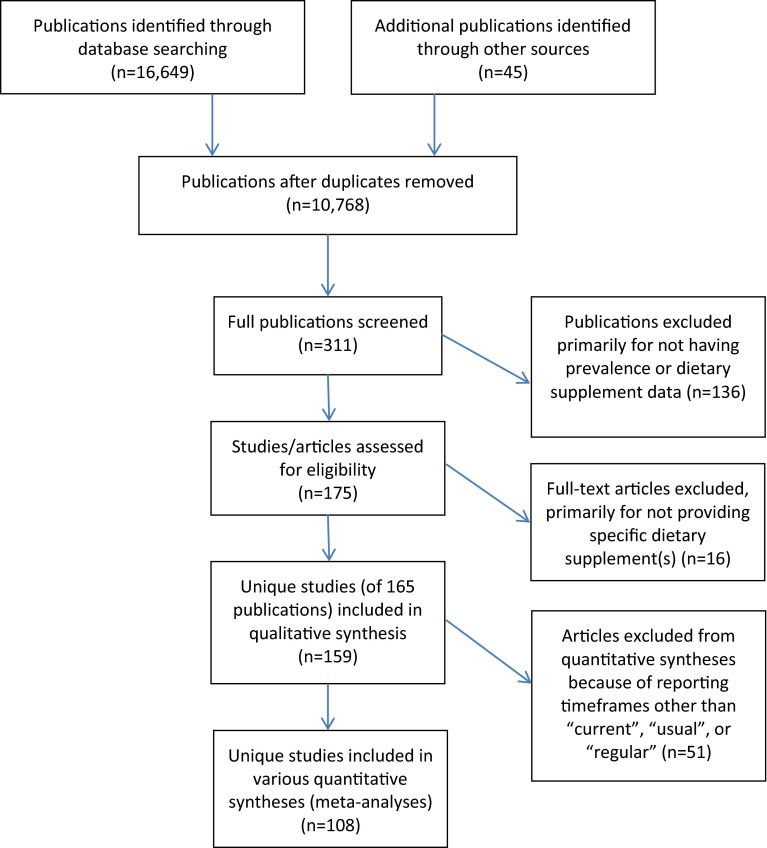
BACKGROUND: Dietary supplements (DSs) are commercially available products consumed as an addition to the usual diet and are frequently ingested by athletes. OBJECTIVE: Our objective was to examine the prevalence of DS use by athletes. DATA SOURCES: PubMed, Ovid MEDLINE, OVID Healthstar, and Cumulative Index to Nursing and Allied Health were searched for original research articles published up to August 2014. Search terms included specific sports, specific DSs, and other terms. STUDY SELECTION: Studies were selected if they were written in English, involved athletes, and provided a quantitative assessment of the proportion of athletes using specific DSs. Percent of athletes using specific DSs. SYNTHESIS OF DATA: Methodological quality of studies was assessed by three reviewers using an 8-point scale that included evaluations for sampling methods, sampling frame, sample size, measurement tools, bias, response rate, statistical presentation, and description of the participant sample. Where there were at least two investigations, meta-analysis was performed to obtain summary (pooled) prevalence estimates (SPEs) on (1) DS use prevalence by sport and sex, (2) DS use prevalence by elite versus non-elite athletic status, and (3) specific DS prevalence for all athletic groups combined. Meta-analyses included evaluations of homogeneity and publication bias. RESULTS: A total of 159 unique studies met the review criteria. Methodological quality was generally low with an average ± standard deviation of 43 ± 16% of available rating points. There was low homogeneity for SPEs when compiled by sport, athletic status, and/or specific DSs. Contributing to the lack of homogeneity were differences in studies' objectives and types of assessments used (e.g., dietary surveys, interviews, questionnaires). Despite these limitations, the data generally indicated that elite athletes used DSs much more than their non-elite counterparts. For most DSs, use prevalence was similar for men and women except that a larger proportion of women used iron while a larger proportion of men used vitamin E, protein, and creatine. No consistent change in use over time was observed because even the earliest investigations showed relatively high use prevalence. CONCLUSION: It was difficult to generalize regarding DS use by athletes because of the lack of homogeneity among studies. Nonetheless, the data suggested that elite athletes used dietary supplements far more than their non-elite counterparts; use was similar for men and women with a few exceptions; use appeared to change little over time; and a larger proportion of athletes used DSs compared with the general US population. Improvements in study methodology should be considered in future studies especially (1) defining DSs for participants; (2) querying for very specific DSs; (3) using a variety of reporting timeframes (e.g., daily, 2-6 times/week, 1 time/week and <1 time/week); (4) reporting the sampling frame, number of individuals solicited, and number responding; (5) reporting characteristics of volunteers (and non-volunteers, if available); and (6) using similar methods on several occasions to examine possible temporal trends among athletes.
Overview
The claims and statistics of this paper haven’t been checked yet.
Free: it reads the open-access text and checks the first 5 claims that cite a source we can check. Create a free account to check every claim.
Integrity signals
Registry
Cites
Statistics
Figures
Verification
Claims the paper makes
The claims and statistics of this paper haven’t been checked yet.
Free: it reads the open-access text and checks the first 5 claims that cite a source we can check. Create a free account to check every claim.
Claims other papers make about this one
Each is checked against this paper’s own text: does it say what the citing paper says it does?
The source backs part of the claim, not all of it — or backs it for a different population, condition or comparison.
In the citing paper
“recent studies show that ~50% of athletes consume some form of micronutrient supplement and between 5–27% are MTEs (Iron, Calcium, Zinc, Selenium or Chromium; [31,40]).”
From The Role of Mineral and Trace Element Supplementation in Exercise and Athletic Performance: A Systematic Review (2019) · cites this paper as [40]
Experimental — accuracy not yet measuredThe source backs part of the claim, not all of it — or backs it for a different population, condition or comparison.
In the citing paper
“the use of dietary supplements to enhance performance or health is not limited to adult populations and is an increasingly popular strategy among young, active individuals (80)”
From Safety of Creatine Supplementation in Active Adolescents and Youth: A Brief Review (2018) · cites this paper as [80]
Experimental — accuracy not yet measuredThe cited source says what the claim attributes to it.
In the citing paper
“A systematic review by Knapik et al. [7] in 2016 reported creatine use in 50 out of 159 (31%) unique studies examining the prevalence of dietary supplement use by athletes of all ages.”
From Creatine Supplementation in Children and Adolescents (2021) · cites this paper as [7]
The check wasn’t confident either way, so it gives no verdict — never disputed.
In the citing paper
“Creatine is not only one of the more popular dietary supplements from a performance perspective, but there is also strong evidence to support its use in clinical settings for a variety of patient populations [1,7].”
From Creatine Supplementation in Children and Adolescents (2021) · cites this paper as [7]
Experimental — accuracy not yet measuredIn the citing paper
“recent studies show that ~50% of athletes consume some form of micronutrient supplement and between 5–27% are MTEs (Iron, Calcium, Zinc, Selenium or Chromium; [31,40]).”
From The Role of Mineral and Trace Element Supplementation in Exercise and Athletic Performance: A Systematic Review (2019) · cites this paper as [40]
2 more claims about this paper
Create a free account to see every claim other papers make about this one.
Self-check
Percentages, sums and reported differences re-computed from the paper’s own numbers.
The self-check needs the paper’s full text.
Citations
Cites
Preferred Reporting Items for Systematic Reviews and Meta-Analyses: the PRISMA statement
Moher, D., Liberati, A., Tetzlaff, J., Altman, D. G., & for the PRISMA Group (2009) · BMJ · doi:10.1136/bmj.b2535 · Cited by 83,823
Preferred Reporting Items for Systematic Reviews and Meta-Analyses: The PRISMA Statement
Moher, D., Liberati, A., Tetzlaff, J., Altman, D. G., & The PRISMA Group (2009) · PLoS Medicine · doi:10.1371/journal.pmed.1000097 · Cited by 64,042 · cited 1×
“This investigation generally followed the Preferred Reporting Items for Systematic Reviews and Meta-Analyses (PRISMA) guidelines [27].”
MethodMeasuring inconsistency in meta-analyses
Higgins, J. P. T., Thompson, S. G., Deeks, J. J., & Altman, D. G. (2003) · BMJ · doi:10.1136/bmj.327.7414.557 · Cited by 63,139
Preferred reporting items for systematic reviews and meta-analyses: the PRISMA Statement.
(2009) · PubMed Central · Cited by 44,859
Wang, G., Ma, R., Qiao, G., Wada, K., Aizawa, Y., & Satoh, T. (2015) · Integrative Medicine International · doi:10.1159/000368408 · Cited by 18,657
Duval, S., & Tweedie, R. (2000) · Biometrics · doi:10.1111/j.0006-341x.2000.00455.x · Cited by 14,099 · cited 1×
“The trim and fill evaluation imputes the number of ‘missing’ studies in the funnel plot and re-computes an adjusted SPE and S95 % CI with the ‘missing’ studies included [31].”
MethodTrumbo (2001) · doi:10.1016/s0002-8223(01)00078-5 · Cited by 4,852
Assessing heterogeneity in meta-analysis: Q statistic or I² index?
Huedo-Medina, T. B., Sánchez-Meca, J., Marín-Martínez, F., & Botella, J. (2006) · Psychological Methods · doi:10.1037/1082-989x.11.2.193 · Cited by 4,256
Cermak, N. M., Res, P. T., de Groot, L. C., Saris, W. H., & van Loon, L. J. (2012) · The American Journal of Clinical Nutrition · doi:10.3945/ajcn.112.037556 · Cited by 827 · cited 2×
“Protein and creatine supplementation have both been demonstrated to increase strength and lean body mass [181, 182].”
BackgroundRadimer, K. (2004) · American Journal of Epidemiology · doi:10.1093/aje/kwh207 · Cited by 818
Research works printed but not linked: 8
- Nutrition Business Journal Global Supplement and Nutrition Industry Report 2014. Nutr Bus J. 2014. http://newhope360.com/site-files/newhope360.com/files/uploads/2014/Global_Report%20summary.pdf . Accessed 23 Aug 2014.
- Campbell ML, MacFadyen KL. Nutrition knowledge. Beliefs and dietary practices of competitive swimmers. Can Home Econ J. 1984;34(1):47–51.
- Bright-See E, Croy J, Brayshaw J, et al. Nutrition briefs and practices of ballet students. J Can Diet Assoc. 1978;39(4):324–31.
- Thibault G, Lambert J, Rivard M, et al. Utilization of ergogenic aids and the attitudes toward safety in marathon runners. In: Katch FI, editor. The 1984 Olympic Scientific Congress proceedings, volume 2 Sports, Health and Nutrition. Champaign: Human Kinetics Publishers Inc; 1986.
- Khoo CS, Rawson NE, Robinson ML, et al. Nutrient intake and eating habits of triathletes. Ann Sports Med. 1987;3:144–50.
- Slavin JL, McNamara EA, Lutter JM. Nutritional practices of women cyclists, including recreational riders and elite riders. In: Katch FI, editor. Sports, health and nutrition. The 1984 Olympic Scientific Congress proceedings, volume 2. Champaign: Human Kinetics Publishers, Inc; 1986. p. 107–11.
- Grandjean AC, editor. Profile on nutrition beliefs and practices of the elite athlete. Human Kinetics: Champaign; 1985.
- Jacobson BH, Sobonya C, Ransone J. Nutrition practices and knowledge of college varsity athletes. J Strength Cond Res. 2001;15(1):63–8.
Cited by
Items 401–500 of 574
Dietary nitrate and sports performance
Jonvik (2018) · Research Publications (Maastricht University) · doi:10.26481/dis.20180913kj · Cited by 1
Hurst, P. (2018) · Create (Canterbury Christ Church University) · Cited by 1
Castro, Z., & Meroño, A. A. (2018) · El Repositorio Academico Digital de la UANL (Universidad Autónoma de Nuevo León) · Cited by 1
Santamaría, L. C. (2021) · LA Referencia (Red Federada de Repositorios Institucionales de Publicaciones Científicas) · Cited by 1
Factors influencing dietary supplements use help identifying athletes with risky behaviors
Marion, S. (2020) · doi:10.71781/29566 · Cited by 1
Ondarra Diarte, R., & Vicente‐Rodríguez, G. (2019) · Zaguan (University of Zaragoza Repository) · Cited by 1
Valoración cineantropométrica, nutricional y consumo de suplementos en futbolistas de élite
Sebastiá-Rico, J. (2024) · Repository of Digital Objects for Teaching Research and Culture (University of Valencia) · Cited by 1
Investigation of the metabolism of ecdysteroids and their human physiological effects
Al-Jaber, M. (2021) · Bristol Research (University of Bristol) · Cited by 1
Beaumont, R. E. (2017) · Loughborough University Institutional Repository (Loughborough University)
Suplementação no futebol: uma visão atual.
de Sousa, F. C. (2017) · Portuguese National Funding Agency for Science, Research and Technology (RCAAP Project by FCT)
Cormano, B., & Elena, M. (2018) · LA Referencia (Red Federada de Repositorios Institucionales de Publicaciones Científicas)
Ergogenic effects of dietary nitrate
Nyakayiru (2019) · Research Publications (Maastricht University) · doi:10.26481/dis.20190213jn
Wauchope, E. (2018) · Durham e-Theses (Durham University)
Roy, K.-A. (2019) · The Atrium (University of Guelph)
The future of genetically based nutritional and pharmacological ergogenic aids in sport
Guest, N. S., García‐Bailo, B., Eny, K. M., Joffre, S., & El‐Sohemy, A. (2019) · Elsevier eBooks · doi:10.1016/b978-0-12-816193-7.00020-8
Fritz, P., Kiss, A., & Pfeiffer, L. (2019) · Recreation · doi:10.21486/recreation.2019.9.3.1
Demir, S. (2019) · Hacettepe University Institutional Repository (hacettepe.edu.tr)
Dairy milk as an ergogenic aid: assessing athletic performance and perceptions
Leaf, M. (2018) · Mspace (University of Manitoba)
Dietary Supplements: Understanding the Complexity of Use and Applications to Health
Secor, E. R. (2020) · Springer eBooks · doi:10.1007/978-3-030-30730-1_43
CREATINA PARA ATLETAS DE ESPORTES COLETIVOS
Oliveira, J. P. D. C., & Guimarães, F. L. R. (2020) · Revista Brasileira do Esporte Coletivo · doi:10.51359/2527-0885.2020.246528
Uso da Beta-Alanina na Prática Desportiva: uma revisão da evidência
Neves, S. P. (2020) · Portuguese National Funding Agency for Science, Research and Technology (RCAAP Project by FCT)
Franco, G. S. (2020) · Digital Library of Theses and Dissertations (Universidade de São Paulo) · doi:10.11606/t.17.2020.tde-23082020-135132
Ross, M. K. (2020) · Open Access at Essex (University of Essex)
Tc-99m ile İşaretli Whey Proteinin Deney Hayvanlarındaki Biyodağılımı
AKINLI, M., Tekin, V., Müftüler, F. Z. B., TOPAL, G., Parlak, Y., Gümüşer, G., & Avcıbaşı, U. (2020) · Hacettepe Journal of Biology and Chemistry · doi:10.15671/hjbc.656021
Factors Influencing Upper Respiratory Tract Symptom Risk in Elite Team-sport Athletes
Keaney, L. C. (2020) · Tuwhera (Auckland University of Technology)
Bass, M. (2019) · Carolina Digital Repository (University of North Carolina at Chapel Hill) · doi:10.17615/zabm-ns23
Mendes, Â. S. F. (2021) · Portuguese National Funding Agency for Science, Research and Technology (RCAAP Project by FCT)
NUTRITIONAL SUPPLEMENTS AND THEIR USE WEIGHTS AMONGST THE AMATEUR BODYBUILDERS
Lupu, G. S. (2021) · Bulletin of the Transilvania University of Braşov Series IX Sciences of Human Kinetics · doi:10.31926/but.shk.2021.14.63.1.28
Bikini fitness -urheilijoiden syömiskäyttäytyminen
Juntunen, T. (2019) · UEF eRepo (University of Eastern Finland)
Doping no esporte de combate: uma análise epidemiológica da realidade brasileira
de Alcântara, G. L., Vello, A. L. S., & Oliveira, M. C. (2022) · Programa de Iniciação Científica - PIC/UniCEUB - Relatórios de Pesquisa · doi:10.5102/pic.n0.2020.8276
Deota, P., & Chandorkar, S. (2023) · Research Square · doi:10.21203/rs.3.rs-2484103/v1
Bruzone, M. A. M.-N., & Jiménez, P. J. (2023) · APUNTES DE PSICOLOGÍA · doi:10.55414/ap.v41i1.1525
Gönülateş, S., Yaan, T., Ziyagil, M., Öztürk, M. A., ÇALIŞKAN, K., Egesoy, H., Yapıcı, A., Atabaş, E. G., Akyüz, Ö., Soysal, S., et al. (2022) · Akademisyen Kitabevi eBooks · doi:10.37609/akya.2376
-, S. S., & Lehri, A. (2023) · International Journal For Multidisciplinary Research · doi:10.36948/ijfmr.2023.v05i06.8637
Cabeza Ruiz, R., Pellicer Chenoll, M. T., & Bianchi, P. (2023) · Universitat de València eBooks · doi:10.7203/puv-oa-634-1
Health Claims in Food Products: Buyers Attitude and Behaviour in Indonesia
Wangsaatmaja, A., & Sunitiyoso, Y. (2024) · International Journal of Current Science Research and Review · doi:10.47191/ijcsrr/v7-i1-35
Davies, S., Marnewick, J. L., Bester, D. J., & Kamati, O. V. (2024) · Journal on Innovation and Sustainability RISUS · doi:10.23925/2179-3565.2023v14i4p84-103
Predicting L-carnitine potential as LDH-inhibitor through In Silico approach
Fukata, E., & Abdullah, A. (2023) · World Journal of Advanced Research and Reviews · doi:10.30574/wjarr.2024.21.2.0446
Obradović, A. (2023) · Fizicka kultura · doi:10.5937/fk77-49915
Peel, J. (2024) · Cronfa (Swansea University) · doi:10.23889/suthesis.66881
Nahrungsergänzungsmittel im Sport – Regulation, Konsum, Nutzen und Risiken
Braun, H. (2024) · Sports Orthopaedics and Traumatology · doi:10.1016/j.orthtr.2024.06.006
Andishmand, N., & Majedi, A. H. (2023) · Nangarhar University international journal of biosciences. · doi:10.70436/nuijb.v2i04.122
Hernandez, S., Santana, A. R., Tórtola-Navarro, A., & Pérez, L. P. (2024) · Nutrición Hospitalaria · doi:10.20960/nh.05197
Jamwal, A. (2024) · International Journal of Science and Research (IJSR) · doi:10.21275/sr241105131541
Moreno-Heredero, B. (2025) · UPM Digital Archive (Technical University of Madrid) · doi:10.20868/upm.thesis.85327
Elliott, J. E., Sicard, S. J., Olivo, C., Cunningham, H. A., Ekis, A. E., Powers, K., Brewer, J. S., D’Silva, J., Happ, S., Hildebrand, A. D., et al. (2025) · medRxiv · doi:10.1101/2025.02.22.25322722
Analysis of Nutritional Supplements Use in Turkish Elite SkiersPreprint
Günalan, E., Sánchez-Oliver, A. J., Turhan, S., Altınok, Ö., Çavak, B. Y., & Cebioğlu, İ. K. (2025) · Research Square · doi:10.21203/rs.3.rs-6251321/v1
Isenmann, E., & Dissemond, J. (2025) · B&G Bewegungstherapie und Gesundheitssport · doi:10.1055/a-2565-6305
Fatlawi, S. M. M., Zahedi, H., Ibrahim, A. S., & Badami, R. (2025) · doi:10.61838/kman.jayps.6.4.11
Future Directions and Emerging Trends in Nano-fuels for Athletes
Das, P., & Apanga, E. A. (2025) · Smart nanomaterials technology · doi:10.1007/978-981-96-5471-0_22
Nanotechnology in Anti-inflammatory Sports Supplements
Sharma, D., Porasar, P., Bharadwaj, A., Roy, A. P., Dua, T. K., Upadhyay, A., Hazarika, D. N., & Dutta, K. N. (2025) · Smart nanomaterials technology · doi:10.1007/978-981-96-5471-0_21
Evans, C., & Kalman, D. (2025) · Journal of Exercise and Nutrition · doi:10.53520/jen2025.103202
Ibrahim, N. H., Alhassi, A., Mohammed, M., Othman, A., & Aldarrat, K. (2025) · Libyan journal of public health practices. · doi:10.37376/ljphp.v2i1.7346
Vitamins, Minerals, and Antioxidants
Petridou, A., & Mougios, V. (2025) · Springer eBooks · doi:10.1007/978-3-031-44270-4_17
Mor, Ö., Sánchez-Oliver, A. J., Bayraktar, B., & Günalan, E. (2025) · Applied Sciences · doi:10.3390/app152011061
Consumption of multivitamins and minerals among youth and adults
Silva, B. O., Vantini, D., Kinsui, G. T., Shintaku, E., de Carvalho, S. S., da Veiga, G. L., Alves, B. D. C. A., Gascón, T. M., Pereira, E. C., & Fonseca, F. L. A. (2025) · Revista Sociedade Científica · doi:10.61411/rsc2025112618
Saleem, S., Batool, R., Fatima, N., Abid, M., & Fatima, N. (2025) · Journal of medical & health sciences review. · doi:10.65035/gyxaxs39
Alkebbeh, L., Alaryan, T., Saad, M. C., & Alzeer, S. (2022) · Figshare · doi:10.6084/m9.figshare.21592598
Noll, M., Rodrigues, A. P. S., & Silveira, É. A. (2020) · Figshare · doi:10.6084/m9.figshare.11972805
Nakajima, R., Komoriya, M., & Watanabe, F. (2024) · Figshare · doi:10.6084/m9.figshare.25045442
Exploring intramuscular energy storage. Implications for health and exercise performance.
Fortis, H. O. (2023) · Liverpool John Moores University · doi:10.24377/ljmu.t.00019048
van Iersel, L. E., Stevens, Y., Conchillo, J. M., & Troost, F. J. (2021) · Figshare · doi:10.6084/m9.figshare.13532756
Consumo de suplementos por atletas de alta competição em Portugal: Uma abordagem de Customer Journey
Rodrigues, A. M. S. (2020) · Portuguese National Funding Agency for Science, Research and Technology (RCAAP Project by FCT) · doi:10.34626/sfy3-mc29
Consumo de Suplementos Nutricionais por Jogadoras de Seleções Nacionais de Futebol
Ferreira, Â. M. S. (2018) · Portuguese National Funding Agency for Science, Research and Technology (RCAAP Project by FCT) · doi:10.34626/98rr-0a05
Características de suplementación nutricional en deportistas que asisten a gimnasios
Zárate, L. M. A., & Ghetti, M. I. (2024) · Revista UniNorte de Medicina y Ciencias de la Salud · doi:10.5281/zenodo.14096583
Hansen, M. W., Ørn, S., Erevik, C. B., Bjørkavoll-Bergseth, M. F., Skadberg, Ø., Melberg, T. H., Aakre, K. M., & Kleiven, Ø. (2021) · Figshare · doi:10.6084/m9.figshare.14870525
Moradi, F., Yazdani, A., Nematolahi, F., Hosseini-Roknabadi, S. M., & Sharifi, N. (2024) · Figshare · doi:10.6084/m9.figshare.26745824
Zoran, T. (2024) · Repository of the University of Ljubljana (University of Ljubljana)
Roberts, C. (2022) · Research Commons (University of Waikato)
Corr, L. (2021) · University of Huddersfield Repository (University of Huddersfield)
Sindrom relativnega energijskega primanjkljaja pri mladih slovenskih športnikih
Peklaj, E. (2024) · Repository of the University of Ljubljana (University of Ljubljana)
Almeida, M. L. P. D., Reis, M. V. M., & Spinelli, C. L. B. D. A. (2024) · Dialnet (Universidad de la Rioja)
Kosik, B. (2024) · Spectrum Research Repository (Concordia University)
Investigation of Ergogenic Aid and Nutritional Supplement Consumption Patterns in Judo Athletes
Demırhan, B., & Riskulbekova, A. (2025) · Darüşşifa İslam Tıp Tarihi Araştırmaları Dergisi
Högström, E., & Erkers, L. (2020) · Dalarna University College Electronic Archive
Stensson, E., & Hedström, V. (2025) · DiVA at Umeå University (Umeå University)
Kortay, İ. (2021) · Eastern Mediterranean University Institutional Repository (Eastern Mediterranean University)
Ognio Salazar, G. R., & Roman Burga-Cisneros, M. (2020) · Repositorio Académico UPC (Universidad Peruana de Ciencias Aplicadas)
Využití moderních analytických technik pro analýzu aminokyselin v potravinových doplňcích
Langová, A. (2021) · Digitální knihovna Univerzity Pardubice (Univerzity Pardubice)
Saastamoinen, R. (2024) · Jyväskylä University Digital Archive (University of Jyväskylä)
Parenteau, F. (2024) · Spectrum Research Repository (Concordia University)
The integration of environmental sustainability in the athlete’s plate nutrition educational tool
Reguant-Closa, A. (2020) · LA Referencia (Red Federada de Repositorios Institucionales de Publicaciones Científicas)
Mira Davita (2024) · Repository at Universitas Pendidikan Indonesia (Universitas Pendidikan Indonesia)
Árnason, G. Ö. (2017) · Skemman
Arruda, R. L., de Almeida, B. R. S., Enes, B. N., & Batista, A. G. (2025) · Dialnet (Universidad de la Rioja)
Machado, W. M. L., Oliveira, C. E. P. D., & Moreira, O. C. (2024) · LA Referencia (Red Federada de Repositorios Institucionales de Publicaciones Científicas)
Mattjus, J. (2017) · Tampere University Institutional Repository (Tampere University)
Селедкова, Ю. А., & Kobelkova, I. V. (2024) · Digital Library of the Belarusian State University (Belarusian State University)
Okta, P. G. (2022) · Eastern Mediterranean University Institutional Repository (Eastern Mediterranean University)
Enseñat Ramón, P., & Álvarez Medina, J. (2024) · Zaguan (Universidad de Zaragoza)
Investigation of nutritional knowledge levels of professional women’s league football players
Luma, D. (2022) · Trakya University's Institutional Open Access System (Trakya University)
Ingestão alimentar, suplementação e composição corporal em atletas com deficiência
Alves, C. P. (2024) · Portuguese National Funding Agency for Science, Research and Technology (RCAAP Project by FCT)
Nahar, N., García-Durán, J., González-Jurado, J. A., & Sánchez-Oliver, A. J. (2025) · SPORT TK-Revista EuroAmericana de Ciencias del Deporte · doi:10.6018/sportk.633331
Akutni vpliv koncentriranega soka rdeče pese na parametre izolmetrične jakosti kolena
Poredoš, D. (2023) · Repository of the University of Primorsk (University of Primorska)
Ocena prehranskega vnosa železa, kalcija in magnezija pri rekreativnih tekačih
Bole, N. (2023) · Repository of the University of Primorsk (University of Primorska)
Mh, K., Koseska, K., Borowicz, J., Górecki, B., Kloch, K., Romaniuk, P., Lohin, M.-K., Strawińska, A., & Bednarczyk, M. M. (2026) · Quality in Sport · doi:10.12775/qs.2026.49.66982
Metadata
- Authors
- Knapik, J. J., Steelman, R. A., Hoedebecke, S. S., Austin, K. G., Farina, E. K., & Lieberman, H. R.
- Affiliations
- U.S. Army Research Institute of Environmental Medicine (US)
- Defense Center for Public Health - Aberdeen (US)
- Corresponding author
- Knapik, Joseph J.
- Venue
- Sports Medicine
- Published
- 2015-10-06
- Volume
- 46
- Issue
- 1
- Pages
- 103-123
- ISSN
- 0112-1642 (ISSN-L)
- 1179-2035
- PMC
- PMC4697915
- OpenAlex
- W1954905436
- Cited by
- 452
- References
- 198
- Citations by year
- 2026: 40 · 2025: 42 · 2024: 52 · 2023: 56 · 2022: 51 · 2021: 56 · 2020: 52 · 2019: 33 · 2018: 39 · 2017: 24 · 2016: 7
- FWCI
- 9.40
- Type
- journal article
- Language
- en
- Open access
- hybrid
- doi.org
- Locations
- Sports Medicine (publishedVersion, cc-by)
- Europe PMC (PubMed Central) (publishedVersion, cc-by)
- PubMed Central (publishedVersion, cc-by)
- PubMed (publishedVersion)
- Funders
- Center Alliance for Nutrition and Dietary Supplement Research
- Topics
- Social Sciences › Sociology and Political Science › Doping in Sports
- Health Sciences › Medicine › Public Health, Environmental and Occupational Health › Nutrition and Health Studies
- Health Sciences › Medicine › Complementary and alternative medicine › Complementary and Alternative Medicine Studies
- Keywords
- dietary supplements, athletes, supplement use prevalence, elite athletes, sex differences, iron supplementation, vitamin E, protein supplementation, creatine supplementation, sports nutrition, methodological quality
- MeSH terms
- Creatine, Dietary Proteins, Humans, Sex Factors, Vitamin E, Iron, Dietary, Dietary Supplements, Athletes
About these checks
Registry, retraction, Cites and statistics results are computed, not judged, with one exception: a printed reference that no index lists is read once by a model before it counts as a citation error. Claims are extracted by a model and kept only when their quote appears verbatim in the text; each cited source is then checked, with a model’s help, for whether it says what the claim relies on. Those verdicts can be wrong — read the claim’s quote and the cited source before relying on one.
Statistics and arithmetic are recomputed, not judged.
Confidence bands are shown only for fields calibrated on our annotated test set. None is calibrated yet, so no band is shown.
What counts as a claim ›How we measure confidence ›How we check this ›
Are you an author, or do you see a problem with this page? Request a review
Data sources
Bibliographic data: Semantic Scholar, OpenAlex, Crossref.
Contains information from the Semantic Scholar Academic Graph Datasets, made available under the ODC Attribution License (ODC-BY 1.0).
Semantic Scholar’s data is described in: Kinney, R., et al. (2023). The Semantic Scholar Open Data Platform. arXiv:2301.10140.
