

Context matters: revisiting the first step of the 'Sequence of Prevention' of sports injuries
Open accessThe DOI matches its Crossref record; 47 of the 47 references it cites were found in a registry or an index.
Abstract
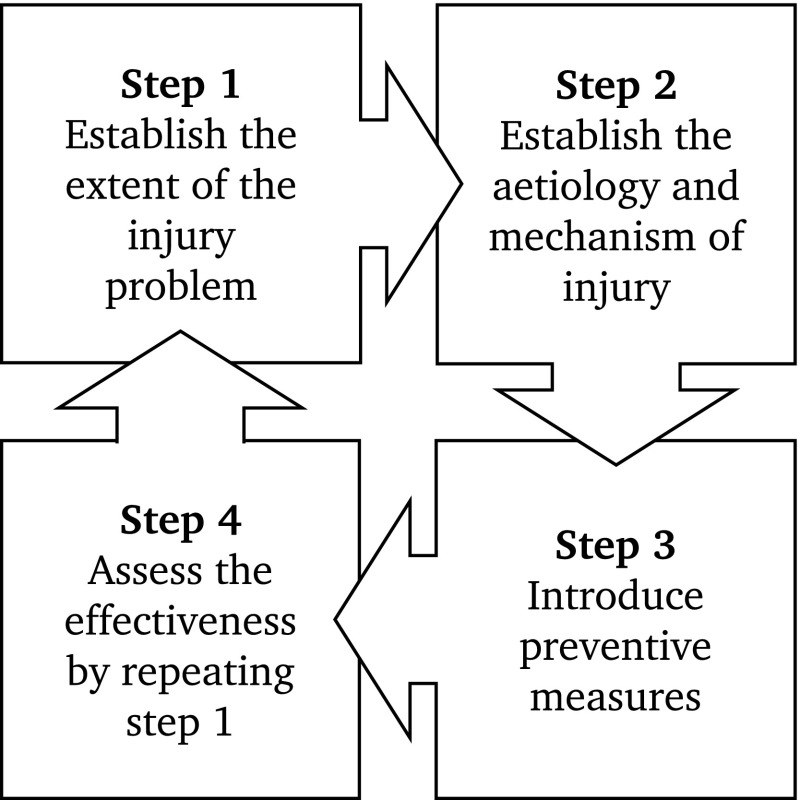
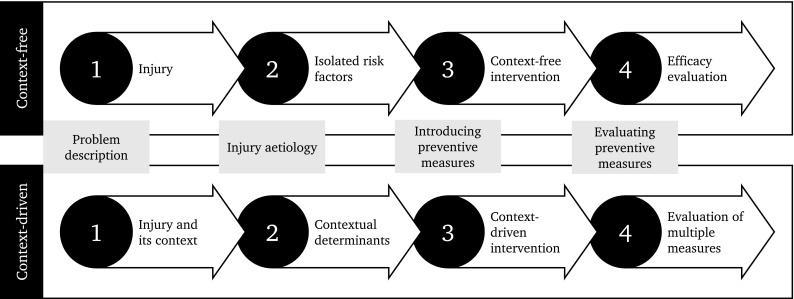
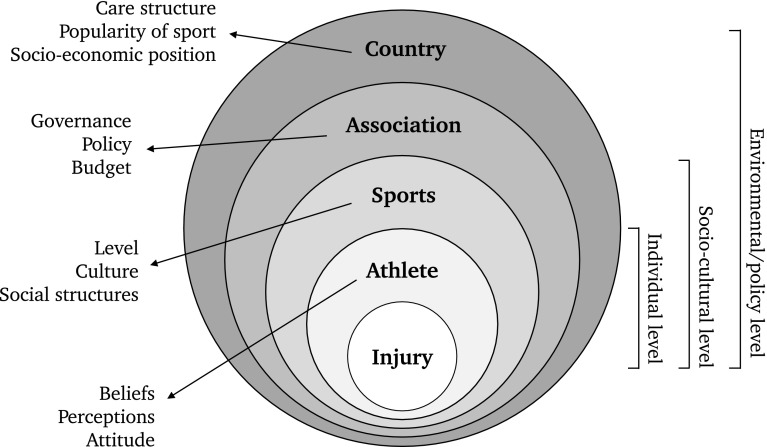
It is possible to prevent sports injuries. Unfortunately, the demonstrated efficacy and effectiveness of injury prevention approaches are not translated into lasting real-world effects. Contemporary views in sports medicine and injury prevention suggest that sports injuries are 'complex' phenomena. If the problem we aim to prevent is complex, then the first step in the 'sequence of prevention' that defines the 'injury problem' already needs to have considered this. The purpose of this paper is to revisit the first step of the 'sequence of prevention', and to explore new perspectives that acknowledge the complexity of the sports injury problem. First, this paper provides a retrospective of the 'sequence of prevention', acknowledging contemporary views on sports injuries and their prevention. Thereafter, from the perspective of the socioecological model, we demonstrate the need for taking into account the complex nature of sports injuries in the first step. Finally, we propose an alternative approach to explore and understand injury context through qualitative research methods. A better understanding of the injury problem in context will guide more context-sensitive studies, thus providing a new perspective for sports injury prevention research.
Overview
The claims and statistics of this paper haven’t been checked yet.
Free: it reads the open-access text and checks the first 5 claims that cite a source we can check. Create a free account to check every claim.
Integrity signals
Registry
Cites
Statistics
Figures
Verification
Claims the paper makes
The claims and statistics of this paper haven’t been checked yet.
Free: it reads the open-access text and checks the first 5 claims that cite a source we can check. Create a free account to check every claim.
Claims other papers make about this one
Each is checked against this paper’s own text: does it say what the citing paper says it does?
The cited source says what the claim attributes to it.
In the citing paper
“Previous authors have suggested a real need to understand the broader factors at play, 52 53 yet there has been a curious and alarming absence of gender in the conversation, given that the higher rate of ACL injury in girls and women reported in the 1990s caused an explosion of research in the area.”
From Anterior cruciate ligament injury: towards a gendered environmental approach (2021) · cites this paper as [52]
Self-check
Percentages, sums and reported differences re-computed from the paper’s own numbers.
The self-check needs the paper’s full text.
Citations
Cites
Research Design: Qualitative, Quantitative, and Mixed Methods Approaches
Creswell, J. W. (1994) · Cited by 35,500
Evaluating the public health impact of health promotion interventions: the RE-AIM framework.
Glasgow, R. E., Vogt, T. M., & Boles, S. M. (1999) · American Journal of Public Health · doi:10.2105/ajph.89.9.1322 · Cited by 7,217
Nature-nurture reconceptualized in developmental perspective: A bioecological model.
Bronfenbrenner, U., & Ceci, S. J. (1994) · Psychological Review · doi:10.1037/0033-295x.101.4.568 · Cited by 2,973 · cited 1×
“Bronfenbrenner and Ceci [29] postulated that to understand an individual’s development and behaviour, the entire ecological system in which this individual acts needs to be taken into account.”
BackgroundTwycross, A. (2004) · Nurse Researcher · doi:10.7748/nr.12.1.82.s2 · Cited by 2,031
Incidence, Severity, Aetiology and Prevention of Sports Injuries: A Review of Concepts
van Mechelen, W., Hlobil, H., & Kemper, H. C. G. (1992) · Sports Medicine · doi:10.2165/00007256-199214020-00002 · Cited by 2,015 · cited 4×
“Conflict of interest Caroline Bolling, Willem van Mechelen, Roeline Pasman and Evert Verhagen declare that they have no conflicts of interest relevant to the content of this review.”
BackgroundInfluential(2010) · Oxford University Press eBooks · doi:10.1093/acref/9780199571123.001.0001 · Cited by 1,610 · cited 1×
“In the Oxford Dictionary, ‘context’ is defined as “the interrelated conditions in which something exists or occurs” [8].”
BackgroundThe need for a complex systems model of evidence for public health
Rutter, H., Savona, N., Glonti, K., Bibby, J., Cummins, S., Finegood, D. T., Greaves, F., Harper, L., Hawe, P., Moore, L., et al. (2017) · The Lancet · doi:10.1016/s0140-6736(17)31267-9 · Cited by 1,260
Evidence-based intervention in physical activity: lessons from around the world
Heath, G. W., Parra, D. C., Sarmiento, O. L., Andersen, L. B., Owen, N., Goenka, S., Montes, F., & Brownson, R. C. (2012) · The Lancet · doi:10.1016/s0140-6736(12)60816-2 · Cited by 1,199
A new framework for research leading to sports injury prevention
Finch, C. (2006) · Journal of Science and Medicine in Sport · doi:10.1016/j.jsams.2006.02.009 · Cited by 1,071
The RE-AIM framework: a systematic review of use over time
Gaglio, B., Shoup, J. A., & Glasgow, R. E. (2013) · American Journal of Public Health · doi:10.2105/ajph.2013.301299 · Cited by 1,029
Learning from Evidence in a Complex World
Sterman, J. D. (2006) · American Journal of Public Health · doi:10.2105/ajph.2005.066043 · Cited by 978
Bittencourt, N. F. N., Meeuwisse, W. H., Mendonça, L. D., Nettel-Aguirre, A., Ocarino, J. M., & Fonseca, S. T. (2016) · British Journal of Sports Medicine · doi:10.1136/bjsports-2015-095850 · Cited by 833
Behavioral science at the crossroads in public health: Extending horizons, envisioning the future
Glass, T. A., & McAtee, M. J. (2006) · Social Science & Medicine · doi:10.1016/j.socscimed.2005.08.044 · Cited by 821
Risk factors for lower extremity injury: a review of the literature
Murphy, D. F., Connolly, D. A. J., & Beynnon, B. D. (2003) · British Journal of Sports Medicine · doi:10.1136/bjsm.37.1.13 · Cited by 758
A Dynamic Model of Etiology in Sport Injury: The Recursive Nature of Risk and Causation
Meeuwisse, W. H., Tyreman, H., Hagel, B., & Emery, C. (2007) · Clinical Journal of Sport Medicine · doi:10.1097/jsm.0b013e3180592a48 · Cited by 667
An introduction to reading and appraising qualitative research
Kuper, A., Reeves, S., & Levinson, W. (2008) · BMJ · doi:10.1136/bmj.a288 · Cited by 519
Practical Challenges of Systems Thinking and Modeling in Public Health
Trochim, W. M., Cabrera, D. A., Milstein, B., Gallagher, R. S., & Leischow, S. J. (2006) · American Journal of Public Health · doi:10.2105/ajph.2005.066001 · Cited by 405
Wiese‐Bjornstal, D. M. (2010) · Scandinavian Journal of Medicine & Science in Sports · doi:10.1111/j.1600-0838.2010.01195.x · Cited by 346
A sports setting matrix for understanding the implementation context for community sport
Finch, C. F., & Donaldson, A. (2010) · British Journal of Sports Medicine · doi:10.1136/bjsm.2008.056069 · Cited by 307
Psychosocial Factors and Sport Injuries: Meta-analyses for Prediction and Prevention
Ivarsson, A., Johnson, U., Andersen, M. B., Tranaeus, U., Stenling, A., & Lindwall, M. (2017) · Sports Medicine · doi:10.1007/s40279-016-0578-x · Cited by 292
Bahr, R., Thorborg, K., & Ekstrand, J. (2015) · British Journal of Sports Medicine · doi:10.1136/bjsports-2015-094826 · Cited by 274
Ekstrand, J., Lundqvist, D., Lagerbäck, L., Vouillamoz, M., Papadimitiou, N., & Karlsson, J. (2017) · British Journal of Sports Medicine · doi:10.1136/bjsports-2017-098001 · Cited by 205
Behaviour, the Key Factor for Sports Injury Prevention
Verhagen, E. A. L. M., van Stralen, M. M., & van Mechelen, W. (2010) · Sports Medicine · doi:10.2165/11536890-000000000-00000 · Cited by 180
Self-citationMeaning and measurement: an inclusive model of evidence in health care
Upshur, R. E. G., VanDenKerkhof, E. G., & Goel, V. (2001) · Journal of Evaluation in Clinical Practice · doi:10.1046/j.1365-2753.2001.00279.x · Cited by 179
O’Brien, J. G., & Finch, C. F. (2014) · Sports Medicine · doi:10.1007/s40279-014-0208-4 · Cited by 176
Complexity, simplicity, and epidemiology
Pearce, N., & Merletti, F. (2006) · International Journal of Epidemiology · doi:10.1093/ije/dyi322 · Cited by 175
Hulme, A., & Finch, C. F. (2015) · Injury Epidemiology · doi:10.1186/s40621-015-0064-1 · Cited by 158
McGlashan, A., & Finch, C. F. (2010) · Sports Medicine · doi:10.2165/11534960-000000000-00000 · Cited by 156
Finch, C. F. (2011) · British Journal of Sports Medicine · doi:10.1136/bjsports-2011-090230 · Cited by 154
Verhagen, E., Voogt, N., Bruinsma, A., & Finch, C. F. (2014) · British Journal of Sports Medicine · doi:10.1136/bjsports-2013-092241 · Cited by 148
Self-citationThe Prevention of Sport Injury: An Analysis of 12 000 Published Manuscripts
Klügl, M., Shrier, I., McBain, K., Shultz, R., Meeuwisse, W. H., Garza, D., & Matheson, G. O. (2010) · Clinical Journal of Sport Medicine · doi:10.1097/jsm.0b013e3181f4a99c · Cited by 138
Utility of Qualitative Research Findings in Evidence‐Based Public Health Practice
Jack, S. M. (2006) · Public Health Nursing · doi:10.1111/j.1525-1446.2006.230311.x · Cited by 116
A qualitative study on overuse injuries: The beliefs of athletes and coaches
van Wilgen, C. P., & Verhagen, E. A. L. M. (2011) · Journal of science and medicine in sport · doi:10.1016/j.jsams.2011.11.253 · Cited by 115
Self-citationVriend, I., Gouttebarge, V., Finch, C. F., van Mechelen, W., & Verhagen, E. A. L. M. (2017) · Sports Medicine · doi:10.1007/s40279-017-0718-y · Cited by 108 · cited 1×
“[21] reviewed intervention strategies for sports injury prevention and concluded that most of Fig.”
BackgroundSelf-citationFagher, K., Forsberg, A., Jacobsson, J., Timpka, T., Dahlström, Ö., & Lexell, J. E. (2016) · European Journal of Sport Science · doi:10.1080/17461391.2016.1192689 · Cited by 107
Bringing complexity to sports injury prevention research: from simplification to explanation
Bekker, S., & Clark, A. M. (2016) · British Journal of Sports Medicine · doi:10.1136/bjsports-2016-096457 · Cited by 87
The injury iceberg: an ecological approach to planning sustainable community safety interventions
Hanson, D., Hanson, J., Vardon, P., McFarlane, K., Lloyd, J., Muller, R., & Durrheim, D. (2005) · Health Promotion Journal of Australia · doi:10.1071/he05005 · Cited by 72
Eime, R., Owen, N. G., & Finch, C. F. (2004) · Sports Medicine · doi:10.2165/00007256-200434100-00001 · Cited by 67
Why don't teenagers use contraception? A qualitative interview study
Brown, S. R., & Guthrie, K. A. (2010) · The European Journal of Contraception & Reproductive Health Care · doi:10.3109/13625181003763456 · Cited by 52
Jacobsson, J., Bergin, D., Timpka, T., Nyce, J. M., & Dahlström, Ö. (2017) · Scandinavian Journal of Medicine and Science in Sports · doi:10.1111/sms.12929 · Cited by 46 · cited 1×
“Some authors have already presented a socioecological model as a framework for analysing the preventive behaviours in sports injury causation [17, 26, 27, 31].”
BackgroundWe dare to ask new questions. Are we also brave enough to change our approaches?
Verhagen, E. A. L. M., & Bolling, C. S. (2018) · Translational Sports Medicine · doi:10.1002/tsm2.8 · Cited by 32 · cited 1×
“New context-specific questions on the ‘how’ and ‘why’ need to be posed in sports injury prevention research in order to provide better understanding of the injury in its context [35].”
BackgroundSelf-citationBaxter, S. K., Blank, L., Preston, L., Squires, H., & Payne, N. (2011) · The European Journal of Contraception & Reproductive Health Care · doi:10.3109/13625187.2011.556762 · Cited by 30
If Athletes Will Not Adopt Preventive Measures, Effective Measures Must Adopt Athletes
Verhagen, E. A. L. M. (2012) · Current Sports Medicine Reports · doi:10.1249/jsr.0b013e318240dabd · Cited by 24
Self-citationMcGlashan, A., Verrinder, G. K., & Verhagen, E. A. L. M. (2018) · International Journal of Environmental Research and Public Health · doi:10.3390/ijerph15020351 · Cited by 19
Self-citationCaron, J. G., Bloom, G. A., & Bennie, A. (2015) · International Sport Coaching Journal · doi:10.1123/iscj.2015-0022 · Cited by 14
‘Research positively embraces questions and challenges’
Malone, B. L. (2005) · Nurse Researcher · doi:10.7748/nr2005.04.12.4.82.c5961 · Cited by 3
Coach perceptions of risk factors associated with lower limb injuries
McGlashan, A. (2017) · Journal of science and medicine in sport · doi:10.1016/j.jsams.2016.12.019 · Cited by 3
Research works printed but not linked: 1
- McGlashan AJ Enhancing the integration of specialised exercise training into coach practices to prevent lower-limb injury: using theory and exploring coaches’ salient beliefs (PhD) 2015 Ballarat Federation University Australia
Cited by
Machine learning methods in sport injury prediction and prevention: a systematic review
Van Eetvelde, H., Mendonça, L. D., Ley, C., Seil, R., & Tischer, T. (2021) · Journal of Experimental Orthopaedics · doi:10.1186/s40634-021-00346-x · Cited by 341
van Dyk, N., Behan, F. P., & Whiteley, R. (2019) · British Journal of Sports Medicine · doi:10.1136/bjsports-2018-100045 · Cited by 333
Anterior cruciate ligament injury: towards a gendered environmental approach
Parsons, J. L., Coen, S. E., & Bekker, S. (2021) · British Journal of Sports Medicine · doi:10.1136/bjsports-2020-103173 · Cited by 300
“99 100 Previous authors have suggested a real need to understand the broader factors at play, 52 53 yet there has been a curious and alarming absence of gender in the conversation, given that the higher rate of ACL injury in girls and women reported in the 1990s caused an explosion of research in…”
BackgroundBiomechanical Risk Factors Associated with Running-Related Injuries: A Systematic Review
Ceyssens, L., Vanelderen, R., Barton, C., Malliaras, P., & Dingenen, B. (2019) · Sports Medicine · doi:10.1007/s40279-019-01110-z · Cited by 261
Clarsen, B., Bahr, R., Myklebust, G., Andersson, S. H., Docking, S. I., Drew, M., Finch, C. F., Fortington, L. V., Harøy, J., Khan, K. M., et al. (2020) · British Journal of Sports Medicine · doi:10.1136/bjsports-2019-101337 · Cited by 258
Self-citation
Metadata
- Authors
- Bolling, C., van Mechelen, W., Pasman, H. R., & Verhagen, E.
- Affiliations
- Amsterdam Public Health (NL)
- University of Cape Town (ZA)
- Corresponding author
- Pasman, H. Roeline
- Venue
- Sports Medicine
- Published
- 2018-06-28
- Volume
- 48
- Issue
- 10
- Pages
- 2227-2234
- ISSN
- 0112-1642 (ISSN-L)
- 1179-2035
- PMC
- PMC6132444
- OpenAlex
- W2811471078
- Cited by
- 262
- References
- 47
- Citations by year
- 2026: 29 · 2025: 33 · 2024: 46 · 2023: 44 · 2022: 38 · 2021: 30 · 2020: 23 · 2019: 15 · 2018: 4
- FWCI
- 3.69
- Type
- journal article
- Language
- en
- Open access
- hybrid
- doi.org
- Licence
- cc-by
- creativecommons.org/licenses/by/4.0 (tdm)
- Locations
- Sports Medicine (publishedVersion, cc-by)
- Europe PMC (PubMed Central) (publishedVersion, other-oa)
- PubMed Central (publishedVersion, cc-by)
- PubMed (publishedVersion)
- Pure Amsterdam UMC (publishedVersion, cc-by)
- Amsterdam UMC (VU Amsterdam) - Institutional Repository (submittedVersion, other-oa)
- VUBIR (Vrije Universiteit Brussel) (submittedVersion)
- Data Archiving and Networked Services (DANS) (submittedVersion, other-oa)
- Funders
- Ministério da Ciência, Tecnologia e Inovação (202242/2015-3)
- Topics
- Health Sciences › Medicine › Orthopedics and Sports Medicine › Sports injuries and prevention
- Health Sciences › Medicine › Public Health, Environmental and Occupational Health › Injury Epidemiology and Prevention
- Social Sciences › Psychology › Developmental and Educational Psychology › Sport Psychology and Performance
- Keywords
- sports injury prevention, socio-ecological model, qualitative research
- MeSH terms
- Athletic Injuries, Humans, Sports Medicine
About these checks
Registry, retraction, Cites and statistics results are computed, not judged, with one exception: a printed reference that no index lists is read once by a model before it counts as a citation error. Claims are extracted by a model and kept only when their quote appears verbatim in the text; each cited source is then checked, with a model’s help, for whether it says what the claim relies on. Those verdicts can be wrong — read the claim’s quote and the cited source before relying on one.
Statistics and arithmetic are recomputed, not judged.
Confidence bands are shown only for fields calibrated on our annotated test set. None is calibrated yet, so no band is shown.
What counts as a claim ›How we measure confidence ›How we check this ›
Are you an author, or do you see a problem with this page? Request a review
Data sources
Bibliographic data: Semantic Scholar, OpenAlex, Crossref.
Contains information from the Semantic Scholar Academic Graph Datasets, made available under the ODC Attribution License (ODC-BY 1.0).
Semantic Scholar’s data is described in: Kinney, R., et al. (2023). The Semantic Scholar Open Data Platform. arXiv:2301.10140.
