

Maltodextrin-Based Carbohydrate Oral Rinsing and Exercise Performance: Systematic Review and Meta-Analysis
Open accessThe DOI matches its Crossref record; 107 of the 107 references it cites were found in a registry or an index.
Abstract
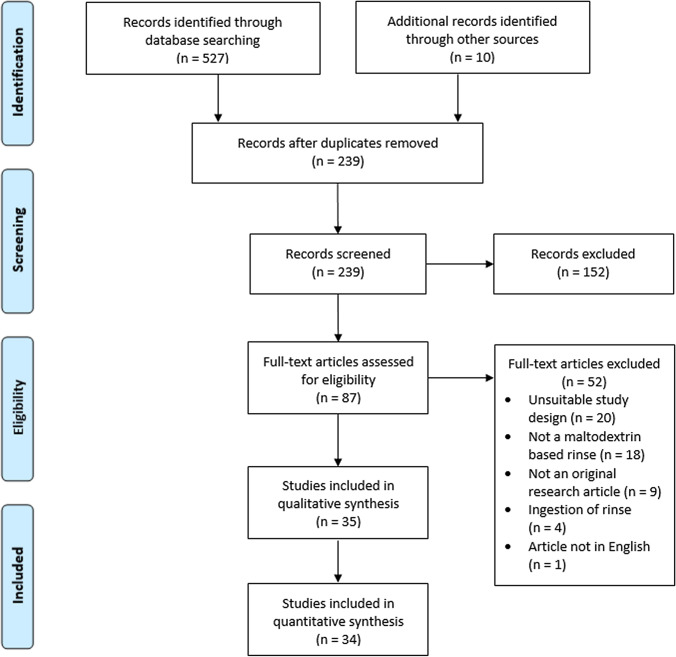
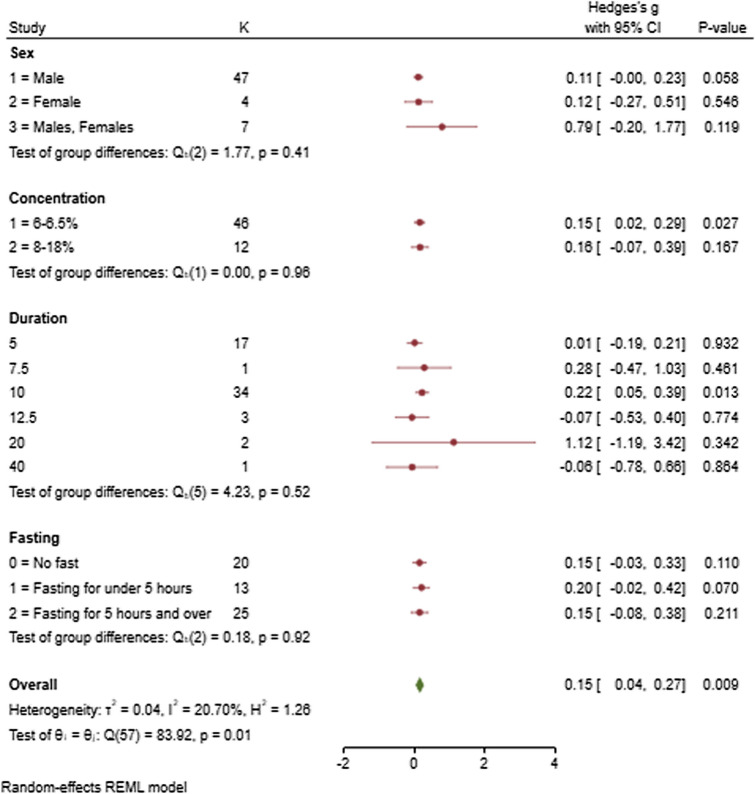
Background: Carbohydrates are an important fuel for optimal exercise performance during moderate- and high-intensity exercise; however, carbohydrate ingestion during high-intensity exercise may cause gastrointestinal upset. A carbohydrate oral rinse is an alternative method to improve exercise performance in moderate- to high-intensity exercise with a duration of 30–75 min. This is the first systematic review and meta-analysis to comprehensively examine the isolated effect of maltodextrin-based rinsing on exercise performance. Objective: The objective of this review was to establish the effect of a maltodextrin-based carbohydrate oral rinse on exercise performance across various modes of exercise. Furthermore, a secondary objective was to determine the effects of moderators [(1) participant characteristics; (2) oral rinse protocols; (3) exercise protocol (i.e. cycling, running etc.) and (4) fasting] on exercise performance while using a maltodextrin-based, carbohydrate oral rinse. Methods: Five databases (MEDLINE, PsycINFO, Embase, SPORTDiscus and Global Health) were systematically searched for articles up to March 2021 and screened using Covidence (a systematic review management tool). A random effects robust meta-analysis and subgroup analyses were performed using Stata Statistical Software: Release 16. Results: Thirty-five articles met the inclusion criteria and were included in the systematic review; 34 of these articles were included in the meta-analysis. When using a conventional meta-analytic approach, overall, a carbohydrate oral rinse improved exercise performance in comparison with a placebo (SMD = 0.15, 95% CI 0.04, 0.27; p = 0.01). Furthermore, when implementing an adjusted, conservative, random effects meta-regression model using robust variance estimation, overall, compared with placebo, a carbohydrate oral rinse demonstrated evidence of improving exercise performance with a small effect size (SMD = 0.17, 95% CI − 0.01, 0.34; p = 0.051). Conclusion: This systematic review and meta-analysis demonstrates that a maltodextrin-based carbohydrate oral rinse can improve exercise performance. When comparing the two meta-analytic approaches, although non-significant, the more robust, adjusted, random effects meta-regression model demonstrated some evidence of a maltodextrin-based carbohydrate oral rinse improving exercise performance overall.
Overview
The claims and statistics of this paper haven’t been checked yet.
Free: it reads the open-access text and checks the first 5 claims that cite a source we can check. Create a free account to check every claim.
Integrity signals
Registry
Cites
Statistics
Figures
Verification
Claims the paper makes
The claims and statistics of this paper haven’t been checked yet.
Free: it reads the open-access text and checks the first 5 claims that cite a source we can check. Create a free account to check every claim.
Claims other papers make about this one
Each is checked against this paper’s own text: does it say what the citing paper says it does?
The source backs part of the claim, not all of it — or backs it for a different population, condition or comparison.
In the citing paper
“During periods of exercise where carbohydrate availability is critically reduced, carbohydrate mouth rinsing (e.g., 5–10 s every 5th min with a 6% carbohydrate solution) has been shown to enhance performance via a non‐metabolic mechanism [39, 72].”
From Carbohydrate Storage and Supplementation Strategies for Peak Performance in Cross-Country Skiing (2026) · cites this paper as [72]
Experimental — accuracy not yet measured
Self-check
Percentages, sums and reported differences re-computed from the paper’s own numbers.
The self-check needs the paper’s full text.
Citations
Cites
Preferred Reporting Items for Systematic Reviews and Meta-Analyses: the PRISMA statement
Moher, D., Liberati, A., Tetzlaff, J., Altman, D. G., & for the PRISMA Group (2009) · BMJ · doi:10.1136/bmj.b2535 · Cited by 83,823
Preferred Reporting Items for Systematic Reviews and Meta-Analyses: The PRISMA Statement
Moher, D., Liberati, A., Tetzlaff, J., Altman, D. G., & The PRISMA Group (2009) · PLoS Medicine · doi:10.1371/journal.pmed.1000097 · Cited by 64,042
The Cochrane Collaboration's tool for assessing risk of bias in randomised trials
Higgins, J. P. T., Altman, D. G., Gotzsche, P. C., Juni, P., Moher, D., Oxman, A. D., Savovic, J., Schulz, K. F., Weeks, L., Sterne, J. A. C., et al. (2011) · BMJ · doi:10.1136/bmj.d5928 · Cited by 33,817
Dermyshi, E., Wang, Y., Yan, C., Hong, W., Qiu, G., Gong, X., & Zhang, T. (2017) · Neonatology · doi:10.1159/000454668 · Cited by 24,451
Wang, G., Ma, R., Qiao, G., Wada, K., Aizawa, Y., & Satoh, T. (2015) · Integrative Medicine International · doi:10.1159/000368408 · Cited by 18,657
Cochrane Handbook for Systematic Reviews of Interventions
(2019) · doi:10.1002/9781119536604 · Cited by 14,828
Shamseer, L., Moher, D., Clarke, M., Ghersi, D., Liberati, A., Petticrew, M., Shekelle, P., Stewart, L. A., & the PRISMA-P Group (2015) · BMJ · doi:10.1136/bmj.g7647 · Cited by 13,120 · cited 1×
“2 Methods The systematic review and meta-analysis was completed according the Cochrane Handbook for Systematic Reviews of Interventions [60] and following the PRISMA (Preferred Reporting Items for Systematic Reviews and Meta-Analyses) statement [61].”
MethodRobust variance estimation in meta‐regression with dependent effect size estimates
Hedges, L. V., Tipton, E., & Johnson, M. C. (2010) · Research Synthesis Methods · doi:10.1002/jrsm.5 · Cited by 2,086 · cited 1×
“Conventional meta-analytic techniques rely on the assumption that effect size estimates from different studies are independent and have sampling distributions with known conditional variances [66, 67].”
BackgroundMorphological, thermal and rheological properties of starches from different botanical sources
Singh, N., Singh, J., Kaur, L., Singh Sodhi, N., & Singh Gill, B. (2003) · Food Chemistry · doi:10.1016/s0308-8146(02)00416-8 · Cited by 1,929
Thomas, D. T., Erdman, K. A., & Burke, L. M. (2016) · Journal of the Academy of Nutrition and Dietetics · doi:10.1016/j.jand.2015.12.006 · Cited by 1,359 · cited 1×
“4% maltodextrin-based solution [19–21] during moderate- to high-intensity exercise with a time span ranging from 30 to 75 min can facilitate improvements in exercise [6, 8].”
Background
Research works printed but not linked: 5
- 5. Burke L, Deakin V. Clinical sports nutrition: sports medicine series. 4th ed. McGraw-Hill Education; 2010.
- 50. de Oliveira JJ, Crisp AH, Barbosa CGR, de Silva AS, Baganha RJ, Verlengia R. Influence of carbohydrate mouth rinse on sprint performance: a systematic review and meta-analysis. J Exer Physiol Online. 2017;20(3):88-99.
- 58. BeMiller JN, Whistler RL. Carboydrates. Third Edition ed. Food Chem. New York: Marcel Dekker; 1996. p. 157-224.
- 75. de Oliveira JJ, de Salles AHS, Barbosa CGR, de Silva JAO, de Dias RM, Ribeiro AGSV, et al. Effect of post-activation potentia- tion and carbohydrate mouth rise on repeated sprint ability in uni- versity futsal players. J Exer Physiol Online. 2020;23(2):29-40.
- 89. Tonoli C, Cumps E, Aerts I, Verhagen E, Meeusen R. Incidence, risk factors and prevention of running related injuries in long- distance running: a systematic review injury, location and type. Sport en Geneeskd. 2010;5:13-8.
Cited by
Exercise Metabolism and Adaptation in Skeletal Muscle
Smith, J. A. B., Murach, K. A., Dyar, K. A., & Zierath, J. R. (2023) · Nature Reviews Molecular Cell Biology · doi:10.1038/s41580-023-00606-x · Cited by 342
Exercise-Induced Central Fatigue: Biomarkers, and Non-Medicinal Interventions
Yang, Y., Feng, Z. W., Luo, Y.-H., Chen, J.-M., Zhang, Y., Liao, Y.-J., Jiang, H., Long, Y., & Wei, B. (2024) · Aging and Disease · doi:10.14336/ad.2024.0567 · Cited by 32
“Potential risks include choking from carbohydrate mouthwash [101], and gastrointestinal strain due to CHO intake during exercise, potentially hampering performance.”
Fed, not fasted: is carbohydrate mouth rinsing still ergogenic? A three-level meta-analysis
Deng, H., Fan, X., Liu, P., Song, T., Fuaad, A. A. H. A., Nasiruddin, N. J. M., & Naharudin, M. N. (2025) · Journal of the International Society of Sports Nutrition · doi:10.1080/15502783.2025.2579027 · Cited by 12
“This finding is consistent with Hartley et al. (2022) and Rodrigues Oliveira-Silva et al. (2023), who similarly reported that fasting duration did not significantly influence CHO mouth rinse effects, even in studies extending beyond four hours of fasting [94,95].”
InfluentialDeng, H., Fan, X., Song, T., Nasiruddin, N. J. M., Fuaad, A. A. H. A., & Naharudin, M. N. (2026) · Journal of the International Society of Sports Nutrition · doi:10.1080/15502783.2026.2638903 · Cited by 8
“In addition, timing the rinse immediately before key pacing or force-production phases may strengthen perception action coupling, whereas spreading stimulation across longer windows may dilute attentional engagement and reduce the functional impact of the cue [86].”
Soylu, Y., Chmura, P., Arslan, E., & Kilit, B. (2024) · Nutrients · doi:10.3390/nu16223910 · Cited by 10
How Attention Changes in Response to Carbohydrate Mouth Rinsing
Hosang, T. J., Laborde, S., Löw, A., Sprengel, M., Baum, N., & Jacobsen, T. (2023) · Nutrients · doi:10.3390/nu15133053 · Cited by 9
Poon, E. T., Tsang, J. H., Sun, F., Ali, A., Rollo, I., & Wong, S. H. (2024) · Applied Physiology, Nutrition, and Metabolism · doi:10.1139/apnm-2024-0228 · Cited by 7
Vigh-Larsen, J. F., Kruse, D. Z., Moseholt, M. B., Hansen, L. G. B., Christensen, A. L., Bæk, A., Andersen, O. E., Mohr, M., & Overgaard, K. (2024) · Scandinavian Journal of Medicine and Science in Sports · doi:10.1111/sms.14731 · Cited by 9
“However, such effects have most commonly been reported with participants exercising in a fasted state [45].”
Central effects of mouth rinses on endurance and strength performance
Tan, S. H., Khong, T. K., Selvanayagam, V. S., & Yusof, A. (2023) · European Journal of Applied Physiology · doi:10.1007/s00421-023-05350-w · Cited by 6
“In addition, a few meta-analyses have also concluded that CHO MR could improve endurance performance (Bri-etzke et al. 2019; Peart 2017; Hartley et al. 2022), muscular endurance (Oliveira-Silva et al. 2022), and strength (isometric/isokinetic) performance (Hartley et al. 2022).”
Nutrition for Mountain Biking and Cyclocross
Oosthuyse, T., Muros, J. J., & Zabala, M. (2025) · International Journal of Sport Nutrition and Exercise Metabolism · doi:10.1123/ijsnem.2025-0036 · Cited by 5
Fuentes-Barría, H., Urrutia-Espinosa, M., Concha-Fuentealba, F., Angarita, L., Carrasco-Hernández, M. E., & Aguilera-Eguía, R. A. (2024) · Nutrición Hospitalaria · doi:10.20960/nh.05253 · Cited by 8
Carbohydrate Oral Rinsing, Cycling Performance and Individual Complex Carbohydrate Taste Sensitivity
Hartley, C., Carr, A. J., Roberts, S., Bredie, W. L. P., & Keast, R. (2024) · Nutrients · doi:10.3390/nu16030459 · Cited by 8
“In a previous meta-analysis of 35 articles, 22 articles mentioned the brand or manufacturer details, while only 3 articles detailed the composition of the maltodex-trin [22].”
BackgroundMethodResultInfluentialSelf-citationSuen, M., Sun, F., Ali, A., & Poon, E. T. (2025) · Journal of the International Society of Sports Nutrition · doi:10.1080/15502783.2025.2562977 · Cited by 4
“The ergogenic effects of 10% CHO and 1.2% CAF mouth rinsing have been reported previously [26,27].”
InfluentialDiretrizes de Prática Clínica para Nutrição Esportiva: Associação Brasileira de Nutrição Esportiva
Quaresma, M. V. L. D. S., Trindade, M. C. D. C., de Oliveira, E. P., Dátilo, M., Pimentel, G. D., de Barros, A. R. Z., Barrella, A. B., Mendes, R. R., Campanholi, R. A., Alvarenga, M. L., et al. (2025) · journal of physical education · doi:10.4025/jphyseduc.v36i1.3605 · Cited by 8
Maltodextrin from Sweet Cassava: A Promising Endurance Enhancer
Posridee, K., Oonsivilai, A., & Oonsivilai, R. (2024) · Foods · doi:10.3390/foods13050766 · Cited by 4
“Carbohydrate oral rinsing with maltodextrin shows some early evidence for performance improvement [11] but requires further investigation.”
BackgroundBezuglov, E., Achkasov, E. E., Vakhidov, T., Kapralova, E., Kuznetsova, Y., Manina, M. A., & Ильинична, Э. С. (2026) · Sport Sciences for Health · doi:10.1007/s11332-026-01661-5 · Cited by 4
Functional Aloe vera Drink Supplementation: Effect on Athlete Health
D’angelo, S., Buzzanca, C., D’Amico, A., Boatta, A., Proia, P., & Stefano, V. A. D. (2026) · Beverages · doi:10.3390/beverages12020023 · Cited by 3
“Based on research, an additional ingredient that is often used is maltodextrin, widely used by athletes to improve performance [17,27].”
High-Intensity Intermittent Exercise and Mouth Rinsing: A Systematic Review and Meta-Analysis
Suen, M., Tsang, J. H., Wong, P.-S., O'Reilly, J., & Poon, E. T. (2026) · International Journal of Sport Nutrition and Exercise Metabolism · doi:10.1123/ijsnem.2025-0135 · Cited by 3
Hsu, T., Hsieh, M.-H., Shiu, Y.-J., & Chiu, C. (2025) · Nutrients · doi:10.3390/nu17010167 · Cited by 4
“In fact, according to a systematic review and meta-analysis study, it was found that there was no gender difference in the effect of CMR on exercise performance [24].”
Nassif, C., Cannon, J., & Marino, F. E. (2026) · European Journal of Applied Physiology · doi:10.1007/s00421-026-06368-6 · Cited by 3
“Alongside ingestion studies, evidence from CHO mouth-rinse paradigms indicates that oral carbohydrate sensing can influence exercise performance via non-metabolic path - ways (Gant et al. 2010; James et al. 2017; Kamaruddin et al. 2019; Hartley et al. 2022 ).”
Carbohydrate Storage and Supplementation Strategies for Peak Performance in Cross-Country Skiing
Ørtenblad, N., Holmberg, H. ‐., Nybo, L., & Gejl, K. D. (2026) · Scandinavian Journal of Medicine & Science in Sports · doi:10.1111/sms.70242 · Cited by 1
“During periods of exercise where carbohydrate availability is critically reduced, carbohydrate mouth rinsing (e.g., 5–10 s every 5th min with a 6% carbohydrate solution) has been shown to enhance performance via a non-metabolic mechanism [39, 72].”
Clarke, N. D., & Richardson, D. L. (2024) · European Journal of Sport Science · doi:10.1002/ejsc.12084 · Cited by 2
“Carbohydrate mouth rinsing (CMR) has regularly been reported to enhance short ‐ term endurance and high ‐ intensity performance (Hartley et al., 2022).”
BackgroundHartley, C., Keast, R., & Bredie, W. L. P. (2025) · Food Science & Nutrition · doi:10.1002/fsn3.4751 · Cited by 2
Self-citationBailey, E., Clarke, N. D., Cole, M., Gough, L. A., Newbury, J. W., & Roberts, C. J. (2025) · Performance Nutrition · doi:10.1186/s44410-025-00002-w · Cited by 2
“Collectively, the overall effect across different exercise protocols is equivocal [12, 18] however the use of CHO-MR may present a convenient, ergogenic benefit in disciplines where time to consume CHO either prior to, or during activity is limited.”
The Impact of Exercise on Dietary Fat Taste Perception: A Report on Its Role in Obesity Prevention
Shanmugamprema, D., Ganapathy, D., Muthuswamy, K., & Selvakumar, S. (2025) · Obesity Reviews · doi:10.1111/obr.70010 · Cited by 1
“While much of the literature emphasizes the effects of exercise on taste perception, recent studies show that taste and exercise are mutually dependent, with oral sensory inputs also influencing exercise performance, metabolism, and recovery [78, 79].”
Supplementation of Maltotetraose Enhances Endurance Capacity and Energy Metabolism of ICR Mice
Gao, F., Kong, H., Tian, Y., Li, D., Li, C., Ban, X., Gu, Z., & Li, Z. (2026) · Journal of Agricultural and Food Chemistry · doi:10.1021/acs.jafc.5c14350 · Cited by 1
Fuentes-Barría, H., Aguilera-Eguía, R. A., & González-Wong, C. (2023) · Retos · doi:10.47197/retos.v47.96338 · Cited by 1
Barylski, N. A., Grewal, L., Nwankwo, A., & Cohen, S. (2025) · Springer eBooks · doi:10.1007/978-3-031-92079-0_9
Şahin, M., Arslan, E., & Soylu, Y. (2025) · Turkish Journal of Kinesiology · doi:10.31459/turkjkin.1689944
Ko, J.-M., So, W.-Y., & Park, S.-E. (2025) · Science & Sports · doi:10.1016/j.scispo.2025.03.001
Han, T. S., Khong, T. K., Selvanayagam, V. S., & Yusof, A. J. (2026) · International Journal of Sport Nutrition and Exercise Metabolism · doi:10.1123/ijsnem.2025-0158
Korohod, T., Pietrzak-Chmiel, M. M., Ramaneckaite, P., Binkiewicz, A., Ślesik, M., Tadulewicz, I., Łatkowska, S., Pawlik, A., & Pudzianowska, A. (2026) · Quality in Sport · doi:10.12775/qs.2026.51.68660 · Cited by 1
ALTINKAYA, Z., Dal, U., Yılmaz, D. D., Yanık, H., Temel, G. Ö., & Veldhuizen, M. G. (2026) · International journal of exercise science · doi:10.70252/ijes2026202
Tarrit, B., Moretton, C., Duclos, M., Metz, L., Chanséaume, E., Ennequin, G., Thivel, D., & RANNOU, F. (2026) · The Journal of Sports Medicine and Physical Fitness · doi:10.23736/s0022-4707.25.17488-4
Prieto, N., Nosworthy, M. G., López-Campos, Ó., Agregán, R., Lorenzo, J. M., Viuda‐Martos, M., & Nieto, G. (2026) · Advances in food and nutrition research · doi:10.1016/bs.afnr.2026.03.006
Li, H., Peng, Y., Liu, B., Ding, L., Xu, K., Lei, T., Gong, B., & Cao, Y. (2026) · Nutrients · doi:10.3390/nu18121868
“…ergogenic effects when ingested by serving as a primary energy source for high-intensity exercise and maintaining glycogen stores and blood glucose levels [14], or via CHO mouth rinsing (CMR), which stimulates oral receptors and activates brain regions related to reward and motor control [15].”
Li, Q., Liu, S., Miao, C., Zhang, Y., & Lu, Y. (2026) · Frontiers in Nutrition · doi:10.3389/fnut.2026.1877453
“In terms of CHO, Hartley et al. (26) showed in a meta-analysis of 35 randomized controlled trials that CHO mouth rinse could improve various types of exercise performance to some extent, including cycling and running.”
Zalagkitis, C., Kraniotaki, A., Simitzis, N., Dallas, K., Moustogiannis, A., Chatzinikita, E., Paradisis, G. P., Τέντα, Ρ., Maridaki, M. D., Veskoukis, A. S., et al. (2026) · Nutrients · doi:10.3390/nu18183099
Mendonça, M. E. D. F., Nehme, R., Mariano, I. M., Vieira, P. F., de Branco, F. M. S., Ferreira, M. C., Carvalho, V. S., Simões, B. O., Morais, D. M., Puga, G. M., et al. (2026) · Research in Sports Medicine · doi:10.1080/15438627.2026.2736778
Metadata
- Authors
- Hartley, C., Carr, A., Bowe, S. J., Bredie, W. L. P., & Keast, R. S. J.
- Affiliations
- Deakin University (AU)
- University of Copenhagen (DK)
- Corresponding author
- Keast, Russell S. J.
- Venue
- Sports Medicine
- Published
- 2022-03-03
- Volume
- 52
- Issue
- 8
- Pages
- 1833-1862
- ISSN
- 0112-1642 (ISSN-L)
- 1179-2035
- PMC
- PMC9325805
- OpenAlex
- W4214866129
- Semantic Scholar
- e14be373c6f0bc8c954259bee9a281da31148d15
- Cited by
- 34
- References
- 106
- Citations by year
- 2026: 11 · 2025: 11 · 2024: 8 · 2023: 4
- FWCI
- 0.83
- Type
- journal article
- Language
- en
- Open access
- hybrid
- doi.org
- Licence
- cc-by
- creativecommons.org/licenses/by/4.0 (tdm)
- creativecommons.org/licenses/by/4.0 (vor)
- Locations
- Sports Medicine (publishedVersion, cc-by)
- PubMed Central (publishedVersion, cc-by)
- PubMed (publishedVersion)
- Research at the University of Copenhagen (University of Copenhagen) (publishedVersion, cc-by)
- Own your potential (DEAKIN) (submittedVersion)
- Figshare (submittedVersion, cc-by)
- Funders
- Deakin University
- Topics
- Health Sciences › Nursing › Nutrition and Dietetics › Muscle metabolism and nutrition
- Health Sciences › Medicine › Orthopedics and Sports Medicine › Sports Performance and Training
- Health Sciences › Medicine › Physiology (medical) › Thermoregulation and physiological responses
- Keywords
- maltodextrin, exercise performance, high-intensity exercise, gastrointestinal discomfort, carbohydrate intake, cycling, running, fasting, robust variance estimation
- MeSH terms
- Bicycling, Humans, Mouthwashes, Polysaccharides, Exercise
About these checks
Registry, retraction, Cites and statistics results are computed, not judged, with one exception: a printed reference that no index lists is read once by a model before it counts as a citation error. Claims are extracted by a model and kept only when their quote appears verbatim in the text; each cited source is then checked, with a model’s help, for whether it says what the claim relies on. Those verdicts can be wrong — read the claim’s quote and the cited source before relying on one.
Statistics and arithmetic are recomputed, not judged.
Confidence bands are shown only for fields calibrated on our annotated test set. None is calibrated yet, so no band is shown.
What counts as a claim ›How we measure confidence ›How we check this ›
Are you an author, or do you see a problem with this page? Request a review
Data sources
Bibliographic data: Semantic Scholar, OpenAlex, Crossref.
Contains information from the Semantic Scholar Academic Graph Datasets, made available under the ODC Attribution License (ODC-BY 1.0).
Semantic Scholar’s data is described in: Kinney, R., et al. (2023). The Semantic Scholar Open Data Platform. arXiv:2301.10140.
