

Epidemiology, health-related quality of life and economic burden of binge eating disorder: a systematic literature review
Open accessThe DOI matches its Crossref record; 60 of the 60 references it cites were found in a registry or an index.
Abstract
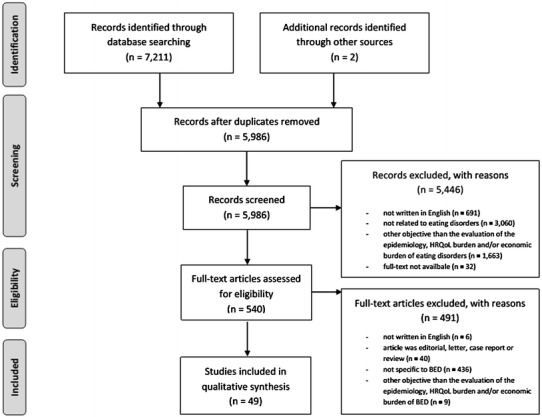
PURPOSE: To perform a systematic review on the epidemiology, the health-related quality of life (HRQoL) and economic burden of binge eating disorder (BED). METHODS: A systematic literature search of English-language articles was conducted using Medline, Embase, PsycINFO, PsycARTICLES, Academic Search Complete, CINAHL Plus, Business Source Premier and Cochrane Library. Literature search on epidemiology was limited to studies published between 2009 and 2013. Cost data were inflated and converted to 2012 US$ purchasing power parities. All of the included studies were assessed for quality. RESULTS: Forty-nine articles were included. Data on epidemiology were reported in 31, HRQoL burden in 16, and economic burden in 7 studies. Diagnosis of BED was made using 4th Edition of The Diagnostic and Statistical Manual of Mental Disorders (DSM-IV) criteria in 46 studies. Lifetime prevalence of BED was 1.1-1.9% in the general population (DSM-IV). BED was associated with significant impairment in aspects of HRQoL relating to both physical and mental health; the Short Form 36 Physical and Mental Component Summary mean scores varied between 31.1 to 47.3 and 32.0 to 49.8, respectively. Compared to individuals without eating disorder, BED was related to increased healthcare utilization and costs. Annual direct healthcare costs per BED patient ranged between $2,372 and $3,731. CONCLUSIONS: BED is a serious eating disorder that impairs HRQoL and is related to increased healthcare utilization and healthcare costs. The limited literature warrants further research, especially to better understand the long-term HRQoL and economic burden of BED.
Overview
The claims and statistics of this paper haven’t been checked yet.
Free: it reads the open-access text and checks the first 5 claims that cite a source we can check. Create a free account to check every claim.
Integrity signals
Registry
Cites
Statistics
Figures
Verification
Claims the paper makes
The claims and statistics of this paper haven’t been checked yet.
Free: it reads the open-access text and checks the first 5 claims that cite a source we can check. Create a free account to check every claim.
Self-check
Percentages, sums and reported differences re-computed from the paper’s own numbers.
The self-check needs the paper’s full text.
Citations
Cites
Diagnostic and Statistical Manual of Mental Disorders
American Psychiatric Association (2013) · doi:10.1176/appi.books.9780890425596 · Cited by 116,369
Diagnostic and Statistical Manual of Mental Disorders
Williams, J. B. W., & First, M. (2013) · Encyclopedia of Social Work · doi:10.1093/acrefore/9780199975839.013.104 · Cited by 109,519
Preferred Reporting Items for Systematic Reviews and Meta-Analyses: the PRISMA statement
Moher, D., Liberati, A., Tetzlaff, J., Altman, D. G., & for the PRISMA Group (2009) · BMJ · doi:10.1136/bmj.b2535 · Cited by 83,823
Preferred reporting items for systematic reviews and meta-analyses: the PRISMA Statement.
(2009) · PubMed Central · Cited by 44,859
Preferred reporting items for systematic reviews and meta-analyses: The PRISMA statement
Moher, D., Liberati, A., Tetzlaff, J., Altman, D. G., & the PRISMA Group* (2009) · Annals of Internal Medicine · doi:10.7326/0003-4819-151-4-200908180-00135 · Cited by 37,554
von Elm, E., Altman, D. G., Egger, M., Pocock, S. J., Gøtzsche, P. C., Vandenbroucke, J. P., & Initiative, F. T. S. (2007) · PLoS Medicine · doi:10.1371/journal.pmed.0040296 · Cited by 23,020
Preferred Reporting Items for Systematic Reviews and Meta-Analyses: The PRISMA Statement
Moher, D., Liberati, A., Tetzlaff, J., & Altman, D. G. (2009) · Journal of Clinical Epidemiology · doi:10.1016/j.jclinepi.2009.06.005 · Cited by 19,575
von Elm, E., Altman, D. G., Egger, M., Pocock, S. J., Gøtzsche, P. C., & Vandenbroucke, J. P. (2008) · Journal of Clinical Epidemiology · doi:10.1016/j.jclinepi.2007.11.008 · Cited by 17,893
von Elm, E., Altman, D. G., Egger, M., Pocock, S. J., Gøtzsche, P. C., Vandenbroucke, J. P., & Initiative, F. T. S. (2007) · Annals of Internal Medicine · doi:10.7326/0003-4819-147-8-200710160-00010 · Cited by 17,796
Diagnostic and Statistical Manual of Mental Disorders, Fourth Edition, Text Revision (DSM-IV-TR)
American Psychiatric Association (2000) · doi:10.1176/appi.books.9780890423349 · Cited by 11,069
Research works printed but not linked: 2
- Canan F Gungor A Onder E Celbek G Aydin Y Alcelik A The association of binge eating disorder with glycemic control in patients with type 2 diabetes Turk Jem 2011 15 26 27
- Saka M Türker FP Bas M Metin S Yilmaz B Köseler E An examination of food craving and eating behaviour with regard to eating disorders among adolescent HealthMED 2012 6 1331 1340
Cited by
Items 101–156 of 156
Prasetyo, Y. B., Nursalam, N., Hargono, R., & Ahsan, A. (2019) · Jurnal NERS · doi:10.20473/jn.v13i2.12735 · Cited by 4
Dissecting compulsive eating behavior into three elements
Moore, C. F., Sabino, V., Koob, G. F., & Cottone, P. (2019) · Compulsive Eating Behavior and Food Addiction · doi:10.1016/b978-0-12-816207-1.00003-2 · Cited by 4
Legenbauer, T., & Preuss, H. (2019) · Kindheit und Entwicklung · doi:10.1026/0942-5403/a000292 · Cited by 4
Svaldi, J., Schopp, B., Schroeder, P. A., Werle, D., & Ehlis, A. (2025) · European Eating Disorders Review · doi:10.1002/erv.70020 · Cited by 9
Harris, A. L., Nunes, A., Dixon, L., Ali, S. I., Town, J. M., Lacroix, E., Gamberg, S., & Keshen, A. (2025) · Eating Disorders · doi:10.1080/10640266.2025.2497665 · Cited by 4
“While BED is associated with significant psychosocial and economic burdens (Ágh et al., 2015), less than half of adults with BED access care for binge eating (Coffino et al., 2019).”
Binge and Loss of Control Eating During Adolescence
Cassidy, O. L., Shank, L. M., Matherne, C. E., Ranzenhofer, L. M., & Tanofsky‐Kraff, M. (2016) · Springer eBooks · doi:10.1007/978-3-319-32132-5_382-2 · Cited by 4
Sağaltıcı, E., Ural, C., Belli, H., Akbudak, M., & Şahin, Ş. K. (2022) · Journal of Contemporary Medicine · doi:10.16899/jcm.1011364 · Cited by 2
Max, S. M., Giel, K. E., Plewnia, C., Lossa, V., Zipfel, S., & Schag, K. (2025) · Appetite · doi:10.1016/j.appet.2025.108051 · Cited by 4
Kinkel‐Ram, S. S., Hunger, J. M., & Smith, A. R. (2025) · Appetite · doi:10.1016/j.appet.2025.108060 · Cited by 2
“Binge eating disorder (BED) impairs individuals ’ mental and physical health, lowers quality of life, and is related to increased healthcare utilization and costs (Agh et al., 2015).”
Rennhak, S. K., Martus, P., Zipfel, S., Giel, K., & Schag, K. (2022) · The Behavior Therapist · doi:10.1016/j.beth.2022.08.007 · Cited by 2
Intuitive eating may underlie the link between food insecurity and binge eating in college students
Rezeppa, T. L., & Forney, K. J. (2025) · Appetite · doi:10.1016/j.appet.2025.108147 · Cited by 2
Affect or restraint: Clinical correlates of the context surrounding binge eating episodes
Matheson, B. E., Welch, H. A., & Bohon, C. (2021) · Journal of Behavioral and Cognitive Therapy · doi:10.1016/j.jbct.2020.11.003 · Cited by 3
Assessment, Diagnosis, and Treatment of Binge Eating Disorder
Sobczak, J. A. (2017) · Journal of Psychosocial Nursing and Mental Health Services · doi:10.3928/02793695-20170627-01 · Cited by 2
Hotte, J. (2018) · Scholarship at UWindsor (University of Windsor) · Cited by 3
Binge Eating-Störung: Ein Überblick
Daugelat, M., Schag, K., & Giel, K. E. (2023) · PSYCH up2date · doi:10.1055/a-1820-5529 · Cited by 1
Àvila-Parcet, A., Martín‐Blanco, A., Gawron, L., Cano, M., la Peña‐Arteaga, V. D., Carceller‐Sindreu, M., Soler, J., Portella, M. J., Faustino, G., Cardoner, N., et al. (2025) · BMC Psychiatry · doi:10.1186/s12888-025-06854-9 · Cited by 2
“Among the different EDs, anorexia nervosa (AN) is the most severe and difficult to treat [3, 4], with a lifetime prevalence of up to 0.5–0.6% [5].”
InfluentialMohsin, M., Hamoui, M., Kozmér, S., Touyz, S. W., Currow, D. C., & Hay, P. (2025) · Obesities · doi:10.3390/obesities5020045 · Cited by 2
Osborne, E., Powell, J., Barker, L., Birtwell, C., Debrou, L., Defever, E., Francis, V., Hunter, E., Kotze, N., Lees, A., et al. (2025) · Journal of Eating Disorders · doi:10.1186/s40337-025-01487-5 · Cited by 1
The critical role of salinity in regulating eutrophication in Lake Urmia
Safaie, A., Aalifar, A., & Moallemi, M. A. (2026) · Journal of Great Lakes Research · doi:10.1016/j.jglr.2026.102860 · Cited by 1
Prasetyo, Y. B., Wardojo, S. S. I., & Pratiwi, I. (2017) · Health Science International Conference (HSIC) · doi:10.2991/hsic-17.2017.70 · Cited by 1
Recent Updates in Eating Disorders
Jáuregui-Lobera, I., & Martínez-Quiñones, J. V. (2022) · IntechOpen eBooks · doi:10.5772/intechopen.100839 · Cited by 1
The Eating Disorder Quality of Life (EDQoL) Scale
Meneguzzo, P., Collantoni, E., Meregalli, V., Tenconi, E., & Favaro, A. (2023) · Springer eBooks · doi:10.1007/978-3-031-16691-4_85 · Cited by 1
Trastornos del ánimo, nutrición y craving
Risco, L., & Aros, C. (2019) · Revista chilena de neuro-psiquiatría · doi:10.4067/s0717-92272019000300295 · Cited by 2
Santos, B. M. N., Vieira, D. A. D. S., de Almeida, R. R., Oliveira, V. B., Pereira, J. D. S., de Souza, M. F. C., Rocha, R. M. S., Almeida-Santos, M. A., Aidar, F. J., & Sousa, A. C. S. (2022) · Obesity Medicine · doi:10.1016/j.obmed.2022.100428 · Cited by 2
The Criterion B Binge-Eating Symptoms
Richson, B. N., Bjorlie, K. A., Chapa, D. A. N., & Forbush, K. T. (2023) · Springer eBooks · doi:10.1007/978-3-031-16691-4_67 · Cited by 1
Fat Mass and Obesity-Related Gene (FTO) and Binge Eating Disorder in Adults and Adolescents
Hintze, L. J., Doucet, É., & Goldfield, G. S. (2023) · Springer eBooks · doi:10.1007/978-3-031-16691-4_61 · Cited by 1
Tratamientos actuales del trastorno por atracón
González-Calderón, M. J., & Ormaechea-Alegre, E. (2016) · Pensando Psicología · doi:10.16925/pe.v12i19.1325 · Cited by 1
Behavioral characterization of an operant model of binge-like eating in rats
Santos, J. (2015) · OpenBU (Boston University)
Neuropsychological Predictors of Risk for Disordered Eating Behaviour in Preschool-Aged Children
Grummitt, J. (2016) · TSpace (University of Toronto)
Eating Disorders in Severe Obesity
Wnuk, S., Exan, J. V., & Hawa, R. (2016) · Springer eBooks · doi:10.1007/978-3-319-42536-8_10
Genetics of feeding and eating disorders
Hübel, C., Bulik, C. M., & Breen, G. D. (2020) · doi:10.1093/med/9780198713005.003.0104
How women experience binge eating : an IPA study
Towner, T. (2019) · UWE Research Repository (UWE Bristol) · Cited by 2
Disturbo da binge-eating - Un update
Grave, R. D., Calugi, S., & Sartirana, M. (2020) · IJEDO · doi:10.32044/ijedo.2020.06
“Queste caratteristiche possono compromettere il funzionamento psicosociale e influire negativamente sulla loro qualità della vita fisica e psicosociale (Agh et al., 2015).”
BackgroundBinge Eating-Störung: Klinisches Bild, Diagnostik und Behandlungsstrategien
Daugelat, M., Schag, K., Dörsam, A. F., Zipfel, S., & Giel, K. E. (2021) · Ernährung & Medizin · doi:10.1055/a-1386-8697
Binge and Loss of Control Eating During Adolescence
Cassidy, O. L., Shank, L. M., Matherne, C. E., Ranzenhofer, L. M., & Tanofsky‐Kraff, M. (2018) · Springer eBooks · doi:10.1007/978-3-319-33228-4_382
Cuzzolaro, M. (2017) · Endocrinology · doi:10.1007/978-3-319-47685-8_18-1
Cuzzolaro, M. (2019) · Endocrinology · doi:10.1007/978-3-319-46933-1_18
(2018) · PeerJ · doi:10.7287/peerj.5113v0.1/reviews/2
“Patients with BED often present with comorbid psychiatric and somatic diagnoses, lower quality of life, more suicide ideation and attempts, and lower social functioning compared to the general population (Agh et al., 2015; Favaro & Santonastaso, 1997; Grilo, White & Masheb, 2009; Hudson et al., 2007; Kessler et al., 2…”
BackgroundVerlauf und Prognose der Binge-Eating-Störung
Schag, K. (2022) · Springer eBooks · doi:10.1007/978-3-662-63544-5_13
Disordered Eating amongst Adolescents
Sardahaee, F. S. (2023) · IntechOpen eBooks · doi:10.5772/intechopen.107302
The Eating Disorder Quality of Life (EDQoL) Scale
Meneguzzo, P., Collantoni, E., Meregalli, V., Tenconi, E., & Favaro, A. (2022) · Springer eBooks · doi:10.1007/978-3-030-67929-3_85-1
Fat Mass and Obesity-Related Gene (FTO) and Binge Eating Disorder in Adults and Adolescents
Hintze, L. J., Doucet, É., & Goldfield, G. S. (2022) · Springer eBooks · doi:10.1007/978-3-030-67929-3_61-1
The Criterion B Binge-Eating Symptoms
Richson, B. N., Bjorlie, K. A., Chapa, D. A. N., & Forbush, K. T. (2022) · Springer eBooks · doi:10.1007/978-3-030-67929-3_67-1
Maternal aggression and child temperament in families with ARFID children in Indonesia
Prasetyo, Y. B., Wahyuni, F., Nursalam, N., Hargono, R., Ahsan, A., & Melliza, N. (2023) · Aṭfālunā Journal of Islamic Early Childhood Education · doi:10.32505/atfaluna.v6i2.7286
Course and Prognosis of Binge Eating Disorder
Schag, K. (2024) · Springer eBooks · doi:10.1007/978-3-662-67662-2_13
Obesità e Binge Eating Disorder: nutriamo il corpo o la mente?
Verrastro, M., Valenta, S. T., Scudellari, P., Ronchi, D. D., & Atti, A. R. (2024) · L Endocrinologo · doi:10.1007/s40619-024-01464-1
“Il BED costituisce un importante problema sanitario in quanto è altamente diffuso nella popolazione generale ed è spesso associato all’obesità e all’obesità estrema [3].”
Varadarajulu, R. N., Muddasani, V., Prabhu, S. H., & Thattil, A. M. T. (2024) · Indian Journal of Social Psychiatry · doi:10.4103/ijsp.ijsp_196_23 · Cited by 1
Binge-Eating Disorder: General Information
Grave, R. D., Sartirana, M., & Calugi, S. (2024) · Springer eBooks · doi:10.1007/978-3-031-71456-6_1
Bossom, I. R. L., Mushquash, C. J., Mushquash, A. R., McGrath, D. S., Sherry, S., & Stewart, S. H. (2025) · SSRN Electronic Journal · doi:10.2139/ssrn.5260565
Sala, M., Roos, C., Ascarrunz, D., Stern, C. M., Bricker, J., Feldman, J. M., Levinson, C., Aslan, M., Hay, J. L., & Kober, H. (2026) · JMIR Research Protocols · doi:10.2196/91761
“Furthermore, BED is linked with high comorbidity [6] and reduced quality of life [7].”
Eating Disorders in the Perinatal Period: Review and Recommendations
Dunford, A., Vanderkruik, R. C., & Dechant, E. (2026) · Current Treatment Options in Psychiatry · doi:10.1007/s40501-026-00385-0
(11234100), E. G., Downs, J. L., Thomas, S., Greville-Harris, M., Moseley, R. L., Jupp, K., Casey, C., May, L., Schmidt, U., & Vuillier, L. (2026) · Research Square · doi:10.21203/rs.3.rs-10129288/v1
Romo‐Nava, F., Burgess, H. J., Blom, T. J., Cao, X., Williamson, B., Georgiev, G., Stoddard, J., Goertemoeller, M., Fu, J., Mori, N. N., et al. (2026) · Research Square · doi:10.21203/rs.3.rs-10684280/v1
“Yet only one FDA-approved pharmacological treatment is available 8,9 .”
Sala, M., Roos, C., Ascarrunz, D., Stern, C. M., Bricker, J., Feldman, J. M., Levinson, C., Aslan, M., Hay, J. L., & Kober, H. (2026) · doi:10.2196/preprints.91761
Metadata
- Authors
- Ágh, T., Kovács, G., Pawaskar, M., Supina, D., Inotai, A., & Vokó, Z.
- Affiliations
- Syreon Research Institute (Hungary) (HU)
- Takeda (United States) (US)
- Eötvös Loránd University (HU)
- Corresponding author
- Ágh, Tamás
- Venue
- Eating and Weight Disorders - Studies on Anorexia, Bulimia and Obesity
- Published
- 2015-01-09
- Volume
- 20
- Issue
- 1
- Pages
- 1-12
- ISSN
- 1124-4909 (ISSN-L)
- 1590-1262
- PMC
- PMC4349998
- OpenAlex
- W2031462388
- Semantic Scholar
- 245fb50c2a2c8fa0dec4d788cdaa3dd08cc3e50c
- Cited by
- 155
- References
- 60
- Citations by year
- 2026: 5 · 2025: 14 · 2024: 15 · 2023: 12 · 2022: 18 · 2021: 11 · 2020: 12 · 2019: 16 · 2018: 17 · 2017: 10 · 2016: 16 · 2015: 9
- FWCI
- 2.49
- Type
- journal article
- Language
- en
- Open access
- hybrid
- doi.org
- Locations
- Eating and Weight Disorders - Studies on Anorexia Bulimia and Obesity (publishedVersion, cc-by)
- PubMed Central (publishedVersion, cc-by)
- PubMed (publishedVersion)
- ELTE Digital Institutional Repository (EDIT) (Eötvös Loránd University) (submittedVersion, other-oa)
- Topics
- Social Sciences › Psychology › Clinical Psychology › Eating Disorders and Behaviors
- Health Sciences › Nursing › Nutrition and Dietetics › Nutrition, Health and Food Behavior
- Health Sciences › Medicine › Public Health, Environmental and Occupational Health › Obesity, Physical Activity, Diet
- Keywords
- binge eating disorder, prevalence, health-related quality of life, economic burden, health care costs, health care utilization, eating disorders
- MeSH terms
- Health Status, Humans, Quality of Life, Prevalence, Health Care Costs, Cost of Illness, Binge-Eating Disorder
About these checks
Registry, retraction, Cites and statistics results are computed, not judged, with one exception: a printed reference that no index lists is read once by a model before it counts as a citation error. Claims are extracted by a model and kept only when their quote appears verbatim in the text; each cited source is then checked, with a model’s help, for whether it says what the claim relies on. Those verdicts can be wrong — read the claim’s quote and the cited source before relying on one.
Statistics and arithmetic are recomputed, not judged.
Confidence bands are shown only for fields calibrated on our annotated test set. None is calibrated yet, so no band is shown.
What counts as a claim ›How we measure confidence ›How we check this ›
Are you an author, or do you see a problem with this page? Request a review
Data sources
Bibliographic data: Semantic Scholar, OpenAlex, Crossref.
Contains information from the Semantic Scholar Academic Graph Datasets, made available under the ODC Attribution License (ODC-BY 1.0).
Semantic Scholar’s data is described in: Kinney, R., et al. (2023). The Semantic Scholar Open Data Platform. arXiv:2301.10140.
