

Testing of detection tools for AI-generated text
Open accessThe DOI matches its Crossref record; 30 of the 31 references it cites were found in a registry or an index; 6 of the 12 sources its claims cite were checked for support.
Abstract
Abstract Recent advances in generative pre-trained transformer large language models have emphasised the potential risks of unfair use of artificial intelligence (AI) generated content in an academic environment and intensified efforts in searching for solutions to detect such content. The paper examines the general functionality of detection tools for AI-generated text and evaluates them based on accuracy and error type analysis. Specifically, the study seeks to answer research questions about whether existing detection tools can reliably differentiate between human-written text and ChatGPT-generated text, and whether machine translation and content obfuscation techniques affect the detection of AI-generated text. The research covers 12 publicly available tools and two commercial systems (Turnitin and PlagiarismCheck) that are widely used in the academic setting. The researchers conclude that the available detection tools are neither accurate nor reliable and have a main bias towards classifying the output as human-written rather than detecting AI-generated text. Furthermore, content obfuscation techniques significantly worsen the performance of tools. The study makes several significant contributions. First, it summarises up-to-date similar scientific and non-scientific efforts in the field. Second, it presents the result of one of the most comprehensive tests conducted so far, based on a rigorous research methodology, an original document set, and a broad coverage of tools. Third, it discusses the implications and drawbacks of using detection tools for AI-generated text in academic settings.
Overview
CoChat Summary
TL;DR
This study tested 14 AI-text detection tools on 54 English-language documents spanning human-written, machine-translated, ChatGPT-generated, manually edited, and machine-paraphrased text. It concludes the tools are neither accurate nor reliable, are biased toward classifying text as human-written, and perform worse under obfuscation.
Key findings
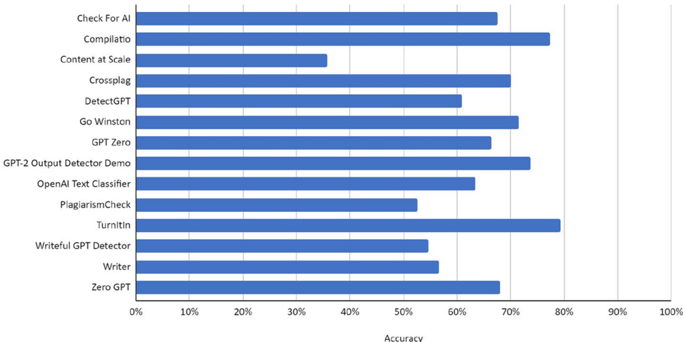
- Across 756 tests, the highest binary-approach accuracy was Turnitin at 76%, followed by Compilatio at 74% and GPT-2 Output Detector Demo at 72%; Content at Scale was lowest at 33%. Turnitin ranked highest across all accuracy approaches, followed by Compilatio and GPT-2 Output Detector.
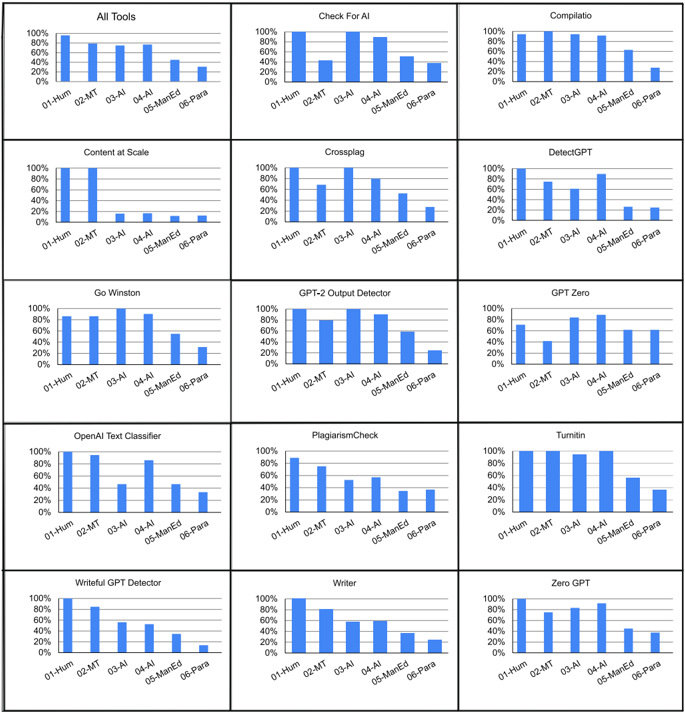
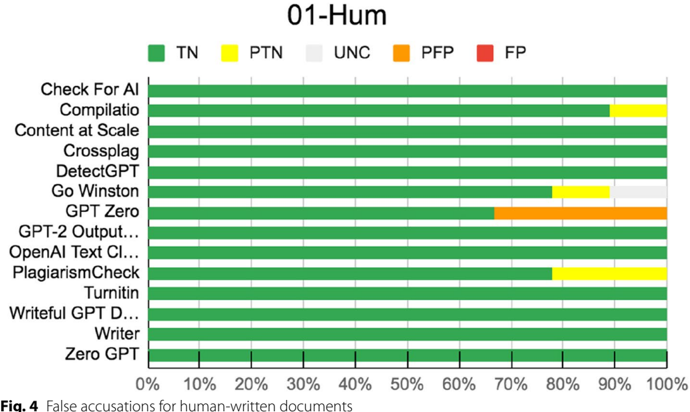
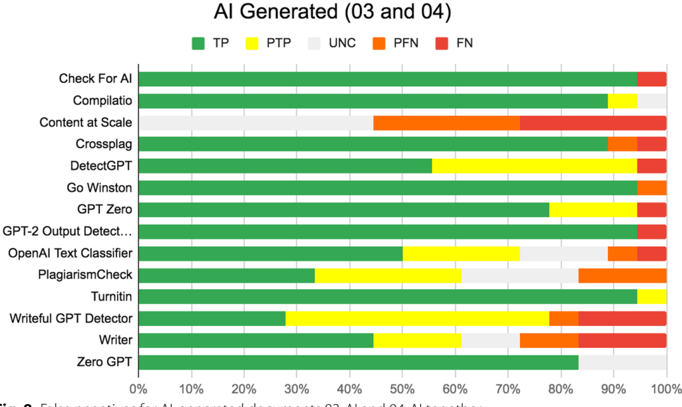
- With the exception of GPT Zero, all tested tools had higher accuracy identifying human-written text than AI-generated or modified text. Overall, approximately 20% of AI-generated texts would likely be misattributed to humans; with obfuscation, approximately 50% would likely be misattributed.
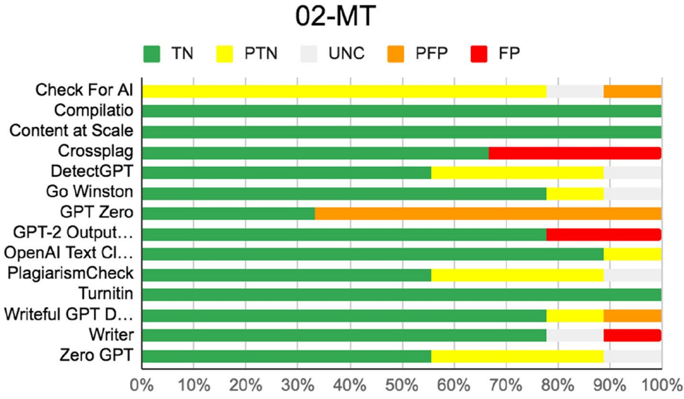
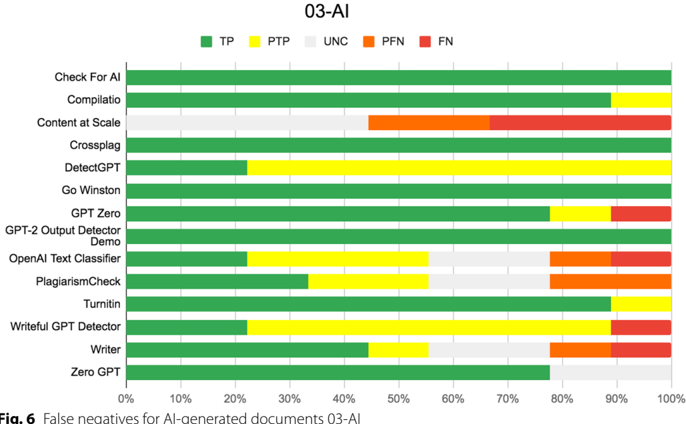
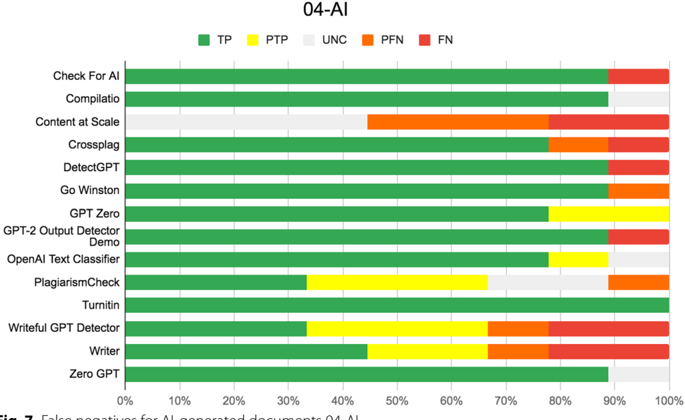
- False-positive probability ranged from 0% (Turnitin) to 50% (GPT Zero); false-negative probability ranged from 8% (GPT Zero) to 100% (Content at Scale).
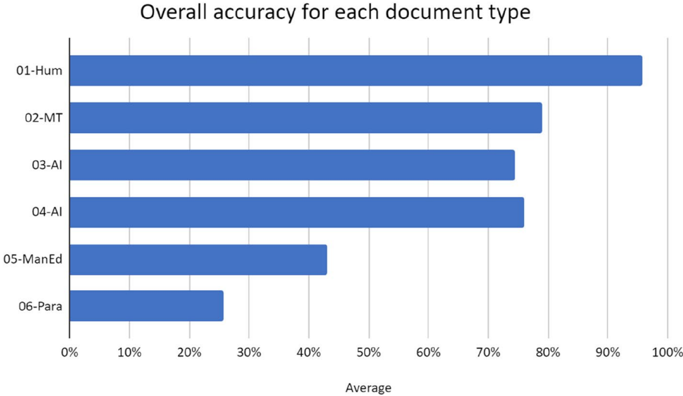
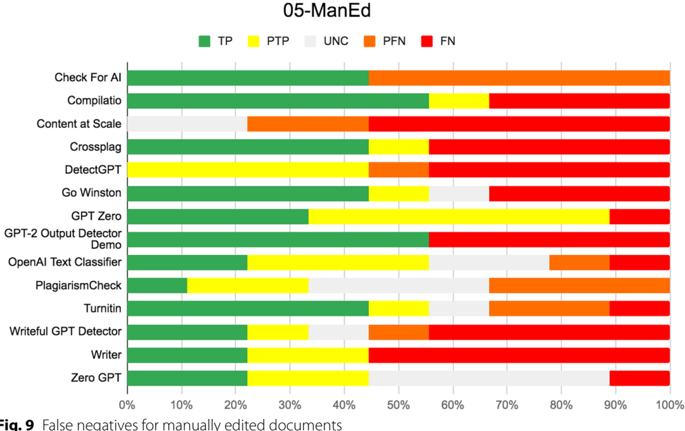
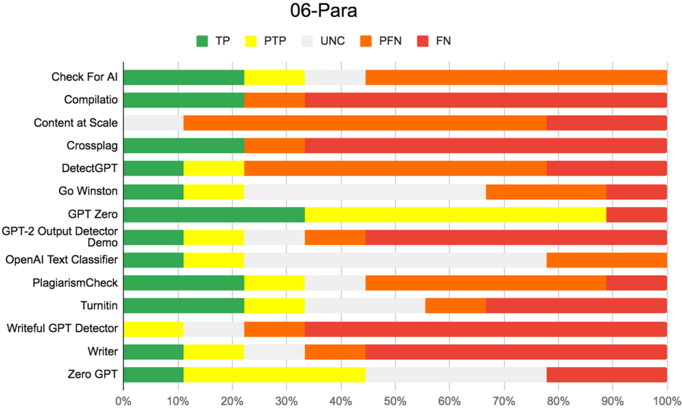
- Machine translation dropped accuracy by 20%; manually edited AI text (05-ManEd) received 42% compared with 74% for unmodified AI cases (03-AI and 04-AI); machine-paraphrased AI text (06-Para) had an overall accuracy of 26%.
Methods
- The researchers created 54 test cases from nine researchers: human-written (01-Hum), human-written then machine-translated (02-MT), ChatGPT-generated (03-AI and 04-AI), ChatGPT-generated then manually edited (05-ManEd), and ChatGPT-generated then machine-paraphrased with Quillbot (06-Para). ChatGPT’s February 13, 2023 model was used; translation used DeepL or Google Translate.
- Fourteen detection tools were tested: 12 publicly available tools plus Turnitin and PlagiarismCheck. Testing occurred March 7–28, 2023, with Turnitin April 14–20 and PlagiarismCheck May 2–8, for 756 total tests.
- Tool outputs were mapped to a five-step classification (TN, PTN, UNC, PFP, FP for human-written; FN, PFN, UNC, PTP, TP for AI-generated). Accuracy was calculated using binary, binary inclusive, semi-binary, and logarithmic approaches; false-positive rate, false-negative rate, recall, and precision were also analyzed.
Limitations
- Stated by the authors: the study focused only on English-language texts; it did not specifically test performance on computer code; it did not systematically examine replicability because results appeared to vary when the same material was tested at different times; and the document set did not test hybrid writing with iterative AI use.
- Evident from the text: the paid tools knew the submitted documents were part of a test suite and could use the entire test document, so their results may differ from free tools; several tools showed beta-stage usability problems, server errors, inconsistent outputs, and unclear result presentation.
- Evident from the text: only one ChatGPT model version and Quillbot’s default settings were used, limiting generalization to other generators or obfuscation settings.
Model-written summary. Check it against the paper before relying on it.
Integrity signals
Registry
Cites
Statistics
Figures
Verification
Claims the paper makes
3 Valid · 13 Not valid · 5 Not checked · 61 Own results and interpretations
Every source the paper cites for this claim was checked and supports it.
In the paper
“As these models are trained on human-written texts, the content generated by these tools can be quite difficult to distinguish from human-written content.”
- Also stated in: § Large language models · p. 3 · plain
“it is capable of creating responses that are hard to distinguish from human-written text (Borji 2023; Brown et al. 2020).”
What the sources say
- Supportedcites Borji 2023 matched to “A Categorical Archive of ChatGPT Failures” (2023) source
The Introduction (p. 1) states that ChatGPT 'is trained on a large corpus of text and is capable of generating new text based on the patterns it has learned from the training data' and that 'Responses in various domains can be so convincing that it becomes difficult to distinguish if they were written by a human or not' — i.e. the training-on-human-text basis plus the indistinguishability point. Section 3.4 Plagiarism reinforces this with 'the challenge of identifying the source of an expertly written ChatGPT essay' and OpenAI developing a tool to distinguish AI-written from human-written text. The only softening is that our copy says 'a large corpus of text' rather than explicitly 'human-written texts', and Section 2.11 notes cues that can reveal non-human authorship (idiom use), but the attributed content is stated in the source. (LLM, conf=0.86)
- Supportedcites Brown et al. 2020 matched to “Language Models are Few-Shot Learners” (2020) source
Section 3.9.4 (p. 26) says much of GPT-3’s generated news-article text was difficult for humans to distinguish from authentic human content. It reports human detection accuracy of about 52%, barely above chance, for articles from the 175B-parameter model. (LLM, conf=0.94)
plain- Asserted: passes — The authors put it forward as true.
- Checkable: passes — It can be checked against evidence.
- Load-bearing: passes — The paper’s conclusions depend on it.
- Based: passes — The paper gives a reason why it holds.
- Also stated in: § Large language models · p. 3 · plain
Every source the paper cites for this claim was checked and supports it.
In the paper
“Although text matching software also suffers from false positives and false negatives (Foltýnek et al. 2020), at least it is possible to provide evidence of potential misconduct.”
What the sources say
- Supportedcites Foltýnek et al. 2020 matched to “Testing of support tools for plagiarism detection” (2020) source
The clause the citation is attached to is stated verbatim in substance by the source: Conclusions and recommendations (bullet 1) says 'all systems suffer from false positives (correctly quoted material counted as similarity) and false negatives (potential sources were not found)', and the Abstract echoes this ('they clearly do not find all plagiarism and at times also identify nonplagiarized material as problematic'; Testing documents notes the set 'also contained original documents to check for possible false positives'). The accompanying point that such software can still yield evidence of potential misconduct is likewise in our copy: Introduction ('The output of such a system is often used as evidence in a disciplinary procedure') and Usability ('The similarity reports ... serve as crucial evidence for decision makers such as honour boards or disciplinary committees'). (LLM, conf=0.90)
hedged- Asserted: passes — The authors put it forward as true.
- Checkable: passes — It can be checked against evidence.
- Load-bearing: passes — The paper’s conclusions depend on it.
- Based: passes — The paper gives a reason why it holds.
- Supported
Every source the paper cites for this claim was checked and supports it.
In the paper
“Our findings are consistent with previously published studies (Gao et al. 2022; Anderson et al. 2023; Elkhatat et al. 2023; Demers 2023; Gewirtz 2023; Krishna et al. 2023; Pegoraro et al. 2023; van Oijen 2023; Wang et al. 2023)”
What the sources say
- Supportedcites Gao et al. 2022 matched to “Comparing scientific abstracts generated by ChatGPT to original abstracts using an artificial intelligence output detector, plagiarism detector, and blinded human reviewers” (2022) source
Our copy is exactly the kind of study the citing sentence invokes: a previously published investigation of AI-generated text detection. The Abstract (p. 1) reports that most ChatGPT-generated medical abstracts were flagged by the 'GPT-2 Output Detector' (median 99.98% 'fake' vs 0.02% for originals, AUROC 0.94) while blinded human reviewers correctly identified 68% of generated abstracts but wrongly flagged 14% of real ones, and the Results/Discussion (p. 2-3) conclude detectors and humans are imperfect discriminators ('AI output detectors may serve as an editorial tool'). The paper does not itself compare its findings to other detection studies, but nothing in our copy contradicts the alignment asserted; the attribution is an identification of this work as a prior detection study, which it is. (LLM, conf=0.85)
- Supportedcites Anderson et al. 2023 matched to “AI did not write this manuscript, or did it? Can we trick the AI text detector into generated texts? The potential future of ChatGPT and AI in Sports & Exercise Medicine manuscript generation” (2023) source
The “Potentially flawed AI detection” section reports that paraphrasing AI-generated essays sharply increased their GPT-2 Output Detector ‘Real’ scores. The paper therefore provides a published finding about AI-generated text detection of the kind the citing sentence invokes; the sentence does not specify a narrower result to check. (LLM, conf=0.86)
- Supportedcites Elkhatat et al. 2023 matched to “Evaluating the efficacy of AI content detection tools in differentiating between human and AI-generated text” (2023) source
The cited paper is a previously published study of AI-generated text detection. Its Conclusion reports variable accuracy across five detection tools, so it supports its use as an example of prior research on the topic. The citing paper’s own assertion that its findings are consistent with that research cannot be assessed from this source alone. (LLM, conf=0.87)
plain- Asserted: passes — The authors put it forward as true.
- Checkable: passes — It can be checked against evidence.
- Load-bearing: unclear — It is unclear whether the paper’s conclusions depend on it.
- Based: passes — The paper gives a reason why it holds.
- Supported
A result the paper reports from its own data — it cites no other source for it, so there is none to check. The quote shows it is in the paper.
In the paper
“Turnitin received the highest score using all approaches to accuracy classification, followed by Compilatio and GPT-2 Output Detector (again in all approaches).”
plain- Asserted: passes — The authors put it forward as true.
- Checkable: passes — It can be checked against evidence.
- Load-bearing: passes — The paper’s conclusions depend on it.
- Based: passes — The paper gives a reason why it holds.
A result the paper reports from its own data — it cites no other source for it, so there is none to check. The quote shows it is in the paper.
In the paper
“The researchers conclude that the available detection tools are neither accurate nor reliable and have a main bias towards classifying the output as human-written rather than detecting AI-generated text.”
plainstates a cause- Asserted: passes — The authors put it forward as true.
- Checkable: passes — It can be checked against evidence.
- Load-bearing: passes — The paper’s conclusions depend on it.
- Based: passes — The paper gives a reason why it holds.
39 more claims
Create a free account to see all 82 claims and to verify the 3 references still open.
- It may state two separate claims as one. 18
- Probably not a substantial claim. 27
Claims other papers make about this one
Each is checked against this paper’s own text: does it say what the citing paper says it does?
The source backs part of the claim, not all of it — or backs it for a different population, condition or comparison.
In the citing paper
“Many early institutional responses to generative AI have emphasized detection tools and misconduct procedures, often more than assessment redesign (Weber-Wulff et al., 2023).”
From Designing AI-resilient assessment in higher education: a four-pillar conceptual framework (2026) · cites this paper as Weber-Wulff et al., 2023
Experimental — accuracy not yet measuredThe source backs part of the claim, not all of it — or backs it for a different population, condition or comparison.
In the citing paper
“many commercially available tools fail to achieve 80% accuracy despite exceptions among a few premium platforms”
From ARE AI DETECTORS FAIR TO EFL LEARNERS? A LIBRARY RESEARCH ON DETECTION BIAS AND ACADEMIC INTEGRITY (2026) · cites this paper as Weber-Wulff et al., 2023
Experimental — accuracy not yet measuredThe source backs part of the claim, not all of it — or backs it for a different population, condition or comparison.
In the citing paper
“The exponential growth of Generative Artificial Intelligence (GAI) and Large Language Models (LLMs) has significantly impacted teaching and learning at all educational levels [1].”
From Generative artificial intelligence in physiotherapy education: great potential amidst challenges- a qualitative interview study (2025) · cites this paper as [1]
Experimental — accuracy not yet measuredThe source backs part of the claim, not all of it — or backs it for a different population, condition or comparison.
In the citing paper
“GPTZero and ZeroGPT produced false-positive rates exceeding 20% on specific samples”
From Designing AI-resilient assessment in higher education: a four-pillar conceptual framework (2026) · cites this paper as Weber-Wulff et al., 2023
Experimental — accuracy not yet measuredThe source backs part of the claim, not all of it — or backs it for a different population, condition or comparison.
In the citing paper
“William H. Walters found that most AI detectors can distinguish papers generated from the GPT3.5 model and human-written papers but fail to identify papers generated from the recent GPT-4 model [138].”
From Survey on Plagiarism Detection in Large Language Models: The Impact of ChatGPT and Gemini on Academic Integrity (2024) · cites this paper as [138]
Experimental — accuracy not yet measured
51 more claims about this paper
Create a free account to see every claim other papers make about this one.
Self-check
Percentages, sums and reported differences re-computed from the paper’s own numbers.
Each contradiction between two passages listed here was confirmed by an independent check.
Rated minor: it would not touch a result — a value no result rests on, a p-value that stays on the same side of the significance level, or a conflict that is clerical, resolved elsewhere in the paper, or outside its own findings.
In the paper
“Note that the maximum value for each cell is now 9 * 16 = 864.”
Reported 864 · recomputed 144
Rated minor: it would not touch a result — a value no result rests on, a p-value that stays on the same side of the significance level, or a conflict that is clerical, resolved elsewhere in the paper, or outside its own findings.
In the paper
§ Abbreviations · p. 36
“04-AI AI-generated text with subsequent human manual edits”
§ Test cases · p. 9
“One set (05-ManEd) was edited manually with a human exchanging some words with synonyms or reordering sentence parts”
Rated minor: it would not touch a result — a value no result rests on, a p-value that stays on the same side of the significance level, or a conflict that is clerical, resolved elsewhere in the paper, or outside its own findings.
In the paper
§ Accuracy · p. 15
“Turnitin received the highest score using all approaches to accuracy classification, followed by Compilatio and GPT-2 Output Detector (again in all approaches).”
§ Accuracy · p. 13
“| GPT Zero | 6 | 3 | 8 | 9 | 8 | 8 | 42 | 78% | 3 |”
Rated minor: it would not touch a result — a value no result rests on, a p-value that stays on the same side of the significance level, or a conflict that is clerical, resolved elsewhere in the paper, or outside its own findings.
In the paper
§ False accusations: harm to individual students · p. 20
“For GPT Zero, half of the positive classifications would be false accusations”
§ Precision · p. 18
“| Prec_incl | 96% | 100% | -- | 88% | 100% | 100% | 79%”
Citations
Cites
Vaswani, A., Shazeer, N., Parmar, N., Uszkoreit, J., Jones, L., Gomez, A. N., Kaiser, L., & Polosukhin, I. (2017) · arXiv · doi:10.48550/arxiv.1706.03762 · Cited by 120,404
BERT: Pre-training of Deep Bidirectional Transformers for Language Understanding
Devlin, J., Chang, M.-W., Lee, K., & Toutanova, K. (2018) · arXiv · doi:10.48550/arxiv.1810.04805 · Cited by 73,173
BERT: Pre-training of Deep Bidirectional Transformers for Language Understanding
Devlin, J., Chang, M.-W., Lee, K., & Toutanova, K. (2019) · Proceedings of the 2019 Conference of the North American Chapter of the Association for Computational Linguistics: Human Language Technologies, Volume 1 (Long and Short Papers) · doi:10.18653/v1/n19-1423 · Cited by 54,325
Efficient Estimation of Word Representations in Vector Space
Mikolov, T., Chen, K., Corrado, G., & Dean, J. (2013) · arXiv · doi:10.48550/arxiv.1301.3781 · Cited by 26,568 · cited 1×
“Efficient methods for the estimation of word representations in multidimensional vector spaces (Mikolov et al., 2013), together with the attention mechanism and transformer architecture (Vaswani et al., 2017) made generating human-like text not only possible, but also computationally feasible.”
MethodLanguage Models are Few-Shot Learners
Brown, T. B., Mann, B., Ryder, N., Subbiah, M., Kaplan, J., Dhariwal, P., Neelakantan, A., Shyam, P., Sastry, G., Askell, A., et al. (2020) · arXiv · doi:10.48550/arxiv.2005.14165 · Cited by 23,372 · cited 2×
“This was in many ways a game-changer, as it is capable of creating responses that are hard to distinguish from human-written text (Borji, 2023; Brown et al., 2020).”
BackgroundKaugeranna, R., Kaugeranna, E., & Aion, (. S. 4. 6. (2023) · DROPS (Schloss Dagstuhl – Leibniz Center for Informatics) · doi:10.4230/lipics.giscience.2023.43 · Cited by 13,690
On the Dangers of Stochastic Parrots: Can Language Models Be Too Big? 🦜
Bender, E. M., Gebru, T., McMillan-Major, A., & Shmitchell, S. (2021) · Proceedings of the 2021 ACM Conference on Fairness, Accountability, and Transparency · doi:10.1145/3442188.3445922 · Cited by 6,988 · cited 1×
“We understand LLMs as systems trained to predict the likelihood of a specific character, word, or string (called a token ) in a particular context (Bender et al., 2021).”
BackgroundGao, C. A., Howard, F. M., Markov, N. S., Dyer, E. C., Ramesh, S., Luo, Y., & Pearson, A. T. (2022) · doi:10.1101/2022.12.23.521610 · Cited by 1,099 · cited 1×
“…was able to make an excellent distinction between original and generated abstracts because the majority of the original abstracts were scored extremely low (corresponding to human-written content) while the detector found a high probability of AI-generated text in the majority (33 abstracts)…”
BackgroundGao, C. A., Howard, F. M., Markov, N. S., Dyer, E. C., Ramesh, S., Luo, Y., & Pearson, A. T. (2023) · npj Digital Medicine · doi:10.1038/s41746-023-00819-6 · Cited by 1,099
Two decades of statistical language modeling: where do we go from here?
Rosenfeld, R. (2000) · Proceedings of the IEEE · doi:10.1109/5.880083 · Cited by 735
Research works printed but not linked: 2
- Clarke R, Lancaster T. (2006). Eliminating the successor to plagiarism? Identifying the usage of contract cheating sites. Proceedings of 2nd International Plagiarism Conference Newcastle, UK, 14
- ICML. (2023). ICML 2023 Call For Papers, Fortieth International Conference on Machine Learning. https:// icml. cc/ Confe rences/ 2023/ CallF orPap ers. Accessed 14 June 2023
Cited by
Items 101–200 of 568
Beyond the virtual classroom: integrating artificial intelligence in online learning
Correia, A., Hickey, S., & Xu, F. (2024) · Distance Education · doi:10.1080/01587919.2024.2338706 · Cited by 22
“As educators engage with students to address these concerns, AI-detection tools have emerged, claiming to be able to identify ChatGPT-generated content (Weber-Wulff et al., 2023).”
Striking the Balance in Using LLMs for Fact-Checking: A Narrative Literature Review
Dierickx, L., van Dalen, A., Opdahl, A. L., & Lindén, C. (2024) · Lecture notes in computer science · doi:10.1007/978-3-031-71210-4_1 · Cited by 26
Who wrote this? Evaluating the reliability of AI detection tools in higher education
Van Vlasselaer, M., Van Droogenbroeck, F., & Spruyt, B. (2026) · International Journal for Educational Integrity · doi:10.1007/s40979-026-00226-w · Cited by 14
“Similarly, Weber-Wulff et al. (2023) also highlighted serious limitations of current AI-generated text detection tools, noting inconsistent results, high rates of false positives and negatives, and their unsuitability as sole evidence in academic misconduct cases.”
InfluentialSebihi, A., Schoelen, L., & Uwamwezi, B. (2025) · Discover Education · doi:10.1007/s44217-025-00576-6 · Cited by 13
Can generative AI Be an effective Co-Teacher? An experiment
Niloy, A. C., Akter, S., Sultana, J., Rahman, M. A., Sultana, N., Islam, T., Isha, N. J., Afroz, M., Zabeen, M., Tabassum, M., et al. (2025) · Computers and Education Artificial Intelligence · doi:10.1016/j.caeai.2025.100418 · Cited by 21
Earp, B. D., Frith, L., Mann, S. P., Sawai, T., Shahvisi, A., & Wangmo, T. (2026) · Journal of Medical Ethics · doi:10.1136/jme-2026-112179 · Cited by 16
“19 And although we do not specifically encourage the use of AI tools to edit and/ or generate text in manuscripts submitted to JME - family journals, nor do we forbid such use—provided that the conditions in Box 4 are adhered to.”
Eaton, S. E. (2024) · International Journal for Educational Integrity · doi:10.1007/s40979-024-00175-2 · Cited by 29
“Then, I go on to explain that research has shown that detection tools for AI generated text are limited at best and should be avoided (for the evidence base for this, see Gegg-Harrison 2023; Roe and Perkins 2022; Weber-Wulff et al. 2023).”
Exploring Academic Integrity in the Age of Generative AI
Ward, A., Manoharan, S., & Ye, X. (2024) · International Conference on Information Technology Based Higher Education and Training (ITHET) · doi:10.1109/ithet61869.2024.10837603 · Cited by 20
Eacersall, D. C. F., Pretorius, L., Smirnov, I., Spray, E., Illingworth, S., Chugh, R., Strydom, S. C., Stratton-Maher, D., Simmons, J. S., Jennings, I., et al. (2025) · Journal of Applied Learning & Teaching · doi:10.37074/jalt.2025.8.2.9 · Cited by 45
The citation catastrophe: Propagation of AI-generated counterfeit citations in scholarship
Camp, N. T., Bengtson, J. A., & Sandstrom, J. C. (2025) · The Journal of Academic Librarianship · doi:10.1016/j.acalib.2025.103065 · Cited by 12
Day, T., Gonzalez, M., Kim, J., McDaniel, P. N., Redican, K., & Zhu, T. (2025) · The Professional Geographer · doi:10.1080/00330124.2025.2478075 · Cited by 14
Detecting contract cheating through linguistic fingerprint
Kutbi, M., Al‐Hoorie, A. H., & Al-Shammari, A. H. (2024) · Humanities and Social Sciences Communications · doi:10.1057/s41599-024-03160-9 · Cited by 19
“Available tools designed to detect AI texts have shown poor accuracy and reliability as well as a bias toward classifying texts as human-written (Weber-Wulff et al. 2023).”
Abubakari, M. S. (2024) · Advances in educational technologies and instructional design book series · doi:10.4018/979-8-3693-0884-4.ch013 · Cited by 14
Pimbblet, K. A., & Morrell, L. J. (2024) · European Journal of Physics · doi:10.1088/1361-6404/ad9874 · Cited by 20
AI disclosure, moral shame, and the punishment of honesty
Bao, A., & Zeng, Y. (2025) · Accountability in Research · doi:10.1080/08989621.2025.2542197 · Cited by 27
“However, given the current academic paper publication process, there is no reliable method to verify whether an author has used AI, leading to an imbalance in practice (Saha and Feizi 2025; Weber-Wulff et al. 2023).”
An Applied Statistics dataset for human vs AI-generated answer classification
Salim, M. S., & Hossain, S. I. (2024) · Data in Brief · doi:10.1016/j.dib.2024.110240 · Cited by 16
“Generic AI-detector tools do not perform well on domain-specific tasks [ 3–5 ], and preparing a subject-specific human-annotated dataset is tedious.”
BackgroundBordalejo, B., Pafumi, D., Onuh, F., Khalid, A. K. M. I., Pearce, M. S., & O’Donnell, D. P. (2025) · International Journal of Educational Technology in Higher Education · doi:10.1186/s41239-025-00505-5 · Cited by 13
“While these AI-powered writing tools offer great benefits, they have also introduced new challenges in academic settings, particularly in the assessment of student work (Adams & Chuah, 2022; Baidoo-Anu & Ansah, 2023; Debora et al., 2023; Giray, 2024; Lambert & Stevens, 2023; Perkins et al., 2023).”
Sun, Y., Liao, Y., & Ma, X. (2026) · Computers & Education · doi:10.1016/j.compedu.2026.105616 · Cited by 31
Singh, A., Sharma, D., Nandy, A., & Singh, V. K. (2023) · Natural Language Processing Journal · doi:10.1016/j.nlp.2023.100050 · Cited by 19
Universities are embracing AI: will students get smarter or stop thinking?
Pearson, H. (2025) · Nature · doi:10.1038/d41586-025-03340-w · Cited by 10
Cheng, A., Lin, Y., Reedy, G. B., Joseph, C., Wirkowski, S., Mallette, V., Nagesh, V., Krieser, D., & Calhoun, A. W. (2025) · Advances in Simulation · doi:10.1186/s41077-025-00396-6 · Cited by 31
“Weber et al. assessed 14 different AI detection tools, and found the overall accuracy ranged from 43–81%, with a bias towards classifying output as human written over detection of AI-generated text (i.e. false negatives) [10].”
InfluentialMurch, H. E., Worley, M., & Volk, F. A. (2025) · Journal of Academic Ethics · doi:10.1007/s10805-025-09634-y · Cited by 14
“Some AI detection tools had high rates of false positives (i.e., classifying a human-written text as AI generated), but Turnitin had zero false positives for the 54 test cases analyzed (Weber-Wulff et al., 2023).”
InfluentialDigital plastic: a metaphorical framework for Critical AI Literacy in the multiliteracies era
Roe, J., Furze, L., & Perkins, M. (2025) · Pedagogies An International Journal · doi:10.1080/1554480x.2025.2557491 · Cited by 31
“We cannot rely on technology to save us from the infiltration of these GenAI outputs into online spaces, as research has shown that attempts at AI detection (at least for textual outputs) are inaccurate and unreliable (Perkins, Roe, et al., 2024, 2024; Weber-Wulff et al., 2023).”
Ah‐Pine, E. N., & Awuye, I. S. (2025) · Journal of International Education in Business · doi:10.1108/jieb-09-2024-0123 · Cited by 14
Assessing EFL students’ GenAI-assisted writing: Teachers’ pains, perceptions and practices
Chen, X., & Pi, X. (2025) · Assessing Writing · doi:10.1016/j.asw.2025.100996 · Cited by 20
van Rensburg, Z. J., & van der Westhuizen, S. (2024) · Advances in educational technologies and instructional design book series · doi:10.4018/979-8-3693-1054-0.ch002 · Cited by 15
Gotcha GPT: Ensuring the Integrity in Academic Writing
Gralha, J. G., & Pimentel, A. S. (2024) · Journal of Chemical Information and Modeling · doi:10.1021/acs.jcim.4c01203 · Cited by 15
Burke, H. H., Kazinka, R., Gandhi, R., & Murray, A. (2024) · Academic Psychiatry · doi:10.1007/s40596-024-02080-9 · Cited by 10
“For example, applicants who speak English as a second language might have a higher likelihood for false detection due to differences in syntax and vocabulary compared to a native speaker [17].”
Hitches, E., Dudley, D. A., Johnstone, M., & Woodcock, S. (2024) · Quality & Quantity · doi:10.1007/s11135-024-02001-w · Cited by 19
“As with these measures in place in education through software such as Turni-tin™ (Weber-Wulff et al. 2023), they are not definitive, but are indicative, and variables within the software to communicate these indicators could direct researchers to those responses which are most likely suspicious.”
InfluentialAgarwal, S., Kweh, Q. L., Jamali, D., Wider, W., Hossain, S. F. A., & Fauzi, M. A. (2025) · Discover Sustainability · doi:10.1007/s43621-025-01480-7 · Cited by 21
“Weber-Wulff et al. [89] and Bock et al. [15] highlight the risk of bypassing essential methodological training in favor of AI-led shortcuts.”
How to Use Generative AI in Educational Research
Roe, J. (2025) · Cambridge University Press eBooks · doi:10.1017/9781009675338 · Cited by 23
Pudasaini, S., Miralles-Pechuán, L., Lillis, D., & Salvador, M. L. (2024) · arXiv · doi:10.48550/arxiv.2407.13105 · Cited by 8
“Findings from Weber-Wulf et al. [139] experiment on fooling 12 publicly available AIGC detectors and two commercial systems, Turnitin and PlgairismCheck, mostly used by universities by applying evasion techniques like translation and paraphrasing, suggested that a reliable solution for AIGC…”
MethodAI detecting AI in academic writing: Why most AI detector findings are false
Tsigaris, P., & Teixeira da Silva, J. A. (2026) · Next Research · doi:10.1016/j.nexres.2026.101396 · Cited by 11
The art of deception: humanizing AI to outsmart detection
Ayub, T., Malla, R. A., Khan, M. Y., & Ganaie, S. A. (2024) · Global Knowledge, Memory and Communication · doi:10.1108/gkmc-03-2024-0133 · Cited by 15
Covington, N. V., & Vruwink, O. (2024) · International Journal of Artificial Intelligence in Education · doi:10.1007/s40593-024-00427-9 · Cited by 12
“…by both students (Holland & Ciachir, 2024) and faculty (Mamo et al., 2024); however, investigations involving plagiarism detection software suggest that existing plagiarism detection tools are not sufficient to accurately identify AI-gener-ated responses (Walters, 2023; Weber-Wulff et al., 2023).”
Gupta, V., & Gupta, C. (2024) · Computer · doi:10.1109/mc.2024.3445068 · Cited by 10
Borderline Disaster: An Empirical Study on Student Usage of GenAI in a Law Assignment
Alimardani, A. (2025) · IEEE Transactions on Technology and Society · doi:10.1109/tts.2025.3540978 · Cited by 18
“Without reliable tools to detect AI-generated content [9], [10], [11], [12], students who exploit GenAI as a means of cheating [13], [14] may achieve unjus-tified academic success compared to their peers, undermining the principles of academic fairness.”
Understanding PSE students’ reactions to the postplagiarism concept: a quantitative analysis
Kumar, R. (2025) · International Journal for Educational Integrity · doi:10.1007/s40979-025-00182-x · Cited by 20
Vindigni, G. (2025) · European Journal of Applied Science Engineering and Technology · doi:10.59324/ejaset.2025.3(3).06 · Cited by 22
Machine Learning and Watermarking for Accurate Detection of AI-Generated Phishing Emails
Brissett, A., & Wall, J. A. (2025) · Electronics · doi:10.3390/electronics14132611 · Cited by 16
Tikhonova, N., & Pomortseva, N. P. (2025) · Высшее образование в России · doi:10.31992/0869-3617-2025-34-6-112-135 · Cited by 16
Local AI Governance: Addressing Model Safety and Policy Challenges Posed by Decentralized AI
Sokhansanj, B. A. (2025) · AI · doi:10.3390/ai6070159 · Cited by 17
DeLuca, C., Volante, L., & Holden, M. (2025) · Educational Researcher · doi:10.3102/0013189x251385537 · Cited by 16
“Just as it is ethi-cally indefensible for teachers to rely on AI tools to prove academic misconduct (Elkhatat et al., 2023; Weber-Wulff et al., 2023), student work needs to be distinct from the outputs of AI applications for it to be ethically considered representative of actual student learning.”
Memarian, B., & Doleck, T. (2025) · SN Computer Science · doi:10.1007/s42979-025-04569-y · Cited by 21
“Within this code, detection products and processes were examined the most [78–81].”
InfluentialMtotywa, M. M., Mowers, J.-L., Ndou, W., Moleko, T. V. Q., & Ledwaba, M. (2026) · Informatics · doi:10.3390/informatics13030043 · Cited by 16
Robustness of generative AI detection: adversarial attacks on black-box neural text detectors
Fishchuk, V., & Braun, D. (2024) · International Journal of Speech Technology · doi:10.1007/s10772-024-10144-2 · Cited by 7
“Habibzadeh (2023) reports an accuracy of 0.80 for the detector, while Weber-Wulff et al. (2023) report an accuracy of only 54% for the very same tool.”
InfluentialBattle of the authors: Comparing neurosurgery articles written by humans and AI
Akgün, M. Y., Savasci, M., Günerbüyük, C., Günara, S. O., Öktenoğlu, T., Özer, A. F., & Ateş, Ö. (2025) · Journal of Clinical Neuroscience · doi:10.1016/j.jocn.2025.111152 · Cited by 13
Ed-Dali, R. (2025) · Cogent Arts and Humanities · doi:10.1080/23311983.2025.2531183 · Cited by 14
“Therefore, students must be aware of when to depend on ai and when to intervene with their judgment. ai-generated translations, despite their progress, may still exhibit inaccuracies (Weber-Wulff et al., 2023).”
Artificial Intelligence in Educational Technology: A Systematic Review of Datasets and Applications
Topham, L., Atherton, P., Reynolds, T., Hussain, Y., Hussain, A. J., Kolivand, H., & Khan, W. (2025) · ACM Computing Surveys · doi:10.1145/3768312 · Cited by 20
“Unlike traditional chatbots, which use tree-based pre-generated responses, generative models have a significantly more extensive range of responses for broader topics.”
Understanding Reader Perception Shifts upon Disclosure of AI Authorship
Nakano, H., Takezawa, J., Matulic, F., Yang, C.-L., & Yatani, K. (2026) · ACM International Conference on Intelligent User Interfaces (IUI) · doi:10.1145/3742413.3789076 · Cited by 27
Practical wisdom, emerging technologies, and AI
McLoughlin, S., Espinosa, V. F., & Gil, M. V. (2026) · Journal of Moral Education · doi:10.1080/03057240.2026.2624863 · Cited by 10
Comparison of algorithms for the recognition of ChatGPT paraphrased texts
Kartelj, A., Mladenović, M., & Stanković, S. V. (2025) · Journal Of Big Data · doi:10.1186/s40537-025-01082-0 · Cited by 13
Kabanda, M. (2025) · EIKI Journal of Effective Teaching Methods · doi:10.59652/jetm.v3i1.404 · Cited by 29
Prevention and Detection of Plagiarism in Higher Education: Paper Mills, Online Assessments and AI
Cortinhas, C., & Deák, S. (2023) · doi:10.53593/n3688a · Cited by 8
Shin, M., & Kim, J. (2024) · SSRN Electronic Journal · doi:10.2139/ssrn.4725351 · Cited by 7
(2025) · Journal of Applied Learning & Teaching · doi:10.37074/jalt.2025.8.1.20 · Cited by 7
Generative AI in Student Essays: English Teachers' Perspectives on Effective Assessment Methods
Lukianenko, V., & Kornieva, Z. (2024) · XLinguae · doi:10.18355/xl.2024.17.04.14 · Cited by 7
Qorich, M., & El Ouazzani, R. (2025) · Expert Systems with Applications · doi:10.1016/j.eswa.2025.128405 · Cited by 6
Schneider, D. M., Mishra, A., Gluski, J. M., Shah, H., Ward, M., Brown, E. D. L., Sciubba, D. M., & Lo, S.-F. L. (2025) · Cureus · doi:10.7759/cureus.79086 · Cited by 19
“Ippolito et al. (2020) observed that perplexity-based detectors can achieve a sensitivity of approximately 80%, a specificity of 90%, and a false positive rate of 10% [18], though more recent investigations have suggested lower values [19].”
Rosenthal, J., Hafferty, F. W., Kulasegaram, K., Wendland, C., & Taylor, J. S. (2025) · Academic Medicine · doi:10.1097/acm.0000000000005964 · Cited by 8
In the wake of ChatGPT: early reflections on marking open-book online accounting assessments
Dosumu, O. E., Porumb, V., Stafford, A., & Zimmer, A. (2025) · Accounting Education · doi:10.1080/09639284.2025.2487487 · Cited by 16
Barrot, J. S., & Aranda, M. R. R. (2025) · Technology Knowledge and Learning · doi:10.1007/s10758-025-09884-0 · Cited by 20
Han, J., Yang, Y., & Liu, G. (2025) · European Journal of Education · doi:10.1111/ejed.70240 · Cited by 13
Miao, W., Zang, H., Liu, Q., Zheng, T., Zhou, Y., Liu, C., Yang, N., Zhang, H., Zhang, Y., Zhang, Y., et al. (2025) · BMC Medical Ethics · doi:10.1186/s12910-025-01288-0 · Cited by 10
“Current detection tools demonstrate limited accuracy and reliability [29].”
'There Has To Be a Lot That We're Missing': Moderating AI-Generated Content on Reddit
Lloyd, T., Reagle, J., & Naaman, M. (2025) · Proceedings of the ACM on Human-Computer Interaction · doi:10.1145/3757445 · Cited by 40
Glynn, A. (2026) · Lecture notes in networks and systems · doi:10.1007/978-3-032-32729-1_19 · Cited by 22
Mapping the Contours: Utopic and Dystopic Perspectives on the Use of AI in Higher Education
Sarkar, S., & Kumar, R. (2024) · Canadian Perspectives on Academic Integrity · doi:10.55016/ojs/cpai.v7i4.78308 · Cited by 9
Shalevska, E., & Kostadinovska-Stojchevska, B. (2024) · Učitel/Teacher · doi:10.20544/teacher.27.08 · Cited by 17
Tang, B. L. (2024) · Science Editing · doi:10.6087/kcse.346 · Cited by 10
“…the prohibited or undeclared use of AI tools for writing as “unauthorized content generation” rather than as plagiarism as such [2], and the researcher Deborah Weber-Wulff was quoted as opin-ing that “plagiarism, for me, would have things that are attributable to another, identifiable person ” [3].”
BackgroundAnderson, J. E., Nguyen, C. A., & Hughes, M. Ü. (2025) · Journal of International Education in Business · doi:10.1108/jieb-07-2024-0081 · Cited by 12
Be AIware! An AI Competency Model for K-12 Education
Sattelmaier, L., & Pawlowski, J. Μ. (2025) · Social Sciences & Humanities Open · doi:10.1016/j.ssaho.2025.101838 · Cited by 13
What Does YouTube Advise Students About Bypassing AI-Text Detection Tools? A Pragmatic Analysis
Foltýnek, T., & Newton, P. M. (2025) · Journal of Academic Ethics · doi:10.1007/s10805-025-09675-3 · Cited by 7
“Tools for the detection of AI-generated text are unreliable (Weber-Wulff et al. 2023), and easily bypassed (Perkins et al., 2024 ).”
Self-citationUnderstanding AI Disclosure Needs for News Production and Journalism
Venkatraj, K. P., Morosoli, S., Cools, H., Naudts, L., de Vreese, C. H., Helberger, N., Cesar, P. S., & Ali, A. E. (2025) · International Conference on Mobile and Ubiquitous Multimedia (MUM) · doi:10.1145/3771882.3771899 · Cited by 9
Pretorius, M., & Thewissen, J. (2026) · Journal of Second Language Writing · doi:10.1016/j.jslw.2026.101286 · Cited by 22
Japanese University EFL Student Insights on the Emerging ChatGPT Phenomenon
Price, G. (2024) · International Journal of Education Learning and Development · doi:10.37745/ijeld.2013/vol12n583100 · Cited by 5
“Furthermore, the use of AI detectors to point out AI-generated writing in student assignments is currently struggling to keep up with GenAI ranging in detection ability from fairly accurate to fair guess (Krishna et al., 2023; Price & Sakellarios, 2023; Walters, 2023; Weber-Wulff et al., 2023).”
Have students’ perceptions of cheating changed post-pandemic?
Felski, E. A. (2025) · Studies in Higher Education · doi:10.1080/03075079.2024.2437057 · Cited by 10
A Deep Learning Approach for Paragraph-Level Paraphrase Generation for Plagiarism Detection
Saqaabi, A. A., Stewart, C. D., Akrida, E. C., & Cristea, A. I. (2025) · Neural Processing Letters · doi:10.1007/s11063-025-11771-9 · Cited by 7
Technological Change and Its Effect on Education
(2024) · Journal of Educational & Psychological Research · doi:10.33140/jepr.06.01.04 · Cited by 11
Comparison of Machine Learning and Deep Learning Models for Detecting Cyberbullying
Lo, K. A., Joe, C. B., Philip, S., & Hidayaturrahman, H. (2024) · International Visualization, Informatics and Technology Conference (IVIT) · doi:10.1109/ivit62102.2024.10692892 · Cited by 8
Alencar‐Palha, C., Ocampo, T. S. C., Silva, T. P., Neves, F. S., & Oliveira, M. L. (2024) · European Journal Of Dental Education · doi:10.1111/eje.13057 · Cited by 8
Porto, J. R., Morgan, K. A., Hecht, C. J., Burkhart, R. J., & Liu, R. W. (2024) · Journal of the American Academy of Orthopaedic Surgeons · doi:10.5435/jaaos-d-24-00084 · Cited by 9
Editorial policies for use and acknowledgment of artificial intelligence in dental journals
de Queiroz, A. B. L., Sartori, L. R. M., Lima, G. D. S., & Moraes, R. R. (2025) · Journal of Dentistry · doi:10.1016/j.jdent.2025.105923 · Cited by 9
Ibrahim, K. H. S., Al Otaibi, D., & Sibai, F. N. (2025) · International Journal of Computer-Assisted Language Learning and Teaching · doi:10.4018/ijcallt.375428 · Cited by 5
AI humanizers and the crisis of information integrity: implications for scientific writing
Giray, L. (2026) · Naunyn-Schmiedeberg's Archives of Pharmacology · doi:10.1007/s00210-026-05200-4 · Cited by 5
“By introducing controlled imperfections and stylistic variability, AI human-izers obscure the provenance of information and sever the traceability that academic institutions rely upon to establish authenticity and credibility (Weber-Wulff et al. 2023).”
Александровна, М. Н., & Nikitina, A. S. (2025) · Semiotic studies · doi:10.18287/2782-2966-2025-5-2-122-133 · Cited by 7
Thi, X. H. N., Thien, H. V. H., Nhung, V. K., & Nguyen, T. T. (2025) · Discover Education · doi:10.1007/s44217-025-00905-9 · Cited by 28
“The main drawbacks are overreliance, limitation of critical thinking skills [27], problems with plagiarism [32, 40, 54], and information inaccuracy [7, 15, 26, 30, 36, 41].”
Tran, K. V., Le, M. T. T., & Pham, A. T. (2025) · International Journal for Educational Integrity · doi:10.1007/s40979-025-00207-5 · Cited by 10
“Moreover, AI detection tools cannot provide fully reliable and persuasive results when it comes to distinguish between human-writ-ten texts and AI-generated texts, as noted in several recent studies (Elkhatat 2023; Wal-ters 2023; Weber-Wulff et al. 2023).”
David, Y. B.-B., Yosef, R., & Segev, E. (2026) · Science Communication · doi:10.1177/10755470251411176 · Cited by 4
“…linguistics studies attempting to detect AI-generated text have revealed challenges in distinguishing AI-assisted from human writing, particularly after iterative revision (Weber-Wulff et al., 2023; Yildiz Durak et al., 2025), underscoring broader questions about authenticity and accountability.”
Makhmutova, A., Sharimbayev, B., Amirzhanov, A., & Shalkarbay-uly, A. (2026) · Journal of Advances in Information Technology · doi:10.12720/jait.17.3.438-449 · Cited by 9
“Fourth, multilingual detection remains underdeveloped: GPTZero failed on machine-translated texts [3], and Weber-Wulff et al. [18] reported accuracy drops of 20% on translated samples, while Gundersen [24] found that LLM-based detectors achieved only ~50% accuracy on Norwegian texts, illustrating…”
AI and the Future of Publishing: Not Detection, but Answerability
Floridi, L. (2026) · Philosophy & Technology · doi:10.1007/s13347-026-01148-8 · Cited by 8
“…Weber-Wulff and colleagues found that none of them reliably dis - tinguishes ChatGPT output from human writing, even after minimal manual editing or machine paraphrasing is applied; the tools also exhibit a marked bias towards clas - sifying outputs as human-written (Weber-Wulff et al., 2023).”
Tammeleht, A., & Löfstrôm, E. (2025) · International Journal for Educational Integrity · doi:10.1007/s40979-025-00192-9 · Cited by 6
“A comprehensive study by Weber-Wulff et al. (2023) tested four-teen detection tools for AI-generated texts.”
AI vs Human Text Detector: Identifying AI-Generated Content Using NLP
Reddy, C. R. A., Muthukumar, D., Thogai Rani, B., Ganesh, N., Rafi, S. M., & Vamsi, P. (2025) · International Conference Intelligent Data Communication Technologies and Internet Things · doi:10.1109/icici65870.2025.11069552 · Cited by 6
“This identified a loophole in the consistency of current detection systems [11].”
AI-Generated Code Detection: An Examination of Current Tools in Education
Argotty, J. E. C., & Manrique, R. (2025) · Lecture notes in computer science · doi:10.1007/978-3-031-98281-1_15 · Cited by 8
Crockett, R., & Howe, R. (2024) · Advances in Educational Marketing, Administration, and Leadership · doi:10.4018/979-8-3693-0240-8.ch010 · Cited by 4
Identifying Whether a Short Essay was written by a University Student or ChatGPT
Saarna, C. (2024) · International Journal of Technology in Education · doi:10.46328/ijte.773 · Cited by 7
“It should be concluded then that both humans (Gao et al., 2023; Waltzer et al., 2023) and AI detectors (Weber-Wulff et al., 2023) are unable to reliably detect AI generated content.”
BackgroundResultGoddiksen, M. P., Johansen, M. W., Armond, A. C. V., Centa, M., Clavien, C., Gefenas, E., Kovács, N., Merit, M. T., Olsson, I. A. S., Poškutė, M., et al. (2024) · International Journal for Educational Integrity · doi:10.1007/s40979-024-00162-7 · Cited by 8
“However, when it comes to detecting AI-generated material, the software plays a much more central role, as the score indicating the probability that a given passage is AI-generated is a crucial part of the evidence (Weber-Wulff et al. 2023).”
BackgroundLin, C.-S. (2025) · The Journal of Supercomputing · doi:10.1007/s11227-024-06882-4 · Cited by 9
Deterrence and Generative Artificial Intelligence Use in Universities
Nazareth, D. L., & Choi, J. H. (2025) · Journal of Computer Information Systems · doi:10.1080/08874417.2025.2492205 · Cited by 6
Improving Harmful Text Detection with Joint Retrieval and External Knowledge
Yu, Z., Wang, S., Jiang, N., Huang, W., Han, X., & Du, J. (2025) · International Seminar on Artificial Intelligence, Networking and Information Technology (AINIT) · doi:10.1109/ainit65432.2025.11035218 · Cited by 6
“Users increasingly rely on content provided by large language models in search engines, social media, online education, medical consultation, and other scenarios [6].”
Metadata
- Authors
- Weber-Wulff, D., Anohina-Naumeca, A., Bjelobaba, S., Foltýnek, T., Guerrero-Dib, J., Popoola, O., Šigut, P., & Waddington, L.
- Affiliations
- HTW Berlin - University of Applied Sciences (DE)
- Riga Technical University (LV)
- Uppsala University (SE)
- Masaryk University (CZ)
- University of Monterrey (MX)
- Queen Mary University of London (GB)
- University of Leeds (GB)
- Corresponding author
- Bjelobaba, Sonja
- ORCID
- Venue
- International Journal for Educational Integrity
- Published
- 2023-12-25
- Volume
- 19
- Issue
- 1
- ISSN
- 1833-2595 (ISSN-L)
- OpenAlex
- W4390175962
- Semantic Scholar
- bd3558bc203b5006d5bcdc214bfcc65430c576d1
- Cited by
- 582
- References
- 21
- Citations by year
- 2026: 265 · 2025: 194 · 2024: 111 · 2023: 11
- FWCI
- 144.96
- Type
- journal article
- Language
- en
- Open access
- gold
- doi.org
- Licence
- cc-by
- creativecommons.org/licenses/by/4.0 (tdm)
- creativecommons.org/licenses/by/4.0 (vor)
- Locations
- International Journal for Educational Integrity (publishedVersion, cc-by)
- Uppsala University Publications (Uppsala University) (submittedVersion, other-oa)
- DOAJ (DOAJ: Directory of Open Access Journals) (submittedVersion, cc-by-sa)
- Funders
- Uppsala University
- Topics
- Social Sciences › Education › Academic integrity and plagiarism
- Physical Sciences › Computer Science › Artificial Intelligence › Authorship Attribution and Profiling
- Social Sciences › Education › Artificial Intelligence in Education
- Keywords
- AI-generated text detection, large language models, ChatGPT, machine translation, Turnitin, academic integrity, generative AI in education
About these checks
Registry, retraction, Cites and statistics results are computed, not judged, with one exception: a printed reference that no index lists is read once by a model before it counts as a citation error. Claims are extracted by a model and kept only when their quote appears verbatim in the text; each cited source is then checked, with a model’s help, for whether it says what the claim relies on. Those verdicts can be wrong — read the claim’s quote and the cited source before relying on one.
A language model drew the claims from the paper on 2026-10-10, under version 3 of the claim definition (model deepseek-v4.1-flash, prompt extract-v3).
A second model labelled each claim on 2026-10-10 (model jev-1.13-20260917, definition revision gold-guideline-v0.2).
Cited sources are checked with a language model’s help (qwen3.8-omni-flash and gpt-6-sol).
Statistics and arithmetic are recomputed, not judged.
Confidence bands are shown only for fields calibrated on our annotated test set. None is calibrated yet, so no band is shown.
What counts as a claim ›How we measure confidence ›How we check this ›
Are you an author, or do you see a problem with this page? Request a review
Data sources
Bibliographic data: Semantic Scholar, OpenAlex, Crossref.
Contains information from the Semantic Scholar Academic Graph Datasets, made available under the ODC Attribution License (ODC-BY 1.0).
Semantic Scholar’s data is described in: Kinney, R., et al. (2023). The Semantic Scholar Open Data Platform. arXiv:2301.10140.
