

Testing of detection tools for AI-generated text
Open accessThe DOI matches its Crossref record; 30 of the 31 references it cites were found in a registry or an index; 6 of the 12 sources its claims cite were checked for support.
Abstract
Abstract Recent advances in generative pre-trained transformer large language models have emphasised the potential risks of unfair use of artificial intelligence (AI) generated content in an academic environment and intensified efforts in searching for solutions to detect such content. The paper examines the general functionality of detection tools for AI-generated text and evaluates them based on accuracy and error type analysis. Specifically, the study seeks to answer research questions about whether existing detection tools can reliably differentiate between human-written text and ChatGPT-generated text, and whether machine translation and content obfuscation techniques affect the detection of AI-generated text. The research covers 12 publicly available tools and two commercial systems (Turnitin and PlagiarismCheck) that are widely used in the academic setting. The researchers conclude that the available detection tools are neither accurate nor reliable and have a main bias towards classifying the output as human-written rather than detecting AI-generated text. Furthermore, content obfuscation techniques significantly worsen the performance of tools. The study makes several significant contributions. First, it summarises up-to-date similar scientific and non-scientific efforts in the field. Second, it presents the result of one of the most comprehensive tests conducted so far, based on a rigorous research methodology, an original document set, and a broad coverage of tools. Third, it discusses the implications and drawbacks of using detection tools for AI-generated text in academic settings.
Overview
CoChat Summary
TL;DR
This study tested 14 AI-text detection tools on 54 English-language documents spanning human-written, machine-translated, ChatGPT-generated, manually edited, and machine-paraphrased text. It concludes the tools are neither accurate nor reliable, are biased toward classifying text as human-written, and perform worse under obfuscation.
Key findings
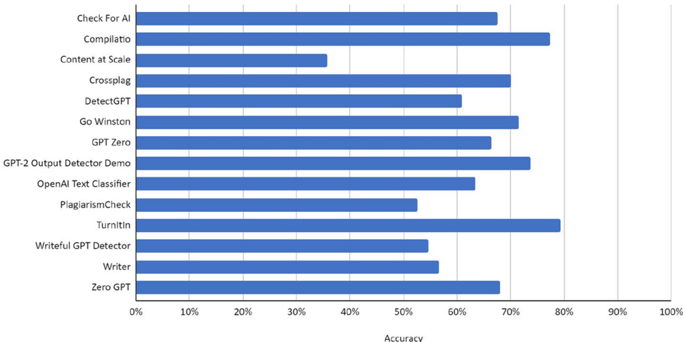
- Across 756 tests, the highest binary-approach accuracy was Turnitin at 76%, followed by Compilatio at 74% and GPT-2 Output Detector Demo at 72%; Content at Scale was lowest at 33%. Turnitin ranked highest across all accuracy approaches, followed by Compilatio and GPT-2 Output Detector.
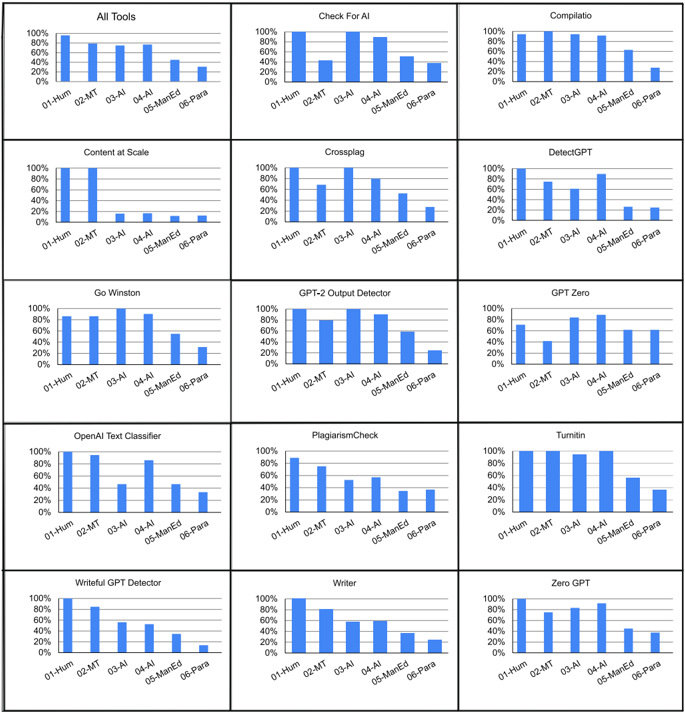
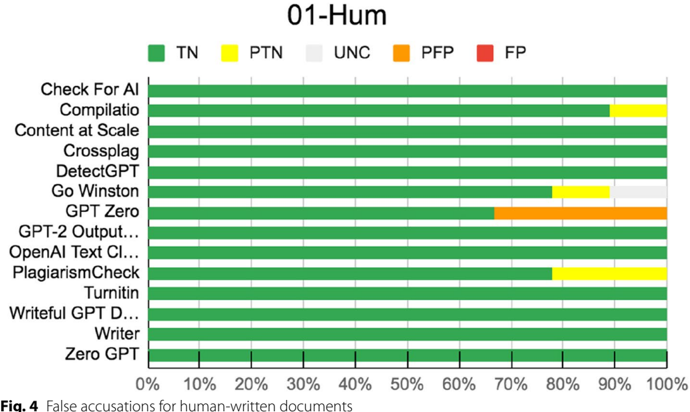
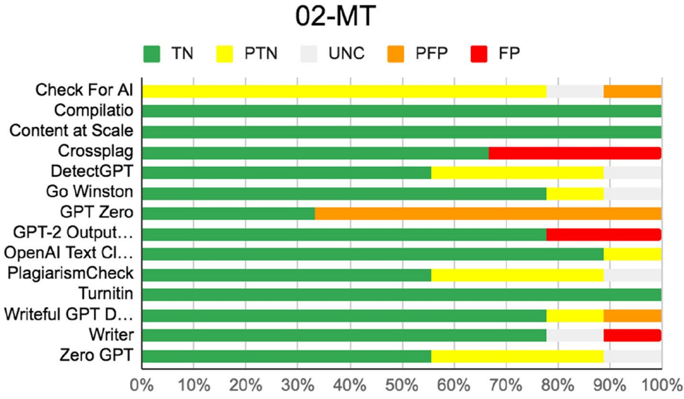
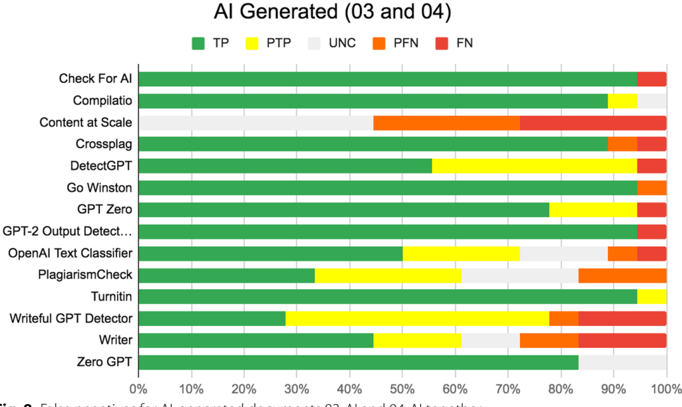
- With the exception of GPT Zero, all tested tools had higher accuracy identifying human-written text than AI-generated or modified text. Overall, approximately 20% of AI-generated texts would likely be misattributed to humans; with obfuscation, approximately 50% would likely be misattributed.
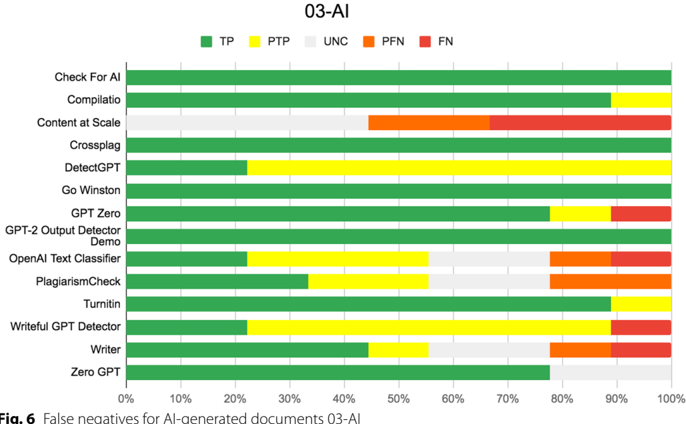
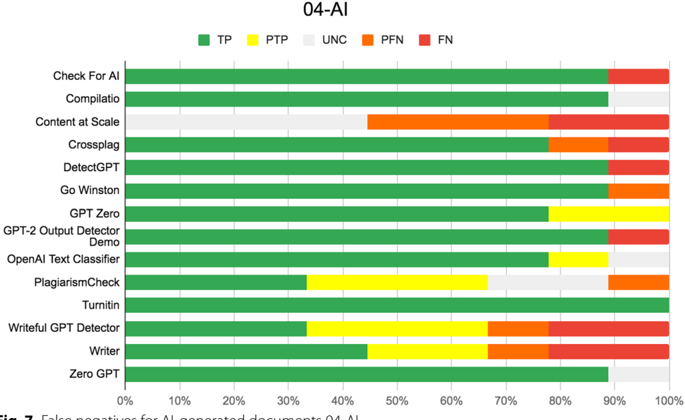
- False-positive probability ranged from 0% (Turnitin) to 50% (GPT Zero); false-negative probability ranged from 8% (GPT Zero) to 100% (Content at Scale).
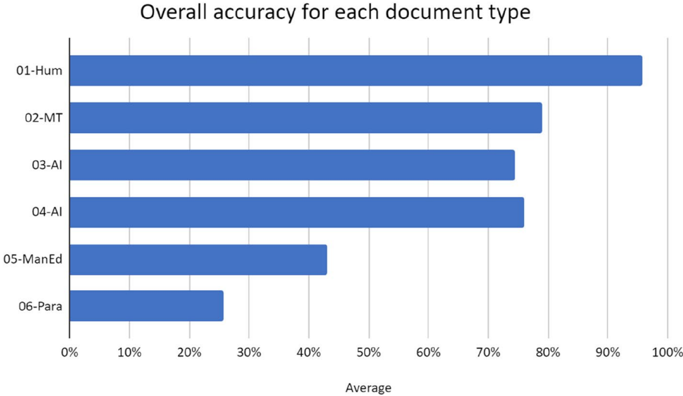
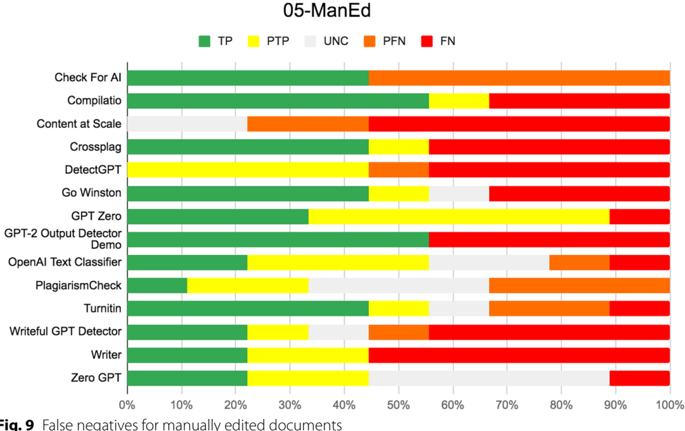
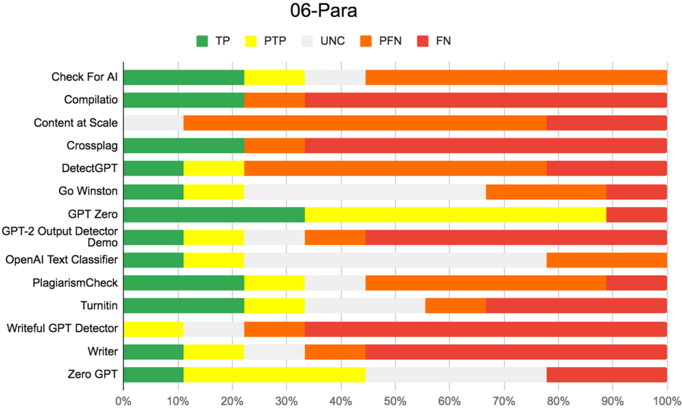
- Machine translation dropped accuracy by 20%; manually edited AI text (05-ManEd) received 42% compared with 74% for unmodified AI cases (03-AI and 04-AI); machine-paraphrased AI text (06-Para) had an overall accuracy of 26%.
Methods
- The researchers created 54 test cases from nine researchers: human-written (01-Hum), human-written then machine-translated (02-MT), ChatGPT-generated (03-AI and 04-AI), ChatGPT-generated then manually edited (05-ManEd), and ChatGPT-generated then machine-paraphrased with Quillbot (06-Para). ChatGPT’s February 13, 2023 model was used; translation used DeepL or Google Translate.
- Fourteen detection tools were tested: 12 publicly available tools plus Turnitin and PlagiarismCheck. Testing occurred March 7–28, 2023, with Turnitin April 14–20 and PlagiarismCheck May 2–8, for 756 total tests.
- Tool outputs were mapped to a five-step classification (TN, PTN, UNC, PFP, FP for human-written; FN, PFN, UNC, PTP, TP for AI-generated). Accuracy was calculated using binary, binary inclusive, semi-binary, and logarithmic approaches; false-positive rate, false-negative rate, recall, and precision were also analyzed.
Limitations
- Stated by the authors: the study focused only on English-language texts; it did not specifically test performance on computer code; it did not systematically examine replicability because results appeared to vary when the same material was tested at different times; and the document set did not test hybrid writing with iterative AI use.
- Evident from the text: the paid tools knew the submitted documents were part of a test suite and could use the entire test document, so their results may differ from free tools; several tools showed beta-stage usability problems, server errors, inconsistent outputs, and unclear result presentation.
- Evident from the text: only one ChatGPT model version and Quillbot’s default settings were used, limiting generalization to other generators or obfuscation settings.
Model-written summary. Check it against the paper before relying on it.
Integrity signals
Registry
Cites
Statistics
Figures
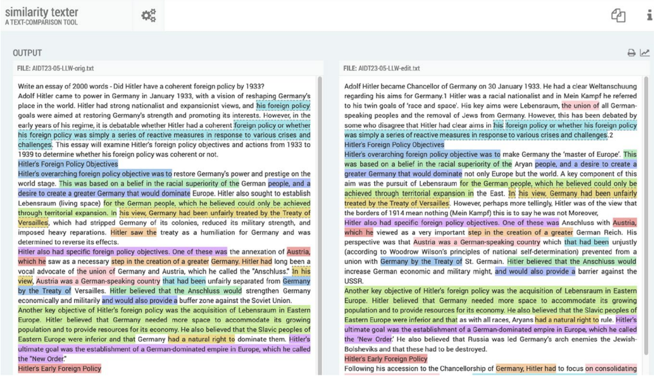
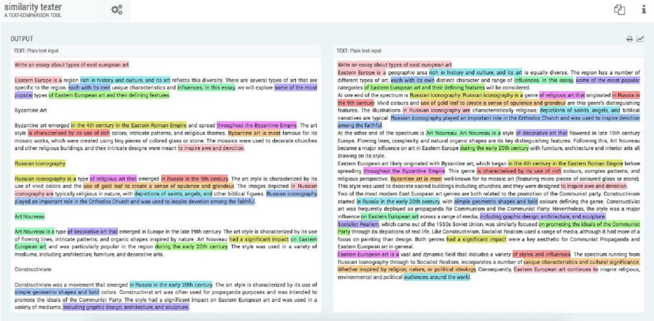
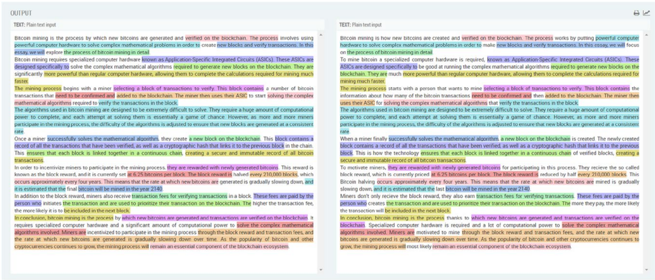
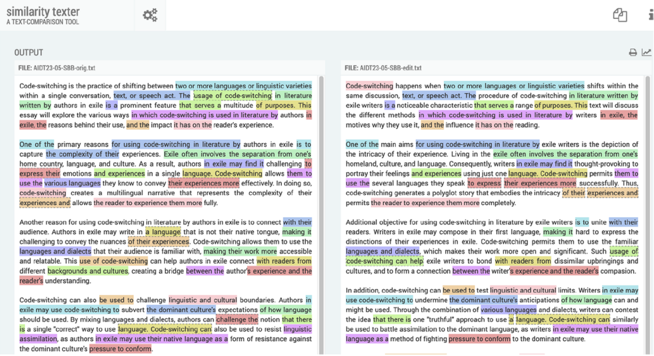
Verification
Claims the paper makes
3 Valid · 13 Not valid · 5 Not checked · 61 Own results and interpretations
Every source the paper cites for this claim was checked and supports it.
In the paper
“As these models are trained on human-written texts, the content generated by these tools can be quite difficult to distinguish from human-written content.”
- Also stated in: § Large language models · p. 3 · plain
“it is capable of creating responses that are hard to distinguish from human-written text (Borji 2023; Brown et al. 2020).”
What the sources say
- Supportedcites Borji 2023 matched to “A Categorical Archive of ChatGPT Failures” (2023) source
The Introduction (p. 1) states that ChatGPT 'is trained on a large corpus of text and is capable of generating new text based on the patterns it has learned from the training data' and that 'Responses in various domains can be so convincing that it becomes difficult to distinguish if they were written by a human or not' — i.e. the training-on-human-text basis plus the indistinguishability point. Section 3.4 Plagiarism reinforces this with 'the challenge of identifying the source of an expertly written ChatGPT essay' and OpenAI developing a tool to distinguish AI-written from human-written text. The only softening is that our copy says 'a large corpus of text' rather than explicitly 'human-written texts', and Section 2.11 notes cues that can reveal non-human authorship (idiom use), but the attributed content is stated in the source. (LLM, conf=0.86)
- Supportedcites Brown et al. 2020 matched to “Language Models are Few-Shot Learners” (2020) source
Section 3.9.4 (p. 26) says much of GPT-3’s generated news-article text was difficult for humans to distinguish from authentic human content. It reports human detection accuracy of about 52%, barely above chance, for articles from the 175B-parameter model. (LLM, conf=0.94)
plain- Asserted: passes — The authors put it forward as true.
- Checkable: passes — It can be checked against evidence.
- Load-bearing: passes — The paper’s conclusions depend on it.
- Based: passes — The paper gives a reason why it holds.
- Also stated in: § Large language models · p. 3 · plain
Every source the paper cites for this claim was checked and supports it.
In the paper
“Although text matching software also suffers from false positives and false negatives (Foltýnek et al. 2020), at least it is possible to provide evidence of potential misconduct.”
What the sources say
- Supportedcites Foltýnek et al. 2020 matched to “Testing of support tools for plagiarism detection” (2020) source
The clause the citation is attached to is stated verbatim in substance by the source: Conclusions and recommendations (bullet 1) says 'all systems suffer from false positives (correctly quoted material counted as similarity) and false negatives (potential sources were not found)', and the Abstract echoes this ('they clearly do not find all plagiarism and at times also identify nonplagiarized material as problematic'; Testing documents notes the set 'also contained original documents to check for possible false positives'). The accompanying point that such software can still yield evidence of potential misconduct is likewise in our copy: Introduction ('The output of such a system is often used as evidence in a disciplinary procedure') and Usability ('The similarity reports ... serve as crucial evidence for decision makers such as honour boards or disciplinary committees'). (LLM, conf=0.90)
hedged- Asserted: passes — The authors put it forward as true.
- Checkable: passes — It can be checked against evidence.
- Load-bearing: passes — The paper’s conclusions depend on it.
- Based: passes — The paper gives a reason why it holds.
- Supported
Every source the paper cites for this claim was checked and supports it.
In the paper
“Our findings are consistent with previously published studies (Gao et al. 2022; Anderson et al. 2023; Elkhatat et al. 2023; Demers 2023; Gewirtz 2023; Krishna et al. 2023; Pegoraro et al. 2023; van Oijen 2023; Wang et al. 2023)”
What the sources say
- Supportedcites Gao et al. 2022 matched to “Comparing scientific abstracts generated by ChatGPT to original abstracts using an artificial intelligence output detector, plagiarism detector, and blinded human reviewers” (2022) source
Our copy is exactly the kind of study the citing sentence invokes: a previously published investigation of AI-generated text detection. The Abstract (p. 1) reports that most ChatGPT-generated medical abstracts were flagged by the 'GPT-2 Output Detector' (median 99.98% 'fake' vs 0.02% for originals, AUROC 0.94) while blinded human reviewers correctly identified 68% of generated abstracts but wrongly flagged 14% of real ones, and the Results/Discussion (p. 2-3) conclude detectors and humans are imperfect discriminators ('AI output detectors may serve as an editorial tool'). The paper does not itself compare its findings to other detection studies, but nothing in our copy contradicts the alignment asserted; the attribution is an identification of this work as a prior detection study, which it is. (LLM, conf=0.85)
- Supportedcites Anderson et al. 2023 matched to “AI did not write this manuscript, or did it? Can we trick the AI text detector into generated texts? The potential future of ChatGPT and AI in Sports & Exercise Medicine manuscript generation” (2023) source
The “Potentially flawed AI detection” section reports that paraphrasing AI-generated essays sharply increased their GPT-2 Output Detector ‘Real’ scores. The paper therefore provides a published finding about AI-generated text detection of the kind the citing sentence invokes; the sentence does not specify a narrower result to check. (LLM, conf=0.86)
- Supportedcites Elkhatat et al. 2023 matched to “Evaluating the efficacy of AI content detection tools in differentiating between human and AI-generated text” (2023) source
The cited paper is a previously published study of AI-generated text detection. Its Conclusion reports variable accuracy across five detection tools, so it supports its use as an example of prior research on the topic. The citing paper’s own assertion that its findings are consistent with that research cannot be assessed from this source alone. (LLM, conf=0.87)
plain- Asserted: passes — The authors put it forward as true.
- Checkable: passes — It can be checked against evidence.
- Load-bearing: unclear — It is unclear whether the paper’s conclusions depend on it.
- Based: passes — The paper gives a reason why it holds.
- Supported
A result the paper reports from its own data — it cites no other source for it, so there is none to check. The quote shows it is in the paper.
In the paper
“Turnitin received the highest score using all approaches to accuracy classification, followed by Compilatio and GPT-2 Output Detector (again in all approaches).”
plain- Asserted: passes — The authors put it forward as true.
- Checkable: passes — It can be checked against evidence.
- Load-bearing: passes — The paper’s conclusions depend on it.
- Based: passes — The paper gives a reason why it holds.
A result the paper reports from its own data — it cites no other source for it, so there is none to check. The quote shows it is in the paper.
In the paper
“The researchers conclude that the available detection tools are neither accurate nor reliable and have a main bias towards classifying the output as human-written rather than detecting AI-generated text.”
plainstates a cause- Asserted: passes — The authors put it forward as true.
- Checkable: passes — It can be checked against evidence.
- Load-bearing: passes — The paper’s conclusions depend on it.
- Based: passes — The paper gives a reason why it holds.
39 more claims
Create a free account to see all 82 claims and to verify the 3 references still open.
- It may state two separate claims as one. 18
- Probably not a substantial claim. 27
Claims other papers make about this one
Each is checked against this paper’s own text: does it say what the citing paper says it does?
The source backs part of the claim, not all of it — or backs it for a different population, condition or comparison.
In the citing paper
“Many early institutional responses to generative AI have emphasized detection tools and misconduct procedures, often more than assessment redesign (Weber-Wulff et al., 2023).”
From Designing AI-resilient assessment in higher education: a four-pillar conceptual framework (2026) · cites this paper as Weber-Wulff et al., 2023
Experimental — accuracy not yet measuredThe source backs part of the claim, not all of it — or backs it for a different population, condition or comparison.
In the citing paper
“many commercially available tools fail to achieve 80% accuracy despite exceptions among a few premium platforms”
From ARE AI DETECTORS FAIR TO EFL LEARNERS? A LIBRARY RESEARCH ON DETECTION BIAS AND ACADEMIC INTEGRITY (2026) · cites this paper as Weber-Wulff et al., 2023
Experimental — accuracy not yet measuredThe source backs part of the claim, not all of it — or backs it for a different population, condition or comparison.
In the citing paper
“The exponential growth of Generative Artificial Intelligence (GAI) and Large Language Models (LLMs) has significantly impacted teaching and learning at all educational levels [1].”
From Generative artificial intelligence in physiotherapy education: great potential amidst challenges- a qualitative interview study (2025) · cites this paper as [1]
Experimental — accuracy not yet measuredThe source backs part of the claim, not all of it — or backs it for a different population, condition or comparison.
In the citing paper
“GPTZero and ZeroGPT produced false-positive rates exceeding 20% on specific samples”
From Designing AI-resilient assessment in higher education: a four-pillar conceptual framework (2026) · cites this paper as Weber-Wulff et al., 2023
Experimental — accuracy not yet measuredThe source backs part of the claim, not all of it — or backs it for a different population, condition or comparison.
In the citing paper
“William H. Walters found that most AI detectors can distinguish papers generated from the GPT3.5 model and human-written papers but fail to identify papers generated from the recent GPT-4 model [138].”
From Survey on Plagiarism Detection in Large Language Models: The Impact of ChatGPT and Gemini on Academic Integrity (2024) · cites this paper as [138]
Experimental — accuracy not yet measured
51 more claims about this paper
Create a free account to see every claim other papers make about this one.
Self-check
Percentages, sums and reported differences re-computed from the paper’s own numbers.
Each contradiction between two passages listed here was confirmed by an independent check.
Rated minor: it would not touch a result — a value no result rests on, a p-value that stays on the same side of the significance level, or a conflict that is clerical, resolved elsewhere in the paper, or outside its own findings.
In the paper
“Note that the maximum value for each cell is now 9 * 16 = 864.”
Reported 864 · recomputed 144
Rated minor: it would not touch a result — a value no result rests on, a p-value that stays on the same side of the significance level, or a conflict that is clerical, resolved elsewhere in the paper, or outside its own findings.
In the paper
§ Abbreviations · p. 36
“04-AI AI-generated text with subsequent human manual edits”
§ Test cases · p. 9
“One set (05-ManEd) was edited manually with a human exchanging some words with synonyms or reordering sentence parts”
Rated minor: it would not touch a result — a value no result rests on, a p-value that stays on the same side of the significance level, or a conflict that is clerical, resolved elsewhere in the paper, or outside its own findings.
In the paper
§ Accuracy · p. 15
“Turnitin received the highest score using all approaches to accuracy classification, followed by Compilatio and GPT-2 Output Detector (again in all approaches).”
§ Accuracy · p. 13
“| GPT Zero | 6 | 3 | 8 | 9 | 8 | 8 | 42 | 78% | 3 |”
Rated minor: it would not touch a result — a value no result rests on, a p-value that stays on the same side of the significance level, or a conflict that is clerical, resolved elsewhere in the paper, or outside its own findings.
In the paper
§ False accusations: harm to individual students · p. 20
“For GPT Zero, half of the positive classifications would be false accusations”
§ Precision · p. 18
“| Prec_incl | 96% | 100% | -- | 88% | 100% | 100% | 79%”
Citations
Cites
Vaswani, A., Shazeer, N., Parmar, N., Uszkoreit, J., Jones, L., Gomez, A. N., Kaiser, L., & Polosukhin, I. (2017) · arXiv · doi:10.48550/arxiv.1706.03762 · Cited by 120,404
BERT: Pre-training of Deep Bidirectional Transformers for Language Understanding
Devlin, J., Chang, M.-W., Lee, K., & Toutanova, K. (2018) · arXiv · doi:10.48550/arxiv.1810.04805 · Cited by 73,173
BERT: Pre-training of Deep Bidirectional Transformers for Language Understanding
Devlin, J., Chang, M.-W., Lee, K., & Toutanova, K. (2019) · Proceedings of the 2019 Conference of the North American Chapter of the Association for Computational Linguistics: Human Language Technologies, Volume 1 (Long and Short Papers) · doi:10.18653/v1/n19-1423 · Cited by 54,325
Efficient Estimation of Word Representations in Vector Space
Mikolov, T., Chen, K., Corrado, G., & Dean, J. (2013) · arXiv · doi:10.48550/arxiv.1301.3781 · Cited by 26,568 · cited 1×
“Efficient methods for the estimation of word representations in multidimensional vector spaces (Mikolov et al., 2013), together with the attention mechanism and transformer architecture (Vaswani et al., 2017) made generating human-like text not only possible, but also computationally feasible.”
MethodLanguage Models are Few-Shot Learners
Brown, T. B., Mann, B., Ryder, N., Subbiah, M., Kaplan, J., Dhariwal, P., Neelakantan, A., Shyam, P., Sastry, G., Askell, A., et al. (2020) · arXiv · doi:10.48550/arxiv.2005.14165 · Cited by 23,372 · cited 2×
“This was in many ways a game-changer, as it is capable of creating responses that are hard to distinguish from human-written text (Borji, 2023; Brown et al., 2020).”
BackgroundKaugeranna, R., Kaugeranna, E., & Aion, (. S. 4. 6. (2023) · DROPS (Schloss Dagstuhl – Leibniz Center for Informatics) · doi:10.4230/lipics.giscience.2023.43 · Cited by 13,690
On the Dangers of Stochastic Parrots: Can Language Models Be Too Big? 🦜
Bender, E. M., Gebru, T., McMillan-Major, A., & Shmitchell, S. (2021) · Proceedings of the 2021 ACM Conference on Fairness, Accountability, and Transparency · doi:10.1145/3442188.3445922 · Cited by 6,988 · cited 1×
“We understand LLMs as systems trained to predict the likelihood of a specific character, word, or string (called a token ) in a particular context (Bender et al., 2021).”
BackgroundGao, C. A., Howard, F. M., Markov, N. S., Dyer, E. C., Ramesh, S., Luo, Y., & Pearson, A. T. (2022) · doi:10.1101/2022.12.23.521610 · Cited by 1,099 · cited 1×
“…was able to make an excellent distinction between original and generated abstracts because the majority of the original abstracts were scored extremely low (corresponding to human-written content) while the detector found a high probability of AI-generated text in the majority (33 abstracts)…”
BackgroundGao, C. A., Howard, F. M., Markov, N. S., Dyer, E. C., Ramesh, S., Luo, Y., & Pearson, A. T. (2023) · npj Digital Medicine · doi:10.1038/s41746-023-00819-6 · Cited by 1,099
Two decades of statistical language modeling: where do we go from here?
Rosenfeld, R. (2000) · Proceedings of the IEEE · doi:10.1109/5.880083 · Cited by 735
Research works printed but not linked: 2
- Clarke R, Lancaster T. (2006). Eliminating the successor to plagiarism? Identifying the usage of contract cheating sites. Proceedings of 2nd International Plagiarism Conference Newcastle, UK, 14
- ICML. (2023). ICML 2023 Call For Papers, Fortieth International Conference on Machine Learning. https:// icml. cc/ Confe rences/ 2023/ CallF orPap ers. Accessed 14 June 2023
Cited by
Items 201–300 of 568
GenAI as scholarly ally: patterns, pedagogy, and policies in graduate writing research
Гаманюк, В. А., Semerikov, S. O., & Shramko, Y. (2025) · Educational Technology Quarterly · doi:10.55056/etq.965 · Cited by 7
Advances in Machine Learning & Artificial Intelligence
Akram, A. (2021) · Advances in Machine Learning & Artificial Intelligence · doi:10.33140/amlai · Cited by 5
“Using a dataset generated by the users themselves, Debora et al. [19] compared and contrasted multiple AI text detection methods.”
ResultHuman-LLM Coevolution: Evidence from Academic Writing
Geng, M., & Trotta, R. (2025) · Findings of the Association for Computational Linguistics: ACL 2025 · doi:10.18653/v1/2025.findings-acl.657 · Cited by 8
Can GPTZero’s AI Vocabulary Distinguish Between LLM-Generated and Student-Written Essays?
Schmalz, V., & Tack, A. (2025) · Proceedings of the 20th Workshop on Innovative Use of NLP for Building Educational Applications (BEA 2025) · doi:10.18653/v1/2025.bea-1.71 · Cited by 4
AI Roles in Lifelong Learning and Professional Development
Rani, J., & Mitra, B. (2025) · IGI Global eBooks · doi:10.4018/979-8-3373-4501-7.ch012 · Cited by 3
The Misclassification of Autistic Writing as AI-Generated
Chambers, S., & Kelley, M. C. (2025) · Lecture notes in computer science · doi:10.1007/978-3-031-98420-4_7 · Cited by 5
“Concerns around AI-detection models have been bolstered by studies revealing their very low accuracy rates [6,39,40] as well as evidence of bias in AI detection against certain groups.”
Shamsi, A., Wang, T., Amraei, M., & Raju, N. V. (2025) · Acta Informatica Pragensia · doi:10.18267/j.aip.293 · Cited by 5
Elkersh, N. M., Saif, N., Samir, W., Hussein, G. B. A., & Mohamed, H. (2026) · European Journal Of Dental Education · doi:10.1111/eje.70104 · Cited by 3
Beyond ChatGPT: a review of the use of AI tools in biological education
Cotton, P. A., & Cotton, D. (2026) · Journal of Biological Education · doi:10.1080/00219266.2026.2628797 · Cited by 8
Huh, S. (2026) · Journal of Korean Medical Association · doi:10.5124/jkma.26.0008 · Cited by 3
“ZeroGPT ( https :// www . zerogpt . com ), GPTZero ( https :// gptzero . me ), Copykiller ( https :// www . copykiller . com / gptkiller ) 등이 있으나 도구마다 Figure 3 에서와 같이 도구 마다 결과가 다르다[ 16 ].”
Freitas, G., Ünal, I., Goldust, M., & Grant-Kels, J. M. (2026) · JAAD reviews. · doi:10.1016/j.jdrv.2026.03.003 · Cited by 5
Curtis, G. J., Arness, D. C., Baird, M., Price, C., Thomson, S., Tremayne, K. S., & White, A. W. (2026) · International Journal for Educational Integrity · doi:10.1007/s40979-026-00215-z · Cited by 6
AI writing detectors are ineffective, unreliable and harmful
Giray, L., Roe, J., & Espiritu, J. D. (2026) · English Teaching Practice & Critique · doi:10.1108/etpc-07-2025-0155 · Cited by 8
Opriş, D. (2024) · Education Sciences · doi:10.3390/educsci14070701 · Cited by 3
Candido, L. S., Barbosa, C. A. D. M., & Costa, E. J. H. (2024) · doi:10.5753/wics.2024.2929 · Cited by 7
Coccoli, M., & Patanè, G. (2024) · IEEE International Forum on Research and Technology for Society and Industry (RTSI) · doi:10.1109/rtsi61910.2024.10761124 · Cited by 8
“Another research focusing on the potential misuse of AI-generated content in academic contexts is reported in [5] where the authors analyze the effectiveness of existing detection tools in distinguishing between human-written and ChatGPT-generated text, also considering the impact of machine…”
Upholding Academic Integrity in EAP
Keser, K. Ş., & Razı, S. (2024) · Springer eBooks · doi:10.1007/978-3-031-72545-6_14 · Cited by 5
AI-Generated and Human-Written Text Detection Using DistilBERT
Gakpetor, J. M., Doe, M., Damoah, M. Y.-S., Damoah, D. D., Arthur, J. K., & Asare, M. T. (2024) · IEEE SmartBlock4Africa · doi:10.1109/smartblock4africa61928.2024.10779494 · Cited by 5
“In [7], examined detection tools for AI-generated text, and their accuracy and error type analysis.”
ConvNLP: Image-based AI Text Detection
Jambunathan, S. P., Shankarnarayan, A., & Dube, P. (2024) · IEEE International Conference on Big Data (BigData) · doi:10.1109/bigdata62323.2024.10825691 · Cited by 3
“Weber-Wulff et al. (2023) evaluated the suitability and effectiveness of popular tools (including Turnitin and PlagiarismCheck (PlagiarismCheck)) for plagiarism detection in academic settings.”
Generative AI in teaching academic writing: guiding students to make informed and ethical choices
Hradilová, A. (2025) · Language Learning in Higher Education · doi:10.1515/cercles-2024-0103 · Cited by 11
Hong, L. (2026) · Linguistics and Education · doi:10.1016/j.linged.2026.101508 · Cited by 8
Detection of AI-generated Text: An Experimental Study
Kalra, M. P., Mathur, A., & Patvardhan, C. (2024) · 2024 IEEE 3rd World Conference on Applied Intelligence and Computing (AIC) · doi:10.1109/aic61668.2024.10731116 · Cited by 3
“Looking into the discrepancy between scientific writing produced by AI and that written by humans, Weber-Wulff et al. [7] observed that: 1) the distributions of text produced by AI and humans differ markedly; 2) the scientific text produced by AI, particularly the scientific abstract, is devoid of…”
BackgroundArtificial Writing and Automated Detection
Jabarian, B., & Imas, A. (2025) · doi:10.2139/ssrn.5407424 · Cited by 3
Appropriate Use and Reporting of AI tools in Manuscript Preparation
Al-Quorain, A. A., Shaikh, A. K., & Salam, A. A. (2026) · Saudi Journal of Medicine and Medical Sciences · doi:10.4103/sjmms.sjmms_10_26 · Cited by 7
Technical Report on the Pangram AI-Generated Text Classifier
Emi, B., & Spero, M. (2024) · arXiv · doi:10.48550/arxiv.2402.14873 · Cited by 2
Detection and Classification of AI-Generated Text
Gupta, S., & Gupta, D. (2024) · International Conference on Computing, Communication and Networking Technologies (ICCCNT) · doi:10.1109/icccnt61001.2024.10724991 · Cited by 2
“According to Wulff et al. [13], a study conducted using 14 AI detection tools, including Compilatio, GPT Zero, Detect GPT, PlagiarismCheck, and Turnitin, AI paraphrased texts yielded an accuracy of only 26%, i.e. most rephrased texts went undetected.”
MethodAI for Formative and Summative Assessment: A Balanced Approach
Dockens, A. L., & Shelton, K. (2025) · Advances in computational intelligence and robotics book series · doi:10.4018/979-8-3373-5102-5.ch013 · Cited by 6
Candido, L. S., Barbosa, C. A. D. M., Martins, L. G., & Costa, E. J. H. (2025) · Anais do Workshop sobre as Implicações da Computação na Sociedade (WICS) · doi:10.5753/wics.2025.8692 · Cited by 2
Grand Challenges in AI and Education Beyond 2030
Woolf, B. P., Allessio, D., Arroyo, I., Gattupalli, S., & Zhang, B. (2025) · Interaction design & architecture(s)/ID&A Interaction design & architecture(s) · doi:10.55612/s-5002-064-001sp · Cited by 2
Embracing Generative AI in Education: A Global View on AI Anxiety Through Digital Literacy
Kristandl, G. (2025) · Springer eBooks · doi:10.1007/978-3-031-97999-6_5 · Cited by 4
Krutrök, M. E., & Isling, P. P. (2025) · New Media & Society · doi:10.1177/14614448251385920 · Cited by 7
“…tools can enhance language learning and adaptation (Zou et al., 2023), prevailing systems often reproduce biases (Hofmann et al., 2024), dilute linguistic specificity (Chandran, 2014), or mis-classify minority languages, undermining their digital and cultural legitimacy (Weber-Wulff et al., 2023).”
Varju, B. R., Noman, M. E., Dicks, A. P., & Seferos, D. S. (2025) · Journal of Chemical Education · doi:10.1021/acs.jchemed.5c00790 · Cited by 3
The ethics of using artificial intelligence in writing medical research papers
Yu, S., & Hwang, H. (2025) · Kosin Medical Journal · doi:10.7180/kmj.25.141 · Cited by 2
“Technological efforts to discern AI-generated text remain unreliable, frequently producing false positives in which authentic human writing is erroneously flagged [78].”
Synergizing linguistic features and transformer networks for detecting AI-generated text
Yadagiri, A., Kumar, P., Poddar, Y., Pakray, P., & Chunka, C. (2026) · Knowledge and Information Systems · doi:10.1007/s10115-025-02637-6 · Cited by 2
“These tools tend to be biased toward classifying outputs as human-authored rather than accurately identifying LLM-generated content [28, 29].”
Chisale, P. B. (2026) · Frontiers in Education · doi:10.3389/feduc.2025.1694819 · Cited by 2
“Prohibition and detector-driven design that misclassifies students and encourages compliance over interpretation and judgement; equity risks for non-native writers (Weber-Wulff et al., 2023; Liang et al., 2023).”
InfluentialEmerging trends and challenges in international student research
Bista, K., Oladipo, O. A., Ge., L., & Qin, T. (2026) · Journal of International Students · doi:10.32674/86wewd47 · Cited by 4
Oh, J. (2026) · Journal of Korean Medical Association · doi:10.5124/jkma.25.0157 · Cited by 2
Khan, M. M., Arslan, M., Haider, K., Arif, M., & Fatima, B. (2026) · Regional lens. · doi:10.55737/rl.v5i1.26166 · Cited by 2
Guarding truth in an AI world: ethics for the next generation of scholarship
Mubarak, F. (2026) · Journal of Information Communication and Ethics in Society · doi:10.1108/jices-09-2025-0241 · Cited by 3
Evaluación auténtica y ética académica ante inteligencia artificial generativa en educación superior
Cangas-Cadena, A. L., Piedra-Castro, W. I., & Sánchez-Simbaña, S. E. (2026) · Revista Científica Enfoques del Conocimiento · doi:10.55813/gaea/revistacec/v3/n2/4 · Cited by 3
“Así, la evaluación debe orientarse a hacer visible el aprendizaje antes que a perseguir únicamente rastros de automatización (Perkins, 2023; Weber-Wulff et al., 2023).”
InfluentialJoo, H. J., Radnaabaatar, M., & Jung, J. (2026) · Journal of Korean Medical Science · doi:10.3346/jkms.2026.41.e306 · Cited by 10
“46 use cases.”
Saleem, N. H., & Jansen, B. J. J. (2026) · Machine Learning and Knowledge Extraction · doi:10.3390/make8080223 · Cited by 3
Detecting Is Just the Start: Deciding Whether to Take Action and Generating Evidence Is Harder
Glendinning, I. (2024) · Advances in educational marketing, administration, and leadership book series · doi:10.4018/979-8-3693-0240-8.ch012 · Cited by 2
Exploring Instructor Roles in Operating and Integrating ChatGPT into Classroom in Higher Education
Han, H.-J. (2024) · Journal of Digital Contents Society · doi:10.9728/dcs.2024.25.2.465 · Cited by 6
Utilizing Generative Artificial Intelligence in the Online Counselor Education Classroom
Brue, J. S., & Brue, J. (2024) · Journal of Technology in Counselor Education and Supervision · doi:10.61888/2692-4129.1100 · Cited by 11
Redesigning Academic Writing Assignments in the Age of AI-Generated Content
Stevkovska, M. (2024) · Advances in educational technologies and instructional design book series · doi:10.4018/979-8-3693-4310-4.ch007 · Cited by 3
Investigating Plagiarism in Second Language Writing
Lei, J., & Hu, G. (2024) · Asian Journal of English Language Teaching · doi:10.1017/9781009350822 · Cited by 6
Challenges and Opportunities of Using Generative AI for Research: Opening the Discussion
Goretti, L., Küsters, A., Morgana, S., & Sharma, A. (2024) · The International Spectator · doi:10.1080/03932729.2024.2435176 · Cited by 4
Goodman, M. A., Lee, A., Schreck, Z., & Hollman, J. H. (2025) · Journal of Physical Therapy Education · doi:10.1097/jte.0000000000000396 · Cited by 9
Hu, F., Chen, L.-Y., Cheng, P.-J., Liu, J.-Y., Wu, J., & Chen, W. (2025) · Asia-Pacific Journal of Ophthalmology · doi:10.1016/j.apjo.2025.100174 · Cited by 4
Ethical implications of artificial intelligence–written personal statements in dermatology
Hanggodo, S., Koustov, T., Sharp, K. L., & Grant-Kels, J. M. (2025) · Journal of the American Academy of Dermatology · doi:10.1016/j.jaad.2025.03.030 · Cited by 2
Quesnel, M. S., & Stoesz, B. M. (2025) · Australasian Journal of Educational Technology · doi:10.14742/ajet.9529 · Cited by 3
Karakash, W. J., Avetisian, H., Ragheb, J. M., Wang, J. C., Hah, R. J., & Alluri, R. K. (2025) · Global Spine Journal · doi:10.1177/21925682251344248 · Cited by 6
“8 The discourse surrounding AI in applications warrants a nuanced approach that considers its diverse capabilities rather than treating it as a binary choice.”
Misiejuk, K., Bastesen, J., & Ershova, T. (2025) · Innovations in Education and Teaching International · doi:10.1080/14703297.2025.2516117 · Cited by 5
“…to which AI was used in writing the essays, as this study relied on self-reported data and did not utilise AI-detection tools due to ethical and reliability issues (Jiang et al., 2024; Weber-Wulff et al., 2023) or had available writing log data to examine student essays to verify the GenAI usage.”
Assessment in creative Technologies education
Ashcroft, E., Gill, L., & Campbell, C. (2025) · Routledge eBooks · doi:10.4324/9781003490715-15 · Cited by 2
A Comparative Pattern Analysis of Qwen 2.5 and Gemma 3 Text Generation
Kopanov, K., & Atanasova, T. V. (2025) · WSEAS Transactions on Information Science and Applications archive · doi:10.37394/23209.2025.22.50 · Cited by 5
Jansen, A. N., Suwandy, J., Muliono, Y., Nadia, N., & Adeta, F. (2025) · IEEE International Conference on Industry 4.0, Artificial Intelligence, and Communications Technology (IAICT) · doi:10.1109/iaict65714.2025.11100306 · Cited by 2
“While most of these models are well implemented, their advancement has also raised some serious challenges, especially concerning plagiarism and the originality of academic written work [1].”
Academic Profile Management: Benchmarking DeepSeek-R1 for Publication and Citation Data
Bankov, B., Parusheva, S. S., Marinova, O., Strashimirova, P., & Petkova, D. (2025) · Lecture notes in computer science · doi:10.1007/978-3-032-05607-8_11 · Cited by 2
Moebert, T., Samoilova, E., & Wiepke, A. (2024) · Informatik-Spektrum · doi:10.1007/s00287-024-01575-x · Cited by 3
Authenticity in Authorship: The Writer's Integrity Framework for Verifying Human-Generated TextPreprint
Aburass, S., & Rumman, M. A. (2024) · Research Square · doi:10.21203/rs.3.rs-4259560/v1 · Cited by 4
AI Content Self-Detection for Transformer-based large Language ModelsPreprint
Caiado, A. J. A., & Hahsler, M. (2024) · Research Square · doi:10.21203/rs.3.rs-4640131/v1 · Cited by 2
False Positive Risk in AI Detection of L2 Academic Writing: A Case Study
Za’rour, R., & Altakhaineh, A. R. M. (2026) · Discourses on Culture · doi:10.2478/doc-2026-0003 · Cited by 2
AI Detection Tools: A Systematic Review of Empirical Evidence and Their Implications for Education
CANER, H. N. (2025) · Khazar Journal of Humanities and Social Sciences · doi:10.5782/2223-2621.1580 · Cited by 2
Pickering, E., & Schuller, C. (2024) · Journal of Academic Ethics · doi:10.1007/s10805-024-09551-6 · Cited by 5
VedicFusion: Bridging Ancient Wisdom and Modern AI Through Natural Language Processing
Kasundra, C., Kariya, S., Dhaduk, M., Rupda, K., Vachhani, G., Jain, R., & Palaniappan, D. (2025) · International Conference on Intelligent Systems, Advanced Computing and Communication (ISACC) · doi:10.1109/isacc65211.2025.10969323 · Cited by 1
“It applies deep sets of datasets for doing a highly extended set of tasks, natural language processing for things such as generating texts, translations, summaries, or just answering questions [11-15].”
Detection of AI-Generated Text
Bharadwaj, R., Dugad, R., Gile, A., Patil, G., & Hatyalikar, S. (2024) · International Conference on Progressive Innovations in Intelligent Systems and Data Science (ICPIDS) · doi:10.1109/icpids65698.2024.00032 · Cited by 2
“[17] This research presents OUTFOX, a framework to distinguish LLM-generated texts from human-authored content, even when paraphrased.”
Detecting Human-to-AI Author Change in Arabic Text
Boutadjine, A., Harrag, F., Bensouilah, M., Karboua, S., & Deriche, M. A. (2025) · International Multi-Conference on Systems, Signals & Devices (SSD) · doi:10.1109/ssd64182.2025.10989918 · Cited by 1
“Weber-Wulff et al. [12] developed test cases for a variety of document types, such as writings created by humans, AI-produced texts, and texts that were translated and manually edited.”
Transformer-Based Approach for Detecting LLM-Generated Scientific Text
Bader, A., & Alhijawi, B. (2025) · International Conference on New Trends in Computing Sciences (ICTCS) · doi:10.1109/ictcs65341.2025.10989343 · Cited by 4
“Weber et al. [16] investigated the ability of 12 publicly open-source tools and two commercial systems (i.e., Turnitin and PlagiarismCheck) to detect ChatGPT-generated text.”
The Role of AI in Modern Research: Transformations, Applications, and Ethical Considerations
Padmanabhan, S. (2025) · Advances in computational intelligence and robotics book series · doi:10.4018/979-8-3693-7873-1.ch004 · Cited by 1
Plagiarism in the Age of Artificial Intelligence: A Call for Ethical Vigilance
Joshi, K., Singhal, S., & Tandon, A. (2025) · NMO journal · doi:10.4103/jnmo.jnmo_25_25 · Cited by 3
The Knowledge Commons in the Age of AI: Opportunities and Risks for Urban Smart Learning
Lister, P. (2025) · Lecture notes in computer science · doi:10.1007/978-3-031-92980-9_4 · Cited by 1
Detectability Analysis of AI-generated Research Articles
Neeraj, Rahman, M. M., Kabir, M. L., & Kabir, S. (2024) · International Conference on Computer and Information Technology (ICCIT) · doi:10.1109/iccit64611.2024.11021828 · Cited by 1
“Numerous studies [5]–[8] have been conducted to evaluate the efficacy of various AI-detection tools in identifying AI-produced content.”
Fine, K. S., Zona, E. E., O’Shea, A. W., Via, E. C., Attaluri, P. K., Wirth, P. J., Dingle, A. M., & Poore, S. O. (2025) · Plastic & Reconstructive Surgery · doi:10.1097/prs.0000000000012242 · Cited by 2
Popescu-Apreutesei, L.-E., Iosupescu, M.-S., Necula, S.-C., & Păvăloaia, V.-D. (2025) · Computers, materials & continua/Computers, materials & continua (Print) · doi:10.32604/cmc.2025.064747 · Cited by 9
Khan, Z. R., & Hemnani, N. (2025) · Ethics and integrity in educational contexts · doi:10.1007/978-3-031-95686-7_3 · Cited by 2
Creating Guidance on Appropriate Use of AI Tools in Relation to Students’ Academic Work
Glendinning, I. (2025) · Ethics and integrity in educational contexts · doi:10.1007/978-3-031-95686-7_11 · Cited by 1
The Lazy Student’s Dream: ChatGPT Passing an Engineering Course on Its Own
Puthumanaillam, G., Bretl, T. W., & Ornik, M. (2025) · IFAC-PapersOnLine · doi:10.1016/j.ifacol.2025.08.049 · Cited by 19
Ujvari, M. M., & Odeh, A. O. (2025) · An-Najah University Journal for Research - B (Humanities) · doi:10.35552/0247.40.4.2538 · Cited by 2
Evaluating reasoning large language models on rumor generation, detection, and debunking tasks
Hu, Y., & Tian, X. (2025) · iScience · doi:10.1016/j.isci.2025.113690 · Cited by 6
Synthetification of public opinion: impacts on deliberative democracies
García, C. S. (2025) · Ethics and Information Technology · doi:10.1007/s10676-025-09870-1 · Cited by 9
“Similarly, in the case of differentiating between GenAI-created texts and human-created texts, the error rate is close to 20% (Weber-Wulff et al., 2023).”
Bhattacharyya, S. (2025) · Discover Education · doi:10.1007/s44217-025-00884-x · Cited by 4
“Weber-Wulff et al. [53] tested various tools which claim effective detection of AI-generated text and found most of them were ineffective in distinguishing human and AI-generated text.”
Аркадьевна, Д. В. (2025) · Вестник Российского университета дружбы народов. Серия: Психология и педагогика · doi:10.22363/2313-1683-2025-22-1-144-174 · Cited by 4
Cheng, P.-J., Hu, F., Chen, L.-Y., Liu, J.-Y., Wu, J., & Chen, W. (2025) · Taiwan Journal of Ophthalmology · doi:10.4103/tjo.tjo-d-25-00072 · Cited by 1
Gantana, E. J., Musekwa, E., Cassim, S., Nell, E., & Chapanduka, Z. C. (2025) · Next research. · doi:10.1016/j.nexres.2025.101002 · Cited by 2
Alharthi, R. S., Ojo, S., Nathaniel, T. I., Samee, N. M. A., Umer, M., Jamjoom, M. M., Alsubai, S., & Khan, J. (2025) · International Journal of Computational Intelligence Systems · doi:10.1007/s44196-025-01025-w · Cited by 5
“Similarly, Weber-Wulff et al. [17] evaluated many detection algorithms to establish their efficacy in distinguishing AI-generated text from human-written content.”
Jazayeri, K. (2025) · International Journal of Artificial Intelligence Tools · doi:10.1142/s0218213025500174 · Cited by 1
Homeric, E., Astuti, W., & Paryasto, M. W. (2025) · International Conference of Computer and Informatics Engineering (IC2IE) · doi:10.1109/ic2ie67206.2025.11283330 · Cited by 1
“Furthermore, their AI detection capabilities, while strong, can be compromised by human-paraphrased text and carry a significant risk of false positives, where student writing is incorrectly flagged [6], [7], [8].”
AI-generated language in introductory physics lab reports in the first year of ChatGPT
Arvidsson, K. (2025) · Discover Artificial Intelligence · doi:10.1007/s44163-025-00742-7 · Cited by 4
“Such paraphrasing is a known cause of making AI-generated content harder to detect [7, 22, 23].”
Eğitimde Yapay Zekâ: Biçimlendirici Değerlendirme ile Denge Arayışı
Arslan, K., & Arslan, K. (2025) · Batı anadolu eğitim bilimleri dergisi · doi:10.51460/baebd.1757476 · Cited by 2
EVALUATING ORIGINALITY IN AI-GENERATED CONTEMPORARY WORKS
Kaur, G., Jagarajan, M., Saini, J., Bhanot, D., Prajapati, D., & Shukla, B. S. (2025) · ShodhKosh Journal of Visual and Performing Arts · doi:10.29121/shodhkosh.v6.i5s.2025.6925 · Cited by 3
Sebo, P., Nie, B., & Wang, T. (2025) · F1000Research · doi:10.12688/f1000research.173647.1 · Cited by 5
Georgiou, G. P. (2026) · AI in Education · doi:10.3390/aieduc2010002 · Cited by 5
“However, current detection algorithms show some limitations in terms of accuracy, credibility, and adaptability in various LLMs and text types (Weber-Wulff et al., 2023).”
Peterson, C., Anderson, C., Berdine, G. G., & NUGENT, K. M. (2026) · Journal of Electronic Resources in Medical Libraries · doi:10.1080/15424065.2026.2626575 · Cited by 2
“Artificial intelligence detection software is available, though this software can suffer from low accuracy and widely varying success across iterations of LLMs, as well as a high rate of false positives (Elkhatat et al., 2023; Odri & Ji Yun Yoon, 2023; Weber-Wulff et al., 2023).”
Scilabra, J., & Russo, D. (2026) · Alfinge Revista de Filología · doi:10.21071/arf.v37i.18691 · Cited by 1
Human versus AI generated text classification using deep learning and transformers
Priyadarshini, I., Chatterjee, J. M., & Rawat, P. (2026) · Neural Computing and Applications · doi:10.1007/s00521-026-11872-z · Cited by 3
AI detectors, student anxiety, and authorial alienation: a qualitative study of affective control
Ardana, S. G., & Christiana, M. (2026) · Teaching in Higher Education · doi:10.1080/13562517.2026.2643825 · Cited by 3
Visual pattern-based watermarking for large language model generated text
Bashir, S. (2026) · Neurocomputing · doi:10.1016/j.neucom.2026.133429 · Cited by 2
Prajapati, M., & Baliarsingh, S. K. (2026) · International Journal of Machine Learning and Cybernetics · doi:10.1007/s13042-026-03070-z · Cited by 2
Odongo, S. O., & Njoroge, G. G. (2025) · KLISC Journal of Information Science & Knowledge Management · doi:10.61735/y0wxxs53 · Cited by 1
“Technology rearranges the plagiarism-integrity dynamic by both facilitating plagiarism through AI paraphrasing tools and essay mills, and potentially thwarting it through detection software and monitoring intensification (Newton & Lang, 2016; Weber-Wulff et al., 2023).”
Statistics education rebooted in the age of artificial intelligence
Awunkori, E., & Matta, V. (2026) · Journal of Decision System · doi:10.1080/12460125.2026.2657509 · Cited by 2
Metadata
- Authors
- Weber-Wulff, D., Anohina-Naumeca, A., Bjelobaba, S., Foltýnek, T., Guerrero-Dib, J., Popoola, O., Šigut, P., & Waddington, L.
- Affiliations
- HTW Berlin - University of Applied Sciences (DE)
- Riga Technical University (LV)
- Uppsala University (SE)
- Masaryk University (CZ)
- University of Monterrey (MX)
- Queen Mary University of London (GB)
- University of Leeds (GB)
- Corresponding author
- Bjelobaba, Sonja
- ORCID
- Venue
- International Journal for Educational Integrity
- Published
- 2023-12-25
- Volume
- 19
- Issue
- 1
- ISSN
- 1833-2595 (ISSN-L)
- OpenAlex
- W4390175962
- Semantic Scholar
- bd3558bc203b5006d5bcdc214bfcc65430c576d1
- Cited by
- 582
- References
- 21
- Citations by year
- 2026: 265 · 2025: 194 · 2024: 111 · 2023: 11
- FWCI
- 144.96
- Type
- journal article
- Language
- en
- Open access
- gold
- doi.org
- Licence
- cc-by
- creativecommons.org/licenses/by/4.0 (tdm)
- creativecommons.org/licenses/by/4.0 (vor)
- Locations
- International Journal for Educational Integrity (publishedVersion, cc-by)
- Uppsala University Publications (Uppsala University) (submittedVersion, other-oa)
- DOAJ (DOAJ: Directory of Open Access Journals) (submittedVersion, cc-by-sa)
- Funders
- Uppsala University
- Topics
- Social Sciences › Education › Academic integrity and plagiarism
- Physical Sciences › Computer Science › Artificial Intelligence › Authorship Attribution and Profiling
- Social Sciences › Education › Artificial Intelligence in Education
- Keywords
- AI-generated text detection, large language models, ChatGPT, machine translation, Turnitin, academic integrity, generative AI in education
About these checks
Registry, retraction, Cites and statistics results are computed, not judged, with one exception: a printed reference that no index lists is read once by a model before it counts as a citation error. Claims are extracted by a model and kept only when their quote appears verbatim in the text; each cited source is then checked, with a model’s help, for whether it says what the claim relies on. Those verdicts can be wrong — read the claim’s quote and the cited source before relying on one.
A language model drew the claims from the paper on 2026-10-10, under version 3 of the claim definition (model deepseek-v4.1-flash, prompt extract-v3).
A second model labelled each claim on 2026-10-10 (model jev-1.13-20260917, definition revision gold-guideline-v0.2).
Cited sources are checked with a language model’s help (qwen3.8-omni-flash and gpt-6-sol).
Statistics and arithmetic are recomputed, not judged.
Confidence bands are shown only for fields calibrated on our annotated test set. None is calibrated yet, so no band is shown.
What counts as a claim ›How we measure confidence ›How we check this ›
Are you an author, or do you see a problem with this page? Request a review
Data sources
Bibliographic data: Semantic Scholar, OpenAlex, Crossref.
Contains information from the Semantic Scholar Academic Graph Datasets, made available under the ODC Attribution License (ODC-BY 1.0).
Semantic Scholar’s data is described in: Kinney, R., et al. (2023). The Semantic Scholar Open Data Platform. arXiv:2301.10140.
