

Testing of detection tools for AI-generated text
Open accessThe DOI matches its Crossref record; 30 of the 31 references it cites were found in a registry or an index; 6 of the 12 sources its claims cite were checked for support.
Abstract
Abstract Recent advances in generative pre-trained transformer large language models have emphasised the potential risks of unfair use of artificial intelligence (AI) generated content in an academic environment and intensified efforts in searching for solutions to detect such content. The paper examines the general functionality of detection tools for AI-generated text and evaluates them based on accuracy and error type analysis. Specifically, the study seeks to answer research questions about whether existing detection tools can reliably differentiate between human-written text and ChatGPT-generated text, and whether machine translation and content obfuscation techniques affect the detection of AI-generated text. The research covers 12 publicly available tools and two commercial systems (Turnitin and PlagiarismCheck) that are widely used in the academic setting. The researchers conclude that the available detection tools are neither accurate nor reliable and have a main bias towards classifying the output as human-written rather than detecting AI-generated text. Furthermore, content obfuscation techniques significantly worsen the performance of tools. The study makes several significant contributions. First, it summarises up-to-date similar scientific and non-scientific efforts in the field. Second, it presents the result of one of the most comprehensive tests conducted so far, based on a rigorous research methodology, an original document set, and a broad coverage of tools. Third, it discusses the implications and drawbacks of using detection tools for AI-generated text in academic settings.
Overview
CoChat Summary
TL;DR
This study tested 14 AI-text detection tools on 54 English-language documents spanning human-written, machine-translated, ChatGPT-generated, manually edited, and machine-paraphrased text. It concludes the tools are neither accurate nor reliable, are biased toward classifying text as human-written, and perform worse under obfuscation.
Key findings
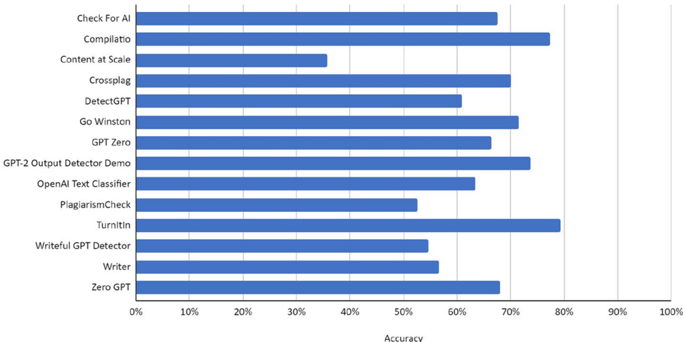
- Across 756 tests, the highest binary-approach accuracy was Turnitin at 76%, followed by Compilatio at 74% and GPT-2 Output Detector Demo at 72%; Content at Scale was lowest at 33%. Turnitin ranked highest across all accuracy approaches, followed by Compilatio and GPT-2 Output Detector.
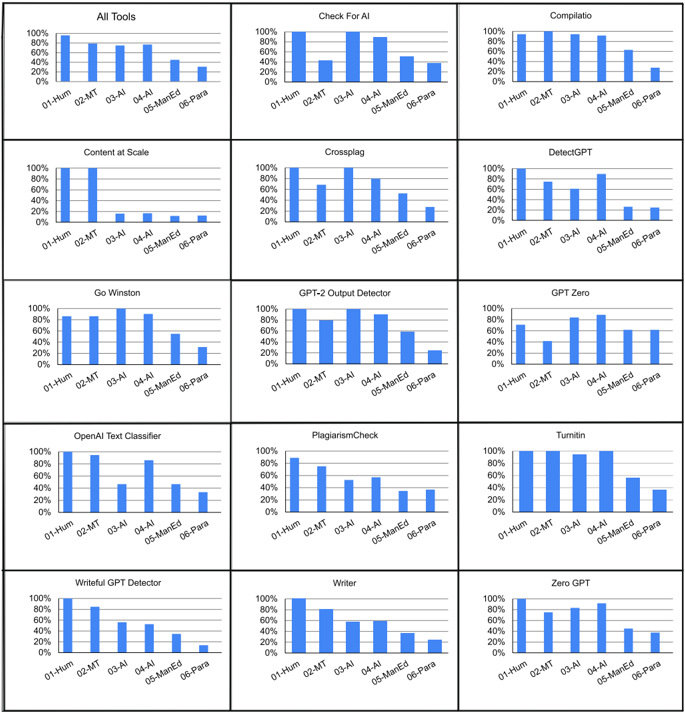
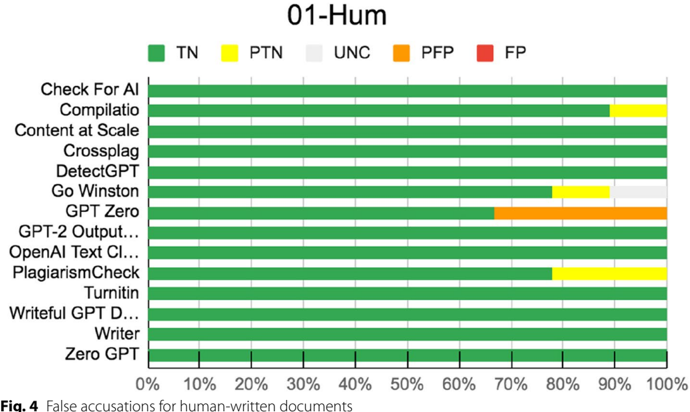
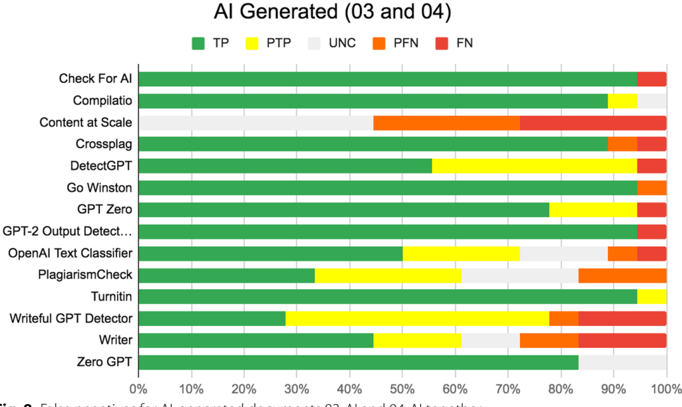
- With the exception of GPT Zero, all tested tools had higher accuracy identifying human-written text than AI-generated or modified text. Overall, approximately 20% of AI-generated texts would likely be misattributed to humans; with obfuscation, approximately 50% would likely be misattributed.
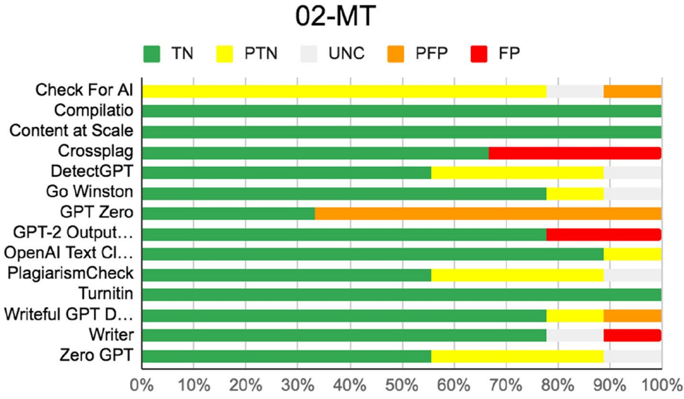
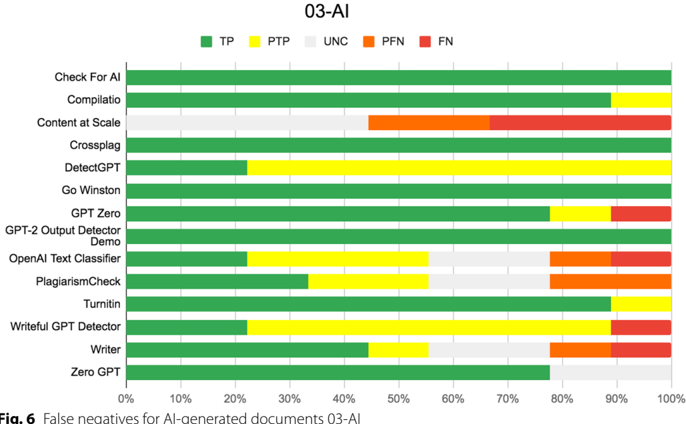
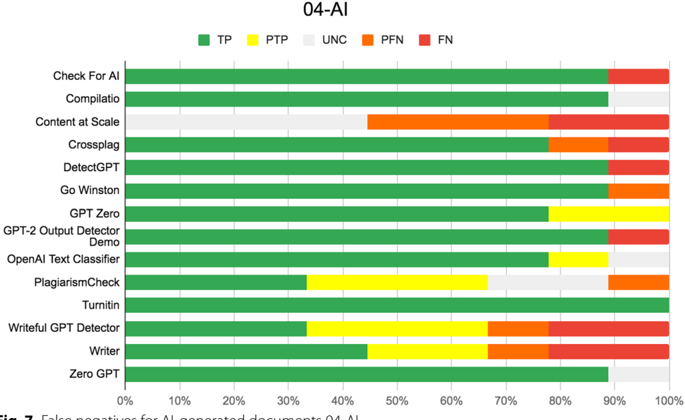
- False-positive probability ranged from 0% (Turnitin) to 50% (GPT Zero); false-negative probability ranged from 8% (GPT Zero) to 100% (Content at Scale).
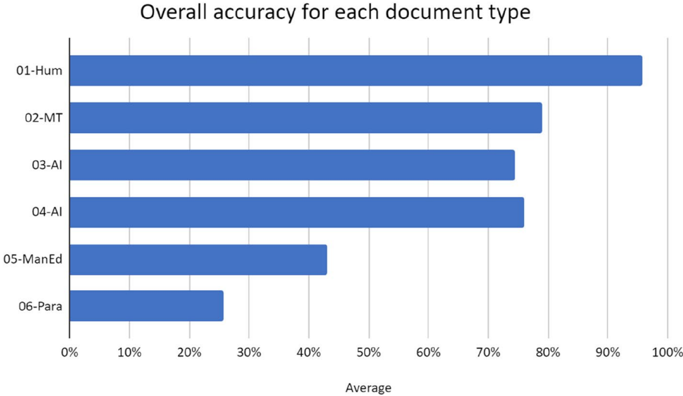
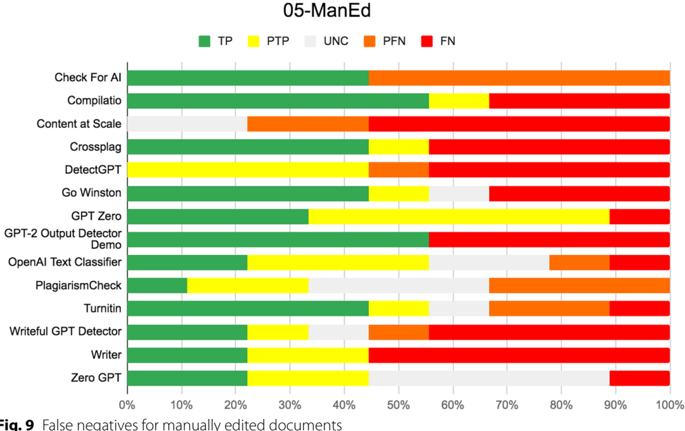
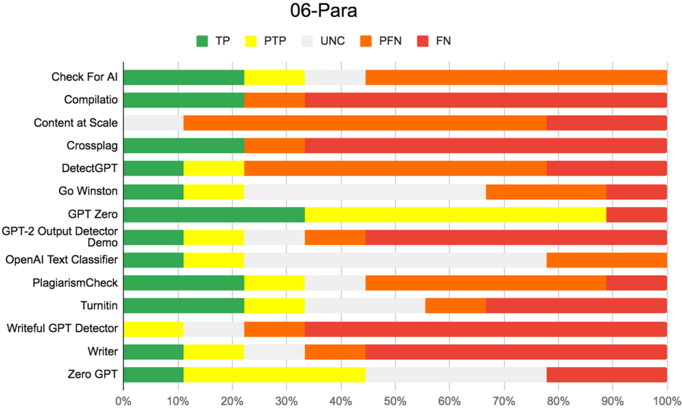
- Machine translation dropped accuracy by 20%; manually edited AI text (05-ManEd) received 42% compared with 74% for unmodified AI cases (03-AI and 04-AI); machine-paraphrased AI text (06-Para) had an overall accuracy of 26%.
Methods
- The researchers created 54 test cases from nine researchers: human-written (01-Hum), human-written then machine-translated (02-MT), ChatGPT-generated (03-AI and 04-AI), ChatGPT-generated then manually edited (05-ManEd), and ChatGPT-generated then machine-paraphrased with Quillbot (06-Para). ChatGPT’s February 13, 2023 model was used; translation used DeepL or Google Translate.
- Fourteen detection tools were tested: 12 publicly available tools plus Turnitin and PlagiarismCheck. Testing occurred March 7–28, 2023, with Turnitin April 14–20 and PlagiarismCheck May 2–8, for 756 total tests.
- Tool outputs were mapped to a five-step classification (TN, PTN, UNC, PFP, FP for human-written; FN, PFN, UNC, PTP, TP for AI-generated). Accuracy was calculated using binary, binary inclusive, semi-binary, and logarithmic approaches; false-positive rate, false-negative rate, recall, and precision were also analyzed.
Limitations
- Stated by the authors: the study focused only on English-language texts; it did not specifically test performance on computer code; it did not systematically examine replicability because results appeared to vary when the same material was tested at different times; and the document set did not test hybrid writing with iterative AI use.
- Evident from the text: the paid tools knew the submitted documents were part of a test suite and could use the entire test document, so their results may differ from free tools; several tools showed beta-stage usability problems, server errors, inconsistent outputs, and unclear result presentation.
- Evident from the text: only one ChatGPT model version and Quillbot’s default settings were used, limiting generalization to other generators or obfuscation settings.
Model-written summary. Check it against the paper before relying on it.
Integrity signals
Registry
Cites
Statistics
Figures
Verification
Claims the paper makes
3 Valid · 13 Not valid · 5 Not checked · 61 Own results and interpretations
Every source the paper cites for this claim was checked and supports it.
In the paper
“As these models are trained on human-written texts, the content generated by these tools can be quite difficult to distinguish from human-written content.”
- Also stated in: § Large language models · p. 3 · plain
“it is capable of creating responses that are hard to distinguish from human-written text (Borji 2023; Brown et al. 2020).”
What the sources say
- Supportedcites Borji 2023 matched to “A Categorical Archive of ChatGPT Failures” (2023) source
The Introduction (p. 1) states that ChatGPT 'is trained on a large corpus of text and is capable of generating new text based on the patterns it has learned from the training data' and that 'Responses in various domains can be so convincing that it becomes difficult to distinguish if they were written by a human or not' — i.e. the training-on-human-text basis plus the indistinguishability point. Section 3.4 Plagiarism reinforces this with 'the challenge of identifying the source of an expertly written ChatGPT essay' and OpenAI developing a tool to distinguish AI-written from human-written text. The only softening is that our copy says 'a large corpus of text' rather than explicitly 'human-written texts', and Section 2.11 notes cues that can reveal non-human authorship (idiom use), but the attributed content is stated in the source. (LLM, conf=0.86)
- Supportedcites Brown et al. 2020 matched to “Language Models are Few-Shot Learners” (2020) source
Section 3.9.4 (p. 26) says much of GPT-3’s generated news-article text was difficult for humans to distinguish from authentic human content. It reports human detection accuracy of about 52%, barely above chance, for articles from the 175B-parameter model. (LLM, conf=0.94)
plain- Asserted: passes — The authors put it forward as true.
- Checkable: passes — It can be checked against evidence.
- Load-bearing: passes — The paper’s conclusions depend on it.
- Based: passes — The paper gives a reason why it holds.
- Also stated in: § Large language models · p. 3 · plain
Every source the paper cites for this claim was checked and supports it.
In the paper
“Although text matching software also suffers from false positives and false negatives (Foltýnek et al. 2020), at least it is possible to provide evidence of potential misconduct.”
What the sources say
- Supportedcites Foltýnek et al. 2020 matched to “Testing of support tools for plagiarism detection” (2020) source
The clause the citation is attached to is stated verbatim in substance by the source: Conclusions and recommendations (bullet 1) says 'all systems suffer from false positives (correctly quoted material counted as similarity) and false negatives (potential sources were not found)', and the Abstract echoes this ('they clearly do not find all plagiarism and at times also identify nonplagiarized material as problematic'; Testing documents notes the set 'also contained original documents to check for possible false positives'). The accompanying point that such software can still yield evidence of potential misconduct is likewise in our copy: Introduction ('The output of such a system is often used as evidence in a disciplinary procedure') and Usability ('The similarity reports ... serve as crucial evidence for decision makers such as honour boards or disciplinary committees'). (LLM, conf=0.90)
hedged- Asserted: passes — The authors put it forward as true.
- Checkable: passes — It can be checked against evidence.
- Load-bearing: passes — The paper’s conclusions depend on it.
- Based: passes — The paper gives a reason why it holds.
- Supported
Every source the paper cites for this claim was checked and supports it.
In the paper
“Our findings are consistent with previously published studies (Gao et al. 2022; Anderson et al. 2023; Elkhatat et al. 2023; Demers 2023; Gewirtz 2023; Krishna et al. 2023; Pegoraro et al. 2023; van Oijen 2023; Wang et al. 2023)”
What the sources say
- Supportedcites Gao et al. 2022 matched to “Comparing scientific abstracts generated by ChatGPT to original abstracts using an artificial intelligence output detector, plagiarism detector, and blinded human reviewers” (2022) source
Our copy is exactly the kind of study the citing sentence invokes: a previously published investigation of AI-generated text detection. The Abstract (p. 1) reports that most ChatGPT-generated medical abstracts were flagged by the 'GPT-2 Output Detector' (median 99.98% 'fake' vs 0.02% for originals, AUROC 0.94) while blinded human reviewers correctly identified 68% of generated abstracts but wrongly flagged 14% of real ones, and the Results/Discussion (p. 2-3) conclude detectors and humans are imperfect discriminators ('AI output detectors may serve as an editorial tool'). The paper does not itself compare its findings to other detection studies, but nothing in our copy contradicts the alignment asserted; the attribution is an identification of this work as a prior detection study, which it is. (LLM, conf=0.85)
- Supportedcites Anderson et al. 2023 matched to “AI did not write this manuscript, or did it? Can we trick the AI text detector into generated texts? The potential future of ChatGPT and AI in Sports & Exercise Medicine manuscript generation” (2023) source
The “Potentially flawed AI detection” section reports that paraphrasing AI-generated essays sharply increased their GPT-2 Output Detector ‘Real’ scores. The paper therefore provides a published finding about AI-generated text detection of the kind the citing sentence invokes; the sentence does not specify a narrower result to check. (LLM, conf=0.86)
- Supportedcites Elkhatat et al. 2023 matched to “Evaluating the efficacy of AI content detection tools in differentiating between human and AI-generated text” (2023) source
The cited paper is a previously published study of AI-generated text detection. Its Conclusion reports variable accuracy across five detection tools, so it supports its use as an example of prior research on the topic. The citing paper’s own assertion that its findings are consistent with that research cannot be assessed from this source alone. (LLM, conf=0.87)
plain- Asserted: passes — The authors put it forward as true.
- Checkable: passes — It can be checked against evidence.
- Load-bearing: unclear — It is unclear whether the paper’s conclusions depend on it.
- Based: passes — The paper gives a reason why it holds.
- Supported
A result the paper reports from its own data — it cites no other source for it, so there is none to check. The quote shows it is in the paper.
In the paper
“Turnitin received the highest score using all approaches to accuracy classification, followed by Compilatio and GPT-2 Output Detector (again in all approaches).”
plain- Asserted: passes — The authors put it forward as true.
- Checkable: passes — It can be checked against evidence.
- Load-bearing: passes — The paper’s conclusions depend on it.
- Based: passes — The paper gives a reason why it holds.
A result the paper reports from its own data — it cites no other source for it, so there is none to check. The quote shows it is in the paper.
In the paper
“The researchers conclude that the available detection tools are neither accurate nor reliable and have a main bias towards classifying the output as human-written rather than detecting AI-generated text.”
plainstates a cause- Asserted: passes — The authors put it forward as true.
- Checkable: passes — It can be checked against evidence.
- Load-bearing: passes — The paper’s conclusions depend on it.
- Based: passes — The paper gives a reason why it holds.
39 more claims
Create a free account to see all 82 claims and to verify the 3 references still open.
- It may state two separate claims as one. 18
- Probably not a substantial claim. 27
Claims other papers make about this one
Each is checked against this paper’s own text: does it say what the citing paper says it does?
The source backs part of the claim, not all of it — or backs it for a different population, condition or comparison.
In the citing paper
“Many early institutional responses to generative AI have emphasized detection tools and misconduct procedures, often more than assessment redesign (Weber-Wulff et al., 2023).”
From Designing AI-resilient assessment in higher education: a four-pillar conceptual framework (2026) · cites this paper as Weber-Wulff et al., 2023
Experimental — accuracy not yet measuredThe source backs part of the claim, not all of it — or backs it for a different population, condition or comparison.
In the citing paper
“many commercially available tools fail to achieve 80% accuracy despite exceptions among a few premium platforms”
From ARE AI DETECTORS FAIR TO EFL LEARNERS? A LIBRARY RESEARCH ON DETECTION BIAS AND ACADEMIC INTEGRITY (2026) · cites this paper as Weber-Wulff et al., 2023
Experimental — accuracy not yet measuredThe source backs part of the claim, not all of it — or backs it for a different population, condition or comparison.
In the citing paper
“The exponential growth of Generative Artificial Intelligence (GAI) and Large Language Models (LLMs) has significantly impacted teaching and learning at all educational levels [1].”
From Generative artificial intelligence in physiotherapy education: great potential amidst challenges- a qualitative interview study (2025) · cites this paper as [1]
Experimental — accuracy not yet measuredThe source backs part of the claim, not all of it — or backs it for a different population, condition or comparison.
In the citing paper
“GPTZero and ZeroGPT produced false-positive rates exceeding 20% on specific samples”
From Designing AI-resilient assessment in higher education: a four-pillar conceptual framework (2026) · cites this paper as Weber-Wulff et al., 2023
Experimental — accuracy not yet measuredThe source backs part of the claim, not all of it — or backs it for a different population, condition or comparison.
In the citing paper
“William H. Walters found that most AI detectors can distinguish papers generated from the GPT3.5 model and human-written papers but fail to identify papers generated from the recent GPT-4 model [138].”
From Survey on Plagiarism Detection in Large Language Models: The Impact of ChatGPT and Gemini on Academic Integrity (2024) · cites this paper as [138]
Experimental — accuracy not yet measured
51 more claims about this paper
Create a free account to see every claim other papers make about this one.
Self-check
Percentages, sums and reported differences re-computed from the paper’s own numbers.
Each contradiction between two passages listed here was confirmed by an independent check.
Rated minor: it would not touch a result — a value no result rests on, a p-value that stays on the same side of the significance level, or a conflict that is clerical, resolved elsewhere in the paper, or outside its own findings.
In the paper
“Note that the maximum value for each cell is now 9 * 16 = 864.”
Reported 864 · recomputed 144
Rated minor: it would not touch a result — a value no result rests on, a p-value that stays on the same side of the significance level, or a conflict that is clerical, resolved elsewhere in the paper, or outside its own findings.
In the paper
§ Abbreviations · p. 36
“04-AI AI-generated text with subsequent human manual edits”
§ Test cases · p. 9
“One set (05-ManEd) was edited manually with a human exchanging some words with synonyms or reordering sentence parts”
Rated minor: it would not touch a result — a value no result rests on, a p-value that stays on the same side of the significance level, or a conflict that is clerical, resolved elsewhere in the paper, or outside its own findings.
In the paper
§ Accuracy · p. 15
“Turnitin received the highest score using all approaches to accuracy classification, followed by Compilatio and GPT-2 Output Detector (again in all approaches).”
§ Accuracy · p. 13
“| GPT Zero | 6 | 3 | 8 | 9 | 8 | 8 | 42 | 78% | 3 |”
Rated minor: it would not touch a result — a value no result rests on, a p-value that stays on the same side of the significance level, or a conflict that is clerical, resolved elsewhere in the paper, or outside its own findings.
In the paper
§ False accusations: harm to individual students · p. 20
“For GPT Zero, half of the positive classifications would be false accusations”
§ Precision · p. 18
“| Prec_incl | 96% | 100% | -- | 88% | 100% | 100% | 79%”
Citations
Cites
Vaswani, A., Shazeer, N., Parmar, N., Uszkoreit, J., Jones, L., Gomez, A. N., Kaiser, L., & Polosukhin, I. (2017) · arXiv · doi:10.48550/arxiv.1706.03762 · Cited by 120,404
BERT: Pre-training of Deep Bidirectional Transformers for Language Understanding
Devlin, J., Chang, M.-W., Lee, K., & Toutanova, K. (2018) · arXiv · doi:10.48550/arxiv.1810.04805 · Cited by 73,173
BERT: Pre-training of Deep Bidirectional Transformers for Language Understanding
Devlin, J., Chang, M.-W., Lee, K., & Toutanova, K. (2019) · Proceedings of the 2019 Conference of the North American Chapter of the Association for Computational Linguistics: Human Language Technologies, Volume 1 (Long and Short Papers) · doi:10.18653/v1/n19-1423 · Cited by 54,325
Efficient Estimation of Word Representations in Vector Space
Mikolov, T., Chen, K., Corrado, G., & Dean, J. (2013) · arXiv · doi:10.48550/arxiv.1301.3781 · Cited by 26,568 · cited 1×
“Efficient methods for the estimation of word representations in multidimensional vector spaces (Mikolov et al., 2013), together with the attention mechanism and transformer architecture (Vaswani et al., 2017) made generating human-like text not only possible, but also computationally feasible.”
MethodLanguage Models are Few-Shot Learners
Brown, T. B., Mann, B., Ryder, N., Subbiah, M., Kaplan, J., Dhariwal, P., Neelakantan, A., Shyam, P., Sastry, G., Askell, A., et al. (2020) · arXiv · doi:10.48550/arxiv.2005.14165 · Cited by 23,372 · cited 2×
“This was in many ways a game-changer, as it is capable of creating responses that are hard to distinguish from human-written text (Borji, 2023; Brown et al., 2020).”
BackgroundKaugeranna, R., Kaugeranna, E., & Aion, (. S. 4. 6. (2023) · DROPS (Schloss Dagstuhl – Leibniz Center for Informatics) · doi:10.4230/lipics.giscience.2023.43 · Cited by 13,690
On the Dangers of Stochastic Parrots: Can Language Models Be Too Big? 🦜
Bender, E. M., Gebru, T., McMillan-Major, A., & Shmitchell, S. (2021) · Proceedings of the 2021 ACM Conference on Fairness, Accountability, and Transparency · doi:10.1145/3442188.3445922 · Cited by 6,988 · cited 1×
“We understand LLMs as systems trained to predict the likelihood of a specific character, word, or string (called a token ) in a particular context (Bender et al., 2021).”
BackgroundGao, C. A., Howard, F. M., Markov, N. S., Dyer, E. C., Ramesh, S., Luo, Y., & Pearson, A. T. (2022) · doi:10.1101/2022.12.23.521610 · Cited by 1,099 · cited 1×
“…was able to make an excellent distinction between original and generated abstracts because the majority of the original abstracts were scored extremely low (corresponding to human-written content) while the detector found a high probability of AI-generated text in the majority (33 abstracts)…”
BackgroundGao, C. A., Howard, F. M., Markov, N. S., Dyer, E. C., Ramesh, S., Luo, Y., & Pearson, A. T. (2023) · npj Digital Medicine · doi:10.1038/s41746-023-00819-6 · Cited by 1,099
Two decades of statistical language modeling: where do we go from here?
Rosenfeld, R. (2000) · Proceedings of the IEEE · doi:10.1109/5.880083 · Cited by 735
Research works printed but not linked: 2
- Clarke R, Lancaster T. (2006). Eliminating the successor to plagiarism? Identifying the usage of contract cheating sites. Proceedings of 2nd International Plagiarism Conference Newcastle, UK, 14
- ICML. (2023). ICML 2023 Call For Papers, Fortieth International Conference on Machine Learning. https:// icml. cc/ Confe rences/ 2023/ CallF orPap ers. Accessed 14 June 2023
Cited by
Items 301–400 of 568
Liu, Y., & Zhang, X. (2026) · Neural Computing and Applications · doi:10.1007/s00521-026-12082-3 · Cited by 1
Baig, M., & Paparo, J. (2026) · Teaching in Higher Education · doi:10.1080/13562517.2026.2663440 · Cited by 4
Isaeva, R., CANER, H. N., Caner, M., Giray, L., & Karadağ, E. (2026) · Computers and Education Artificial Intelligence · doi:10.1016/j.caeai.2026.100606 · Cited by 19
ShadowGPT: Linguistic Fingerprinting for Robust Detection of AI-Generated Phishing Emails
Dayeh, Y. A. (2025) · IEEE MIT Undergraduate Research Technology Conference (URTC) · doi:10.1109/urtc68753.2025.11533111 · Cited by 1
“AI text detection tools like GPTZero and Originality.ai report 55-97% accuracy on general text [7], with performance varying dramatically across domains.”
GPTZero and the challenges of AI detection in assessing writing
Giray, L., Sevnarayan, K., & Maphoto, K. B. (2026) · Assessing Writing · doi:10.1016/j.asw.2026.101078 · Cited by 3
Wölfle, A., & Schmuck, D. (2026) · Computers in Human Behavior Reports · doi:10.1016/j.chbr.2026.101145 · Cited by 1
Automated integrity or automated injustice? Turnitin’s AI detection in multilingual writing contexts
Maphoto, K. B., Giray, L., & Sevnarayan, K. (2026) · Assessing Writing · doi:10.1016/j.asw.2026.101086 · Cited by 2
Грона, Н. В., & Семеног, О. М. (2026) · Dialogica · doi:10.5709/dialogica-02.01.2026-06 · Cited by 6
Du, P., Tingting, L., & Xian, X. (2026) · Frontiers in Psychology · doi:10.3389/fpsyg.2026.1889402 · Cited by 3
Schnatz, N. I. (2026) · MedienPädagogik Zeitschrift für Theorie und Praxis der Medienbildung · doi:10.21240/mpaed/jb23/2026.08.23.x · Cited by 1
The emotional impact of academic misconduct allegations on students
Curtis, G. J., & White, A. W. (2026) · Assessment & Evaluation in Higher Education · doi:10.1080/02602938.2026.2725802 · Cited by 2
Enhancing AI Text Detection: Embracing Bi-LSTM and Transformer Block Fusion
Noheria, A., Ratna, S., & Ram, P. K. (2024) · International Conference on Computing, Communication and Networking Technologies (ICCCNT) · doi:10.1109/icccnt61001.2024.10725394 · Cited by 4
“In [11], Weber-Wulff et al. have conducted a meticulous evaluation of detection tools for AI-generated text, shedding light on their efficacy and limitations.”
BackgroundTekhnologii mediabezopasnosti: metody protivodeistviia feik-kontentu v tsifrovykh media
Mironova, N. G. (2024) · Publishing house Sreda eBooks · doi:10.31483/r-113839 · Cited by 1
GenAI and Academic Integrity: Redefining the Role of Writing Centres in a Shifting Digital Landscape
Moussu, L. (2025) · Journal of Scholarly Publishing · doi:10.3138/jsp-2024-1122 · Cited by 3
“However, the advent of advanced GenAI tools has enabled the transformation of GenAI-generated content into more human-like writing, significantly diminishing the effectiveness of these detectors (Weber-Wulff et al., 2023 ).”
Karlin, M., Stephany, C., Okamura, '., & Nam-Huh, Y. (2026) · Frontiers in Artificial Intelligence · doi:10.3389/frai.2026.1834667 · Cited by 3
Comparative Analysis of Copilot 4 and Chatgpt 4 for Literary Translation: A Comprehensive EvaluationPreprint
Ed-Dali, R. (2024) · SSRN Electronic Journal · doi:10.2139/ssrn.4782157 · Cited by 2
Large Language Models for Behavioral Economics: Internal Validity and Elicitation of Mental ModelsPreprint
Jabarian, B. (2024) · SSRN Electronic Journal · doi:10.2139/ssrn.4880892 · Cited by 1
Shin, M., Kim, J., & Shin, J. (2024) · SSRN Electronic Journal · doi:10.2139/ssrn.5004194 · Cited by 4
Writing with AI at the Margins: Student Voice and Authenticity at a Minority-Serving InstitutionPreprint
Chick, J. (2025) · Research Square · doi:10.21203/rs.3.rs-8427622/v1 · Cited by 4
When Is Self-Disclosure Optimal? Incentives and Governance of AI-Generated ContentPreprint
Wu, J., Zhang, Z., & Mehra, A. (2026) · SSRN Electronic Journal · doi:10.2139/ssrn.6135668 · Cited by 2
Columbus, A. (2026) · Journal of Data Science · doi:10.6339/25-jds1208d · Cited by 1
Liu, J., He, Y., Zheng, Z., Bu, Y., & Ni, C. (2025) · arXiv · doi:10.48550/arxiv.2511.15872 · Cited by 1
AI Writing Assistants in Higher Education: A Comprehensive Review of Impact, Literacy, and Policy
Elharrouss, O., Mahmood, Y., Naouss, M., & Badidi, E. (2026) · Education Sciences · doi:10.3390/educsci16091571
Tao, Y., Ryan, M., Bialy, F., & Zhang, X. (2026) · Research Square (preprint) · doi:10.21203/rs.3.rs-10029667/v1
Think tasks, not tools: why AI policy in higher education needs constructive alignment
Santschi, S. (2026) · Teaching in Higher Education · doi:10.1080/13562517.2026.2671391 · Cited by 1
Designing AI-resilient assessment in higher education: a four-pillar conceptual framework
Nikolić, D., & Basta Nikolić, M. (2026) · Frontiers in Artificial Intelligence · doi:10.3389/frai.2026.1841682 · Cited by 1
AI-generated text boundary detection with RoFTPreprint
Kushnareva, L., Gaintseva, T., Magai, G., Barannikov, S., Abulkhanov, D., Kuznetsov, K., Tulchinskii, E., Piontkovskaya, I., & Nikolenko, S. (2023) · arXiv (Cornell University) · doi:10.48550/arxiv.2311.08349 · Cited by 20
Shin, M., Kim, J., & Shin, J. (2024) · PsyArXiv (OSF Preprints) · doi:10.31234/osf.io/fdzqg · Cited by 1
Erkennungsverfahren für KI-generierte Texte: Überblick und Architekturentwurf
Pröhl, T., Mohrhardt, R., Förster, N., Putzier, E., & Zarnekow, R. (2024) · HMD Praxis der Wirtschaftsinformatik · doi:10.1365/s40702-024-01051-w · Cited by 1
Lee, Y., & Kim, N. (2024) · Journal of Korean society of Dental Hygiene · doi:10.13065/jksdh.20240018
Når kunstig intelligens bliver en del af vejledningsrummet
Jensen, T. W. (2024) · Dansk Universitetspædagogisk Tidsskrift · doi:10.7146/dut.v19i36.140339 · Cited by 4
(2024) · Učitel/Teacher · doi:10.20544/teacher.27.full
Jovanović, S., Bukumira, A., Vojinović, O., Ilkovski, P., Ristić, J., & Milentijcvić, I. (2024) · International Conference on Electrical, Electronic and Computing Engineering (IcETRAN) · doi:10.1109/icetran62308.2024.10645093 · Cited by 1
“Related studies use precision and recall [5], or accuracy [6] to evaluate the performance of detectors.”
BackgroundSpennemann, D. H. R., Spennemann, R. J., & Singh, C. (2024) · Forensic Science International Digital Investigation · doi:10.1016/j.fsidi.2024.301821 · Cited by 3
Detecting the Usage of Large Language Models Exploiting Generative Adversarial Networks
Aversano, L., Bernardi, M. L., & Cimitile, M. (2024) · Communications in computer and information science · doi:10.1007/978-3-031-67351-1_9
Large language models and artificial intelligence: the coming storm for academia
Murali, M., & Wiles, M. D. (2024) · Anaesthesia · doi:10.1111/anae.16441 · Cited by 1
Artificial Neural Network With M5P Tree Method Based Typical Error Detection in English Language
Niu, N. (2024) · International Conference on Networks, Multimedia and Information Technology (NMITCON) · doi:10.1109/nmitcon62075.2024.10699198
“The English typical error detection happens while meaning writing piece conveyed doesn’t matches intended message that leads to misunderstanding, misinterpretations and perhaps consequence of unintended [5].”
BackgroundYahya, N. A., & Manan, H. A. (2025) · Radiography · doi:10.1016/j.radi.2024.12.017
Editing and Synthesising AI Generated Content to Deliver Professional Communication Materials
Sutherland, K. E. (2025) · Springer eBooks · doi:10.1007/978-981-96-2575-8_10
Balahadia, F. F. (2025) · AIP conference proceedings · doi:10.1063/5.0262061 · Cited by 2
Constantin, F. (2024) · Annals of Faculty of Economics · doi:10.47535/1991auoes33(2)020
Picasso, F., Agostini, D., & Serbati, A. (2025) · Emerald Group Publishing Limited eBooks · doi:10.1108/978-1-83797-857-120251013 · Cited by 1
Unveiling the Source: Differentiating Human and Machine-Generated Texts in a Multilingual Setting
Chhatwal, G. S., & Zhao, J. (2024) · IEEE/WIC/ACM International Conference on Web Intelligence and Intelligent Agent Technology (WI-IAT) · doi:10.1109/wi-iat62293.2024.00029
“Most detectors out there are insufficient for real-world tasks like academic use [33].”
Đánh giá độ tin cậy của phần mềm phát hiện AI
Cảnh, T. Q., & Chỉnh, H. T. (2024) · TẠP CHÍ KHOA HỌC ĐẠI HỌC MỞ THÀNH PHỐ HỒ CHÍ MINH - KỸ THUẬT VÀ CÔNG NGHỆ · doi:10.46223/hcmcoujs.tech.vi.20.1.3589.2025
Comparing Human and AI Discourse: A Forensic Linguistic Approach EmphasizingPreprint
Ali, S. S. (2025) · SSRN Electronic Journal · doi:10.2139/ssrn.5259615
Afaq, K. M., Amjad, A., Tai, L., et al. (2025) · PeerJ Computer Science · doi:10.7717/peerj-cs.2906
Latsabidze, N. (2025) · Advances in computational intelligence and robotics book series · doi:10.4018/979-8-3373-1952-0.ch006
Harrath, A. E. (2025) · International Journal of Linguistics and Translation Studies · doi:10.36892/ijlts.v6i3.593 · Cited by 2
STT Technology for Measuring Chinese Pronunciation Accuracy
Chandra, M. R., Karjo, C. H., & Ying, Y. (2025) · International Conference on e-Education, e-Business, e-Management and e-Learning · doi:10.1109/ic4e65071.2025.11075310
“Meanwhile [6], elaborate the factors including the quality of the speech recognition algorithms used, the training data available, the language models utilized and the level of background noise during speech input.”
Is AI-assisted paraphrase the new tool for fake review creation? Challenges and remedies
Xylogiannopoulos, K. F., Xanthopoulos, P., Karampelas, P., & Bakamitsos, G. A. (2025) · Knowledge-Based Systems · doi:10.1016/j.knosys.2025.114151 · Cited by 7
Can ChatGPT Recognize Its Own Writing in Scientific Abstracts?
Sebo, P. (2025) · Cureus · doi:10.7759/cureus.88774 · Cited by 2
“These findings align with a growing body of literature suggesting that AI-generated scientific writing is increasingly difficult to distinguish from human-authored content [4,10-16].”
Sciberas, C., & Fournier, M. A. (2025) · SSRN Electronic Journal · doi:10.2139/ssrn.5374389
Diagnosis: Identifying Key Challenges in Implementing the Twin Transition in Schools
Serodes, F. (2025) · Springer eBooks · doi:10.1007/978-3-031-97864-7_2
LLM Text Detection Using BERT-Base Models
Patankar, T., Bhute, H. A., Bharambe, K., Bhoyar, A., & Gholave, S. (2025) · Lecture notes in electrical engineering · doi:10.1007/978-981-96-5848-0_25
The Power of Patterns in Detecting News Articles Written by AI
Sicard-Noel, L., Wu, E., & Wu, C. (2025) · IEEE International Conference on Artificial Intelligence Testing (AITest) · doi:10.1109/aitest66680.2025.00010
“2) Tool Reliability: Current commercial detection tools show inconsistent performance, with particular weakness in correctly identifying AI-generated content [5], [7].”
AI Content Self-Detection for Transformer-Based Large Language Models
Caiado, A. J. A., & Hahsler, M. (2025) · Lecture notes in networks and systems · doi:10.1007/978-3-031-99965-9_10
Chen, D., Cui, X., & Liang, T. (2025) · doi:10.1145/3746469.3746489
Detecting AI-Generated Filipino Text: A Synthetic Data Approach with Pre-Trained LLMs
Ong, C., & Cheng, C. K. (2025) · International Conference on Asian Language Processing · doi:10.1109/ialp68296.2024.11156751
“In particular, [4] finds a few commercial tools having high false positive ratios.”
InfluentialA Literature Review on AI Detection: Investigating the Potential of Authorship Attribution Methods
van Rensburg, Z. J. (2025) · Ethics and integrity in educational contexts · doi:10.1007/978-3-031-98157-9_1
Williams, J. E., Luongo, N., Finetti, M., & Garrels, J. (2025) · Advances in computational intelligence and robotics book series · doi:10.4018/979-8-3373-0396-3.ch007
Merino, M., & Duarte, S. R. (2025) · Advances in computational intelligence and robotics book series · doi:10.4018/979-8-3373-7574-8.ch004
Policy Directions with Alternative Frameworks for AI in Higher Education Institutions
Jin, T. (2025) · Research of Chinese education · doi:10.1007/978-981-96-9005-3_6
Detecting AI-Generated Text in Student Submissions Using Multi-Modal Classification
Yamashita, H., & Meier, L. (2025) · doi:10.38124/ijisrt/25oct1328 · Cited by 2
Zaitsu, W., Jin, M., Ishihara, S., et al. (2025) · SSRN Electronic Journal · doi:10.2139/ssrn.5707872
AI-Generated Hate Speech Detection
Yadav, N., Singh, M., & Tyagi, V. (2025) · Advances in computational intelligence and robotics book series · doi:10.4018/979-8-3373-3063-1.ch006
Rizki, I. A., & Daoud, R. (2025) · New Zealand Journal of Educational Studies · doi:10.1007/s40841-025-00417-y · Cited by 8
“Findings from the literature also less suggestive in using AI detection tools due to data privacy issues and unreliable results, making them more likely unsuitable as the sole basis for accusing students of cheating (Dabis & Csáki, 2024; Perkins et al., 2024; Weber-Wulff et al., 2023).”
AI Generated Text Detection using LORA based fine-tuning of LLM Models
Akhilesh, P., Chennupati, A., Prahas, B., Jasvitha, B. D., & Venugopalan, M. (2025) · World Conference on Communication & Computing (WCONF) · doi:10.1109/wconf64849.2025.11233554 · Cited by 3
“Weber et al. [12] examine the accuracy of different detection tools in detecting AI-generated content in another study.”
Redefining academic integrity: patterns of assignment cheating with generative AI tools
Erdoğmuş, Y. K., & Uygur, S. S. (2025) · AI and Ethics · doi:10.1007/s43681-025-00863-w · Cited by 1
“Studies have shown that artificial intelligence detec - tion tools produce inconsistent results [33, 34].”
Generative artificial intelligence in postgraduate medical education
Akbarnezhad, N. (2025) · International Journal of Clinical Medical Research · doi:10.61466/ijcmr3060004
“42 Certain authors advocate for the formulation of policies regarding the utilization of generative artificial intelligence in personal statements and letters of recommendation, with a prevalent suggestion being that the writer disclose the use of generative artificial intelligence.”
An empirical comparative study to detect AI generated scientific text using statistical featuresPreprint
Chizari, H., Chizari, M., Malekinezhad, F., Alam, A., & Cook, R. (2025) · SSRN Electronic Journal · doi:10.2139/ssrn.5869483
„Für Matura-Ausarbeitungen war es wirklich ein Lifesaver!“: KI und Schreiben in der Schule
Atanasoska, T. (2025) · Literatur - Medien - Didaktik · doi:10.57088/978-3-7329-8796-2_10 · Cited by 2
Detection of AI-Generated texts with BERT variants
Balara, V., & Machová, K. (2025) · International Conference on Emerging eLearning Technologies and Applications (ICETA) · doi:10.1109/iceta67772.2025.11280096
“With the advent of ChatGPT, a large number of studies focused on the content generated by it through using it for the classification or testing and creating a survey of online available tools for ChatGPT content detection [19].”
From Essay to AI-Augmented Writing: Reframing Pedagogy and Feedback Through the AAWP ModelPreprint
Askari, M., & Rahim, A. S. (2025) · SSRN Electronic Journal · doi:10.2139/ssrn.5771957
A Comprehensive Survey of Machine-Generated Text Detection
孙, 一. (2025) · Artificial Intelligence and Robotics Research · doi:10.12677/airr.2026.151005
Shafi, T. B., Siddique, T., Tasnim, F., Chowdhury, S. J., Chowdhury, M. S., Mahmud, T., Deb, K., Hossain, M. S., & Hanip, A. (2025) · Communications in computer and information science · doi:10.1007/978-3-032-11355-9_8 · Cited by 1
Trust and Social Robots: How can We Prevent Social Robots from Eroding Trust?
Strasser, A. (2026) · Social and cultural studies of robots and AI · doi:10.1007/978-3-031-99290-2_9
Natural language processing in impact assessment: a review of applications and concerns
Hung, S. F., kumar, P., & Fischer, T. B. (2026) · Impact Assessment and Project Appraisal · doi:10.1080/14615517.2026.2620186 · Cited by 4
Code or Copy? Investigating Generative AI Use in Web Development Assignments
Manoharan, S., Millar, R., & Ye, X. (2025) · IEEE International Conference on Teaching, Assessment, and Learning for Engineering · doi:10.1109/tale66047.2025.11346711
“Detecting AI-generated content, even in essays, is problematic, resulting in numerous false positives and false negatives [10]–[12].”
Kreuz, R. J. (2026) · Cambridge University Press eBooks · doi:10.1017/9781009618335.010
Reimagining academic writing in higher education in the age of artificial intelligence
Mhlongo, P. S. (2025) · South African Journal of Education · doi:10.15700/saje.v45n4a2689 · Cited by 4
The challenges of developing AI text detectors, and their moral implications
Sharifzadeh, R. (2026) · Journal of Information Communication and Ethics in Society · doi:10.1108/jices-10-2025-0292
Zaripova, R. R., Danilov, A., Salekhova, L., Fazliakhmetov, T. R., & Krylov, E. (2025) · International Conference on Developments in eSystems Engineering (DeSE) · doi:10.1109/dese68208.2025.11367933
“In a 2023 article by D. Weber-Wulff and colleagues, several questions highly relevant to our study were raised, in particular [8]: • Can AI text detection tools reliably recognize texts written by humans?”
The Teacher's Journey to AI: The EFL AI-PACK Framework
Koraishi, O., & Erol, M. (2026) · Advances in computational intelligence and robotics book series · doi:10.4018/979-8-3373-2752-5.ch013
A Survey of the Applications of Large Language Models in the Educational Sector
Muchina, F. E., Damle, A., Yadav, S., Kaushik, A., & Morris, D. B. (2026) · Advances in computational intelligence and robotics book series · doi:10.4018/979-8-3373-9195-3.ch006
Sciberas, C., & Fournier, M. A. (2026) · Journal of Research in Personality · doi:10.1016/j.jrp.2026.104709
Motylińska, P., & Pieczka-Węgorkiewicz, A. (2026) · Communications in computer and information science · doi:10.1007/978-3-032-17272-3_10
Deconstructing AI Detection Tools: Accuracy Limits, Bias, and Human Consequences
Patra, S. K., Gargya, A., Rana, V., Mahajan, S., & Khera, P. (2025) · International Conference on Intelligent Systems for Cybersecurity (ISCS) · doi:10.1109/iscs69371.2025.11386453
“Larger detector ecosystems have been tested in earlier analyses, such as the Turnitin multi-classifier system [12], the OpenAI classifier that was discontinued [13] , the probability curvature model of DetectGPT [14], or the Perkins et al. study of systematic detection failures [15].”
Redefining Academic Integrity in the Age of AI: Ethics and Security in Academic Content Creation
Reginio, F. N., Marces, R. K. J. G., Lolong, H. M. G., & Niko, N. (2026) · Advances in computational intelligence and robotics book series · doi:10.4018/979-8-3373-5601-3.ch016 · Cited by 1
Fang, Y., & Zhou, T. (2026) · Information & Management · doi:10.1016/j.im.2026.104322
Palazón, T. P., Fernández, C. G., & Buxarrais, M. R. (2025) · International Conference on Education Technology and Computer · doi:10.1109/icetc66579.2025.11387569 · Cited by 2
The Future of Higher Education in the Era of Generative AI
Williams, J. S. (2026) · Springer eBooks · doi:10.1007/978-981-95-1875-3_15
Χρυσανθοπούλου, Κ. (2026) · Ετήσιο Ελληνόφωνο Επιστημονικό Συνέδριο Εργαστηρίων Επικοινωνίας · doi:10.12681/cclabs.9684
Ruby, M. F. (2026) · Research Square · doi:10.21203/rs.3.rs-8800271/v1
From essay to AI-augmented writing: reframing pedagogy and feedback through the AAWP model
Askari, M., & Rahim, A. S. (2026) · Assessment & Evaluation in Higher Education · doi:10.1080/02602938.2026.2638914 · Cited by 1
Liu, S., Li, X., & Hao, J. (2026) · Interactive Learning Environments · doi:10.1080/10494820.2026.2635540 · Cited by 2
“This phenomenon can bias instructors’ assessments of students’ true competencies, thereby undermining the accuracy of classroom feedback and instructional adjustment (Elkhatat et al., 2023; Weber-Wulff et al., 2023).”
Database Deception using Large Language Models
Landsborough, J., Rowe, N. C., & Nguyen, T. D. (2025) · Annual Computer Security Applications Conference Workshops (ACSAC Workshops) · doi:10.1109/acsacw69556.2025.00070
Metadata
- Authors
- Weber-Wulff, D., Anohina-Naumeca, A., Bjelobaba, S., Foltýnek, T., Guerrero-Dib, J., Popoola, O., Šigut, P., & Waddington, L.
- Affiliations
- HTW Berlin - University of Applied Sciences (DE)
- Riga Technical University (LV)
- Uppsala University (SE)
- Masaryk University (CZ)
- University of Monterrey (MX)
- Queen Mary University of London (GB)
- University of Leeds (GB)
- Corresponding author
- Bjelobaba, Sonja
- ORCID
- Venue
- International Journal for Educational Integrity
- Published
- 2023-12-25
- Volume
- 19
- Issue
- 1
- ISSN
- 1833-2595 (ISSN-L)
- OpenAlex
- W4390175962
- Semantic Scholar
- bd3558bc203b5006d5bcdc214bfcc65430c576d1
- Cited by
- 582
- References
- 21
- Citations by year
- 2026: 265 · 2025: 194 · 2024: 111 · 2023: 11
- FWCI
- 144.96
- Type
- journal article
- Language
- en
- Open access
- gold
- doi.org
- Licence
- cc-by
- creativecommons.org/licenses/by/4.0 (tdm)
- creativecommons.org/licenses/by/4.0 (vor)
- Locations
- International Journal for Educational Integrity (publishedVersion, cc-by)
- Uppsala University Publications (Uppsala University) (submittedVersion, other-oa)
- DOAJ (DOAJ: Directory of Open Access Journals) (submittedVersion, cc-by-sa)
- Funders
- Uppsala University
- Topics
- Social Sciences › Education › Academic integrity and plagiarism
- Physical Sciences › Computer Science › Artificial Intelligence › Authorship Attribution and Profiling
- Social Sciences › Education › Artificial Intelligence in Education
- Keywords
- AI-generated text detection, large language models, ChatGPT, machine translation, Turnitin, academic integrity, generative AI in education
About these checks
Registry, retraction, Cites and statistics results are computed, not judged, with one exception: a printed reference that no index lists is read once by a model before it counts as a citation error. Claims are extracted by a model and kept only when their quote appears verbatim in the text; each cited source is then checked, with a model’s help, for whether it says what the claim relies on. Those verdicts can be wrong — read the claim’s quote and the cited source before relying on one.
A language model drew the claims from the paper on 2026-10-10, under version 3 of the claim definition (model deepseek-v4.1-flash, prompt extract-v3).
A second model labelled each claim on 2026-10-10 (model jev-1.13-20260917, definition revision gold-guideline-v0.2).
Cited sources are checked with a language model’s help (qwen3.8-omni-flash and gpt-6-sol).
Statistics and arithmetic are recomputed, not judged.
Confidence bands are shown only for fields calibrated on our annotated test set. None is calibrated yet, so no band is shown.
What counts as a claim ›How we measure confidence ›How we check this ›
Are you an author, or do you see a problem with this page? Request a review
Data sources
Bibliographic data: Semantic Scholar, OpenAlex, Crossref.
Contains information from the Semantic Scholar Academic Graph Datasets, made available under the ODC Attribution License (ODC-BY 1.0).
Semantic Scholar’s data is described in: Kinney, R., et al. (2023). The Semantic Scholar Open Data Platform. arXiv:2301.10140.
