

Efficacy of imagery rehearsal therapy in the treatment of traumatic nightmares in youth with complex post-traumatic stress disorder
Open accessThe DOI matches its Crossref record; 83 of the 84 references it cites were found in a registry or an index; 4 of the 36 sources its claims cite were checked for support.
Abstract
BACKGROUND: Traumatic nightmares are a core feature in adolescents with complex PTSD (CPTSD) exposed to early and repeated trauma, maintaining hyperactivity and dysregulation. Despite their prevalence and functional impact, targeted treatments for youth remain scarce. Imagery rehearsal therapy (IRT) is a brief cognitive-behavioral intervention effective in adults, but evidence in adolescents with CPTSD is limited. METHODS: This study assessed the feasibility and preliminary effectiveness of four sessions of IRT adapted for young participants (14-25 years) with CPTSD. Thirty-nine participants presenting ICD-11 criteria for CPTSD were recruited after at least 3 months of psychiatric follow-up. They received IRT and completed pre- and post-intervention self-report measures of nightmare frequency and distress (NDQ-13), sleep quality (PSQI, ISI), PTSD symptoms (CPTS-RI, CPC, PCL-5), anxiety, depression, and quality of life. RESULTS: All participants reported severe traumatic nightmares, mainly linked to repeated sexual (75%) and physical (65%) violence. After four IRT sessions, nightmare frequency per week decreased (5.7 vs. 2.8, p = 0.011) as did the distress rate on the visual analogue scale between 0 and 10 (7.7 vs. 4.4, p = 0.004). Sleep improved (PSQI 9.1 vs. 13.3, p = 0.007; ISI 12.2 vs. 17.9, p = 0.005), and quality of sleep (6.8 vs. 4.4, p = 0.01) and of life increased (6.8 vs. 4.7, p = 0.014), while anxiety and depressive symptomatology remained stable. CONCLUSION: IRT appears feasible and promising in this population and was associated with reduced nightmare frequency and distress, along with improved sleep and quality of life. These results highlight its potential as a safe and easily disseminable intervention, also suitable for vulnerable or low-resource populations. CURRENT KNOWLEDGE/STUDY RATIONALE: Traumatic nightmares are highly prevalent and impairing in adolescents with complex PTSD (CPTSD), yet developmentally adapted treatments remain scarce. Imagery Rehearsal Therapy is effective in adults, but evidence in youth exposed to early and repeated trauma is limited. STUDY IMPACT: This study suggests that a brief, four-session IRT protocol is feasible and may reduce nightmare frequency and distress in adolescents and young adults with CPTSD. The findings support IRT as a safe and scalable intervention that may help improve sleep and functioning in vulnerable or low-resource populations.
Overview
CoChat Summary
TL;DR
In 39 adolescents and young adults with ICD-11 complex PTSD and trauma-related nightmares, four adapted imagery rehearsal therapy (IRT) sessions were feasible and associated with reduced nightmare frequency/distress and improved sleep and quality of life. Anxiety and depressive symptoms remained stable, and the uncontrolled pre-post design limits causal conclusions.
Key findings
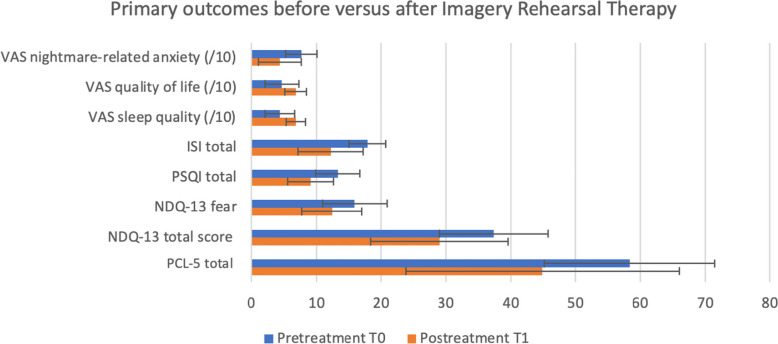
- Nightmare frequency per week decreased from 5.7 to 2.8 (p = 0.011), nightmare-related distress on a 0–10 VAS decreased from 7.7 to 4.4 (p = 0.004), and NDQ-13 total score decreased from 35.92 to 29.0 (p = 0.011).
- Sleep improved: PSQI decreased from 12.85 to 9.08 (p = 0.007), ISI decreased from 17.23 to 12.23 (p = 0.005), VAS sleep quality increased from 4.67 to 6.57 (p = 0.010), and VAS quality of life increased from 4.68 to 6.58 (p = 0.014).
- PTSD symptoms decreased on the PCL-5 in the adult subgroup (58.34 to 44.9, p = 0.034, n = 5), while adolescent PTSD measures showed a non-significant trend; anxiety, depressive symptoms, fatigue, and affective lability did not change significantly.
- Acceptability was 100%, satisfaction was 95%, and dropout was 0%.
Methods
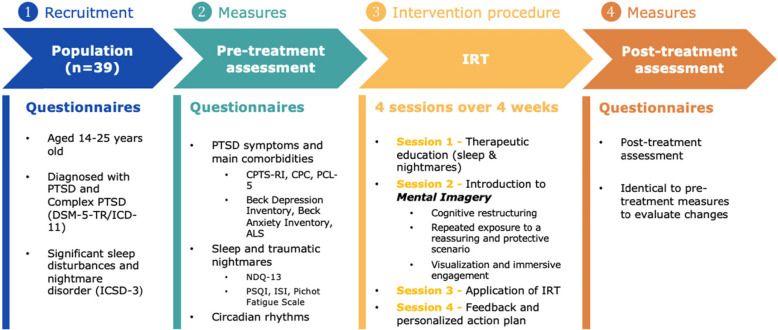
- Thirty-nine participants aged 14–25 years (32 girls, 7 boys; mean age 16.4 ± 3.1; 34 minors, 5 adults) with ICD-11 CPTSD and ICSD-3 nightmare disorder were recruited from Strasbourg University Hospitals between August 2022 and January 2025.
- All received four individual weekly 90-minute IRT sessions adapted from Krakow’s protocol, with pre-treatment (T0, 2 weeks before therapy) and post-treatment (T1, 6 weeks after the four sessions) self-report measures of nightmares, sleep, PTSD symptoms, anxiety, depression, affective lability, and quality of life.
- Analyses used Jamovi, non-parametric Wilcoxon signed-rank tests for paired pre-post comparisons, effect sizes, and a 5% significance level; no formal correction for multiple comparisons was applied.
Limitations
- The paper states a small sample (39), no control group, short follow-up, no formal correction for multiple comparisons, developmental/psychometric heterogeneity from combining adolescents and young adults assessed with different age-adapted PTSD instruments, and a very small adult subgroup (n = 5).
- The paper also states no independent formal rating of treatment fidelity was performed, and at study initiation no validated French-language tool was available to assess CPTSD in participants under 18.
- Evident from the text: the uncontrolled pre-post design means observed improvements are preliminary associations after treatment rather than evidence of a specific causal effect of IRT, and findings near the significance threshold should be interpreted cautiously.
Model-written summary. Check it against the paper before relying on it.
Integrity signals
Registry
Cites
Statistics
Figures
Verification
Claims the paper makes
4 Valid · 3 Not valid · 14 Not checked · 76 Own results and interpretations
The cited sources support only part of this claim — read each source’s verdict below.
In the paper
“with significant improvement in subjective sleep quality (PSQI: 13.3 → 9.1; p = 0.007 vs. 13.6 → 10.0; p = 0.002)) [61, 62, 77, 78, 80]”
§ Efficacy of imagery rehearsal therapy in the treatment of traumatic nightmares in youth with complex post-traumatic stress disorder > Discussion > Efficacy of imagery rehearsal therapy
What the sources say
- Not checked — no full text of the sourcecites [61] Harb GC, Thompson R, Ross RJ, Cook JM. Combat‐related PTSD nightmares and imagery rehearsal: nightmare characteristics and relation to treatment outcome. J Trauma Stress. 2012;25(5):511–8. 10.1002/jts.21748. 23047646 source
- Not checked — no full text of the sourcecites [62] Harb GC, Phelps AJ, Forbes D, Ross RJ, Gehrman PR, Cook JM. A critical review of the evidence base of imagery rehearsal for posttraumatic nightmares: pointing the way for future research: imagery rehearsal for trauma nightmares. J Trauma Stress. 2013;26(5):570–9. 10.1002/jts.21854. 24114887 source
- Not checked — no full text of the sourcecites [77] Lu M, Wagner A, Van Male L, Whitehead A, Boehnlein J. Imagery rehearsal therapy for posttraumatic nightmares in U.S. veterans. J Trauma Stress. 2009;22(3):236–9. 10.1002/jts.20407. 19444882 source
- Not checked — no full text of the sourcecites [78] Nappi CM, Drummond SPA, Thorp SR, McQuaid JR. Effectiveness of imagery rehearsal therapy for the treatment of combat-related nightmares in veterans. Behav Ther. 2010;41(2):237–44. 10.1016/j.beth.2009.03.003. 20412888 source
- Partly supportedcites [80] Berlin KL, Means MK, Edinger JD. Nightmare reduction in a Vietnam veteran using imagery rehearsal therapy. J Clin Sleep Med. 2010;6(5):487–8. PMC2952754 20957851 sourceExperimental — accuracy not yet measured
Our copy supports only the qualitative half of the claim: the Abstract and Report of Case (p. 487) state that 'Posttreatment, the veteran reported less nighttime awakening and improved quality of sleep' and that 'Nightmares were considerably reduced and the quality of sleep greatly improved after treatment.' However, this is a single-case report of one 69-year-old Vietnam veteran; it administered no PSQI and reports no baseline/post scores (13.3 → 9.1, 13.6 → 10.0) and no p-values (0.007, 0.002) — searches for 'PSQI / Pittsburgh Sleep Quality Index' and for 'statistical significance p value' returned no such data, and the only measures described are 6 weeks of sleep logs and 13 weeks of nightmare logs (Figure 1). The claimed between-group comparison and the statistical confirmation of subjective sleep-quality improvement are therefore not attributable to this source. (LLM, conf=0.75)
plainstates a cause- Asserted: passes — The authors put it forward as true.
- Checkable: passes — It can be checked against evidence.
- Load-bearing: passes — The paper’s conclusions depend on it.
- Based: passes — The paper gives a reason why it holds.
A result the paper reports from its own data — it cites no other source for it, so there is none to check. The quote shows it is in the paper.
In the paper
“Sleep quality was positively associated with quality of life (r = 0.581, p < 0.01).”
§ Efficacy of imagery rehearsal therapy in the treatment of traumatic nightmares in youth with complex post-traumatic stress disorder > Results
plainstates an association- Asserted: passes — The authors put it forward as true.
- Checkable: passes — It can be checked against evidence.
- Load-bearing: unclear — It is unclear whether the paper’s conclusions depend on it.
- Based: passes — The paper gives a reason why it holds.
A result the paper states — it cites no source for it, so there is none to check. The quote shows it is in the paper.
In the paper
“No significant improvement was observed in the ALS score, likely reflecting its limitations in capturing the specific emotional dysregulation seen in CPTSD.”
§ Efficacy of imagery rehearsal therapy in the treatment of traumatic nightmares in youth with complex post-traumatic stress disorder > Discussion > Efficacy of imagery rehearsal therapy
hedged- Asserted: passes — The authors put it forward as true.
- Checkable: passes — It can be checked against evidence.
- Load-bearing: passes — The paper’s conclusions depend on it.
- Based: passes — The paper gives a reason why it holds.
A result the paper reports from its own data — it cites no other source for it, so there is none to check. The quote shows it is in the paper.
In the paper
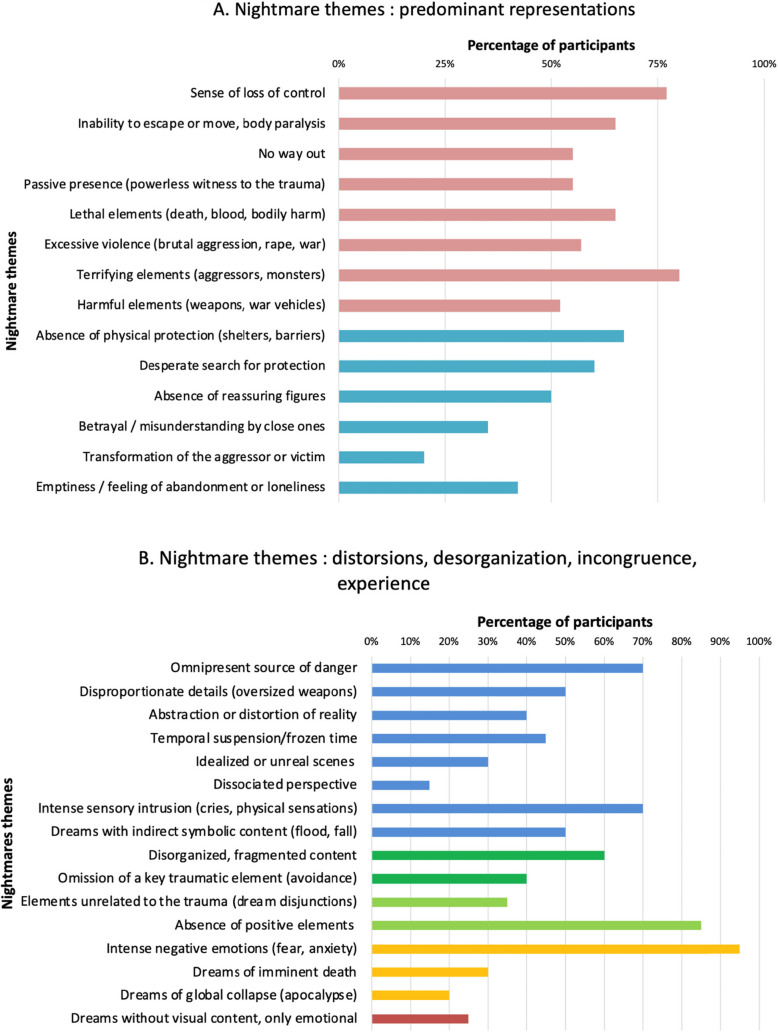
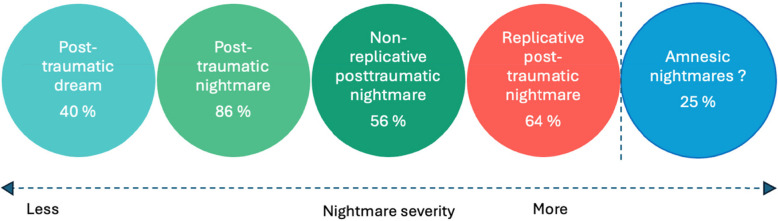
“In addition, about 25% of the children assessed at the regional psychotrauma center reported nocturnal awakenings following trauma exposure without dream recall yet experienced as equivalent to a nightmare on both the emotional and physiological level.”
§ Efficacy of imagery rehearsal therapy in the treatment of traumatic nightmares in youth with complex post-traumatic stress disorder > Discussion > Traumatic themes and emotional content of nightmares
plain- Asserted: passes — The authors put it forward as true.
- Checkable: passes — It can be checked against evidence.
- Load-bearing: unclear — It is unclear whether the paper’s conclusions depend on it.
- Based: passes — The paper gives a reason why it holds.
A result the paper states — it cites no source for it, so there is none to check. The quote shows it is in the paper.
In the paper
“The lack of change in chronotype after IRT aligns with its nature as a stable biological trait unlikely to shift with short-term psychotherapy.”
§ Efficacy of imagery rehearsal therapy in the treatment of traumatic nightmares in youth with complex post-traumatic stress disorder > Discussion > Efficacy of imagery rehearsal therapy
plain- Asserted: passes — The authors put it forward as true.
- Checkable: passes — It can be checked against evidence.
- Load-bearing: unclear — It is unclear whether the paper’s conclusions depend on it.
- Based: passes — The paper gives a reason why it holds.
28 more claims
Create a free account to see all 97 claims and every source verdict.
- It may state two separate claims as one. 47
- Probably not a substantial claim. 23
- The quote only partly states this claim. 1
Self-check
Percentages, sums and reported differences re-computed from the paper’s own numbers.
Each contradiction between two passages listed here was confirmed by an independent check.
Rated minor: it would not touch a result — a value no result rests on, a p-value that stays on the same side of the significance level, or a conflict that is clerical, resolved elsewhere in the paper, or outside its own findings.
In the paper
“| History of challenging out-of-home placement | 18 (45%) |”
§ Efficacy of imagery rehearsal therapy in the treatment of traumatic nightmares in youth with complex post-traumatic stress disorder > Results
Reported 45 · recomputed 46.153846
Rated minor: it would not touch a result — a value no result rests on, a p-value that stays on the same side of the significance level, or a conflict that is clerical, resolved elsewhere in the paper, or outside its own findings.
In the paper
§ Efficacy of imagery rehearsal therapy in the treatment of traumatic nightmares in youth with complex post-traumatic stress disorder > Abstract > Results
“quality of sleep (6.8 vs. 4.4, p = 0.01)”
§ Efficacy of imagery rehearsal therapy in the treatment of traumatic nightmares in youth with complex post-traumatic stress disorder > Results
“| VAS sleep quality (/10) | 39 | 4.67 | 1.37 | 6.57 | 2.28 | 0.010* | 0.759 |”
Rated minor: it would not touch a result — a value no result rests on, a p-value that stays on the same side of the significance level, or a conflict that is clerical, resolved elsewhere in the paper, or outside its own findings.
In the paper
§ Efficacy of imagery rehearsal therapy in the treatment of traumatic nightmares in youth with complex post-traumatic stress disorder > Abstract > Results
“Sleep improved (PSQI 9.1 vs. 13.3, p = 0.007; ISI 12.2 vs. 17.9, p = 0.005)”
§ Efficacy of imagery rehearsal therapy in the treatment of traumatic nightmares in youth with complex post-traumatic stress disorder > Results
“| ISI total | 39 | 17.23 | 2.68 | 12.23 | 5.05 | 0.005* | 0.816 |”
Rated minor: it would not touch a result — a value no result rests on, a p-value that stays on the same side of the significance level, or a conflict that is clerical, resolved elsewhere in the paper, or outside its own findings.
In the paper
§ Efficacy of imagery rehearsal therapy in the treatment of traumatic nightmares in youth with complex post-traumatic stress disorder > Abstract > Results
“Sleep improved (PSQI 9.1 vs. 13.3, p = 0.007; ISI 12.2 vs. 17.9, p = 0.005)”
§ Efficacy of imagery rehearsal therapy in the treatment of traumatic nightmares in youth with complex post-traumatic stress disorder > Results
“| PSQI total | 39 | 12.85 | 3.26 | 9.08 | 3.52 | 0.007* | 0.785 |”
Rated minor: it would not touch a result — a value no result rests on, a p-value that stays on the same side of the significance level, or a conflict that is clerical, resolved elsewhere in the paper, or outside its own findings.
In the paper
§ Efficacy of imagery rehearsal therapy in the treatment of traumatic nightmares in youth with complex post-traumatic stress disorder > Discussion > Traumatic themes and emotional content of nightmares
“Nightmare-related emotional distress before treatment was particularly severe (NDQ-13 mean: 37.3)”
§ Efficacy of imagery rehearsal therapy in the treatment of traumatic nightmares in youth with complex post-traumatic stress disorder > Results
“| NDQ-13 total score | 39 | 35.92 | 8.15 | 29.0 | 10.58 | 0.011* | 0.749 |”
1 more finding
Create a free account to see every finding of this check.
Citations
Cites
The Pittsburgh Sleep Quality Index: a new instrument for psychiatric practice and research
Buysse, D. J., Reynolds, C. F., Monk, T. H., Berman, S. R., & Kupfer, D. J. (1989) · Psychiatry Research · doi:10.1016/0165-1781(89)90047-4 · Cited by 35,234 · cited 1×
“• Pittsburgh Sleep Quality Index (PSQI; score 0–21, higher = poorer sleep quality) [43].”
Diagnostic and Statistical Manual of Mental Disorders
American Psychiatric Association (2022) · doi:10.1176/appi.books.9780890425787 · Cited by 23,476
An inventory for measuring clinical anxiety: Psychometric properties.
Beck, A. T., Epstein, N., Brown, G., & Steer, R. A. (1988) · Journal of Consulting and Clinical Psychology · doi:10.1037/0022-006x.56.6.893 · Cited by 14,407
Beck, A. T., Steer, R. A., & Brown, G. (2011) · PsycTESTS Dataset · doi:10.1037/t00742-000 · Cited by 7,535
Blevins, C. A., Weathers, F. W., Davis, M. T., Witte, T. K., & Domino, J. L. (2015) · Journal of Traumatic Stress · doi:10.1002/jts.22059 · Cited by 5,233
Morin, C. M., Belleville, G., Bélanger, L., & Ivers, H. (2011) · Sleep · doi:10.1093/sleep/34.5.601 · Cited by 4,620 · cited 1×
“• Insomnia Severity Index (ISI; 0–7 no insomnia, 8–14 subclinical, 15–21 moderate, 22–28 severe) [42].”
(1976) · PubMed · Cited by 3,979
Gender differences in stress and coping styles
Matud, M. P. (2004) · Personality and Individual Differences · doi:10.1016/j.paid.2004.01.010 · Cited by 1,880 · cited 2×
“Our sample also showed a female overrepresentation (82%), well documented in the literature [54], and explained by various authors by greater exposure to interpersonal violence, particularly sexual violence [53], a higher tendency to verbalize emotional distress, and recruitment biases associated…”
Complex Trauma in Children and Adolescents
Cook, A., Spinazzola, J., Ford, J., Lanktree, C., Blaustein, M., Cloitre, M., DeRosa, R., Hubbard, R., Kagan, R., Liautaud, J., et al. (2005) · Psychiatric Annals · doi:10.3928/00485713-20050501-05 · Cited by 1,619 · cited 1×
“Complex PTSD (CPTSD), often linked to repeated or inescapable trauma, involves persistent disturbances in self-organization (emotional dysregulation, negative self-perception, relational difficulties) [7, 8].”
Epidemiology of the human circadian clock
Roenneberg, T., Kuehnle, T., Juda, M., Kantermann, T., Allebrandt, K., Gordijn, M., & Merrow, M. (2007) · Sleep Medicine Reviews · doi:10.1016/j.smrv.2007.07.005 · Cited by 1,545 · cited 1×
“Chronotype [45] was assessed with: • Horne & Ostberg questionnaire (H&O) [46, 47]; scoring: ≥ 70 = extreme morning type, ≤ 30 = extreme evening type.”
Cloitre, M., Shevlin, M., Brewin, C. R., Bisson, J. I., Roberts, N. P., Maercker, A., Karatzias, T., & Hyland, P. (2018) · Acta Psychiatrica Scandinavica · doi:10.1111/acps.12956 · Cited by 1,314 · cited 1×
“In addition to age-specific PTSD symptom scales, the International Trauma Questionnaire (ITQ [41]) was used to support the clinical characterization of ICD-11 CPTSD, particularly the assessment of DSO dimensions.”
The Effects of Family and Community Violence on Children
Margolin, G., & Gordis, E. B. (2000) · Annual Review of Psychology · doi:10.1146/annurev.psych.51.1.445 · Cited by 1,252 · cited 2×
“…diary (see circadian rhythms section) using a standardized instruction limited to a maximum of 15 lines, allowing participants to freely describe their traumatic nightmares (instructions: “Describe your nightmare concisely in a few lines [5–10], including the elements that are important to you”).”
The role of sleep in emotional brain function
Goldstein, A. N., & Walker, M. P. (2014) · Annual Review of Clinical Psychology · doi:10.1146/annurev-clinpsy-032813-153716 · Cited by 1,052 · cited 1×
“Repeated nocturnal re-experiencing disrupts emotional processing and memory consolidation, creating a vicious cycle: hyperarousal, REM sleep fragmentation, and sleep debt worsen daytime emotional reactivity and reduce regulation [23, 24].”
Rates of post-traumatic stress disorder in trauma-exposed children and adolescents: meta-analysis
Alisic, E., Zalta, A. K., van Wesel, F., Larsen, S. E., Hafstad, G. S., Hassanpour, K., & Smid, G. E. (2014) · British Journal of Psychiatry · doi:10.1192/bjp.bp.113.131227 · Cited by 930 · cited 1×
“This severity can be explained by the cumulative and chronic nature of the trauma experienced [65, 66], emotion regulation difficulties typical of adolescence, and recruitment from specialized hospital units in psychotraumatology and sleep.”
Cicchetti, D., & Toth, S. L. (2005) · Annual Review of Clinical Psychology · doi:10.1146/annurev.clinpsy.1.102803.144029 · Cited by 861 · cited 1×
“Among youth, PTSD disrupts multiple developmental domains: attachment, emotional regulation, school adjustment [4, 5].”
Sleep disturbances as the hallmark of PTSD: where are we now?
Germain, A. (2013) · American Journal of Psychiatry · doi:10.1176/appi.ajp.2012.12040432 · Cited by 634 · cited 1×
“This absence of significant effects may reflect IRT’s specific focus on traumatic nightmares without addressing broader cognitive and emotional schemas that require more sustained interventions [85].”
Krakow, B., Hollifield, M., Johnston, L., Koss, M., Schrader, R., Warner, T. D., Tandberg, D., Lauriello, J., McBride, L., Cutchen, L., et al. (2001) · JAMA · doi:10.1001/jama.286.5.537 · Cited by 557
Disturbed sleep in post-traumatic stress disorder: secondary symptom or core feature?
Spoormaker, V. I., & Montgomery, P. (2008) · Sleep Medicine Reviews · doi:10.1016/j.smrv.2007.08.008 · Cited by 527 · cited 2×
“These disturbances significantly impair sleep quality [11], as reflected in high scores on the PSQI, NDQ-13 (nightmares), and ISI (insomnia) scales [51], consistent with the work of Germain et al. [22] and Spoormaker & Montgomery [52].”
Germain, A., Buysse, D. J., & Nofzinger, E. (2008) · Sleep Medicine Reviews · doi:10.1016/j.smrv.2007.09.003 · Cited by 421 · cited 4×
“%) suggests material that is difficult to process, serving as both a marker of unresolved psychological distress and of impaired nocturnal emotional regulation [22, 56, 67, 68].”
InfluentialREM sleep and the early development of posttraumatic stress disorder
Mellman, T. A., Bustamante, V., Fins, A. I., Pigeon, W. R., & Nolan, B. (2002) · American Journal of Psychiatry · doi:10.1176/appi.ajp.159.10.1696 · Cited by 414 · cited 2×
“Thus, traumatic nightmares are not mere symptoms but major pathogenic mechanisms of uncontrollable nocturnal re-experiencing that sustain and worsen PTSD [25, 26].”
Murray, K. E., Davidson, G. R., & Schweitzer, R. D. (2010) · American Journal of Orthopsychiatry · doi:10.1111/j.1939-0025.2010.01062.x · Cited by 385 · cited 1×
“This transferability suggests that the intervention may be adaptable to diverse populations, including those living in contexts of precarity, as illustrated by the IRT program implemented by the National Association of County and City Health Officials (NACCHO) [90].”
Nightmares: A new neurocognitive model
Nielsen, T., & Levin, R. (2007) · Sleep Medicine Reviews · doi:10.1016/j.smrv.2007.03.004 · Cited by 378 · cited 4×
“Qualitative analysis of reported nightmares confirmed classically observed phenotypic criteria: stereotyped and repetitive content, heightened sensory realism (visual, auditory, olfactory, tactile), poor narrative structure, and fragmented content [26, 55].”
InfluentialCloitre, M., Hyland, P., Bisson, J. I., Brewin, C. R., Roberts, N. P., Karatzias, T., & Shevlin, M. (2019) · Journal of Traumatic Stress · doi:10.1002/jts.22454 · Cited by 340
The affective lability scales: Development, reliability, and validity
Harvey, P. D., Greenberg, B. R., & Serper, M. R. (1989) · Journal of Clinical Psychology · doi:10.1002/1097-4679(198909)45:5<786::aid-jclp2270450515>3.0.co;2-p · Cited by 316
Clinical Management of Chronic Nightmares: Imagery Rehearsal Therapy
Krakow, B., & Zadra, A. (2006) · Behavioral Sleep Medicine · doi:10.1207/s15402010bsm0401_4 · Cited by 281 · cited 1×
“IRT, developed in the 1990 s by Barry Krakow and colleagues, aims to reduce nightmares’ impact through cognitive restructuring and positive imagery [30].”
Twelve‐Year Follow‐up Study of Khmer Youths Who Suffered Massive War Trauma as Children
SACK, W. H., HIM, C., & DICKASON, D. (1999) · Journal of the American Academy of Child & Adolescent Psychiatry · doi:10.1097/00004583-199909000-00023 · Cited by 241 · cited 1×
“This severity can be explained by the cumulative and chronic nature of the trauma experienced [65, 66], emotion regulation difficulties typical of adolescence, and recruitment from specialized hospital units in psychotraumatology and sleep.”
Sleep pathophysiology in posttraumatic stress disorder and idiopathic nightmare sufferers
Germain, A., & Nielsen, T. A. (2003) · Biological Psychiatry · doi:10.1016/s0006-3223(03)00071-4 · Cited by 214 · cited 2×
“The clinical features of participants’ nightmares support the hypothesis that sleep disturbances contribute to the maintenance of hyperarousal and the failure of fear extinction [22, 25, 26, 52, 57], sustaining a vicious cycle between daytime symptoms and nightmares.”
The association between sleep quality and quality of life: a population-based study
Lee, S., Kim, J. H., & Chung, J. H. (2021) · Sleep Medicine · doi:10.1016/j.sleep.2021.05.022 · Cited by 212 · cited 1×
“Functionally, the positive correlation between global sleep improvement (PSQI, ISI, sleep VAS) and quality of life ( p = 0.014) underscores the importance of addressing sleep disturbances in PTSD treatment given their direct impact on daytime functioning and psychological well-being [84].”
InfluentialOutline for a theory on the nature and functions of dreaming.
Hartmann, E. (1996) · Dreaming · doi:10.1037/h0094452 · Cited by 201 · cited 1×
“According to Hartmann, nightmares are not simply replays of traumatic events but emotionally charged dream productions attempting to integrate intense affects—fear, vulnerability—into memory processing [69, 70].”
Aetiology and treatment of nightmare disorder: State of the art and future perspectives
Gieselmann, A., Ait Aoudia, M., Carr, M., Germain, A., Gorzka, R., Holzinger, B., Kleim, B., Krakow, B., Kunze, A. E., Lancee, J., et al. (2019) · Journal of Sleep Research · doi:10.1111/jsr.12820 · Cited by 195 · cited 2×
“Repeated nocturnal re-experiencing disrupts emotional processing and memory consolidation, creating a vicious cycle: hyperarousal, REM sleep fragmentation, and sleep debt worsen daytime emotional reactivity and reduce regulation [23, 24].”
Casement, M. D., & Swanson, L. M. (2012) · Clinical Psychology Review · doi:10.1016/j.cpr.2012.06.002 · Cited by 192 · cited 2×
“Its efficacy is well demonstrated in adults, reducing nightmare frequency and distress and improving sleep [31, 32].”
Belicki, K. (1992) · Dreaming · doi:10.1037/h0094355 · Cited by 155 · cited 1×
“• Nightmare Distress Questionnaire (NDQ; 13 items, score > 20 indicates significant distress) [44], with added custom items on post-traumatic parasomnias and visual analog scales for nightmare-related distress.”
Valli, K., Revonsuo, A., Pälkäs, O., Ismail, K. H., Ali, K. J., & Punamäki, R.-L. (2005) · Consciousness and Cognition · doi:10.1016/s1053-8100(03)00019-9 · Cited by 153 · cited 1×
“Unlike ordinary nightmares, which are more varied, narrative, and less emotionally charged, traumatic nightmares are consistent and clinically significant [19].”
Trauma associated sleep disorder: a parasomnia induced by trauma
Mysliwiec, V., Brock, M. S., Creamer, J. L., O'Reilly, B. M., Germain, A., & Roth, B. J. (2018) · Sleep Medicine Reviews · doi:10.1016/j.smrv.2017.01.004 · Cited by 150 · cited 5×
“Some authors suggest that such combinations of night-mares, confusional arousals, and abnormal motor behaviors may represent a distinct sleep disorder—“Trauma-Associ-ated Sleep Disorder” (TASD)—warranting specific diagnostic and therapeutic approaches [59].”
InfluentialDreams in the acute aftermath of trauma and their relationship to PTSD
Mellman, T. A., David, D., Bustamante, V., Torres, J., & Fins, A. (2001) · Journal of Traumatic Stress · doi:10.1023/a:1007812321136 · Cited by 149 · cited 1×
“This proposal is consistent with recent approaches encouraging a shift beyond dream content-based analyses to focus more on the repetitive, emotional, and physiological dimensions of traumatic nightmares [21, 74].”
Understanding posttraumatic nightmares: An empirical and conceptual review
Phelps, A. J., Forbes, D., & Creamer, M. C. (2007) · Clinical Psychology Review · doi:10.1016/j.cpr.2007.06.001 · Cited by 136 · cited 1×
“This proposal is consistent with recent approaches encouraging a shift beyond dream content-based analyses to focus more on the repetitive, emotional, and physiological dimensions of traumatic nightmares [21, 74].”
Mysliwiec, V., O'Reilly, B., Polchinski, J., Kwon, H. P., Germain, A., & Roth, B. J. (2014) · Journal of Clinical Sleep Medicine · doi:10.5664/jcsm.4120 · Cited by 127
Memory processes in post-traumatic stress disorder
Brewin, C. R. (2001) · International Review of Psychiatry · doi:10.1080/09540260120074019 · Cited by 127 · cited 1×
“These encoding and consolidation dysfunctions [72, 73] may explain narrative fragmentation (60%), temporal distortions, and constant feeling of threat (70”
A Review of the Relationship Between Emotional Learning and Memory, Sleep, and PTSD
Colvonen, P. J., Straus, L. D., Acheson, D. T., & Gehrman, P. (2019) · Current Psychiatry Reports · doi:10.1007/s11920-019-0987-2 · Cited by 126 · cited 1×
“These encoding and consolidation dysfunctions [72, 73] may explain narrative fragmentation (60%), temporal distortions, and constant feeling of threat (70”
Fan, F., Zhou, Y., & Liu, X. (2017) · The Journal of Clinical Psychiatry · doi:10.4088/jcp.15m10206 · Cited by 119 · cited 2×
“The high prevalence of depressive symptomatology, the most common PTSD comorbidity, appears to be exacerbated by the chronicity of posttraumatic symptoms and associated sleep disturbances [12, 29].”
Treatment of chronic nightmares in adjudicated adolescent girls in a residential facility
Krakow, B., Sandoval, D., Schrader, R., Keuhne, B., Mcbride, L., Yau, C. L., & Tandberg, D. (2001) · Journal of Adolescent Health · doi:10.1016/s1054-139x(00)00195-6 · Cited by 115 · cited 3×
“After IRT, nightmares were associated with being less frequent and distressing (NDQ-13 total: p = 0.011; “fear” subscale: p = 0.012) [76–79], with significant improvement in subjective sleep quality (PSQI: 13.3 → 9.1; p = 0.007 vs. 13.6 → 10.0; p = 0.002)) [61, 62, 77, 78, 80].”
InfluentialSleep Disturbance in Pediatric PTSD: Current Findings and Future Directions
Kovachy, B., O’Hara, R., Hawkins, N., Gershon, A., Primeau, M. M., Madej, J., & Carrion, V. (2013) · Journal of Clinical Sleep Medicine · doi:10.5664/jcsm.2678 · Cited by 109 · cited 2×
“These disturbances significantly impair sleep quality [11], as reflected in high scores on the PSQI, NDQ-13 (nightmares), and ISI (insomnia) scales [51], consistent with the work of Germain et al. [22] and Spoormaker & Montgomery [52].”
Forbes, D., Phelps, A. J., McHugh, A. F., Debenham, P., Hopwood, M., & Creamer, M. (2003) · Journal of Traumatic Stress · doi:10.1023/a:1025718830026 · Cited by 104 · cited 1×
“However, most studies focus on adults with “classic” PTSD, with limited research in adolescents or in CPTSD populations [31, 33, 34].”
Augedal, A. W., Hansen, K. S., Kronhaug, C. R., Harvey, A. G., & Pallesen, S. (2013) · Sleep Medicine Reviews · doi:10.1016/j.smrv.2012.06.001 · Cited by 98 · cited 1×
“Its efficacy is well demonstrated in adults, reducing nightmare frequency and distress and improving sleep [31, 32].”
Dreams and exposure therapy in PTSD
Rothbaum, B. O., & Mellman, T. A. (2001) · Journal of Traumatic Stress · doi:10.1023/a:1011104521887 · Cited by 86 · cited 1×
“Their chronicity may also compromise first-line PTSD treatment effectiveness [27, 28], while targeted sleep interventions can improve recovery [29].”
Yücel, D. E., van Emmerik, A. A. P., Souama, C., & Lancee, J. (2020) · Sleep Medicine Reviews · doi:10.1016/j.smrv.2019.101248 · Cited by 85 · cited 2×
“After IRT, nightmares were associated with being less frequent and distressing (NDQ-13 total: p = 0.011; “fear” subscale: p = 0.012) [76–79], with significant improvement in subjective sleep quality (PSQI: 13.3 → 9.1; p = 0.007 vs. 13.6 → 10.0; p = 0.002)) [61, 62, 77, 78, 80].”
InfluentialSelf-reported and agency-notified child sexual abuse in a population-based birth cohort
Mills, R., Kisely, S., Alati, R., Strathearn, L., & Najman, J. (2016) · Journal of Psychiatric Research · doi:10.1016/j.jpsychires.2015.12.021 · Cited by 84 · cited 1×
“…overrepresentation (82%), well documented in the literature [54], and explained by various authors by greater exposure to interpersonal violence, particularly sexual violence [53], a higher tendency to verbalize emotional distress, and recruitment biases associated with help-seeking behaviors.”
Characteristics of chronic nightmares in a trauma-exposed treatment-seeking sample.
Davis, J. L., Byrd, P., Rhudy, J. L., & Wright, D. C. (2007) · Dreaming · doi:10.1037/1053-0797.17.4.187 · Cited by 83 · cited 1×
“Most participants described nightmares directly linked to traumatic events, with intense emotional content and abrupt awakenings in over 90% of cases [57, 58].”
Wallace, D. M., Shafazand, S., Ramos, A. R., Carvalho, D. Z., Gardener, H., Lorenzo, D., & Wohlgemuth, W. K. (2011) · Sleep Medicine · doi:10.1016/j.sleep.2011.06.004 · Cited by 83 · cited 1×
“These disturbances significantly impair sleep quality [11], as reflected in high scores on the PSQI, NDQ-13 (nightmares), and ISI (insomnia) scales [51], consistent with the work of Germain et al. [22] and Spoormaker & Montgomery [52].”
Phelps, A. J., Kanaan, R. A. A., Worsnop, C., Redston, S., Ralph, N., & Forbes, D. (2018) · Sleep · doi:10.1093/sleep/zsx188 · Cited by 81 · cited 1×
“Critically, traumatic nightmares are a core PTSD symptom, marked by high recurrence (≥ 2/week), intense sensory content, and strong autonomic activation [16].”
Post-traumatic stress disorder: a psychiatric disorder requiring urgent attention
Du, J., Diao, H., Zhou, X., Zhang, C., Chen, Y., Gao, Y. F., & Wang, Y. (2022) · Medical Review · doi:10.1515/mr-2022-0012 · Cited by 81 · cited 1×
“In adults, lifetime prevalence ranges from 1.3 to 12.2% [2].”
InfluentialNappi, C. M., Drummond, S. P. A., Thorp, S. R., & McQuaid, J. R. (2010) · Behavior Therapy · doi:10.1016/j.beth.2009.03.003 · Cited by 80 · cited 3×
“After IRT, nightmares were associated with being less frequent and distressing (NDQ-13 total: p = 0.011; “fear” subscale: p = 0.012) [76–79], with significant improvement in subjective sleep quality (PSQI: 13.3 → 9.1; p = 0.007 vs. 13.6 → 10.0; p = 0.002)) [61, 62, 77, 78, 80].”
InfluentialRandomized Controlled Trial of Imagery Rehearsal for Posttraumatic Nightmares in Combat Veterans
Harb, G. C., Cook, J. M., Phelps, A. J., Gehrman, P. R., Forbes, D., Localio, R., Harpaz-Rotem, I., Gur, R. C., & Ross, R. J. (2019) · Journal of Clinical Sleep Medicine · doi:10.5664/jcsm.7770 · Cited by 77 · cited 1×
“The significant reduction in nightmare-related emotional distress aligns with Krakow [81] and recent studies [62, 78, 82], including Sayk et al. [83], conducted in adults with borderline personality disorder (BPD), over 90% of whom had experienced repeated and severe trauma.”
Enhancing imagery rehearsal therapy for nightmares with targeted memory reactivation
Schwartz, S., Clerget, A., & Perogamvros, L. (2022) · Current Biology · doi:10.1016/j.cub.2022.09.032 · Cited by 73
Imagery rehearsal therapy for posttraumatic nightmares in U.S. veterans
Lu, M., Wagner, A., Van Male, L., Whitehead, A., & Boehnlein, J. (2009) · Journal of Traumatic Stress · doi:10.1002/jts.20407 · Cited by 67 · cited 3×
“These findings, necessarily exploratory, do not allow firm conclusions regarding the impact of IRT on these dimensions, which may either be less directly targeted by the intervention or require a longer time to evolve [62, 77].”
InfluentialParasomnias: A Comprehensive Review
Singh, S., Kaur, H., Singh, S., & Khawaja, I. (2018) · Cureus · doi:10.7759/cureus.3807 · Cited by 67 · cited 1×
“In this context, PTSD, with its physiological hyperactivation and dissociative aspects, promotes the emergence of “borderline” parasomnias [59], exacerbated by REM sleep fragmentation and reduced slow-wave sleep [60].”
Adaptation of imagery rehearsal therapy for nightmares in children: A brief report.
Simard, V., & Nielsen, T. (2009) · Psychotherapy: Theory, Research, Practice, Training · doi:10.1037/a0017945 · Cited by 55 · cited 1×
“The small sample size (39 participants), the absence of a control group, and the short follow-up period limit the strength of the conclusions [87].”
Vallat, R., Chatard, B., Blagrove, M., & Ruby, P. (2017) · PLOS ONE · doi:10.1371/journal.pone.0185262 · Cited by 55 · cited 1×
“%) suggests material that is difficult to process, serving as both a marker of unresolved psychological distress and of impaired nocturnal emotional regulation [22, 56, 67, 68].”
Lewis, C., Lewis, K., Kitchiner, N., Isaac, S., Jones, I., & Bisson, J. I. (2020) · European Journal of Psychotraumatology · doi:10.1080/20008198.2020.1767349 · Cited by 55
Harb, G. C., Thompson, R., Ross, R. J., & Cook, J. M. (2012) · Journal of Traumatic Stress · doi:10.1002/jts.21748 · Cited by 53 · cited 4×
“After IRT, nightmares were associated with being less frequent and distressing (NDQ-13 total: p = 0.011; “fear” subscale: p = 0.012) [76–79], with significant improvement in subjective sleep quality (PSQI: 13.3 → 9.1; p = 0.007 vs. 13.6 → 10.0; p = 0.002)) [61, 62, 77, 78, 80].”
InfluentialPsychometric properties of the French version of the Composite Scale of Morningness in adults
Caci, H., Nadalet, L., Staccini, P., Myquel, M., & Boyer, P. (1999) · European Psychiatry · doi:10.1016/s0924-9338(99)00169-8 · Cited by 51 · cited 1×
“Chronotype [45] was assessed with: • Horne & Ostberg questionnaire (H&O) [46, 47]; scoring: ≥ 70 = extreme morning type, ≤ 30 = extreme evening type.”
Sleep and PTSD in the Military Forces: A Reciprocal Relationship and a Psychiatric Approach
Saguin, E., Gomez-Merino, D., Sauvet, F., Leger, D., & Chennaoui, M. (2021) · Brain Sciences · doi:10.3390/brainsci11101310 · Cited by 50 · cited 1×
“Beyond being distressing, they reinforce trauma-related memory networks, maintaining the vividness and emotional charge of the memory [20–22].”
Waltman, S. H., Shearer, D. S., & Moore, B. A. (2018) · Current Psychiatry Reports · doi:10.1007/s11920-018-0971-2 · Cited by 49
(1996) · doi:10.4159/9780674270534 · Cited by 48
Influence of Sleep Disturbance on Global Functioning After Posttraumatic Stress Disorder Treatment
Brownlow, J. A., McLean, C. P., Gehrman, P. R., Harb, G. C., Ross, R. J., & Foa, E. B. (2016) · Journal of Traumatic Stress · doi:10.1002/jts.22139 · Cited by 45
Harb, G. C., Phelps, A. J., Forbes, D., Ross, R. J., Gehrman, P. R., & Cook, J. M. (2013) · Journal of Traumatic Stress · doi:10.1002/jts.21854 · Cited by 41
Polysomnography in patients with post‐traumatic stress disorder
Yetkin, S., Aydin, H., & Özgen, F. (2010) · Psychiatry and Clinical Neurosciences · doi:10.1111/j.1440-1819.2010.02084.x · Cited by 39 · cited 1×
“Sleep architecture is disrupted, with reduced non-REM consolidation and fragmented REM sleep [15].”
Trauma, dreaming, and psychological distress among Kurdish children.
Punamäki, R.-L., Ali, K. J., Ismahil, K. H., & Nuutinen, J. (2005) · Dreaming · doi:10.1037/1053-0797.15.3.178 · Cited by 39
The nature of posttraumatic nightmares and school functioning in war-affected youth
Harb, G. C., & Schultz, J.-H. (2020) · PLoS ONE · doi:10.1371/journal.pone.0242414 · Cited by 38
DSM-5-TR Manuel diagnostique et statistique des troubles mentaux, texte révisé
Manus, J.-M. (2023) · Revue Francophone des Laboratoires · doi:10.1016/s1773-035x(24)00008-x · Cited by 33
Olliac, B., Birmes, P. J., Bui, É., Allenou, C., Brunet, A., Claudet, I., de Gauzy, J. S., Grandjean, H., & Raynaud, J. (2014) · PLoS ONE · doi:10.1371/journal.pone.0112603 · Cited by 29
The nightmare severity index ( NSI ): A short new multidimensional tool for assessing nightmares
Geoffroy, P. A., Stern, É., Maruani, J., Cornic, R., Bazin, B., Clerici, E., Akkaoui, M. A., Lopez, R., Frija‐Masson, J., d’Ortho, M., et al. (2023) · Journal of Sleep Research · doi:10.1111/jsr.14065 · Cited by 24
Rolling, J., Rabot, J., Reynaud, È., Kolb, O., Bourgin, P., & Schroder, C. M. (2023) · Journal of Clinical Medicine · doi:10.3390/jcm12206570 · Cited by 22
Self-citationEl-Khoury, F., Rieckmann, A., Bengtsson, J., Melchior, M., & Rod, N. H. (2021) · Journal of Psychiatric Research · doi:10.1016/j.jpsychires.2021.02.034 · Cited by 21 · cited 1×
“These early difficulties can persist into adulthood, severely impacting quality of life [6].”
Nightmare Reduction in a Vietnam Veteran Using Imagery Rehearsal Therapy
Berlin, K. L., Means, M. K., & Edinger, J. D. (2010) · Journal of Clinical Sleep Medicine · doi:10.5664/jcsm.27940 · Cited by 17
Chiu, H. T. S., Alberici, A., Claxton, J., & Meiser‐Stedman, R. (2023) · Journal of Affective Disorders · doi:10.1016/j.jad.2023.08.033 · Cited by 17
Gindt, M., Richez, A., Battista, M., Fabre, R., Thümmler, S., Fernandez, A., & Askenazy-Gittard, F. (2021) · Frontiers in Psychiatry · doi:10.3389/fpsyt.2021.678916 · Cited by 15
Self-citationSaguin, E., Hulot, L. J., Roseau, J.-B., Metlaine, A., Paul, F., Nicolas, F., Sipahimalani, G., Léger, D., Gomez-Mérino, D., & Chennaoui, M. (2022) · Military Medicine · doi:10.1093/milmed/usac107 · Cited by 14 · cited 1×
“Moreover, validating the Nightmare Symptom Inventory (NSI) [88] and the Trauma-Related Nightmare Survey (TRNS) [89] for trauma-related nightmares in youth is an important next step.”
Hulot, J., Roseau, J.-B., Gomez-Merino, D., Chennaoui, M., & Saguin, E. (2024) · L'Encéphale · doi:10.1016/j.encep.2022.10.002 · Cited by 12 · cited 1×
“Traumatic nightmares are stereotyped, repetitive, and highly sensory (visual, tactile, olfactory) [18].”
Psychosocial intervention and dreaming among war-affected Palestinian children.
Qouta, S. R., Peltonen, K., Diab, S. Y., Anttila, S., Palosaari, E., & Punamäki, R.-L. (2016) · Dreaming · doi:10.1037/drm0000025 · Cited by 9 · cited 1×
“IRT aims to break this cycle by promoting more structured and positive dream content, enabling more adaptive cognitive-emotional processing of trauma [24, 75].”
Stern, E., Maruani, J., & Geoffroy, P. A. (2022) · Médecine du Sommeil · doi:10.1016/j.msom.2022.01.191 · Cited by 7
Sayk, C., Koch, N., Stierand, J., Timpe, F., Ngo, H.-V. V., Wilhelm, I., & Junghanns, K. (2025) · Journal of Psychiatric Research · doi:10.1016/j.jpsychires.2024.12.044 · Cited by 7 · cited 4×
“The absence of drop-out in our study, in contrast to Sayk’s study (33% among patients with borderline personality disorder) [83], may be explained by the containing, structured, and narrative nature of IRT, which may be particularly compatible with adolescents’ psychological functioning (activation…”
InfluentialRuby, P. M. (2021) · EDP Sciences eBooks · doi:10.1051/978-2-7598-2541-7 · Cited by 4
Le grand livre du trauma complexe. De l'enfant à l'adulte
Rolling, J., & Speranza, M. (2023) · Dunod eBooks · doi:10.3917/dunod.mengi.2023.01.0418 · Cited by 1
Self-citation
Research works printed but not linked: 6
- American Academy of Sleep Medicine. International classification of sleep disorders-third edition. 2014. Available from: https://learn.aasm.org/Public/Catalog/Details.aspx?id=QptXz3m0Wu8%3d
- Alisic E, Zalta AK, van Wesel F, Larsen SE, Hafstad GS, Hassanpour K, et al. Rates of post-traumatic stress disorder in trauma-exposed children and adolescents: meta-analysis. Br J Psychiatry. 2014;204(5):335–40. 10.1192/bjp.bp.113.131227. 24785767 · DOI · Paper page
- Hartmann E. Dreams and nightmares: The origin and meaning of dreams (1st paperback ed.). Cambridge, MA: Perseus Publishing; 2001. p. 315.
- Phelps AJ, Forbes D, Hopwood M, Creamer M. Nightmares and the hippocampus: a clinical neurobiological perspective. Sleep Med Rev. 2018;37:70–8.
- Krakow B, Hollifield M, Johnston L, Koss M, Schrader R, Warner TD, et al. Imagery rehearsal therapy for chronic nightmares in sexual assault survivors with posttraumatic stress disorder: a randomized controlled trial. JAMA. 2001;286(5):537. 10.1001/jama.286.5.537. 11476655 · DOI · Paper page
- Germain A. Sleep disturbances as the hallmark of PTSD: where are we now? Am J Psychiatry. 2013;170(4):372–82. 10.1176/appi.ajp.2012.12040432. 23223954 PMC4197954 · DOI · Paper page
Metadata
- Authors
- Rolling, J., Monnier, L., Zanfonato, T., Kilic-Huck, U., Ruppert, E., Comtet, H., Mengin, A., Fernandez, A., Kerbage, H., Bourgin, P., & Schroder, C. M.
- Affiliations
- Centre National de la Recherche Scientifique (FR)
- Hôpitaux Universitaires de Strasbourg (FR)
- Université Côte d'Azur (FR)
- Inserm (FR)
- Corresponding author
- Rolling, Julie
- Venue
- Journal of Clinical Sleep Medicine
- Published
- 2026-06-17
- Volume
- 22
- Issue
- 1
- ISSN
- 1550-9389 (ISSN-L)
- 1550-9397
- PMC
- PMC13275963
- OpenAlex
- W7165005755
- Semantic Scholar
- 75366322af764c75a5e20f9abf09465741b56422
- Cited by
- 0
- References
- 82
- FWCI
- 0.00
- Type
- journal article
- Language
- en
- Open access
- hybrid
- doi.org
- Licence
- cc-by-nc-nd
- creativecommons.org/licenses/by-nc-nd/4.0 (tdm)
- creativecommons.org/licenses/by-nc-nd/4.0 (vor)
- Locations
- Journal of Clinical Sleep Medicine (publishedVersion, cc-by-nc-nd)
- PubMed (publishedVersion)
- PubMed Central (publishedVersion, cc-by-nc-nd)
- Funders
- Université de Strasbourg
- Topics
- Social Sciences › Psychology › Experimental and Cognitive Psychology › Sleep and related disorders
- Social Sciences › Psychology › Clinical Psychology › Posttraumatic Stress Disorder Research
- Social Sciences › Psychology › Clinical Psychology › Psychoanalysis and Psychopathology Research
- Keywords
- imagery rehearsal therapy, complex PTSD, adolescents, youth trauma, sleep quality, quality of life, anxiety, depression, sexual violence, physical violence, feasibility, ICD-11 criteria, trauma exposure, posttraumatic stress symptoms, trauma-informed care, trauma-informed education
- MeSH terms
- Sleep Quality, Adolescent, Adult, Dreams, Feasibility Studies, Female, Humans, Male, Quality of Life, Stress Disorders, Post-Traumatic, Treatment Outcome, Imagery, Psychotherapy, Young Adult
About these checks
Registry, retraction, Cites and statistics results are computed, not judged, with one exception: a printed reference that no index lists is read once by a model before it counts as a citation error. Claims are extracted by a model and kept only when their quote appears verbatim in the text; each cited source is then checked, with a model’s help, for whether it says what the claim relies on. Those verdicts can be wrong — read the claim’s quote and the cited source before relying on one.
The claim verdicts this report counts are experimental: their accuracy is not yet measured.
A language model drew the claims from the paper on 2026-10-10, under version 3 of the claim definition (model deepseek-v4.1-flash, prompt extract-v3).
A second model labelled each claim on 2026-10-10 (model jev-1.13-20260917, definition revision gold-guideline-v0.2).
Cited sources are checked with a language model’s help (qwen3.8-omni-flash).
Statistics and arithmetic are recomputed, not judged.
Confidence bands are shown only for fields calibrated on our annotated test set. None is calibrated yet, so no band is shown.
What counts as a claim ›How we measure confidence ›How we check this ›
Are you an author, or do you see a problem with this page? Request a review
Data sources
Bibliographic data: Semantic Scholar, OpenAlex, Crossref.
Contains information from the Semantic Scholar Academic Graph Datasets, made available under the ODC Attribution License (ODC-BY 1.0).
Semantic Scholar’s data is described in: Kinney, R., et al. (2023). The Semantic Scholar Open Data Platform. arXiv:2301.10140.
