

General purpose technologies ‘Engines of growth’?
Open accessThe DOI matches its Crossref record; 39 of the 45 references it cites were found in a registry or an index.
Abstract
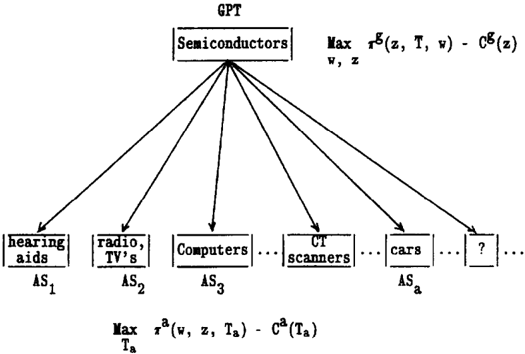
Whole eras of technical progress and growth appear to be driven by a few ‘General Purpose Technologies’ (GPT's), such as the steam engine, the electric motor, and semiconductors. GPT's are characterized by pervasiveness, inherent potential for technical improvements, and ‘innovational complementarities’, giving rise to increasing returns-to-scale. However, a decentralized economy will have difficulty in fully exploiting the growth opportunities of GPT's: arms-length market transactions between the GPT and its users may result in ‘too little, too late’ innovation. Likewise, difficulties in forecasting the technological developments of the other side can lower the rate of technical advance of all sectors.
Overview
The claims and statistics of this paper haven’t been checked yet.
Free: it reads the open-access text and checks the first 5 claims that cite a source we can check. Create a free account to check every claim.
Integrity signals
Registry
Cites
Statistics
Figures
Verification
Claims the paper makes
The claims and statistics of this paper haven’t been checked yet.
Free: it reads the open-access text and checks the first 5 claims that cite a source we can check. Create a free account to check every claim.
Claims other papers make about this one
Each is checked against this paper’s own text: does it say what the citing paper says it does?
The source backs part of the claim, not all of it — or backs it for a different population, condition or comparison.
In the citing paper
“The impacts of GPT are pivotal explanatory factors of long-term economic growth: 'One of the most important aspects of GPT is that they rejuvenate the growth process by creating spillovers that go far beyond the concept of measurable externalities' [80] (p. 100).”
From Digitalization and the Decoupling Debate: Can ICT Help to Reduce Environmental Impacts While the Economy Keeps Growing? (2020) · cites this paper as [80]
Experimental — accuracy not yet measuredThe source backs part of the claim, not all of it — or backs it for a different population, condition or comparison.
In the citing paper
“We conclude that LLMs such as GPTs exhibit traits of general-purpose technologies”
From GPTs are GPTs: An Early Look at the Labor Market Impact Potential of Large Language Models (2023) · cites this paper as Bresnahan and Trajtenberg, 1995
Experimental — accuracy not yet measuredThe source backs part of the claim, not all of it — or backs it for a different population, condition or comparison.
In the citing paper
“General purpose technologies (GPTs) such as AI enable and require significant complementary investments, including co-invention of new processes, products, business models and human capital.”
From The Productivity J-Curve: How Intangibles Complement General Purpose Technologies (2021) · cites this paper as Bresnahan and Trajtenberg 1995
Experimental — accuracy not yet measuredIn the citing paper
“AI, and in particular the subfield of AI called machine learning, is pervasive, improves over time, and spawns complementary innovation, thereby meeting Bresnahan and Trajtenberg's (1995) three canonical GPT criteria.”
From The Productivity J-Curve: How Intangibles Complement General Purpose Technologies (2021) · cites this paper as Bresnahan and Trajtenberg's (1995)
In the citing paper
“Specifically, they are pervasive, improve over time, and lead to complementary innovation (Bresnahan and Trajtenberg 1995).”
From The Productivity J-Curve: How Intangibles Complement General Purpose Technologies (2021) · cites this paper as Bresnahan and Trajtenberg 1995
Self-check
Percentages, sums and reported differences re-computed from the paper’s own numbers.
The self-check needs the paper’s full text.
Citations
Cites
Increasing returns and long-run growth
Romer, P. M. (1986) · Journal of Political Economy · doi:10.1086/261420 · Cited by 20,149
Technical Change and the Aggregate Production Function
Solow, R. M. (1957) · The Review of Economics and Statistics · doi:10.2307/1926047 · Cited by 12,259
The Theory of Industrial Organization
Jean Tirole, Z. (1988) · MIT Press Books · Cited by 8,651
Economic Welfare and the Allocation of Resources for Invention
Arrow, K. J. (1962) · The Rate and Direction of Inventive Activity · doi:10.1515/9781400879762-024 · Cited by 8,635
The Strategy of Economic Development
Linder, S. B., & Hirschman, A. O. (1959) · Ekonomisk Tidskrift · doi:10.2307/3438684 · Cited by 6,249
Innovation and Growth in the Global Economy.
Taylor, M. S., Grossman, G. M., & Helpman, E. (1993) · Economica · doi:10.2307/2554862 · Cited by 6,231
Theory of Industrial Organization.
Rubinstein, A., & Tirole, J. (1989) · Economica · doi:10.2307/2554286 · Cited by 5,142
Holmstrom, B. (1982) · The Bell Journal of Economics · doi:10.2307/3003457 · Cited by 4,903
Innovation and growth in the global economy
Broadberry, S. (1992) · International Journal of Industrial Organization · doi:10.1016/0167-7187(92)90023-r · Cited by 3,930
Hybrid Corn: An Exploration in the Economics of Technological Change
Griliches, Z. (1957) · Econometrica · doi:10.2307/1905380 · Cited by 3,330
Research works printed but not linked: 4
- Fisher, F.M., J.E. Greenwood, and J.J. McGowan, 1983, Folded, spindled, and mutilated: Economic analysis of U.S. vs. IBM (MIT Press, Cambridge, MA).
- Landes, D., 1969, The unbound Prometheus (Cambridge University Press, Cambridge).
- Mokyr, J., 1990, The lever of riches (Oxford University Press, New York, NY).
- Pakes, A. and P. McGuire, 1992, Computation of Markov perfect Nash equilibrium: Numerical implications of a dynamic differentiated product model, NBER technical discussion paper.
Cited by
Items 101–200 of 1,010
Commercializing generic technology: The case of advanced materials ventures
Maine, E., & Garnsey, E. (2006) · Research Policy · doi:10.1016/j.respol.2005.12.006 · Cited by 263
The broadband digital divide and the economic benefits of mobile broadband for rural areas
Prieger, J. E. (2013) · Telecommunications Policy · doi:10.1016/j.telpol.2012.11.003 · Cited by 262
Müller, J. M. (2019) · Journal of Manufacturing Technology Management · doi:10.1108/jmtm-01-2018-0008 · Cited by 258
Assessing the regional digital divide across the European Union-27
Vicente, M. R., & López, A. J. (2011) · Telecommunications Policy · doi:10.1016/j.telpol.2010.12.013 · Cited by 258
Technical Progress and Co-Invention in Computing and in the Uses of Computers
Bresnahan, T., Greenstein, S., Brownstone, D., & Flamm, K. (1996) · Brookings Papers on Economic Activity. Microeconomics · doi:10.2307/2534746 · Cited by 254
Self-citationThe Open Innovation in Science research field: a collaborative conceptualisation approach
Beck, S., Bergenholtz, C., Bogers, M., Brasseur, T.-M., Conradsen, M. L., Di Marco, D., Distel, A. P., Dobusch, L., Dörler, D., Effert, A., et al. (2022) · Industry and Innovation · doi:10.1080/13662716.2020.1792274 · Cited by 254
The education-related digital divide: An analysis for the EU-28
Cruz-Jesus, F., Vicente, M. R., Bacao, F., & Oliveira, T. (2016) · Computers in Human Behavior · doi:10.1016/j.chb.2015.11.027 · Cited by 252
The end of corporate computing
Carr, N. G. (2005) · MIT Sloan Management Review · Cited by 251
Basu, S., Fernald, J. G., Oulton, N., & Srinivasan, S. (2003) · NBER Macroeconomics Annual · doi:10.1086/ma.18.3585244 · Cited by 249
Feldman, M. (2005) · Research and Technological Innovation · doi:10.1007/3-7908-1658-2_9 · Cited by 247
Mission AI: The New System Technology
Sheikh, H., Prins, C., & Schrijvers, E. (2023) · Research for Policy · doi:10.1007/978-3-031-21448-6 · Cited by 125
Hao, Y., Guo, Y., & Wu, H. (2022) · Business Strategy and the Environment · doi:10.1002/bse.2901 · Cited by 245
Bresnahan, T. (2010) · Handbook of the Economics of Innovation · doi:10.1016/s0169-7218(10)02002-2 · Cited by 241
Self-citationWhat Do We Learn From Schumpeterian Growth Theory?
Aghion, P., Akcigit, U., & Howitt, P. (2014) · Handbook of Economic Growth · doi:10.1016/b978-0-444-53540-5.00001-x · Cited by 240
The evolution of the global digital platform economy: 1971–2021
Acs, Z. J., Song, A. K., Szerb, L., Audretsch, D. B., & Komlósi, É. (2021) · Small Business Economics · doi:10.1007/s11187-021-00561-x · Cited by 237
Some Simple Economics of the Blockchain
Catalini, C., & Gans, J. S. (2016) · SSRN Electronic Journal · doi:10.2139/ssrn.2874598 · Cited by 236
Wages, Skills, and Technology in the United States and Canada
Murphy, K., Riddell, W. C., & Romer, P. (1998) · National Bureau of Economic Research · doi:10.3386/w6638 · Cited by 101
The enabling technologies of industry 4.0: examining the seeds of the fourth industrial revolution
Martinelli, A., Mina, A., & Moggi, M. (2021) · Industrial and Corporate Change · doi:10.1093/icc/dtaa060 · Cited by 230
Beaudry, P., Doms, M., & Lewis, E. (2010) · Journal of Political Economy · doi:10.1086/658371 · Cited by 229
Productivity Trends in Advanced Countries between 1890 and 2012
Bergeaud, A., Cette, G., & Lecat, R. (2016) · Review of Income and Wealth · doi:10.1111/roiw.12185 · Cited by 229
How Does New Infrastructure Investment Affect Economic Growth Quality? Empirical Evidence from China
Xin, D., Zhang, H., & Han, Y. (2022) · Sustainability · doi:10.3390/su14063511 · Cited by 235
As Time Goes By: From the Industrial Revolutions to the Information Revolution
Freeman, C., & Louçã, F. (2002) · doi:10.1093/0199251053.001.0001 · Cited by 226
The Evolution of Management Models: A Neo-Schumpeterian Theory
Bodrožić, Z., & Adler, P. S. (2018) · Administrative Science Quarterly · doi:10.1177/0001839217704811 · Cited by 226
Productivity Effects of Organizational Change: Microeconometric Evidence
Bertschek, I., & Kaiser, U. (2004) · Management Science · doi:10.1287/mnsc.1030.0195 · Cited by 226
Business modelling revisited: the configuration of control and value
Ballon, P. (2007) · info · doi:10.1108/14636690710816417 · Cited by 225
Wages and Human Capital in the U.S. Financial Industry: 1909-2006
Philippon, T., & Reshef, A. (2009) · National Bureau of Economic Research · doi:10.3386/w14644 · Cited by 228
Productivity and Potential Output Before, During, and After the Great Recession
Fernald, J. (2014) · National Bureau of Economic Research · doi:10.3386/w20248 · Cited by 223
Research and development in the growth process
Aghion, P., & Howitt, P. (1996) · Journal of Economic Growth · doi:10.1007/bf00163342 · Cited by 223
What Do We Learn From Schumpeterian Growth Theory?
Aghion, P., Akcigit, U., & Howitt, P. W. (2013) · National Bureau of Economic Research · doi:10.3386/w18824 · Cited by 225
The transformative potential of artificial intelligence
Gruetzemacher, R., & Whittlestone, J. (2022) · Futures · doi:10.1016/j.futures.2021.102884 · Cited by 220
Uncovering GPTS with Patent Data
Hall, B. H., & Trajtenberg, M. (2004) · National Bureau of Economic Research · doi:10.3386/w10901 · Cited by 223
Self-citationICT and Productivity in Europe and the United States Where Do the Differences Come From?
van Ark, B. (2003) · CESifo Economic Studies · doi:10.1093/cesifo/49.3.295 · Cited by 219
Artificial intelligence in Finance: a comprehensive review through bibliometric and content analysis
Bahoo, S., Cucculelli, M., Goga, X., & Mondolo, J. (2024) · SN Business & Economics · doi:10.1007/s43546-023-00618-x · Cited by 218
The Evolutionary Dynamics of the Artificial Intelligence Ecosystem
Jacobides, M. G., Brusoni, S., & Candelon, F. (2021) · Strategy Science · doi:10.1287/stsc.2021.0148 · Cited by 217
Björkdahl, J. (2009) · Research Policy · doi:10.1016/j.respol.2009.07.006 · Cited by 217
Industry-specific competencies and converging technological systems: evidence from patents
Fai, F., & von Tunzelmann, N. (2001) · Structural Change and Economic Dynamics · doi:10.1016/s0954-349x(00)00035-7 · Cited by 216
The Impact of Information Technology on Emergency Health Care Outcomes
Athey, S., & Stern, S. (2002) · The RAND Journal of Economics · doi:10.2307/3087465 · Cited by 215
Artificial intelligence in science: An emerging general method of invention
Bianchini, S., Müller, M., & Pelletier, P. (2022) · Research Policy · doi:10.1016/j.respol.2022.104604 · Cited by 213
ICT adoption in Italian manufacturing: firm-level evidence
Fabiani, S. (2005) · Industrial and Corporate Change · doi:10.1093/icc/dth050 · Cited by 213
Customer preference discontinuities: a trigger for radical technological change
Tripsas, M. (2008) · Managerial and Decision Economics · doi:10.1002/mde.1389 · Cited by 213
The Effects of Technical Change on Labor Market Inequalities
Hornstein, A., Krusell, P., & Violante, G. L. (2005) · Handbook of Economic Growth · doi:10.1016/s1574-0684(05)01020-8 · Cited by 213
ROSENBERG, N., & TRAJTENBERG, M. (2004) · The Journal of Economic History · doi:10.1017/s0022050704002608 · Cited by 211
Self-citationGoldfarb, A., Taska, B., & Teodoridis, F. (2023) · Research Policy · doi:10.1016/j.respol.2022.104653 · Cited by 209
Lim, K. (2009) · Industrial and Corporate Change · doi:10.1093/icc/dtp044 · Cited by 209
Strategic Management of Innovation and Design
Le Masson, P., Weil, B., & Hatchuel, A. (2010) · Cambridge University Press eBooks · doi:10.1017/cbo9780511779916 · Cited by 208
The Consequences of Financial Innovation: A Counterfactual Research Agenda
Lerner, J., & Tufano, P. (2011) · Annual Review of Financial Economics · doi:10.1146/annurev.financial.050808.114326 · Cited by 208
Mobile telecommunications and the impact on economic development: MOBILES AND GROWTH
Gruber, H., & Koutroumpis, P. (2011) · Economic Policy · doi:10.1111/j.1468-0327.2011.00266.x · Cited by 208
Is the Internet a US invention?—an economic and technological history of computer networking
Mowery, D. C., & Simcoe, T. (2002) · Research Policy · doi:10.1016/s0048-7333(02)00069-0 · Cited by 206
Pradhan, R. P., Arvin, M. B., & Norman, N. R. (2015) · Technology in Society · doi:10.1016/j.techsoc.2015.04.002 · Cited by 206
Artificial intelligence and productivity: global evidence from AI patent and bibliometric data
Parteka, A., & Kordalska, A. (2023) · Technovation · doi:10.1016/j.technovation.2023.102764 · Cited by 207
Productivity and ICT: a review of the evidencePreprint
Draca, M., Sadun, R., & Reenen, J. M. V. (2006) · RePEc: Research Papers in Economics · Cited by 209
Ridership effects of real-time bus information system: A case study in the City of Chicago
Tang, L., & Thakuriah, P. (. (2012) · Transportation Research Part C: Emerging Technologies · doi:10.1016/j.trc.2012.01.001 · Cited by 205
Gans, J. S., & Stern, S. (2010) · Industrial and Corporate Change · doi:10.1093/icc/dtq023 · Cited by 203
Organizational Barriers to Technology Adoption: Evidence from Soccer-Ball Producers in Pakistan*
Atkin, D., Chaudhry, A., Chaudry, S., Khandelwal, A. K., & Verhoogen, E. (2017) · The Quarterly Journal of Economics · doi:10.1093/qje/qjx010 · Cited by 203
Assessing the nature of nanotechnology: can we uncover an emerging general purpose technology?
Youtie, J., Iacopetta, M., & Graham, S. (2008) · The Journal of Technology Transfer · doi:10.1007/s10961-007-9030-6 · Cited by 203
Jovanovic, B., & Rousseau, P. (2005) · National Bureau of Economic Research · doi:10.3386/w11093 · Cited by 201
The transformational dimension in the realization of business value from information technology
Gregor, S., Martin, M., Fernandez, W., Stern, S., & Vitale, M. (2006) · The Journal of Strategic Information Systems · doi:10.1016/j.jsis.2006.04.001 · Cited by 200
Adedoyin, F. F., Bekun, F. V., Driha, O. M., & Balsalobre-Lorente, D. (2020) · Technological Forecasting and Social Change · doi:10.1016/j.techfore.2020.120297 · Cited by 199
Industrial digitalization. A systematic literature review and research agenda
Matt, D. T., Pedrini, G., Bonfanti, A., & Orzes, G. (2022) · European Management Journal · doi:10.1016/j.emj.2022.01.001 · Cited by 206
Pearson, P. J. G., & Foxon, T. J. (2012) · Energy Policy · doi:10.1016/j.enpol.2012.07.061 · Cited by 197
What drives innovation? Evidence from economic history
Taalbi, J. (2017) · Research Policy · doi:10.1016/j.respol.2017.06.007 · Cited by 198
Wages and Employment in the United States and Germany:What Explains the Differences?
Beaudry, P., & Green, D. A. (2003) · American Economic Review · doi:10.1257/000282803322156990 · Cited by 196
Value creation and value capture for AI business model innovation: a three-phase process framework
Åström, J., Reim, W., & Parida, V. (2022) · Review of Managerial Science · doi:10.1007/s11846-022-00521-z · Cited by 195
Towards an Economic Framework for Network Neutrality Regulation.
van Schewick, B. (2007) · J. Telecommun. High Technol. Law · Cited by 194
Disrupting Governance: The New Institutional Economics of Distributed Ledger TechnologyPreprint
Davidson, S., Filippi, P. D., & Potts, J. (2016) · SSRN Electronic Journal · doi:10.2139/ssrn.2811995 · Cited by 202
Corporate digital transformation and labor structure upgrading
Dou, B., Guo, S., Chang, X., & Wang, Y. (2023) · International Review of Financial Analysis · doi:10.1016/j.irfa.2023.102904 · Cited by 193
Identifying artificial intelligence (AI) invention: a novel AI patent dataset
Giczy, A. V., Pairolero, N. A., & Toole, A. A. (2021) · The Journal of Technology Transfer · doi:10.1007/s10961-021-09900-2 · Cited by 193
Of Mice and Academics: Examining the Effect of Openness on Innovation
Murray, F., Aghion, P., Dewatripont, M., Kolev, J., & Stern, S. (2016) · American Economic Journal: Economic Policy · doi:10.1257/pol.20140062 · Cited by 188
Improving the return on IT investment: the productivity paradox
Santos, B. D., & Sussman, L. (2000) · International Journal of Information Management · doi:10.1016/s0268-4012(00)00037-2 · Cited by 188
Melville, N., Gurbaxani, V., & Kraemer, K. (2007) · Decision Support Systems · doi:10.1016/j.dss.2006.09.009 · Cited by 187
Blockchain for Cities—A Systematic Literature Review
Shen, C., & Pena-Mora, F. (2018) · IEEE Access · doi:10.1109/access.2018.2880744 · Cited by 187
General Purpose Technology and Wage Inequality
Aghion, P., Howitt, P., & Violante†, G. L. (2002) · Journal of Economic Growth · doi:10.1023/a:1020875717066 · Cited by 187
Arora, A., & Gambardella, A. (2010) · Handbook of the economics of innovation · doi:10.1016/s0169-7218(10)01015-4 · Cited by 187
Exploding Productivity Growth: Context, Causes, and Implications
Gordon, R. J. (. J. (2003) · Brookings Papers on Economic Activity · doi:10.1353/eca.2004.0006 · Cited by 186
Gorton, G., & Ordoñez, G. L. (2019) · Journal of the European Economic Association · doi:10.1093/jeea/jvy058 · Cited by 187
Digital Prosperity: Understanding the Economic Benefits of the Information Technology RevolutionPreprint
Atkinson, R. D., & McKay, A. S. (2007) · SSRN Electronic Journal · doi:10.2139/ssrn.1004516 · Cited by 189
Coccia, M. (2016) · Technological Forecasting and Social Change · doi:10.1016/j.techfore.2016.05.019 · Cited by 183
Spatial growth and industry age
Desmet, K., & Rossi-Hansberg, E. (2009) · Journal of Economic Theory · doi:10.1016/j.jet.2008.11.001 · Cited by 182
Cicerone, G., Faggian, A., Montresor, S., & Rentocchini, F. (2022) · Regional Studies · doi:10.1080/00343404.2022.2092610 · Cited by 182
What Do We Learn from Schumpeterian Growth Theory?Preprint
Aghion, P., Akcigit, U., & Howitt, P. W. (2013) · SSRN Electronic Journal · doi:10.2139/ssrn.2274704 · Cited by 183
Blockchain for sustainability: A systematic literature review for policy impact
Mulligan, C. E. A., Morsfield, S. G., & Cheikosman, E. (2023) · Telecommunications Policy · doi:10.1016/j.telpol.2023.102676 · Cited by 183
The economics of information technology: an introduction
(2006) · Choice Reviews Online · doi:10.5860/choice.43-2910 · Cited by 181
Quantifying the Impact of ICT Capital on Output Growth: A Heterogeneous Dynamic Panel Approach
O'Mahony, M., & Vecchi, M. (2005) · Economica · doi:10.1111/j.1468-0335.2005.0435.x · Cited by 178
Technological exploration through licensing: new insights from the licensee’s point of view
Laursen, K., Leone, M., & Torrisi, S. (2010) · Industrial and Corporate Change · doi:10.1093/icc/dtq034 · Cited by 166
Coccia, M. (2015) · Technology in Society · doi:10.1016/j.techsoc.2015.05.008 · Cited by 181
The Impact of Automation on Employment: Just the Usual Structural Change?
Vermeulen, B., Kesselhut, J., Pyka, A., & Saviotti, P. P. (2018) · Sustainability · doi:10.3390/su10051661 · Cited by 177
Artificial intelligence and radical innovation: an opportunity for all companies?
Grashof, N., & Kopka, A. (2023) · Small Business Economics · doi:10.1007/s11187-022-00698-3 · Cited by 177
A multivariate framework for the analysis of the digital divide: Evidence for the European Union-15
Vicente Cuervo, M. R., & López Menéndez, A. J. (2006) · Information & Management · doi:10.1016/j.im.2006.05.001 · Cited by 177
Innovation and ICT in service firms: towards a multidimensional approach for impact assessment
Gago, D., & Rubalcaba, L. (2006) · Journal of Evolutionary Economics · doi:10.1007/s00191-006-0030-8 · Cited by 178
Spatial implications of digitization: State of the field and research agenda
Haefner, L., & Sternberg, R. (2020) · Geography Compass · doi:10.1111/gec3.12544 · Cited by 179
A Novel ICT Framework for Sustainable Development Goals
Kostoska, O., & Kocarev, L. (2019) · Sustainability · doi:10.3390/su11071961 · Cited by 176
Precautionary Demand for Education, Inequality, and Technological Progress
Gould, E. D., Moav, O., & Weinberg, B. A. (2001) · Journal of Economic Growth · doi:10.1023/a:1012782212348 · Cited by 175
Alternative Futures for the Digital Transformation: A Macro-Level Schumpeterian Perspective
Bodrožić, Z., & S. Adler, P. (2022) · Organization Science · doi:10.1287/orsc.2021.1558 · Cited by 136
The Fourth Industrial Revolution – The Case of South Africa
Sutherland, E. (2020) · Politikon · doi:10.1080/02589346.2019.1696003 · Cited by 174
Creative destruction and firm-specific performance heterogeneity☆
CHUN, H., KIM, J., MORCK, R., & YEUNG, B. (2008) · Journal of Financial Economics · doi:10.1016/j.jfineco.2007.06.005 · Cited by 174
Knowledge spillovers from clean and dirty technologies
Dechezleprêtre, A., Martin, R., & Mohnen, M. (2014) · London School of Economics and Political Science Research Online (London School of Economics and Political Science) · Cited by 176
Lin, L.-H. (2011) · The International Journal of Human Resource Management · doi:10.1080/09585192.2011.540149 · Cited by 142
Cloud Computing Uncovered: A Research Landscape
Hamdaqa, M., & Tahvildari, L. (2012) · Advances in computers · doi:10.1016/b978-0-12-396535-6.00002-8 · Cited by 174
Explaining a Productive Decade
Oliner, S., Sichel, D. E., & Stiroh, K. J. (2007) · Brookings Papers on Economic Activity · doi:10.1353/eca.2007.0014 · Cited by 172
Innovation and the dynamics and evolution of industries: Progress and challenges
Malerba, F. (2007) · International Journal of Industrial Organization · doi:10.1016/j.ijindorg.2006.07.005 · Cited by 172
Metadata
- Authors
- Bresnahan, T. F., & Trajtenberg, M.
- Affiliations
- National Bureau of Economic Research (US)
- Corresponding author
- Bresnahan, Timothy F.
- Venue
- Journal of Econometrics
- Publisher
- Elsevier BV
- Published
- 1995-01
- Volume
- 65
- Issue
- 1
- Pages
- 83-108
- ISSN
- 0304-4076 (ISSN-L)
- OpenAlex
- W2033912020
- Cited by
- 2,879
- References
- 45
- Citations by year
- 2026: 331 · 2025: 227 · 2024: 174 · 2023: 140 · 2022: 146 · 2021: 144 · 2020: 124 · 2019: 124 · 2018: 105 · 2017: 130 · 2016: 91 · 2015: 86 · 2014: 79 · 2013: 79 · 2012: 96
- FWCI
- 29.27
- Type
- journal article
- Language
- en
- Open access
- hybrid
- doi.org
- Licence
- cc-by-nc-nd
- www.elsevier.com/tdm/userlicense/1.0/ (tdm)
- www.elsevier.com/legal/tdmrep-license (tdm)
- creativecommons.org/licenses/by-nc-nd/4.0/ (vor, 2287 d)
- Locations
- Journal of Econometrics (publishedVersion, cc-by-nc-nd)
- RePEc: Research Papers in Economics (submittedVersion)
- Topics
- Social Sciences › Economics, Econometrics and Finance › Economics and Econometrics › Economic Growth and Productivity
- Social Sciences › Economics, Econometrics and Finance › General Economics, Econometrics and Finance › Economic Development and Digital Transformation
- Social Sciences › Decision Sciences › Management Science and Operations Research › Innovation Diffusion and Forecasting
- Keywords
- general purpose technologies, technological progress, economic growth, innovation complementarity, increasing returns to scale, decentralized economy, technology forecasting, semiconductors, electric motors, steam engines
About these checks
Registry, retraction, Cites and statistics results are computed, not judged, with one exception: a printed reference that no index lists is read once by a model before it counts as a citation error. Claims are extracted by a model and kept only when their quote appears verbatim in the text; each cited source is then checked, with a model’s help, for whether it says what the claim relies on. Those verdicts can be wrong — read the claim’s quote and the cited source before relying on one.
Statistics and arithmetic are recomputed, not judged.
Confidence bands are shown only for fields calibrated on our annotated test set. None is calibrated yet, so no band is shown.
What counts as a claim ›How we measure confidence ›How we check this ›
Are you an author, or do you see a problem with this page? Request a review
Data sources
Bibliographic data: Semantic Scholar, OpenAlex, Crossref.
Contains information from the Semantic Scholar Academic Graph Datasets, made available under the ODC Attribution License (ODC-BY 1.0).
Semantic Scholar’s data is described in: Kinney, R., et al. (2023). The Semantic Scholar Open Data Platform. arXiv:2301.10140.
