

General purpose technologies ‘Engines of growth’?
Open accessThe DOI matches its Crossref record; 39 of the 45 references it cites were found in a registry or an index.
Abstract
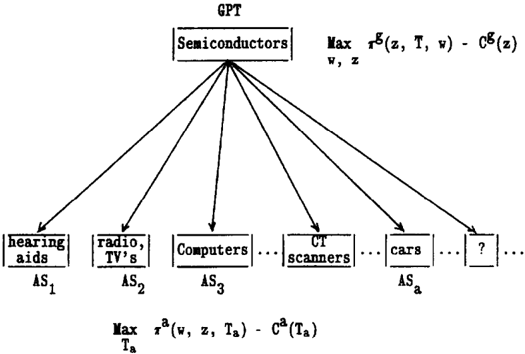
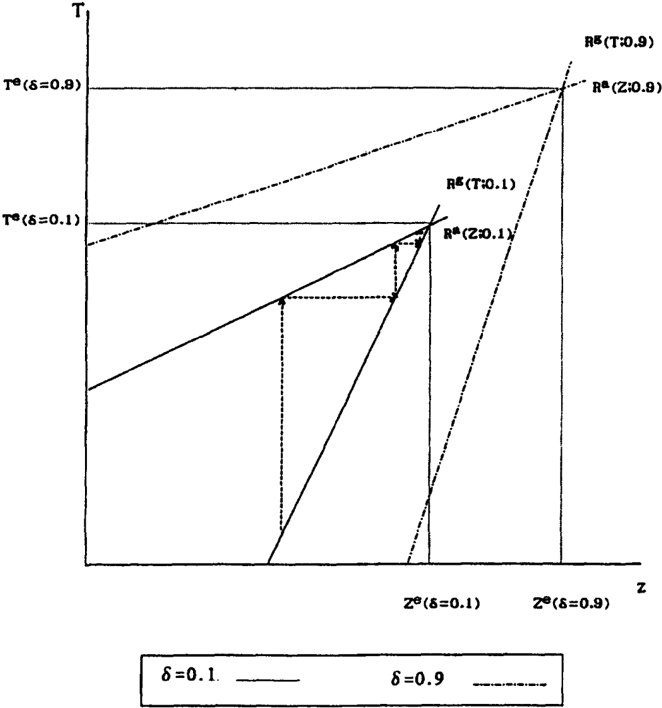
Whole eras of technical progress and growth appear to be driven by a few ‘General Purpose Technologies’ (GPT's), such as the steam engine, the electric motor, and semiconductors. GPT's are characterized by pervasiveness, inherent potential for technical improvements, and ‘innovational complementarities’, giving rise to increasing returns-to-scale. However, a decentralized economy will have difficulty in fully exploiting the growth opportunities of GPT's: arms-length market transactions between the GPT and its users may result in ‘too little, too late’ innovation. Likewise, difficulties in forecasting the technological developments of the other side can lower the rate of technical advance of all sectors.
Overview
The claims and statistics of this paper haven’t been checked yet.
Free: it reads the open-access text and checks the first 5 claims that cite a source we can check. Create a free account to check every claim.
Integrity signals
Registry
Cites
Statistics
Figures
Verification
Claims the paper makes
The claims and statistics of this paper haven’t been checked yet.
Free: it reads the open-access text and checks the first 5 claims that cite a source we can check. Create a free account to check every claim.
Claims other papers make about this one
Each is checked against this paper’s own text: does it say what the citing paper says it does?
The source backs part of the claim, not all of it — or backs it for a different population, condition or comparison.
In the citing paper
“The impacts of GPT are pivotal explanatory factors of long-term economic growth: 'One of the most important aspects of GPT is that they rejuvenate the growth process by creating spillovers that go far beyond the concept of measurable externalities' [80] (p. 100).”
From Digitalization and the Decoupling Debate: Can ICT Help to Reduce Environmental Impacts While the Economy Keeps Growing? (2020) · cites this paper as [80]
Experimental — accuracy not yet measuredThe source backs part of the claim, not all of it — or backs it for a different population, condition or comparison.
In the citing paper
“We conclude that LLMs such as GPTs exhibit traits of general-purpose technologies”
From GPTs are GPTs: An Early Look at the Labor Market Impact Potential of Large Language Models (2023) · cites this paper as Bresnahan and Trajtenberg, 1995
Experimental — accuracy not yet measuredThe source backs part of the claim, not all of it — or backs it for a different population, condition or comparison.
In the citing paper
“General purpose technologies (GPTs) such as AI enable and require significant complementary investments, including co-invention of new processes, products, business models and human capital.”
From The Productivity J-Curve: How Intangibles Complement General Purpose Technologies (2021) · cites this paper as Bresnahan and Trajtenberg 1995
Experimental — accuracy not yet measuredIn the citing paper
“AI, and in particular the subfield of AI called machine learning, is pervasive, improves over time, and spawns complementary innovation, thereby meeting Bresnahan and Trajtenberg's (1995) three canonical GPT criteria.”
From The Productivity J-Curve: How Intangibles Complement General Purpose Technologies (2021) · cites this paper as Bresnahan and Trajtenberg's (1995)
In the citing paper
“Specifically, they are pervasive, improve over time, and lead to complementary innovation (Bresnahan and Trajtenberg 1995).”
From The Productivity J-Curve: How Intangibles Complement General Purpose Technologies (2021) · cites this paper as Bresnahan and Trajtenberg 1995
Self-check
Percentages, sums and reported differences re-computed from the paper’s own numbers.
The self-check needs the paper’s full text.
Citations
Cites
Increasing returns and long-run growth
Romer, P. M. (1986) · Journal of Political Economy · doi:10.1086/261420 · Cited by 20,149
Technical Change and the Aggregate Production Function
Solow, R. M. (1957) · The Review of Economics and Statistics · doi:10.2307/1926047 · Cited by 12,259
The Theory of Industrial Organization
Jean Tirole, Z. (1988) · MIT Press Books · Cited by 8,651
Economic Welfare and the Allocation of Resources for Invention
Arrow, K. J. (1962) · The Rate and Direction of Inventive Activity · doi:10.1515/9781400879762-024 · Cited by 8,635
The Strategy of Economic Development
Linder, S. B., & Hirschman, A. O. (1959) · Ekonomisk Tidskrift · doi:10.2307/3438684 · Cited by 6,249
Innovation and Growth in the Global Economy.
Taylor, M. S., Grossman, G. M., & Helpman, E. (1993) · Economica · doi:10.2307/2554862 · Cited by 6,231
Theory of Industrial Organization.
Rubinstein, A., & Tirole, J. (1989) · Economica · doi:10.2307/2554286 · Cited by 5,142
Holmstrom, B. (1982) · The Bell Journal of Economics · doi:10.2307/3003457 · Cited by 4,903
Innovation and growth in the global economy
Broadberry, S. (1992) · International Journal of Industrial Organization · doi:10.1016/0167-7187(92)90023-r · Cited by 3,930
Hybrid Corn: An Exploration in the Economics of Technological Change
Griliches, Z. (1957) · Econometrica · doi:10.2307/1905380 · Cited by 3,330
Research works printed but not linked: 4
- Fisher, F.M., J.E. Greenwood, and J.J. McGowan, 1983, Folded, spindled, and mutilated: Economic analysis of U.S. vs. IBM (MIT Press, Cambridge, MA).
- Landes, D., 1969, The unbound Prometheus (Cambridge University Press, Cambridge).
- Mokyr, J., 1990, The lever of riches (Oxford University Press, New York, NY).
- Pakes, A. and P. McGuire, 1992, Computation of Markov perfect Nash equilibrium: Numerical implications of a dynamic differentiated product model, NBER technical discussion paper.
Cited by
Items 201–300 of 1,010
Hasan, I., (Stan) Hoi, C.-K., Wu, Q., & Zhang, H. (2020) · Journal of Corporate Finance · doi:10.1016/j.jcorpfin.2020.101623 · Cited by 172
Economic Growth in Europe: A Comparative Industry Perspective
Timmer, M. P., Inklaar, R., O’Mahony, M., & van Ark, H. H. (2010) · Cited by 172
Social Networks in Silicon Valley
Joseph, J., & Leu (2006) · 软件工程师 · Cited by 172
The impact of ICT development on the global digital divide
Doong, S. H., & Ho, S.-C. (2012) · Electronic Commerce Research and Applications · doi:10.1016/j.elerap.2012.02.002 · Cited by 176
External knowledge search, opportunity recognition and industry 4.0 adoption in SMEs
Ricci, R., Battaglia, D., & Neirotti, P. (2021) · International Journal of Production Economics · doi:10.1016/j.ijpe.2021.108234 · Cited by 170
Dahlke, J., Beck, M., Kinne, J., Lenz, D., Dehghan, R., Wörter, M., & Ebersberger, B. (2023) · Research Policy · doi:10.1016/j.respol.2023.104917 · Cited by 175
The birth of a new industry: entry by start-ups and the drivers of firm growth
Giarratana, M. S. (2004) · Research Policy · doi:10.1016/j.respol.2004.01.001 · Cited by 173
Economic Policy for Artificial Intelligence
Agrawal, A., Gans, J., & Goldfarb, A. (2018) · National Bureau of Economic Research · doi:10.3386/w24690 · Cited by 169
The Evolution of Technologies: An Assessment of the State-of-the-Art
Dosi, G., & Nelson, R. R. (2013) · Eurasian economic review : · doi:10.14208/bf03353816 · Cited by 173
Technological pervasiveness and variety of innovators in Green ICT: A patent-based analysis
Cecere, G., Corrocher, N., Gossart, C., & Özman, M. (2014) · Research Policy · doi:10.1016/j.respol.2014.06.004 · Cited by 171
Assessing the barriers to Industry 4.0 implementation from a workers’ perspective
Müller, J. M. (2019) · IFAC-PapersOnLine · doi:10.1016/j.ifacol.2019.11.530 · Cited by 169
Riddell, W. C., & Song, X. (2017) · ILR Review · doi:10.1177/0019793916687719 · Cited by 110
Determinants of ICT adoption: evidence from firm-level data
Haller, S. A., & Siedschlag, I. (2011) · Applied Economics · doi:10.1080/00036841003724411 · Cited by 168
The role of services for manufacturing firm exports
Lodefalk, M. (2013) · Review of World Economics · doi:10.1007/s10290-013-0171-4 · Cited by 169
Is Neoclassical Economics still Entrepreneurless?
Milo Bianchi, Y., & Henrekson, M. (2005) · Kyklos · doi:10.1111/j.0023-5962.2005.00292.x · Cited by 172
Demand-pull and environmental innovations: Estimating the effects of innovative public procurement
Ghisetti, C. (2017) · Technological Forecasting and Social Change · doi:10.1016/j.techfore.2017.07.020 · Cited by 167
The impact of broadband on jobs and the German economy
Katz, R. L., Vaterlaus, S., Zenhäusern, P., & Suter, S. (2010) · Intereconomics · doi:10.1007/s10272-010-0322-y · Cited by 167
Electrochemical sensors and biosensors for the analysis of antineoplastic drugs
Lima, H. R. S., da Silva, J. S., Farias, E. A. D. O., Teixeira, P. R. S., Eiras, C., & Nunes, L. C. C. (2018) · Biosensors and Bioelectronics · doi:10.1016/j.bios.2018.02.034 · Cited by 167
AI Adoption in America: Who, What, and Where
McElheran, K., Li, J. F., Brynjolfsson, E., Kroff, Z., Dinlersoz, E., Foster, L., & Zolas, N. (2023) · National Bureau of Economic Research · doi:10.3386/w31788 · Cited by 42
Productivity and ICTs: A review of the evidence
Draca, M., Sadun, R., & Reenen, J. M. V. (2009) · Oxford University Press eBooks · doi:10.1093/oxfordhb/9780199548798.003.0005 · Cited by 170
David, P. A. (2000) · The MIT Press eBooks · doi:10.7551/mitpress/6986.003.0005 · Cited by 170
Shakina, E., Parshakov, P., & Alsufiev, A. (2021) · Technological Forecasting and Social Change · doi:10.1016/j.techfore.2020.120405 · Cited by 165
Future applications of generative large language models: a data-driven case study on ChatGPT
Chiarello, F., Giordano, V., Spada, I., Barandoni, S., & Fantoni, G. (2024) · Technovation · doi:10.1016/j.technovation.2024.103002 · Cited by 164
Belvedere, V., Grando, A., & Bielli, P. (2013) · International Journal of Production Research · doi:10.1080/00207543.2011.648278 · Cited by 164
International connectivity and the digital divide in Sub-Saharan Africa
Cariolle, J. (2020) · Information Economics and Policy · doi:10.1016/j.infoecopol.2020.100901 · Cited by 167
Human-AI agency in the age of generative AI
Krakowski, S. (2025) · Information and Organization · doi:10.1016/j.infoandorg.2025.100560 · Cited by 162
The Economics of Innovation, New Technologies and Structural Change
Antonelli, C. (2014) · Routledge eBooks · doi:10.4324/9780203217436 · Cited by 160
Blockchains and the Boundaries of Self-Organized Economies: Predictions for the Future of Banking
MacDonald, T., Allen, D. W. E., & Potts, J. (2016) · New economic windows · doi:10.1007/978-3-319-42448-4_14 · Cited by 162
How intelligent is Watson? Enabling digital transformation through artificial intelligence
Magistretti, S., Dell’Era, C., & Messeni Petruzzelli, A. (2019) · Business Horizons · doi:10.1016/j.bushor.2019.08.004 · Cited by 159
The supply chain economy: A new industry categorization for understanding innovation in services
Delgado, M., & Mills, K. (2020) · Research Policy · doi:10.1016/j.respol.2020.104039 · Cited by 161
Karim, S., & Kaul, A. (2015) · Organization Science · doi:10.1287/orsc.2014.0952 · Cited by 158
The role of markets and policies in delivering innovation for climate change mitigation
Newell, R. G. (2010) · Oxford Review of Economic Policy · doi:10.1093/oxrep/grq009 · Cited by 157
The composite link between technological change and employment: A survey of the literature
Mondolo, J. (2021) · Journal of Economic Surveys · doi:10.1111/joes.12469 · Cited by 160
Industry 4.0: What makes it a revolution? A historical framework to understand the phenomenon
Klingenberg, C. O., Borges, M. A. V., & Antunes, J. A. V. (2022) · Technology in Society · doi:10.1016/j.techsoc.2022.102009 · Cited by 162
An industrial policy framework for OECD countries: Old debates, new perspectives
Criscuolo, C., Gonne, N., Kitazawa, K., & Lalanne, G. (2022) · OECD science, technology and industry policy papers · doi:10.1787/0002217c-en · Cited by 159
Kemeny, T., & Storper, M. (2020) · London School of Economics and Political Science Research Online (London School of Economics and Political Science) · doi:10.13140/rg.2.2.19192.19202 · Cited by 159
Antonelli, C. (2002) · Information Economics and Policy · doi:10.1016/s0167-6245(02)00093-8 · Cited by 158
Towards a More Historical Approach to Technological Change
Wright, G. (1997) · The Economic Journal · doi:10.1111/j.1468-0297.1997.tb00066.x · Cited by 154
The Disappointing Recovery of Output after 2009
Fernald, J. G., Hall, R. E., Stock, J. H., & Watson, M. W. (2017) · Brookings Papers on Economic Activity · doi:10.1353/eca.2017.0000 · Cited by 154
The Innovation Pause Hypothesis and the Strategy of Modernization
Polterovich, V. M. (2009) · Voprosy Ekonomiki · doi:10.32609/0042-8736-2009-6-4-23 · Cited by 156
Dimelis, S. P., & Papaioannou, S. (2009) · European Journal of Development Research · doi:10.1057/ejdr.2009.45 · Cited by 158
Factor prices and productivity growth during the British industrial revolution
Antràs, P., & Voth, H.-J. (2003) · Explorations in Economic History · doi:10.1016/s0014-4983(02)00024-4 · Cited by 128
Technology diffusion, human capital and economic growth in developing countriesPreprint
Mayer, J. (2001) · RePEc: Research Papers in Economics · Cited by 153
Working with AI: Measuring the Applicability of Generative AI to Occupations
Tomlinson, K., Jaffe, S., Wang, W., Counts, S., & Suri, S. (2025) · arXiv · doi:10.48550/arxiv.2507.07935 · Cited by 152
Intelligent technologies and productivity spillovers: Evidence from the Fourth Industrial Revolution
Venturini, F. (2021) · Journal of Economic Behavior & Organization · doi:10.1016/j.jebo.2021.12.018 · Cited by 152
VERTICAL SPECIALIZATION AND INDUSTRY STRUCTURE IN HIGH TECHNOLOGY INDUSTRIES
Macher, J. T., & Mowery, D. C. (2004) · Advances in strategic management · doi:10.1016/s0742-3322(04)21011-7 · Cited by 150
American Macroeconomic Growth in the Era of Knowledge-Based Progress: The Long-Run Perspective
Abramovitz, M., & David, P. A. (2000) · Cambridge University Press eBooks · doi:10.1017/chol9780521553087.002 · Cited by 149
Was Electricity a General Purpose Technology? Evidence from Historical Patent Citations
Moser, P., & Nicholas, T. (2004) · American Economic Review · doi:10.1257/0002828041301407 · Cited by 149
EXPLAINING RISING INEQUALITY: SKILL‐BIASED TECHNICAL CHANGE AND NORTH–SOUTH TRADE*
Chusseau, N., Dumont, M. L., & Hellier, J. (2008) · Journal of Economic Surveys · doi:10.1111/j.1467-6419.2007.00537.x · Cited by 152
Changes in U.S. Wages, 1976–2000: Ongoing Skill Bias or Major Technological Change?
Beaudry, P., & Green, D. S. (2005) · Journal of Labor Economics · doi:10.1086/430288 · Cited by 151
The Rapid Adoption of Generative AI
Bick, A., Blandin, A., & Deming, D. J. (2024) · Social Science Research Network · doi:10.20955/wp.2024.027 · Cited by 151
A theory of growth and volatility at the aggregate and firm level
Comín, D., & Mulani, S. (2009) · Journal of Monetary Economics · doi:10.1016/j.jmoneco.2009.10.004 · Cited by 148
General purpose technologies in theory, application and controversy: a review
Bekar, C. T., Carlaw, K. I., & Lipsey, R. G. (2017) · Journal of Evolutionary Economics · doi:10.1007/s00191-017-0546-0 · Cited by 148
Collaboration Moves Productivity to the Next Level
Schuh, G., Potente, T., Varandani, R. M., Hausberg, C., & Fränken, B. (2014) · Procedia CIRP · doi:10.1016/j.procir.2014.02.037 · Cited by 148
Technometrics: origins, historical evolution and new directions
Coccia, M. (2005) · Technological Forecasting and Social Change · doi:10.1016/j.techfore.2005.05.011 · Cited by 71
Computer technology and probable job destructions in Japan: An evaluation
Dávid, B. (2017) · Journal of the Japanese and International Economies · doi:10.1016/j.jjie.2017.01.001 · Cited by 148
COMPUTERS, PRODUCTIVITY, AND INPUT SUBSTITUTION
STIROH, K. J. (1998) · Economic Inquiry · doi:10.1111/j.1465-7295.1998.tb01705.x · Cited by 146
Schumpeterian patterns of innovative activity in the ICT field
Corrocher, N., Malerba, F., & Montobbio, F. (2007) · Research Policy · doi:10.1016/j.respol.2007.01.002 · Cited by 146
Modelling the joint impact of R&D and ICT on productivity: A frontier analysis approach
Pieri, F., Vecchi, M., & Venturini, F. (2018) · Research Policy · doi:10.1016/j.respol.2018.06.013 · Cited by 147
Klinger, J. A., Mateos-Garcia, J. C., & Stathoulopoulos, K. (2018) · Scientometrics · doi:10.1007/s11192-021-03936-9 · Cited by 148
Digital Conglomerates and EU Competition PolicyPreprint
Bourreau, M., & de Streel, A. (2019) · SSRN Electronic Journal · doi:10.2139/ssrn.3350512 · Cited by 147
Pyka, A. (2017) · Journal of Open Innovation Technology Market and Complexity · doi:10.1186/s40852-017-0079-7 · Cited by 146
The adoption of digital technologies: Investment, skills, work organisation
Cirillo, V., Fanti, L., Mina, A., & Ricci, A. (2023) · Structural Change and Economic Dynamics · doi:10.1016/j.strueco.2023.04.011 · Cited by 147
The Role of Electricity in Industrial Development
Rosenberg, N. (1998) · The Energy Journal · doi:10.5547/issn0195-6574-ej-vol19-no2-2 · Cited by 144
Business dynamics and digitalisation
Calvino, F., & Criscuolo, C. (2019) · OECD science, technology and industry policy papers · doi:10.1787/6e0b011a-en · Cited by 144
The economics of innovation: from the classical legacies to the economics of complexity
Antonelli, C. (2009) · Economics of Innovation and New Technology · doi:10.1080/10438590802564543 · Cited by 147
Productivity and Potential Output Before, During, and After the Great Recession
Francisco, F. R. B. O. S., & Fernald, J. G. (2014) · Federal Reserve Bank of San Francisco, Working Paper Series · doi:10.24148/wp2014-15 · Cited by 142
Experience and Technology Adoption
Weinberg, B. A. (2004) · SSRN Electronic Journal · doi:10.2139/ssrn.522302 · Cited by 124
Evidence on Learning and Network Externalities in the Diffusion of Home Computers
Goolsbee, A., & Klenow, P. J. (1999) · National Bureau of Economic Research · doi:10.3386/w7329 · Cited by 144
When does AI pay off? AI-adoption intensity, complementary investments, and R&D strategy
Lee, Y. S., Kim, T., Choi, S., & Kim, W. (2022) · Technovation · doi:10.1016/j.technovation.2022.102590 · Cited by 141
A Theory of the General Causes of Long Waves: War, General Purpose Technologies, and Economic Change
Coccia, M. (2017) · Technological Forecasting and Social Change · doi:10.1016/j.techfore.2017.11.013 · Cited by 141
China 2030: Building a Modern, Harmonious, and Creative Society
World Bank (2013) · World Bank, Washington, DC eBooks · doi:10.1596/978-0-8213-9545-5 · Cited by 140
The dynamics of technological change in UK retail banking services: An evolutionary perspective
Consoli, D. (2005) · Research Policy · doi:10.1016/j.respol.2005.02.001 · Cited by 139
The impacts of government ideology on innovation: What are the main implications?
Wang, Q., Feng, G., Chen, Y. E., Wen, J., & Chang, C. (2019) · Research Policy · doi:10.1016/j.respol.2018.12.009 · Cited by 139
Chen, Y., Li, Y., & Li, C. (2020) · Journal of Cleaner Production · doi:10.1016/j.jclepro.2020.122071 · Cited by 143
The Intangible Costs and Benefits of Computer Investments: Evidence from the Financial Markets
Brynjolfsson, E., & Yang, S. (2001) · Cited by 139
Recombinant knowledge and growth: The case of ICTs
Antonelli, C., Krafft, J., & Quatraro, F. (2010) · Structural Change and Economic Dynamics · doi:10.1016/j.strueco.2009.12.001 · Cited by 138
The effects of ICT⁎ on output per worker: A study of the Chinese economy
Kumar, R. R., Stauvermann, P. J., & Samitas, A. (2015) · Telecommunications Policy · doi:10.1016/j.telpol.2015.06.004 · Cited by 138
Technological Opportunity and Growth
Olsson, O. (2005) · Journal of Economic Growth · doi:10.1007/s10887-005-1112-4 · Cited by 138
An ex ante evaluation framework for the regional benefits of publicly supported R&D projects
Roper, S., Hewitt‐Dundas, N., & Love, J. H. (2004) · Research Policy · doi:10.1016/j.respol.2003.10.002 · Cited by 142
Finding Needles in Haystacks: Artificial Intelligence and Recombinant Growth
Agrawal, A., McHale, J., & Oettl, A. (2018) · National Bureau of Economic Research · doi:10.3386/w24541 · Cited by 72
Introduction: Interfirm heterogeneity--nature, sources and consequences for industrial dynamics
Dosi, G., Lechevalier, S., & Secchi, A. (2010) · Industrial and Corporate Change · doi:10.1093/icc/dtq062 · Cited by 141
The life and times of the Information Society
Mansell, R. E. (2010) · Prometheus · doi:10.1080/08109028.2010.503120 · Cited by 138
On the sources of technological change: Assessing the evidence
Clarke, L., Weyant, J. P., & Birky, A. (2006) · Energy Economics · doi:10.1016/j.eneco.2006.05.004 · Cited by 137
Koutroumpis, P., Leiponen, A. E., & Thomas, L. D. W. (2020) · Industrial and Corporate Change · doi:10.1093/icc/dtaa002 · Cited by 137
Blade Runner economics: Will innovation lead the economic recovery?
Archibugi, D. (2016) · Research Policy · doi:10.1016/j.respol.2016.01.021 · Cited by 136
Innovation in Real Places: Strategies for Prosperity in an Unforgiving World
Breznitz, D. (2021) · doi:10.1093/oso/9780197508114.001.0001 · Cited by 138
When code isn’t law: rethinking regulation for artificial intelligence
Judge, B., Nitzberg, M., & Russell, S. (2024) · Policy and Society · doi:10.1093/polsoc/puae020 · Cited by 139
Technological change and the growing inequality in managerial compensation☆
Lustig, H. N., Syverson, C., & Nieuwerburgh, S. V. (2010) · Journal of Financial Economics · doi:10.1016/j.jfineco.2010.09.007 · Cited by 138
The modern drivers of productivity
Venturini, F. (2014) · Research Policy · doi:10.1016/j.respol.2014.10.011 · Cited by 136
Hughes, J. R. T., Cain, L. P., Vickers, C., & Ziebarth, N. L. (2026) · Routledge eBooks · doi:10.4324/9781003606451 · Cited by 135
Productivity and Potential Output before, during, and after the Great Recession
Francisco, F. R. B. O. S., & Fernald, J. G. (2012) · Federal Reserve Bank of San Francisco, Working Paper Series · doi:10.24148/wp2012-18 · Cited by 111
Galperín, H., & Viecens, M. F. (2014) · Development Policy Review · doi:10.1111/dpr.12210 · Cited by 139
The Global Digital Divide: Evidence and Drivers
Cruz-Jesus, F., Oliveira, T., & Bacao, F. (2018) · Journal of Global Information Management · doi:10.4018/jgim.2018040101 · Cited by 106
The unsustainable directionality of innovation – The example of the broadband transition
Røpke, I. (2012) · Research Policy · doi:10.1016/j.respol.2012.04.002 · Cited by 133
Adjusting to a New Technology: Experience and Training
Helpman, E., & Rangel, A. (1998) · Journal of Economic Growth · doi:10.1023/a:1009888907797 · Cited by 135
Santarius, T., Pohl, J., & Lange, S. (2020) · Sustainability · doi:10.3390/su12187496 · Cited by 132
Computer Use and Productivity Growth in US Federal Government Agencies, 1987–92
Lehr, W., & Lichtenberg, F. R. (1998) · The Journal of Industrial Economics · doi:10.1111/1467-6451.00071 · Cited by 108
The Internet of Things and economic growth in a panel of countries
Edquist, H. O., Goodridge, P., & Haskel, J. E. (2019) · Economics of Innovation and New Technology · doi:10.1080/10438599.2019.1695941 · Cited by 134
General technological capabilities, product market fragmentation, and markets for technology
Gambardella, A., & Giarratana, M. S. (2012) · Research Policy · doi:10.1016/j.respol.2012.08.002 · Cited by 131
Metadata
- Authors
- Bresnahan, T. F., & Trajtenberg, M.
- Affiliations
- National Bureau of Economic Research (US)
- Corresponding author
- Bresnahan, Timothy F.
- Venue
- Journal of Econometrics
- Publisher
- Elsevier BV
- Published
- 1995-01
- Volume
- 65
- Issue
- 1
- Pages
- 83-108
- ISSN
- 0304-4076 (ISSN-L)
- OpenAlex
- W2033912020
- Cited by
- 2,879
- References
- 45
- Citations by year
- 2026: 331 · 2025: 227 · 2024: 174 · 2023: 140 · 2022: 146 · 2021: 144 · 2020: 124 · 2019: 124 · 2018: 105 · 2017: 130 · 2016: 91 · 2015: 86 · 2014: 79 · 2013: 79 · 2012: 96
- FWCI
- 29.27
- Type
- journal article
- Language
- en
- Open access
- hybrid
- doi.org
- Licence
- cc-by-nc-nd
- www.elsevier.com/tdm/userlicense/1.0/ (tdm)
- www.elsevier.com/legal/tdmrep-license (tdm)
- creativecommons.org/licenses/by-nc-nd/4.0/ (vor, 2287 d)
- Locations
- Journal of Econometrics (publishedVersion, cc-by-nc-nd)
- RePEc: Research Papers in Economics (submittedVersion)
- Topics
- Social Sciences › Economics, Econometrics and Finance › Economics and Econometrics › Economic Growth and Productivity
- Social Sciences › Economics, Econometrics and Finance › General Economics, Econometrics and Finance › Economic Development and Digital Transformation
- Social Sciences › Decision Sciences › Management Science and Operations Research › Innovation Diffusion and Forecasting
- Keywords
- general purpose technologies, technological progress, economic growth, innovation complementarity, increasing returns to scale, decentralized economy, technology forecasting, semiconductors, electric motors, steam engines
About these checks
Registry, retraction, Cites and statistics results are computed, not judged, with one exception: a printed reference that no index lists is read once by a model before it counts as a citation error. Claims are extracted by a model and kept only when their quote appears verbatim in the text; each cited source is then checked, with a model’s help, for whether it says what the claim relies on. Those verdicts can be wrong — read the claim’s quote and the cited source before relying on one.
Statistics and arithmetic are recomputed, not judged.
Confidence bands are shown only for fields calibrated on our annotated test set. None is calibrated yet, so no band is shown.
What counts as a claim ›How we measure confidence ›How we check this ›
Are you an author, or do you see a problem with this page? Request a review
Data sources
Bibliographic data: Semantic Scholar, OpenAlex, Crossref.
Contains information from the Semantic Scholar Academic Graph Datasets, made available under the ODC Attribution License (ODC-BY 1.0).
Semantic Scholar’s data is described in: Kinney, R., et al. (2023). The Semantic Scholar Open Data Platform. arXiv:2301.10140.
