

General purpose technologies ‘Engines of growth’?
Open accessThe DOI matches its Crossref record; 39 of the 45 references it cites were found in a registry or an index.
Abstract
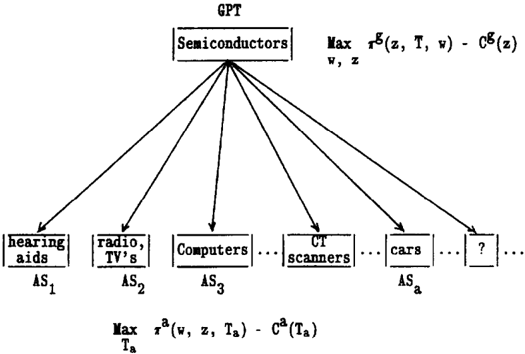
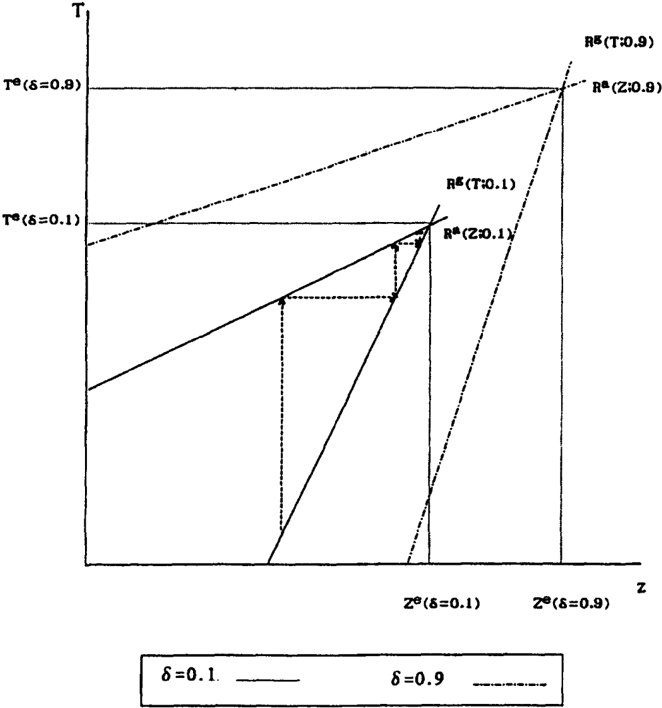
Whole eras of technical progress and growth appear to be driven by a few ‘General Purpose Technologies’ (GPT's), such as the steam engine, the electric motor, and semiconductors. GPT's are characterized by pervasiveness, inherent potential for technical improvements, and ‘innovational complementarities’, giving rise to increasing returns-to-scale. However, a decentralized economy will have difficulty in fully exploiting the growth opportunities of GPT's: arms-length market transactions between the GPT and its users may result in ‘too little, too late’ innovation. Likewise, difficulties in forecasting the technological developments of the other side can lower the rate of technical advance of all sectors.
Overview
The claims and statistics of this paper haven’t been checked yet.
Free: it reads the open-access text and checks the first 5 claims that cite a source we can check. Create a free account to check every claim.
Integrity signals
Registry
Cites
Statistics
Figures
Verification
Claims the paper makes
The claims and statistics of this paper haven’t been checked yet.
Free: it reads the open-access text and checks the first 5 claims that cite a source we can check. Create a free account to check every claim.
Claims other papers make about this one
Each is checked against this paper’s own text: does it say what the citing paper says it does?
The source backs part of the claim, not all of it — or backs it for a different population, condition or comparison.
In the citing paper
“The impacts of GPT are pivotal explanatory factors of long-term economic growth: 'One of the most important aspects of GPT is that they rejuvenate the growth process by creating spillovers that go far beyond the concept of measurable externalities' [80] (p. 100).”
From Digitalization and the Decoupling Debate: Can ICT Help to Reduce Environmental Impacts While the Economy Keeps Growing? (2020) · cites this paper as [80]
Experimental — accuracy not yet measuredThe source backs part of the claim, not all of it — or backs it for a different population, condition or comparison.
In the citing paper
“We conclude that LLMs such as GPTs exhibit traits of general-purpose technologies”
From GPTs are GPTs: An Early Look at the Labor Market Impact Potential of Large Language Models (2023) · cites this paper as Bresnahan and Trajtenberg, 1995
Experimental — accuracy not yet measuredThe source backs part of the claim, not all of it — or backs it for a different population, condition or comparison.
In the citing paper
“General purpose technologies (GPTs) such as AI enable and require significant complementary investments, including co-invention of new processes, products, business models and human capital.”
From The Productivity J-Curve: How Intangibles Complement General Purpose Technologies (2021) · cites this paper as Bresnahan and Trajtenberg 1995
Experimental — accuracy not yet measuredIn the citing paper
“AI, and in particular the subfield of AI called machine learning, is pervasive, improves over time, and spawns complementary innovation, thereby meeting Bresnahan and Trajtenberg's (1995) three canonical GPT criteria.”
From The Productivity J-Curve: How Intangibles Complement General Purpose Technologies (2021) · cites this paper as Bresnahan and Trajtenberg's (1995)
In the citing paper
“Specifically, they are pervasive, improve over time, and lead to complementary innovation (Bresnahan and Trajtenberg 1995).”
From The Productivity J-Curve: How Intangibles Complement General Purpose Technologies (2021) · cites this paper as Bresnahan and Trajtenberg 1995
Self-check
Percentages, sums and reported differences re-computed from the paper’s own numbers.
The self-check needs the paper’s full text.
Citations
Cites
Increasing returns and long-run growth
Romer, P. M. (1986) · Journal of Political Economy · doi:10.1086/261420 · Cited by 20,149
Technical Change and the Aggregate Production Function
Solow, R. M. (1957) · The Review of Economics and Statistics · doi:10.2307/1926047 · Cited by 12,259
The Theory of Industrial Organization
Jean Tirole, Z. (1988) · MIT Press Books · Cited by 8,651
Economic Welfare and the Allocation of Resources for Invention
Arrow, K. J. (1962) · The Rate and Direction of Inventive Activity · doi:10.1515/9781400879762-024 · Cited by 8,635
The Strategy of Economic Development
Linder, S. B., & Hirschman, A. O. (1959) · Ekonomisk Tidskrift · doi:10.2307/3438684 · Cited by 6,249
Innovation and Growth in the Global Economy.
Taylor, M. S., Grossman, G. M., & Helpman, E. (1993) · Economica · doi:10.2307/2554862 · Cited by 6,231
Theory of Industrial Organization.
Rubinstein, A., & Tirole, J. (1989) · Economica · doi:10.2307/2554286 · Cited by 5,142
Holmstrom, B. (1982) · The Bell Journal of Economics · doi:10.2307/3003457 · Cited by 4,903
Innovation and growth in the global economy
Broadberry, S. (1992) · International Journal of Industrial Organization · doi:10.1016/0167-7187(92)90023-r · Cited by 3,930
Hybrid Corn: An Exploration in the Economics of Technological Change
Griliches, Z. (1957) · Econometrica · doi:10.2307/1905380 · Cited by 3,330
Research works printed but not linked: 4
- Fisher, F.M., J.E. Greenwood, and J.J. McGowan, 1983, Folded, spindled, and mutilated: Economic analysis of U.S. vs. IBM (MIT Press, Cambridge, MA).
- Landes, D., 1969, The unbound Prometheus (Cambridge University Press, Cambridge).
- Mokyr, J., 1990, The lever of riches (Oxford University Press, New York, NY).
- Pakes, A. and P. McGuire, 1992, Computation of Markov perfect Nash equilibrium: Numerical implications of a dynamic differentiated product model, NBER technical discussion paper.
Cited by
Prior Knowledge and the Discovery of Entrepreneurial Opportunities
Shane, S. (2000) · Organization Science · doi:10.1287/orsc.11.4.448.14602 · Cited by 4,585
The NBER Patent Citation Data File: Lessons, Insights and Methodological Tools
Hall, B., Jaffe, A., & Trajtenberg, M. (2001) · National Bureau of Economic Research · doi:10.3386/w8498 · Cited by 3,507
Self-citationBeyond computation: Information technology, organizational transformation and business performance
Brynjolfsson, E., & Hitt, L. M. (2000) · Journal of Economic Perspectives · doi:10.1257/jep.14.4.23 · Cited by 3,335
On the Opportunities and Risks of Foundation Models
Bommasani, R., Hudson, D. A., Adeli, E., Altman, R., Arora, S., von Arx, S., Bernstein, M. S., Bohg, J., Bosselut, A., Brunskill, E., et al. (2021) · arXiv · doi:10.48550/arxiv.2108.07258 · Cited by 2,676
The Skill Content of Recent Technological Change: An Empirical Exploration
Autor, D., Levy, F., & Murnane, R. (2001) · National Bureau of Economic Research · doi:10.3386/w8337 · Cited by 2,587
GPTs are GPTs: An Early Look at the Labor Market Impact Potential of Large Language Models
Eloundou, T., Manning, S., Mishkin, P., & Rock, D. (2023) · arXiv · doi:10.48550/arxiv.2303.10130 · Cited by 2,330
Current trends in Smart City initiatives: Some stylised facts
Neirotti, P., De Marco, A., Cagliano, A. C., Mangano, G., & Scorrano, F. (2014) · Cities · doi:10.1016/j.cities.2013.12.010 · Cited by 2,322
Powell, W. W., & Snellman, K. (2004) · Annual Review of Sociology · doi:10.1146/annurev.soc.29.010202.100037 · Cited by 1,922
Bridging differing perspectives on technological platforms: Toward an integrative framework
Gawer, A. (2014) · Research Policy · doi:10.1016/j.respol.2014.03.006 · Cited by 1,869
Teece, D. J. (2018) · Research Policy · doi:10.1016/j.respol.2017.01.015 · Cited by 1,767
Computing Productivity: Firm-Level Evidence
Brynjolfsson, E., & Hitt, L. M. (2003) · Review of Economics and Statistics · doi:10.1162/003465303772815736 · Cited by 1,441
Broadband Infrastructure and Economic Growth
Czernich, N., Falck, O., Kretschmer, T., & Woessmann, L. (2011) · The Economic Journal · doi:10.1111/j.1468-0297.2011.02420.x · Cited by 1,383
Loebbecke, C., & Picot, A. (2015) · The Journal of Strategic Information Systems · doi:10.1016/j.jsis.2015.08.002 · Cited by 1,317
Fortune favors the prepared: How SMEs approach business model innovations in Industry 4.0
Müller, J. M., Buliga, O., & Voigt, K.-I. (2018) · Technological Forecasting and Social Change · doi:10.1016/j.techfore.2017.12.019 · Cited by 1,262
The NBER Patent Citations Data File: Lessons, Insights and Methodological Tools
Hall, B. H., Jaffe, A. B., & Trajtenberg, M. (2001) · Cited by 1,164
Self-citationAcemoglu, D. (2001) · National Bureau of Economic Research · doi:10.3386/w8287 · Cited by 1,069
The Productivity J-Curve: How Intangibles Complement General Purpose Technologies
Brynjolfsson, E., Rock, D., & Syverson, C. (2021) · American Economic Journal: Macroeconomics · doi:10.1257/mac.20180386 · Cited by 1,003
Fifty Years of Empirical Studies of Innovative Activity and Performance
Cohen, W. M. (2010) · Handbook of the Economics of Innovation · doi:10.1016/s0169-7218(10)01004-x · Cited by 962
Siggelkow, N., & Levinthal, D. A. (2003) · Organization Science · doi:10.1287/orsc.14.6.650.24840 · Cited by 950
Knowledge-relatedness in firm technological diversification
Breschi, S., Lissoni, F., & Malerba, F. (2003) · Research Policy · doi:10.1016/s0048-7333(02)00004-5 · Cited by 919
The double‐edged sword of recombination in breakthrough innovation
Kaplan, S., & Vakili, K. (2015) · Strategic Management Journal · doi:10.1002/smj.2294 · Cited by 776
Artificial Intelligence and the Modern Productivity Paradox: A Clash of Expectations and Statistics
Brynjolfsson, E., Rock, D., & Syverson, C. (2017) · National Bureau of Economic Research · doi:10.3386/w24001 · Cited by 773
ICT and productivity: conclusions from the empirical literature
Cardona, M., Kretschmer, T., & Strobel, T. (2013) · Information Economics and Policy · doi:10.1016/j.infoecopol.2012.12.002 · Cited by 760
Energy, the Environment, and Technological Change
Popp, D., Newell, R. G., & Jaffe, A. B. (2010) · Handbook of the Economics of Innovation · doi:10.1016/s0169-7218(10)02005-8 · Cited by 757
Jovanovic, B., & Rousseau, P. L. (2005) · Handbook of Economic Growth · doi:10.1016/s1574-0684(05)01018-x · Cited by 708
Siggelkow, N., & Levinthal, D. A. (2003) · Organization Science · doi:10.1287/orsc.14.6.650.24870 · Cited by 953
Behind the definition of Industry 4.0: Analysis and open questions
Culot, G., Nassimbeni, G., Orzes, G., & Sartor, M. (2020) · International Journal of Production Economics · doi:10.1016/j.ijpe.2020.107617 · Cited by 692
Secular stagnation: facts, causes and cures
Teulings, C. N., & Baldwin, R. (2014) · UvA-DARE (University of Amsterdam) · Cited by 699
Artificial Intelligence: The Ambiguous Labor Market Impact of Automating Prediction
Agrawal, A., Gans, J. S., & Goldfarb, A. (2019) · Journal of Economic Perspectives · doi:10.1257/jep.33.2.31 · Cited by 685
Information Technology and Productivity: A Review of the Literature
Brynjolfsson, E., & Yang, S. (1996) · Advances in Computers · doi:10.1016/s0065-2458(08)60644-0 · Cited by 673
The Mystery of Economic Growth
Cooper, R. N., & Helpman, E. (2004) · Foreign Affairs · doi:10.2307/20034157 · Cited by 665
Gambardella, A., & McGahan, A. M. (2010) · Long Range Planning · doi:10.1016/j.lrp.2009.07.009 · Cited by 659
Social media definition and the governance challenge: An introduction to the special issue
Obar, J. A., & Wildman, S. (2015) · Telecommunications Policy · doi:10.1016/j.telpol.2015.07.014 · Cited by 650
Architectural Leverage: Putting Platforms in Context
Thomas, L. D. W., Autio, E., & Gann, D. M. (2014) · Academy of Management Perspectives · doi:10.5465/amp.2011.0105 · Cited by 639
Ready or not, AI comes—an interview study of organizational AI readiness factors
Jöhnk, J., Weißert, M., & Wyrtki, K. (2021) · Business & Information Systems Engineering · doi:10.1007/s12599-020-00676-7 · Cited by 637
Technical Change and Industrial Dynamics as Evolutionary Processes
Dosi, G., & Nelson, R. R. (2010) · Handbook of the Economics of Innovation · doi:10.1016/s0169-7218(10)01003-8 · Cited by 617
Technological Change and the Environment
Jaffe, A., Newell, R., & Stavins, R. (2000) · National Bureau of Economic Research · doi:10.3386/w7970 · Cited by 591
Global platforms and ecosystems: Implications for international business theories
Nambisan, S., Zahra, S. A., & Luo, Y. (2019) · Journal of International Business Studies · doi:10.1057/s41267-019-00262-4 · Cited by 587
Digital technologies, innovation, and skills: Emerging trajectories and challenges
Ciarli, T., Kenney, M., Massini, S., & Piscitello, L. (2021) · Research Policy · doi:10.1016/j.respol.2021.104289 · Cited by 583
Blockchains and the economic institutions of capitalism
DAVIDSON, S., DE FILIPPI, P., & POTTS, J. (2018) · Journal of Institutional Economics · doi:10.1017/s1744137417000200 · Cited by 582
Barro, R. J. (1999) · Journal of Economic Growth · doi:10.1023/a:1009828704275 · Cited by 556
Wages and Human Capital in the U.S. Finance Industry: 1909–2006*
Philippon, T., & Reshef, A. (2012) · The Quarterly Journal of Economics · doi:10.1093/qje/qjs030 · Cited by 521
On open innovation, platforms, and entrepreneurship
Nambisan, S., Siegel, D., & Kenney, M. (2018) · Strategic Entrepreneurship Journal · doi:10.1002/sej.1300 · Cited by 519
Look Before You Leap: Market Opportunity Identification in Emerging Technology Firms
Gruber, M., MacMillan, I. C., & Thompson, J. D. (2008) · Management Science · doi:10.1287/mnsc.1080.0877 · Cited by 495
Information Technology and Intangible Output: The Impact of IT Investment on Innovation Productivity
Kleis, L., Chwelos, P., Ramirez, R. V., & Cockburn, I. (2012) · Information Systems Research · doi:10.1287/isre.1100.0338 · Cited by 479
The Impact of Artificial Intelligence on Innovation
Cockburn, I., Henderson, R., & Stern, S. (2018) · National Bureau of Economic Research · doi:10.3386/w24449 · Cited by 478
Technological change and the Environment
Jaffe, A. B., Newell, R. G., & Stavins, R. N. (2003) · Handbook of Environmental Economics · doi:10.1016/s1574-0099(03)01016-7 · Cited by 473
Research in Cognition and Strategy: Reflections on Two Decades of Progress and a Look to the Future
Kaplan, S. (2011) · Journal of Management Studies · doi:10.1111/j.1467-6486.2010.00983.x · Cited by 465
The Robot Revolution: Managerial and Employment Consequences for Firms
Dixon, J., Hong, B., & Wu, L. (2021) · Management Science · doi:10.1287/mnsc.2020.3812 · Cited by 463
Innovation and economic performance in services: a firm-level analysis
Cainelli, G., Evangelista, R., & Savona, M. (2006) · Cambridge Journal of Economics · doi:10.1093/cje/bei067 · Cited by 462
Some simple economics of the blockchain
Catalini, C., & Gans, J. S. (2020) · Communications of the ACM · doi:10.1145/3359552 · Cited by 459
Ideas for rent: an overview of markets for technology
Arora, A., & Gambardella, A. (2010) · Industrial and Corporate Change · doi:10.1093/icc/dtq022 · Cited by 454
Artificial intelligence and firm-level productivity
Czarnitzki, D., Fernández, G. P., & Rammer, C. (2023) · Journal of Economic Behavior & Organization · doi:10.1016/j.jebo.2023.05.008 · Cited by 438
A capability theory of the firm: an economics and (Strategic) management perspective
Teece, D. J. (2019) · New Zealand Economic Papers · doi:10.1080/00779954.2017.1371208 · Cited by 426
Barbieri, N., Marzucchi, A., & Rizzo, U. (2020) · Research Policy · doi:10.1016/j.respol.2019.103901 · Cited by 426
The Economics of Information Technology: An Introduction
Varian, H. R., Farrell, J., & Shapiro, C. D. (2004) · Cambridge University Press eBooks · doi:10.1017/cbo9780511754166 · Cited by 434
The demand for AI skills in the labor market
Alekseeva, L., Azar, J., Giné, M., Samila, S., & Taska, B. (2021) · Labour Economics · doi:10.1016/j.labeco.2021.102002 · Cited by 414
Evidence on Learning and Network Externalities in the Diffusion of Home Computers
Goolsbee, A., & Klenow, P. J. (2002) · The Journal of Law and Economics · doi:10.1086/344399 · Cited by 410
Some Simple Economics of the Blockchain
Catalini, C., & Gans, J. (2016) · National Bureau of Economic Research · doi:10.3386/w22952 · Cited by 403
AI adoption in America: Who, what, and where
McElheran, K., Li, J. F., Brynjolfsson, E., Kroff, Z., Dinlersoz, E., Foster, L., & Zolas, N. (2024) · Journal of Economics & Management Strategy · doi:10.1111/jems.12576 · Cited by 155
O’Mahony, M., & van Ark, B. (2003) · Cited by 385
Blockchain and smart contracts in supply chain management: A game theoretic model
De Giovanni, P. (2020) · International Journal of Production Economics · doi:10.1016/j.ijpe.2020.107855 · Cited by 374
Dehghan Shabani, Z., & Shahnazi, R. (2019) · Energy · doi:10.1016/j.energy.2018.11.062 · Cited by 372
Computing Productivity: Firm-Level Evidence
Brynjolfsson, E., & Hitt, L. M. (2003) · SSRN Electronic Journal · doi:10.2139/ssrn.290325 · Cited by 369
Three-Way Complementarities: Performance Pay, Human Resource Analytics, and Information Technology
Aral, S., Brynjolfsson, E., & Wu, L. (2012) · Management Science · doi:10.1287/mnsc.1110.1460 · Cited by 365
Competitive Advantage Through Artificial Intelligence: Toward a Theory of Situated AI
Kemp, A. (2024) · Academy of Management Review · doi:10.5465/amr.2020.0205 · Cited by 362
Artificial intelligence and corporate innovation: A review and research agenda
Bahoo, S., Cucculelli, M., & Qamar, D. (2023) · Technological Forecasting and Social Change · doi:10.1016/j.techfore.2022.122264 · Cited by 362
Aghion, P., David, P. A., & Foray, D. (2009) · Research Policy · doi:10.1016/j.respol.2009.01.016 · Cited by 352
Digitalization and globalization in a turbulent world: Centrifugal and centripetal forces
Autio, E., Mudambi, R., & Yoo, Y. (2021) · Global Strategy Journal · doi:10.1002/gsj.1396 · Cited by 345
Building new places of the creative economy. The rise of coworking spacesPreprint
Moriset, B. (2013) · HAL · Cited by 354
Reconsidering the Bayh-Dole Act and the Current University Invention Ownership Model
Kenney, M., & Patton, D. (2009) · Research Policy · doi:10.1016/j.respol.2009.07.007 · Cited by 324
More bits – more bucks? Measuring the impact of broadband internet on firm performance
Bertschek, I., Cerquera, D., & Klein, G. J. (2013) · Information Economics and Policy · doi:10.1016/j.infoecopol.2012.11.002 · Cited by 323
Bridging Differing Perspectives on Technological Platforms: Toward an Integrative Framework
Gawer, A. (2014) · Academy of Management Proceedings · doi:10.5465/ambpp.2014.278 · Cited by 319
Computer Mediated Transactions
Varian, H. R. (2010) · American Economic Review · doi:10.1257/aer.100.2.1 · Cited by 318
Related variety and regional growth in Spain
Boschma, R., Minondo, A., & Navarro, M. (2012) · Papers in Regional Science · doi:10.1111/j.1435-5957.2011.00387.x · Cited by 313
The OECD Innovation Strategy: Getting a Head Start on Tomorrow
OECD (2010) · OECD eBooks · doi:10.1787/9789264083479-en · Cited by 310
Davidson, S., De Filippi, P., & Potts, J. (2016) · SSRN Electronic Journal · doi:10.2139/ssrn.2744751 · Cited by 308
Measuring Patent Quality: Indicators of Technological and Economic Value
(2013) · OECD Science, Technology and Industry Working Papers · doi:10.1787/5k4522wkw1r8-en · Cited by 308
Coccia, M. (2017) · Journal of Social and Administrative Sciences · doi:10.1453/jsas.v4i4.1518 · Cited by 318
The skill bias effect of technological and organisational change: Evidence and policy implications
Piva, M., Santarelli, E., & Vivarelli, M. (2005) · Research Policy · doi:10.1016/j.respol.2004.11.005 · Cited by 304
Crandall, R. W., Litan, R. E., & Lehr, W. H. (2008) · Cited by 299
Gkrimpizi, T., Peristeras, V., & Magnisalis, I. (2023) · Education Sciences · doi:10.3390/educsci13070746 · Cited by 297
Two Centuries of Productivity Growth in Computing
Nordhaus, W. D. (2007) · The Journal of Economic History · doi:10.1017/s0022050707000058 · Cited by 295
ICT as a driver of economic growth: A survey of the literature and directions for future research
Vu, K., Hanafizadeh, P., & Bohlin, E. (2020) · Telecommunications Policy · doi:10.1016/j.telpol.2020.101922 · Cited by 293
Schumpeter and the revival of evolutionary economics: an appraisal of the literature
Fagerberg, J. (2018) · Innovation, Economic Development and Policy · doi:10.4337/9781788110266.00008 · Cited by 288
The Economic Geography of the Internet's Infrastructure*
Malecki, E. J. (2002) · Economic Geography · doi:10.1111/j.1944-8287.2002.tb00193.x · Cited by 286
Economic Policy for Artificial Intelligence
Agrawal, A., Gans, J., & Goldfarb, A. (2019) · Innovation Policy and the Economy · doi:10.1086/699935 · Cited by 283
The Corporate Digital Divide: Determinants of Internet Adoption
Forman, C. (2005) · Management Science · doi:10.1287/mnsc.1040.0343 · Cited by 283
A bibliometric review of the innovation adoption literature
van Oorschot, J. A. W. H., Hofman, E., & Halman, J. I. M. (2018) · Technological Forecasting and Social Change · doi:10.1016/j.techfore.2018.04.032 · Cited by 280
Müller, J. M., & Voigt, K.-I. (2018) · International Journal of Precision Engineering and Manufacturing-Green Technology · doi:10.1007/s40684-018-0056-z · Cited by 279
INTERFIRM KNOWLEDGE EXCHANGES AND THE KNOWLEDGE CREATION CAPABILITY OF CLUSTERS.
ARIKAN, A. T. (2009) · Academy of Management Review · doi:10.5465/amr.2009.44885776 · Cited by 277
Ford, E. W., Menachemi, N., & Phillips, M. T. (2006) · Journal of the American Medical Informatics Association · doi:10.1197/jamia.m1913 · Cited by 275
Towards a capability theory of (innovating) firms: implications for management and policy
Teece, D. J. (2017) · Cambridge Journal of Economics · doi:10.1093/cje/bew063 · Cited by 272
The Digital Entrepreneurial Ecosystem—a critique and reconfiguration
Song, A. K. (2019) · Small Business Economics · doi:10.1007/s11187-019-00232-y · Cited by 272
The Extroverted Firm: How External Information Practices Affect Innovation and Productivity
Tambe, P., Hitt, L. M., & Brynjolfsson, E. (2012) · Management Science · doi:10.1287/mnsc.1110.1446 · Cited by 272
Basu, S., & Fernald, J. (2007) · German Economic Review · doi:10.1111/j.1468-0475.2007.00402.x · Cited by 271
Filippucci, F., Gál, P., Jona‐Lasinio, C., Leandro, Á., & Nicoletti, G. (2024) · OECD artificial intelligence papers · doi:10.1787/8d900037-en · Cited by 282
Artificial intelligence, firms and consumer behavior: A survey
Abrardi, L., Cambini, C., & Rondi, L. (2019) · Journal of Economic Surveys · doi:10.1111/joes.12455 · Cited by 277
How did location affect adoption of the commercial Internet? Global village vs. urban leadership
Forman, C., Goldfarb, A., & Greenstein, S. (2005) · Journal of Urban Economics · doi:10.1016/j.jue.2005.05.004 · Cited by 268
Schumpeterian Growth Theory and the Dynamics of Income Inequality
Aghion, P. (2002) · Econometrica · doi:10.1111/1468-0262.00312 · Cited by 266
Metadata
- Authors
- Bresnahan, T. F., & Trajtenberg, M.
- Affiliations
- National Bureau of Economic Research (US)
- Corresponding author
- Bresnahan, Timothy F.
- Venue
- Journal of Econometrics
- Publisher
- Elsevier BV
- Published
- 1995-01
- Volume
- 65
- Issue
- 1
- Pages
- 83-108
- ISSN
- 0304-4076 (ISSN-L)
- OpenAlex
- W2033912020
- Cited by
- 2,879
- References
- 45
- Citations by year
- 2026: 331 · 2025: 227 · 2024: 174 · 2023: 140 · 2022: 146 · 2021: 144 · 2020: 124 · 2019: 124 · 2018: 105 · 2017: 130 · 2016: 91 · 2015: 86 · 2014: 79 · 2013: 79 · 2012: 96
- FWCI
- 29.27
- Type
- journal article
- Language
- en
- Open access
- hybrid
- doi.org
- Licence
- cc-by-nc-nd
- www.elsevier.com/tdm/userlicense/1.0/ (tdm)
- www.elsevier.com/legal/tdmrep-license (tdm)
- creativecommons.org/licenses/by-nc-nd/4.0/ (vor, 2287 d)
- Locations
- Journal of Econometrics (publishedVersion, cc-by-nc-nd)
- RePEc: Research Papers in Economics (submittedVersion)
- Topics
- Social Sciences › Economics, Econometrics and Finance › Economics and Econometrics › Economic Growth and Productivity
- Social Sciences › Economics, Econometrics and Finance › General Economics, Econometrics and Finance › Economic Development and Digital Transformation
- Social Sciences › Decision Sciences › Management Science and Operations Research › Innovation Diffusion and Forecasting
- Keywords
- general purpose technologies, technological progress, economic growth, innovation complementarity, increasing returns to scale, decentralized economy, technology forecasting, semiconductors, electric motors, steam engines
About these checks
Registry, retraction, Cites and statistics results are computed, not judged, with one exception: a printed reference that no index lists is read once by a model before it counts as a citation error. Claims are extracted by a model and kept only when their quote appears verbatim in the text; each cited source is then checked, with a model’s help, for whether it says what the claim relies on. Those verdicts can be wrong — read the claim’s quote and the cited source before relying on one.
Statistics and arithmetic are recomputed, not judged.
Confidence bands are shown only for fields calibrated on our annotated test set. None is calibrated yet, so no band is shown.
What counts as a claim ›How we measure confidence ›How we check this ›
Are you an author, or do you see a problem with this page? Request a review
Data sources
Bibliographic data: Semantic Scholar, OpenAlex, Crossref.
Contains information from the Semantic Scholar Academic Graph Datasets, made available under the ODC Attribution License (ODC-BY 1.0).
Semantic Scholar’s data is described in: Kinney, R., et al. (2023). The Semantic Scholar Open Data Platform. arXiv:2301.10140.
