

General purpose technologies ‘Engines of growth’?
Open accessThe DOI matches its Crossref record; 39 of the 45 references it cites were found in a registry or an index.
Abstract
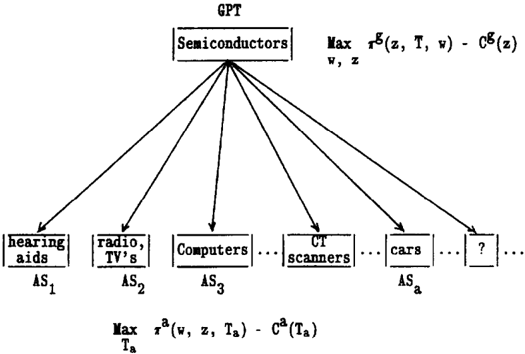
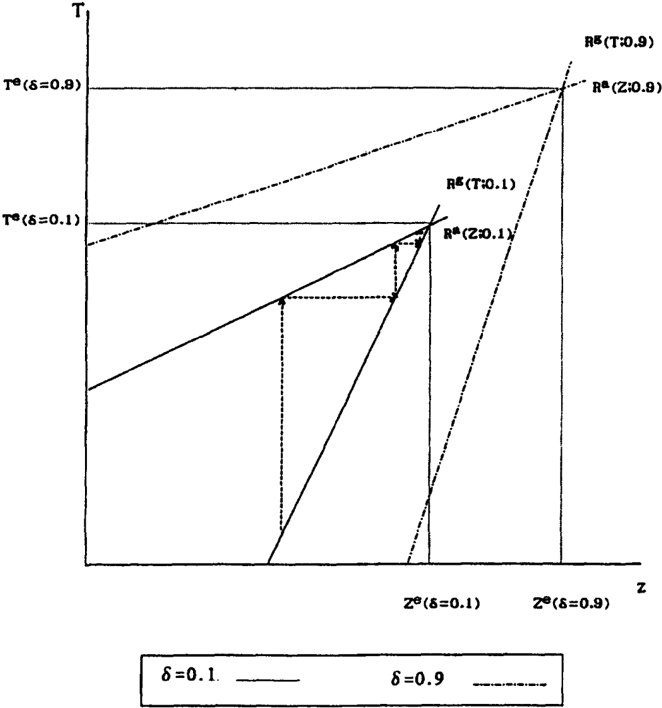
Whole eras of technical progress and growth appear to be driven by a few ‘General Purpose Technologies’ (GPT's), such as the steam engine, the electric motor, and semiconductors. GPT's are characterized by pervasiveness, inherent potential for technical improvements, and ‘innovational complementarities’, giving rise to increasing returns-to-scale. However, a decentralized economy will have difficulty in fully exploiting the growth opportunities of GPT's: arms-length market transactions between the GPT and its users may result in ‘too little, too late’ innovation. Likewise, difficulties in forecasting the technological developments of the other side can lower the rate of technical advance of all sectors.
Overview
The claims and statistics of this paper haven’t been checked yet.
Free: it reads the open-access text and checks the first 5 claims that cite a source we can check. Create a free account to check every claim.
Integrity signals
Registry
Cites
Statistics
Figures
Verification
Claims the paper makes
The claims and statistics of this paper haven’t been checked yet.
Free: it reads the open-access text and checks the first 5 claims that cite a source we can check. Create a free account to check every claim.
Claims other papers make about this one
Each is checked against this paper’s own text: does it say what the citing paper says it does?
The source backs part of the claim, not all of it — or backs it for a different population, condition or comparison.
In the citing paper
“The impacts of GPT are pivotal explanatory factors of long-term economic growth: 'One of the most important aspects of GPT is that they rejuvenate the growth process by creating spillovers that go far beyond the concept of measurable externalities' [80] (p. 100).”
From Digitalization and the Decoupling Debate: Can ICT Help to Reduce Environmental Impacts While the Economy Keeps Growing? (2020) · cites this paper as [80]
Experimental — accuracy not yet measuredThe source backs part of the claim, not all of it — or backs it for a different population, condition or comparison.
In the citing paper
“We conclude that LLMs such as GPTs exhibit traits of general-purpose technologies”
From GPTs are GPTs: An Early Look at the Labor Market Impact Potential of Large Language Models (2023) · cites this paper as Bresnahan and Trajtenberg, 1995
Experimental — accuracy not yet measuredThe source backs part of the claim, not all of it — or backs it for a different population, condition or comparison.
In the citing paper
“General purpose technologies (GPTs) such as AI enable and require significant complementary investments, including co-invention of new processes, products, business models and human capital.”
From The Productivity J-Curve: How Intangibles Complement General Purpose Technologies (2021) · cites this paper as Bresnahan and Trajtenberg 1995
Experimental — accuracy not yet measuredIn the citing paper
“AI, and in particular the subfield of AI called machine learning, is pervasive, improves over time, and spawns complementary innovation, thereby meeting Bresnahan and Trajtenberg's (1995) three canonical GPT criteria.”
From The Productivity J-Curve: How Intangibles Complement General Purpose Technologies (2021) · cites this paper as Bresnahan and Trajtenberg's (1995)
In the citing paper
“Specifically, they are pervasive, improve over time, and lead to complementary innovation (Bresnahan and Trajtenberg 1995).”
From The Productivity J-Curve: How Intangibles Complement General Purpose Technologies (2021) · cites this paper as Bresnahan and Trajtenberg 1995
Self-check
Percentages, sums and reported differences re-computed from the paper’s own numbers.
The self-check needs the paper’s full text.
Citations
Cites
Increasing returns and long-run growth
Romer, P. M. (1986) · Journal of Political Economy · doi:10.1086/261420 · Cited by 20,149
Technical Change and the Aggregate Production Function
Solow, R. M. (1957) · The Review of Economics and Statistics · doi:10.2307/1926047 · Cited by 12,259
The Theory of Industrial Organization
Jean Tirole, Z. (1988) · MIT Press Books · Cited by 8,651
Economic Welfare and the Allocation of Resources for Invention
Arrow, K. J. (1962) · The Rate and Direction of Inventive Activity · doi:10.1515/9781400879762-024 · Cited by 8,635
The Strategy of Economic Development
Linder, S. B., & Hirschman, A. O. (1959) · Ekonomisk Tidskrift · doi:10.2307/3438684 · Cited by 6,249
Innovation and Growth in the Global Economy.
Taylor, M. S., Grossman, G. M., & Helpman, E. (1993) · Economica · doi:10.2307/2554862 · Cited by 6,231
Theory of Industrial Organization.
Rubinstein, A., & Tirole, J. (1989) · Economica · doi:10.2307/2554286 · Cited by 5,142
Holmstrom, B. (1982) · The Bell Journal of Economics · doi:10.2307/3003457 · Cited by 4,903
Innovation and growth in the global economy
Broadberry, S. (1992) · International Journal of Industrial Organization · doi:10.1016/0167-7187(92)90023-r · Cited by 3,930
Hybrid Corn: An Exploration in the Economics of Technological Change
Griliches, Z. (1957) · Econometrica · doi:10.2307/1905380 · Cited by 3,330
Research works printed but not linked: 4
- Fisher, F.M., J.E. Greenwood, and J.J. McGowan, 1983, Folded, spindled, and mutilated: Economic analysis of U.S. vs. IBM (MIT Press, Cambridge, MA).
- Landes, D., 1969, The unbound Prometheus (Cambridge University Press, Cambridge).
- Mokyr, J., 1990, The lever of riches (Oxford University Press, New York, NY).
- Pakes, A. and P. McGuire, 1992, Computation of Markov perfect Nash equilibrium: Numerical implications of a dynamic differentiated product model, NBER technical discussion paper.
Cited by
Items 701–800 of 1,010
Net neutrality, zero rating and the Minitelisation of the internet
Belli, L. (2016) · Journal of Cyber Policy · doi:10.1080/23738871.2016.1238954 · Cited by 42
Innovation and Growth: The Schumpeterian Perspective
Aghion, P., & Akcigit, U. (2017) · Cambridge University Press eBooks · doi:10.1017/9781316636404.003 · Cited by 43
We, L., Tan, R., Li, Z., Cao, G., & Yu, F. (2020) · Journal of Knowledge Management · doi:10.1108/jkm-09-2019-0502 · Cited by 42
The effects of technology standards on complementor innovations: Evidence from the IETF
Wen, W., Forman, C., & Järvenpää, S. L. (2022) · Research Policy · doi:10.1016/j.respol.2022.104518 · Cited by 42
Stephens, H., Mack, E. A., & Mann, J. (2022) · Telematics and Informatics · doi:10.1016/j.tele.2022.101873 · Cited by 42
What Can CIS Data Tell Us about Technological Regimes and Persistence of Innovation?
Frenz, M., & Prevezer, M. (2012) · Industry and Innovation · doi:10.1080/13662716.2012.694676 · Cited by 43
A New View of General Purpose Technologies
Cantner, U., & Vannuccini, S. (2012) · De Gruyter eBooks · doi:10.1515/9783110504927-007 · Cited by 43
Firm-level analysis of information network use and productivity in Japan
Motohashi, K. (2005) · Journal of the Japanese and International Economies · doi:10.1016/j.jjie.2005.08.001 · Cited by 42
Services, innovation and the new economy
Zagler, M. (2002) · Structural Change and Economic Dynamics · doi:10.1016/s0954-349x(02)00004-8 · Cited by 42
Productivity Growth in UK Industries, 1970-2000: Structural Change and the Role of ICTPreprint
Oulton, N., & Srinivasan, S. (2005) · SSRN Electronic Journal · doi:10.2139/ssrn.824104 · Cited by 42
Artificial Intelligence at Work: An Overview of the LiteraturePreprint
Özkızıltan, D., & Hassel, A. (2021) · SSRN Electronic Journal · doi:10.2139/ssrn.3796746 · Cited by 43
Chun, Y., & Hwang, J. (2024) · Journal of the Knowledge Economy · doi:10.1007/s13132-024-02076-8 · Cited by 42
Giri, F. S., & Chaparro, T. S. (2024) · Business Strategy & Development · doi:10.1002/bsd2.70038 · Cited by 44
The Neoclassical Approach to Induced Technical Change: From Hicks to Acemoglu
Brugger, F., & Gehrke, C. (2016) · Metroeconomica · doi:10.1111/meca.12141 · Cited by 43
POLÍTICAS PÚBLICAS EN NANOTECNOLOGÍA EN AMÉRICA LATINA
Foladori, G. (2016) · Problemas del Desarrollo Revista Latinoamericana de Economía · doi:10.1016/j.rpd.2016.03.002 · Cited by 41
Digital knowledge generation and the appropriability trade-off
Antonelli, C. (2016) · Telecommunications Policy · doi:10.1016/j.telpol.2016.12.002 · Cited by 41
Ciaramella, L., Martínez, C., & Ménière, Y. (2017) · Scientometrics · doi:10.1007/s11192-017-2411-1 · Cited by 41
Evaluating the effects of ICT core elements on CO2 emissions: Recent evidence from OECD countries
Briglauer, W., Köppl–Turyna, M., Schwarzbauer, W., & Bittó, V. (2023) · Telecommunications Policy · doi:10.1016/j.telpol.2023.102581 · Cited by 42
How Do Industry Features Influence the Role of Location on Internet Adoption?
Chris Forman, A., Avi Goldfarb, B., & Chris Forman, A. (2005) · Journal of the Association for Information Systems · doi:10.17705/1jais.00072 · Cited by 41
Is there an ICT impact on TFP? A heterogeneous dynamic panel approach * .Preprint
Vecchi, M. (2003) · RePEc: Research Papers in Economics · Cited by 41
Productivity Growth and the Role of ICT in the United Kingdom: An Industry View, 1970-2000Preprint
Oulton, N., & Srinivasan, S. (2005) · RePEc: Research Papers in Economics · Cited by 41
Technology-Skill Complementarity in Early Phases of Industrialization
Franck, R., & Galor, O. (2017) · National Bureau of Economic Research · doi:10.3386/w23197 · Cited by 42
The EPOCH of AI: Human-Machine Complementarities at WorkPreprint
Loaiza, I., & C, R. R. B. (2024) · SSRN Electronic Journal · doi:10.2139/ssrn.5028371 · Cited by 41
Modern development strategy requires a turn to planning
Bodrunov, S. D. (2021) · Economic Revival of Russia · doi:10.37930/1990-9780-2021-3-69-5-13 · Cited by 40
Wu, Q., Qalati, S. A., Tajeddini, K., & Wang, H. (2025) · Industrial Management & Data Systems · doi:10.1108/imds-06-2023-0378 · Cited by 41
Digital divide and income inequality: causal evidence from Italian provinces
Bergantino, A. S., Fusco, G., Intini, M., & Monturano, G. (2025) · The Annals of Regional Science · doi:10.1007/s00168-025-01440-z · Cited by 42
Gill, L., Ramsey, P., & Leberman, S. (2015) · Systemic Practice and Action Research · doi:10.1007/s11213-015-9345-4 · Cited by 40
Beaudry, P., & Collard, F. (2003) · Scandinavian Journal of Economics · doi:10.1111/1467-9442.t01-2-00007 · Cited by 41
Using innovation contests to promote the development of generic technologies
Kokshagina, O., Gillier, T., Cogez, P., Masson, P. L., & Weil, B. (2016) · Technological Forecasting and Social Change · doi:10.1016/j.techfore.2016.07.035 · Cited by 41
How Can Government Promote Technology Diffusion in Manufacturing Paradigm Shift? Evidence From China
Xu, G., Zhou, Y. J., & Ji, H. (2020) · IEEE Transactions on Engineering Management · doi:10.1109/tem.2020.2981147 · Cited by 40
Big science and innovation: gestation lag from procurement to patents for CERN suppliers
Bastianin, A., Castelnovo, P., Florio, M., & Giunta, A. (2021) · The Journal of Technology Transfer · doi:10.1007/s10961-021-09854-5 · Cited by 40
Trade and innovation policies: Coexistence and spillovers
Auboin, M., Koopman, R., & Xu, A. (2021) · Journal of Policy Modeling · doi:10.1016/j.jpolmod.2021.02.010 · Cited by 42
Understanding the long-term emergence of autonomous vehicles technologies
Woo, S., Youtie, J., Ott, I., & Scheu, F. (2021) · Technological Forecasting and Social Change · doi:10.1016/j.techfore.2021.120852 · Cited by 41
From hackers to start-ups: Innovation commons and local entrepreneurial activity
Cuntz, A. N., & Peuckert, J. (2022) · Research Policy · doi:10.1016/j.respol.2022.104675 · Cited by 40
Energy distribution and economic growth
Dalgaard, C., & Strulik, H. (2011) · Resource and Energy Economics · doi:10.1016/j.reseneeco.2011.04.004 · Cited by 40
Knowledge Products and Network Externalities: Implications for the Business Strategy
Torrent‐Sellens, J. (2012) · Journal of the Knowledge Economy · doi:10.1007/s13132-012-0122-7 · Cited by 42
Currás, M. B., Lera‐López, F., & Serrano, S. O. (2007) · Cuadernos de Economía · doi:10.1016/s0210-0266(07)70006-7 · Cited by 43
The mechanisms of information technology's contribution to economic growth
Bresnahan, T. F. (2003) · Edward Elgar Publishing eBooks · doi:10.4337/9781781951279.00013 · Cited by 40
Self-citationNonlinear dynamism of innovation and business cycles
Hirooka, M. (2005) · Springer eBooks · doi:10.1007/3-540-26994-0_16 · Cited by 40
Computer and Internet Use by Great Plains FarmersPreprint
Smith, A. D., Paul, C. J. M., Goe, W. R., & Kenney, M. F. (2005) · SSRN Electronic Journal · doi:10.2139/ssrn.711262 · Cited by 40
The geography of innovation and development: global spread and local hotspots
Crescenzi, R., Iammarino, S., Ioramashvili, C., Rodríguez‐Pose, A., & Storper, M. (2020) · London School of Economics and Political Science Theses Online (London School of Economics and Political Science) · Cited by 40
Technological Disruption in the Labor Market
Deming, D., Ong, C., & Summers, L. H. (2025) · National Bureau of Economic Research · doi:10.3386/w33323 · Cited by 43
Andersen, A. D., & Wicken, O. (2020) · Innovation and Development · doi:10.1080/2157930x.2020.1770975 · Cited by 39
Measuring ICT externalities and their contribution to productivity: A bilateral trade based approach
Kim, K., Bounfour, A., Nonnis, A., & Özaygen, A. (2021) · Telecommunications Policy · doi:10.1016/j.telpol.2020.102085 · Cited by 39
Spillovers from Wiring Schools with Broadband: The Critical Role of Children
Belo, R., Ferreira, P., & Telang, R. (2016) · Management Science · doi:10.1287/mnsc.2015.2324 · Cited by 40
Technology-Skill Complementarity in Early Phases of Industrialisation
Franck, R., & Galor, O. (2021) · The Economic Journal · doi:10.1093/ej/ueab056 · Cited by 39
Ogbo, E., Brown, T., Gant, J. P., & Sicker, D. (2021) · Journal of Information Policy · doi:10.5325/jinfopoli.11.2021.0104 · Cited by 39
Sustained endogenous growth driven by structured and evolving general purpose technologies
Carlaw, K. I., & Lipsey, R. G. (2011) · Journal of Evolutionary Economics · doi:10.1007/s00191-010-0212-2 · Cited by 39
R&D networks: an evaluation framework
Sala, A., Landoni, P., & Verganti, R. (2010) · International Journal of Technology Management · doi:10.1504/ijtm.2011.037236 · Cited by 39
STRUCTURAL CHANGE AND THE GROWTH OF INDUSTRIAL SECTORS: EMPIRICAL TEST OF A GPT MODEL
Castellacci, F. (2010) · Review of Income and Wealth · doi:10.1111/j.1475-4991.2010.00380.x · Cited by 39
Marszk, A., & Lechman, E. (2018) · Journal of Macroeconomics · doi:10.1016/j.jmacro.2018.10.001 · Cited by 39
Long-term growth driven by a sequence of general purpose technologies
Schaefer, A., Schiess, D., & Wehrli, R. (2013) · Economic Modelling · doi:10.1016/j.econmod.2013.10.014 · Cited by 39
Productivity Growth in the 2000s
DeLong, J. B. (2002) · NBER Macroeconomics Annual · doi:10.1086/ma.17.3585280 · Cited by 39
The Changing Structure of Wages in the US and Germany: What Explains the Differences?
Beaudry, P., & Green, D. G. (2000) · National Bureau of Economic Research · doi:10.3386/w7697 · Cited by 39
Forman, C., Goldfarb, A., & Greenstein, S. M. (2003) · National Bureau of Economic Research · doi:10.3386/w9979 · Cited by 39
The impact of ICT on the growth of the service industriesPreprint
Sapprasert, K. (2007) · RePEc: Research Papers in Economics · Cited by 41
Opwaarderen: borgen van publieke waarden in de digitale samenleving
Kool, L., Timmer, J., Royakkers, L. M. M., & van Est, Q. C. (2017) · TU/e Research Portal · Cited by 44
Deep Learning in SciencePreprint
Bianchini, S., Müller, M., & Pelletier, P. (2020) · RePEc: Research Papers in Economics · doi:10.48550/arxiv.2009.01575 · Cited by 40
The Knowledge Growth Regime: A Schumpeterian Approach
Antonelli, C. (2019) · Springer eBooks · doi:10.1007/978-3-030-05508-0 · Cited by 38
Own the Unknown: An Anticipatory Approach to Prepare Society for the Quantum Age
de Jong, E. J. (2022) · Digital Society · doi:10.1007/s44206-022-00020-4 · Cited by 38
Private and social functions of patents: Innovation, markets, and new firms
Gambardella, A. (2021) · Research Policy · doi:10.1016/j.respol.2023.104806 · Cited by 38
Yoruk, E., Radošević, S., & Fischer, B. B. (2023) · Research Policy · doi:10.1016/j.respol.2023.104847 · Cited by 39
Mansell, R. E., & Tremblay, G. (2013) · London School of Economics and Political Science Research Online (London School of Economics and Political Science) · Cited by 40
Analyzing the complementarity of web infrastructure and eInnovation for business value generation
Popa, S., Soto‐Acosta, P., & Loukis, E. (2015) · Data Technologies and Applications · doi:10.1108/prog-09-2015-0065 · Cited by 38
Do Older Workers Lower IT-Enabled Productivity? Firm-Level Evidence from Germany
Bertschek, I., & Meyer, J. (2009) · Jahrbücher für Nationalökonomie und Statistik · doi:10.1515/jbnst-2009-2-315 · Cited by 39
Internet jako nowe dobro wspólne Justyna Hofmokl
Hofmokl, J. (2009) · Cited by 38
David, P. A., & Wright, G. (2005) · RePEc: Research Papers in Economics · Cited by 38
Evaluating the Impact of Science, Technology and Innovation Programs: a Methodological Toolkit
Crespi, G., Maffioli, A., Mohnen, P., & Vázquez, G. (2011) · doi:10.18235/0008984 · Cited by 40
Accountable, Not Liable: Injunctions Against IntermediariesPreprint
Husovec, M. (2016) · SSRN Electronic Journal · doi:10.2139/ssrn.2773768 · Cited by 38
The Economics of Big Science: Essays by Leading Scientists and Policymakers
Beck, H. P., & Charitos, P. (2020) · Science policy reports · doi:10.1007/978-3-030-52391-6 · Cited by 37
Rathi, S., Majumdar, A., & Chatterjee, C. (2023) · Technological Forecasting and Social Change · doi:10.1016/j.techfore.2023.122940 · Cited by 37
Ding, J. (2024) · International Studies Quarterly · doi:10.1093/isq/sqae013 · Cited by 37
Lehr, W. H., Clark, D. D., Bauer, S., Berger, A., & Richter, P. (2018) · Journal of Information Policy · doi:10.5325/jinfopoli.9.1.0001 · Cited by 37
Organization capital and analysts’ forecasts
Kim, H., Park, K., & Song, K. (2020) · International Review of Economics & Finance · doi:10.1016/j.iref.2020.10.009 · Cited by 37
(Infra)structural Discontinuity: Capital, Labour, and Technological Change
Cole, M. (2022) · Antipode · doi:10.1111/anti.12887 · Cited by 38
The Changing World of Mobile Communications: 5G, 6G and the Future of Digital Services
Ahokangas, P., & Aagaard, A. (2023) · Springer eBooks · doi:10.1007/978-3-031-33191-6 · Cited by 37
Regional Innovation Systems in Small and Medium-Sized Regions : A Critical Review and Assessment
Andersson, M., & Karlsson, C. (2006) · RePEc: Research Papers in Economics · Cited by 38
DECOMPOSING THE TECHNOLOGY SHIFT: EVIDENCE FROM THE SWEDISH MANUFACTURING SECTOR
Lundquist, K.-J., Olander, L., & Henning, M. (2008) · Tijdschrift voor Economische en Sociale Geografie · doi:10.1111/j.1467-9663.2008.00450.x · Cited by 37
Information Technology, Organizational Transformation, and Business Performance
Hitt, L. M., & Brynjolfsson, E. (2002) · The MIT Press eBooks · doi:10.7551/mitpress/5609.003.0007 · Cited by 38
Does Experience Matter? Innovations and the Productivity of ICT in German ServicesPreprint
Hempell, T. (2002) · SSRN Electronic Journal · doi:10.2139/ssrn.320985 · Cited by 39
Turovets, Y. V. (2021) · Engineering Management in Production and Services · doi:10.2478/emj-2021-0001 · Cited by 36
Global adoption of generative AI: What matters most?
Ali, H., Mustafa, A. U., & Aysan, A. F. (2024) · Journal of Economy and Technology · doi:10.1016/j.ject.2024.10.002 · Cited by 36
Rinaldi, A., & Vasta, M. (2012) · Enterprise & Society · doi:10.1017/s146722270001123x · Cited by 36
Huang, Y., & Khan, J. (2021) · Review of Development Economics · doi:10.1111/rode.12821 · Cited by 36
Worker Productivity in Operations Management
Diwas Singh, K. C. (2020) · Foundations and Trends® in Technology Information and Operations Management · doi:10.1561/0200000095 · Cited by 41
Zooming in or zooming out: Entrants' product portfolios in the nascent drone industry
Shermon, A., & Moeen, M. (2022) · Strategic Management Journal · doi:10.1002/smj.3407 · Cited by 37
Nylund, P. A., Ferràs, X., Pareras, L., & Brem, A. (2022) · Journal of Business Research · doi:10.1016/j.jbusres.2022.05.071 · Cited by 36
The history of energy efficiency in economics: Breakpoints and regularities
Giraudet, L.-G., & Missemer, A. (2023) · Energy Research & Social Science · doi:10.1016/j.erss.2023.102973 · Cited by 36
Pundzienė, A., Gerulaitienė, N., Bez, S. M., Georgescu, I., Mathieu, C., Carrabina, J., Criado, J. R., Nieminen, H., Värri, A. O., Boethius, S., et al. (2023) · Technovation · doi:10.1016/j.technovation.2023.102748 · Cited by 36
Exploring Over: The Presumed Identity of Emerging Technology
Gillier, T., & Piat, G. (2011) · Creativity and Innovation Management · doi:10.1111/j.1467-8691.2011.00614.x · Cited by 36
Technology and external conditions at play: A study of learning-by-licensing practices in China
Wang, Y., Zhou, Z., Ning, L., & Chen, J. (2015) · Technovation · doi:10.1016/j.technovation.2015.03.006 · Cited by 39
Green technological diversification of European ICT firms: a patent-based analysis
Corrocher, N., & Özman, M. (2019) · Economics of Innovation and New Technology · doi:10.1080/10438599.2019.1645989 · Cited by 37
A Layman's Guide to Evolutionary EconomicsPreprint
Fagerberg, J. (2002) · RePEc: Research Papers in Economics · Cited by 36
The Renewal of the Old Economy: An International Comparative Perspective
van Ark, B. (2001) · OECD science, technology and industry working papers · doi:10.1787/844262803138 · Cited by 36
Barrios, J. M., Campbell, J. L., Johnson, R. G., & Liu, C. (2025) · SSRN Electronic Journal · doi:10.2139/ssrn.5133107 · Cited by 37
Engineering Value: The Returns to Technological Talent and Investments in Artificial Intelligence
Rock, D. (2019) · doi:10.2139/ssrn.3427412 · Cited by 35
BENEFITING FROM MARKETS FOR IDEAS — AN INVESTIGATION ACROSS DIFFERENT TYPOLOGIES
Garavelli, A. C., Petruzzelli, A. M., Natalicchio, A., & Vanhaverbeke, W. P. M. (2013) · International Journal of Innovation Management · doi:10.1142/s1363919613400173 · Cited by 35
Information and communication technologies and firms’ export performance
Higón, D. A., & Bonvin, D. (2022) · Industrial and Corporate Change · doi:10.1093/icc/dtac017 · Cited by 37
Aggregate fluctuations in adaptive production networks
König, M., Levchenko, A. A., Rogers, T., & Zilibotti, F. (2022) · Proceedings of the National Academy of Sciences · doi:10.1073/pnas.2203730119 · Cited by 35
The Impact of Artificial Intelligence on Firm Performance
Kim, T., Park, Y., & Kim, W. (2022) · Portland International Conference on Management of Engineering and Technology (PICMET) · doi:10.23919/picmet53225.2022.9882634 · Cited by 36
Metadata
- Authors
- Bresnahan, T. F., & Trajtenberg, M.
- Affiliations
- National Bureau of Economic Research (US)
- Corresponding author
- Bresnahan, Timothy F.
- Venue
- Journal of Econometrics
- Publisher
- Elsevier BV
- Published
- 1995-01
- Volume
- 65
- Issue
- 1
- Pages
- 83-108
- ISSN
- 0304-4076 (ISSN-L)
- OpenAlex
- W2033912020
- Cited by
- 2,879
- References
- 45
- Citations by year
- 2026: 331 · 2025: 227 · 2024: 174 · 2023: 140 · 2022: 146 · 2021: 144 · 2020: 124 · 2019: 124 · 2018: 105 · 2017: 130 · 2016: 91 · 2015: 86 · 2014: 79 · 2013: 79 · 2012: 96
- FWCI
- 29.27
- Type
- journal article
- Language
- en
- Open access
- hybrid
- doi.org
- Licence
- cc-by-nc-nd
- www.elsevier.com/tdm/userlicense/1.0/ (tdm)
- www.elsevier.com/legal/tdmrep-license (tdm)
- creativecommons.org/licenses/by-nc-nd/4.0/ (vor, 2287 d)
- Locations
- Journal of Econometrics (publishedVersion, cc-by-nc-nd)
- RePEc: Research Papers in Economics (submittedVersion)
- Topics
- Social Sciences › Economics, Econometrics and Finance › Economics and Econometrics › Economic Growth and Productivity
- Social Sciences › Economics, Econometrics and Finance › General Economics, Econometrics and Finance › Economic Development and Digital Transformation
- Social Sciences › Decision Sciences › Management Science and Operations Research › Innovation Diffusion and Forecasting
- Keywords
- general purpose technologies, technological progress, economic growth, innovation complementarity, increasing returns to scale, decentralized economy, technology forecasting, semiconductors, electric motors, steam engines
About these checks
Registry, retraction, Cites and statistics results are computed, not judged, with one exception: a printed reference that no index lists is read once by a model before it counts as a citation error. Claims are extracted by a model and kept only when their quote appears verbatim in the text; each cited source is then checked, with a model’s help, for whether it says what the claim relies on. Those verdicts can be wrong — read the claim’s quote and the cited source before relying on one.
Statistics and arithmetic are recomputed, not judged.
Confidence bands are shown only for fields calibrated on our annotated test set. None is calibrated yet, so no band is shown.
What counts as a claim ›How we measure confidence ›How we check this ›
Are you an author, or do you see a problem with this page? Request a review
Data sources
Bibliographic data: Semantic Scholar, OpenAlex, Crossref.
Contains information from the Semantic Scholar Academic Graph Datasets, made available under the ODC Attribution License (ODC-BY 1.0).
Semantic Scholar’s data is described in: Kinney, R., et al. (2023). The Semantic Scholar Open Data Platform. arXiv:2301.10140.
